Views: 1345
Mythology is the remarkable attempt to address questions of fundamental importance for mankind: it is the form of study that not only demands to know the world and the self, but also demands some kind of practical justification or guarantee for such knowledge.
The Ancient Greeks formulated what they called aporetic questions, realising that the journey of knowledge is long, arduous and sometimes dangerous. They were the first to concentrate their attention on the art of thinking in the hope that the journey will end well, in spite of oracular proclamations to the effect that it is ruin and destruction that awaits mankind.
The Ancient Greek Philosophers also attempted to answer the so-called aporetic questions they formulated methodically, by developing the tools of dialectic, elenchus and logic. This exploration, however, was preceded by the obscure and secretive methods used by the Oracles to arrive at two of the truths relating to mans essence that were expressed in the hylomorphic account of Aristotle’s “rational animal capable of discourse.”:
- Everything created by man is destined for ruin and destruction
2. Know thyself
These truths were proclamatory warnings agains the hubris of man who had proceeded by this time, to build complex civilisations. governed by the rule of law. These warnings, indeed may have been Parthian shots by the Oracles, whose influence was already beginning to wane in Greece. Socrates and Plato were, we now know, abandoning the temple for the agora, the ampitheatre and the Academy. Plato, we also know, chose to present the thoughts of Socrates in dialogue form, which were then performed in the ampitheatres and also in the Olympic Games. Aristotle’s Lyceum was, on the other hand, engaging in early biological experiments alongside lectures on the principles of psuché .
Plato, then may well have been the first of the institutional professors, and together with Aristotle, symbolised a concept of “The University”, which was never pursued, namely that which was striving to produce polymaths in the name of the love of wisdom. Nevertheless in the case of Plato and the case of Aristotle, there is deep respect for religion and the oracles of the temples. Some of Plato’s ideas, however, can be construed as the beginning of a process of the marginalisation of religious practices and institutions.
Socrates, we know, as part of his defence against the charge of heresy claimed that Philosophy was one of the children of the Gods and this at the time, might also have been regarded as heretical. We do not know exactly how it was received by the 500 man jury most of whom probably did not understand what Socrates was attempting to do in the agora or even why the Oracle thought he was the wisest man in Athens. Both Plato and Aristotle believed that the proclamation by the oracle to “Know thyself” was an important one, and the failure to follow this piece of advice might well end in the ruin and destruction of civilisation. The Ancient Greeks we know when confronted by the gigantic Persian army were proud of their own civilisation and their Independence from what they saw to be an autocratic tyrannical form of government.
The characterisation of Justice that Socrates provides us with early on in the Republic is that justice consists in citizens of the Republic working in accordance with a principle of specialisation where they work in occupations suited to their abilities and capacities and not interfere with the work of occupations they have no ability for. This argument for justice in the city, of course ,builds upon the Socratic account of justice for the individual which is that those guilty of unjust conduct get what they deserve. This, in turn, relates to the Oracular proclamation that Everything created by humans is destined for ruin and destruction in the sense that it is unjust conduct on a large scale that will lead to the ruin and destruction of the city-state.
Campbell refers to this principle of specialisation when he points out that the first early civilisations that endured over time were characterised by the professionalisation of various important occupations. He names priests, merchants and farmers but interestingly fails to mention teachers and warriors. Perhaps it was not yet evident that a civilisation needs, according to Aristotle, three different kinds of forms, namely reproduction of children, reproduction of important artefacts and tools for living and finally but perhaps most important, the reproduction of important ideas via the process of teaching. All three kinds of forms were necessary according to Aristotle if a city-state was to become self sufficient and not be dependent on external circumstances for its survival. As the civilisation progresses, the need for a greater differentiation of occupations becomes necessary for self sufficiency. We ought to recall the evolutionary development of the city state for Aristotle begins in the large extended family, continues with a number of extended families forming a village ,and then ends with a number of villages coalescing to form the city-state. Self sufficiency is a difficult concept to define but it almost certainly refers to the needs of the citizens which would be exceedingly difficult to list.
The Psychology of Maslow may, however, serve as a guide in this matter. Maslow argues that certain needs are more fundamental than others and some needs arise when the more fundamental needs are met. Given the fact that we are animals, survival and reproduction are obviously important needs and Maslow includes both sexual and physiological needs for food, water and oxygen etc. If these needs are consistently and systematically met the next needs to arise are security/safety needs which, in our more complex societies can take a manifold of foms, e.g. Physical safety from physical harm, health safety which follows from access to medical care,, emotional security follows from not being subjected to anxiety fear and stress consistently and systematically, financial and work security follows from having a job which provides us with money and resources to meet our maintenance needs, legal and social security follow from the prevalence of justice in the society and the sense of being part of a whole.
The next level of needs are love and belongingness needs which follow from the need for intimate relations and friendships. Self-esteem needs are next in the hierarchy and this follows from the more abstract need for respect. All these hierarchical levels also require that our cognitive and aesthetic needs are met, and these are also relatively abstract and concerned with knowledge, justice and freedom. if, Maslow argues, all these needs are consistently and systematically met we will as individuals become self sufficient and relatively independent of our circumstances.
Self sufficiency for a city-state is relative because of the obvious difficulties in obtaining justice and freedom for everyone. It would seem as if the fundamental condition for such a state of affairs would be the citizens all being friends and treating each other as ends-in-themselves which is something that according to Kant might take one hundred thousand years to achieve. It is clear now why the wisest of the Ancient Greeks, namely Socrates, thought Philosophy to be a child of the Gods and a necessary discipline if one was to be able to answer all the aporetic questions arising about our human political, religious, artistic and ethical lives. Mathematics was of course taught to some professions who needed such knowledge for the instrumental purposes of the state such as tax collecting ,designing temples etc. Pythagoras, was a teacher of mathematics as a form of epistemé, but his life is shrouded in mystery.
The transmission of skills is obviously an important civilisation builder and various instrumental forms of practical knowledge are necessary for such technical matters. These forms of knowledge obviously differ to those forms of knowledge that are categorical such as the knowledge of arché (principles) and diké(justice). The logical principles of noncontradiction and sufficient reason are then, necessary to justify categorical answers to categorical questions such as “What is justice?”. St Augustine, for example, uses the principle of noncontradiction to point out that “An unjust law is no law at all”. The importance of knowledge to Ancient Greece, then stands in sharp contrast to the role that knowledge plays in the Garden of Eden myth whose moral is that we ought not to have eaten the fruit of the tree of the knowledge of good and evil because this was a divine matter to be left to divine beings. Questions relating to the knowledge of good and evil are clearly aporetic questions, and Socrates, Plato and Aristotle took us some way along the path of answering these questions . Kant took us further along the path, but the journey has not ended and Kant was probably correct in his judgement that the journey to the cosmopolitan kingdom of ends that lies at the end of the path is going to occupy us for a very long time indeed. The complex interplay of the threads of arché, epistemé, areté, logos, and aletheia will need to be unravelled to lay bear the nature of such knowledge of “The Good”. Given the obvious importance of knowledge in the process of the actualisation of the idea of “The Good”, one implication for the professions occupied with city-state business is that teachers play a vitally important role in the fate of the city-state. Institutions such as the Academy and the Lyceum were indeed originally used as blueprints for our Universities, but that blueprint appears to have used a principle of specialisation in an exceedingly narrow sense and as a consequence lost the grasp of many universal aporetic questions such as “What is knowledge?” “What is The Good?”, “What is the beautiful and sublime?” and perhaps also the questions, “What is Justice?” and “In what sense does God exist?”
Perusing the educational system of the ancient Greeks we find that doctors were trained in temples using an apprenticeship system . This may have been due to the promotion of Aeschylus to the status of a God. Priests, paradoxically were not trained in the temple but in specialised religious institutions, and perhaps here too the principle of specialisation was conceived too narrowly. Plato’s Academy contained an area devoted to the worship of the gods and we also know that the last request of Socrates before he was put to death by drinking from the poisoned chalice, was to request that one of his friends sacrifice a cock to Asclepius, presumably in gratitude for the relatively painless effect of the poison he was forced to imbibe.
When Socrates was practicing his new method of elenchus in the agora it was clear to him that his method needed to justify the oracles claim that he was the wisest man in Athens. His chosen targets were powerful people, politicians, sophists, priests who were prepared to use the law to retain their power over the community, using it as a means to their ends, that is to say unethically. This particular use of the law brought Athens into disrepute and established Philosophy as an important subject in the task of educating the citizens of a society. The early Philosophers, we ought to recall were so called natural philosophers interested in the phenomenal happenings of the physical world, especially what is happening in the heavens. We recall the curious role of Anaxagoras in this respect who proclaimed that the moon was not a God-like ethereal entity but rather a solid body similar to that of the earth reflecting the light of the sun. Anaxagoras claimed also that noos was the initiator and regulator of all change, a kind of cosmic mind. Apparently Socrates was convinced by Anaxagoras ‘s writings to abandon his investigations into the physical world and concentrate instead upon the cosmic mind or noos. Socrates eventually transferred his efforts into the field of the life-world and focussed upon those various powerful experts in the polis who thought they knew what they were doing but were simply making the worse argument appear the better to those who questioned what was being done. The Socratic method then was both philosophical and educational.
Plato’s Theory of Forms, we ought to recall proposed that the Form of the Good was the most important of all the forms and Plato sought to justify his claim by using both argumentation and allegory, thus combining both philosophical and mythological thought. Forms are forms of thought which according to Plato, determine the template for everything we name or talk about and Plato furthermore characterises external world entities as imitations or copies of the original forms. Forms, for both Plato and Aristotle are that which justifies and explains what we encounter and question in the external physical world . For Aristotle, However, the formal “cause” (explanation) of something is only one kind of explanation and furthermore this is not as Plato claimed situated in some kind of non physical spiritual realm but rather, for Aristotle, something that is situated in the world.
The mythology and religion of Plato’s times was one source of the “form of the good” and good art for Plato refused to present the gods fighting, arguing, stealing etc., as we encounter them in Homer. Eros in relation to the beauty of the human body, the human soul and the human laws of the city involved the power of the imagination, the emotions, understanding and reason, all of which were necessary for leading the examined contemplative life characteristic of eudaimonia. Divine powers as represented by the demiurge and the erinyes/euminedes formed part of the Greek pantheon of powers which have a complex relation to what Plato and Aristotle called the formal causes or what religion regarded as the “realm of the sacred”. Both of these mythical impersonal powers belonged to an older conception of the divine and sacred which was later supplemented by Zeus and his anthopomorphised pantheon of personalities which included many goddesses such as Athena who concerned herself with principles of wisdom and justice.
Ancient Greek Philosophy did not disassociate itself from the realms of the divine and the sacred, preferring instead to include mythological concerns under the umbrella of Philosophy, the latest supplement to the pantheon of the Gods. Indeed this realm is definitely included in the Aristotelian position that “being has many meanings”. As mentioned previously for Aristotle, the forms were transmitted down the generations in fundamentally three ways, reproduction of children, the creation of artefacts and tools and learning of skills associated with them, and thirdly, the transmission of important ideas from teacher to pupil,
Doctors, politicians, priests, warriors and Philosophers, were also involved in the care for the body, soul, and city which all Greeks thought to be important. Lawyers too, were emerging given the complex legal system of Athens which permitted citizens to lodge indictments against each other, as instanced by the infamous indictment of Socrates by Meletus. Sophists became paid experts in “making the worse argument seem the better” for payment and thereby provided the legal profession with an inauspicious beginning.
As the centuries passed however, the Philosophy of Socrates, Plato and Aristotle endured as an intellectual activity concerned with the answering of aporetic questions, usually reserved for the oracles, questions concerned with Being, the sacred, the true, the beautiful, the sublime, and justice. Mythology, however was experiencing a decline owing firstly, to the ascendency of Christianity which historically has proved itself to be one of the more intolerant religions, secondly, due to the decoupling of the forms (the true, good, beautiful etc) from religious practices and institutions. Scientific knowledge, then, became more and more dependent upon a mathematical form of thinking and as a result promoted a general scepticism about anything that could not be observed, measured or manipulated. The formulating of aporetic questions relating to abstract ideas such as Being and other transcendental and metaphysical matters were lost in the wave of secularisation that began sweeping over Europe. One reaction to this state of affairs was the emergence of “spirit seers” who appealed to supernatural experiences that were appearing increasingly delusional with the passing of the centuries. Kant warned us of this emerging phenomenon, yet as late as the 1900’s Carl Jung was still attempting to rehabilitate the supernatural world of spirits in the name of psychology.
In relation to this wave of secularisation, Campbell claims the following:
“The word myth now means falsehood, and so we have lost the symbols and the mysterious world of which they speak. But we need the symbols, and so they come up in disturbed dreams and nightmares that are then dealt with by psychiatrists. It was Sigmund Freud, Carl Jung and Jacob Adler who realised that the figures of dreams are really figures of personal mythologisation….At present our culture has rejected the world of symbology. It has gone into an economic and political phase where spiritual principles are completely disregarded…Our religious life is ethical not mystical. The mystery has gone and society is disintegrating as a result.”(The Myth of Light…P.18-19)
We see a sign of this decay in the writings of the psychiatrist Jung. Campbell talks about this in terms of the transcendent and the metaphysical mysteries being transposed into the so-called “Mystery” of an after-life populated with ghosts and spirits. For Freud, these are fantasy laden figures generated by psychological processes that we need his later work to give a full account of. The clinical Freud and his technical language, indeed, help us to understand the defence mechanisms operating: sometimes these spiritual experiences relate to trauma and sometimes to modern mans fundamental discontentment with a life without obvious meaning which Kant decribed already during his time as “melancholically haphazard”. Kant we know explored in detail the mysterious aporetic questions relating to God, the soul and freedom and he was perhaps the last great philosopher who could write with an open mind about a transcendental ego situated in a noumenal world which we can merely glimpse from our lives in a phenomenal world of space, time and causation.
Freud claims he is a Kantian Psychologist but does not seem able to capture the Kantian penchant for exploring the transcendent and metaphysical realm of the sacred. When Freud speaks of god and religion he tends to focus upon popular attitudes toward spiritual figures, which are clearly childish projections of anxieties and wishes. Fear and desire are the major characters of the Freudian religious drama: characters that do not perform any cathartic function. From Freudian times onward (dating perhaps from 1929) it appears as if the mystery of life is no longer the concern of anyone. The aporetic question of “Being and its many meanings” has all but disappeared from our intellectual concerns. Campbell evokes Eastern Myth in general and the Upanishads in particular which he claims retains a concern for one of the many meanings of being, namely ,the mystery of life:
“Bring me a fruit of that banyan tree,
Here is is venerable sir,
Break it
It is broken venerable sir,
What do you see there?
These seeds exceedingly small,
Break one of these my son,
It is broken venerable sir,
What do you see there?
Nothing at all venerable sir
The father said: That subtle essence, my dear, which you do not perceive there, from this very essence this great banyan arises. Believe me my dear. Now that which is the subtle essence. In it all that exists has its self. That is true,. That is the self.. Thou art that Svetaketu (The Chandogya Upanishad Ch 12)
Nothingness, then, is not nothing but a something that appears to defy the normal categories of understanding and therefore, perhaps the normal principles of judgement. Hence the tendency toward the use of allegories, parables and dialogues. The Self or transcendental ego is not in the world like the banyan tree, but rather lies at the boundary of the world. There is no difficulty in identifying the above form of the banyan tree even if nothing can be seen. In the above however it seems that this truth is also connected to the truth of a Self which also cannot be seen. “Thou art that”–it is stated. This is a transcendental truth and reminds us of the Wittgensteinian dictum:
“Whereof one cannot speak thereof one must consign to silence.”(Prop 7 Tractatus- Logico-Philosophicus)
This, however, would not have been the view either of the Upanishads or Aristotle’s Metaphysics. The above mythological/religious text appears to be attempting to reveal “The Truth” in the Greek spirit of aletheia. This is not being done in the way in which Aristotle seeks “The Truth” of the “many meanings of Being”. Aristotle is a rationalist and sees arché ( founding principles) to be the most reliable component of Logos, and for him it is clear that there are principles or forms connected to that realm of Being called psuché which is that form of life which inhabits the physical realm of space, time and matter. For Aristotle matter is essentially connected to that which forms it into the entities we experience, and it is these forms that function like organising principles. Life is as much, for Aristotle, defined by its origins, as its end in death, and the origin mythology focuses upon insofar as life is concerned is that of mother earth.
The mystery for mythology is simple: How can a living entity emerge form a non living environment? The many different forms of life are, of course, fascinating but none is more fascinating than the human form who is capable of significantly changing the environment he lives in by building cities and civilisations, whilst inquiring into his own nature and the nature of everything around him. The powers of human nature, then, are important areas of study more for the Philosopher than the priest or mythologist.
Campbell claims that we no longer live in an age of mythology, religion art or philosophy, but rather appear to have succumbed to the more materialistically constituted forces of economics and politics. Campbell, notes, for example, with considerable regret that after Thomas Mann went to live in America he became engaged with political issues and lost his creative flair. This was around the time when Wittgenstein was complaining about the sound of engines in the music of Brahms and some time after Renoir made his aesthetic complaint about modern architecture:
“We get too accustomed to these things and to such a point that we dont realise how ugly they are. And if the day ever comes when we become entirely accustomed to them, it will be the end of a civilisation which gave us the Parthenon and the Cathedral of Rouen. Then men will commit suicide from boredom or will kill each other off just for the pleasure of it”(Stokes, A, The Collected Writings of Adrian Stokes, Vol 3, The Invitation in Art, London, Thames and Hudson, 1978, P 278)
The 1900 s of course began with the “ready-made urinal ” of Duschamps and in the name of this “Modern Art”we also experienced a number of paradoxical “works ” in several mediums, from weightless sculptures to empty canvasses, to soundless musical performances. T S Eliot also contributed to the spirit of these times with his poem, “The Waste Land.” and Hannah Arendt noted that the political party system was already collapsing around the turn of the century: the conditions were being laid for the emergence of totalitarian regimes and the subsequent deaths of millions of people, amongst them those hundreds of thousands of Japanese civilians that died from the dropping of two atomic bombs.
Wittgenstein, prior to these traumatic political events had left Vienna to study Philosophy at Cambridge University and within a relatively short period of time produced a work entitled “Tracatatus Logico-Philosophicus” (1922), which claimed that it was the “final solution” of the problems of Philosophy. Wittgenstein himself, of course was forced to retract this claim when he was preparing another work “Philosophical Investigations”, which would not be published in his lifetime: a work which moreover would contribute to mitigating some of the negative developments of modern Philosophy that in their turn were neutralising the arguments of Aristotle and Kant. In his final solution from his earlier work it is stated that “the world is the totality of facts” (not things like a banyan tree) . Language pictures facts, and the soul was essentially characterised as a linguistic solipsistic soul. The later work abandoned these positions in favour of the activity of language being embedded in Aristotelian “forms of life”, and the meaning of language was characterised as its use in various language-games. The solipsistic self was dropped for a soul embedded in a life world which was essentially public and communal. yet it was the early work which most reflected the spirit of the times and Campbell notes how such a spirit affected the interpretation of important religious texts:
“We take the Old Testament God to be a fact, not a symbol. The Holy Land is a specific place and no other, man is superior to the beasts, and nature has fallen. With the fall in the Garden of Eden, nature becomes a corrupt force, so we do not give ourselves to nature…..What do we read? We read newspapers concerned with murders, rapes, politicians and athletes and thats about it. This is the reading that people used to devote to worship, to legends, of deities who represent the founding figures of their lives and religion. People today are hunting around for what they have lost. Some know they are hunting. The ones who dont are having a really hard time.” (P.19-20)
Viewing the Bible as a totality of historical facts displaces the true locus of mythological and religious texts which is, according to Paul Ricoeur:
“For us moderns a myth is only a myth because we can no longer connect that time with the time of history as we write it, employing the critical method, nor can we connect mythical places with our geographical space. This is why the myth can no longer be an explanation; to exclude its etiological intention is the theme of all necessary demythologization. But in losing its explanatory pretensions the myth reveals its exploratory significance and its contribution to understanding, which we shall later call its symbolic function–that is to say, its power of discovering and revealing the bond between man and what he considers sacred.” (Symbolism of Evil, P.5)
Evil is a critical idea in the realm of the sacred : it is Ricoeur claims the critical point of our bond to the realm of the sacred. It involves the:
“threat of the dissolution of the bond between man and the sacred and makes us most intensely aware of mans dependence on the powers of the sacred. Therefore the myth of “crisis” is at the same time the myth of “totality”: in recounting how these things began and how they will end the myth places the experience of man in a whole which thus receives orientation and meaning from the narration. Thus, an understanding of human reality as a whole operates through the myth by means of a reminiscence and an expectation.” (Symbolism of Evil, P.6)
So, our newspapers are filled with atomic facts which we read in a curious frame of mind that does not resemble the way in which we traditionally read our sacred texts. We no longer refer what we read to these holistic humanistic concerns with, for example, mans capacity for evil, his capacity to bring down ruin and destruction upon himself and everyone around him. “Sin” was a universal idea of faith that evoked expectations that man shall be worthy of the life he possesses and leads. This moral dimension disappears when the emphasis upon the symbolic nature of mans existence is replaced by a myriad of different economic and political concerns. of course, if one tires of economical and political news, there is always the latest news about our sporting or entertainment heroes who always seem to be getting themselves into trouble, at least insofar as news reporting is concerned. It does rather appear as if concern with the news has become what Freud would call a substitute satisfaction, especially when we no longer desire to reminisce or concern ourselves with eudaimonia (leading a good spirited flourishing life). Modern man does not appear to be aware that he has lost something, and the question is whether we have regressed in relation to Campbells observation that we all appear to be hunting for something.
Campbell provides us, however, with a pedagogical item of news, namely the return of the Apollo mission where the first men walked on the moon. Returning to earth from the mission the crew received a question from mission control asking who was navigating the craft. The surprising answer given by one of the astronauts was “Newton”. Here were a group of scientists/ engineers for whom trust in the laws of nature was absolute and unquestionable and for whom the world was so much more than a totality of facts. It is clear from this example that the actual practice of science involves trust in the metaphysics of nature: Campbell’s response to this was the following:
“I immediately thought of Kant’s Transcendental Aesthetic, the first section of his “Critique of Pure Reason” where he says that time and space are forms of sensibility and that they are essential to our mode of experience. We can experience. anything outside of them. They are apriori forms. So it seems we know the laws of space before we get there. In his introduction to metaphysics, Kant asks, “How is it that we can be certain that mathematical calculations made in this space here would work in that space there?” The answer came to me from these men. “There is only one space because there is only one mind at work here.”….Enough was known of the laws of space to know just what energy should be put out of the rockets and what angle to bring the space-ship down within a mile of the boat waiting for them in the Pacific Ocean…The knowledge of space is the knowledge of our lives. We were born from space. It was from space that the Big Bang came that sent forth galaxies and out of galaxies, solar systems. The planet we are on is one little pebble on one of these things and we have grown out of the earth of this pebble. This is the fantastic mythology thats waiting for someone to write poems about.”(P-19-20)
These astronauts also manifested the reverse of what the ancients felt looking out into space, when they looked back at the awe inspiring view of the earth from the heavens. Kant in his writings about the mathematical sublime pointed out that experiences involving vast magnitudes such as that of outer space, quicken in us a feeling of the sublimity of the experience. Part of this experience is the realisation that the experiencer possesses cognitive powers that are appropriate to appreciate this magnitude. Kant takes this experience of nature and uses it in an example that he uses to demonstrate the metaphysics of morals.
Carazans dream is a dream of a man who had throughout his life been using the people around him for his own ends, He dreams one night of a judgement on his life and a punishment of speeding out into the vast infinity of space far away from even the light of solar systems. He awakens in a state of despair and resolves never to abuse his fellow man again. Carazan felt the consequences of a life of evil. This vice of acquisitiveness has, of course, existed throughout the ages in different forms, but up until modern times it has been seen to be what it is, namely a vice or evil that is detrimental for the character of man which, according to Aristotle and Kant, by nature strives for the good.
Hannah Arendt’s perceptive analysis of the banality of evil was proposed even in relation to the Nazis that decimated the Jews of Europe. They were not capable, she argued, of thinking, which on her account of the importance of human thought for bringing about the good, was a significant criticism, much more significant than the emotional reactions to this deed that insisted on calling the Nazis monsters. The Carazan of her time was probably Cecil Rhodes who upon perusing the planets did not experience the awe and wonder of the ancients, but a far more modern response of wondering whether they could be colonised (presumably for profit). She characterised him and a number of others beginning with Descartes as the “new men”: men who no longer thought as men once did but for whom anything was possible if you could persuade the masses that it was. Many, a significant minority, of these masses of course knew that with modern resources, nothing of significance was possible any longer. During these modern times the call has gone out several times from intellectuals for a “Newton of the moral universe” but no candidate has been found apparently, in spite of the obvious cultural presences of Aristotle and Kant.
What have we done to ourselves if the above claims are true? Many things, but one important thing is that we have objectified ourselves into a hypothetical totality of facts without any relation to the sacred, the good, the beautiful and the sublime. Hume was the leader of a movement which claimed that one cannot find a self in our perceptions even if the self is a bundle of perceptions. Kant of course combatted such a view in his Critical Philosophy but his views were vey quickly turned upside down by Hegel, and the self of modern Psychology in the 1900s moved from being a science of sensations, feelings and consciousness to being a science of observable measurable behaviour. In this process all the intellectual powers of the self or the soul fell away, until we find the lonely logical solipsist of Wittgenstein’s Tractatus proclaiming that the world is a totality of facts and the self is a subject about which nothing can be said. Of course, waiting in the wings of the universities there were followers of Aristotle and Kant and the later Wittgenstein, trying to restore something of the Ancient Spirit of Greece and the more recent spirit of the Enlightenment. Ideas of the good will and the importance of the proclamation “know thyself!” continued to be significant for these scholars working in the shadow of a modernist flow of ideas that disregarded the importance of historical approaches. This flow of ideas included regarding religion either as anathema or in terms of the fantasy-laden idea of a day of judgement in the after-life up in the heavens or down in the fires of hell. This belief in the after-life had no real connection to experience.
We pointed earlier to Campbells failure to take into account Kant’s ideas from the third Critique, the “Critique of Judgement”. In this Kantian work we encounter explanations of, and justifications for, the idea of God as well as descriptions/explanations of the idea of the sublime which Campbell refers to in the following way:
“This is what is known as the sublime, the experience either of space or of energy that is so prodigious that the individual simply diminishes out of sight. I have talked with people who were in some of the German cities during the British and American saturation bombings in World War 2 and they told me it was a sublime experience. So there is more than beauty in the world—there is the sublime. The mythology comingto us from space is sublime.”
Kant in his third Critique, “The Critique of Aesthetic Judgement” ,discusses two kinds of sublimity, the mathematically sublime and the dynamically sublime. In both cases the phenomenon that causes the response defies our power of imagination and the faculty of reason steps in either with the idea of infinity or the idea of moral agency. In the case of space that Campbell refers to above, it is clearly the idea of infinity that reason is using, but the case of the Germans who had been bombed is less clear, but might involve the idea of freedom and moral agency. The citizens, that is, take solace in the fact that they are not succumbing to the ruin and destruction wrought upon them from mechanical machines in the air. In both cases the Aristotelian faculty of noos is involved in appealing to the idea of infinity or the power of causing oneself to act freely in an expression of moral agency. In terms of the Upanishad idea of “Thou art that”, both ideas of infinity and freedom may be involved.
We in the West are obviously more familiar with the origins of our civilisation and those of the Near East than we are with the origins of civilisations in the far East, e.g. India and China. Campbell is attempting to increase our familiarity with the mythology of these distant cultures. In his discussion of Hinduism, he notes:
“The Earth is the energy of which some god is the personification and of which matter is a concretisation, and these things exist in eons and eons of time.” (Myths of Light, P.21)
He then tells us a story about the hubris of the god Indira and the intervention of Brahma who has the task of humbling Indira’s pretensions.Indira is informed, for example that he is only one of a multitude of Indiras that came before him and will come after him and all of them will descend into the life-forms of ants at some point in the future. These texts that use the idea of the infinite come to us from ca 400 AD, during the period of the decline of the Roman Empire. During this period both Plato’s and Aristotle’s ideas were still influential through the teachings of philosophical schools and academies which would just over a century later be closed by the emperor Justinian. The translations of Plato’s works were , however, more widely available than those of Aristotles, many of which were lost.
Campbell argues that civilisations in the West and Near East were more susceptible to invasion than those in the East which were more naturally protected by their geographical locations. The Northern Nomadic Aryans, from the North and the Semites from the Middle Eastern desert continually caused many settlements considerable difficulty, forcing them to adapt to radical changes in their lives. The first organised settlements arose in the Near East around 8000. BC with higher forms of culture emerging around 2500 BC in India and 1600 BC in China. Nomadic hunting and foraging were replaced by agriculture and animal husbandry. Around 4000 B C the first city-states emerged in the Tigris-Euphrates valley. Campbell points out that these city-states developed a division of labour based on a principle of specialisation, e.g. politicians, priests, merchants and farmers. He does not mention teachers, which is curious given the obvious importance of knowledge in the transmission of ideas in the society. Around 3500 BC we see the emergence of writing , mathematical calculation, astronomical observation and tax collection arising as a result of the principle of specialisation.
Village agricultural communities emerged somewhat later in Ancient Greece, ca 7000 BC. Settlers from the Near East probably brought the necessary skills and knowledge to form these communities. As a consequence organised city-states emerged somewhat later in Ancient Greece. The first city state was probably Iklaina (ca 1600-1100 BC). Persian city-states in contrast to those in Ancient Greece were autocratic and it was not long before rulers began to desire larger territories. Athens and Sparta soon became targets. The Athens of the 5th century BC was a city state with a complex system of law that had recently humanised an earlier Draconian system of law by, for example, redressing injustices between the rich and the poor.
Campbell argues that the mythology of the above system of city states as well as those of the Far East possessed the structures they did owing to being expressions of archetypal patterns of the human mind. These archetypal patterns were both models of the cosmos and the human mind. Archeology, for example has revealed that many civilised settlements had a mandala structure. in which the god/king/ruler was centrally placed in the settlement with his servants all around him. Campbell notes the calm acceptance of Far East peoples of the world the way it is , resting calm in the daily presence of their religions. They do not need to anthromorphise the powers of nature because their primary concern is not to harness these powers but see them rather as divine conditions for human existence. For them whatever is transcendental lies beyond the scope of human thought and there is therefore no attempt to understand God, because only God can know God. For the Eastern mind God is the infinite both without and within man: an infinite that has no name. Campbell contributes the following problematic reflection:
“in Occidental theology the word transcendent is used to mean outside of the world. In the East it means outside of thought. To imagine that your definitions of God have anything to do with that ultimate mystery is a form of sheer idolatry from this standpoint.” (P. 33)
Aristotle’s God is not defined, but portrayed as a special form of thinking which is completely different from human thinking , which is thinking about the world. On this account God is neither outside the world nor outside of thought. God as a prime mover is sometimes characterised in empirical thought as a force or power which imparts movement or motion to the world. On Aristotles account, however, God is a prime form which is more akin to a first principle. This does not put Aristotle’s God outside the world because for him forms are inside the world and not, as was the case with Plato’s forms something spiritual and beyond the physical world. Whilst on such an account Gods thinking is beyond our range of thinking , Gods thought about himself is nevertheless, not transcendent. Campbells formulation above is therefore awkward.
Similarly for Kant the transcendental x means something more akin to a first principle than anything more concrete or more spiritual. Indeed the relation of what Kant refers to as the noumenal world of things-in-themselves has a far more complex relation to our phenomenal world of experience. It is, for example, that which we can think and therefore cannot be outside or beyond our thought–but it is beyond our knowledge because it is beyond our experience or sensible intuition. God is therefore an idea of pure reason, a pure thought.
Theology, being a rational systematic study of God whether he be idea or existence, contrasts itself with mythology, which relies on the narrative forms of allegory and parable to communicate the meaning of its religion to us. For us in the West there does not see to be any reason to deny Aristotles or Kant’s thoughts on religion the status of theology. Indeed the clouds of mythology appear to condense into the drop of one question: “Can the relation of the world of man to his gods be the same as the relation of principle to the world and thought of man?” The mythological proclamation of “Thou art that” appears to raise other types of question relating to the principle of psuché and its relation to first principles. Campbell claims:
“You yourself are that which you would know”(P.34)
This rings true insofar as it hearkens back to the oracle of Ancient Greek and the challenge thrown down to us to “Know thyself!” Whilst we cannot have knowledge of the noumenal world in which God dwells we can nevertheless, according to Kant, think about God without being able to think like him. For Kant this kind of human thinking is not conceptual because given the fact that God is not in space and time, we cannot have any intuition of something that has the characteristic of being omnipresent in the past, present, future: no intuition of what is eternally present is possible. Man may well be made in God’s image but what it is that brings us closer to God is the relation of God, the first principle to mans cognitive powers, noos, for Aristotle, or Pure Practical Reason for Kant. In the third Critique Kant maintains that:
“we are wholly unable to cognise apriori whatsoever the ends of nature in the physical order, and above all it is impossible to see that a nature could not exist apart from such ends.” (Critique of Teleological Judgement, P.112)
Kant elaborates further upon this point:
“While fear in the first instance may have been able to produce gods, that is demons, it is only reason by its moral principle which has been able to produce the conception of God.”..” (P.112)
Kant has been arguing throughout his work that the theoretical proofs for the existence of God fail, and the only satisfactory proof we have for the existence of this first principle is a moral proof. Insofar as we can never have a conception of a nexus finalis in physical nature, we cannot definitely attribute any worth to, for example, a speck of dust floating in a shaft of light, a range of mountains, a waterfall etc.. Worth begins in the realm of thought and cognitive powers which only human psuché is capable of. The Categorical Imperative , then, is a principle that urges us to treat all men as ends-in-themselves which implies not using them instrumentally without their consent for our own narcissistic purposes. Whilst it is not the first principle for Kant, it is so connected to that first principle which Kant describes as the moral author of our world, situating it squarely in the holy space of the sacred.
Kant relates this moral argument for the existence of God to religion and theology:
“The fact that in respect of all our ideas of the supersensible, reason is restricted to the conditions of its practical employment is of obvious use in connection with the idea of God. It prevents theology from losing itself in the clouds of theosophy, i.e. in transcendent conceptions that confuse reason, or from sinking into the depths of demonology, i.e. an anthropomorphic mode of representing the Supreme Being. Also it keeps Religion from falling into theurgy which is a fanatical delusion that a feeling can be communicated to us from other super-sensible beings and that we in turn can exert an influence on them, or into idolatry which is a superstitious delusion that one make oneself acceptable to the Supreme Being by other means than that of having the moral law at heart.”(P.130)
Insofar as life after death is concerned, Kant argues that this at best is a theoretical issue which cannot be resolved because we have no choice but to construe the thinking self as alive (P.132) which we interpret to mean that the idea of life after death is a practical contradiction. It is of course possible to think about someone after their death, but that has no implications for their continued existence as a person. After ones death, a corpse continues to subsist, and it may resemble the body when alive in a state of sleep, but it cannot be woken. A physical analogy might assist us to understand the role of the body in life, e.g. when a light bulb fails to function because it is permanently damaged, i.e. ceases to produce light when connected to electricity. As such it is a light bulb in name only. A light bulb’s primary function is to produce light, but when the physical conditions for this function are no longer present, the bulb is no longer a medium for the production of light. Typically in such circumstances we discard the light bulb and think no more about it. This is a useful analogy in that light is like life, which also requires functioning material if it is to express itself in its various forms, performing certain functions through the use of its powers, e.g. in thought and thinking. Imagining oneself speaking , thinking or perceiving after ones death violates the principles of life articulated by both Aristotle and Kant.
Furthermore, one of the implications of the above Kantian account of religion is that our idea of our souls(psuché) are only possible on practical grounds and because of the ideas of reason, God, the soul, and freedom. Yet it is only the latter that:
“proves its objective reality by its possible effect there. By this means it makes possible the connection of the other two ideas with nature, and the connection of all three to form a religion.” (P.149)
This is a secular vision of religion and it further suggests why the rule of law was so important for those early civilisation-builders like Solon and Pericles during the Golden Age of Greece. On Kant’s reading morality would be the primary focus for the law, and Religion only a secondary concern. This puts into perspective the trial of Socrates, the wisest man in Athens who, together with Aristotle was arguing for the importance of morality in the civilisation building process. Aristotle too, we recall was accused of heresy, and there is an argument for claiming that these three Ancient Philosophers, Socrates, Plato and Aristotle, began the secularisation process that prioritised morality over religion. Kant, continued this secularisation process by producing a moral system that formed the basis for international law and human rights as well as a basis for the telos of a cosmopolitan kingdom of ends one hundred thousand years in the future. In such a cosmopolitan world, war will no longer occur, and the spare resources will be used for relieving poverty and education of the masses.
On the above view one might in one respect regret the diminishing importance of mythological religion in our modern societies, but given the sordid history of the use of religion to prosecute and kill so called heretics, perhaps the secularisation of religion was the only solution to prevent those in power from persecuting their enemies. In retrospect, now we have been exposed to the vast array of gods from different civilisations, the accusation of not believing in the one particular god a particular civilisation had chosen at a particular point in its history, the killing of people for such preudo-offences had no real justification. Kant’s secularism is however not the secularism we experience in our modern societies, where many people refuse to believe in the moral author of the Categorical Imperative, indeed refuse to believe in anything of significance. For Kant there is an important place for the realm of the sacred. This is not an invitation of the kind we find in mythology to “unite with the divine” (as Campbell put the matter, P.35):
“So, here we are in our exile. What can we do about the mysterious transcendent X? To find, as many a mystic has, that he was one with X and then be united with it on a martyr’s pyre, this was not permitted. In our religions we can only achieve a relationship to X. Our religions–and this is a very important point–seek a relationship to God, not the experience of identity with the divine. How does oe achieve a relationship to God? Well there are several ways of being related to this particular deity. One is the way of the Jewish tradition, another is the way of the Christian, and a third is the way of Islam.”
“Envelopment” as it occurs in religious contexts is an extreme response to sacred experiences and one advantage of the Kantian relation to the divine is that it occurs via understanding the self-sufficiency and independence of the moral principles associated with the categorical imperative. The religions mentioned above have, unfortunately, through their persecution of their enemies throughout their History exhausted their credibility by using their victims for their own ends—accusing them of pseudo-offences such as blasphemy and heresy. Socrates certainly sensed this when he defended himself against the charge of heresy by claiming that he was the midwife of Philosophy, one of the children of the gods. Kant almost set the record straight but he too was warned by his Emperor not to voice his opinion upon sacred matters.
Campbell virtually ignores this secular viewpoint and hails the recent arrival of Oriental religious influences such as Buddhism and Hinduism, as representing an awakening of our pre-Christian hearts (P.37), whatever this is supposed to mean. He refers to the great Greek tradition, but also to the not so great Roman tradition as well as Celtic and German mythology and fails to recognise the fundamental differences between these traditions. Can there, for example, be any greater difference between the Golden Age of Greek civilisation building in the spirit of Reason and the dark age of Roman military/engineering which chose Christianity as its religion : a religion which then built a bureaucratic Church around it, defending it by the cruellest means.
One candidate for the Transcendental X is of course the self. Campbell elaborates upon this possibility by referring to Indian writings:
“So in the beginning that was no beginning, there was nothing but the Self. And the Self at a moment that was no moment said: “I. Aham.Ego”. And as soon as it thought “I”, it experienced fear. Then it reasoned, though it was not very complicated reasoning—this was the very first attempt at reasoning after all–“Since there is nothing else in the world what do I have to be afraid of?” That eliminated the fear. Of course, no sooner was the fear eliminated than it had desire:”I wish there were another.” Well, in that state of being, a wish is as good as a fact. The Self swelled and split in half and voilá–there were two…” (p.38)
The process of splitting continued down the line of animal forms and the self named all the animal forms but soon became bored with the activity until God put the “I” to sleep and generated the female Eve. Campbell points to the resemblance between this narrative and that contained in Plato’s Symposium where a whole monstrous human being is divided into two to reduce its power, and separated, placing the two separate parts far away from each other:
“In their efforts to find each other again, they built cities and civilisations. This is really a basis for the Freudian view that all civilisation is a sublimation of disappointed sex.” (P.39)
The symposium dialogue however was about Eros not sex. Freud’s later theorising was also centred around Eros, a wider concept than sexual libido but the reference to Freud is certainly relevant. Campbell continues:
“In the Greek world a god is not a creator: rather the gods are our big brothers, and you know how it is with big brothers, you’ve got to be careful with them: but they really dont have the right to order you around. Still you’d better do what they tell you or else you’ll get hurt. This is a quite different attitude from that of the Biblical, Near Eastern Tradition, where God creates men to be his servants and He gives the orders.” (P.39)
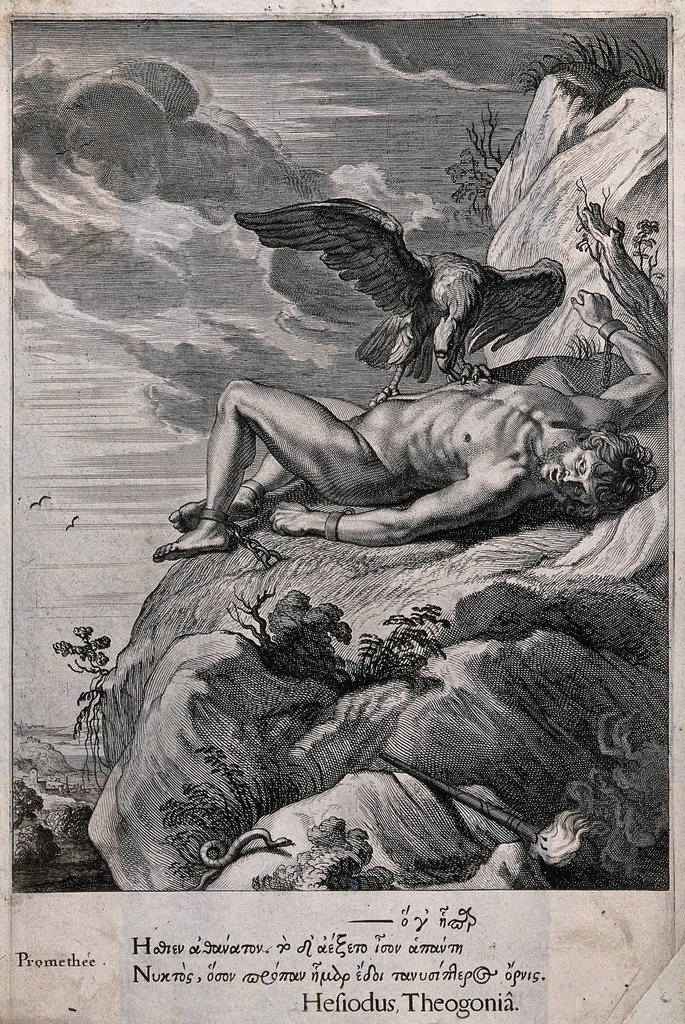
So, in our Christian tradition, which is not the Greek tradition, we submit to God even in the most extreme circumstances such as those Job found himself in. No Greek would have accepted what Job was forced to accept. Yet both of these traditions form our heritage. The Greek demigod Prometheus embodies Greek defiance. Prometheus steals fire from the gods to give to man, and is punished by Zeus by being chained to a cliff face and tormented by an eagle, but Prometheus remains undaunted and expresses contempt for Zeus. Prometheus was free to determine his own fate and this freedom surfaced again during both the Renaissance and the Enlightenment. Socrates modelled himself not on Zeus who had a problematic relation to his father but rather on Prometheus, attempting to define the idea of justice for man. Socrates did not, however, show contempt for the Athenian justice system when it sentenced him to death unjustly. Socrates, indeed, was in many respects the new kind of hero, the hero of the examined life, freeing himself from religion and unjust tyranny. Socrates, we know, regrettably published nothing and we only glimpse the contours of his life thanks to his pupil Plato who himself was no doubt influenced by the thought of Socrates, but nevertheless went off in a direction Socrates may not have agreed with. Indeed if any direction was true to the spirit of the Socratic examined life it was either that of Aristotle’s hylomorphism or Kant’s Critical Philosophy of Freedom.