Philosophy, Politics, Education, Ethics, Psychology, Religion, Psychoanalysis, Aesthetics, Humanism, The Arts, Ancient Greek Philosophy, Enlightenment Philosophy. A site dedicated to the humanistic art of lecturing and the synthesis of Aristotelian, Kantian, and Wittgensteinian Philosophy: The Pre-Socratics, Socrates, Plato, The scholastics, Descartes, Spinoza, Hobbes, Hume, Heidegger, Freud, Arendt, Sartre, Merleau-Ponty, Ricoeur, Jaynes, Cavell, O Shaughnessy, Shields, Lear, S. Gardner, Korsgaard, P.M.S. Hacker, G.E.M. Anscombe
Anaxagoras, a pre-Socratic Philosopher, influenced Socrates, turning his attention away from physical investigations and toward noos, that power which Anaxagoras claimed was the cosmic first principle. This principle was not a principle related to the constitution or causation of matter, but was rather related to the order and harmony of a universe which housed human psuché with its very special array and repertoire of material and spiritual powers. For Aristotle the power of noos was a complex matter with at least three aspects:
The aspect of the divine. Noos is likened unto a first principle which transcends our understanding. A principle which is simultaneously inside of human psuché, and externally situated in the physical world.
The Aspect of the Good. All human activities, according to Aristotle, (Nichomachean Ethics), including the arts and sciences aim at the form of the Good. Areté. Dike, episteme, logos, Aletheia, are all forms of the Good.
The Aspect of Wisdom. All men desire to Know, Aristotle argued in his work the Metaphysics: a work which is about the first principles or what he called “first Philosophy”. Noos, for Aristotle insofar as it is to be found spiritually within us was an active principle that is shared with divine thought. All men possess this divine part of the human psuché. It is, however, situated in a material body that is bound in space and time to the here and now. In this bound state we humans can only think something about something, whereas divine thought or contemplation takes the transcendent form of thinking about thinking:—a form of thought we are incapable of, but in compensation we seek the life of contemplation and thinking about principles is the closest we can come: principles related to The Good, The True, and The Beautiful.
The practical use of reason for Aristotle, aims at the wisdom of phronesis, which is associated with the understanding and judgement of the Phronimos. Aristotle also characterises the Divine in hylomorphic terms, in terms of “Pure Form”. Pure Form is an active principle which is characterised as the condition of the existence of everything that can be thought of or experienced. Noos, then, is the dwelling place of Pure Form, and is conceived of by Aristotle as “separable” (with certain reservations) from the body. When, in the course of contemplation, the divine thinks about thinking, it is not the world that is the object of the thinking process, but, rather, Aristotle argues, the divine is thinking itself. This reflects also what is meant by the term “principle”, which is the active element of a process that creates what it explains.
There is a human correlate to this process in which a principle relates to the condition(s) of what is conditioned. Such a principle is located spiritually in human psuché, and Kantian Critical Metaphysical Philosophy gives us a very complex account of this self-causing principle, which Kant designates as an idea of practical reason, namely freedom: an active human principle that brings about the reality of what it desires, intends, and thinks about. The Good Will is the most important concept in Kants Philosophical Psychology, and his Ethics. It is a self-causing power that actively embodies the moral law which has the logical characteristics of universality and necessity and more concretely, is responsible for treating all other human beings as ends-in-themselves.
This correlation between divine and human activity may in fact assist us in understanding the role that transcendental analogy plays in the understanding of the relation between the divine and the human. The analogy picks out the love that a father has for his family, and claims this to be a model for the love which the divine has for us. Freud may well have had an opinion about this. We know he thought the command to love one’s enemies was a dangerous one, and we also know that Freud did not have a high opinion about the rationality of religion. Kant might also have thought that the awe and wonder we at times feel in the presence of the divine does not qualify to be called “love”. He may, however, have felt that doing one’s duty in accordance with the moral law could be done out of love for the divine, and the justice we receive in return in the form of leading a good spirited flourishing life, may also qualify for the term “love” to be used. There is an element of gratefulness involved, so perhaps there is an argument to support such a position. The maxim for such actions however would then be differently expressed as firstly obeying (and perhaps loving?) the moral law, and secondly obeying because one loves the divine.
Kantian Enlightenment Philosophy differentiates itself from Aristotelian Hylomorphic Philosophy insofar as the Ancient Greek matrix of areté, dike, episteme, phronesis and eudaimonia are placed by Kant in a the context of a wider discussion in which Philosophical Psychology plays a fundamental role, hopefully providing us with greater insight into the being-in-the-world of the rational animal capable of discourse.
Campbells combination of the poetry of Walt Whitman and the Upanishads occurs in the last chapter of “ Myths to Live By”, a chapter entitled “No More Horizons”. Campbell attempts to summarize his position by also referring to the Gnostic Gospel of Thomas:
“I am the All, the All came forth from me, and the All attained to me.” (Page 252)
Campbells position may in fact, to some extent, converge with that of Kant when it is claimed that all ideas of the divine originate in mans imagination(located in the faculty of sensibility),which as we know from Kants account, functions very differently to the powers located in the faculties of the understanding and reason. Campbell further argues that:
“since such images stem from the psyche, they refer to the psyche. They tell us of its structure, its order and its forces, in symbolic terms.”(Page 253)
Campbell elaborates upon this account with the claim that the historical context of these mythological narratives are largely unnecessary embellishments that can be questioned in a period when all our horizons are disappearing:
“with the dissolution of horizons we have experienced and are experiencing, collisions, terrific collisions, not only of peoples, but also of their mythologies….And so we are right now in an extremely perilous age of thunder, lightning and hurricanes all around. I think it is improper to become hysterical about it projecting hatred and blame.” (Page 255)
The collision of the masses from India, the Far East and Europ,e is certainly a violent turbulent moment in our respective spiritual histories. Campbell, like T S Eliot, before him, invokes Dante rather than the Ancient Greeks and their philosophers, muses and oracles. What Cambell hopes will come out of this chaotic period, is the possible recognition of a common sacred realm that is located both within us spiritually, and external to the human psuche: the realm of noos?—the Kantian noumenal realm of Being?
Campbell argues further that the realm he is investigating is not that of the Freudian Personal Unconscious, but rather something resembling the collective realm envisaged by Jung: a “Mythological transpersonal order.” (Page 260)
The concentration upon Dante and the Roman Catholic Church, however, risks marginalising one of the major influences upon European Civilisation, namely that of Ancient Greece. Campbell, instead suggests a different polarity than that which is normally suggested, that of Jerusalem and Rome. The more normal suggestion for the founding influences of European Culture is that of Jerusalem and Athens, but to ignore the Roman Empire would of course be problematic from a purely Historical perspective. The issue may however not turn upon the magnitude of an empire, but rather upon the magnitude and quality of the ideas and principles that emerged from the tradition of Philosophers, Muses and Oracles that was to be found in not just Athens but Ancient Greece as a whole, which would include the Empire of Alexander the Great. Undoubtedly it was the size and influence of the Roman Empire which succeeded Alexanders Empire that perhaps contributed to the diminishing of the influence of Athens over the succeeding ages. It ought to be kept in mind, however, that Rome was a product of engineers and soldiers rather than the product of Philosophers leading an examined contemplative life.
Superstitious Rome was the home for a number of religious sects, and one of them, namely, Christianity, was eventually chosen as the Religion of the Empire, and subsequently emerged as a candidate for a world-religion. It is, indeed, not difficult to understand that much of our modern world is modelled on technical and military excellence because these virtues above all others have become the “horizons” for our modern life. Horizons, which Campbell argues, are on the verge of disappearing. What will remain after the storm passes?:
“God is an intelligible sphere whose center is everywhere and circumference is nowhere. So we are told in a little 12th century book entitled “The Book of the 24 Philosophers”. Each of us—whoever and whatever he may be, is then the center, and within him, whether he knows it or not, is that Mind at large, the laws of which are the laws not only of all minds but of all space as well…we are the children of this beautiful planet… We are its eyes and mind, its seeing and its thinking… So that we are the mind, ultimately of space. No wonder, then, for its laws and ours are the same!” (Pages 265-266)
For Kant the laws of the faculty of Sensibility are those of Space and Time, and the laws of understanding and reason are different laws: laws of the forms that order spatial and temporal experiences. Our minds, of course, are embodied in space and time, and it may be this that provides us with the principles of our finitely temporally structured human experiences. The powers of human psuché such as the imagination and reason are very different powers, but they emerge from a bodily structure which it will be the concern of future Philosophical Psychology to both describe and explain.
After the inward journey of our spirit the moon is the next Dantesque stopping point for the modern myth aiming for the further planets of the solar system. There is nothing earthly about this conversation where the earth is termed a paradise or an oasis in space. Man, Campbell argues, is filled with the Spirit of Exploration and preoccupied by the awe and wonder directed at the Magnitude and Order of the heavens. Campbell appears to neglect the moral journey proposed for humanity by the Kantian moral law which, it was claimed, is going to lead us into a Cosmopolitan Kingdom of Ends— a long and momentous journey into the future heading toward a telos that is very different to the journey of the mystics who appear to be attempting to reduce the light of ones light to a pinpoint of inner enlightenment. Ancient Greek Philosophy certainly would not regard the life of a mystic as falling under the heading of a good spirited flourishing life. In the light of this good spirited flourishing life we can then view with less scepticism Freuds claim that the mystic life does not meet the requirement of the reality principle or the requirements for a healthy mental life. Campbell discusses the influence of Apollo and the Nine muses, but he does not seek to unravel the mystery surrounding the oracles and their wisdom. Many Ancient Greek Philosophers embraced the most famous of their proclamations, namely
“Everything created by humans is destined for ruin and destruction”
And
“Know Thyself!”
Both of which require an understanding of many of the principles of Philosophical Psychology, Ethics, Politics, Aesthetics and Religion, as well as an understanding of the importance of the role that the freedom of choice plays in the drama of humanity.
Campbell rightly admires the vision of the earth from the earth that was beamed back to earth via the amazing technology we have developed for the communication of images. The images of the astronaut’s footprints in the dust of the moon must have put the final nail in the coffin of the myth of the moon being the:
“residence of the souls of those who have passed away and are there waiting to return for rebirth. For the moon, as we see it, dies and is resurrected.”(Page 235)
Campbell feels the presence of both Newton and Kant in this technical saga of mans explorations. The Copernican revolution, it is argued, proposed a universe in which the imagination was needed to apprehend the enormity of what could be perceived. What was happening in front of our eyes on the television screen, was the substitution of a scientific imagination for the imagination of an artist tied to a mortal coil. Indeed, it was both Newton and Kant that provided us with the philosophical foundations for this experience, by convincing us with their power of reasoning that mathematical calculations and judgements about space have a universal character and use our a priori knowledge of Space and Time. The laws of space and time are akin to the moral law which, according to Kant, is also capable of evoking feelings of awe and admiration in us. Campbell half acknowledges the importance of this by claiming:
“we ourselves are no less mysterious. In searching out its wonder, we are learning simultaneously the wonder of ourselves. That moon flight as an outward journey was inward into ourselves.”(Page 239)
Campbell then seeks to investigate the origins of our interest in artefacts and begins with Peking man (Sinanthropus), using fire for warmth, light and protection ca 400,000 years ago. This was also read mythologically to be a moment in which we displeased the Gods by receiving the goods of the fire stolen from them. Prometheus, we know was the thief and he was punished for this crime quite severely. In harnessing the power of fire, man embarked on his journey: a journey that, thanks to the use of his powers of imagination and thought, would make him the best of the animals: powers which would enable him to become almost anything he wanted to be:
“A lion has to be a lion all is life: a dog to be a dog. But a human being can be an astronaut, a troglodyte, philosopher, mariner, tiller of the soil, or sculptor. He can play and actualise in his life any one of any number of hugely differing destinies.”(Page 242)
Campbell elaborates upon this by paradoxically claiming that man’s choices will not follow either reason or common sense: rather passions and excitement will be the primary motivators of human psuché. This might have been the case insofar as pre-civilised man was concerned, but once the power of his imagination began to expand his life-horizons, and was subjected to categories, principles and laws, the older covenants made with the animal and plant world,s became less important. At this point the covenants made with his fellow man in the form of civil laws, the arts, the sciences, and Philosophy became more valued activities.
Campbell claims that each individual form of human psuché is unique and will therefore follow its own unique inner laws which will determine the form the individual’s life will take. Campbells implication is clear: these unique laws will be more important than that aspect of mans Being-in-the-world which makes him a part of a larger community. Both Plato and Aristotle, however pointed to the limitations of a life in which extreme choices are generated by an unregulated imagination and passions. What these Philosophers and their followers, e.g. Kant, emphasised, was the importance of actualising a number of psychological and mental powers that include language, understanding, judgement and reason. All these powers are necessary for the development of a large array of sciences that Aristotle categorised in terms of the theoretical, practical and productive sciences.
Campbell addresses the issue of the status of “modern science” and its differentiation into specialisations:
“Today , as we all know, such thoughts and forms are of a crumbling past and the civilisation dependent upon them in disarray and dissolution. Not only are societies no longer attuned to the courses of the planets, sociology and physics, politics and astronomy are no longer understood to be departments of a single science.”(Page 243)
There are many different kinds of science being taught in Universities and the principle of specialisation has perhaps usurped the role of the ideal of the universal element of knowledge (laws and principles). This point, however, runs contrary to the presuppositions of myth that often do not mesh with certain scientific principles. Campbell claims that myth has taught us that:
“There are no laws out there that are not right here, no gods out there that are not right here, and not only here, but within us, in our minds.” (Page 244)
The above could well be an implication of both Hylomorphic and Critical Philosophy (with certain reservations), and moreover teaches us to distinguish between kinds of laws and principles which in Philosophy occurs via the use of the categories of understanding/judgement as well as the logical principles of noncontradiction and sufficient reason.
Time, of course has been a concern for Philosophers throughout the ages. Kant claimed that Time was an a priori form of intuition that belongs to the faculty of sensibility which essentially provides the sensible content used by the faculty of understanding. Sensible items in motion in the external world for both Aristotle and Kant call for temporal measuring activity which occurs in terms of before and after (in accordance with Aristotles definition of Time). The Time of Human Psuché, on the other hand, is the Time of growth, maturation, deterioration and death. Campbell then refers to Leo Frobenius who fixates upon these more general aspects in his investigative characterisation of the human race:
“Its childhood was of the long, long distant period of the primitive hunters, fishers, root-foragers and planters. The second stage, which Frobenius termed the Monumental, commenced with the rise of the earlier agriculturally based, urban and literate civilisations, each structured to accord with an imagined cosmic order, made known by way of the movements and conditions of the planetary lights. For those lights were then supposed to be the residences of governing spirits whereas, as just remarked, we knew them to be as material as ourselves. The laws of the earth and our own minds have been extended to incorporate what formerly were the ranges and the powers of the gods, now recognised as of ourselves. Hence the whole imagined support of the Monumental Order has been withdrawn from “out there” , found centred in ourselves, and a new world-age projected, which is to be global “materalistic” (as Frobenius termed it), comparable in spirit to the spirit of old age in its disillusioned wisdom and concern for the physical body, concentrating rather on fulfilment in the present than on any distant future. The residence of the spirit now is experienced as centred not in fire, in the animal and plant worlds, or aloft among the planets and beyond, but in men, right here on earth.”(Pages 244-5)
But how, then, are we supposed to characterise our relation to this world of ours. Firstly it has been made ours after a long childhood and after we have been, as Heidegger puts the matter, “thrown into the world”. Campbell refers in the context of this discussion to a view held by Alan Watts:
“you did not come into this world at all. You came out of it in just the same way as a leaf comes out of a tree or a baby from a womb…Our world is peopling just as the apple tree apples, and just as the vine grapes.”(Page 245)
Watts, then, improves upon Heideggers answer to the aporetic questions raised by human existence and its origins. Campbell elaborates upon this position by maintaining that we humans originated from an intelligent energy system in which certain forms of life give rise to just those forms and not others. “Dust thou art and unto dust thou shallt return!”, the Church tells us on the occasions of death. When the astronauts left their footprints in the dust of the lost souls on the moon this was just one more moment in the process of the collective disillusionment of Humanity.
Aristotle referred to several different forms of psuché, plant, animal and human, all of which shared the characteristics of birth, life-activity and death. Animals have the form of plant life within, as the human forms have both animal and plant life systems within themselves. Trees have bee the form of plant life that most interests us humans and throughout history and poetry, they have been referred to sympathetically. Standing tall in the midst of a storm that tests the strength of their roots, they do not move and stand stoically unmoved. In the Old Testament it is trees that are the heroes in the Garden of Eden, relating to both the knowledge of good and evil and even life itself. The Cross (symbolising the tree of life), Campbell argues has become a powerful Christian symbol, but Campbell simultaneously believes that Christianity itself is maturing toward an end in which the Holy Spirit speaks directly to the hearts of men without any “ecclesiastical mediation”. When this finally happens, Campbell argues the Church will dissolve and we will then begin living in an age of “pentacostal spirituality”.(Page 248)
Campbell argues that this is the situation we moderns find ourselves in today, following as we do the symbolic heroes of the age, namely “The Astronauts”, who walked so carelessly in the dust of the moon.
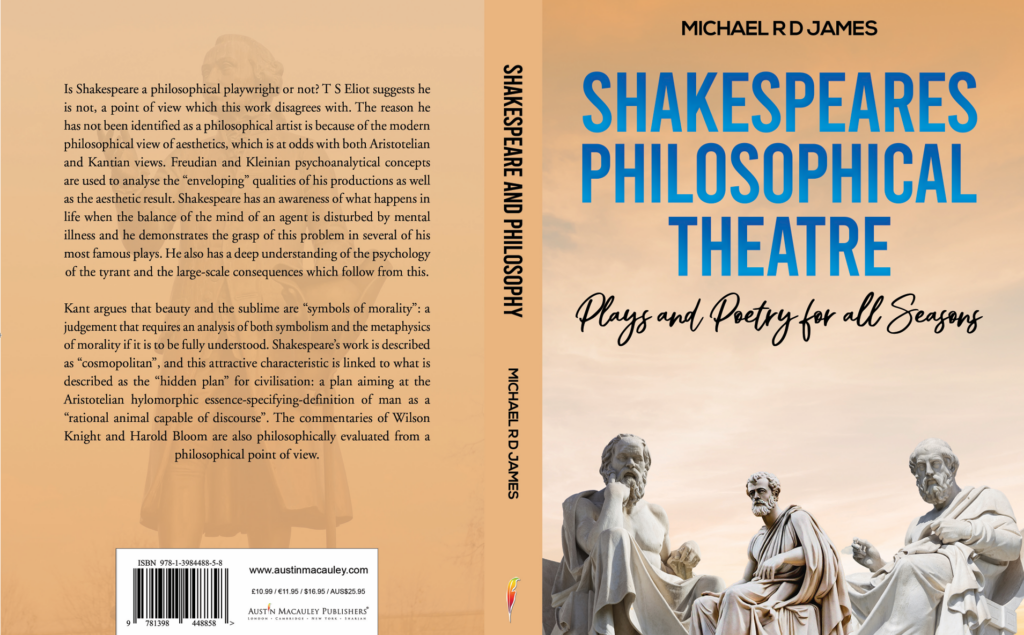
Below is a critical review of Shakespeare’s Philosophical Theatre: Plays and Poetry for All Seasons by Michael R. D. James, grounded in the book’s published description and the author’s stated aims rather than reader ratings (the book is newly released in May 2026).
Book Review: Shakespeare’s Philosophical Theatre
Michael R. D. James �Austin Macauley Publishers, 2026
Overview and Central Argument
In Shakespeare’s Philosophical Theatre, Michael R. D. James advances a bold and unapologetically philosophical thesis: William Shakespeare should be understood as a genuinely philosophical artist, not merely a dramatist whose work happens to touch on philosophical themes. Explicitly challenging T. S. Eliot’s influential claim that Shakespeare “did not think philosophically,” James argues that this verdict stems from modern aesthetic assumptions that distort how Shakespeare’s drama actually works.
James proposes that when Shakespeare is read against Aristotelian and Kantian aesthetics, rather than post-Romantic or modernist frameworks, his plays reveal a coherent vision of mind, morality, political power, and civilisation. This repositioning of Shakespeare as a philosophical dramatist is the book’s conceptual backbone.
Philosophical Framework and Method
The study is notably interdisciplinary. James draws on Aristotle, Kant, Freud, and Kleinian psychoanalysis to explore what he calls the “enveloping” qualities of Shakespearean theatre—how drama operates simultaneously on intellectual, emotional, and moral levels 1. Rather than treating psychoanalysis reductively, James uses it to illuminate Shakespeare’s sustained interest in mental disturbance, tyranny, and the fragile balance of the psyche, particularly in tragedies such as Hamlet, King Lear, and Macbeth.
One of the book’s more ambitious claims is that Shakespeare demonstrates a philosophically sophisticated grasp of mental illness and political pathology, anticipating later psychological and ethical analyses of power and degeneration. James links this to Kant’s idea that beauty and the sublime function as “symbols of morality,” using Shakespeare as a concrete artistic embodiment of this claim.
Engagement with Shakespeare Criticism
A significant portion of the book is devoted to critical dialogue with earlier Shakespeare scholars, most notably G. Wilson Knight and Harold Bloom. Rather than dismissing these figures, James reassesses their interpretations from an expressly philosophical standpoint, questioning where poetic intuition ends and philosophical coherence begins.
James also introduces the concept of Shakespeare as a “cosmopolitan” thinker, whose work implicitly participates in what Kant described as a hidden plan for civilisation. This plan culminates in an Aristotelian definition of the human being as a “rational animal capable of discourse,” a formulation James sees as quietly structuring Shakespeare’s dramatic universe.
Style, Strengths, and Limitations
The book is dense, intellectually demanding, and unapologetically philosophical. Readers without background in Kantian moral philosophy or psychoanalytic theory may find portions challenging. However, this density is also the book’s strength: James does not simplify Shakespeare to fit contemporary tastes but instead insists on taking both drama and philosophy seriously on their own terms.
One limitation is that the argument occasionally privileges philosophical coherence over theatrical contingency; some readers may wish for more sustained attention to performance history or textual instability. Nonetheless, this is a deliberate choice rather than an oversight.
Conclusion
Shakespeare’s Philosophical Theatre is a substantial and original contribution to Shakespeare studies, particularly for readers interested in philosophy, aesthetics, and philosophical psychology. It is not an introductory guide but a serious scholarly intervention that challenges long-standing assumptions about Shakespeare’s intellectual depth. For philosophers of art and advanced Shakespeare scholars alike, James’s work offers a demanding but rewarding re-evaluation of what it means to think philosophically through theatre.
Campbell makes a very interesting claim about the relation of mythology to mental illness which deserves close attention. He compares mythological images with the images experienced whilst undergoing a psychosis. This comparison is on a par with that made by Freud between the rituals and symbolism we find in myths, and the behaviour and narratives of paranoid psychotics such as Schreber. Carl Jungs work on the collective archetypes of the unconscious has been referred to several times throughout Campbells writings but it is not clear that Jung can provide us with the theoretical underpinnings we find in Freuds Kantian Philosophical Psychology. Both Psychologists appear however to believe that the root of the problem lies in the unconscious, which for Freud contained instincts with an essentially sensory-motor character.
In an interview where his disagreement with Freud was commented upon, Jung claimed that the disagreement occurred because his work was grounded in Kantian Philosophy. Freud also claimed his Psychology was Kantian, so the disagreement appears to turn upon this issue. If, however one appreciates Freuds commitment to Darwins Theory of Evolution plus the presence of Aristotelian Hylomorphic principles in Freuds works, then, it would appear that at least insofar as Freuds later work was concerned, where we see clearly the influences of both Plato and Aristotle, there is more Philosophical content in Freud’s theories, especially when one considers the extent to which Kants work contained a number of hylomorphic principles. Jungian Theory proceeds in a completely different direction, attempting as it does to present a trait-based theory of personality. Freud, on the other hand attempted to produce a principle-based theory, where the reality principle was intimately connected to both the pleasure-pain and energy regulation principles which operate on different psychological levels ranging from the instinctive to the level of higher mental processes.
There is of course something interesting about Jungs theory of the collective archetypes, as it appears to address problems arising from our descriptions of the inner reaches of the outer world. Aristotle claimed in his work on the soul entitled De Anima, that the first actuality of the body in the actualisation process of human psuché, is the soul. Spinoza elaborated upon this by claiming that the first idea of the mind is the idea of the body. Freud in turn builds upon these principles in his later work and asserts that the Ego is an agency of the mind and one of its primary functions is the protection of the body and this testifies to the fact that the Egos is an advanced vicissitude of the instincts: instincts that are dedicated to the fulfilment of a large variety of different kinds of needs ranging from self-preservation to more advanced projects connected to the love-life and work-life of man.
Melanie Klein elaborated upon this point by pointing out the complexity of the ego and that it can be “split” into the good ego and the bad ego in a similar fashion to the way in which the baby’s idea of the mother can be split into a good mother and a bad mother. Kleins hylomorphic theory also speaks about the relation of the ego to part and whole objects like the breast of the mother . In circumstances where the baby’s basic physiological and safety needs are met, howeve,r both the breasts and the mother will be incorporated into the whole object of the person of the mother. For Jung this Kleinian account would belong to what he called the personal unconscious of an individual and this for him was a different realm to that of the collective unconscious he was interested in, with its more abstract and advanced images of deities and devils.
Cambell refers to this process of “splitting” in this chapter on Schizophrenia (a term which literally means “split mind”). In his attempt to chart the depth of the waters of schizophrenia in its various forms Campbell states:
“the first experience is of a sense of splitting. The person sees the world going into two: one part of it moving away; himself in the other part… He may see himself, for a time, in two roles. One is the role of the clown, the ghost, the witch, the queer one, the outsider. That is the outer role that he plays, making little of himself as the fool, a joke, the one kicked around, the patsy. Inside, however, he is the saviour, and he knows it. He is the hero chosen for a destiny.” (Page 218)
Campbell was startled by the resemblance between schizophrenic experiences and the experiences of the hero embarking on a dangerous journey into the unknown. We are dealing here with more serious mental health issues which “envelop” patients like Schreber and causing an “oceanic feeling” in which the individual feels at one with the entire universe. In such states schizophrenic patients may feel that they have lived forever through many lifetimes, and will continue to do so ad infinitum. Freud clearly saw such experiences to be psychotic and anathema to the temperate life of a man whose ego is following the reality principle or the principle of the Golden Mean. There is clearly an aesthetic element to such a life which is founded on the harmony of the faculties of sensibility, understanding, and reason: a life in which whole objects are not part or bad objects but, rather, good self-sufficient independent objects. This would be one aspect of the Freudian Reality Principle, which in Aristotelian terms, would understand the material, efficient, formal and final causes of our object relations. Psychotic states such as those connected above with the “oceanic feeling” function, for Freud, were related to two principles: the energy regulation principle (regulating primitive pleasures pains and anxieties) and the pleasure-pain principle relating to more complex experiences. Campbell has the following to say on this topic:
“Ineffable realisations are experienced; and, in fact, as we read about them, we can only be amazed. I have now read dozens of accounts; and they correspond, often amazingly, to the insights of the mystics and to the images of Hindu, Buddhist, Egyptian and classical myth…. For example, a person who has never believed, or even heard of reincarnation will begin to feel that he has lived forever.”(Page 219)
Freuds case-study of Judge Schreber reveals a complex picture of the interplay of unconscious and conscious processes rooted in sexuality. The sexual organs, amongst all the organs of the body which, on the hylomorphic view, are important physical conditions of the human soul (psuché), are more connected to intense pleasurable and painful experiences. Images also supervene in relation to these experiences. Freuds interpretation of Schreber’s case referred to fixations and regressions to an early stage of libidinal development. Putative conscious experiences relating to beliefs that one loves somebody are shown instead to be disguised feelings of hate, and Freud explains the mechanisms responsible for such reversals. We should however, be aware that Freud claimed in relation to his interpretation of Schrebers symptoms, that he was dealing only with one type of paranoia. He was also careful to point out that his exposure as a consultant to these types of cases was limited because the authorities did not believe in favourable outcomes for such patients.
Indeed, the Schreber case, like that of Woodrow Wilson was based on the material from autobiographies and biographies. Campbell also spoke of different kinds of schizophrenia. He distinguishes between those psychoses in which the sufferer is passive and overwhelmed by the experience and the presence of high levels of anxiety, and those in which there is an active decision to bring about the psychotic experience through various techniques including meditation. In the former case the condition often requires some form of treatment in an institution because suicide attempts and violence towards others is a part of the symptom pattern.
Campbell also refers to a “literary” case reported by R D Laing. A case of a 38 year-old Royal Navy man by the name of Jessie Watkins who felt as if he had died, but also felt that he could see himself as a baby had hear himself cry. Both Schreber and Watkins felt themselves to be superior to God. Watkins, in particular, felt burdened by the work he was called on to do partly because God was a “madman”. Campbell refers to the work of Silverman and the distinction he draws between cases of paranoid schizophrenia and what he calls “essential schizophrenia which is related to shamanic psychotic crises. Silverman points out that in cases of paranoid schizophrenia one encounters hyperattention accompanied by an acute awareness of immanent threat and danger, resulting he argues, from an inability to confront the terrors of the inner world.
The shamanic psychotic experience, on the other hand, is more like that of the journey of a hero whose outcome ends positively when the inner and outer life have reached some kind of accord.Here too the shaman may experience an “oceanic feeling” in which he feels he and the universe are one. The paranoid schizophrenic, on the other hand is drowning in relation to his unconscious images, whereas the shaman and other so-called “essential schizophrenics” and mystics are swimming with their unconscious tide. The explanation for such a state of affairs, then, may depend upon future development s in the field of Philosophical Psychology and in the field of future scholarship into the powers of the human psuché.
Why do words matter to us? It is important to answer this question if we are to understand how myths have affected us throughout the ages. Is the effect of myths upon us easily described? Probably not, considering two important variables, namely, the long period over which they have existed and the simultaneous evolution of our human aesthetic and cognitive capacities. Theories of meaning have been proposed by various schools of modern Philosophy but these have been proposed in the light of unanswered questions relating to our aesthetic and cognitive powers: questions best answered by the arena of debate we term “Philosophical Psychology”. The words of the oracles obviously were revered by even the Philosophers of Ancient Greece, and this response of awe and admiration bears witness to this question of the effect of words upon the mind. Mythology itself does not provide us with an account of word-meaning or word-effect or the general role that the power of language plays in the lives of men.
We know through the theory and practice of psychoanalysis in its early phase, therapy proceeded via hypnosis—an abnormal state of consciousness which is still responsive to language. This state of affairs also reminds us of reports that oracles could sometimes deliver their proclamations in a trance-like state. Freud discussed the issue of hypnotism in therapy and pointed to the suggestive effect of his words on his patients. This suggestive effect we also know is used by professional hypnotists to get people they have hypnotised to perform certain actions.
Freud relatively early on in this process abandoned hypnosis in his therapy in favour of more technical methods of accessing what he called the unconscious mind, claiming that being in a conscious state of mind when accessing material from this realm was important for the cathartic process that was occurring. Many different powers from different faculties of mind (sensibility, understanding, reason) are involved in this cathartic process, including that of memory when we are dealing with traumatically induced neuroses. In such cases it is important that traumatised memories are converted into normal memories that are not abnormally affected by high anxiety levels. Dream interpretation and free association were important specialist techniques that were used to provide information relating to what in the unconscious mind was having a deleterious effect upon the life of the patient. In this process there is an attempt to restore the function of the cognitive powers of the patient, thus enabling a more efficacious relation to the reality of everyday life. The principle guiding this procedure was termed by Freud “The Reality Principle”. What we are witnessing in such circumstances is a self-actualisation process which all humans experience, partly because of their long childhoods—their long period of dependency upon parental care.
An interesting question to pose at this point in the discussion is whether mankind has always possessed its current array of powers in its current state or whether, as some Psychologists, like Julian Jaynes maintains, we are dealing with an evolving state of affairs in which there may well be significant changes occurring which could be termed “vicissitudes of Consciousness”. Freud, in the context of this discussion, we ought to recall, spoke of Consciousness itself in terms of a “vicissitude of the instincts”. Julian Jaynes makes an important contribution to this discussion when he attempts, on the basis of his brain research, and available literary and archaeological evidence, to claim that the emergence of Consciousness could be dated to ca 1200 BC. This entailed, in his view, that prior to Consciousness emerging, there was a state of mind which he described as “bicameral mind”, where language was in fact situated bilaterally in the brain, but perhaps undergoing transition: owing to the ability of some people to both read and write, they may have been transitioning faster than those who were illiterate. This reflection suggests that the power of language played an important role in this process. Julian Jaynes in his work “The Origins of Consciousness in the breakdown of the bicameral mind”(Houghton Mifflin, Boston, 1976), discusses an important mechanism of change operating in our usage of language, namely metaphor:
“For metaphor….is the very constitutive ground of language. I am using metaphor here in its most general sense: the use of one term to describe another because of some kind of similarity between them or between their relations to other things. There are thus always two terms in a metaphor, the thing to be described which I shall call the metaphrand, and the thing or relation used to elucidate it, which I shall call the metaphier…..It is by metaphor that language grows.”(Pages 48-9)
Jaynes notes further that the human body is an often used metaphier:
“The head of an army….the face of the clock…the eyes of needles, storms targets, flowers or potatoes….the arm of a chair or the sea.”(Page 49)
This account is in accord with Aristotles account of metaphor in which it is asserted that when we are dealing with the names of things, metaphor takes us into a realm of experience that is unnamed, thus creating a new usage of the term. Julian Jaynes also connects language to evolving levels of consciousness:
“Language, Jaynes argues, began as an expressive phenomenon partly connected to events of importance in the external world (e.g hunting, gathering etc.,). By a charted series of functions this developmental sequence eventually reaches the level of representative thought in which we find the names for animals, developing into a more complex stage in which names are given to individual people. At this stage it would be fair to say that we are definitely thinking something. As group life evolved we then find language evolving into more complex forms via the use of sentences with subject-predicate structures which illustrate the fully mental power of thinking something about something, which Heidegger called the veritative (truth-making) synthesis. This however is not the final level of the Mental, which is achieved only when the Principles of Logic and Truth Tables begin to constitute and regulate the field of sound argumentation—the field of rationality. (The World Explored, the World Suffered: A Philosophical History of Psychology, Cognition, Emotion, Consciousness, and Action, Volume 4, James, M,.R.,D., 2022)
This initial excursion into the interior mechanism of language-use and its evolution is meant to complement Campbell’s account of Mythologies of War and Peace especially when put into relation to the “power of suggestion” that is contained in mythological language. One thing that can be immediately noted in this context is that the power of words in the rhetoric associated with war, has been more effective in Ancient times than it is now. This is not to deny, however, that even in our modern era, two countries historically have sought to promote the solution of war to many diplomatic problems where rational discourse might have been used instead, namely the Soviet Union and the USA. This is not a new phenomenon and may lie behind the reason why Historians have adopted the practice of naming wars after the country or region that has been attacked, suggesting that morality is playing some kind of role in the discipline.
Campbell claims paradoxically in this chapter that wars are agents of the Darwinian mechanism of natural selection resulting in the telos of the “Survival of the Fittest”. Continuing on the theme of his reference to animals, Campbell notes Spenglers reference to man being a “beast or prey” that has triumphed over his vegetarian victims, because, it is claimed, of his superior intelligence.
Campbell claims that no primitive mythologies depict war as an evil but there are interesting ideas that may be related to why this is so, such as “there is no such thing as death”. Death appears, on these views, to be but a punctuation mark in an ongoing narrative where life is reborn again and again:
“the beast will return next season to yield its temporal body again.” (Page 171)
“Likewise, after episodes of battle special rituals are enacted to assuage and release to the land of spirits, the ghosts of those that have been slain.” (Page 171)
War mythologies are based on the assumption that some humans are subhuman monsters and it is heroic to slay such monsters. Campbell notes that there was no problem during such primitive times in persuading people to become warriors, and this might have been due to the suggestive power of the language of the myths in contexts where the recipients may or may not have full conscious control of the instincts. When, however, stronger egos developed, perhaps partly because of the evolution of language, there may well have developed simultaneously inhibitory mechanisms such as interrogative thought processes: “Should I do X?” and this eventually may have made the rhetorical persuasion process more difficult. Culture also plays an important role in the way in which consciousness chooses to categorise and see the world. The Ancient Greeks, for example, through their balanced view of the opposites friend-enemy, may well have been less inclined to war given their more nuanced view of the relation between what is holy and what is just. This, it can be argued, was the beginning of a secularisation process that began with the Socratic/Platonic attempt to provide us with a Philosophical theory of the relation of Justice to what is Holy. This process also appears to be associated with cosmopolitanism or globalisation, with the caveat that this latter may be more associated with military objectives than the commonwealth of ideas. Whether the plot of the world-play we are watching is a tragedy, in accordance with the oracular proclamation that “Everything created by humans is destined for ruin and destruction”, or whether we are instead watching the Kantian Enlightenment “play” in which it is claimed that the “plot” of the civilisational process is following a “hidden plan” where in the last scene of the last Act we find ourselves living in a Cosmopolitan Kingdom of Ends, leading a good spirited flourishing life, remains to be seen. It is interesting to note, however, that the Ancient Greeks maintained a psychic distance to strangers which accorded them, a respectful status. Campbell also notes in the context of this discussion the “modern” national problem of persuading the youth to fight wars on behalf of their communities. Perhaps this might be one more sign that an increased conscious awareness and a more complex language has strengthened our egos with the determination to establish “Perpetual Peace” (A Kantian ideal)
Campbell points out that not all primitive peoples have been warriors. The settled village people of the tropics for example, may not exactly promote a culture of warfare but in their various rituals we nevertheless encounter a savage bloodthirstiness which testifies to a lack of respect for human life perhaps because of a fundamental belief in the process of organic life renewing itself from an inorganic non-living base. Campbell claims that this supports the idea that killing, (e.g. headhunting) actually enhances the process of the renewal of life (P 172). He also notes that:
“it is in fact exactly in those parts of the world that the most horrible and grotesque rituals of human sacrifice obtain even to this day…It is in these areas that the headhunt flourishes.” (Page 172)
Campbell also refers to the continuous practice of human sacrifices by the Aztecs.
A new order of human life began to emerge in the eighth millennium BC: a form of life where grain planting and harvesting communities arose in the Ancient Near East (P.173). Fertility rites were embedded in the mythology and religion of the times. The warrior culture during this period of 1-2000 years was marginalised until archaeological finds uncovered walls which presumably were for the purpose of defending these peaceful communities from marauding bands of animal herders invading from the East and the South. The Bible records the above period of invasions in the OT. The Iliad from approximately this era also is a work of war mythology. The OT we know is about a chosen race and a partisan wrathful God in sharp contrast to the polytheistic pantheon of bipartisan Gods we encounter in the Iliad. The OT texts contain brutal recommendations relating to how one should treat strangers occupying territory one wishes to conquer, ( Deuteronomy, Joshua, Judges, Kings). The Arabs too, Campbell argues, produced a war mythology of their own and there is no trace of the ethical and political dimensions of the kind we encounter in Ancient Greece. Campbell notes also that both of these war mythologies are operating even today in the Near east: one of the many powder kegs of the modern world.
The Aryan Persians, on the other hand, engaged in conquests with the intent to govern the territory they conquered more benevolently, allowing the local populations to retain their religious belief systems as well as their own local rulers (Page 182) (cf Alexander the Great from Ancient Greece). The mythology of Zarathustrianism was also to influence Christianity with its presentation of a creation myth in which the powers of light/darkness, truth/illusion-deception, life/death compete with each other. This mythology also contains and important reference to freedom:
“every individual, of whatever race or tribe must through his own free will choose sides and align himself with the powers either of goodness or evil in this world. If the former he will contribute through his thoughts, words, and deeds to the restoration of the universe to perfection.” (Page 187)
So, on this account the good will restores goodness to the universe and everyone is free to choose whether to do this good or not. Evil might, on some interpretations, be purely the refusal or omission to engage in this work of restoration and the maintenance of institutions, structures and systems designed to propagate good in the universe. Persian Kings, on this view were expected to be the representatives and will of the “Lord of Light”. (Page 183)
“And so we find that in the great multiracial and multicultural empire of the Persians—which, in fact, was the first such Empire in the History of the World—there was a religiously authorised imperialistic impulse, to the end that, in the name of truth, goodness and the light, the Persian King of Kings should become the leader of mankind to the restitution of truth.” (Page 183)
The eschatological dimension of the above account points to a dramatic battle between opposing forces which would rage for 40 years before saviour or Messiah emerged. It was in this period-in waiting that Christianity emerged, and the assumption of Jesus was that this battle had already occurred, and he was the emergent saviour. Christianity was intended as a mythology religion of peace:
“But I say to you, love your enemies, and pray for those who persecute you, so that you may be sons of your father who is in heaven: for he makes the sun rise on the evil and on the good, and sends rains on the just and the unjust (Mathew 5: 43-45)
This, it was anticipated, would be a revolutionary mythology because it is also claimed:
“For I have come to set a man against his father, and a daughter against her mother, and a daughter-in-law against her mother-in-law; and a man’s foes will be those of his own household. He who loves father or mother more than me is not worthy of me; and he who loves son or daughter more than me is not worthy of me.” (Mathew 10)
On this radical account one should also give away one’s possessions to the poor and follow the Master, for so it is written. This is an anti-family Philosophy and perhaps also anti-secular in that it promotes also an ascetic form of existence which attempts to shift concern from the eschatological dimension of the future to the task of living in the present and finding God in everyday life at least insofar as the Gnostic Gospel was concerned (which Campbell quotes from). Those that live by the sword, it is claimed, shall die by the sword. The theory of Christianity appeared to be one thing whilst its practice became another, perhaps because of the enduring influence of the OT. Crusades against the Arab infidel became eventually an important project for monarchs who claimed as a consequence a divine right to rule.
Another mythology of peace was that promoted by the Jains of India whose teacher Mahavira was a contemporary of Buddha. (Page 189) . One of the messages of this mythology was that all forms of life (down to the vegetative, e.g. grass) possessed an absolute value which must not be violated. Buddhism shared this life-philosophy but on this account there is also an attitude towards the ego or the self which maintains that it must be banished: yet, in a certain sense this is consistent with the view that ones own individual life lacks significance. It is not absolutely clear, perhaps because of this last caveat, whether Buddhism, for Campbell can be categorised as a Romantic mythology.
As we move eastward, however to Japan and China, Campbell has no hesitation in categorising these as both peaceful and Romantic. Yin and Yang reminds us of Zarathustrianism but “The Way of all things, the Tao” is a virtue-based approach which is more reminiscent of one of the concerns of Ancient Greek Philosophy. This eastern approach focuses, however on “Resoluteness” as well as the idea that taking up arms is one of the last resorts of a wise man. (Page 192). This, as a matter of fact, has not been an approach manifested in the rules of a long series of Chinese tyrants who obviously did not embrace the way of the Tao. Campbell notes, instead that from this period two Machiavellian war-mongering historical documents have replaced this way of the Tao. Campbell recalls in the context of this discussion that the Bhagavad Gita, too, addresses both the arts of government and war. In this text it is noted how important the treasury is to these arts and individual life:
“ A person who has no wealth is more dead than alive.” (Page 195)
A Machiavellian spirit haunts some of the pages of this work:
“A King seeking prosperity should not hesitate to kill his son, brother, father, friend.” (Page 196)
Power, on this account is of more importance than Right:
“Every work should be done completely… By killing its inhabitants, by destroying its roads, and burning and pulling down its houses, a King shall devastate his enemy´s realm.” (Page 196)
Such thoughts place such ideas in the realm of war mythology, and here too, we find the idea that the Self can never be slain, a different thesis to that of the no-Self view of Buddhism. Machiavelli again emerges when the Prince is discussed:
“The duty of Princes being to fight and to slay.”(Page 197)
Yet in both Buddhism and Hinduism we encounter the idea of a farther shore we are journeying toward: a shore which transcends the opposites of light and darkness, truth and illusion, war and peace. Buddha-consciousness is impersonal, selfless and guiltless.
After charting the history of war mythologies Campbell then interestingly maintains (in the spirit of Philosophy):
“But on the other hand, in the annals of world history accounts are to be found also of a diametrically opposite point of view to this, where the aim is to be quit of war and strife altogether in a state of perpetual peace.” (Page 198)
“Perpetual Peace is a Kantian term used in his writings on History: writings which include a recommendation for the establishment of the Cosmopolitan institution of the United Nations whose task it will be to regulate war-peace relations between nations. The actual institution of the United Nations also has the task of regulating the human rights of the citizens of all nations, something that was made possible via the Kantian account of Moral Law. The idea of Rights also emerged in Grotius’s thesis “The Rights of War and Peace”, a work which also discusses a “law of nations based on ethical , not jungle principles” (Page 199).
Returning to the issue of the power of mythological language to suggest Projects of War and Peace we ought obviously to note that it is far easier to appeal to the emotions associated with war, than the reasons associated with peace. Depicting strangers as enemies and diminishing their humanity, is far easier than appealing to principles of reason and the moral law. Metaphorical language plays a significant role in such a process, which is reaching into the realm of the unknown and unnamed. Both war and peace symbols however are relatively abstract, e.g. Janus or the olive branch. As mythology has evolved throughout the ages, Consciousness (beginning with the first idea of the body) has actualised the potential of language to integrate both the sensible and intellectual powers of man into an ego that is self-consciously related to both the Truth and the Good. The articulation of the form these stages take are beginning to emerge on the foundations laid by Aristotle, Kant, and Freud and their followers. Whether, however, we will ever be able to postulate historical dates for the different stages of this evolutionary actualisation process, is, however open to question.
The Western/Occidental concern with matter and form in our aesthetics may be present in some way in Oriental Art. Campbell claims that 4 types of subject matter are involved:
“Abstract qualities such as goodness, truth, beauty, and the like; next types of action and mood (the slaying of monsters, the winning of a lover, moods of melancholy, bliss, and so on): third, human types (Brahmins, mendicants, holy or wicked princes, merchants, servants, lovers, outcastes, criminals, etc) and, finally deities—all of which we know are abstract.”( Page 105)
Campbell claims further that there is no interest in the individual, or in unique unprecedented events in Oriental life and Oriental Art, but we do nevertheless see reference to types (forms?) of action and human beings in the above quote. This concern, however, does not amount to a theoretical or practical interest in human psuché and its psychological and mental vicissitudes, which include an interest in arete (doing the right thing at the right time in the right way) dike (justice), epistemé (knowledge) and arché (principles, laws).
The Ancient Greek concern for the importance of knowledge and Aristotle’s specific categorisation of knowledge into the theoretical, practical, and productive sciences may to some limited extent be mirrored in the Oriental sciences of Medicine, Astronomy, Mathematics etc. Ancient Greek science, however, thanks to the work of Aristotle is definitively more systematic, and also involves more complex links to the complex repertoire of powers and capacities of the human mind. Another important difference between Oriental and Western knowledge systems is the presence in the latter and the absence in the former of attention to forms of explanation related to principles such as noncontradiction and sufficient reason. Ancient Greek Philosophers reflected generally upon the status of all explanations relating to rules, principles and laws and these reflections have been documented as epistemological issues as well as issues within the spheres of Metaphysics and Philosophical Psychology. All these reflections occurred within the context of a basic term, namely, psuché which was a term covering all forms of life from that of a simple plant up to and including human psuché, which Aristotle defined in terms of a “rational animal capable of discourse”. All these life-forms were observed in the light of a categorical framework that was implemented in experimental/clinical contexts designed to chart the structure and function of both these organisms as a whole but also their parts, thus effectively founding the disciplines of Biology, Anatomy, and perhaps also Physiology. There is, however, no evidence that Aristotle ever dissected a human discourse for a number of possible reasons. Firstly, due to the pressure of religious belief which regarded the body as sacred and secondly owing to the belief that its form ought to remain intact for the burial when acts of remembrance would take place and the transition to a possible afterlife would begin (Aristotle may have remained sceptical to accounts of the afterlife for logical reasons).
The conceptual diversity and density of Aristotelian explanations (aitia) which we find represented in a multitude of sciences falling into three different categories (theoretical, practical, productive) make possible a nuanced perception of our environment as well as an account of the complex nature of our thoughts about the world and ourselves, and the complex relation between these two domains of reflection. Diagnosis in the case of the trans-scientific discipline of Occidental medicine is a systematic activity, relating as it does to hylomorphic explanations embedded in a complex matrix of episteme, areté, arché, logos, psuché, Aletheia, dunamis, and eudaimonia. Concepts are the tools of our faculties of understanding and reason, especially when combined into meaningful propositions. The subject matter of Medicine is constituted by both animal and human forms of life (psuché) and diagnosis attempts to assume proper or normal function of the forms as a whole and the proper or normal function of their parts (including organ systems).
Aesthetics falls into the category of the productive sciences which in turn relates to the ideas or basic terms of the beautiful and sublime as revealed by the powers of perception and imagination (faculty of sensibility), and to some extent involve the understanding and reason, especially if the objects of perception are works of art.
Campbell takes up the interesting fact that the praxis of portraiture has never been important in Oriental Art. He claims that the reason for this is that our Occidental Mythological Culture has placed an importance upon the individual that is considered dysfunctional in Oriental Mythological Culture. This issue highlights a significant Metaphysical problem. Is Campbells description of this East- West conflict the correct one? Buddhism certainly claims what is often referred to as a no-self doctrine which means that there is no substantial existential entity lying behind our references to an “I”. Kant has claimed that the “I think” is a transcendental condition of the experience of, for example, objects, and that one can think about the phenomenal self of experience and make empirical judgements about this empirical self, but it is not this empirical self that is the transcendental condition of our experience. The Buddhist doctrine of the no-self, however, seems to entail that there is no permanent self behind our experiences, since it is in a state of constant change. Aristotle pointed out that change in the world can only be explained if we assume a constant bearer of change that remains the same throughout the process. This was an assumption Kant embraced. For Both Aristotle and Kant there are a multitude of powers from different faculties that have helped to constitute this unity of apperception which is in turn a condition of apriori intuitions of space and time, and the categories of the understanding. The physical substrate of this “I” is according to Aristotle Human Psuché which is constituted by a complex organ system including the brain that has been described by brain researchers as the most complex object in the universe. The brain is also connected to other organs and a constellation of limbs, hands etc. An upright posture is also an important element of the Aristotelian essence specifying definition of human psuché, namely rational animal capable of discourse. Such a complex entity obviously requires a multitude of sciences to explain its Being-in-the-world.
Psychoanalysis, Freud claimed was a Kantian Psychology and it was certainly trans-scientific in its attempt to explain the clinical phenomenon of mental dysfunction, mental disease. Historically, attempts by one particular science to discredit the scientific credentials of this Freudian discipline seem, in the light of these considerations to be otiose.
Criticism of Western philosophical explanations of the “I” by Eastern Mythology may, then also be otiose. Criticism of the East by the Philosophical tradition that lies behind our system of Sciences has included horror at the practice of certain rituals such as that of widows casting themselves onto their husband’s funeral pyres: a horror which is expressed at the wasteful unnecessary loss of human life. This is not a judgement from an individual about another individual, but rather a general universal judgement about the value of a praxis in relation to human psuché as such which we also may extend to our preferred animals as well. We, Westerners believe generally, that it is irresponsible to throw the gift of life away in such tragic circumstances, especially if there are children who will now be asked to mourn not one, but both, beloved parents. We too, believe in obedience but not blind obedience to a deity blind to the value of human life. In this respect we owe our heritage to those Ancient Greek oracles who did not believe in casting the transcendental self aside even if “Everything created by humans is destined for ruin and destruction”, suggesting rather that human psuché engage systematically in the task of “Knowing thyself”, and knowing the world which is the setting of our lives.
We can see, given the above considerations that Occidental Aesthetics is differently grounded in a repertoire of human powers such as perception, imagination, understanding/judgement, and reason. Oriental Art seems to appeal to a more limited repertoire with imagination taking precedence. Perception, understanding and reason appear not to be constitutive of the Oriental experience which appeals to a world of hallucinations and dreams.
The Western portrait is a celebration of the importance of the idea of the human form of Being in a complex world much of which was his own making. Western artists know that the portrait for many appreciators is a learning experience teaching us the relation of a particular human form to a particular life the characterisation of which is going to have some universal and necessary characteristics. Kant, in his reflections upon Art in his Third Critique, claimed that the form of the human body was an ideal of our Western Art, and this belief was undoubtedly shared by the artists of Ancient Greece who believed in a healthy body-mind relationship.
Artistically designed buildings (architecture), Adrian Stokes argues, is the mother of all Art, and he takes up the example of Quattrocento Art in which the mass-effect of the stone is part of the total impression aimed at by the Architect. This very general characteristic of the material the artist uses, is abstracted from the purpose of the building which could be a Temple, a Tomb, a School, or a Palace. The form these buildings take is in accordance with a rational, very general idea of the Good. For Adrian Stokes, the Kleinian art critic, the idea of the good, whole object is a key concern of the artist. This idea of wholeness is Aristotelian and defines how we view the parts f the whole. The “whole person” for Aristotle was undoubtedly conceived of in terms of possessing both a healthy body and a healthy mind, and this in turn must be interpreted in the light of the Aristotelian dictum that the mind or the soul is the first actuality of the body composed of organs, limbs, hands, upright posture etc. The soul, then, becomes the home of a repertoire of psychological and mental powers which include perception, imagination, understanding, judgement, and reasoning. The multitude of sciences and arts falling into three categories are, then, the products of the human repertoire of powers.
Campbell points to the portrait productions of Titian and Rembrandt but he argues that it is the uniqueness of the individual that is the point of the portrait. This is not the whole story behind this genre of painting, which requires a much more complex form of explanation. We pointed earlier to the fact that the artist is providing an object which is intended to be the stimulus for an aesthetic lesson. Human character in relation to the ethical idea of The Good is certainly a part of the story and the lesson which will also include reference to the concepts of areté (doing the right thing in te right way at the right time, dike (justice)episteme, phronesis and eudaimonia: all in the name of the Form of the Good, an idea surpassing that of particular existents or particular individuals. Campbell, however, elaborates upon his simple characterisation of Occidental Art, claiming that in Oriental Life:
“the individual is expected not to innovate or invent, but to perfect himself in the knowledge and rendition of norms.” (Page 106)
This identification of the Western individual with the Ego is questionable. What is partly at stake here is what Campbell means by the terms “knowledge” and “norms” in the above quote. Oriental ideas of knowledge and norms are undoubtedly at odds with our Western beliefs in the importance of the ideas of human psuché and the Forms of The Good (norms?) This Western idea of human psuché is also connected to the Judgement “All men are mortal” and the principle lying behind it that life ends with death: on this position there is not another life after this, in other words the idea of an afterlife is a contradiction given the current state of our knowledge (which is considerable if we are reasoning against the background of the Western Canon of Philosophy and the Sciences). When the body gives up its life, the ghost of consciousness also ceases to exist. The afterlife on this account is a dreamlike hallucinatory idea which Campbell also insightfully extends to Oriental Buildings and Cities:
“I wonder if that may not be the reason why, in certain Oriental cities, one can feel, even today, that one is moving in a dream: the city is dreamlike because in its inception it was actually suggested by a dream, which then was rendered in stone.” (Page 107)
Adrian Stokes in his critical reflections upon Quattrocento Art, notes how the mass-effect of the stone appeals to our Western idea of a self sufficient independent object of perception which invites the imagination of the perceiver to live in the spirit of the Object, using not just the dreamlike function of the imagination, but also the powers of understanding and reason. Oriental art-objects have a completely different structure and tend to invite different responses tied to more instinctively grounded powers and their vicissitudes.
There follows a long exposition on the Art of Yoga and its discipline of awakening inner instinctive powers, which confirm the above remarks: it seems that we are dealing here with the powers of the body that produce dreamlike and hallucinatory experiences. Campbell in the context of this discussion begins to draw attention to a major disruption of the body-image which is connected to the transcendental experience of a “third eye”:
“Indian Art, that is to say, is an art concerned with the transcendence of our normal two-eyed experiences of life, meant to open this third eye, in the middle of the forehead, of the lotus of command, and to reveal to us thus, even while we are awake, a dream-like vision of Heaven and Hell become stone.” (Page 115)
Consciousness is a vicissitude of Instinct, according to Freud, and it is a power that is prominent in our Western Canon of Knowledge systems, but it is a very different vicissitude to that of the hallucination. Perhaps it is this third eye that is the source of hallucinations and dreams, but its mode of operation is not that of a normal eye whose function it is to organise the forms of space into a figure background structure that contains self-sufficient independent objects that can be explored using the motor system of the body. These objects in our environment can produce a variety of responses ranging from beautiful objects of nature, beauties of intentionally produced art objects and also instrumentally constituted objects that are useful as a means to other ends.
Campbell also refers to Japanese and Chinese Art which characterises the vastness of the universe in terms of:
“The world of ten thousand things” (Page 115)
The way in which the divine dwells in such a universe is indeed paradoxical, however:
“For even in a single hair”, as I have heard, there are a thousand golden lions.” (Page 115)
Campbell elaborates upon his account claiming that landscape painting is crafted in the spirit of Tao:
“And this way of Nature is the way in which all things come into being out of darkness into light, then pass out of light back into darkness, the two principles—light and dark—being in perpetual interaction and, in variously modulated combinations, constituting this whole world of ten thousand things.” (Page 116)
This Yin/Yang Principle is more related to the powers of perception and consciousness than is the case in Indian Art. Campbell uses this principle in his account of the Chinese Artistic process:
“So the artist with his brush, is manipulating tinctures of the very principles that underlie all nature. The artwork, thus brings forth and makes known the essence of the world itself, that essence being an interplay f these two, the yang and the yin, through no end of modulation.” (Page 117)
So, transposing this into the object world of Quattrocento Art, it appears as if the visual aspects of light/dark are more important in Chinese visual Art than the visual/tactile aspects of the mass-effects of the stone so important in Quattrocento architecture. Stone is an intersensory object with protective functions which transcend the purely visual phenomena of light/dark. Touch is a phenomenon that is intimately related to motor function and together with visual information is part of the intersensory unity of an object: it is part of what makes an object a self-sufficient independent object. Of course the Quattrocento architect will have considered the way in which the sunlight illuminates the building as well as the effect of darkness upon its interior but this will have been just one consideration among many.
Campbell continues his account by invoking 6 considerations the Chinese artist takes into account, beginning with the idea of rhythm. The artist upon painting bamboo it is argued will attempt to identify its rhythm, organic form, trueness to nature, colour, placement in a field, and style. If, it is argued, one paints without forcing the painting of the field, the bamboo will reveal itself in its nature.
Cambell attempts a comparison of Indian and Chinese art, claiming that the former uses the “soaring power” of the imagination and he contrasts this with the Chinese world we live in, the world of ten thousand things:
“artists of the Tao prefer to remain with nature, in harmony with its wonder.” (Page 121)
The basic attitude f the Japanese/Chinese artist is one of play:
“his approach to life is not of work but of play” (Page 123)
Adrian Stokes wrote an essay entitled “Life is a game that must be lost”, arguing that the restoration of lost objects of value is a key aspect of the artists activity. Perhaps this was in fact a response to the Chinese view of life as a game. Campbell concludes this essay with a Buddhist story where the appreciator of a painting magically finds himself participating in the painting, interacting with a pretty girl until he was whisked back into life and reality, noticing that his presence had changed the content of the painting. Testifying to what? The fact that life is magical? That both art and life are games? This tale would not have impressed the Ancient Greek artists who would see the continuity of life and art, but also see the implausibility of a tale that did not appreciate just how Art imitated life, and the importance of the production of a self-sufficient independent object that cannot be changed by magic. The issue of the integrity of the object is obviously manifest in portraits of nobles and royalty, and in such objects the Aristotelian poetic idea of character is clearly on display. What is less obvious, however, is the subtle role of the power of the imagination which not only provides us with images but also with a magical enveloping function which seeks to “identify or “make one” the work and the response to it.
Ritual is an important activity of the human “form of life”, an expression used by Wittgenstein in grounding his “Philosophical Investigations”. Aristotle does not use this specific expression, but it is nevertheless implied in the term “psuché”, the hylmorphic account of which would contain the idea of “form” as “principle”. For Campbell it is clear that the higher the form of life the more complex the “structure” of the organism will be. He opens this essay as follows:
“The function of ritual as I understand it is to give form to human life, not in the way of a mere surface arrangement, but in depth. In ancient times every social occasion was ritually structured and the sense of depth was rendered through the maintenance of a religious tone. Today, on the other hand, the religious tone is reserved for exceptional, very special “sacred” occasions. And yet even in the patterns of our secular life, ritual survives. It can be recognized, for example ,in the decorum of courts and regulations of military life, but also in the manners of people sitting down to table together. All life is structure. In the biosphere, the more elaborate the structure, the higher the life form.” (Page 44)
This is a hylomorphic account of ritual that probably would have been accepted by Kant, but university life is not mentioned in spite of its largely secular adherence to ceremonious rituals and its very influential role in the shaping of civilisation and culture in the Western World. Many university rituals have remained the same for centuries even if the influence f Universities has been in decline since the beginning of the 20th century. These rituals include examinations, the awarding of proof of achievement in graduation ceremonies reflecting the different structural levels of knowledge, and academic staff installations, e.g. Professorial “chairs”.
Campbell then proceeds to provide an account of the instincts, beginning at the base-level manifesting itself in simple forms of lif,e and simple behaviours such as nest-buidling, beehives, anthills etc., and moving up to human psuché where , it is argued stereotypical reflexes are no longer produced by innate releasing mechanisms. In human psuché, behaviour is converted into Action via the operation of multiple psychological and mental powers which give rise, firstly, to the vicissitude of the instincts we call consciousness and secondly, to those higher vicissitudes manifested in the higher mental powers such as understanding/judgement, and reasoning. The operation of Thinking in such higher organisms attempts to achieve not just a harmony of the faculties of sensibility, understanding and reason, but also the efficient use of the multiple powers we encounter in human psuché. Campbell then makes a very interesting claim relating to the long childhood of human psuché, which, it is argued, causes our instincts to mature more slowly, a process which allows the mechanism of “imprinting” to take place in relation to a complex environment/world possessing multifarious sources of influence:
“It acquires its human character, upright stature, ability to speak, and the vocabulary of its thinking under the influence of a specific culture, the features of which are engraved, as it were, upon its nerves; so that the constitutional patternings which in the biological world are biologically inherited are, in the human species matched largely by socially transmitted forms, imprinted during what have been long known as the “impressionable years”, and rituals have been everywhere the recognised means of such imprinting. Myths are the mental supports of rites; rites the physical enactments of myths.” (Page 45)
Aristotle’s hylomorphic theory has long been a source of the idea that society maintains its structure and innovates via the generation of firstly, the forms of reproduction, secondly, forms related to tools and implements, and thirdly, forms related to ideas communicated in educational processes involving teachers and pupils.
Much of the time spent in childhood and adolescence occurs in the context of a family, living in a home, and this together with the time spent in educational institutions are the major bearers of the development of mental capacities that function in accordance with what Freud and Campbell refer to as the reality principle or reality function: a function involving the inhibition or overriding of most instinctive affective and spiritual impulses. Campbell claims that this in turn is dependent upon the individual becoming a creative innovative “centre of the life process”( Page 47). He further claims that “Modern Occidental civilisations” have been the major source of innovation in the world but he points to 1914 suggesting that things may have changed at this point in History: a point in time when man begins to question and even reject much of what mythology and Religion had to offer mankind. He interestingly cites Rousseau as the source of this attitude that led to a general discontentment with our civilisations.
Rousseau, we ought to recall was a Counter-Enlightenment figure, a modern version of Diogenes sensing a discontentment in the darkest regions of Europe. Rousseau believed that men are born free, but everywhere in chains because they are enslaved by the authorities and institutions of a corrupt social order. He did not, however, personally believe in the power of family life to moderate the sexual impulse, placing 5 of his illegitimate children in an orphanage, effectively abandoning them. It is somewhat surprising to learn that the Enlightenment Philosopher, Immanuel Kant, was influenced by Rousseaus claim that man in his natural state was a noble creature, and it is even rumoured that Kant. a creature of habit, allowed his daily walk to be disrupted because he was reading the Work “Emile”. Kant, however, would certainly have questioned the prohibition relating to Emile reading the Bible. He might also have questioned Rousseaus contention that the tears of the baby teach the infant to manipulate others in the course of getting what was wanted.
Kant may have agreed, however, that with the crying of the baby we may be witnessing the first appearance of acts of the will. Manipulative tears, Rousseau argued, was one of the first signs of an attitude he termed “amour propre”, a fundamentally negative attitude that will assist in the corrupt enslavement of man. On the political front, Rousseau sees in the middle class, not the Aristotelian enlightened class, but rather a class that has embraced the corrupt values of the upper class. Plato and Aristotle both viewed oligarchy as a deficient form of government, embracing many of the excesses of the appetitive and spiritual parts of a persons character. Such an uncontrolled proliferation of desires would have been attributed to a passionate imagination which was unmoderated by reason.
Rousseau was the father of Romanticism, furthering the myth of the “noble-savage” whose passions, Kant argued, symbolised an illness of the mind, impermeable to mediating influences. For Plato, Aristotle and Kant it is mans unbridled passions that enslaves men in the chains of self-love. Freud’s accounts of the narcissistic personality is especially relevant here, and would invoke the impulsiveness of a personality functioning in accordance with the pleasure-pain principle rather than the reality principle.
Freudian Psychoanalysis in its later form was of course based on the Socratic principle that the polis or society is the human psuché writ large. Freud was convinced that the categories used to describe ad explain the activities and power of human psuché, could be used in the description and explanation /justification of the powers of the State. This was the reason he could write meaningfully about the History and State of the Society he was a part of. The myth of the “band of brothers” was a Freudian constructed conjectural narrative of the origins of society before the time of civilisation and its institutions. The narrative begins with the tyranny of a ruler-father who suppresses his sons and uses the available women to meet his narcissistic sexual needs. The sons band together and kill the father in order to escape his aggression, and gain access to the females of the group/tribe, but they almost immediately regret the act realising that whoever rules will in all likelihood be subjected to the same fate. They eventually reach an agreement on a law/taboo of murder, incest and cannibalism. This, for Freud is the moment in History when the light of Reason dawns, and a significant connection is made between what has happened in the past and the future of the tribe. This is also the triumph of Eros over Thanatos and the birth of a hope for a better future. The principle behind the taboo/law is the principle of equality: the beginning of the operation of the Kantian “hidden plan” in accordance with the operation of a “good will”.It is not clear where Freud stood on this issue of the hidden plan. He did claim to be a Kantian Psychologist and Vienna was a Cosmopolitan city, but he did not like Vienna, given the fact that he was a Jew in anti-Semitic times. Rousseau, however would not have endorsed Cosmopolitanism because for him when men come together corruption increases.
Campbell claims that the long period of dependency creates a large problem for the civilisational process because it is not easy to transcend this state and move to a state of independence:
“And with the extension of the period of dependency in our own civilisation into the middle or even late twenties, the challenge today is more threatening than ever, and our failures are increasingly apparent.”(Page 46)
Campbell likens this failure to a neurosis and warns of a “substitute dependency” upon the state and the social order, which has become the source of meeting the needs of human psuché for safety and belongingness. Such is the difficulty and pain of this process that it is referred to as a “second birth”, which results in a life led in accordance with the Reality Principle:
“We ask and are expecting, rather, that he should develop what Sigmund Freud called his “reality function” that faculty of the independently observant free thinking individual who can evaluate without preconception the possibilities of his environment and of himself within it, criticising and creating, not simply reproducing inherited patterns of thought and action, but becoming himself an innovating centre, an active, creative center of the life process.” (Page 47)
There is no mention of any qualification of this position related to the conservation of the knowledge and institutions we have established: no mention of the importance of History in this so-called civilising process. 1914, however is an interesting choice for the beginning of the decline of civilisation which Campbell characterises thus:
“life, freedom and force have not ben gained but lost.” (Page 49)
Campbell connects the loss of “form” in the arts to this moment in time, and claims that form was acknowledged in the smaller community of Athens but was already disappearing in the larger community of Rome. This process of the loss of form continues in large cities like New York, London and Paris where Campbell claims artists, instead of spending their time learning about their mediums and refining their work with continuous production, attend cocktail parties to promote themselves. What the Ancient Greeks may have claimed upon being confronted with “modern art”, is that a matrix of values have been lost in the search for “innovation”, values embodied in the terms, arché, areté, diké, epistemé, aletheia ,logos, phronesis, dunamis, and eudaimonia. The so-called “ready-mades” of modern art clearly rejected the history of working in a chosen medium, preferring instead to “innovate” by rejecting classical forms and creating instead a repertoire of emotions associated with the shock, surprise and indignation that their work generated. Campbell, in the context of this discussion complains, probably correctly, that James Joyce never received the Nobel Prize for Literature.
Campbell cites Spenglers work “The Decline of the West” in relation to the decline of the influence of the hylomorphic notion of “form” (an important force in the shaping-process of our civilisations/cultures and individual characters). He notes that in spite of the goal of being great innovators we send a large proportion of our lives imitating what is occurring all around us. In the beginning of this process as primitive men, we imitated and were influenced by animals, the vegetative world, and finally the heavens above became the models for our communities. Worshipping the sun and the moon, for example, were a part of this civilising process. Myths and rituals played important roles in such a “forming process”, but these have largely been abandoned in modern times, except perhaps in the secular cases of the institutions of The Law and Universities. Part of this civilising process involved the demythologizing of the animal and vegetative worlds and the model of the heavens for the structure of our cities.(Frobenius). This resulted in man himself being placed at the centre of the universe. Unfortunately it was not the man described and justified by the ideas of Ancient Greece, the Renaissance, and the Enlightenment, but rather the romantically inspired hero, troubadour and explorer who proclaims “I am who I am”: the face that Freud removed the veil from with his hylomorphic and critical theories.
Campbell appeals to the work of Joyce entitled “Portrait of an Artist as a Young Man” as part of this unveiling process, and we find Stephen Dedalus accusing Aristotle of failing to define the key emotions of pity and terror and providing us with the following definitions:
“Pity is the feeling that arrests the mind in the presence of whatsoever is grave and constant in human sufferings and unites us with the human sufferer. Terror is the feeling that arrests the mind in the presence of whatever is grave and constant in human sufferings and unites it with the secret cause.” (Page 59)
This secret cause, Campbell argues is related to our mortality, the death of which we are so certain. The fading influence of Art, of course, has led us further down the path of discontentment, the path where History and Tradition have been rejected for the romantic spirit of exploration. One could also mention here, as Arendt did, the failure of the Political forces to preserve the “forms” for posterity, or the failing influence of Education.
The rituals of Universities may have continued unchanged for centuries but they occur in a context of a theory of specialisation that has compromised the universality of knowledge and wisdom that is implied by their very names. The only institutions whose integrity has largely remained intact is that of the Law, but given the fact that the most militarily powerful country in the world, the USA, has historically refused to participate meaningfully in the process of the International Court of Justice and that the current President is an uneducated convicted felon, we may well be witnessing the death of that Ancient Greek institution which has carried us so far in the civilising process. If this is true then the words of the Oracle that:
Everything created by man is destined for ruin and destruction”
The Delphic Podcasts Review of Campbells Essays Myths to Live By. 1. ”The Impact of Science”
In many respects Campbells view of science is a popular view, undervaluing the role of institutions such as schools, universities, and institutions related to the law: institutions based on ideas and principles that have in the course of a History beginning with the Ancient Greeks, contributed to the building of civilisations. Such institutions were strengthened during the Enlightenment period, especially in relation to the Philosophy of Kant, which defended Newtonian science, as well as the many meanings of Science. Given this state of affairs, it is also not surprising to find Campbell underestimating the role and power of the above institutions in the shaping process of cultural forces. Kants view of History, referred in the context of this discussion, to the “hidden plan for humanity”, namely a Kingdom of Ends, that lies one hundred thousand years in the future. International institutions such as the United Nations and the International Court of Justice were in fact conceived of by Kant already toward the end of the 18th century.
Science has a history of being subjected to metaphysical criticism, beginning with Aristotles hylomorphism and its assumption of “The Many Meanings of Being”. This criticism is embedded in a Theory of Change which established Philosophy as a methodical, critical discipline, concerned with human thought, action, understanding, judgement and reason. The matrix of this concern was expressed in terms of four kinds of change, three media of change (space, time, and matter) three principles and four causes, all of which constituted a number of sciences, categorised into three domains of theoretical, practical and productive. This matrix also included basic constitutive concepts such as areté (doing the right thing in the right way at the right time) epistemé (knowledge) diké (order, justice) arché ( principles) psuché (forms of life), logos, phronesis and eudaimonia (good spirited flourishing life). Aristotle’s Hylomorphism was built on foundations provided by both Socrates and Plato, and a number of pre-Socratic Philosophers. Socrates left no writings of his own, but Plato, his pupil, portrayed a reliable picture of Socrates’ Philosophical activity in the agora of Athens confronting those that thought they knew about important matters such as the nature of holiness.
Plato’s dialogues and lectures were also important insofar as they extended the Socratic method of elenchus with more theoretical applications of the principles of noncontradiction and sufficient reason. Given the political concerns of both Socrates and Plato, the pre-Socratic figure of Solon, and the contemporary figure of Thucydides were also important influences upon Aristotle’s Political and ethical views. Solon was called upon, for example, during a period of crisis and chaos in Athens, to stabilise the polis in various ways, including a legislative agenda which proclaimed the importance of equality before the law as well as the participation of citizens in both the passing of laws and their enforcement and appeal procedures. Practical Reasoning and Sound Judgement were, in Solons view important elements of his reform program.
Thucydides, the Historian, outlined the threats to the polis if Practical Reason and Sound Judgement were compromised by careless and dangerous rhetoric which, in his view changed the meaning of the everyday expressions used in the polis. Such careless talk, it was argued, risked undermining the spirit of the law as well as the everyday trust for institutions of law, especially if the rhetoric of the day attempted to “make the worse argument seem the better” (in the spirit of Sophism). Thucydides was acutely aware of the possibility that dangerous rhetoric could invert or subvert the course of justice unless institutions possessed a sound understanding of the law and the practical reasoning and sound judgement that was needed to sustain its credibility. In many senses Socratic demonstrated these ideals of reasoning and judgement, and it is indeed ironic to note that the accusations levelled at Socrates by his indicters were accusations that were normally levelled at the Sophists of the era.
The Aristotelian Canon of the Practical Sciences included Ethics, Politics and household management, and their major focus was upon the Form of the Good rather than Knowledge, which is one of the primary concerns of the Theoretical Sciences (Physics, Maths, Theology/Metaphysics). The interesting outlier of the Sciences is the discipline of Rhetoric which, during the time of Aristotle, was closely allied to the Practical Science of Politics, but later degenerated into a mere technique (techné) of the Productive Sciences. Paradoxically, in spite of Socrates’ brilliant defence-speech during his trial, rhetoric became associated with attempts to “make the worse argument sound the better”. During Aristotle’s time the enthymemes of Rhetoric obviously aimed at the Truth in the name of the Good, probably because it was an activity, and all activities aimed at the Good against the background of the claim in the Metaphysics that all men desire to know.
Campbell, on the other hand is a dedicated follower of science but his view of this discipline is a very different view to that which we encounter in Aristotelian Hylomorphic and Kantian Critical accounts of the Metaphysics of science. It is even doubtful whether Campbells view is in accord with the way in which Science is taught in the University Systems of the World, which we know has its roots in Plato’s Academy and Aristotle’s Lyceum. The Medieval Christian academic tradition did much to weaken the status of both Science and Philosophy in the Schools (until closed in the 6th century) and Universities. Campbell expresses his view n the following:
“Copernicus published his paper on the heliocentric universe (1543) and some years after that Galileos little telescope brought tangible confirmation of this Copernican view….today of course we have much larger telescopes….so that not only is the sun now well established at the centre of our planetary system but we know it to be but one of some two hundred billion suns in a galaxy of such blazing spheres: a galaxy shaped like a prodigious lens many hundreds of quintillion miles in diameter. And not only that! But our telescopes are now disclosing to us among those shining suns, certain other points of light that are themselves not suns but whole galaxies, each as large and great and inconceivable as our own—of which already many thousands upon thousands have been seen.” ( Myths to live by, New York, Viking Press, 1972, Page 7 )
Campbell elaborates upon this by claiming that our prescientific communities could never have imagined such a “revelation”. The Ancient Greeks and Kant both refer to experiences of awe and wonder, whilst surveying what could be seen with the naked eye of the “starry heavens above”. Anaximander, the Pre Socratic thinker, believed the heavens originated in the apeiron (the unlimited) implying that the heavens were finite in their magnitude but still sufficiently extensive to inspire the experience of awe and wonder.
We know that Socrates began his career investigating the nature of physical phenomena but turned away from such investigations upon reading a work by Anaxagoras, which claimed that the mind played a large part in our representations of the physical world, referring to a part of the mind, noos, which Aristotle would later identify as the divine part of our human minds. Kant, the Enlightenment Critical Philosopher, also referred to this experience of awe and wonder in relation to our idea of the moral law which may be located in the so called divine part of the mind striving for the dignity associated with a good will. The History of Philosophy is in fact littered with examples of Philosophers who initially were attracted to scientific investigations of the physical external world but then turned toward more humanistically based investigations: investigations involving noos, practical reasoning and sound judgement, e.g.
Kant whose early work attempted to reconcile Leibniz’s metaphysics with Newtonian Science, and whose elater work argued for a metaphysics of morals that provided us with the basis for a theory of human rights .
2. Wittgenstein whose early logical atomism inspired positivistic science made way for an Aristotelian based human science based in instinct, forms of life, and language-games.
3. Freud whose early neurologically based psychology brain psychology was literally burned by Freud and replaced by instincts (eros, Thanatos) and their psychological and mental vicissitudes embedded in human contexts of love and work: the civilisation building activities par excellence .
It appears as if Campell is not aware of the above key events in the History of Philosophy and the “pattern” they constitute: a pattern that has great respect for the various disciplines of the sciences (theoretical practical, and productive), but seeks to interrogate the necessary and sufficient conditions of these activities whilst simultaneously understanding the limitations involved in investigating phenomena in accordance with the categories of the understanding and principles of reason. Campbell also seems to have a perspectival view of the technology of science which is certainly not confined to the peaceful star-gazing telescopes, but includes weapons of mass destruction too. Indeed Campbell himself must have been aware of that moment in the History of Science where scientists actively collaborated with governments to produce an atomic bomb as part of the “final solution” to the Japanese problem.
Hannah Arendt referred to the 20th century as “this terrible century”, referring specifically not only to the holocaust but also to the dropping of two atomic bombs on civilian populations of Japan. Indeed it is also relevant to point out that no one has been held accountable before the law for these actions, in spite of the existence of the International Court of Justice envisaged by Kant. The reason for this is partly because the US has refused to ratify the authority of this court. This state of affairs sets a terrible precedent for the future and the Kantian Project of the Rule of International Law.
War, for Philosophers is a highly questionable activity, which in most cases, has not been subjected to the criteria set forth in the Philosophical community by, for example, Socrates, Plato, Aristotle, Kant, Freud and Wittgenstein. Socrates claimed that we fear injustice more than death, implying that wars must be just wars which, in turn, implies that wars can never be just in that they cannot possibly meet the criteria of both being good in their consequences and good in themselves. Socrates also specified more specific criteria relating to the exercise f violence, e.g. that one must never respond to being wronged by doing something wrong oneself: a policy he applied in relation to the unjust Athenian death sentence which took his life. For Socrates obedience to the law, for example, was more important than life itself or victory in relation to any cause.
Plato elaborated further upon this position by referring to the parts of the soul and their life-functions of appetite and spirit, which can both produce disorder in the soul and the polis, if not regulated by the rational part of the soul and polis: an order which ensures harmony and eudaimonia (good spirited flourishing life). In Plato’s Republic the warriors are important representatives of the spirited part of the soul/polis but are nevertheless regulated by the Philosopher-rulers who know the Form of the Good and its relevance to eudaimonia. Aristotle would have accepted some of Plato’s points but probably not the recommendation that Philosophers ought to rule the polis (a position Plato himself seems to have abandoned by the time he wrote “The Laws” ). Indeed Aristotle would have complemented what Socrates and Plato postulated with the qualification that regulation must occur in terms of the Principle of the Golden Mean and War could only be justified if its particular goal was to bring about peace.
For Kant it is the moral law that grounds the more modern idea of human rights which can only be universally valid if there are institutions such as the United Nations and the International Court of Justice to enforce them. This conforms with the intuition that a right can only exist if there is some authority standing ready to defend it. These authorities or international institutions must take responsibility for preventing wars between nations and penalising warmongers for violating human rights in warfare. These institutions were part of the Kantian “hidden plan”, and seem indeed to confirm the existence of such a plan for the fate of humanity: a plan that will end in a Kingdom of Ends in which everyone will treat everyone else as ends-in-themselves.
Wittgenstein who, as a young man, fought in the first world war in the trenches, believed that war was not only difficult to justify but difficult to talk about because the use of language and reason in the course of life-threatening situations is very limited. War, for Freud, is an expression of the instinct Thanatos, which emerges if other vicissitudes fail to provide the community with the moral strength to settle disputes rationally according to moral principles (the moral law, the golden mean?).
Freud used the Reality Principle and its opposition to the Pleasure Pain Principle to explain what is occurring in such a state of affairs where fear and desire for victory may neutralise more rational solutions to disputes. In this context he argued for strong legal, political and educational institutions if the aggression emerging from the death instinct was to be sufficiently regulated. The Desire for Peace, for Freud, was a Project of Eros, but Eros was “at war” with Thanatos and the outcome was always uncertain given mans inherent narcissism. Without strong institutions, however, man’s discontent can reach disruptive levels and destroy the harmony and cohesion of the community.
One possible reason for the marginalisation of the History of Philosophy, Mythology, Religion within the bounds of Reason, the activity of Art, the enthymemes of Politicians, and Psychology, is the sceptical response of science to these enterprises. Certainly, it cannot be denied that when we focus on the activities of sciences such as archaeology and physical anthropology, and their discovery of the sites of ancient civilisations and the bones of our human ancestors, we are provided with important information at a descriptive level which can contradict other descriptions from other more speculative sources. Such findings could never, however, call into question the principles of noncontradiction, sufficient reason or the Golden Mean. It is even doubtful whether any such findings could ever shed light on ideas such as the Kantian “hidden plan”.
Similarly brain research, even in its infancy during the time of Freud, was refuting the hypotheses of Charcot, who claimed that all mental illness was related to lesions in the brain, but it could never prove the negative that there is no area of the brain associated with the unconscious. Indeed, if images such as dream images are products of the unconscious, brain research proves that dream activity is associated with activity in various parts of the brain. This is something that Freud specifically claimed, namely, that his reflections on mental illness would be proved by future brain research. This has also been the case for other aspects of his theory which have been confirmed by the Nobel Prize winning researchers Gerald Edelman and Eric Candel.
The Physical Sciences of Nature are also undoubtedly of significance in relation to issues such as climate change where both the diagnosis of a complex problem and solutions for clean energy are of the utmost importance over the coming decades.
Campbell points to remarkable similarities in content in the Myths that emanate from very different regions of the world where there is no evidence of dispersion of ideas. He also takes up the burning issue of the discontentment of modern man claiming that when belief in Myth and Religion dissipates, we witness a distinct deterioration of and disruption in our Being-in-the-World. Campbell describes this in startling terms which reminds us somewhat of the picture of the Freudian battling Giants, Eros and Thanatos:
“With our old mythologically founded taboos unsettled by our own modern sciences, there is everywhere in the civilised world a rapidly rising incidence of vice and crime, mental disorders, suicides and dope addiction, shattered homes, impudent children, violence, murder, and despair. These are facts….they challenge too the modern educator with respect to his own faith and ultimate loyalty. Is the conscientious teacher—-concerned for the moral character as well as for the book learning of his student—to be loyal first to the supporting myths of our civilisation or to the “factualised “ truths of his science? Are the two, on every level at odds? Or is there not some point of wisdom beyond the conflicts of illusion and truth by which lives can be put back together again.?” (Page 11)
From the Philosophical perspective that believes in the “hidden plan”, the above is of course a false choice of the alternatives available. There is clearly a choice which embraces both factual truth and the validity of principles that are not illusory. The relation between these two aspects was given by Aristotle when he claimed the facts relate to the what-content of the claim and the principles relate to why the facts are as they are. Sciences of different kinds whether they relate to nature or to Psuché or to Psuché writ large in the polis, will manifest this relation in different ways. Whether lives will be put together again may well depend upon acknowledging these kinds of metaphysical matters with the help of the institutions of the polis. Some civilisations bear our Greek and Enlightenment heritage better than others, and in the context of such a discussion we ought to remind ourselves of the Freudian warning about the Soviet Union and the US where the rational part of our souls, according to Freud, are not “writ large”. It certainly seems as if for Freud Thanatos was winning the battle of the giants in these societies.
Campbells answer to his aporetic question relating to putting our lives together again is to find a modern myth by which we can live. He gives us two different kinds of answer to this question, the first of which is as follows:
“It is my considered belief that the best answer to this critical problem will come from the findings of Psychology, and specifically those findings having to do with the source and nature of myth. For since it has always been in myths that the moral orders of societies have been founded, the myths canonised as religion, and since the impact of science on myths results—apparently inevitably—in moral disequilibration, we must now ask whether it is not possible to write scientifically on such an understanding of the life supporting nature of myths.” Pages 11-12
We have discussed in other reviews, this relation to Jungian theory which possesses a more truncated view of our psychological and mental powers than that which can be found in Freudian theory. It is our contention, then, that Freudian theory would indeed be a better candidate insofar as the principles of Psychology and their relation to mythology was concerned. This position furthermore has the advantage of not firstly marginalising major accounts of the psuché, like those that we find in the works of Aristotle and Kant, and secondly, the History of Philosophy.
The second solution Campbell presents us with is the concrete example of the film “Star Wars”, which he presents as a candidate of a myth to live by in our modern world. This is a fantastic picture of the life of the universe containing alien species of all shapes and sizes and this is certainly a major feat of the power of the imagination, but it is not supported by any facts. Questionable transportations of the body through space involved in beaming personnel down from and up to the spaceship “Enterprise”, are also counterintuitive given the knowledge we have of the body and the possible rearrangement of its fundamental particles, not to mention the ease with which the ship can travel across galaxies at fantastic speeds. As with all imaginative negatives it is of course impossible to prove that these phenomena are not possible.
Science can of course be conceived of in positivist terms of:
“The world is the totality of facts and not of things” (Proposition 1, Tractatus Logico-Philosophicus, 1922)
This view of course was bot historically abandoned by many positivists and by Wittgenstein himself.
Is not science conceived of metaphysically or hylomorphically cognisant of concrete investigations into the ancient sites of civilisations, the bones of fossils, brain research and the historical development of the structures and functions of the brain as it increased in size and diversified itself in terms of its functions? This must be the case. Moreover conceiving of science thus, preserves Religion within the bounds of Reason, even if the idea of freedom becomes increasingly important as does the Metaphysics of Morals.
Campbell discusses Frazer’s work “The Golden Bough” and the role of magic and superstition in the History of Myth. He cites the “principle” of the “effect resembling the cause” and cites the example of a rattle (resembling the sound of falling rain) used in a ritual designed to “cause” real rainfall in the real world. He sees the need for an explanation of such phenomena and turns to the work of Charcot and Freud to assist in the process of ridding humanity of its rituals, superstitious thoughts and feelings. Campell, however, does not discuss the Freudian position in any detail and rests his case for Psychology on the work of Jung:
“What is required, states Jung, therefore is a dialogue… a dialogue by way of symbolic forms put forth from the unconscious mind and recognised by the conscious in continuous interaction. And so what happens to the children of a society that has refused to allow any such interplay to develop, but clinging to its inherited dream as to a fixture of absolute truth, rejects the novelties of consciousness, of reason, science, and new facts?” (Page 15)
Campbell notes in the context of the above discussion that there is a risk of remaining hostage of archaic rituals, thoughts and feelings, thereby alienating oneself from the ever-changing demands of the modern world and modern consciousness. Campbell repeats here the mantra of the modern scientist on the theme of the “absolute truth”, implying that both Aristotle and Kant have failed to provide us with this chimera of “absolute truth” which may not be a dispute about the facts, but rather a contradiction in terms. Neither Philosopher would have claimed that they have provided us with the illusion of “the absolute”. Both would, however, have claimed that their work provides us with a number of important principles and laws, whose logical implications remain to be worked out.
Kant specifically claimed that it is the task of reason to discover the totality of conditions of phenomena and he also provided us with a hylomorphic/critical framework containing arguments against rationalism/empiricism/dualism from both the Ancient Greek era, the Enlightenment era and the Modern era beginning at the end of the 19th century. This Kantian position argues for a Religion within the bounds of Critical Reason and rejects all forms of superstitious ritual, thoughts and feelings.
Campbell ends this essay by appealing to an example of Hindu myth and a tale of a war between gods and anti-gods, the “churning” of the Milky Ocean, the Cosmic Serpent, a great cloud of poisonous smoke which is drunk by Shiva. Th churning continues and an elephant with 8 trunks, the moon and the sun emerge together with a magnificent horse. Campbell ends the essay by paradoxically claiming that this myth is a myth for the modern world but his reason for this claim remains obscure.
Campbell, in his interview entitled “The Road of Trials” (Pages 52-53) suggests that the things that cannot be talked about are easily misunderstood because they transcend the dialectical orientation of everyday language in which opposites are generated by the negation function of such language which is oriented to everyday circumstances. In such everyday circumstances it is the selfish “I” that is speaking about worldly experiences.
Campbell acknowledges that Psychology has an important role to play in the understanding of man, the rational anaimal capable of discourse, and, of course, his myths. In the context of this discussion Campbell articulate what he sees to be the fundamental difference between Jungain and Freudian Psychology. He obviously has a preference for Jungian archetypal patterns and its home in the collective unconscious which he claims is in contrast to the Freudian notion of a personal unconscious. Freud, in fact, speaks of both forms of the unconscious especially in the later phases of his work where he refers to the battle of the Giants, namely Eros and Thanatos fighting for the fate of our civlisation. Campbell claims that Jung aspouses a more biological universal form of the unconscious that is a function of the effect of our organs on our psychic activity, and this is a hylomorphic view of how the psychic representatives of the unconscious are formed, which Freud undoubtedly in some sense embraced. Freud, of course, also spoke of the personal impact of the traumas of childhood upon the psychological well being of the individual.
Eros and Thanatos are also represented in the artistic genres of Tragedy and Comedy which is a title of a chapter in Campbell’s “The Hero with a thousand faces”. Campbell refers to “amor fati” (the love of fate) which certainly recalls the Delphic proclamation: “Everything created by humans is destined for ruin and destruction”. This proclamation haunted Ancient Greek consciousness, especially in relation to its preoccupation with the powers of the mind and the task of harmonising the powers and their relation with the external world, which, we ought to recall was a central concern of Freudian Psychoanalysis. For Freud, the driving force of unconscious instincts could be both positive (eros) and negative (thanatos), and this together with the aganecy of the ego which was constituted by a precipitate of lost objects helped to create the impression Kant had of everyday life which he described in terms of being “Melancholically haphazard”.
Modernism which according to Arendt, stretches back to Descartes and Hobbes, stretches forward to what Arendt called “This terrible century” (20th century). During this centiry we saw the pendulum of values swing between good and evil, right and wrong, lawfulness and unlawfulness, and we saw moreover, how there was an inversion of these opposites where tyants for example took the right for the wrong and evil for what was good. Many historical events were produced by Arendt in evidence for her judgements on the origins of totalitarianism, but other Philosophers, e.g. Paul Ricoeur, also pointed to the disappearance of the discipline of rhetoric during this period. The event of the divorce between Psychology as a science and Philosophy in in 1870, also testified to the collapse of many traditional political and cultural structures and practices. Stanley Cavell, for example, points to the marginalisation of many aesthetic values during the beginning of the century when so-called modern art began challenging many historical beliefs and practices. Cavell speciifically also drew attention to the refusal to consider the history of the belief or practice of the activity one was engaging in or questioning. Heidegger too, entered the arena of the deabte over the presence of confusion over the translation of key Ancient Greek terms into Latin, claiming that the Latin translations of, for example, aletheia and phusis gave rise to a number of confusions. Wittgenstein, in the period under consideration, pointed to the prevalence of conceptual confusion in the discipline of Psycholgy. P M S Hacker a Wittgensteinian scholar, also pointed out a number of conceptual confusions in the field of neuroscience. Many of these problems can be traced back to a confusion over what can and what cannot be said about the Ancient Greek concept of psuché, the human form of life.
Modern Art of the early 20th century was enveloped by a vortex of controversy, with musical compositions containing no sound, in the name of music, weightless sculptures, in the name of sculpture , blank canvasses, in the name of painting. Wittgenstein claimed that in the classical music of Brahms he could hear the sound of engines. Our contention is that many of the above confusions arise not from local factual misunderstandings but from a fundamental misunderstanding of the principles and categories of thought that are appropriate to use in relation to the concept of psuché, rather than as Heidegger claimed a “forgetfulness of Being”, which, of course, is a more abstract and general characterisation of the problems under consideration. If one accepts this line of reasoning, then one see all the above problems, including the origins of totalitarianism, under the aspect of a systematic misunderstanding of a category of Being. Heidegger however, in his investigations of the human form of Being-in-the-world, highlights the confusions relating to death in everyday dscourse which he argues fails to confront the phenomenon of death meaningfully.
T S Eliot, one of Campbells favourite writers, postulates that our modern world has become a wasteland, which is represented in the mythical figure of the wounded, impotent, Grail King. All of the above indicates the nature of the value of the objects the Ego has been forced to abandon and mourn in a mood edging toward melancholia. What transpires, as a consequence, is a consciousness preoccupied with the events of the external world which evoke the power of the imagination more than the powers of understanding and reason: a state of mind that marginalises the realm of the sacred (Ricoeur) and the Metaphysics of Nature and Morals. What is also implied by the marginalisations of historically important domains of thought, is the following: when the attention of consciousness is constantly trained upon stimulating objects, the emotional and passionate states generated require a return to a state of homeostasis, which is this state edging toward melancholia. This is a passive state which Arendt captures in her characterisation of the masses “for whom nothing is possible anymore”.
God may either be dead, or merely deus absconditis, for the modern wastelanders, who see “fear in a handful of dust”. T S Eliot we know, in his later life, sought redemption in the Christian Faith. His poem “Four Quartets” is about Time and a Spiritual Journey that circles back upon itself, tofind itself back at the beginning of the journey, but wiser for the experience, possessing more knowledge of the world and oneself. Where we are currently on this journey was earlier characterised in terms of a “wasteland”, but this situation in the “Four Quartets” is nevertheless conceived of in more positive terms of a life which can understand how formless our lives in general has become.
The tragic pair of Pity and Fear are, of course, present in different ways in Eliot’s poetry but he does not embrace the conceptual framework of Ancient Greek thought, preferring the framework of Catholicism and its fixation upon the Grail King, sacraments, and visions of heaven and hell which Campbell believes is merely a local ethnographic perspectival vision of the realm of the sacred and the divine that he believes takes us no closer to the goal of providing humanity with a universally valid planetary myth or religion. Knowledge and Rationality does not play the central role it plays in Ancient Greek Philosophy which rests upon the ideas of areté, arché, diké logos, aletheia, psuché, phusis, phronesis and eudaimonia.
The Ancient Greek conception of techné presupposed epistemé, areté, logos, psuché and aletheia, but this conceptual framework has been abandoned by the modern world largely because our modern science has limited itself to the goal of the quantification of nature via the use of the method of observation in a context of exploration: a use which rejects many rational principles, e.g. the principle of sufficient reason. The spirit of Newtonain and Kantian science was one which embraced a set of first, rational principles that the scientist approached nature with, in the spirit of a judge who puts conceptual questions to nature and expects answers in accordance with those first principles. This modern spirit of science is so difficult to characterise because of its limited focus, and its increasing complexity. What can be said, is that it is certainly embedded in a technological network of Heideggerian instrumentalities that always seem to refer beyond themselves in the sense of being “for-the-sake-of”. For the Acient Greeks, techné was situated in the domain of the productive sciences which included sculpture, builders, carpentry and weaponry, but did not include medicine, mathematics and rhetoric, all of which had intimate relations to the rational basic ides of aletheia, eåistemé and logos.
Psychoanalysis would, then, on the above account, be a skill, a technique, and an intellectual discipline. Epistemé for the Ancient Greeks was certainly a higher intellectual power and a superior form of knowledge obeying intellectual rational principles. Knowledge does not belong in the same category of instrumentalities which are not ends-in-themselves but rather means to ends or, as Heidegger expressed the matter, that “for- the. sake-of”. Instrumentalities, in other words, are cause-effect relations and do not have a telos connected to the more categorical forms of arché that we find situated in the context of explanation/justification.
The Arts of Tragedy and Comedy, as practiced by Shakespeare, occurred over a century later than the “times of the troubadour”, and several centuries later than the age of chivalry, which initated for Campbell, the romantic form of individualism he believes is central to our Western identities. Shakespeare skillfully combined these themes with the themes of Ancient Greek tragedy and Philosophy, that were being reawakened during the Renaissance. God, during the time of Shakespeare, was still an important presence, but the star of Religion was waning in importance in the light of the Protestant Revolution. Many Renaissance artists, such as Michelangelo, remained intensely religious, but were becoming more courageous in their challenges to the authority of the Church insofar as the limitations imposed by the church upon what they may or may not represent was concerned.
Science, too, with the invention of the telescope, was making space for itself in our everyday life, which now knew we were actively exploring the heavens and the movement of the stars and planets. The space of infinity and the time of eternity, were now transforming the activity of observing the heavens with a discipline which would become the discipline of astronomy. We were challenging the magnitude of the physical universe and thereby becoming so much more than a handful of dust reminding us of the lost object of a life that was no more because its powers had been extinguished. The transcendental attitude was being restored, but at the same time narrative accounts relating to the the place of the heavens, where wandering souls were domiciled, became less plausible. The image of ghosts and one soul leaving a body and entering another, was, of course, an image of the imagination which was not connected to reality in the way in which the memory or consciousness was.
Heraclitus claimed that the logos of change was to understand that two phenomena such as the road leading up the hill and the road leading down the hill were to be thought of as in soem sense the same. Aristotle saw the principles of change to be manifested in kinds of change, principles, media and causes: e complex network of considerations which was in accordance with logos, epistemé, and aletheia, which three different domains of science could investigate. These domains of science of course concerned themselves with psuché in different ways given that they related to knowledge and skills of different kinds, and given that explanations and justifications. Such explanations and justifications occurred in relation to the many principles regulating all the changes in the natural world as well as the changes in the the world of psuché.
Campbell points out that the narratives of myth are about the changes the hero undergoes in the course of his/her heroic quest, and many of the events are dreamlike, because, presumably, the changes we are witnessing are being processed by the imagination and the emotions that are being evoked by outer changes. Dreams require interpretation because they too are products of inner psychic change in the medium of images which resemble in many respects the images of film that Stanley Cavell discussed in his work “The World Viewed:Reflections on the Ontology of Film”. The imges of film, in contrast to our dream images, are automated, and the objects photographed “participate” in “the photographic presence of themselves on film”: making them, in fact, more like memories than the images of dreams (which are inserted in a wish-fulfillment complex). The dreamlike quality of film is difficult to analyse, but they too, in some sense, relate to the imagination and passions of the creator of the plot of the film. This, added to the fact that there is a form of “technical intelligence”, involved in the automation process which relates to instrumental forms of reasoning connected to the instrumental notion of “for-the-sake-of”. The camera, moving over a landscape, from object to object is an imitation of sensory experience: an automated form of sensory experience which is very different to that form that occurs in relation to a human body (the human body, that is, possesses a sensori-motor unity based on a constellation of organs and limbs typical of the human form of life(psuché)). Cavell is suggesting here that the moving automated images and mechanically induced movement of the film camera, provide us with a sense of a Being-in-the-world which is not human. The lack of real depth in the movement of the photographic images also suggest the lack of the presence of many categories associated with the understanding of human movement, because as Brian O Shaughnessy suggests:
“concepts play a causal role in the genesis of visual depth experience.” (The Will: A Dual Aspect Theory”. Page 171)
Films imitate the depth of three dimensional space in two dimensional images, and everything viewed “participates” in the real forms of the world and this might partly explain the dreamlike quality of the film experience. There is no suggestion that Campbell believes that our modern art-form of film-making could be the basis for the Planetary mythology he is seeking.
We have questioned the metaphysical status Campbell attaches to the hero, equating as he does the hero with a God in his work “The Hero with a thousand faces”. Overcoming overwhleming forces and manifesting supernatural powers against terrifying monsters are certainly not as realistic as the Socratic responses to the overwhelming forces he was confronted with. Socrates of course was not a mythological figure and would have objected to be called a God in the way Buddha was. The Buddha narrative speaks of an unnantural birth and a figure who sits under a Bodi tree “fighting a dark army” led by Kama-Mara. There was not, for Socrates, as there was for Buddha, a King of the Serpents protecting him from various supernatural dangers.
Campbell also refers to Prometheus and his world-transcending deed of stealing fire from the Gods to give to humanity. There is here an allusion to the pre-history of humanity, and the importance of the role of fire in the early phases of the primitive hunting/gathering groups living in caves. The narrative surrounding Prometheus, however, was not a clinical historical account but rather a narrative driven by the passionate desires: a narrative that desired to metaphorically communicate the sacred meaning of certain events in man’s history. Campbell claims that Jungian archetypes were involved in the construction of the Pometheus narrative, in particular the archetype of the Hero:
“Whether the hero be ridiculous or sublime, Greek or barbarian, Gentile or Jew, his journey varies little in essential plan. Popular tales represent the heroic action as physical: the higher religions show the deed to be moral: neverthless there will be found astonishingly little variation in the morphology of the adventure, the character roles involved, the victories gained. If one or another of the basic elements of the archetypal pattern is omitted from a given fairy tale, legend, ritual, or myth, it is bound to be somehow or other implied–and the omission itself can speak volumes for the history and pathology of the example.” Page 30 “The Hero with the thousand faces “
Philosophical mythology would of course not be so concerned with physical world-historical deeds such as those attributed to Achilles , but more concerned with the moral deeds of world-philosophical characters such as Socrates, e.g. his activities in the agora and his relation to death as a consequence of his death sentence by the Athenian courts.
Philip Cousineau in his Introduction to Campbell’s “The Hero’s Journey” claims that Campbell’s search was for the Logos of the phenomena he investigated. The concern, that is, was what these phenomena had in common rather than what differentiated them from each other. The method used was described as comparative historical elucidation and it can be contrasted with the method of Wittgenstein, which sought essentially to differentiate between different phenomena. Cousineau reminds us of the proclamation we encounter in the Vedas, namely:
“Truth is one, the sages speak of it by many names”
In this regard reference is often made to the collective archetypes of Jung, which are used to justify the denotation of many sacred narratives Campbell calls these sacred narratives or myths the “Masks of god” which partly constitute the “morphogenetic field” which we presume is identified with “The Truth” mentioned in relation to the Vedas above. The role of the hero is, we have agued in previous reviews of Campbell’s work, an ambiguous reference, which appears to exclude the quiet contemplative rational transformation Philosophers like Socrates, Plato and Aristotle appear to have undergone in their essentially intellectual journeys. These are the “modern” “pathfinders” in the modern morphogenetic field. We do find Socrates engaged in inner communication with his daemon in life-crisis situations, but Psychoanalysis would have no difficulty in explaining this communication as one between the ego and the superego, in a situation where a choice of life-defining alternative actions are being considered. The life defining experiences of saints, prophets and shamans are of course a much more dramatic affair.
Cousineau claimed that Campbell’s method involved the use of the hermeneutical method. Paul Ricoeur, the Philosopher, articulates well the concern of hermeneutics for “symbols”, claiming that symbols possess the semantic property of “double meaning”. Expressions with a so-called manifest meaning provoke thought to move to another deeper meaning in what Ricoeur calls the “realm of the sacred”, which we mortals seem able to comprehend only through a glass darkly. Kant speaks in his Third Critique of Judgment of a statue of Isis and an inscription that says “no mortal has ever lifted my veil”.
Aristotle refers to this realm in terms of the realm of Being and he further claims that “Being has many meanings” . This concerns not merely our relation to God, but also our relation to life (psuché), death and the mysteries of the external world. Campbell uses the word “metaphor” in its Ancient Greek meaning of “carrying beyond”: a meaning that transcends the more modern interpretation in terms of a shift from one semantic region to another. Reference is also made to the archetypes of the soul in the spirit of aletheia (unconcealment or revelation). We encounter this spirit in the Gnostic Gospel of Thomas which articulates a framework for the “many meanings of Being”, by claiming that the Kingdom of God is both within us and out there in the world, here and now. Eastern Religion also articulates this transcendental feature of our experience in terms of “Thou art that!”.
Ambiguous references to the archetype of the hero and his journey do not, as we have claimed earlier, acknowledge the possibility that this appears to run contrary to his stated view that we ought to be wary of unnecessarily universalising particular perspectival narratives which express local ethnographic concerns. It is true that prior to the introduction of Philosophical Reasoning and its Categorical concern with Being and Principles (such as noncontradiction and sufficient Reason), the heros narrative was steered by an imaginative idea of the heros journey. But even if our physiology has stayed the same for 40,000 years as Campbell claimed, the organisation of the brain due to the introduction of writing and reading may well be responsible, as Julian Jaynes suggests, for the kind of self-consciousness that has evolved as a human vicissitude of the instincts. We can see clearly in Plato’s writings, the change of emphasis from the virtue of courage to the virtue of wisdom, and the increasing importance of various forms of knowledge insofar as leading the good spirited flourishing life (eudaimonia) was concerned. Achilles excelled in battle, but his courageous life, otherwise did not meet Socratic or Aristotelian criteria. It was Socrates and the mythical Philosophers, returning to the cave from which they originated, that became the new “ideal”, representing wisdom. Whether we can regard these figures as “heros” is not clear. With the advent of philosophers there is an important shift from the individual perspective to the perspective of the polis which, for Socrates, was the soul (psuché) writ large. Socrates was searching for the definition of justice but it was Aristotle who presented us with an essence specifying definition of Man, namely rational animal capable of discourse which transcended the old ideal of the courageous warrior, and perhaps the so called archetype of the hero dissipated with Aristotelian Rationalism and the telos of the contemplative life.
Socrates’ life was, however, in the old sense “heroic” because it ended the way it did for the reasons that it did, but it was not the battlefield but the agora which was the scene of his activities. Challenging those who thought they knew and who were trying to make the worse argument seem the better, of course, took both courage and wisdom. Socrates, like Jesus, knew the risks he was taking in attempting to persuade people to “know thyself!”. What happened to Socrates proved that the Athenian system was not quite equipped to handle appeals to “the child of the Gods”, namely Philosophy. Aristotle too, became persona non grata and was forced to flee from Athens. There is an argument for the position that the polis as a constitutional entity was not equipped to meet the demands for the “new ideals” the Philosophers were arguing for, namely justice, knowledge, and freedom. An interesting footnote to this discussion is the attempt of Alexander the Great, Aristotle’s pupil, to establish a Greek Empire, thereby helping to destabilise the existing system of polis/states. In the spirit of the Aristotelian principle of the Golden Mean, it is worth pointing out that during Kant’s time, neither cities nor empires, but nations became the entities with constitutions.
Campbell in the Preface to his 1949 edition of “The Hero with a thousand faces” refers to a Freudian critique of religion and mythology:
“The Truths contained in religious doctrines are after all so distorted and systematically disguised that the mass of humanity cannot recognise them as truth. The case is similar to what happens when we tell a child that new-born babies are brought by the stork. Here too, we are telling the truth in symbolic clothing, for we know what the large bird signifies. But the child does not know it. He hears only the distorted part of what we say, and feels he has been deceived: and we know how often his distrust of the grown-ups, and his refractoriness actually take their start from this impression. We nave become convinced that it is better to avoid such symbolic disguisings of the truth in what we tell the children and not to withhold from them a knowledge of the true state of affairs commensurate with their intellectual level.” (Pages 44-45)
Freud’s point was, according to Campbell, that the ancient muses knew what they were talking about and which metaphors to use to carry their message further. We moderns, however, need to learn again the “grammar of the symbols”. Campbell adds:
“as a key to this mystery I know of no better modern tool than psychoanalysis.”(The Hero with a thousand faces” (Page xii)
Psychoanalysis, however, has a complex history with roots both in Aristotelian Hylomorphism and Kantian Critical Philosophy, but it is perhaps the latter that is especially relevant to this discussion, given the Freudian declaration that he was a “Kantian Psychologist”. Alongside these relevant facts, however, there is also the deliberate Freudian choice of terminology drawn from Platonic Philosophy, e.g. Eros, Thanatos, Ananke, logos, which clearly transcend the technical language Freud uses to characterise the treatment of his patients. The Freudian theory of the “psychic-apparatus” and its possession of psychological powers in relation to the external world, also manifests elements of Greek thinking that presupposed the Greek view of psuché embedded in a categorical framework of areté, dike, arché, epistemé, aletheia and eudaimonia. In this Philosophical/technical framework there is no clear role for narratives of heros and their quests. The heros quest for self- transformation often contains the occurrence of supernatural events in which tremendous forces are overcome by a superhuman will and determination, communicating perhaps the narcissistic message that “anything is “possible” for such men. The Aristotelian process of self- actualisation is not embedded in a narrative or a story, but is rather part of a philosophical account of the cultural development of a number of powers of human psuché, including the powers of discourse and rationality which are integrated with a number of other psychological/mental powers or functions that in turn have important relations to the external world.
It was Plato that initiated this transition from the form of the narrative to a more enlightened philosophical form of “Philosophical dialogues” featuring the “ very real character” of Socrates, whose mode of being was one of self-efacement rather than self-proclamation. His power of persuasion was considerable, because it was founded upon areté, arché, episteme dike, aletheia, logos, and eudaimonia. One can, if one so desires, read the episodes of the dialogues in terms of the adventures of Socrates, but that would be to miss the pedagogical point of the dialogues, which was to herald in the new era of the new ideals of principles and rationality, emphasising simultaneously the rejection of heros and the rejection of the strategy of making the worse argument seem the better.
The heroic narrative is at best an exercise of the imagination and emotion in the name of the good spirited flourishing life of the individual which, in an aesthetic context, carries the subjective message of exemplary universality and necessity articulated in Kant’s Third Critique. It is true that the trilogy of dialogues, Euthyphro, Apology and Phaedo, seemingly promote a narrative of the Socratic journey to his final destination in a death-cell. The message of these dialogues, however, is more complex. A man who has dedicated his life to justice is convicted for attempting to make citizens aware of the essence of Justice. Socrates at no point proclaimed himself to be a hero or a saviour, and he did not proclaim directly that Philosophy could save us from the Delphic prophecy of ruin and destruction. He nevertheless, over time, became a symbol for the necessity and transcendence of Philosophy.
Athens was the home of three of the greatest Philosophers in history, in relatively rapid succession, and their bond of connection was a sacred one: that of teacher-pupil. Plato incorporated the spirit of Socrates into his dialogues, and Aristotle incorporated the spirits of both Socrates and Plato into his writings. Campbells account of the heros journey has a very different structure, which it can be argued, was promoted into a cult of the hero by Thomas Carlysle, which in turn was transformed into the Hegelian idea of world historical individuals such as Napoleon . This underwent a further transformation into Nietzsches “Will to power”. Associated ideas of “Domination” and Colonisation” were political ideals that have been embraced by a number of modern tyrants since Napoleon. The Greek political heritage, however, probably lies closer to Schopenhauers “will to live” and Kant’s “good will”. Its epistemological heritage encourages a belief in “scientific” explanation/justification. Its artistic heritage includes a belief in the importance of Art and its associated ideals of the beautiful and sublime.
Campbell was undoubtedly a significant explorer of the breadth and depth of psuché via the linking of distant mythologies such as that of the Navaho and Hinduism. His arguments are sometimes hylomorphic and sometimes Kantian but they lack an important philosophical dimension which we have attempted to articulate. It is true as Campbell maintains that mans physiology has not altered for 40000 years but mans most important organ is his brain and the organisation of the functions of that organ may have changed during this period. Language, Julian Jaynes has argued was originally a bilateral function like all the other physiological functions of the brain. The science of physiology teaches us that an organ can lose one function and acquire another. In the case of the origins and history of the function of language, Jaynes has interesting theories to contribute:
“Language, Jaynes argues, began as an expressive phenomenon partly connected to events of importance in the external world /e.g. hunting, and gathering). By a charted series of functions, this developmental sequence eventually reaches the level or representative thought in which we find the names for animals developing into a more complex stage in which names are given to individual people. At this stage it would be fair to say that we are definitely thinking something. As group life evolved we then find language evolving into more complex forms via the use of sentences with subject-predicate structures which illustrate the fully mental power of thinking something about something which Heidegger called the veritative (truth-making) synthesis. This, however is not the final level of the Mental which is achieved only when the principles of Logic and Truth tables begin to constitute and regulate the field of sound argumentation—the field of rationality. These higher mental operations are undoubtedly inhabitants of the realm of the mental being essentially connected to the telos of self-conscious thought.” (James, M.R.,D., The World Explored, the World suffered: A Philosophical istory of Psychology, Cognition, Emotion, Consciousness, and Action: Volume four, Page 194)
This is a hylomorphic account of the development and integration of human psychological powers that are implied by the essence specifying definition of human psuché, namely rational animal capable of discourse. Whilst different languages spoken by different races of man with different histories compel us to attend to these differences, biological reflection focuses upon what we, who are different in certain respects, have in common. In simple primitive environments consciousness may not have possessed the same level of complexity, but mythical narratives certainly appealed to the powers of the imagination and sensibility, quickening in those who had the requisite capacities, an experience of transcendence. Primitive man certainly used myths to orient himself in his environment as well as to begin the attempt to know himself. Campbell claims in this context:
“The symbols of mythology are not manufactured: they cannot be ordered, invented or permanently suppressed. They are spontaneous productions of the psyche, and each bears within it, undamaged, the germ power of its source.” (The Hero with a thousand faces, Page 2)
Many scientific disciplines contribute to our understanding of primitive man and his primitive form of life and Campbell invokes psychoanalysis amongst these. He refers to the long childhood of man, and the subsequent long period of dependence upon our care-givers. As the repertoire of human psychological and mental powers develop much can go awry to disturb this development, and identification of the causes of psychological or mental health problems are not always straightforward matters. One image which the Ancient Greeks use to provide us with an understanding of the human self actualisation process is that of the labyrinth, and psychoanalysis certainly provides us with one of the threads leading out of the cave and into the sunlight. Myth and Religion too provides us with such a thread as does Philosophy.
In an interview entitled “The Road of Trials” Campbell refers to James Joyce and the Arts as responsible for awakening in them the realisation of the universal meaning of the symbols we find in our Myths. In this context he also refers to Hinduism which already in the 9th century BC acknowledged that:
“all the deities are projections of psychological power, and they are within you and not out there. They’re out there also, in a certain way, in a mysterious way but the real place for them is in here (points to the heart).” (Pages 36-37)
James Joyce helped Campbell understand the Eastern texts and laid the foundation for the next phase of his journey, in which he discovered Freud, Jung, and Thomas Mann whilst studying Sanskrit. Yet it was another German Psychologist whom he met in 1981 who would play a large part in helping him to synthesise ideas from Myth, Art, Psychology and Literature, and relate these ideas to the fundamental problem of life, which is:
“to become transparent to transcendence: so that you realise that you are yourself a manifestation of this” (Campbells The Hero’s Journey, Page 51).
Campbell spent one hour with Karlfried Graf Durckheim from Freiburg and emerged from this meeting with a definition of myth as:
“a metaphor transparent to transcendence” (Page 51)
The Ancient Greek spirit of aletheia hovers over all these reflections because it is clear that we are in a world of symbolic language which carries us beyond the normal concerns of speech into the “realm of the sacred”, which is the realm of psuché (life) in which we feel at one with the Universe and especially with all forms of life. Schopenhauer, following Kant, highlighted this aspect of metaphysics when he pointed to the phenomenon of humans sacrificing their lives to save the lives of others, thereby transcending Spinoza’s principle of self preservation in which it is claimed all things strive to preserve themselves in existence.
The imagination, according to Aristotle, is Janus-faced: it can either be subject to the will and be categorised as an active categorical power, or it can be characterised as a passive process in which the schema imposed upon what is seen, remembered, and “thought” has its source in sensations or feelings, whose essential characteristic is that they “happen to one”. Imagination in this latter case is non-conceptual. In an article entitled “Aristotle on the Imagination” by Malcolm Schofield(“Articles on Aristotle”, ed. by Barnes J., Schofield, M., Scrabji, R., (London Duckworth, 2003), it is argued that the Greek equivalent to our word “imagination” is “phantasia”:
“But Aristotle’s own unitary explanation of dreams and such pathological phenomena, on the one hand, and the similarity between pathological and normal seeing of aspects, on the other, put us in a position in which we can now exhibit the unity in Aristotle’s conception of phantasia, while retaining our characterisation of it as imagination.” (P. 125)
We should in the context of this discussion recall that for Aristotle:
“Every art and every inquiry, and similarly every action and pursuit, is thought to aim at some good; and for this reason the good has rightly been declared to be that at which all things aim.” (The Collected Works of Aristotle)
On this account dreams must aim at the good in spite of their tenuous connection to reality: they do not, that is, aim at the true. The dreamer believes that they are experiencing or seeing a man in a red shirt, and do not know that they are merely imagining that they are seeing a man in a red shirt. The absence of actual experience or actual perception in this situation means that memory must be playing a role in the production of these images, and the question then becomes: what is it that is activating the memory to produce such images. For Freud, dreams are wish-fulfilments in a double sense: they are disguised desires for something which requires the art of interpretation to make manifest, and they express the wish to continue sleeping. Two different types of “good” are being aimed at. In both cases the wish is located in the unconscious or preconscious systems of the psychic apparatus. For Freud, we should recall, dreams were the royal road to the unconscious system of our mind: memories were presented in disguised form on the dream screen in accordance with both the pleasure-pain principle and the energy regulation principle. Dreams such as the father’s dream of a child that has recently died, manifest the wish on the part of the father that the child was still alive. The memory that he is dead is overridden by other memories of the child alive, which are more in accord with the fathers desire that the child not be dead. The dream-memory of the child shouting out “father, father, cant you see that I am burning!” is a synthesis of the present near-waking experience of the body being burned by candles that have fallen over near the body, plus the memory of the event of the dying as a result of a burning fever. The dream is a phantasy: it never happened and what is wished for could never happen, now that the child is dead. Yet it is a real expression of a real wish projected onto the dream screen of a sleeping subject. It is most definitely a substantial clue in relation to the royal road of the subject’s state of mind. It is also part of the mourning process: a process that will for some time prevent the subject from fully engaging with his life-projects in accordance with the reality principle: the pleasure-pain principle(which uses feelings as regulators) rules on this royal road. The task for the father is to become fully conscious of his wish, and its role in the mourning process. Feelings are manifestations of what is happening to the body, and share with sensations, a non-active status. Bring them into a context of judgement as Kant did in his Critique of Aesthetic Judgement, and they can be subject to the activities of the imagination, the understanding and judgement. For Kant, the aesthetic judgement is concerned with the active communication of a feeling of the harmony of different powers of the mind, e.g. the imagination and the understanding. In such judgements there may even be a partial aim at the truth when, for example, one claims that the evening sunset is beautiful. Kant maintains that this is a cognitive claim on the grounds that we attempt, as Kant puts the matter, to speak with a “universal voice”. In this form of judgement, the understanding and its categories are involved in the organisation of the representations involved in this judgement. We know from his work on the Rhetoric and De Anima, that Aristotle believed Emotions can be connected to both our powers of understanding and judgement, and have therefore a claim to be cognitive (emotions have both objects and grounds for their occurrence). Anger, to take a typical Aristotelian example, connects judgement and thought via an awareness of an apparent injustice that has been done to the angry subject. Here Aristotle appeals to his hylomorphic account, and speaks of the matter of anger being the physiological response of the agitation of the blood around the heart: he also speaks of the form of the subjects anger being related to the subjects desire for retaliation or revenge. It is clear here that the subject’s judgement, in such circumstances, is only partially overcome and there is a complex relation to the pain involved in the situation. Fear, too, has a similar structure in which the matter are a number of complex physiological responses and the form is connected to the perception or thought of an evil that is related to imminent danger and the possible pain associated with this danger. Both anger and fear can be, as Aristotle claimed, praised or blamed for their positive or negative relation to the good. The angry man must believe that he has been insulted for the anger to be authentic, and the fearful man must believe in dangerous circumstances, if the fear is to be genuine. Fear and anger can be communicated in rhetorical speeches, which may also contain elements of deliberation or reasoning about the insult or danger, either diminishing its magnitude or fortifying a good spirited response to the events in question.
Modern positivist theories, we know, proposed an account of a special kind of meaning–emotional meaning–in response to the more ethical accounts of anger and fear. Such accounts focussed on the moment of persuasion involved in such circumstances, analysing the idea of the good into a feeling component and a subjective imperative component. Such an account was meant to be critical of Aristotelian accounts of ethics and emotions as well as Kantian accounts which attached great importance to the role of ethical law and principles in ethical judgements. For Aristotle, both Ethics and rhetoric involve practical reasoning in the process of praising and blaming the judgements and actions of the agents responsible for them. The grounds for such praise and blame lie in the realm of ought judgements and action—what we ought and ought not to have done. The practical reasoning used in such circumstances will, for example involve appeal to principles of judgement which claim that fear and anger can be appropriate if the circumstances and objects are appropriate. Aristotle’s account also refers to appetition, hunger, thirst and sexual desire which for both Plato and Aristotle were clearly linked to what both Freud and William James designated as the realm of instinct. Freud presupposes much of what Aristotle wrote in his account of the sexual instincts where sources, objects, and aims are all connected to the cathartic effect of a form of discourse that possessed the power to mitigate the undue influence of sexual desire in our lives. So, with respect to Freud’s account of the life instinct, we encounter a hylomorphic strategy which appeals to both form and matter. With respect to hunger and thirst for example a biological account of the physiological functions of the body suffice to explain such phenomena. Sexual instincts, on the other hand, require a more formal account to complement the bodily sources of the associated phenomena. Practical reasoning of the kind we encounter in relation to anger and fear plays an important role in the discourse we use to praise and blame agents for the appropriateness of their sexual activity(areté).
Aristotle’s work on poetic and epic tragedy speaks about the use of the emotions in dramatic works of art, in particular, the emotions of pity and fear. The cathartic process Aristotle describes is a process involving good objects that may be lost, good grounds, and associated goods such as areté and diké. All in accordance with the essence-specifying definition of tragedy:
“the imitation of an action that is serious and complete…..accomplishing through pity and fear the catharsis of such affections.”(The Complete Works of Aristotle. The revised Oxford Edition edited by Barnes J.,(Princetown, Princetown University Press, Vol 2, 1984(Poetics)
The actions concerned are concerned with what ought or ought not to be done or said, the moral quality of the actors, and the catharsis referred to is more of an educational and less of a medical-physical process. Medical catharsis involves the purging of pathological impurities related to states of health or disease of the body, whereas educational catharsis is concerned with the pathologies and the healing of the soul(psuché) in relation to areté and diké. There is, as Aristotle maintains, a kind of educational pleasure attached to this process in which one learns what the good is. Needless to say, we are concerned with the imagination and its universalisation in the process of appreciating dramatic works of art. There is an equivalent work of appreciation which helps us to understand the peculiar nature of those goods that are both good in their consequences and good in themselves. Knowledge(epistemé) of the Good is at issue in the mimetic context of an art work and the imagination therefore plays a decisive role in both the creation and the appreciation of works of art. Judgement, therefore, plays a more important role than reason in the realm of the productive sciences such as rhetoric and art.
In contexts of practical reason where we are directly concerned with action rather than imitative representations, understanding and reason play a larger constitutive role and teleological judgement and imagination a lesser role. The key idea involved in ethical forms of practical reasoning, is that of the freedom to choose ones action-alternatives. This is a direct consequence of the Kantian claim that forms of life are entities that are self-causing and can therefore negate any destructive desire that arises in their mental arena, e.g. refusing to take a drink if one is a recovering alcoholic. Sartre characterises this freedom in terms of Consciousness, and claims that the essence of consciousness is Negation. Freud, here, as in other matters, aligns himself more with Kant, and claims that the desire to take a drink as a result of the cravings of ones appetite-system arises as a so-called “primary process”, activity which can be neutralised by a secondary process reality-based operation of choosing not to imbibe. The secondary process is operating in these circumstances as an inhibitory power. In this process the representation of the drink thus becomes a lost object in the history of the individuals desire. The wounded desire that resulted in the choice not to take the drink is then required to submit to an attitude of resignation and acceptance of the wound to the self. This impulse-control triangle is for Freud related to the Greek idea of arête, which ensures that we do the right thing in the right way at the right time. Yet the whole process is haunted by feelings of mourning and melancholia, which hover like dark clouds over such kinds of action.
Paul Ricouer, in his work, “Freud and Philosophy: An essay in Interpretation”, is more inclined to place faith in the teleological aspect of action processes which he claims must supplement the so-called archeologically oriented account provided by Freud. This presupposes that Freud’s account did not contain a teleological element, which is a questionable presupposition, given Freud’s use of Platonic themes and ideas in his later work. Plato’s “Republic, we know, was an attempt to provide an account of the Good-in-itself and the Good-in-its-consequences, in relation to the ideas of areté and diké. Ricouer, in contrast, attempts to synthesise the teleological and archeological aspects he refers to with a theologically-laden eschatological meaning of justice (getting what one deserves). This places both the Socratic account of Justice (involving knowledge (epistemé) of how the laws work in the polis), and the Aristotelian account of justice (involving the virtues of a middle class who choose to rule in accordance with the principle or law of the golden mean), in a state of suspension. Behind the account given by Ricouer, lies a conviction that Psychology is not an observational science, but rather an exegetical science: a science involving language and what he regards as its relation to a dialectics of presence and absence.
The Psychoanalytical theory of Freud we know demanded a theory to guide the interpretation of dreams, symptoms, and pathological behaviour of his patients, who were providing Freud with a “story about their lives and its meaning”. This story reached back into the past and forwards out into an imagined future. Such a story could not possibly be conceived of as a collection of facts established by observational activity, but must rather be conceived of as a motivational history organised by the “types” constituted by case studies of individuals. The questions raised in this latter kind of “science” is less akin to establishing the facts (questio factii) of the case, and more concerned with what Kant would have called “questio juris”—an organisation of the facts in accordance with principles and laws that justify/explain the conditions of the possibility of the history of the patients failures and lost-objects. Psychoanalysis, then, in its theoretical aspect is concerned with the “production” of mental health, but also with areté and diké, with how the patient ought to be leading their life in order to achieve eudaimonia (a good-spirited flourishing life). The concept of “health” being presupposed, is a teleological concept that has both technological (techné) and practical ethical aspects, hence Freud’s claim that he was a Kantian Psychologist. The combination of principles of the productive sciences (techné) and the principles of ethics in psychoanalytical theory must also be part of the reason why Freud focussed on the ideas of “meaning” and “interpretation”.
Freud is sometimes characterised as an anti-phenomenological theorist, and if ones models of phenomenological theory emanate from Husserl or Heidegger, there may be some substance to this claim, but if one, instead, compares the Phenomenology of Merleau -Ponty to Freudian theory, the differences of the positions seem less striking. For Merleau-Ponty, the human body is not a set of causally related entities and processes, but rather a lived form of being-in-the-world (psuché), in which meanings relate to meanings in a way very different to the way in which material and efficient causation relate to their effects. For both Merleau-Ponty and Freud, sexuality is a form of life with global rather than “local” meaning, and is related to our freedom, which also has a global meaning. Freedom, however, has more “cultural” significance than sexuality, and there are therefore circumstances in which culture rightly demands of us that we sacrifice our sexual satisfactions for higher purposes. Freud in his work “Civilisation and its Discontents” claimed that this “giving up of sexual objects and satisfactions”, was not a straightforward sacrifice and may give rise to a form of discontentment with our civilisation. This inhibitory process is obviously connected to the work of the Ego and the defence mechanism of “sublimation”, which is, in fact, a vicissitude of instinct. What is being invoked here is the Freudian impulse-control-triangle of Desire-Demand-Refusal, and the melancholic image that emerges from this, is of the wounded self that needs to go in search of “treatment”, that hopefully results in the resignation and acceptance that comes with increased “wisdom and understanding (A process steered by the Reality Principle). This latter characterisation of the education of desire is, in fact, difficult to represent using phenomenological concepts and ideas, since there is no clear role for rational principles in this kind of account.
Consciousness is one of the central ideas of Phenomenological accounts. It is sometimes characterised in terms of its images (Heidegger’s Transcendental Imagination in his Kant-book), which appear to be regressive forms of perception. There is no obvious role for the rational principle of non-contradiction in phenomenological accounts, which claim to be searching for essential descriptions of phenomena in the dream-like world of images. There is also lacking, the space-time continuity that is present in our perception of the world. For Freud, the history of our desires could be recorded in our dream images which are in need of principles involved in self-knowledge, if the interpretative process of the meaning of these archeological representations is to be made manifest. Knowledge (epistemé) of the complex functioning of the psychic apparatus is at the very least a necessary condition of interpreting the meaning of these images. In his work “The Interpretation of Dreams”, Freud maintains that the dream-work is a regressive activity, but at the same time the work of interpretation of these images is the royal road for gaining insight into the patient’s state of mind. Returning to the Freudian triangle of demand-refusal-wounded ego, the demands of the life instinct begin the demand-process and the more materialistic these demands are, the more likely it is that anxiety will arise in relation to the stage of refusal: this anxiety can then haunt the ego. If the ego is strong enough to tolerate this anxiety, a stoical form of resignation/acceptance of the refusal will contribute to the formation of more realistic demands in conjunction with more realistic means to achieve such demands. If, for various developmental reasons, the ego is not sufficiently strong to tolerate the resultant anxiety connected with refusal, defence mechanisms (which are also vicissitudes of the instincts) such as repression, will seek to manage the pain and suffering in ways that may eventually compromise the functioning of the ego. In such cases these unconscious residues would need to re-emerge into consciousness, and be reported to the analyst who will attempt to restructure, and/or re-situate this experience in the preconscious system of the patient (with the aid of language and the memory system). This process of “working through” can occur in relation to dreams symptoms and pathological behaviour.
The Delphic Oracle suspected that the process of knowing oneself would not be an easy one, and Aristotle, Kant, and Freud would undoubtedly have agreed with such a judgement. This process of working-through requires the operation of the reality principle insofar as it regulates both the theoretical discourse connected with the treatment, and the practical activities/symptoms of the patient. With respect to the latter, the task of the therapist is to improve the life of the patient by strengthening the ego with a greater capacity to tolerate refusal and accept the patients “lost-objects” of desire. If the patient has been traumatised, and the ego is strengthened so that the patient no longer blindly and pathologically repeats an activity or “acts-out”, the consequence of good treatment will be to convert traumatic anxiety-laden images into normal memories that will fade in intensity with the passing of time. Memory of the traumatic episode ought, that is, to be recalled in the course of time with diminished levels of anxiety. During the course of this therapeutic process the patient will be subjected to a therapeutic technique that relates to the refusal phase of the Freudian triangle. The analyst, that is, will use the transference love that the patient feels for the analyst, for the purposes of overcoming the patient’s resistances to the treatment. The task of the analyst is partly to overcome the narcissism of the patient, which resists reality when the patient attempts to consolidate a defensive position via the energy regulation principle and the pleasure-pain principle. The instincts and their more positive vicissitudes, such as sublimation, need to be mobilised in a therapeutic process that aims at displacing narcissistic tendencies. If the ego remains narcissistic, lost objects of desire that are valued highly may not be merely mourned but may be subject to the self-destructive mood of melancholia which testifies to the presence of the death instinct. Aggression is the typical response of a narcissist to what is perceived as a universally hostile environment:
“One of the vicissitudes of the death instinct is aggression and it is this which is unleashed by the narcissist upon his environment if he is frustrated. If he desires an object and then loses that object, the memory system is not sufficiently structured for the work of mourning to occur, and the work of melancholia occurs. Here we can see the limited role of consciousness and the importance of the Metapsychology of the instincts and their vicissitudes.”( James, M.,R.,D., The World Explored, the World Suffered: A Philosophical History of Psychology, Cognition, Emotion, Consciousness and Action, Lambert Academic Press, Mauritius, 2020, Page 203)
Campbell addresses the problem of beauty in the following manner:
“And with respect to the problem of beauty—is this beauty intended? Or is it something that is the natural expression of a beautiful spirit? Is the beauty of the birds song intentional? In what sense is it intentional? Or is it the expression of the bird, the beauty of the birds spirit you might say? I think that way very often about this art. To what degree was the intention of the artist what we would call “aesthetic” or to what degree expressive? And to what degree is the art something that they had simply learned to do that way? When a spider makes a beautiful web, the beauty comes out of the spiders nature. Its instinctive beauty. How much of the beauty of our own lives is about the beauty of being alive? How much of it is conscious and intentional? That is the big question. ” (page 100)
The art being referred to in the above quote is the art of the cave painting, painted during a time when humans did not live in settlements and during a time when death, or “passing through the dark gates” was probably experienced on a regular basis in a relatively small group struggling every day to meet their most basic needs. The “Either/Or” structure alluded to in the above quote appears to eliminate the possibility that both the premise “The bird song is intentional” and the premise “The bird song is expressive of its spirit.”, could both be true. There are of course difficulties with both premises. Animals are beings not capable of discourse and they therefore do not possess the capacity to see that one and the same act can fall under , for example, four different descriptions.
To take the example discussed by Elisabeth Anscombe in her work “Intention”, the bodily action of moving ones arm up and down is done with the intention of operating the pump, with the intention of pumping the water into the house, and with the intention of poisoning the inhabitants of the house. The first description is of the physical action performed by an agents body and it is a condition of the second and both are a condition of the third and so on. “Poisoning the inhabitants of the house” is then an answer to the questions “Why are you moving your arm up and down?, Why are you operating the pump?, Why are you pumping water into the house? The operating of the pump is the reason for moving the arm up and down, and the pumping of the water into the house is the reason for operating the pump and the poisoning of the inhabitants of the house is the reason for pumping the water into the house. Human Instrumental action is rational and dependent upon knowledge that a totality of conditions is necessary for a desired outcome.
Animals, not being capable of discourse (logos) cannot be said to understand that anything they do falls under a decription, but they are capable of purposive behaviour such as hunting, which may involve being in some sense instinctively aware of the conditions necessry for catching the prey. The bird song, similarly, may be one condition for attracting a mate and it would not be very difficult to assert that the bird in some sense is instinctively aware that there is a relation between what it is doing and the possible consequence of attracting a mate. Given these facts it would not be difficult to assert that both premises must be true. There is also no doubt that the bird in singing is naturally expressive of its spirit: the bird is, according to Spinoza, endeavouring to persist in its existence.
O Shaughnessy’s account of “Life” (psuché) in his work “The Will: A dual Aspect Theory”, contains a notion of the will which refers to the ideas of “an impulsive urge to act” and “striving” , and he cites Freud’s theory of the instincts and the ego against a background of firstly: that the first idea of the ego is the body, and secondly, that the sensations of pleasure are differently located throughout the different stages of development of a body that has a long childhood, a longe period of dependency upon its parents. O Shaughnessy’s essentially hylomorphic position thus links the expression of a bird song with the intention of attracting a mate.
Aristotle pointed out in his work “History of Animals” that bird songs as distinguished from shorter bird calls, are learned, and whilst it would be associated with the pleasure/pain of survival, it would nevertheless lack the logos of speech. The consequence of this claim is that human intentional action would be a more complex phenomenon that that of the simpler animals like birds. In accordance with Aristotel’s methodology of the biological investigation of forms of life, thie science of Biology is in agreement that there is a firm associative-relation between the expression of the song and the pleasurable activity of attracting a mate. This is in accordance with Anscombes criterion that an intentional action is one in which a certain sense of the question “Why?” has application. Given, however, O Shaughnessy’s claim that animals are tethered to their environment, and are not therefore as future oriented as human beings, (who can readily represent absent objects through their language), we would not expect to find an embedded sequence of conditions of the kind we find in Anscombes example of poisoning the inhabitants of a house, which is the end of the plot of a story containing relatively abstract objects located in the future.
With more complex animals than birds, however, the intentional action of hunting may well contain a large number of enveloped conditions causally related to each other and to the end of the sequence, which may end in success or failure. The articulation of these enveloped conditions would also, for example, be expressive of the “spirit” of the hunter, a big cat, for example.
The cave painting therefore, can be both viewed as an expression of the spirit of human psuché and an intentional action whose ultimate telos is not entirely clear as yet given the location of the phenomenon in the long distant past. One can of course investigate the cave paintings of contemporary primitive tribes but the time lapse between the two sets of phenomena makes it very difficult to arrive at any categorical claims.
When, however, we move to art objects produced by artists living in larger less primitive societies in which the needs being met are more complex, the nature of the “striving” also becomes more complex, especially given the presence of cultural activities such as story-telling and Philosophical argumentation about the “forms” of phenomena encountered in relation to both the Metaphysics of Man and the Metaphysics of Nature. Indeed, the primary point of the striving in such complex communities perhaps ceases to be survival, but rather the quality and the length of the life that is being lived. There is, however a discernible link between the experience of the cave painting and the paintings in the vault of the Sistine chapel. Campbell, in the context of this discussion sees fundamental similarities in relation to the cave painting and the interior of a modern cathedral which contains an array of intentional objects designed specifically for spiritual purposes.
Perhaps both phenomena invoke responses that are more akin to the experience of awe and wonder characteristic of the sublime, rather than the experience of pleasure associated with the experience of beauty. Campbell elaborates upon the experience one has in walking into a modern cathedral:
“a temple is a landscape of the soul. When you walk into a Cathedral, you move into a world of spiritual images. It is the mother womb of your spiritual life—mother church. All the forms around are significant of spiritual value. Now, in a Cathedral the imagery is in anthropomorphic form. God and Jesus and the Saints are all in human form. And in the caves the images are in animal form. But it is the same thing believe me. The form is secondary. The message is wht is important.”(Page 101)
Campbell argues that the cave-paintings were used to educate young hunters which is a plausible hypothesis, given the cirumstances. If so, the painting would have had an instrumental significance–serving an interest—which runs contrary to the Kantian account of the experience of beauty. This experience, Kant maintains, is not instrumental but rather associated with a categorical disinterested form of pleasure that is in turn related to the harmony of the faculties of the imagination and understanding. The fact that we know so little about the life of these primitive peoples does, however, suggest that we hesitate before categorising the experience of those associated with the cave paintings as “beautiful”.
Campbell is surely correct in his claim that our bodies are esentially the same as they were during the era of Cro-Magnin man, but we ought also to point out that the human form of life has significantly altered in this period of 40,000 years. During this period there has occurred the transition from the nomadic to the more settled form of life in larger communities with a greater diversity of purposes and aims. Survival needs were more easily met in these larger communities (longevity increases). The agenda of man then changes from mere survival to the quality of life, owing to the increase in the complexity of institutions (the law, education, etc) and the range of human powers which needed to be developed in relation to them.
These powers, for example, being capable of discourse and reasoning, were essence-defining powers for Aristotle and both contributed to creation of the sciences and the arts, which have proliferated significantly over the last 2500 years. We call this settled form of life “civilisation” and whilst it has had its critics over the centuries, it appears that it is the best means we as human forms of life have for achieving the quality of life the Ancient Greeks referred to via the term “eudaimonia” (good spirited flourishing life).
An Aristotelian self-actualisation process is needed not just for the development of what Freud would call a strong personal ego but also in order to avoid the extreme forms of life connected to striving after Wealth and Honour without due respect for the Principle of the Golden Mean. What Aristotle did not comment upon in his investigations of human Psuché, is the long childhood or period of dependency we humans experience. Campbell notes that that he is familiar with men who need psychoanalytical treatment to assist in breaking the chains of this dependency upon their fathers (Page 102)
It is not clear whether the phenomenon of discontentment with our civilisations has increased with the disappearance of the formative influences of religion, mythology and art, but Campbell does insist that we need, and are in search of a planetary mythology. He evaluates modern movies as one means of replacing initiation rituals for the youth into society, and notes that the stories or plots of the movies we encounter, are not created responsibly with a concern for the experience of Transcendence. He believes that the lack of effective initiation rituals has had the consequence that many male youths join gangs which have a problematic relation to the laws and morals of society. Females, he argues, are not affected as much because the biological changes to their body, for example, menstruation, are in themselves dramatic signals fo what their future role in society is going to be. Campbell elaborates upon this point:
“..the boy does not have a happening of this kind, so he has to be turned into a man and voluntarily become a servant of something greater than himself.” (Page 104)
Campbell also notes that in primitive societies ungovernable children who refused to participate cooperatively in relation to initiation rites, might be killed, and this partly reflected a different attitude to death than we moderns have, and partly an undeveloped respect for the dignity of each living human being as an end-in-themselves which has become our heritage from the Ancient Greeks. Campbell claims that it is the artist alone who attempts to shoulder the cultural burden of assuming the history and responsibility of mythology and the various rituals that were once so important to us. Campbell characterises the artist thus:
“There is an old romantic idea in German, das Vol dichtet, which says that the ideas and poetry of the traditional cultures come out of the folk. They do not. They come out of an elite experience, the experience of people particularly gifted whose ears are open to the song of the universe. These people speak to the folk, and there is an answer from the folk, which is then received as an interaction.. But the first impulse in the shaping of a folk tradition comes from above, not from below.” (Page 107)
T S Eliot, one of Campbell’s favourite poets, was writing poetry whilst personally struggling as a Christian with this problem of the disappearance of rituals that included the disappearance of the awe and wonder connected with the experience of the sublime transcendence related to the Metaphysics of Nature and the Metaphysics of Man. Campbells idea of the song of the universe can be combined with Eliots idea of the dance being at the “still point of the turning world”, but neither of these ideas seem to address our metaphysical concerns. The “song” of the universe is obviously a metaphor, but it is interesting in that it links in an interesting fashion the Metaphysics of Man with the Metaphysics of Nature, which perhaps Eliots notion of “the dance” does not. The link the idea of the song establishes is with the idea of the “Music of the spheres”, and also with the idea of the sound “Aum” that we find in Eastern mysticism.
The fundamental form of Aristotelian “Prime matter” may well be energy as such, but sound waves are one manifestation of energy. Light waves are obviously another fundamental mode of energy which may be more closely related to the conditions of life as such, relating to the temperature conditions for the body and the sense data communicated to the organ of the eye. That sense data as such is essentially two- dimensional according to O Shaughnessy, and the interesting question that needs to be asked is how a three dimensional “model” of the world comes to manifest itself in our thoughts. The most obvious candidate is that this three dimensional understanding occurs in the sensory motor spehere via the use of a body-image which is mobilised in intentional action.
Music, defined as “sound pleasurably organised in time” is, no doubt, an interesting phenomenon in both primitive and civilised societies (even if not all primitive societies possessed musical instruments), especially in relation to dance, where the aim of the activity was to induce a changed state of consciousness that transcends our everyday states.
Campbell introduces an idea of elitism into the debate but fails to note that there are many different kinds of elitism. Some kinds would be frowned upon by the Ancient Philosophers, for example, the elite of the powerful, or the elite of the wealthy oligarchs whose major motivation was to benefit themselves or their particular group within society. The elites of the gifted or the educated, on the other hand, would appear to be more in line with the agenda of these Philosophers. Many Greek stories have as their theme the hubris of individuals who lead themselves and everyone around them onto paths of ruin and destruction. These Philosophers understood that not everyone was in tune with the “song of the universe” or “music of the spheres”. The possession and understanding of higher mental powers such as understanding, judgement and reasoning would seem to be necessary to fully accept the responsibility of continuing the heritage we have recieved from both mythology and religion and this requires an understanding of both Aristotelian Hylomorphic and Kantian Critical theorising. Given Campbells claim that a shaman or seer is a being who has undergone an overwhleming psychological experience perhaps Freudian theory is also relevant to this discussion:
“The shaman is a person, male or female who, in his late childhood or early youth has an overwhelming psychological experience that turns him totally inward. Its a kind of schizophrenic crack-up. The whole unconscious opens up and the shaman falls into it. The shaman experience has been described many, many times. It occurs all the way from Siberia right through the Americas down to Tierra del Fuego.”( Page 107)
We find ourselves once again on the territory of an earlier discussion relating to mystics and their ability to swim rather than sink into a psychosis-like mental state. The differentiation between the mental state of the mystic and the mentally ill patient would seem certainly to require Freudian theory for a full articulation. The difference would seem to reside in the extent to which the unconscious material which erupts into consciousness does so in a cathartic fashion, thus strengthening the individuals ability to experience the associated desires and fears in a spirit of areté (in the right way and at the right time).
The bushmen of the Khalahari are still to be found dancing all night around their women until the overwhelming psychological experience causes an individual to collapse at the peak of a frenzy. The individual concerned reports his experiences, and as a result is regarded as a shaman. Campbell notes that whipping a whole group into a frenzy often occurs in wartime situations immediately before battle.
It ought also to be noted in this context that such an overwhelming psychological experience is viewed negatively by both Christianity and Medicine. In the former case the suspicion is that the individual has been possessed by an evil spirit and in the latter case the individual is daignosed with a mental illness and sedated with medicine. Nietzsche, Campbell notes, warns us about not taking the phenomenon more seriously:
“Be careful in casting out the devils, you cast out the best thing thats in you.” (Page 110)
Julian Jaynes in his work on the Origins of Consciousness is also however hesitant about the medical response to frenzied hallucinatory behaviour, believing that what we are experiencing might be cathartic. If this were so, then we ought to see the patient taking possession of the state rather than the state overwhelming him. This, however, does not appear to occur if the hallucinatory frenzy is allowed to run its course. Perhaps some specific technique of embedding these experiences in a linguistic and cognitive framework is required if the experience is to become fully cathartic.
Campbell opens this chapter with a characterisation of Myth:
“like dreams they are the revelations of the deeper desires, hopes, fears, potentialities and conflicts of the human will moved by the organs of the body operating variously against each other and in concert.”
The mythological view of the world is in fact, to some extent in accordance with Kant’s critical Philosophy which also claims that both life forms and inorganic physical objects are metaphysically grounded in a realm beyond phenomenal space, time, and matter: a realm that can only be reached by the mind. A temple, for example, is more than a building for worship, it is, as Campbell puts it, a concretisation of the noumenal world: a bearer of many symbolic properties that relate to the transcendental realm of the sacred.
There are many interesting relations between the mythological view of the world and the aesthetic views of the beautiful and sublime which bring us into contact with a repertoire of emotions that relate either to the form or the formlessness of the object we are confronting/contemplating. In Kant’s account of the dynamically sublime from his third Critique, the human will plays an important role and insofar as the appreciation of beautiful works of art are intentionally produced objects, the will is obviously involved in this experience too. One of the aims of the artist is to induce a feeling of pleasure in the audience of the work: a feeling that Kant argues is based on the harmony of the operation of the faculties of the imaginations and the understanding.
The task the artist sets for his audience is also one of passing judgement upon the work as a whole. This involves the application of some universal idea to the particulars of the object created. A transcendental principle is involved in this transaction: a principle Kant describes in terms of the “form of finality of the object”. The aesthetic judgement is characterised by Kant as one in which we demand agreement, on the basis of the fact that the feeling of pleasure experienced, is grounded in the harmony of the faculties. Even in this pure form, the mind, Kant argues is also prepared for moral feeling because Beauty “is the symbol of morality”. The feelings related to the experience of the sublime on the other hand relates to ideas of practical reason that are connected to our moral agency.
Mythological views of death, on the other hand, relate more closely to ideas we find in the various religions. Freud, we know, in his later writings was influenced by Greek mythology and its view of Thanatos but Freud, the scientist also grounds the phenomenon of death in Science. In his work Beyond the Pleasure Principle, Freud claims:
“The attributes of life were at some time evolved in inanimate matter by the action of a force of whose nature we can frm no conception. The tension which then arose in what had hitherto been inanimate substance endeavoured to cancel itself out. In this way the first drive came into being, the drive to return to the inanimate state.” ( Beyond the pleasure Principle in Metapsychological papers, P.38)
This is the beginning stage of Freuds so called “Mythology of the instincts”. Life emerged at some point in the history of the earth and just as its origin is a mystery, so is its end, because in the case of every living individual, the dead body no longer displays any signs of consciousness or life. Life as such will continue when these individuals die but only until that point at which their “time has come”, as we say. In human psuché the understanding and acknowledgment of these facts is part of the function of the Ego, which is carried out in accordance with the Reality Principle. It is the ego which is the dynamic agency responsible for the protection and preservation of the body and the self. As an agency it is situated topographically in all three zones of the unconscious, the preconscious and consciousness. The pleasure ego is the most primitive aspect of the undeveloped ego, which also has an intimate connection with the biological energy regulation principle that basically aims for the homeostasis of the body whilst still keeping some energy in reserve for some special or emergency actions. The Ego, that is, learns to postpone gratification, tolerating the painful tension involved in the postponement of desired actions. Freud appeals to Fechner’s connection of the feeling of pleasure to topographical consciousness:
“In so far as conscious impulses always have some relation to pleasure or unpleasure, pleasure and unpleasure too can be regarded as having a psycho-physical relation to conditions of stability and unstability….every psycho-physical motion rising above the threshold of consciousness is attended by pleasure in proportion, as beyond a certain limit,it approximates to complete stability, and is attended by unpleasure in proportion as, beyond a certain limit, it deviates from complete stability; while between the limits which may be described as qualitative thresholds of pleasure and unpleasure, there is a certain margin of aesthetic indifference.”( Beyond the Pleasure Principle, (226-7)
There is, then, in Freud’s work complex relations between the biological energy regulation principle and the psychological pleasure-unpleasure and reality principles. We should recall in the context of this discussion the theory of pleasure presented by Plato via Socrates in the dialogue “The Republic”. In this dialogue Plato argues for an important distinction between the pleasures of the body which are transitory and mixed with pain and the pleasures of the soul which are more aligned with the fulfilment of our more spiritual needs, e.g. our need for knowledge, reason and virtue. We note that neither in Plato’s view nor in Freud’s view are these accounts contaminated with a theory of Consciousness which insists that I cannot be mistaken about my experience of pleasure. There are, of course, affections of the body which cease before they are registered in consciousness, and the energy regulation principle will explain such phenomena adequately by reference to the telos of body/organ functioning, namely, homeostasis. Obviously homeostatic functioning of the organs is an important condition for both short term survival but also long term quality of life. There is a complex overlaying and integration of biological/psychological and mental powers which may make it difficult for the individual to categorically know what kind of pleasure that they are experiencing. Indeed Socrates in Plato’s Republic points to the relativity of pleasure/happiness when he notes that healthy people may not relate their happiness specifically to their health. If, however, they become ill they may well upon returning to a healthy state be happy about such a change in their state. If such an individual is, moreover, poverty stricken they may experience unpleasure until their toil and work takes them out of such a state. They might temporarily feel as if they could not feel happier until ,as was the case with the character Cephalus in the Republic, they have their money unjustly taken away by the state. The politicians responsible for taking the money of Cephalus may well temporarily feel pleasure until other politicians take their money away, or perhaps even conspire to have them murdered. Such a sequence of cases is of course the reason why Socrates and Aristotle recommended leading the examined/contemplative life, which according to both philosophers knows all the different kinds of pleasure and knows the pleasure of leading an examined/contemplative life is the most reliable and best. What we have described are Plato’s objective criteria for leading a life of virtue determined by the form of the Good. The subjective account of the wealthy mans transitory happiness and the politicians transitory happiness are based on subjective perceptions of pleasure. Plato even describes the life of the powerful ruling tyrant: a bloodthirsty life that ends in premature death because of the lack of understanding of the importance of the virtuous life. What gives the tyrant pleasure or makes him happy are giving in to the temptations of both unnecessary and unlawful desires.
Plato’s theoretical account of pleasure and pain maintains that they are not as common sense would have it, contraries. There is in fact a middle ground between these two types of experience. In other words, not all experience is either pleasurable or painful—some experiences are neutral. The reason we believe that the “neutral ground” belongs in the territory of these so-called contraries is that if either pleasure or pain are immediately adjacent to a neutral experience there is a tendency to give the neutral ground the name of what one has experienced immediately prior to the neutral experience. Alternatively, there is a tendency upon feeling relief from bodily pain to name the absence of pain as “Pleasing”.
Now whilst knowledge of the good must be related to desire, knowledge of the true need not be. For example, on thinking through the sequence of premises, “All men are mortal”, Socrates is a man”, “Socrates is mortal”, I know all these premises to be true irrespective of any feelings: I may have, e.g. regret at the death of Socrates. The interesting question to raise in this context is whether in knowing the truth that I am mortal, I can grasp this truth in a desire-free state. According to both Spinoza and Freud the desire to continue existing is one of the strongest of the animal desires. Yet we find Socrates in his death cell claiming that death is good . Is this because he lived the examined life as part of his his three score years and ten? The religious individuals acceptance of their death is perhaps not quite in the same spirit, believing as they do in a life after death which has no philosophical support. True acceptance of death would seem to entail being cleansed of all fear and desire, and this might not be true of religious individuals with false beliefs firstly, about their God being the only God and secondly, about a life after death.
Freud’s view of stability is certainly connected to the Greek idea of eudaimonia (the good spirited flourishing life) which requires the overlaying and integration of a number of different powers energised by eros or the life instinct. For Freud it is the secondary process of the mind which sublimates the primary process where the death instinct or Thanatos may be playing a larger role in the life of the individual. The primary process of the mind is the process in which the most primitive instinctive drives of the mind strive for uninhibited gratification. The secondary process seeks to postpone all such gratification in favour of less dangerous and more lasting , secure gratifications. Both Socrates and Aristotle agree that secondary process gratifications were part of the structure of leading the examined-contemplative life. Freud elaborates upon this theme:
“We know that the pleasure principle is proper to a primary method of working on the part of the mental apparatus, but that from the point of view of the self-preservation of the organism among the difficulties of the external world, it is from the very outset inefficient and even highly dangerous….the pleasure principle long persists however as the method of working employed by the sexual instincts which are so hard to “educate”, and starting from these instincts, or in the ego itself, it often succeeds in overcoming the reality principle, to the detriment of the organism as a whole.” (P.278)
This entails, Freud argues, that two defences are used by the ego against the primary process pleasure principle, namely splitting and repression. In the former case those instincts that are difficult to educate are split off from consciousness and they are then repressed allowing the ego to compensate for this loss of energy by using another defence mechanism, namely sublimation to produce creations of works of art.
In a long section of this essay (Beyond the Pleasure Principle), Freud discusses what we know about life at the cellular level, and in so doing admits that we know as little about the origins of the sexual instinct as we know about the origins of life. After postulating and abandoning various hypotheses he finally settles upon what he calls a “mythological” account” that originates in both Plato’s symposium and the Indian Upanishads. In these latter writings Atman:
“felt no delight. Therefore a man that is lonely feels no delight. He wished for a second. He was so large as man and wife together. He then made his self fall into two and then arose husband and wife.” (ftnt. P.331)
Freud, however, remains hesitant and treats his final position on this issue as a speculative hypothesis, naming this position as his “Mythology of the Instincts”. On this final account sexuality’s function is to reconcile the two halves of split man, each desiring the other not romantically but out of biological/psychological necessity (Platonic love?). On this account hate belongs to that other. school of instincts, death, construed as “the destroyer of worlds” (Bhagavad Gita). After a protracted hylomorphic discussion which included Schopehauers claim that the purpose of life is death, Freud finally placed his hope in future Biological Science. If Schopenhauer is correct in his characterisation of the relation of these two different groups of instincts, then this kind of account would allow us to understand more fully that Socratic moment in the Phaedo where Socrates claims that whatever death is in its nature, it must be good. Perhaps such an interpretation would also allow a more complete understanding of the oracular proclamation that:
“Everything created by humans is destined for ruin and destruction.”
The above interpretations perhaps would lead man to appreciate more fully the life he is currently leading as well as the reason why it is important to strive for the examined/contemplative life. Aristotelian hylomorphism, seems, then, to make even more sense in the context of a discussion in which life is portrayed as an irritation/excitation of inorganic matter that is temporarily displaced whist life continues to exist. Aristotle postulated the idea of prime matter, and whatever that is in its nature, we can, Aristotle argues, only know of it in some form (shape). Life for this hylomorphic view is an energetic organisation of matter, and death occurs either when this energy dissipates or the organs necessary for the distribution and transformation of energy are no longer able to maintain the minimum requirements of homeostasis.
A stone is formed matter as is a, a star and a galaxy. The kingdom of Minerals have their forms and functions as do the Kingdom of Plants and Animals. We, according to Aristotle have the potentiality to become both the worst and the best of animals, suggesting that the constellation of the powers of the human psuché may well be a mixed blessing. The question to raise here is whether the study of Mythology can lead to a greater understanding of the origins and telos of the three kingdoms proposed by Linnaeus.
Campbell claims that Mythology can release us from fixation upon false ideas which, if true, indicates an important kinship with both Ancient Greek and Enlightenment Philosophy. He initiates a discussion of Kantian Critical Philosophy, one of whose aims was certainly to neutralise the power of false claims by analysing the logical properties of judgements based on a trifold characterisation of the faculties of human psuché (sensibility, understanding and reason) Kant draws a major distinction between aposteriori judgements based upon experience, and apriori judgements which are known via the analysis of concepts. It is interesting in such a context to pose the question whether the judgement, “All men are mortal” is an example of an analytic or synthetic judgement (based on experience). The concept of mortality would appear to have a necessary relation to the concept of man because man belongs primarily to the kingdom of living things and the final cause or condition for the existence of living things is that they will inevitably die and return their inorganic elements to the earth. Freud pointed this out and claimed that this process was operating even during life in the form of a drive.
Kant’s idea of death is that it is the end of life and further that since life is the condition of all possible experience, including the experience of the soul as an object, death is the end of all experience.(Prolegomena P.76, §48). All men are mortal cannot, then, be known by experience because the species of man stretches far into the future beyond our current experience, and whether or not all men are going to die, cannot be verified at any present moment. This does not mean that this statement is either false or meaningless, but rather that it has to be supported by judgements relating to the totality of conditions constituting life and its ultimate end in death. It must therefore be a contradiction to claim that men are not mortal given all the facts that can be produced in support of this judgement., e.g. hylomorphic facts about the nature of cells, tissues organs, etc .The question that remains hanging in the air is whether All men are mortal is an analytic or synthetic a priori judgement since both are related in different ways to the principles of noncontradiction and sufficient reason.
Kant claims that Metaphysics rests upon a base of synthetic apriori judgements which connect concepts necessarily but not analytically, i.e. mortality may not be “contained ” in the concept of man, because it is science that classifies man as an entity within a much larger class of animals, and all living things. Now whilst the origin of life may be a mystery, its natural manifestations in accordance with principles governing such manifestations are not. It is therefore the task of the Aristotelian essence-specifying-definition of man to locate him in the animal kingdom, and at the same time to differentiate him from other members of this class, via his unique powers of discourse and rationality. All animals may be mortal, but not all animals can speak and reason. Knowledge of biology is the science we rely upon to provide us with the essence-specifying-definitions of all living things. The human psuché, on the other hand, requires not just the knowledge of Biology but knowledge of many disciplines if we are going to be able to understand the full range and limitations of its powers.
Mythology like many other disciplines , if it is to continue occupying an important role in our lives, must acknowledge the above biological, philosophical and psychological accounts of the being of human being which includes knowledge of life, death, space, time, and matter. Paul Ricoeur summarises the function of myth well in his work “Symbolism of Evil”:
“”Myths will be here taken to mean what the history of religions now finds in it: not a false explanation by means of images and fables, but a traditional narration which relates to events that happened at the beginning of time, and which has the purpose of providing grounds for the ritual actions of men today, and, in a general manner, establishing all the forms of action and thought by which man understands himself in his world.. For us moderns a myth is only a myth because one no longer connects mythical places with our geographical space. This is why myth can no longer be an explanation… But in losing its explanatory pretensions the myth reveals its exploratory significance and its contribution to understanding which we shall later call its symbolic function–that is to say its power of discovering and revealing the bond between man and what he considers sacred.” (P.5)
One recalls in this context the insistence by many “scientists” that for example the City of Troy was a fabled location until in the 19th century when it was actually discovered to have existed. Nevertheless it can be argued that mythological thinking even of the literate societies has its limitations. In a review of Paul Ricoeur’s “Time and Narrative, Vol 1 , the following is claimed:
“The limitations of myth may well have given birth to Philosophy, when it came to providing explanations demanded by aporetic questions, and raising issues relating to the infinite media of change, namely, space, time and matter. It no longer seemed efficacious to personify Time by the figure or image of Chronos, engaging in the curious activity of eating his children. and being castrated by the most powerful of his children. Such images just did not seem to respond appropriately to the awe and wonder of a newly awoken consciousness in the face of the sublimity of life in a world of such complexity. These images did not possess the required universality and necessity of the philosophical principle of sufficient reason.”(http://michaelrdjames.org)
Some commentators, however have been carried away by the desire to criticise the limitations of myth, e.g. Ernst Cassirer in his work “Language and Myth” (trans Langer, S. K., New York, Dover, 1946). Cassirer points to the Socratic complaint from the dialogue the Phaedrus.: e.g. to explain death by an image of a god-like wind whisking the soul away is to misunderstand the phenomenon of death. Neither Gods nor monsters, Socrates argued, meet the criteria of sufficient reason demanded by Philosophical explanation.
We know that Plato, too, was not averse to using allegories and analogies to explain enigmatic phenomena when philosophical arguments could not be provided. The Myth of the Cave obviously relied heavily on the analogous relations between the warmth and light of our sun and the form of the good (the virtuous life). We remember too that it was in the Republic that Socrates rebuked Homer for his poetic representation of the gods as deceitful, unjust, and prone to immoral behaviour. These gods for Socrates were not manifestations of the form of the Good proposed by Plato in his Theory of Forms, but many interpretations of the intentions of Homer are possible including the possibility that he favoured certain elements of the previous pantheon of impersonal deities/forces such as the demiurge, the erinyes/euminedes etc over the “new pantheon”. The last act of Socrates was a request to a friend to make a sacrifice to Asclepius, the god of medicine, presumably as thanks for the relatively painless experience of being poisoned to death. This indicates that some of the gods, especially those connected with knowledge and leading a good spirited flourishing life, were admired by Socrates. We also ought to recall in this context that the early career of Socrates was spent as a so called “natural Philosopher”, investigating the physical world and its elements. Socrates himself attributes to Anaximander’s claim that “All is mind (noos)”, the inspiration for the turn away from this kind of physical investigation and toward the investigation of the human psuché (its powers of virtue and vice). This Socratic turn at least mitigated the accusations directed at Socrates for being an atheist, a rumour that may have aided in his unpopularity with a large part of the jury that considered the accusation levelled against him of denying the value of the gods of the polis and corrupting the minds of the youth. Anaximander claimed, as we now that the moon is made of stone, and perhaps Socrates believed this proposition to be true whilst also believing in the demiurge and noos. As far as mythology was concerned Socrates was prepared to consider myths symbolically but he refrained from interpreting Orphic and other mythological images literally ,and as we have mentioned, objected to the Homeric images of the Greek gods behaving immorally. There was probably no clear distinction in the minds of the Ancient Greeks between Religion and Mythology as there is for the modern understanding, e.g. Freud.
Freud would in his later works produce a theory with implications for both mythology and religion, in which he cautioned against embracing pathologically originated images of figures related to, for example, the Oedipus Complex. We ought, however, in this context, to recall his positive references to Greek literature and Mythology(Oedipus Rex, Eros, Thanatos, Ananke). Freud was also familiar with Ancient Greek Philosophy which he actively referred to in his later work using his “God” logos to illuminate the many meanings of “Being” referred to by the terms, areté, arché, diké, phronesis, and eudaimonia. Part of the logos of the transcendent involved the use of allegory and analogy which Campbell uses Kantian Critical Philosophy to explain:
“A is to B what C is to X points to a resemblance not between two things but between two relationships between quite dissimilar things. The relation of A to B perfectly resembles that of C to X and what X represents is a quantity that is not only unknown but absolutely unknowable, which is to say metaphysical.”
Campbell then produces examples of two Kantian analogies in order to illustrate how we can via discourse and reasoning (logos) illuminate aspects of metaphysical “quantities” or entities:
“as the promotion of the happiness of children(A) is related to the parents love(B) so is the welfare of the human race (C) to that unknown which is God’s love(X)
“The causality of the Highest Cause (X) is precisely in respect to the world (C) what Human Reason (B) is in respect to the work of human art.(A)”
This form of reasoning by analogy to “reveal” something about the unknowable X, is the Kantian equivalent of the Platonic strategy of using allegory or analogy whenever logos or argumentation failed to “reveal” the full nature of what one was attempting to explain or justify. Aristotle’s Hylomorphic Metaphysics could situate God on his pure-matter—pure form continuum, characterising God as pure form but confounding his readers when he tried to attach concrete content to his characterisation: content such as God is thinking about thinking and in doing so is thinking about himself. We are, of course, finite beings and can only think something about something, a power which originates in our experience of the world. Thinking about thinking is clearly a higher power which we might expect of a being of infinite power. If Gods thinking were in any respect related to the world, he would have to be situated somewhere in that world, and that would immediately compromise the status of his infinitude. Indeed it is this relation of infinite Being to the temporal which myth attempts to “show” in its images, metaphors, allegories and analogies. Such images immediately bring with them “the affect” connected to awe and wonder which appears to be occur more readily once we are prepared to discard our own selfish desires and fears. Campbell points out that insofar as we can speak meaningfully about this highest or first cause, it can only be done in the metaphorical mode of “as if”. This is best done he argues via:
“a psychologically affective image transparent to transcendence”
Campbell further elaborates upon this position by claiming that the Lord’s Prayer which begins “Our father..” is a metaphorical invocation, given the fact that we know we are not addressing a parent of ours, any male parent, or indeed any specific human being. Therefore, Campbell argues, this prayer’s impact is primarily psychological, especially given the fact that it is not embedded in any network of concepts and judgements, but at best inheres in a system of parent-child sentiments. The prayer, of course, also contains a confession of our sins and a request for forgiveness which Freud may well have claimed has a cathartic value in relation to the fear we all feel for the consequences of our actions. The reference to “heaven” in the prayer is of course not a real location-designation, but rather a term which designates a metaphorically constituted “morphogenetic field”, to use Campbells expression.
Campbell insightfully hypothesises that there might have been a Lord’s Prayer that began “Our Mother:::”. We ought to recall in the context of this discussion that the Greek oracles were predominantly female. It would not stretch the powers of the imagination too far to conceive of a prayer to these oracles, who thought that everything created by humans is destined for ruin and destruction ,and every human, therefore, had a responsibility to “know thyself!”
Campbell also notes the fact that ferocious wars have been fought over what he calls “tribal literal interpretations of the meaning of their own locally conceived deities”. The local deity was taken to be a fact of universal significance which, if ignored, proved that we are dealing with fundamentally irrational beings. Whereas, what in fact was occurring, was combat over different metaphorical interpretations of one and the same transcendental X.
Aristotle’s “First Philosophy”, “Metaphysics”, was groundbreaking in that it provided us with the first panoramic view of the world that was based on pure reason and science but was also in accord with the knowledge we possessed of diké, arché, epistemé. As we have seen God was interpreted in terms of this Aristotelian hylomorphic framework, and the thought that men might fight over different secular philosophical interpretations of “being” would have caused amusement amongst the followers of Aristotle. For hylomorphism and critical Philosophy, claiming that the tentative characterisations of the transcendental X that is an in- itself is absolutely unknowable, are facts, would merely reveal that one did not know what epistemé, (knowledge or science), was. Unfortunately Europe in particular has been at various points in its history transformed into “killing fields” because of a lack of knowledge of political science and ethics. Secular wars such as we have witnessed seem to have been provoked for more secular reasons, relating to national boundaries and ideologies rather than whose God was the true God.
Campbell in explaining the contrast between metaphor ,allegory, and fact, points to “symbols”: e.g. the moon as the power of life and the sun as the transcendental eternal energy/light of knowledge and consciousness. The moon symbolises life because of the allegory with the life of a man waxing and waning until a new moon/life begins the process all over again. On the 15th night of the new moon, Campbell claims, when the moon is full, the waning process begins. The denotation of this symbolism is that of a life as measured by the Biblical, namely, three score years and ten, which reaches its zenith at 35 years before the life-waning processes begin to take effect. It is at this point in mans maturity that the light/energy of his consciousness/knowledge is at its peak, and identification with the transcendental X in our lives can occur. Once this occurs, Campbell argues we can regard a part of ourselves (noos?) as consubstantial with this transcendental X which does not belong to the space and time our bodies inhabit because this part of ourselves appears to be beyond death. Campbell sums up this discussion by referring to a key thought of the Upanishads:
“Thou art that!”
Metaphysical ends transcend death. but can also be represented in the “virgin births” so common in some mythologies. The divine being is anthropomorphised, and embodied, and thereby enabled to act in our space-time continuum whilst partaking of the realm of the sacred. Poetry can also be concerned with this transcendental X. The best Ancient Greek source we have in the field of aesthetics is of course the work of Aristotle. He begins with the position that “Being has many meanings” and goes on to analyse the meaning of tragic/poetical narratives. Three of the primary meanings of Being are connected to the ideas of reason, the good, the true, and the beautiful/sublime, and it is important to understand that we can study these ideas via the three kinds of sciences , theoretical science, practical science, and productive science. The narratives of tragedy may be literally true or only partly true as is the case with Shakespeares tragedy of Macbeth who was not a fictional character, being a real historical king, but many of his actions would have been characterised by Aristotle as mimesis Praxeus whilst at the same time embodying artistic intentions to relate to the transcendental X ‘s of ethics/politics and the beautiful/sublime. Aristotles views of the function of poetic/tragic narrative are summarised below:
“Aristotles poetics give us an account of the function of the narrative that ties the beginning, middle and end of the attempt to represent or imitate action into a composite whole. This composition or plot refuses a reduction into episodic point-like events, because the creator is concerned to connect events/actions in a universal manner. The theme of this universality is more concerned with areté (doing the right thing in the right way at the right time) and diké (justice) than it is with the divine form of logos. The spectator of the drama learns from what he witnesses the possibilities related to a tragic reversal of fortune from the good to the bad. Involved in this learning process is a recognition that we all get what we deserve in the spirit of diké…… This change of focus from Homers Gods living on Olympus to an inner controlling voice was also linked to the Socratic account about Homer and the depiction of the Gods as engaging in unethical actions” (Essay 2 in Ricoeur’s “Time and Narrative” Vol.1–Aristotle’s Poetics and Muthos (http://michaelrdjames.org)
Mythology, Philosophy and Art all deal with Time in different but related ways. Tragedy, Ricoeur argues in “Time and Narrative” attempts to articulate the relations between time as opaquely lived in our everyday life-worlds, and time as transfigured in the tragic mimesis.In the constructed time of the narrative whose telos is to reveal the true denotation of tragedy, we encounter the death we all owe to nature. The scientist, fixated upon the methodology and strategies of theoretical science mistakenly universalises this agenda to all the sciences, at best sees in tragedy an experimental laboratory in which hypotheses are being tested, and at worst sees a cauldron of “subjective” emotions. Such scientists cannot see the relation of our life-world to the transcendental X Kant highlights in his “Metaphysics of Morals” and “Prolegomena” (cited by Campbell):
“The peculiar features of a science may consist of a simple difference of object, or the sources of cognition, or the kind of cognition, or perhaps of all three conjointly. On these features therefore depends the idea of a possible science and its territory.” (Prolegomena to an future metaphysics that will be able to come forward as a science, Translated Ellington, J., W., (Indianapolis, Hacket Publishing, 1977)
The transcendental X’s of nature are different kinds of Object to the transcendental X’s of a human psuché engaged in the projects of the ethical life-world. In terms of Time, the Practical Scientist is not looking into the past for the causes of a present phenomenon in order to project the future, but is rather engaged in seeing how a future telos of a project is going to determine what is to be done in the present. Indeed, it might even be claimed that the theoretical scientist, in doing what he is doing, is atomising time in a similar fashion to St Augustine’s division of time into the past-present- and future. Aristotle, on the other hand presents us with a definition of time which whilst dividing time, preserves its holistic character:
“The measurement of motion in terms of before and after”
Time, on Aristotle’s account, measures objects of motion in a space-time continuum by dividing the time-continuum into before-now-after with a view to establishing principles of motion that are embedded in a network of causes and effects discoverable by observation in either natural or laboratory conditions. The concern of the practical and productive scientist (ethics and arts) does not measure out time in coffee-spoons but seeks its phenomenal meaning in, for example, tragedies and myths. The framework of cause and effect is used in Tragedy, Myth, and History, but in these contexts we are not concerned with observation-based measurements but rather with the validation of judgements relating to The Good which are in turn related to categorical-ends-in-themselves. In other words, the “objects” we are concerned with in such contexts are “ideal objects” and “ideal causes”connected to our actions and strivings.
One interesting feature of tragedies as we enter the modern world via the tragedies of Shakespeare is the concentration on “losing ones mind” or “losing the balance of ones mind”. Macbeth, first sees a dagger freely hanging in the air when the balance of his mind is disturbed and as the play progresses he loses more and more control until in the final sections he hallucinates Banquo’s ghost at a feast taunting him for his crimes. This, then, is a “modern” tragic concern, although Plato did alert us to this kind of phenomenon with his account of the fate of the tyrant in his dialogue “The Republic”. Both Macbeth and the Platonic tyrant bring about their own deaths by actions rooted in unnecessary and unlawful desires.
Mythology, Poetry, and Philosophy are all concerned with finding answers to aporetic questions formulated by Kant in relation to the 4 questions he claims defines the territory of Philosophy, namely, “What is man?”, What can I know?”, “What ought I to do?” ans “What can we hope for?”. All three questions are related to the Delphic concern with both
“Everything created by humans is destined for ruin and destruction” and
“Know thyself!”
Some sceptically-inclined doomsday commentators claim that all hope is lost and that we are culturally experiencing, “the last days of terror”, before an apocalyptic end. In these last days it will appear that our entire value system has been upended. This of course is tragedy dramatically universalised, but it is not clear that these commentators do not have adequate grounds for their prognosis.
Kant’s Critical Philosophy claimed that we could in fact use both the concepts and principles of both theoretical and practical reasoning to characterise the History of man and his civilisations. We can, that is, attempt to describe ad explain all phenomena we encounter in terms of cause and effect using the methodology of observation, measurement and manipulation of variables in designed experiments. We can also, however, “interpret” the events or actions we witness as being regulated by categorical laws and principles, ending the process with a judgement on the value of what we have witnessed in relation to these principles and laws.
Morality and Law are twins from the same mother, diké. The moral consequences of a legal judgement that one is guilty of a crime are considerable. During such a process if we discover that the moral character of a witness is unworthy, they will not be counted on to tell the truth and their testimony can be ignored.
Conceiving of the world as a totality of facts as some theoretical scientists do and conceiving of any search after a transcendental X as irrelevant is an anti-metaphysical stance that has been very popular in certain scientific circles. Such scientists have come to regard all metaphysics as “idealism” and as anathema to the scientific project, categorising Kantian Critical Philosophy in these terms, thereby denying the dual-aspect account of explanation/justification we find in Kantian theory.
According to Kant History uses both types of reasoning in its descriptions and explanations of the facts that belong to a particular region of the world and a particular period. Yet it is criticism from this discipline that has so tarnished the reputation of traditional myths and legends, especially when it could not be immediately shown that Agamemnon or the City of Troy actually existed. There does not appear to be any obvious search for a transcendental X in historical texts, even if such an X is clearly referenced in both ethical and religious texts. We have previously argued in earlier essays (reviewing Ricoeur’s “Time and Narrative”) that History is “trans-scientific”(concerned with at least two types of science) and also connected intimately with the major thesis of Aristotles “Metaphysics” which is:
“All men desire to know”
and the major thesis of Aristotle’s Nichomachean Ethics, namely:
“All human activity strives for the Good”
We know that in spite of the Aristotelian essence-specifying-definition of man being “rational animal capable of discourse”, rationality per se, was only a potentiality for man. History, therefore ,would have as its major theme the attempt of the human species to collectively become rational in a hylomorphic actualisation process. History up to this point therefore has been principally a history of our desires and fears, an important aspect of the project “know thyself!” set for man by the Delphic oracle. It is difficult sometimes to disentangle the mythical from the historical content of the Bible, which Campbell claims is charting the fall of man from the Grace of God . This is a complicated agenda:
“”Mythologically, the fall is related to the separation of Heaven and Earth where the consciousness of an eternal presence is represented as lost and the mind and spirit of mankind is trapped in the phenomenal realm.”
He refers to the Gnostic Gospel of Thomas in which God claims that he is everywhere “spread upon the earth and man does not see it”. We dwell, Campbell claims, in two worlds simultaneously which are symbolised by the illuminated temporal moon and the eternally burning sun. This abyss between the world of the divine and man, was the reason, it is argued, that the Christian God sent his son to earth to save mankind–an embodied presence in the phenomenal realm that both originates from and returns to the realm of the transcendental X–the sacred eternal realm of forms.
In the Gnostic tradition the Kingdom of Heaven is not only all around you but also within. It is in this context that we ought to understand the Hindu proclamation “Thou art that!”. Campbell argues that “Man has closed himself up in his cave” and this takes us back to the famous Platonic “Myth of the Cave” where it is required that man find his way out to the sacred light and warmth of the sun which is an allegory of that transcendental X–The Form of the Good. Campbell, however prefers the allegory that originates from the Upanishads:
“”So the light of the moon( A) is to the light of the sun (B) as is moral life (C) to the lives of all around me are to that Atman -Brahma (X) which is absilutely beyond all name, form, relatin, and definition.”
This example uses the metaphysics of Nature to “picture” the moral relation and thereby subsuming the physical world of nature under the moral world of the spirit. There is no doubt that there are aspects of both worlds that awaken awe and wonder in man but here Kant’s approach whereby the awe and wonder is directed at the power of a great waterfall or storm at sea appears more convincing and illuminating especially if one believes the experience of the sublime is a key experience insofar as access to the transcendental X is concerned. One can also in the context of this discussion draw attention to the folowing Kantian example of the sublime:
Calling upon Kant only to set his reasoning on this topic aside requires explanation which I cannot provide. It would seem that Philosophy is more committed to a holistic understanding of the world as a systematic whole than religion is. Our Jewish Christian relation to the transcendental X of the Godhead is one of submission and anxiety whereas the Kantian relation to the transcendental X builds upon the moral confidence of an agent who is worthy of our moral respect at least insofar as the experience of the sublime is concerned. Perhaps Campbell feels that the Upanishads convey a message of moral confidence and respect. In this context Campbell discusses “The Way of Art” (the heading of chapter 3) and the relationship between the way of art and the way of the mystic who has no craft and who recommends a disavowal of the body:
“I spit out the body”
Whether this is a realistic attitude toward the body is of course questionable, given that the human body is the origin and home of human life and consciousness. We recall in this context, the Cartesian sceptical claim, that we can imagine the “I” without a body, but also that this modern form of dualism was well-refuted by the critical Philosophy of Kant which accepts the hylomorphic view of pusché and many hylomorphic principles. Freud, too, would have been highly sceptical of this mystical disavowal of the body and its accompanying implication that disembodied thought could be the source or origin of life and consciousness . The artist works through his body ,with physical media such as , language, paint , stone, sound, etc, thus mobilising the life force and feelings of the body in the name of the search for the beautiful which Kant claims is the symbol of morality. This physical process for Freud is a non-sexual form of substitute satisfaction which he terms “sublimation” (an important vicissitude of the instincts).
Both the artist and the mystic are, of course concerned with the transcendental X in their different ways, but Freud would certainly have claimed that the way of the artist was the healthiest form of life, and more likely to maintain a harmony and balance of the mind conducive to eudaimonia (the good spirited flourishing life). Recall too, that the first principle of psuché maintained that the soul (psuché) was the first actuality of the body with its constellation of organs and limbs. In the context of Indian Religion we ought also to bear in mind that in the spiritual exercises of the yogi, it is recommended that we discard the external world toward the end of the meditating process. Whether it is possible to separate desire and its representations completely from a body and the external world is a question that Campbell does not raise. This would seem to be an important aspect to consider given the title of the work indicates that Campbell is exploring the inner reaches of outer space.
We conclude with Kants view of the sublime in relation to both art and religion given to us in his Analytic of the Sublime, contained in the third Critique of Judgement:
“Perhaps there has never been a more sublime utterance, or a thought more sublimely expressed than the well known inscription upon the Temple of Isis(Mother Nature): “I am all that is, and that was and that shall be, and no mortal hath raised the veil before my face” ( Kant’s Critique of Judgement, Translated Meredith, J., C., (Oxford, Clarendon Press, 1973), P.179
The inscription is on a statue of Isis located at the Temple. Plutarch’s Moralia characterises Isis thus:
“Moreover, many writers have held her to be the daughter of Hermes, and many others the daughter of Prometheus, because of the belief that Prometheus is the discoverer of wisdom and forethought, and Hermes the inventor of grammar and music. For this reason they call the first of the Muses at Hermopolis Isis as well as Justice: for she is wise, as I have said, and discloses the divine mysteries to those who truly and justly have the name of “bearers of the sacred vessels” and “wearers of the sacred robes.” (https://penelope.uchicago.edu/thayer/e/roman/texts/plutarch/moralia/isis_and_osiris*/a.html)
Campbell claims that human physiology has not changed over the last 40000 years, but there is a theory proposed by Julian Jaynes that with the advent of writing( ca 3000 BC), a major reorganisation of the function of the organ of the brain occurred: two areas of the left-side of the brain became firmly associated with two language functions (language comprehension and motor-language function. This reorganisation is assumed to be the result of the complex uses of language that for example culminated in highly literate civilisations such as that of Ancient Greece, where during the period from 400-300 BC, Plato and Aristotle were producing highly complex philosophical dialogues and records of lectures in areas such as metaphysics, logic, biology, politics rhetoric and the arts.
Homer too must be mentioned in this context with, for example, his Iliad , an account of the Trojan War which modern archaeology has now firmly established as a historical event. This period of Ancient Greece stands out in mythological contexts because although Homer wrote about the warrior Achilles who undoubtedly was a great hero of the times for the Ancient Greeks, it was Plato with his dialogue about the last days of Socrates that was arguing for a new kind of spiritual hero in the name of Philosophy. This establishment of a spiritual hero was obviously also related to the theoretical turning of attention to the way in which the polis was ruled. Plato named no corrupt individual Kings or rulers in his criticism of Athenian government, but merely pointed abstractly to the importance of enlightened rule and the rule according to Laws. Achilles, on Plato’s and Aristotles account of the virtuous man, did not live up to their criteria of areté (doing the right thing in the right way at the right time) when it came to his behaviour of desecrating the bodies of his enemies on the battlefield amongst other things. Socrates was named the wisest man in Athens for his intellectual pursuits, but he too had a history of bravery in battle. Socrates we should recall was also sceptical about the invention of writing on the grounds that he believed it would lead mankind to place less reliance on his memory. At this stage of its evolution, writing had not yet achieved its full potential and the phenomenon Socrates may have been referring to was those readers who were using texts blindly for source material rather than for the purposes of learning the content. Current knowledge of the way in which the brain has been organised by written texts, includes the fact that the language function of the brain may serve to enhance memory via multiple association pathways associated for example with the verbal heard image of the words and the visual written image of the words.
Modern research requires of course reference to multiple written sources representing the history of the knowledge in a particular area of research, and this practice may have been initiated by Aristotle who saw it as his scholarly duty to criticise and synthesise multiple historical sources in his reasonings about a particular topic of research.Most of Aristotles dialogues and theoretical published writings have been lost so we do not have a complete record of his evolving theoretical commitments. This was not the case with Plato’s works.
When Campbell states at the beginning of his work “The Inner Reaches of Outer Space” that both myths and dreams come from a single psychological source, namely the imagination, he connects this source to “the conflict of the organs of the body” which must include the brain. This is a hylomorphic position which we ought to recall claims that the first actuality of the body is the soul (psuché). Campbells position is also similar to that of Spinoza in which it is claimed that an adequate idea of the soul will entail realising that its first idea is the idea of its body. For Aristotle, however, it is not just the human constellation of organs that constitutes human psuché, but also the configuration of the human limb system, its extensions, and human posture that are important factors to take into consideration.
Campbell also refers to the will, a concept which in fact is a later elaboration upon hylomorphic theory best characterised by Kant in his critical writings. The will can, of course, be associated with an impulsive desire or wish to do something and in such circumstances the imagination plays a central role, but it can also be an instrument of reason. The rituals and images of myth would appear to be driven more by the imagination than reason, although as we deal with the myths of more advanced civilisations, there is an increasing presence of rational content. Insofar as primitive mythology is concerned, however, it would appear that the Psychology of Jung is a more appropriate theory than that of the Kantian Psychologist Freud. Indeed Jung’s concept of the “collective unconscious” containing as it does reference to universal human desires and fears, is more useful in this context than that of the more technical Freudian idea of the unconscious which may well contain the elementary ideas and archetypes Campbell refers to.
Freud however, may also have regarded behaviour that is directed and regulated by certain elementary ideas and archetypes as psychotic. In an account of the behaviour of the Yogi from early Indian Mythology Campbell himself claims that the yogi is swimming in the same waters the psychotic is drowning in. To record and communicate the imaginative adventures of so many peoples and civilisations, however, would certainly have seemed for Freud to be part of the “talking cure” mankind was in need of if he was to fully understand his animal origins and early mental evolution. For Freud, as was the case with Kant, the actualisation of the power of rationality in the species of homo sapiens lay in the far distant future, and perhaps we should add that whether this process would reach its telos or end was more of a question for Freud than it was for Kant. The weapons of mass destruction had not yet been created or used by the time Freud died in 1939, but we can already note in his work from 1929, Civilisation and its Discontents, that he thought the future for mankind looked problematic. Indeed it must have seemed to Freud as his books were being burned by the Nazis that in the battle between the giants of Eros and Thanatos, the latter was faring better than expected. Freud was a man of science and must have seen its civilisation building potential especially in the field of medicine. Had he lived until 1945 he might well have seen in the creation of the weapons of mass destruction by the scientists of the day, the presence of Thanatos.
Einstein who cooperated with Freud on a project designed to explain the psychological mechanisms involved, in warfare, refused to participate on the infamous Manhattan Project. The success of this project in the production of a weapon of mass destruction and the decision by Truman to use the weapon on civilian populations at the end of the second world war must have seemed by many humanists to be a low point in the history of civilisation. Shortly after this catastrophic event for the Japanese however, the influence of Eros was felt when the Kantian project of the United Nations was actualised, thus providing us with renewed hope for a humanistic future, however far away that future may be.
The concept of consciousness for Freud was loaded with Cartesian implications which Freud did not accept completely given his commitment to the role of the instincts and the preconscious mind in the human form of life (psuché). The Preconscious, for him was a function related to both the meanings of words, and our knowledge, and these functions could easily be activated by questions such as “What is the meaning of the word x?” and “What is x?”. This preconscious function obviously became more complex with the advent of writing which supplemented our verbal images of words with visual images, thus providing language with a gravitas it had not possessed before, whatever the effect it might have had on our memories. That one text like Aristotle’s “Metaphysics” can be a synthesis of a large number of preceding historical texts has obvious advantages when it comes to the advancement of thought on a particular subject or in a specific area of study. Aristotles collected works are also a testament to the diversification of intellectual interests one could find in the Ancient Greece of his lifetime.
You can find a number of references to mythology in Aristotles works but his interpretations were never literal , urging us rather to search for and find the “symbolic or metaphorical meanings of the myths he referenced. Ideas such as life after death or the characterisations of malevolent or protective spirits were still subject, in his Philosophy, to regulation by the principles of noncontradiction and sufficient reason. For example, the emotions of fear and desire in his work were sublimated and subjected to the search for first principles. Indeed such is the range of Aristotles thought it is doubtful whether a thinker of such a kind could have been possible before the invention of writing.
We know the importance of principles and a methodology to Philosophers such as Plato and Aristotle. The distinction between what is true (Aletheia) and what is not true, required both principles and a methodology, as did the distinction between what is empirical and what is transcendent. Neither the elementary ideas or the archetypes were as such direct concerns of Philosophy. Philosophy’s concern with psuché, to take one example, was not connected to ideas relating to the question of whether there was a personal life after death. Taking such a position literally would have seemed to many Aristotelian inspired philosophers to be violating the principle of noncontradiction. An imagined personal life after death for them was just a figment of the imagination.
For Freud there was, in our unconscious minds, a sense that nothing can happen to us–the absence of a sense of our own mortality–which can be interpreted as meaning that we believe ourselves to be immortal but does not necessarily have to be interpreted in this way.
Indeed, if Aristotles dictum that the first actuality of the human body is the soul is correct, then this would also suggest that the death of the body entails the death of the soul, and insofar as the body is also the bearer of consciousness this suggests that the death of the body also entails the disappearance of consciousness. Since Socrates claimed in the dialogue, the Phaedo, that death was one long dreamless sleep this too speaks for the absence of even unconsciously motivated psychic activity. Paradoxically it was Freud, the anti-religious Philosopher that took us back to the work of Plato and the cultural battle between Eros and Thanatos. In this battle on the individual plane ,a wish or will not to die originates in the unconscious and can be used by the power of the imagination to motivate acts of heroism or even foolish acts of bravado.
Thanatos for Freud was subject to regulation by Eros and its institutions but, Freud maintained that a narcissistically inclined ego can engage in compulsive aggressive behaviour of various kinds for various reasons. Freud referred to a case history of a one and a half year old boy who engaged in repetitive compulsive behaviour in response to anxiety over the absence of his mother. Freud’s analysis of this behaviour attributed a motivating influence to Thanatos, the death drive or death instinct.
Freud was of course theorising in a very different cultural climate to that of either Aristotle or Kant. Kant, is the philosopher of freedom par excellence, but he was not living in Freudian times when a whole-scale inversion of moral values and laws was taking place. Plato we know feared the abuse of freedom that resulted in lack of respect for ones parents and teachers which was not the case during Freudian times but is becoming prevalent in our so-called “Modern times”: this extreme idea of freedom in some quarters appears to be nihilistically detaching the idea from our individual and collective responsibilities. Hannah Arendt pointed to the collapse of respect for authority that has been occurring over the centuries since Henry 8th’s dissolution of the monastries, so perhaps we can presume that Freud would not have been surprised by these phenomena and by our modern secularism and atheism. We believe we fought two world wars for the idea of freedom, but if these reflections are credible then the only conclusion we can draw is the gloomy one that we did not have an adequate idea of what we were fighting for while we were fighting against what we perceived to be evil. The Kantian idea of the good will was certainly eclipsed at the end of the second world war when the USA dropped two atomic bombs on civilian populations as part of the “final solution” to the “Japanese problem”.Indeed it is to Freud’s credit that he identified the United States as a problem in his work “Civilisation and its Discontents”, having visited the country earlier in the century. Russia was also identified as a problem for the evolution of civilisation, a prophecy that is becoming increasingly relevant as we move through the 21st century. Both of these countries, Freud claimed, are threats to the hope for the progress of Western Civilisation.
Freud, we should also recall, co-authored a book on Woodrow Wilson, the American President behind the Treaty of Versaille. With the help of a co-author who knew the President and had access to Presidential correspondence, Freud psychoanalysed Woodrow Wilson who as we now know suffered a series of mental breakdowns during his life. We can see therefore how important historical writings are, and perhaps also how important it is that they are cleansed of the material of imaginative fears and desires, cleansed of ideas of malevolent and protective spirits.
History does, however, seems to have shown us that a very materialistic view of the world has prevailed over the kind of spiritual view manifested in the work of Kant. This secularistic and atheistic spirit has however produced a backlash in the form of the art of those who wish to regress to an Ancient Indian view of civilisation which, as we know involves detaching ourselves from the external world in favour of an inner space which remains at rest amidst all the commotion and noise of the universe. This kind of retreat from the world would have been highly problematic from both the Kantian and Freudian points of view.
Freud’s Reality Principle is a very pragmatic principle requiring much knowledge of the world and oneself which is Kantian to its core. Freuds pragmatism is not however materialistic and acknowledges the need for a spiritual dimension involving a respect for both knowledge and the moral values of the society. The Ego is an important Freudian agency whose first concern is the protection of the body, but whose concerns continue in the spirit of areté (doing the right thing in the right way at the right time–the civilisation building power). These demands from our external world can only be achieved if one has knowledge of the world and of ones own powers. Knowledge of the world is defined in such contexts in terms of knowledge of relevant facts and reasons for these facts. Aristotle’s remarkable discovery of logic pointed out that if you know the principle or reason for a state of affairs you can then deduce another state of affairs, e.g.:
All men are mortal
Socrates is a man
Therefore Socrates is mortal
“All men are mortal” is a universal conceptual truth that is connected to both the facts that all men are born, live, and then die as well as the reasons for these facts such as “All life forms are mortal”, “All men are life-forms”. Reality, for Freud then, is definitely connected to rationality and the principles of thought and judgement. For Aristotle and Kant and perhaps for Freud too, the above “logical truths”and their experiential consequences belong in the realm of the study of Metaphysics which also discusses the theoretical idea of God in relation to both the principles of Nature and Morality. Amongst these principles are the logical principles of noncontradiction and sufficient reason, which belong to the Kantian faculty of reason that has the telos or purpose of exploring the totality of conditions for a state of affairs to be the way it is or for human psuché to be the form of life that it is.
The Oracular proclamation, that:
“Everything created by humans is destined for ruin and destruction”
was of course very much on the minds of Socrates, Plato, and Aristotle and perhaps was also on the minds of Kant and Freud, as was the challenge that we human beings need to know ourselves if we are to avoid ruin and destruction. That we are all destined for this inevitable loss of the gift of life is clear, given the facts we know and can justify, and the reasons for them. For Aristotle and perhaps for Kant too, all human activities aim at the good in spite of the fate that awaits us all. It is human psuché with its potential to be both the best of animals and the worst of animals which most clearly manifests the presence of protective ad malevolent spirits.
Socrates suggests that we seek for justice in its magnified form in the polis because it is here that it is easy to see if and how the city encourages its citizens to lead a good-spirited flourishing life (eudaimonia). Such a life entails that its citizens possess the virtues of wisdom, courage and temperance in the face of the temptations to lead lives dedicated to bodily pleasures, or the acquisition of wealth and power. Socrates in Plato’s Republic proposes a principle of specialisation for the citizens of this ideal polis: a principle that the polis should be organised in such a way that the essential work of the polis ought to be done by those that are most suited for that work, i.e. amongst other aspects, important tasks ought to be done by those that have the powers or capacities required for the tasks. To take just one key example, those that are tasked with the activity of passing laws must pass laws that are just. Plato with his class division between workers, warriors and philosopher-rulers, elaborates upon this idea with a strangely uncharacteristic materialistic idea of souls that are composed of bronze, silver and gold which are manipulated by the rulers who institute controversial “breeding programs” to maintain the integrity of the classes. There is no trace of either this programme or the rigid division Plato recommended in the Republic in Aristotle’s work but he did propose that an ideal enlightened middle class should emerge in the future to rule according to the principle of the Golden Mean : a principle which navigates a middle course between the demands for the freedom of the poor and the demands for unbridled power by the rich. Such an ideal middle class, Aristotle argued, would rule in the name of justice and rationality embodied in the Ancient Greek understanding of epistemé, areté, diké, arché, aletheia, logos, eros, and eudaimonia. The larger the middle class, he argued, the more stable will the polis be. This, by the way, is the aim of many contemporary centrist Politicians in Europe. The Ancient Greek idea of human psuché was well captured by Aristotle’s essence specifying definition: “rational animal capable of discourse”. The discourse at issue here manifested a concern for the above Greek ideas as a means of bringing about a good spirited flourishing polis that will remain stable and not fall into the abyss of ruin and destruction.
The institution of written texts and documents is also an essential aspect of the governing of the polis which requires possession of the knowledge necessary for prudent, just and wise rule: the great-souled man, (phronimos) possesses such knowledge. One important aspect of running the polis is care for those citizens who are disadvantaged in various ways, e.g. suffering from mental health issues. Without statistical data it is difficult to know just how prevalent such issues were. One assumes it was the medical profession of the time that helped these patients for obvious reasons given the Greek view of psuché where body and soul were so intimately related. Many but not all mental health issues begin with traumatic experience which of course affects the normal functioning of the body in various ways. There were of course no institutions for mental health care as was the case during Freud’s times. There is a suggestion in Plato that it was the family that took the major responsibility for patients suffering from serious mental health issues. We ought, however, to remember in the context of this discussion that institutionalisation of mentally ill patients during Freud’s lifetime could not be called either prudent or wise. We recall that whilst Freud was initiating his “talking cure” literally thousands of women were being forcibly incarcerated in European mental institutions for “hysteria”, a condition that Freud, together with Josef Breuer would investigate using the so-called “talking cure”. Their treatment was dubbed the “moral treatment” because it respected the patients wishes.
The trauma hysterical patients experienced was not always remembered or even acknowledged by them and Freud and Breuer therefore resorted to hypnosis to gain access to the traces of the traumatic experience. Hypnosis however proved not to be a viable technique because not everybody could be hypnotised, but also because the only treatment available was through post hypnotic suggestion in which the symptom would often disappear once the patient returned to consciousness. This was not a cure though because another symptom would just take its place. What was needed for a complete treatment was a state of mind in which the patient was conscious but relaxed enough to gain access to unconscious memories with the help of appropriate techniques such as free association and dream interpretation. The number one rule of the psychoanalytical discourse was that the patient honestly communicate all the thoughts they are having during the treatment period. The techniques used in these sessions also needed to identify the defensive “resistances ” that prevented the unconscious material from emerging during these sessions.
Consciousness, we know, is merely a vicissitude of the instincts and it is used by the ego in relation to the pleasure-pain and reality principles with a preference for the latter, especially when it comes to subjecting emotional gratifications and anxiety to the discipline of rationality. In this regulation process it appears as if the mind is layered and the lower layers do not easily manifest in consciousness requiring special techniques if they are to be accessed (free association, dream interpretation , and managing resistances).
For Freud it was clear from the beginning of his theorising that the unconscious was not a location in the mind which was in many other theories regarded as a special kind of substance. Rather the unconscious was part of a functional mental process regulated by the energy regulation and pleasure-pain principles. Freud, claimed he was a Kantian Psychologist and it is against the background of this claim that we should seek to understand why he wished to use the term “Mythology” in relation to his theory about the role of the instincts in psychoanalysis. Kant, we know, was engaged in a much larger metaphysical project charting the totality of conditions for mental functioning. What Freud is engaged upon could well be described as theorising about the outer reaches of inner space. Interior trauma eventually expresses itself in outer symptoms, which are both bodily and behavioural. It is important in psychoanalytical treatment that the traumatic memory become part of a cathartic process which brings it into some kind of relation both to consciousness and to language.
O Shaughnessy in his work “The Will: a Dual Aspect Theory” provides us with an account of the role of the body image in the context of normal action. The Will, he argues, in its active physical projects involving the body uses what he calls a projected “body image”(consisting of all of the parts of the body that are under the control of the will) to initiate the action desired. In seeing an apple and desiring to eat it, my arm and hand are energised in order for the reaching and picking activity to provide the necessary conditions for the activity of eating the apple. O Shaughnessy is influenced by the writings of Freud. We are, O Shaughnessy argues, mentally aware of the act of moving our arm and this awareness is non-observational: it is an immediate awareness. These explorations are obviously relevant to explaining what it is that is happening when a patient suffering from hysteria suddenly cannot use their legs or their eyes: i.e. cases of hysterical paralysis and hysterical blindness. Physical investigations of such paralysis and blindness reveal no real cause but there must be a cause nevertheless, and this must be similar to the causes that produce our imagined dream images, imagined actions and imagined sensations. The dreaming mind is to some extent a deranged mind operating in extremely unnatural circumstances, and this is also true of the hysterical patients mind. The relation of the body-image to the hysterical mind is, of course, not a normal one and perhaps what is creating hysterical phenomena is more closely connected to dream mechanisms and phenomena than to normal mechanisms and phenomena. O Shaughnessy is also critical of some of Freud’s positions, e.g. He claims that instinctive drives are not for Freud connected to representations. This criticism may have been true of Freuds very early materialistic theories but it is not true of the later theorising where Freud is insistence that he is dealing only with the psychical representatives of the instincts which otherwise for him, as is the case for Kant, are an unknown X.
Schopenhauer’s account of the will maintains that the will is independent of representation. Perhaps the best way of conceiving of Freuds position philosophically is through the lens of Aristotles hylomorphic theory. Instincts for hylomorphic theory would be matter that is organised by certain principles that typically operate in the realm of psuché, but they can also in their turn be regulated by other principles and become vicissitudes of instincts, e.g. consciousness. Now my awareness of the movement of my arm may be instinctive but it is a form of knowledge of myself, and some form of knowledge of myself is also going to be operating in my consciousness of myself as thinking. Campbell argues that the images of mythology come from a conflict among the organs of the human psuché, and the most dramatic examples of this phenomena come in the form of dream images when we are seemingly woken suddenly and seem to remember walking down some steps and missing a step after perhaps falling asleep in a very tired state. This phenomenon may have been produced by the life instinct in an emergency response to the organs of the body (including the breathing responses of our lungs) shutting down too fast and too completely. This image, like all dream images has the function of trying to keep us asleep–here the conflict is seen clearly.
Now dreams do not normally connect to the transcendent dimensions of our existence in the way in which Myth does, although Carl Jung maintains that the dreams of individuals in the later stages of the self-individuation process may relate to the transcendent and the infinite more directly. Campbell believes that many narratives of Mythology connect more directly to the metaphysics of nature and the metaphysics of moral than our Christian narratives. The growing trend of secularisation and atheism indicates however that our Christian religion is not providing us with meaningful symbols. Campbell argues that now that we have the knowledge of the universe that we do, and have walked on the surface of the moon looking at our planet from outer space, we have to develop a mythology that relates to our planet and its place in the universe. This is not an easy task given the facts that our planetary system is merely a series of specks in the galaxy which in its turn is but one galaxy in an almost inconceivable number of other galaxies. Narratives normally posses the telos or purpose of celebrating our lives on this planet, celebrating the power of being human in response to the powers of nature and space. The Greek and Shakespearean genre of tragedy, when performed on a stage as a visible spectacle may, however, be the best we can do in the form of acknowledgement of the power of nature versus the power of man, who, as the Greek oracles claimed is destined for ruin and destruction. The proclamation from the same oracles to “know thyself!” may also be the registration of an ancient pre-literate wisdom which respects that aspect of nature which is beyond human control, for example, a huge asteroid impacting the earth, a large volcano erupting and exploding, a large devastating earthquake, constant heavy rain for a long period of time, etc. Having watched men walk on the moon was significant in many respect but perhaps its primary significance is in the realisation that should something cataclysmic occur on our planet there is a t least the remote possibility of starting again somewhere else. So perhaps our modern mythology might create narratives related to the problems of moving a civilisation to an inhospitable environment. The heroes of such narratives would obviously be scientists and engineers as long as the cataclysmic event on earth was not of the scientists making. If, however, the weapons of mass destruction which they have invented produces a cataclysmic event, they will be held responsible for destroying what took tens of thousands of years to create and will in Jung’s terms be manifestations of the Shadow of the Psuché. The Shadow for Jung took many concrete forms of minsters and demons and was seemingly less abstractly conceived than the Freudian death instinct which was related to Thanatos of ancient Greek Mythology.
Campbell, in the context of this discussion, notes that contemporary popular themes of concern are health, progeny and prosperity and these seem not to acknowledge the possible tragic fate of mankind and also do not seem to acknowledge the second coming of the saviour as prophesied by our Christian religion.
In a chapter of this work entitled “Cosmology and the Mythic Imagination”, Campbell once again takes up the Apollo mission and its use of what he claims is Kantian a priori knowledge of the laws of space:
“The laws of space are known to the mind because they are of the mind…..Outer space is within inasmuch as the laws of space(known by NASA) are within us….Outer space and inner space are the same.”
We are, he claims, born out of the space containing our sun and our earth in a galaxy formed long before we were born. Our earth is on the galactic view merely a satellite of the sun. We are creations of this earth, our eyes are of this earth and our knowledge too belongs to this earth which is a creation of space. Campbell refers in the context of this discussion to the “Atlas of the Universe”. Out universe, he claims:
“Is a universe of unimaginable magnitude and inconceivable violence. In it billions of thermo-nuclear furnaces are scattering from each other…some stars are blowing themselves to pieces littering the universe with dust and gas from which new stars and their satellites are being born.”
Add to this the traces of micro-waves we have discovered and attribute to being remnants of a huge explosion ca 18 billion yers ago and we begin to understand why scientists wish to speak about a space-time continuum in which they claim we are seeing the traces of an event that occurred eons ago. Space, time, and matter, are for Aristotle and Kant in their constitution infinite, but it is difficult to believe that either Philosopher would have claimed as some scientists have that the universe came into existence with this huge explosion. They would undoubtedly have agreed that this explosion carried an important cosmological significance with it. Both Philosophers, in all likelihood would have been more inclined to side with Ovids account of the universe for which there might have been no beginning, merely a chaos of elements which Deus brought into order by sending all the elements to their places. For these philosophers anthropomorphizations of God or the gods would have been essentially contradictory since Deus for them was something abstract like the laws of space/time/matter/psuché.
Psuché, according to Plato, Jung and Campbell is the location of concrete elementary ideas or archeytpes which, if the circumstances are propitious, we can recollect. For Campbell, Mythology contains the images of Deities which are local forms of the elementary ideas and archetypes. He further claims that the mere contemplation of these elementary ideas and archetypes sends us into a state of ecstatic rapture. Kant felt aw and wonder at the mere perception of outer space and the thought of the moral law within and Aristotle probably felt the same in relation to the thought of the infinite and Prime Form.
Campbell also points out in this chapter that the book of Genesis in the OT is “merely the local and tribal mythology of one of the peoples on earth and does not therefore meet the criteria of universality and necessity sought by, for example, the philosophers. He does not specifically say so, but he probably means to level this accusation of perspectivalism at Greek Mythology. Concrete images such as the gods living on Mount Olympus would appear to support his position but we ought also recall that Zeus and the pantheon of the Greek Gods replace the earlier mythological figures of the demiurge, the erinyes/euminedes, eros and thanatos. The proclamations of the oracles seem indeed to predate the later mythology relating to the war between the gods and the titans.
Campbell claims that mythology is essentially trying to reveal what is transcendent and metaphysical in our existence and we should not therefore fixate upon the concrete manifestations of these symbols. In this context we ought to realise that Mythology is an art form and as such is presenting elementary ideas to audiences aesthetically. Now Kant has pointed out that both universality and necessity were involved in aesthetic judgements and activity, but in a subjective form. The particular province of Mythology appears however to incorporate knowledge of the transcendental ideas of nature and the transcendental ideas of the power of being human. The sublime is, then, an important focus for mythology and the communication of sublime truths may have been one of the tasks of the Ancient Greek oracles, e.g. “everything created by man is destined for ruin and destruction”. Campbell, in this context, points to the destruction of the city of Jerusalem in 70 AD. God’s chosen people had their city, their temple and the ark of the covenant destroyed. Campbell wishes to point to such events as illustration of the fact that the laws of man and his cities do not elevate them above nature and that we should always bear in mind that different mythologies are there to curb the hubris of man by reminding us of the relativity of different deities and lifestyles.
The invention of writing was of course an important cultural event that allowed mythologies to be written down and preserved for the attention of future historians. Around the time that writing and mathematics was being invented priests were curious about the immensity of the heavens which could not be explored by earth bound beings such as us. This awe and wonder was then sublimated by the invention of mathematics which attempted to find a means to measure space and time and thus project human ideas and numerals upon space and temporal duration. Numbers were obviously related not just to space but also to time. As a result of this invention and its projection, the heavens began to become associated with almost inconceivable magnitudes and events occurring in the heavens over time also appeared to manifest regularities that also symbolised the transcendent and the metaphysical. Numbers became thus associated with sacred properties especially when particular numbers began to appear in cultures as distant as Iceland and India.
Darkness is the prevalent property of the universe and light is a secondary phenomenon generated by thermo-nuclear reactors (stars) but in spite of this fact it is light that is associated with the good and darkness with evil, especially for those forms of psuché possessing the power of vision. These visual properties of darkness and light have no particular meaning for plant life which does not possess a visual system. The light and darkness for plant life are stimuli that produce not pictures of reality but a chemical reaction.
Campbell claims that the Nietzschean proclamation that God is dead was only directed at the jealous angry Gods of different tribes and he also claims that we moderns have left these gods behind for experiences of transcendence. Now Kant certainly experienced and theorised about transcendence and found space in his life-world for the sublime and the sacred. We moderns of the 21st century, however appear too preoccupied with our technological gadgets to search for the mysteries of life in our secularised societies. Campbell claims the following:
“God is the infinite sphere whose centre is everywhere and circumference nowhee.”
This is a fine characterisation of the infinite universe and also accounts for the fact that:
“Every local image of God is one among millions possible”
Mythological places may be symbolic but they may also be actual. Heaven and hell are obviously symbolic, sublime and dreaded places located in the inner space of mans psuché which may then be projected upon real geographical places such as the heavens or the bowels of the earth. We need to understand, Campbell argues, that when the Bible claims that Jesus ascended up to heaven that this event really did not take place as described, and we are dealing with something metaphysical and transcendent. In this event what we are witnessing is the retreat of Jesus as an real figure in outer space to our inner space.
Hinduism has its pantheon of deities which include Brahman, Atman, Indira, Vishnu and Shiva. In one of the Hindu narratives Indira believes he is the only god of the universe until Brahman informs Indira that is rather he, Brahman who will foresee the dissolution of the universe and that he, indira is but one of a very large number of Indiras. The hubris of Indira is thereby neutralised. We are also introduced to Atman that part of the individual psuché that is a part of Brahman and therefore eternal and unchangeable. The Buddhists deny this because for them there is no constant essence of the soul. Both religions believe in resurrections of the soul which compromises any notion of life that maintains that it is of the essence of life to come to an end in death.
Mythology is the remarkable attempt to address questions of fundamental importance for mankind: it is the form of study that not only demands to know the world and the self, but also demands some kind of practical justification or guarantee for such knowledge.
The Ancient Greeks formulated what they called aporetic questions, realising that the journey of knowledge is long, arduous and sometimes dangerous. They were the first to concentrate their attention on the art of thinking in the hope that the journey will end well, in spite of oracular proclamations to the effect that it is ruin and destruction that awaits mankind.
The Ancient Greek Philosophers also attempted to answer the so-called aporetic questions they formulated methodically, by developing the tools of dialectic, elenchus and logic. This exploration, however, was preceded by the obscure and secretive methods used by the Oracles to arrive at two of the truths relating to mans essence that were expressed in the hylomorphic account of Aristotle’s “rational animal capable of discourse.”:
Everything created by man is destined for ruin and destruction
2. Know thyself
These truths were proclamatory warnings agains the hubris of man who had proceeded by this time, to build complex civilisations. governed by the rule of law. These warnings, indeed may have been Parthian shots by the Oracles, whose influence was already beginning to wane in Greece. Socrates and Plato were, we now know, abandoning the temple for the agora, the ampitheatre and the Academy. Plato, we also know, chose to present the thoughts of Socrates in dialogue form, which were then performed in the ampitheatres and also in the Olympic Games. Aristotle’s Lyceum was, on the other hand, engaging in early biological experiments alongside lectures on the principles of psuché .
Plato, then may well have been the first of the institutional professors, and together with Aristotle, symbolised a concept of “The University”, which was never pursued, namely that which was striving to produce polymaths in the name of the love of wisdom. Nevertheless in the case of Plato and the case of Aristotle, there is deep respect for religion and the oracles of the temples. Some of Plato’s ideas, however, can be construed as the beginning of a process of the marginalisation of religious practices and institutions.
Socrates, we know, as part of his defence against the charge of heresy claimed that Philosophy was one of the children of the Gods and this at the time, might also have been regarded as heretical. We do not know exactly how it was received by the 500 man jury most of whom probably did not understand what Socrates was attempting to do in the agora or even why the Oracle thought he was the wisest man in Athens. Both Plato and Aristotle believed that the proclamation by the oracle to “Know thyself” was an important one, and the failure to follow this piece of advice might well end in the ruin and destruction of civilisation. The Ancient Greeks we know when confronted by the gigantic Persian army were proud of their own civilisation and their Independence from what they saw to be an autocratic tyrannical form of government.
The characterisation of Justice that Socrates provides us with early on in the Republic is that justice consists in citizens of the Republic working in accordance with a principle of specialisation where they work in occupations suited to their abilities and capacities and not interfere with the work of occupations they have no ability for. This argument for justice in the city, of course ,builds upon the Socratic account of justice for the individual which is that those guilty of unjust conduct get what they deserve. This, in turn, relates to the Oracular proclamation that Everything created by humans is destined for ruin and destruction in the sense that it is unjust conduct on a large scale that will lead to the ruin and destruction of the city-state.
Campbell refers to this principle of specialisation when he points out that the first early civilisations that endured over time were characterised by the professionalisation of various important occupations. He names priests, merchants and farmers but interestingly fails to mention teachers and warriors. Perhaps it was not yet evident that a civilisation needs, according to Aristotle, three different kinds of forms, namely reproduction of children, reproduction of important artefacts and tools for living and finally but perhaps most important, the reproduction of important ideas via the process of teaching. All three kinds of forms were necessary according to Aristotle if a city-state was to become self sufficient and not be dependent on external circumstances for its survival. As the civilisation progresses, the need for a greater differentiation of occupations becomes necessary for self sufficiency. We ought to recall the evolutionary development of the city state for Aristotle begins in the large extended family, continues with a number of extended families forming a village ,and then ends with a number of villages coalescing to form the city-state. Self sufficiency is a difficult concept to define but it almost certainly refers to the needs of the citizens which would be exceedingly difficult to list.
The Psychology of Maslow may, however, serve as a guide in this matter. Maslow argues that certain needs are more fundamental than others and some needs arise when the more fundamental needs are met. Given the fact that we are animals, survival and reproduction are obviously important needs and Maslow includes both sexual and physiological needs for food, water and oxygen etc. If these needs are consistently and systematically met the next needs to arise are security/safety needs which, in our more complex societies can take a manifold of foms, e.g. Physical safety from physical harm, health safety which follows from access to medical care,, emotional security follows from not being subjected to anxiety fear and stress consistently and systematically, financial and work security follows from having a job which provides us with money and resources to meet our maintenance needs, legal and social security follow from the prevalence of justice in the society and the sense of being part of a whole.
The next level of needs are love and belongingness needs which follow from the need for intimate relations and friendships. Self-esteem needs are next in the hierarchy and this follows from the more abstract need for respect. All these hierarchical levels also require that our cognitive and aesthetic needs are met, and these are also relatively abstract and concerned with knowledge, justice and freedom. if, Maslow argues, all these needs are consistently and systematically met we will as individuals become self sufficient and relatively independent of our circumstances.
Self sufficiency for a city-state is relative because of the obvious difficulties in obtaining justice and freedom for everyone. It would seem as if the fundamental condition for such a state of affairs would be the citizens all being friends and treating each other as ends-in-themselves which is something that according to Kant might take one hundred thousand years to achieve. It is clear now why the wisest of the Ancient Greeks, namely Socrates, thought Philosophy to be a child of the Gods and a necessary discipline if one was to be able to answer all the aporetic questions arising about our human political, religious, artistic and ethical lives. Mathematics was of course taught to some professions who needed such knowledge for the instrumental purposes of the state such as tax collecting ,designing temples etc. Pythagoras, was a teacher of mathematics as a form of epistemé, but his life is shrouded in mystery.
The transmission of skills is obviously an important civilisation builder and various instrumental forms of practical knowledge are necessary for such technical matters. These forms of knowledge obviously differ to those forms of knowledge that are categorical such as the knowledge of arché (principles) and diké(justice). The logical principles of noncontradiction and sufficient reason are then, necessary to justify categorical answers to categorical questions such as “What is justice?”. St Augustine, for example, uses the principle of noncontradiction to point out that “An unjust law is no law at all”. The importance of knowledge to Ancient Greece, then stands in sharp contrast to the role that knowledge plays in the Garden of Eden myth whose moral is that we ought not to have eaten the fruit of the tree of the knowledge of good and evil because this was a divine matter to be left to divine beings. Questions relating to the knowledge of good and evil are clearly aporetic questions, and Socrates, Plato and Aristotle took us some way along the path of answering these questions . Kant took us further along the path, but the journey has not ended and Kant was probably correct in his judgement that the journey to the cosmopolitan kingdom of ends that lies at the end of the path is going to occupy us for a very long time indeed. The complex interplay of the threads of arché, epistemé, areté, logos, and aletheia will need to be unravelled to lay bear the nature of such knowledge of “The Good”. Given the obvious importance of knowledge in the process of the actualisation of the idea of “The Good”, one implication for the professions occupied with city-state business is that teachers play a vitally important role in the fate of the city-state. Institutions such as the Academy and the Lyceum were indeed originally used as blueprints for our Universities, but that blueprint appears to have used a principle of specialisation in an exceedingly narrow sense and as a consequence lost the grasp of many universal aporetic questions such as “What is knowledge?” “What is The Good?”, “What is the beautiful and sublime?” and perhaps also the questions, “What is Justice?” and “In what sense does God exist?”
Perusing the educational system of the ancient Greeks we find that doctors were trained in temples using an apprenticeship system . This may have been due to the promotion of Aeschylus to the status of a God. Priests, paradoxically were not trained in the temple but in specialised religious institutions, and perhaps here too the principle of specialisation was conceived too narrowly. Plato’s Academy contained an area devoted to the worship of the gods and we also know that the last request of Socrates before he was put to death by drinking from the poisoned chalice, was to request that one of his friends sacrifice a cock to Asclepius, presumably in gratitude for the relatively painless effect of the poison he was forced to imbibe.
When Socrates was practicing his new method of elenchus in the agora it was clear to him that his method needed to justify the oracles claim that he was the wisest man in Athens. His chosen targets were powerful people, politicians, sophists, priests who were prepared to use the law to retain their power over the community, using it as a means to their ends, that is to say unethically. This particular use of the law brought Athens into disrepute and established Philosophy as an important subject in the task of educating the citizens of a society. The early Philosophers, we ought to recall were so called natural philosophers interested in the phenomenal happenings of the physical world, especially what is happening in the heavens. We recall the curious role of Anaxagoras in this respect who proclaimed that the moon was not a God-like ethereal entity but rather a solid body similar to that of the earth reflecting the light of the sun. Anaxagoras claimed also that noos was the initiator and regulator of all change, a kind of cosmic mind. Apparently Socrates was convinced by Anaxagoras ‘s writings to abandon his investigations into the physical world and concentrate instead upon the cosmic mind or noos. Socrates eventually transferred his efforts into the field of the life-world and focussed upon those various powerful experts in the polis who thought they knew what they were doing but were simply making the worse argument appear the better to those who questioned what was being done. The Socratic method then was both philosophical and educational.
Plato’s Theory of Forms, we ought to recall proposed that the Form of the Good was the most important of all the forms and Plato sought to justify his claim by using both argumentation and allegory, thus combining both philosophical and mythological thought. Forms are forms of thought which according to Plato, determine the template for everything we name or talk about and Plato furthermore characterises external world entities as imitations or copies of the original forms. Forms, for both Plato and Aristotle are that which justifies and explains what we encounter and question in the external physical world . For Aristotle, However, the formal “cause” (explanation) of something is only one kind of explanation and furthermore this is not as Plato claimed situated in some kind of non physical spiritual realm but rather, for Aristotle, something that is situated in the world.
The mythology and religion of Plato’s times was one source of the “form of the good” and good art for Plato refused to present the gods fighting, arguing, stealing etc., as we encounter them in Homer. Eros in relation to the beauty of the human body, the human soul and the human laws of the city involved the power of the imagination, the emotions, understanding and reason, all of which were necessary for leading the examined contemplative life characteristic of eudaimonia. Divine powers as represented by the demiurge and the erinyes/euminedes formed part of the Greek pantheon of powers which have a complex relation to what Plato and Aristotle called the formal causes or what religion regarded as the “realm of the sacred”. Both of these mythical impersonal powers belonged to an older conception of the divine and sacred which was later supplemented by Zeus and his anthopomorphised pantheon of personalities which included many goddesses such as Athena who concerned herself with principles of wisdom and justice.
Ancient Greek Philosophy did not disassociate itself from the realms of the divine and the sacred, preferring instead to include mythological concerns under the umbrella of Philosophy, the latest supplement to the pantheon of the Gods. Indeed this realm is definitely included in the Aristotelian position that “being has many meanings”. As mentioned previously for Aristotle, the forms were transmitted down the generations in fundamentally three ways, reproduction of children, the creation of artefacts and tools and learning of skills associated with them, and thirdly, the transmission of important ideas from teacher to pupil,
Doctors, politicians, priests, warriors and Philosophers, were also involved in the care for the body, soul, and city which all Greeks thought to be important. Lawyers too, were emerging given the complex legal system of Athens which permitted citizens to lodge indictments against each other, as instanced by the infamous indictment of Socrates by Meletus. Sophists became paid experts in “making the worse argument seem the better” for payment and thereby provided the legal profession with an inauspicious beginning.
As the centuries passed however, the Philosophy of Socrates, Plato and Aristotle endured as an intellectual activity concerned with the answering of aporetic questions, usually reserved for the oracles, questions concerned with Being, the sacred, the true, the beautiful, the sublime, and justice. Mythology, however was experiencing a decline owing firstly, to the ascendency of Christianity which historically has proved itself to be one of the more intolerant religions, secondly, due to the decoupling of the forms (the true, good, beautiful etc) from religious practices and institutions. Scientific knowledge, then, became more and more dependent upon a mathematical form of thinking and as a result promoted a general scepticism about anything that could not be observed, measured or manipulated. The formulating of aporetic questions relating to abstract ideas such as Being and other transcendental and metaphysical matters were lost in the wave of secularisation that began sweeping over Europe. One reaction to this state of affairs was the emergence of “spirit seers” who appealed to supernatural experiences that were appearing increasingly delusional with the passing of the centuries. Kant warned us of this emerging phenomenon, yet as late as the 1900’s Carl Jung was still attempting to rehabilitate the supernatural world of spirits in the name of psychology.
In relation to this wave of secularisation, Campbell claims the following:
“The word myth now means falsehood, and so we have lost the symbols and the mysterious world of which they speak. But we need the symbols, and so they come up in disturbed dreams and nightmares that are then dealt with by psychiatrists. It was Sigmund Freud, Carl Jung and Jacob Adler who realised that the figures of dreams are really figures of personal mythologisation….At present our culture has rejected the world of symbology. It has gone into an economic and political phase where spiritual principles are completely disregarded…Our religious life is ethical not mystical. The mystery has gone and society is disintegrating as a result.”(The Myth of Light…P.18-19)
We see a sign of this decay in the writings of the psychiatrist Jung. Campbell talks about this in terms of the transcendent and the metaphysical mysteries being transposed into the so-called “Mystery” of an after-life populated with ghosts and spirits. For Freud, these are fantasy laden figures generated by psychological processes that we need his later work to give a full account of. The clinical Freud and his technical language, indeed, help us to understand the defence mechanisms operating: sometimes these spiritual experiences relate to trauma and sometimes to modern mans fundamental discontentment with a life without obvious meaning which Kant decribed already during his time as “melancholically haphazard”. Kant we know explored in detail the mysterious aporetic questions relating to God, the soul and freedom and he was perhaps the last great philosopher who could write with an open mind about a transcendental ego situated in a noumenal world which we can merely glimpse from our lives in a phenomenal world of space, time and causation.
Freud claims he is a Kantian Psychologist but does not seem able to capture the Kantian penchant for exploring the transcendent and metaphysical realm of the sacred. When Freud speaks of god and religion he tends to focus upon popular attitudes toward spiritual figures, which are clearly childish projections of anxieties and wishes. Fear and desire are the major characters of the Freudian religious drama: characters that do not perform any cathartic function. From Freudian times onward (dating perhaps from 1929) it appears as if the mystery of life is no longer the concern of anyone. The aporetic question of “Being and its many meanings” has all but disappeared from our intellectual concerns. Campbell evokes Eastern Myth in general and the Upanishads in particular which he claims retains a concern for one of the many meanings of being, namely ,the mystery of life:
“Bring me a fruit of that banyan tree,
Here is is venerable sir,
Break it
It is broken venerable sir,
What do you see there?
These seeds exceedingly small,
Break one of these my son,
It is broken venerable sir,
What do you see there?
Nothing at all venerable sir
The father said: That subtle essence, my dear, which you do not perceive there, from this very essence this great banyan arises. Believe me my dear. Now that which is the subtle essence. In it all that exists has its self. That is true,. That is the self.. Thou art that Svetaketu (The Chandogya Upanishad Ch 12)
Nothingness, then, is not nothing but a something that appears to defy the normal categories of understanding and therefore, perhaps the normal principles of judgement. Hence the tendency toward the use of allegories, parables and dialogues. The Self or transcendental ego is not in the world like the banyan tree, but rather lies at the boundary of the world. There is no difficulty in identifying the above form of the banyan tree even if nothing can be seen. In the above however it seems that this truth is also connected to the truth of a Self which also cannot be seen. “Thou art that”–it is stated. This is a transcendental truth and reminds us of the Wittgensteinian dictum:
“Whereof one cannot speak thereof one must consign to silence.”(Prop 7 Tractatus- Logico-Philosophicus)
This, however, would not have been the view either of the Upanishads or Aristotle’s Metaphysics. The above mythological/religious text appears to be attempting to reveal “The Truth” in the Greek spirit of aletheia. This is not being done in the way in which Aristotle seeks “The Truth” of the “many meanings of Being”. Aristotle is a rationalist and sees arché ( founding principles) to be the most reliable component of Logos, and for him it is clear that there are principles or forms connected to that realm of Being called psuché which is that form of life which inhabits the physical realm of space, time and matter. For Aristotle matter is essentially connected to that which forms it into the entities we experience, and it is these forms that function like organising principles. Life is as much, for Aristotle, defined by its origins, as its end in death, and the origin mythology focuses upon insofar as life is concerned is that of mother earth.
The mystery for mythology is simple: How can a living entity emerge form a non living environment? The many different forms of life are, of course, fascinating but none is more fascinating than the human form who is capable of significantly changing the environment he lives in by building cities and civilisations, whilst inquiring into his own nature and the nature of everything around him. The powers of human nature, then, are important areas of study more for the Philosopher than the priest or mythologist.
Campbell claims that we no longer live in an age of mythology, religion art or philosophy, but rather appear to have succumbed to the more materialistically constituted forces of economics and politics. Campbell, notes, for example, with considerable regret that after Thomas Mann went to live in America he became engaged with political issues and lost his creative flair. This was around the time when Wittgenstein was complaining about the sound of engines in the music of Brahms and some time after Renoir made his aesthetic complaint about modern architecture:
“We get too accustomed to these things and to such a point that we dont realise how ugly they are. And if the day ever comes when we become entirely accustomed to them, it will be the end of a civilisation which gave us the Parthenon and the Cathedral of Rouen. Then men will commit suicide from boredom or will kill each other off just for the pleasure of it”(Stokes, A, The Collected Writings of Adrian Stokes, Vol 3, The Invitation in Art, London, Thames and Hudson, 1978, P 278)
The 1900 s of course began with the “ready-made urinal ” of Duschamps and in the name of this “Modern Art”we also experienced a number of paradoxical “works ” in several mediums, from weightless sculptures to empty canvasses, to soundless musical performances. T S Eliot also contributed to the spirit of these times with his poem, “The Waste Land.” and Hannah Arendt noted that the political party system was already collapsing around the turn of the century: the conditions were being laid for the emergence of totalitarian regimes and the subsequent deaths of millions of people, amongst them those hundreds of thousands of Japanese civilians that died from the dropping of two atomic bombs.
Wittgenstein, prior to these traumatic political events had left Vienna to study Philosophy at Cambridge University and within a relatively short period of time produced a work entitled “Tracatatus Logico-Philosophicus” (1922), which claimed that it was the “final solution” of the problems of Philosophy. Wittgenstein himself, of course was forced to retract this claim when he was preparing another work “Philosophical Investigations”, which would not be published in his lifetime: a work which moreover would contribute to mitigating some of the negative developments of modern Philosophy that in their turn were neutralising the arguments of Aristotle and Kant. In his final solution from his earlier work it is stated that “the world is the totality of facts” (not things like a banyan tree) . Language pictures facts, and the soul was essentially characterised as a linguistic solipsistic soul. The later work abandoned these positions in favour of the activity of language being embedded in Aristotelian “forms of life”, and the meaning of language was characterised as its use in various language-games. The solipsistic self was dropped for a soul embedded in a life world which was essentially public and communal. yet it was the early work which most reflected the spirit of the times and Campbell notes how such a spirit affected the interpretation of important religious texts:
“We take the Old Testament God to be a fact, not a symbol. The Holy Land is a specific place and no other, man is superior to the beasts, and nature has fallen. With the fall in the Garden of Eden, nature becomes a corrupt force, so we do not give ourselves to nature…..What do we read? We read newspapers concerned with murders, rapes, politicians and athletes and thats about it. This is the reading that people used to devote to worship, to legends, of deities who represent the founding figures of their lives and religion. People today are hunting around for what they have lost. Some know they are hunting. The ones who dont are having a really hard time.” (P.19-20)
Viewing the Bible as a totality of historical facts displaces the true locus of mythological and religious texts which is, according to Paul Ricoeur:
“For us moderns a myth is only a myth because we can no longer connect that time with the time of history as we write it, employing the critical method, nor can we connect mythical places with our geographical space. This is why the myth can no longer be an explanation; to exclude its etiological intention is the theme of all necessary demythologization. But in losing its explanatory pretensions the myth reveals its exploratory significance and its contribution to understanding, which we shall later call its symbolic function–that is to say, its power of discovering and revealing the bond between man and what he considers sacred.” (Symbolism of Evil, P.5)
Evil is a critical idea in the realm of the sacred : it is Ricoeur claims the critical point of our bond to the realm of the sacred. It involves the:
“threat of the dissolution of the bond between man and the sacred and makes us most intensely aware of mans dependence on the powers of the sacred. Therefore the myth of “crisis” is at the same time the myth of “totality”: in recounting how these things began and how they will end the myth places the experience of man in a whole which thus receives orientation and meaning from the narration. Thus, an understanding of human reality as a whole operates through the myth by means of a reminiscence and an expectation.” (Symbolism of Evil, P.6)
So, our newspapers are filled with atomic facts which we read in a curious frame of mind that does not resemble the way in which we traditionally read our sacred texts. We no longer refer what we read to these holistic humanistic concerns with, for example, mans capacity for evil, his capacity to bring down ruin and destruction upon himself and everyone around him. “Sin” was a universal idea of faith that evoked expectations that man shall be worthy of the life he possesses and leads. This moral dimension disappears when the emphasis upon the symbolic nature of mans existence is replaced by a myriad of different economic and political concerns. of course, if one tires of economical and political news, there is always the latest news about our sporting or entertainment heroes who always seem to be getting themselves into trouble, at least insofar as news reporting is concerned. It does rather appear as if concern with the news has become what Freud would call a substitute satisfaction, especially when we no longer desire to reminisce or concern ourselves with eudaimonia (leading a good spirited flourishing life). Modern man does not appear to be aware that he has lost something, and the question is whether we have regressed in relation to Campbells observation that we all appear to be hunting for something.
Campbell provides us, however, with a pedagogical item of news, namely the return of the Apollo mission where the first men walked on the moon. Returning to earth from the mission the crew received a question from mission control asking who was navigating the craft. The surprising answer given by one of the astronauts was “Newton”. Here were a group of scientists/ engineers for whom trust in the laws of nature was absolute and unquestionable and for whom the world was so much more than a totality of facts. It is clear from this example that the actual practice of science involves trust in the metaphysics of nature: Campbell’s response to this was the following:
“I immediately thought of Kant’s Transcendental Aesthetic, the first section of his “Critique of Pure Reason” where he says that time and space are forms of sensibility and that they are essential to our mode of experience. We can experience. anything outside of them. They are apriori forms. So it seems we know the laws of space before we get there. In his introduction to metaphysics, Kant asks, “How is it that we can be certain that mathematical calculations made in this space here would work in that space there?” The answer came to me from these men. “There is only one space because there is only one mind at work here.”….Enough was known of the laws of space to know just what energy should be put out of the rockets and what angle to bring the space-ship down within a mile of the boat waiting for them in the Pacific Ocean…The knowledge of space is the knowledge of our lives. We were born from space. It was from space that the Big Bang came that sent forth galaxies and out of galaxies, solar systems. The planet we are on is one little pebble on one of these things and we have grown out of the earth of this pebble. This is the fantastic mythology thats waiting for someone to write poems about.”(P-19-20)
These astronauts also manifested the reverse of what the ancients felt looking out into space, when they looked back at the awe inspiring view of the earth from the heavens. Kant in his writings about the mathematical sublime pointed out that experiences involving vast magnitudes such as that of outer space, quicken in us a feeling of the sublimity of the experience. Part of this experience is the realisation that the experiencer possesses cognitive powers that are appropriate to appreciate this magnitude. Kant takes this experience of nature and uses it in an example that he uses to demonstrate the metaphysics of morals.
Carazans dream is a dream of a man who had throughout his life been using the people around him for his own ends, He dreams one night of a judgement on his life and a punishment of speeding out into the vast infinity of space far away from even the light of solar systems. He awakens in a state of despair and resolves never to abuse his fellow man again. Carazan felt the consequences of a life of evil. This vice of acquisitiveness has, of course, existed throughout the ages in different forms, but up until modern times it has been seen to be what it is, namely a vice or evil that is detrimental for the character of man which, according to Aristotle and Kant, by nature strives for the good.
Hannah Arendt’s perceptive analysis of the banality of evil was proposed even in relation to the Nazis that decimated the Jews of Europe. They were not capable, she argued, of thinking, which on her account of the importance of human thought for bringing about the good, was a significant criticism, much more significant than the emotional reactions to this deed that insisted on calling the Nazis monsters. The Carazan of her time was probably Cecil Rhodes who upon perusing the planets did not experience the awe and wonder of the ancients, but a far more modern response of wondering whether they could be colonised (presumably for profit). She characterised him and a number of others beginning with Descartes as the “new men”: men who no longer thought as men once did but for whom anything was possible if you could persuade the masses that it was. Many, a significant minority, of these masses of course knew that with modern resources, nothing of significance was possible any longer. During these modern times the call has gone out several times from intellectuals for a “Newton of the moral universe” but no candidate has been found apparently, in spite of the obvious cultural presences of Aristotle and Kant.
What have we done to ourselves if the above claims are true? Many things, but one important thing is that we have objectified ourselves into a hypothetical totality of facts without any relation to the sacred, the good, the beautiful and the sublime. Hume was the leader of a movement which claimed that one cannot find a self in our perceptions even if the self is a bundle of perceptions. Kant of course combatted such a view in his Critical Philosophy but his views were vey quickly turned upside down by Hegel, and the self of modern Psychology in the 1900s moved from being a science of sensations, feelings and consciousness to being a science of observable measurable behaviour. In this process all the intellectual powers of the self or the soul fell away, until we find the lonely logical solipsist of Wittgenstein’s Tractatus proclaiming that the world is a totality of facts and the self is a subject about which nothing can be said. Of course, waiting in the wings of the universities there were followers of Aristotle and Kant and the later Wittgenstein, trying to restore something of the Ancient Spirit of Greece and the more recent spirit of the Enlightenment. Ideas of the good will and the importance of the proclamation “know thyself!” continued to be significant for these scholars working in the shadow of a modernist flow of ideas that disregarded the importance of historical approaches. This flow of ideas included regarding religion either as anathema or in terms of the fantasy-laden idea of a day of judgement in the after-life up in the heavens or down in the fires of hell. This belief in the after-life had no real connection to experience.
We pointed earlier to Campbells failure to take into account Kant’s ideas from the third Critique, the “Critique of Judgement”. In this Kantian work we encounter explanations of, and justifications for, the idea of God as well as descriptions/explanations of the idea of the sublime which Campbell refers to in the following way:
“This is what is known as the sublime, the experience either of space or of energy that is so prodigious that the individual simply diminishes out of sight. I have talked with people who were in some of the German cities during the British and American saturation bombings in World War 2 and they told me it was a sublime experience. So there is more than beauty in the world—there is the sublime. The mythology comingto us from space is sublime.”
Kant in his third Critique, “The Critique of Aesthetic Judgement” ,discusses two kinds of sublimity, the mathematically sublime and the dynamically sublime. In both cases the phenomenon that causes the response defies our power of imagination and the faculty of reason steps in either with the idea of infinity or the idea of moral agency. In the case of space that Campbell refers to above, it is clearly the idea of infinity that reason is using, but the case of the Germans who had been bombed is less clear, but might involve the idea of freedom and moral agency. The citizens, that is, take solace in the fact that they are not succumbing to the ruin and destruction wrought upon them from mechanical machines in the air. In both cases the Aristotelian faculty of noos is involved in appealing to the idea of infinity or the power of causing oneself to act freely in an expression of moral agency. In terms of the Upanishad idea of “Thou art that”, both ideas of infinity and freedom may be involved.
We in the West are obviously more familiar with the origins of our civilisation and those of the Near East than we are with the origins of civilisations in the far East, e.g. India and China. Campbell is attempting to increase our familiarity with the mythology of these distant cultures. In his discussion of Hinduism, he notes:
“The Earth is the energy of which some god is the personification and of which matter is a concretisation, and these things exist in eons and eons of time.” (Myths of Light, P.21)
He then tells us a story about the hubris of the god Indira and the intervention of Brahma who has the task of humbling Indira’s pretensions.Indira is informed, for example that he is only one of a multitude of Indiras that came before him and will come after him and all of them will descend into the life-forms of ants at some point in the future. These texts that use the idea of the infinite come to us from ca 400 AD, during the period of the decline of the Roman Empire. During this period both Plato’s and Aristotle’s ideas were still influential through the teachings of philosophical schools and academies which would just over a century later be closed by the emperor Justinian. The translations of Plato’s works were , however, more widely available than those of Aristotles, many of which were lost.
Campbell argues that civilisations in the West and Near East were more susceptible to invasion than those in the East which were more naturally protected by their geographical locations. The Northern Nomadic Aryans, from the North and the Semites from the Middle Eastern desert continually caused many settlements considerable difficulty, forcing them to adapt to radical changes in their lives. The first organised settlements arose in the Near East around 8000. BC with higher forms of culture emerging around 2500 BC in India and 1600 BC in China. Nomadic hunting and foraging were replaced by agriculture and animal husbandry. Around 4000 B C the first city-states emerged in the Tigris-Euphrates valley. Campbell points out that these city-states developed a division of labour based on a principle of specialisation, e.g. politicians, priests, merchants and farmers. He does not mention teachers, which is curious given the obvious importance of knowledge in the transmission of ideas in the society. Around 3500 BC we see the emergence of writing , mathematical calculation, astronomical observation and tax collection arising as a result of the principle of specialisation.
Village agricultural communities emerged somewhat later in Ancient Greece, ca 7000 BC. Settlers from the Near East probably brought the necessary skills and knowledge to form these communities. As a consequence organised city-states emerged somewhat later in Ancient Greece. The first city state was probably Iklaina (ca 1600-1100 BC). Persian city-states in contrast to those in Ancient Greece were autocratic and it was not long before rulers began to desire larger territories. Athens and Sparta soon became targets. The Athens of the 5th century BC was a city state with a complex system of law that had recently humanised an earlier Draconian system of law by, for example, redressing injustices between the rich and the poor.
Campbell argues that the mythology of the above system of city states as well as those of the Far East possessed the structures they did owing to being expressions of archetypal patterns of the human mind. These archetypal patterns were both models of the cosmos and the human mind. Archeology, for example has revealed that many civilised settlements had a mandala structure. in which the god/king/ruler was centrally placed in the settlement with his servants all around him. Campbell notes the calm acceptance of Far East peoples of the world the way it is , resting calm in the daily presence of their religions. They do not need to anthromorphise the powers of nature because their primary concern is not to harness these powers but see them rather as divine conditions for human existence. For them whatever is transcendental lies beyond the scope of human thought and there is therefore no attempt to understand God, because only God can know God. For the Eastern mind God is the infinite both without and within man: an infinite that has no name. Campbell contributes the following problematic reflection:
“in Occidental theology the word transcendent is used to mean outside of the world. In the East it means outside of thought. To imagine that your definitions of God have anything to do with that ultimate mystery is a form of sheer idolatry from this standpoint.” (P. 33)
Aristotle’s God is not defined, but portrayed as a special form of thinking which is completely different from human thinking , which is thinking about the world. On this account God is neither outside the world nor outside of thought. God as a prime mover is sometimes characterised in empirical thought as a force or power which imparts movement or motion to the world. On Aristotles account, however, God is a prime form which is more akin to a first principle. This does not put Aristotle’s God outside the world because for him forms are inside the world and not, as was the case with Plato’s forms something spiritual and beyond the physical world. Whilst on such an account Gods thinking is beyond our range of thinking , Gods thought about himself is nevertheless, not transcendent. Campbells formulation above is therefore awkward.
Similarly for Kant the transcendental x means something more akin to a first principle than anything more concrete or more spiritual. Indeed the relation of what Kant refers to as the noumenal world of things-in-themselves has a far more complex relation to our phenomenal world of experience. It is, for example, that which we can think and therefore cannot be outside or beyond our thought–but it is beyond our knowledge because it is beyond our experience or sensible intuition. God is therefore an idea of pure reason, a pure thought.
Theology, being a rational systematic study of God whether he be idea or existence, contrasts itself with mythology, which relies on the narrative forms of allegory and parable to communicate the meaning of its religion to us. For us in the West there does not see to be any reason to deny Aristotles or Kant’s thoughts on religion the status of theology. Indeed the clouds of mythology appear to condense into the drop of one question: “Can the relation of the world of man to his gods be the same as the relation of principle to the world and thought of man?” The mythological proclamation of “Thou art that” appears to raise other types of question relating to the principle of psuché and its relation to first principles. Campbell claims:
“You yourself are that which you would know”(P.34)
This rings true insofar as it hearkens back to the oracle of Ancient Greek and the challenge thrown down to us to “Know thyself!” Whilst we cannot have knowledge of the noumenal world in which God dwells we can nevertheless, according to Kant, think about God without being able to think like him. For Kant this kind of human thinking is not conceptual because given the fact that God is not in space and time, we cannot have any intuition of something that has the characteristic of being omnipresent in the past, present, future: no intuition of what is eternally present is possible. Man may well be made in God’s image but what it is that brings us closer to God is the relation of God, the first principle to mans cognitive powers, noos, for Aristotle, or Pure Practical Reason for Kant. In the third Critique Kant maintains that:
“we are wholly unable to cognise apriori whatsoever the ends of nature in the physical order, and above all it is impossible to see that a nature could not exist apart from such ends.” (Critique of Teleological Judgement, P.112)
Kant elaborates further upon this point:
“While fear in the first instance may have been able to produce gods, that is demons, it is only reason by its moral principle which has been able to produce the conception of God.”..” (P.112)
Kant has been arguing throughout his work that the theoretical proofs for the existence of God fail, and the only satisfactory proof we have for the existence of this first principle is a moral proof. Insofar as we can never have a conception of a nexus finalis in physical nature, we cannot definitely attribute any worth to, for example, a speck of dust floating in a shaft of light, a range of mountains, a waterfall etc.. Worth begins in the realm of thought and cognitive powers which only human psuché is capable of. The Categorical Imperative , then, is a principle that urges us to treat all men as ends-in-themselves which implies not using them instrumentally without their consent for our own narcissistic purposes. Whilst it is not the first principle for Kant, it is so connected to that first principle which Kant describes as the moral author of our world, situating it squarely in the holy space of the sacred.
Kant relates this moral argument for the existence of God to religion and theology:
“The fact that in respect of all our ideas of the supersensible, reason is restricted to the conditions of its practical employment is of obvious use in connection with the idea of God. It prevents theology from losing itself in the clouds of theosophy, i.e. in transcendent conceptions that confuse reason, or from sinking into the depths of demonology, i.e. an anthropomorphic mode of representing the Supreme Being. Also it keeps Religion from falling into theurgy which is a fanatical delusion that a feeling can be communicated to us from other super-sensible beings and that we in turn can exert an influence on them, or into idolatry which is a superstitious delusion that one make oneself acceptable to the Supreme Being by other means than that of having the moral law at heart.”(P.130)
Insofar as life after death is concerned, Kant argues that this at best is a theoretical issue which cannot be resolved because we have no choice but to construe the thinking self as alive (P.132) which we interpret to mean that the idea of life after death is a practical contradiction. It is of course possible to think about someone after their death, but that has no implications for their continued existence as a person. After ones death, a corpse continues to subsist, and it may resemble the body when alive in a state of sleep, but it cannot be woken. A physical analogy might assist us to understand the role of the body in life, e.g. when a light bulb fails to function because it is permanently damaged, i.e. ceases to produce light when connected to electricity. As such it is a light bulb in name only. A light bulb’s primary function is to produce light, but when the physical conditions for this function are no longer present, the bulb is no longer a medium for the production of light. Typically in such circumstances we discard the light bulb and think no more about it. This is a useful analogy in that light is like life, which also requires functioning material if it is to express itself in its various forms, performing certain functions through the use of its powers, e.g. in thought and thinking. Imagining oneself speaking , thinking or perceiving after ones death violates the principles of life articulated by both Aristotle and Kant.
Furthermore, one of the implications of the above Kantian account of religion is that our idea of our souls(psuché) are only possible on practical grounds and because of the ideas of reason, God, the soul, and freedom. Yet it is only the latter that:
“proves its objective reality by its possible effect there. By this means it makes possible the connection of the other two ideas with nature, and the connection of all three to form a religion.” (P.149)
This is a secular vision of religion and it further suggests why the rule of law was so important for those early civilisation-builders like Solon and Pericles during the Golden Age of Greece. On Kant’s reading morality would be the primary focus for the law, and Religion only a secondary concern. This puts into perspective the trial of Socrates, the wisest man in Athens who, together with Aristotle was arguing for the importance of morality in the civilisation building process. Aristotle too, we recall was accused of heresy, and there is an argument for claiming that these three Ancient Philosophers, Socrates, Plato and Aristotle, began the secularisation process that prioritised morality over religion. Kant, continued this secularisation process by producing a moral system that formed the basis for international law and human rights as well as a basis for the telos of a cosmopolitan kingdom of ends one hundred thousand years in the future. In such a cosmopolitan world, war will no longer occur, and the spare resources will be used for relieving poverty and education of the masses.
On the above view one might in one respect regret the diminishing importance of mythological religion in our modern societies, but given the sordid history of the use of religion to prosecute and kill so called heretics, perhaps the secularisation of religion was the only solution to prevent those in power from persecuting their enemies. In retrospect, now we have been exposed to the vast array of gods from different civilisations, the accusation of not believing in the one particular god a particular civilisation had chosen at a particular point in its history, the killing of people for such preudo-offences had no real justification. Kant’s secularism is however not the secularism we experience in our modern societies, where many people refuse to believe in the moral author of the Categorical Imperative, indeed refuse to believe in anything of significance. For Kant there is an important place for the realm of the sacred. This is not an invitation of the kind we find in mythology to “unite with the divine” (as Campbell put the matter, P.35):
“So, here we are in our exile. What can we do about the mysterious transcendent X? To find, as many a mystic has, that he was one with X and then be united with it on a martyr’s pyre, this was not permitted. In our religions we can only achieve a relationship to X. Our religions–and this is a very important point–seek a relationship to God, not the experience of identity with the divine. How does oe achieve a relationship to God? Well there are several ways of being related to this particular deity. One is the way of the Jewish tradition, another is the way of the Christian, and a third is the way of Islam.”
“Envelopment” as it occurs in religious contexts is an extreme response to sacred experiences and one advantage of the Kantian relation to the divine is that it occurs via understanding the self-sufficiency and independence of the moral principles associated with the categorical imperative. The religions mentioned above have, unfortunately, through their persecution of their enemies throughout their History exhausted their credibility by using their victims for their own ends—accusing them of pseudo-offences such as blasphemy and heresy. Socrates certainly sensed this when he defended himself against the charge of heresy by claiming that he was the midwife of Philosophy, one of the children of the gods. Kant almost set the record straight but he too was warned by his Emperor not to voice his opinion upon sacred matters.
Campbell virtually ignores this secular viewpoint and hails the recent arrival of Oriental religious influences such as Buddhism and Hinduism, as representing an awakening of our pre-Christian hearts (P.37), whatever this is supposed to mean. He refers to the great Greek tradition, but also to the not so great Roman tradition as well as Celtic and German mythology and fails to recognise the fundamental differences between these traditions. Can there, for example, be any greater difference between the Golden Age of Greek civilisation building in the spirit of Reason and the dark age of Roman military/engineering which chose Christianity as its religion : a religion which then built a bureaucratic Church around it, defending it by the cruellest means.
One candidate for the Transcendental X is of course the self. Campbell elaborates upon this possibility by referring to Indian writings:
“So in the beginning that was no beginning, there was nothing but the Self. And the Self at a moment that was no moment said: “I. Aham.Ego”. And as soon as it thought “I”, it experienced fear. Then it reasoned, though it was not very complicated reasoning—this was the very first attempt at reasoning after all–“Since there is nothing else in the world what do I have to be afraid of?” That eliminated the fear. Of course, no sooner was the fear eliminated than it had desire:”I wish there were another.” Well, in that state of being, a wish is as good as a fact. The Self swelled and split in half and voilá–there were two…” (p.38)
The process of splitting continued down the line of animal forms and the self named all the animal forms but soon became bored with the activity until God put the “I” to sleep and generated the female Eve. Campbell points to the resemblance between this narrative and that contained in Plato’s Symposium where a whole monstrous human being is divided into two to reduce its power, and separated, placing the two separate parts far away from each other:
“In their efforts to find each other again, they built cities and civilisations. This is really a basis for the Freudian view that all civilisation is a sublimation of disappointed sex.” (P.39)
The symposium dialogue however was about Eros not sex. Freud’s later theorising was also centred around Eros, a wider concept than sexual libido but the reference to Freud is certainly relevant. Campbell continues:
“In the Greek world a god is not a creator: rather the gods are our big brothers, and you know how it is with big brothers, you’ve got to be careful with them: but they really dont have the right to order you around. Still you’d better do what they tell you or else you’ll get hurt. This is a quite different attitude from that of the Biblical, Near Eastern Tradition, where God creates men to be his servants and He gives the orders.” (P.39)
So, in our Christian tradition, which is not the Greek tradition, we submit to God even in the most extreme circumstances such as those Job found himself in. No Greek would have accepted what Job was forced to accept. Yet both of these traditions form our heritage. The Greek demigod Prometheus embodies Greek defiance. Prometheus steals fire from the gods to give to man, and is punished by Zeus by being chained to a cliff face and tormented by an eagle, but Prometheus remains undaunted and expresses contempt for Zeus. Prometheus was free to determine his own fate and this freedom surfaced again during both the Renaissance and the Enlightenment. Socrates modelled himself not on Zeus who had a problematic relation to his father but rather on Prometheus, attempting to define the idea of justice for man. Socrates did not, however, show contempt for the Athenian justice system when it sentenced him to death unjustly. Socrates, indeed, was in many respects the new kind of hero, the hero of the examined life, freeing himself from religion and unjust tyranny. Socrates, we know, regrettably published nothing and we only glimpse the contours of his life thanks to his pupil Plato who himself was no doubt influenced by the thought of Socrates, but nevertheless went off in a direction Socrates may not have agreed with. Indeed if any direction was true to the spirit of the Socratic examined life it was either that of Aristotle’s hylomorphism or Kant’s Critical Philosophy of Freedom.
Life and Death, Eros and Thanatos, Desire and Fear, the Body and the soul. These are the dialectical opposites that have to be reconciled in any account of the human psuché. Freud, in his theorising discovered relatively late on in his process, the relevance of the death instinct, and its vicissitude aggression to the diagnosis of his patient’s maladies. For many rationalist Philosophers, the life(psuché) instinct ,must be a primary form of being-there-in-the world and any essence-specifying definition of life, must refer to the fundamental telos of this power, namely that it must come to an end in that state we call Death. The Proposition that “All life is mortal” must, that is, connect the concepts of life and death inextricably. The phenomenon of death is mysterious, and as such demands a complex form of explanation which does not deny the essential nature of Life.
Paul Ricoeur in his work on Freud and Philosophy (An Essay in Interpretation, trans by Savage, D., New Haven, Yale University Press, 1970) claims that we, the human form of psuché, are creatures possessed of desires, which are both disguised and revealed in different ways and in different situations. These desires belong to a cycle of life which in its turn expresses an ancient theme of mythology and Philosophy, namely the mystery of the infinite and its relation to Being.
Campbell in his essay refers to the mythical cycle of the movement of the zodiac constellation: a movement which apparently takes 432,000 years to complete. These constellations never cease moving of course and will continue their motion forever, or at least for very long periods of time. The journey of the constellations reach a point without resting, and continue on their journey. Were this to be the journey of a life form, one may well reach a point on a cyclical journey which one recognises to be a beginning, and recognise it to be such, perhaps also, as T S Eliot claims, “knowing” it for the first time”.
432,000 years ago is a period in which homo sapiens did not exist but earlier hominid forms did. It is not surprising that the Greek astronomers observed celestial phenomena with the awe and wonder normally reserved for the divinities of their mythological narratives. For some reason unknown to us the Ancients regarded this number of 432,000 as something with mystical, magical, occult powers, and we find even the Philosopher Plato talking about this magic number in his work “The Republic”. This connection of zodiac animal shapes and forms to numbers, remind us of course both of the animals we find in the darkness of primitive caves, and the Platonic journey out of the dark cave of our ignorance into the enlightening sunlight, where other forms begin to attract our attention, and numbers are used to measure out our life in coffee spoons. The Republic, of course, sought to overthrow the world of superstition in favour of a knowledge-based world, where the form of the Good was the primary principle of human existence. Yet even here, in this work, we find “noble lies”, and reliance on allegories to explain the mysteries connected to the human form of psuché.
Another later rationalist, Spinoza, speculating about the problem of Being qua Being, which revealed itself to his understanding as something infinite in form, eternal and self-causing, claimed that everything in the universe is striving to maintain itself in existence. The smallest speck of dust floating in a shaft of sunlight is striving to find its resting place as are all objects under the sun. Spinoza argues that Philosophy is capable of enabling us to view the world sub specie aeternitatis, in spite of our propensity to view the world as a series of beginnings and endings in which entities come into existence and go out of existence. He argues that is, that the idea of Being as a whole, can be both revealed and disguised in our everyday dealings with the world. The matter of psuché accumulates in one location, and life supervenes at the beginning of a psychic journey, where along the way, various capacities and powers form, and perhaps build upon other capacities and powers, in accordance with hylomorphic forms or principles. In the course of this actualisation process on the road to the end of the journey, a curious phenomenon occurs. We encounter individuals who wish for nothing more than to rewrap this gift of life and return it to its material source . This phenomenon appears to call into question the claim made by Spinoza that all entities strive to maintain themselves in their current state of existence, perhaps in the human form even transcending it. Appearances we have learned from the Philosophers, can be deceptive.
Paul Ricoeur claims that as a man possessed by desire we often go forth in disguise, and this may be what the Greek oracles had in mind when they proclaimed that acquiring self-knowledge was the most desirable of all philosophical quests. Life undoubtedly, is a good-in-itself, and also something that is good in its consequences, if Aristotle is indeed correct in saying that all of mans activity aims at the good. If the end of life is good, and life is a good in itself, then death as a consequence of life must also be a good as Socrates proclaimed from his death-cell. This is a departure from the position that death is only in very special circumstances a good outcome. One of the logical consequences of life being a good-in-itself, is the Kantian argument that using life to take a life is a practical contradiction, and this applies especially to oneself. If this position is correct, then the desire to commit suicide cannot as such be possible, and must be another disguised desire.
Joseph Campbell touches upon this issue and refers to Schopenhauer’s essay “on the Foundations of Morality” where the enigmatic phenomenon of men who jeopardise their own existence to save the lives of others. is discussed : a phenomenon which appears on the face of it to question Spinoza’s claim that all entities strive to maintain themselves in their existence. Campbell, in relation to this discussion cites a personal experience in Hawaii where someone attempting to commit suicide by jumping off a cliff, is rescued by two passing police officers, one of whom were, in the process almost pulled off the cliff. This type of phenomenon, Campbell argues, is a symbolic phenomenon of metaphysical importance, because it reveals or shows that men possess unconscious knowledge that all living human beings share an essence which is more important than our distinctness or separateness from one another. Campbell also refers to Kant in this discussion:
“But this of course is an idea that was already implicit for Schopenhauer and in Kant’s Critique of Pure Reason, part 1”, in the “Transcendental Aesthetic” where it is shown that the “forms of sensibility”, time and space, condition all of our perceptions, and that it is within this field of time and space and what Nietzsche then termed principium individuationis, the principle of individuation, is experienced. Whence it follows that whatever may underlie or be antecedent to our experiences within this field must be unity, a “principle of unity”, or, perhaps, indeed, something even more mysterious than unity, beyond all our categories of thinking whatsoever—-categories such as unity and multiplicity being but forms, finally of our thinking. Underlying this field of multiplicity, then, there is mystery. And this is the mystery of our Being, the mystery of the Being of the universe, the mystery of the Being of all things.”
Campbell then continues this discussion by referring to the Kapha Upanishad, which claims that the True Self, that belongs to our human psuché, does not show itself except to those with “subtle intellect”. Perhaps Campbell would have included both Spinoza and Kant in this category of subtle intellects. The realm of Being referred to above, does not, Campbell continues, permit of the dialectic of opposites such as good and evil, life and death, etc. This realm of Being qua Being is not that of the Heraclitean dialectical realm of strife, but rather a more peaceful region of silence, where the opposites of motion and rest do not form part of the field of thought. Rather, under the aspect of Thought, it is Truth that is one and eternal. For Spinoza, Substance is identified with what he calls infinite substance which itself contains an infinite number of attributes. We finite human beings only know of this divine substance through the attributes of thought and extension. Under the attribute of extension we know of God via space, time and matter in space and time which we also know are infinite. Aristotle’s basic metaphysical and hylomorphic term of prime form is also an attempt to explain the meaning of infinite substance for us human finite forms of Being. Given the fact that all human experience is temporal, this of course produces a problem for understanding the infinity of Being or Substance. This prejudices our inquiry into Being in favour of investigating phenomenal motion and matter in space and time, the traditional sphere of concern for materialists. Prime form ,of course, is intimately connected with the divine form of thought that thinks itself, it is eternal and causes itself to exist.
Jung and Freud differ fundamentally in their different interpretations of dreams. Freud whilst being convinced that dreams provided him with a royal road to the unconscious, nevertheless was practically concerned with the problem of helping his patients return to the path of living, and the task of leading a flourishing life. For Jung, it appears that the issue of dreams was more metaphysical, and connected with mythological and religious concerns in relation to the unconscious and its determinative role in the life of man. It is remarkable to note that in spite of their considerable differences in viewing the basic terms of psychoanalysis, both Psychologists claimed that they were influenced by Kant. The dream of oneself, a 75 year old man as a 25 year old university student reveals the timeless character of the unconscious. The past of the dreamer is once again made present not in the form of a memory, but in the form of a current ongoing experience. If the dream was one involving the student looking for the location of a scheduled lecture, the different interpretations of Jung and Freud must surely suggest that there are fundamental differences of principle between the two, which in turn suggests that perhaps we should examine their claims to be influenced by Kant more carefully. Freud would be able to interpret the above dream in terms of the historical (reaching back to infancy) personal desires and fears of the patient. Jung on the other hand would generalise the interpretation and appeal to the desires and fears of mankind. Jung that is, appears to believe that dreams reach into the future and can be sketches of a solution to serious life-problems. Freud would probably not deny that such dreams are possible in the life of those with “subtle intellects”.
The Ancient Greek Philosophers were concerned with the power of discourse and rationality to overcome and transform those desires and fears that stand in the way of humans achieving the good spirited flourishing life (eudaimonia). Socrates, Plato and Aristotle were, of course, more concerned with the ethical and political problems associated with eudaimonia, than its psychological or anthropological aspects . For these thinkers, and for Spinoza, epistemé, arché, areté and techné all played a part in the processes of striving to lead a good spirited flourishing life. Indeed, Spinoza, for example, specifically says that it is a lack of adequate ideas about our life-worlds that hinders man from achieving what he strives for. One of these critical ideas is the idea of the scope and limits of the powers of our bodies, which Spinoza claims is the first idea in our minds.
Adequate ideas are of course, for Kant, constituted of both an understanding of the categories of thought and appropriate principles. The body is the bearer of our passions and emotions, and Spinoza produces excellent accounts of the principles underlying our understanding of these kinds of states and processes found in human psuché. Insofar as man is striving, not just to maintain himself in existence, but for perfection, he is steered by the pleasure-pain principle and the reality principle, if we are to use Freudian terms. Pleasure, for Spinoza, occurs when man attains a greater degree of perfection, and pain when man is diminished in his perfection. Man therefore lives for those things that contribute to his desire for perfection and hates those things which significantly diminish his perfection. Spinoza argues that it is the essence of being human to desire this perfection of being human, which of course will not be divine, but rather resemble the divine state of perfection. He also argues that given the fact that love is intimately connected to seeking a higher state of perfection, and given the fact that there can be no higher state of perfection than that which is divine, we humans can certainly love God, but God can neither love nor hate us because his perfection is not alterable. So when the Bible claims that God so loved mankind that he sent his son down to save us from ourselves, the term “love” must have a metaphorical sense. For Spinoza, then, having adequate ideas of God, and adequate ideas of our own bodies and minds, are all necessary to lead the good spirited flourishing life referred to earlier. Acting in accordance with inadequate ideas, he also argues, is typical of emotions where perceptions and imagination play a large role in our understanding of what we are doing. The tools of our understanding and reason are more likely to bring about agreement with our fellows than are actions motivated by the passions, it is argued.
Aristotle touches upon the role of the emotions in his work on Tragedy, in particular the emotions of pity and fear, which as we all know occur in particular circumstances have particular bodily symptoms and characteristic behaviour. Aristotle attributes to the tragic poets, the task of the catharsis of these emotions, which amounts to ensuring that we feel both pity and fear in the right way at the right time. Art, we know, is not just driven by reason but also uses pleasure and pain in order to envelop its audience in its project by deliberately evoking these emotions, and guiding them in accordance with adequate rational aesthetic and rational(ethical) ideas. Art, it is maintained, imitates life, but insofar as it does use adequate ideas of the emotions, and rational desires of man, it performs an important function in our lives–namely that of contributing to a better understanding of our human essence or our human nature.
Reason enables us, Spinoza argues, to view the world and ourselves under an aspect of eternity (sub specie aeternitatis) thus transcending the constraints of space, time and matter. This is a similar position to that we find in both the Aristotelian and Kantian accounts of the divine which Ricoeur characterises as the “realm of the sacred”. In the case of Aristotle we glimpse the perfection of God eternally thinking via a use of a part of the human mind he called noos, which reveals the divine primary form only through a glass darkly. Gods thinking, we have stated, is a thinking about thinking, and this is to be distinguished from our human form of thought which, because it is situated in space and time, can only think something about something. In this latter form of thought, a particular located in space and time is conceptualised in accordance with certain categories of thought and principles of reason.
An example of the above form of thinking is captured in the proposition “All men are mortal”, which we regard as a conceptual truth: a truth whose contradiction does not make any sense. Aristotles emotions of pity and fear are certainly tied up with the lack of understanding of death and the theme of death has been a concern of the poets, priests, and philosophers throughout the ages. According to Christianity a proper catharsis of the emotions of pity and fear would require for example loving both our neighbour and enemies, on the grounds that we all participate equally in being a human form of life (psuché).
This brings us back to our example of the dust particle floating in a shaft of light. Spinoza believes that the particle is striving to maintain itself in its existence but this particle differs in one essential respect from any life form associated with psuché, namely it is inert, not capable of causing itself to do what it is doing. The explanation of its behaviour will reside in a summation of external causes. Forms of life are, on the contrary, self determining, and to a greater degree less determined by external causes. We are dealing here with items from two different kingdoms of Being namely the mineral kingdom whose primary characteristics is its inertness, and the animal kingdom whose motions are determined by internal self causing desires and beliefs. There is, however, a relation between these two kingdoms which is suggested by the Biblical lamentation that we are dust, and to dust ,we will return.
Philosophers have argued that I cannot doubt the fact that I am going to die, and because I believe all men are mortal, I cannot doubt that other humans will also die, someday. This might explain why I care deeply about the loss of human life, and perhaps also care about the loss of the love of others close to me. This care about loss, for Freud, could take the forms of both mourning and melancholia, and it is significant that in Freud’s theorising, he sought for a particular mechanism to explain why in the case of mourning over the loss of a life through the act of suicide, we care so deeply that someone took their own life in defiance of Spinozas reference to the essential human desire to preserve its own form of existence. Kant too, embraced this thesis when he claimed that it is a practical contradiction to use ones life to take that same life: thus placing life clearly in the category of things that are good-in-themselves. Life, then, in both mythological and philosophical contexts has a defined position in the realm of the sacred in a way in which the dust particle floating in a shaft of sunlight does not, even if it too might become the focus of awe and wonder if we see that it too might be connected to life in the way the Bible suggests. An interesting footnote to add here, is that pollen, so essential to the maintenance of the existence of plant-life, can not be seen in a shaft of light and might need a microscope to detect its presence. This reminds us of the limitations of our sensory perception, which, in turn, reminds us of our finitude. Pollen, of course, insofar as it affects humans with allergies might not, as far as they are concerned, evoke the feelings of awe and wonder that might otherwise be associated with it. There is though the Indian myth of the “Pollen-Path” that must have evoked feelings of awe and wonder for those who know this story.
It might be argued that given our reliance on food that is grown, the plant kingdom is of greater interest for us than the occupants of the world of minerals. The primary phenomenon that excites our interest in all kingdoms, is change or motion in the context of space and time, and Aristotle’s hylomorphic theory of change referring as it does to 4 kinds of change, three media of change(space time matter), 3 principles of change and 4 causes of change, forms an essential framework for explaining why change occurs in the form that it does. This framework is then utilised in three different kinds of science (theoretical, practical, productive) to form theories about the domains these sciences are concerned with. Aristotles hylomorphic theory, that is, provides us with a categorical framework which is regulated by the principles of logic, e.g. noncontradiction and sufficient reason.
Campbell’s references to both Spinoza and Kant are interesting and significant, but he omits consideration of Kant’s Third critique, “The Critique of Judgement”, in his discussions. In the Introduction to the section entitled “Critique of Teleological Judgement” Kant claims:
“The Possibility of a living matter is quite inconceivable.The very conception of it involves self-contradiction, since, lifelessness, inertia, constitutes the essential characteristic of matter”. (Page 46)
If, Spinozas position is categorised as hylozoism which still remains an open question given the convolutions and nuances of Spinozas theory , such a position would be rejected categorically by Kant, and possibly by Aristotle too, in his later reflections, on grounds similar to those assumed by Linnaeus. The Ancient Greek term psuché, it has been argued in an earlier work, is categorically distinct from the inert world of matter and artifacts.
Kant’s teleological reflections elaborate in more detail upon Spinozas account of infinite Substance, which, for Kant, was one way of referring to God, or the underlying principle of change and motion in the universe . The connection of the scientific concept of substance to matter in space and time, however, might confuse the issue, and this requires that we must specifically designate the substance talked about by Aristotle Spinoza and Kant as a technical philosophical concept. The idea of God for Aristotle, Spinoza ,Kant and mythology, has no connection with scientific concerns of any kind ,even if we know that Spinoza was one of Einsteins favourite Philosophers. Campbells suggestion that there is an affinity between the Kantian idea of God, and some mythological ideas is certainly valid. Campbell might well have referred to the following passage in Kant to support his argument:
“We cannot conceive or render intelligible to ourselves the finality which must be introduced as the basis even of our knowledge of the intrinsic possibility of many material things, except by representing it, and, in general, the world, as the product of an intelligent cause–in short, of a God” (Page 53)
Kant claims further that the above kind of reasoning is also necessary for the conceptualisation of living forms, because:
“It is, I mean, quite certain that we can never get a sufficient knowledge of organised beings and their inner possibility, much less get an explanation of them, by looking merely to mechanical principles of nature. Indeed, so certain is it, that we may confidently assert that it is absurd for men even to entertain any thought of so doing or to hope that another Newton may some day arise to make intelligible to us, even the genesis of but a blade of grass from natural laws that no designer has ordered. Such insight we must absolutely deny to mankind.”(Page 54)
An adequate idea of God, then, lies beyond the scope of human knowledge, but it can nevertheless be thought and regulated by the principles of noncontradiction and sufficient reason. The idea, therefore, is not objectively valid, but nevertheless can be attributed to all judging subjects who possess the powers of sensibility, understanding and reason. There can never be, according to Kant, any sensible presentation of God, and as a consequence, no conclusive proof of his existence, but because we are thinking, speaking beings, we can think and judge that it is God who guarantees the validity of moral judgements relating to the character and future of mankind. God that is, according to Kant, guarantees that virtuous behaviour will be its own reward, even if in many other respects we might find our life wanting. In a very special sense, then, the kinds of judgements we make about God are Subjective, in the aesthetic sense. Nevertheless we speak with a universal voice about God, and we can motivate what we say with moral arguments. In theoretical contexts Kant also relates noumenal reality to God as an idea of pure reason. Noumenal reality is defines as :
“the non-sensible something containing the ultimate ground of the world of sense” (P.139)
The objects connected with these ideas of God, the immortality of the soul are, Kant argues matters of faith (Page 143), which is characterised in the following way:
“Faith as habitus,not as actus, is the moral attitude of reason in its assurance of the truth of what is beyond the reach of theoretical knowledge. It is the steadfast principle of the mind, therefore, according to which the truth of what must necessarily be presupposed as the condition of the supreme final end being possible is assumed as true in consideration of the fact that we are under an obligation to pursue that end.”(Pages 145-6)
If we shift our focus to the practical, bearing in mind that in theoretical contexts concerned with the truth, God is an idea of the mind which we must have faith in given the arguments. This is a shift away from the abstract truth of the matter, and towards the form of the good, and in this practical realm, freedom is the primary practical idea of reason which Kant claims has objective reality:
“Freedom is the one and only conception of the supersensible which (owing to the causality implied in it) proves its objective reality in nature by its possible effect there. By this means it makes possible the connection of the two other ideas with nature, and the connection of all three to form a religion.” (P.149)
This is the reasoning that makes freedom the primary focus for Kant’s answer to the questions “What can we hope for?” and “What is a human being?”, and this is why Kant is the metaphysical philosopher par excellence of the Enlightenment. God is not abolished from his supersensible reflections, but, rathe,r is an idea that is used to justify the free exercise of our duties along with the categorical imperative in its various formulations. The personal end of a good spirited flourishing life is, then, further connected to a teleological cosmopolitan kingdom of ends, which may or may actualise over the period of the next one hundred thousand years.
The theoretical idea of the immortality of the soul is, of course, a major concern for mythology and religion ,and therefore for Campbell in his reflections. It is in this context that he considers the very profane and secular act of committing suicide, that Kant regarded as a practical misuse of our freedom— a practical contradiction which he expressed in terms of the ought-judgement–man ought not to use his life to take his life. If, in dying, we merely passed into another form of after-life which is better than this one, why, it could be asked, would religions that believe in the after-life, prohibit suicide? It could, of course, be argued that life is so precious that only God with his divine judgement could adequately decide whether that life should be ended. This makes sense, and gives theological weight to the verdict of an inquest, that John Doe committed suicide whilst the balance of his mind was disturbed. A more Freudian reading, however, may refer to a weakened ego submitting to the influence of a superego, turning aggression inward in accordance with the death instinct. The pain and suffering of John Doe obviously, in this case ,distorted the operation of the reality principle which normally acts in accordance with the desire to continue living, because living, as Aristotle testifies, is an absolute good or end-in-itself. This, in turn, entails that if we understand psuché, in Spinozas terms, and have an adequate idea of what life is, we must realise that death is an absolute and final end to any particular life, partly because a mind without an idea of a living body is no longer a mind. A corpse is a dead body, it is not alive. It is, that is, logically impossible (the logic of practical reason) that death– real death–not false alarms where the heart may stop and someone helps to start is beating again—but real alarms for those witnessing the event, and perhaps for whom the psychological loss will mean considerable suffering during a period of mourning: it is logically possible that death is a Good. The ambiguous descriptions of experiencing the occult “other side” could never be validated, because the experienced did not in any sense know what it was they were experiencing. There is a discussion in psychology relating to out of body experiences, and many text books on the subject do not commit themselves to a position because they do not have adequate ideas of the power of the body. There are, it is maintained in this context, recorded testimonies of people experiencing what they call the “other side” whilst being operated upon when their heart stops. It seems something of them floats upwards to watch proceedings they even seem to be able to relatively accurately describe in spite of being under anaesthetic. We know under anaesthetic that there are levels of unconsciousness and we know that at certain levels of unconsciousness we dream, and we also know some dreams relate rather specifically to what is actually going on in the body. Given these facts it is not out of the question that some kind of bodily awareness of what is happening is being transformed on the dream screen into realistic images. Freud testifies to the existence of these types of dreams in his “interpretation of Dreams”:
“The psyche attains in sleep a much more profound and wide-ranging sensory consciousness of its bodily nature than it does when awake, and cannot but receive and be affected by impressions of certain stimuli that originates in parts of the body, and in changes there, which it was unware of when awake.” (Strumpell 1877)
Aristotle, Freud points out, claims that certain illnesses can be foretold in dreams that relate to sensations connected to these illnesses that have as yet not supervened in the patient. Campbell, we noted in an earlier essay, subscribes to the hylomorphic thesis that the sensations and impressions relating to organs can connect to the imagination.
In his story about the two heroic police officers, Campbell noted that the man who was saved was, paradoxically, grateful to the two officers for saving his life, and this would seem to support our position thus far. Life is sacred and must have some sort of absolute value in our humanly populated world. The man who is dead, is the man for whom the ultimate and final event that can happen to a man has happened, namely the event of death. This event practically means that the memory system has recorded its last memory, consciousness has made its last appearance, and no exercises of any other psychological powers can occur. The dead body, the corpse, can of course be observed by others but it will no longer move unless it is being moved by some force outside it. We cannot sensibly say that the soul has been freed or liberated or has gone to heaven. Indeed the Socratic description of death being a dreamless sleep is apt as a metaphorical characterisation of this event of death that happens to everyone and is characterised well by the judgement:
What implications does the above have for the Freudian account of suicide? Those that attempt the deed of committing suicide half-heartedly or in desperation to flee from a life of misery, suffering and pain might be doing what they are doing “blindly”. That is, they may not know what they are doing. They may unconsciously be hoping for some care and attention, or even physical help to stop the process they have begun. All of these alternatives would seem to be covered by the description “committed suicide whilst the balance of the mind was disturbed”. We can also normally engage in actions “blindly”. There are many issues at play here, but given the fact that this is in fact a legal verdict, and as such rests upon an adequate understanding of the psychological factors involved, we can accept such a description as accurate, and to be clearly distinguished from a verdict of “Death by misadventure”, where the victim is trying to climb a cliff without adequate knowledge of climbing techniques. Anyway in a possible Freudian account of the act, reference would be made to the wounding of a weak ego by trauma or loss such that the suffering involved overwhelms the operation of the reality principle and a cruel superego used to hating and ruled by the death instinct instead of unleashing aggression outward, paranoically, turns the aggression inward and either punishes the possessor or in the worst case scenario murders the person concerned. There are many psychological mechanisms involved in such a state of affairs and Freud can account for most of them. The expression “Balance of the mind” therefore, is one which also indicates that the victim was not freely acting but instead was a victim of a number of causal mechanisms which blinded” him to reality.
Campbell in this essay also points to the influence of mythology and religion upon past generations who found themselves in circumstances different to ours and were perhaps not as “free.” as we are. Such individuals perhaps did not perhaps possess the knowledge of psuché that we have now. This period that Campbell speaks about was not as long ago as one might imagine. Even during the time of Socrates we still find the Philosopher sacrificing a cock in gratitude for a painless administration of poison. Animal life was not respected as much as it is today by the man in the street. Recall Pythagoras’ account of passers by kicking a dog, and his reprimand that the “animals have souls too”: they too, for him, were psuché, (forms of life). One does not have to go too far back in time to encounter the practice of human sacrifice to the gods, indicating a disrespect for even the human form of life. Did these primitive civilisations not then feel what we feel, and flinch at using the life principle to take a life? Campbell argues that such sacrificial rituals might have inherited an attitude toward life from Mother earth religions where:
“The first fact of life is that life consumes life, eats life: and the image of the oroberic serpent biting its own tail is a representation of this mystery. But another mystery of the serpent is indicated when it sheds its skin and is born again. So that along with the idea of death as the precondition of life comes this other idea of an involved power in life within this phenomenal field of time and space which puts on bodies and puts them off(as we read in the Bhagavad Gita) as a man puts off and puts on clothing.”
The image of the serpent being born again when he has not died, but only shed his skin is somewhat strained if it is to serve as an argument for life taking the same body after it has died. Only the skin has died, the snakes body remains alive and the same. A better image would be an image of the actual death of the snake in the vicinity of its reproduced offspring. Even this image only records the comings and goings of life as such. There is no image of, or argument for, an afterlife in these remarks. Such a religion also suggests the possibility of the phenomenal realm opening out into a timeless realm of the noumenal or supersensible. It leaves understanding of this timeless zone to those subtle and superior intellects who can for example see what is happening in dreams and understand their latent meaning.
As human life transformed itself from a nomadic form of existence to the earliest form of the city. states we find for example in Mesopotamia (Ur, Uruk, Lagesh, Nippur, Shuruppak etc), that the organisation of the city introduced initially a hierarchy of professional functions, e.g. priests (with superior subtle intellects?)politicians, traders, farmers, warriors etc. It was no accident that it was during this phase of mans history that writing and mathematics emerged to assist in the process of the organisation of the city-states. We also encounter the phenomenon of star gazing and the noticing of the ever so slightly changing positions of the constellations in the sky. Observing and measuring what was observed, appeared to be a favourite past-time of some of occupants of the city. This activity eventually generated a mathematical tool based on the number 60, capable of measuring circular motions. Buddha argued that at this time in the East the ego was “witnessing”, whatever this meant exactly, ones thoughts, feelings and the activities of the body.
This ego according to Buddha could not be directly witnessed and lay as Wittgenstein claimed in his early work at the boundary of the world, and not in the world like the heavenly constellations. This transcendental ego, it was suggested, lay in a supersensible realm but was no “god” in the normal sense of the word. Other religions suggested other conceptions of Gods, but the Western tradition probably began with Zorastrianism which expressed itself in the Philosophy of Heraclitus and in favour of a dialectical field of opposites that saw opposites to be separated without any possible category of unification, e.g. light and dark, good and evil. In our Western tradition also, the deities were many, usually instantiating different kinds of power and possessing different names. Some deities were associated with Good, and some with Evil and the devil, which possessed the power to possess good souls and make them do evil things. The Bible, for example contains the record of the struggle between such deities, e.g. biblical kings sacrificing to more primitive nature-gods. The Greeks mitigated this Heraclitean dialectical play of opposition forces by trying to domesticate the more evil forces such as Poseidon with his trident ruling the underwater world: by, that is, allowing him to live in divine and sacred spaces. At the same time as men were recording the motions of the constellations in the heavens, there were Greek figures like Anaxogoras who suddenly claimed that this sacred space of the heavens was inhabited by planets and , stars. He claimed further that the moon was made of the same kind of material as the earth , the sun was made of red hot metal, and the other stars were fiery rocks (Source AI summary and Stanford Encyclopaedia of Philosophy).
This view probably contributed to his expulsion from Athens on religious grounds.The light of the moon was as a consequence of this picture, claimed to be the reflected light of the sun. and he was the first to correctly explain how eclipses occur.This was one of the first excursions of science into the sacred space of religion and mythology. Anaxagoras we know was in Athens at the time of Socrates and his work could be bought for one drachma. He was not, as some claim, a pure materialist because he claimed that the intellectual force of noos produced order in the universe . Euripides interpreted this to mean that noos was inside of all ensouled entities including humans. Noos produced order within us too. Anaxagoras, we know was instrumental in influencing Socrates to abandon his earlier materialistic physical investigations and begin looking both for a method of explanation and the philosophical explanation for noos.
Plato too is actually ambiguous in his mythology both claiming that mathematics was very important knowledge for the building of the ideal city-state but at the same time using an allegorical argument for the form of the good (which was related to noos), namely the role of the sun in everyones lives. As we mentioned earlier Plato in his republic was also fascinated by what he called this magic number of 432,000—the time it took for the constellations of the zodiac to rotate back to the same position. In his dialogues about Socrates, Plato emphasised the wisdom of his teacher as demonstrated by his use of elenchus in the agora on those experts on various subjects who thought they knew what they clearly did not. These dialogues were one of the first competitors to mythology and the allegories contained therein. Argument rather than allegory was the tool of the Philosophers that came after Plato, especially Aristotle who more or less invented both Logic and Biology as areas of study. Something being “like” something else, was a mere rhetorical device insofar as Aristotle was concerned.
The Delphic challenge to “know thyself! ” also became an important concern for Socrates, Plato and Aristotle who all sought in their various ways to formulate a theory of the human form of psuché. Aristotle was perhaps the most successful in this quest, arriving as he did at the essence specifying definition: rational animal capable of discourse, a definition related to both his knowledge in biology and his use of logic. The definition does not proclaim that all men are actually rational, only that this is the highest potential for man if he be fortunate enough to develop a subtle and superior intellect. Kant would later elaborate upon Aristotles hylomorphism and whilst the argumentative principles of noncontradiction and sufficient reason were an important part of his methodology, what he said about Being and its many meanings and psuché, allows mythology a place in his conceptual framework.
The Greek contribution to synthesising Western and Eastern mythological ideas was one seeking harmony rather than opposition, seeking a way to reveal the mysteries of the universe, and the self, in a spirit of logos and aletheia which respected the infinite complexity of Being and the finitude of human knowledge. The Greek view of Science was perhaps best represented by the writings of Aristotle who certainly used observation and mathematics in those realms that required them, in accordance with his hylomorphic theory. A position that clearly proclaimed that the realms of the supersenible and sacred lay beyond the capacity of the human understanding.
Campbell refers to how the spirit of pure observation and measurement (disconnected from their wise use in the three different kinds of sciences constituting the Aristotelian architectonic) transformed very rapidly into a hard concern for hard facts and he refers to Darwin with the words:
“The hero was swept right off the earth”
American Behaviourism emerged shortly after Darwins ideas and very soon after that we find the early Wittgenstein proclaiming in the name of science that “The world is the totality of facts”. This form of logical atomism favoured a dividing up of the life-world into stimuli and responses, a world in which it was claimed either that consciousness did not exist, or at best was not relevant to psychological investigation, which must concern itself only with what can be observed and measured. This also laid the foundations for the equation of the psychology of man with a theory of machine functioning. This state of affairs coincided with Arendt’s reflections upon what was occurring in Europe soon after the publication of Darwins ideas. European political parties were losing their authority and this created a space for uneducated charlatans and madmen in which they could claim power and shape the world according to their twisted conceptions of good and evil–conceptions which denied the values embodied in our inherited traditions and educational systems. Whether this can be described as sweeping heroes off the map of the world is questionable, because our earlier thinkers found themselves in an environment where they were constantly responding to the demands for the justification of what was being done, and this is not the context for heroes. Campbell claimed that when these heroes were swept away the world was one devoid of live and positive transformative power. In Campbells eyes the two policemen saving the man from attempting to end his life were certainly heroes in such dramatic circumstances. Lives, however, are also changed and saved by discourse and the use of rationality in everyday less dramatic circumstances. Campbell argued too that the resultant state of affairs favoured a reemergence of what he called the “immanence of the occult”. If one cannot save the world with knowledge and reason then perhaps all that remains is magic.
During the early 1900’s two Giants of psychology(Freud and Jung) emerged in different parts of Europe to challenge behaviourism and the Philosophy of logical positivism lying behind it , and these two figures had very different relations to the occult. Carl Jung, for Campbell, may perhaps have been a heroic figure. This is indeed an interesting comparison because as we know, the first time that these two figures met ,they apparently talked uninterruptedly for thirteen hours about psychological and philosophical issues. Freud ,the founder and leader of an International Psychoanalytic movement that had spread rapidly around the world in fact later, appointed Jung as its President . Soon after this, however there was a falling out and the issue that separated these two men was the issue of the role of the occult in psychological theory—should it be regarded as an actual phenomenon indicating the presence of a spirit world or was it rather as Freud thought a phenomenon which demanded explanations either in terms of illusory sensory stimuli or in more complex cases , a product of unbalanced minds? This was a particularly interesting conflict, because both figures claimed to be influenced by Kant. Kant as we know wrote an essay entitled “Dreams of a Spirit seer” in which he made it clear that Critical Philosophy ,whilst acknowledging the realm of the noumenal or supersensible, cannot validate the descriptions of events that spirit seers give us. Using a form of elenchus and rational argumentation, Kant does not question that men may think they see and hear spirits from another realm of existence, but these phenomena permit of alternative descriptions and explanation, which are more in accord with what it is possible for us to know (as outlined in Kants Critical Philosophy). The mystery of the supersensible realm, argues Kant, must be carefully explored using what we know about the nature of the world and the nature of our minds. Mysticism, he argues, does not possess the conceptual framework or authority necessary to give us a reliable and valid account of “mysterious phenomena”. Freud of course was put in a difficult position when Jungs interest in paranormal phenomena became known to him and he wrote thus in one of his letters to Jung in 1911:
“I am aware that you are driven with innermost inclination to the study of the occult and I am sure you will return home richly laden. I cannot argue with that, it is always right to go where your impulses lead–You will be accused of mysticism, but the reputation you won with “Dementia” will hold up for quite some time against that. Just dont stay in the tropical colonies too long, you must remain at home” 12th May 1911
It is clear that the Freudian theorising on the nature of psuché includes a reference to the idea of a supersensible realm but we should recall in this context that the project Kant was engaged upon involved creating a new sense of the metaphysical that was not mystical but instead allowed a logical space for the great truths of mythology to persist with Philosophical support and in accordance with a tradition of rationalism stretching back to Plato and Aristotle. Seances and a belief in a spiritual after life is inconsistent with this tradition and its understanding of the scope and limits of the basic term psuché, which itself contains reference to the transcendental and metaphysical in its human form. On such an account the concept of the after-life may at best be metaphorical and at worst an example of what Freud referred to as projection to reduce anxiety or fulfill a fantasy laden wish.
The above letter was written before Freud’s later wave of theorising which was more rooted in the ideas of Plato, Aristotle and Kant so it is possible that Freud’s earlier responses to Jung’s mysticism was not as diplomatic as the written response. Freud was familiar with the work of Kant and would have read “Dreams of a spirit seer”, Kants criticism of the mystic, Swedenborg. Metaphysical spiritualism was certainly one of the targets of Kant’s critical Philosophy as was hylozoism and materialism of various forms.
Both Jung’s “collective unconscious” and Freuds “unconscious” were sceptical of the prevailing psychology of consciousness which was attempting to confront head-on the materialism of behaviourism. Freud, we ought to recall in this context was a reductionist, and committed neuroscientific materialist, when he wrote the work “Project for a Scientific Psychology”. In this work, which he later burned, for fear of tarnishing his reputation, he postulated three types of neurone and the energy regulation and pleasure pain principles which he would later retain in a larger framework of ideas. Jung does in his Psychology attempt to use certain Kantian terms such as intuition and thought, but his concern was not to provide an essence specifying definition of human psuché, but rather to map the differences in personality between people. For Jung, personality was mostly conceived to be determined by inherited predispositions to be found in the collective unconscious of mankind. These dispositions determined both the behaviour and thought of man. Jung also referred to two attitudes, extraversion and introversion, and two kinds of states of mind concerned with ones balance of mind, namely stability and neuroticism as well as 4 psychological functions, sensing ,feeling, intuition ,and thinking. These latter functions were then used to determine 16 psychological personality types. This is an impressive framework dedicated to the mapping of differences between men, and to that extent one may feel that Jung’s work has made a contribution to the discipline of Psychology. To some extent his work complements the work of Freud. Yet at the same time, it must be noted that there is a major difference between these two Psychologists insofar as the importance of religion is concerned. Freud must be regarded as concerned with criticising primarily Western religion and Jung perhaps promoted archetypes of many world religions.
Laurens van der Post’s book (“Jung and the story of our time”(London, Penguin, 1976) claims:
“..this ancient Greek world seemed a more naturally religious world than the Christian world in which the Reformation was about to explode. Even at the greatest period of Greek history and its point of loftiest achievement in arts, science, philosophy, politics and affairs of religion, the gods themselves did not hesitate to come down from Olympus and participate in some shape, in the heat and dust of the battle to live out the meaning that invested life on earth. Indeed the fact that the Gods themselves were housed in their native Olympus seemed to be significant proof of the close and intimate connection of Greece with its religious experiences. It was also significant that Greece’s decline started with the relegation of its gods to the planets and outer space.” (P.31)
It is clear from van der Post’s account that the Ancient Greeks lived in a religious space and time, and everyone during the day in the agora or dreaming in their homes during the night, were in some sense in the company of their gods. He also notes that the period of the Renaissance was a period in which an attempt was made to revive this passion for living by using all the powers at the disposal of ones personality. He expressed admiration for the Elisabethan Renaissance and its primary spokesman Shakespeare whom he claimed possessed an unparallelled gift for expression (P.33). This extraverted spirit of the time, however, was soon to turn to its negation in introversion, and seek to remedy the diminishing role of religion by a psychological mechanism which projected its aggression outward, thus creating the ideal atmosphere for wars that became increasingly barbaric as the technology for the instigation of death became more and more lethal. In this context it is worthwhile recording that Descartes, one of the “new men”, was a mercenary in the 30 year war , and also a designer of “war machines”.
We should also point out that it was to Freud that Einstein, (commissioned by the League of nations )turned for a psychological analysis of war in 1933. Freud by this time would have been able not to just list the psychological conditions necessary for the rise of mad tyrants and their success in persuading the masses to sanction their mad violent projects, but also refer to the kind of psychological effects that wars have upon their participants. Amongst these conditions however, Freud did not refer to the after effects of the ongoing process of secularisation and the collapse of the authority of religion.
Revolutions can be at least as brutal as war and van der Post has no doubt that the French Revolution was associated with the deposing of religion and the crowning of reason amidst the atrocities committed:
“After all one cannot overlook the symbolic importance of the fact that when the French revolution. was perpetrating its greatest inhumanities against helpless men and women, it officially deposed God and in his place actually crowned a goddess of reason in Notre Dame in Paris. “(P.37)
Rousseau is the enigmatic counter enlightenment figure that stands opposed both to the authority of religion and reason. We should recall however that Rousseau played an important part in Kant’s Enlightened Critical Philosophy by convincing Kant to abandon his Wolffian rationalism and adopt a more nuanced approach which took into account the dignity of man. In his work on Emile which Kant avidly read we find a pupil who does not read the Bible but rather “Robinson Crusoe”. We also find Rousseau affectionately embracing his fictional ideal pupil and leaving his own children to an orphanage. Van der Post points to Rousseau’s claim that civilisation is no longer progressing and also to the fact that Rousseau’s Philosophising does little to mitigate the suffering soul of modern man, but he attributes much to the inefficacy of religion to affect the spirit of man positively.
The decline in the respect for the dignity of man for Kant resides in the fact that man does not dare to use his reason in accordance with its scope and limits. The Enlightenment followed the Renaissance which followed a long period of Roman domination in which the Roman military and engineering spirit curiously settled upon the sect of Christianity as its chosen religion. The narrative of the life of Jesus was of course addressing the problem of mans failure to use his reason by suggesting that man instead love his neighbour and enemies as ends-in-themselves, but the narrative contained certain fantasy-laden supernatural events which raised questions about the validity of the account, given the previous heritage of the power of logos and argumentation from the Greeks.
Part of the dispute between Jung and Freud centred upon the role of sexuality in personality development–a thesis Jung contested. Freud never abandoned his sexual stages but he did widen the scope of meaning of eros, to include all life affirmative thinking and activity. Darwin had been the inspiration for much of Freuds so-called mythology of the instincts which included the sexual instincts under the broader category of the life instincts. Freud and other Darwinians were largely responding to the fact that evolution had for some reason ensured that humans spend a long time being dependent upon their parents, thus creating the need for institutions such as the family to last for long periods of time. This, however was not the only reason for the insistence upon the importance of sexuality. Freuds clinical experience with his neurotic patients regularly encountered sexual fantasies of certain kinds. Much time was spent analysing and interpreting these fantasies. So, Freud in fact responded positively to Jung’s criticism by expanding the scope of the meaning of eros to include civilisation building activities.
The Kantian emphasis upon the will and its relation to treating humanity as an end in itself was to be transposed to a lower psychological level by Freud, into the instincts and their vicissitudes, and Freud specifically claimed that he had charted the path of only some of the instincts. What he meant is not entirely clear, but we should remember that Schopenhauer had written a work entitled “The World as Will and Representation”, and in it he referred to the phenomenon of the will operating according to a principle of mercy (operative in the case of the heroic policemen). Is this something separate to what Kant meant by the good will or is it the case that the good will is in fact partly a vicissitude of this principle? The good will obviously has a sensible aspect and this might be a part of that aspect, i.e. there is nothing in Kant to prevent us from postulating that he adopted the hylomorphic thesis that psychological powers built upon other powers as well as integrating themselves with other powers. Freud referred to his Psychology as Kantian, and he also referred to the Hughlings Jackson neural thesis that lower parts of of the brain can be integrated into the higher parts. In this case the categorical imperative which urges mankind to treat his fellows as end-in-themselves could be construed as a higher level vicissitude of the principle of mercy.
Campbell discusses this principle in another essay in this collection in relation to the work of Thomas Mann. It has to be said that there is a tendency in Campbells presentation of Freud’s ideas to fail to see that in relation to the Freudian dictum “Where id was there ego shall be”, it is the energy of the id that is used for the purposes of the ego and the superego, and all three systems are integrated with each other and not as separate as some commentators claim.
Van der Post comments upon the “loneliness” of modern man and claims that this was a symptom of his times. For the Greeks, what man had in common, was related to psuché and its attendant capacities and powers, but for Kant it was the good will that was the driving force in man. This is not to say that man in fact universally possessed a good will, but rather possessed a consciousness of the imperative that he ought to treat his fellow man ends-in-themselves. The imperative to think rationally is also a demand made in the form of an “ought-to”: man ought not to contradict himself, but, as we all know, this demand does not hinder him from doing so, thereby contributing to the presence of confusion in the world. This could be clearly seen in the case of the tyrants of the time, who inverted good and evil and made the worst argument appear the better.
Freud’s work became over time, less materialistic and more Platonic and Kantian whilst at the same time being rooted in the hylomorphism that was presence in his medical training from Vienna University. Insofar as Freud could be regarded as concerned with mans spirituality, this was not in the form of the imagination and fantasy but rather in the form of the way in which eros and logos produce order and good in the world. Of course Thanatos and uncontrolled desires and fears were also striving to use the energy of the id for more narcissistic purposes, and the domination of such forces may partly account for the loneliness of modern man van der Post referred to. Previously one of the functions of myth was to bring men together via narratives that clarified mans relation to the realm of the sacred, and all that was required for such stories were an understanding of certain categories of judgement and an active imagination. As the world became more complex it was inevitable that Reason and argumentation would be needed to give man an understanding of his relation to this world in which the sacred appeared to become more and more marginalised, and this too might have contributed to mans feeling of loneliness.
Paul Ricouer’s work on Freud and The Symbolism of Evil in particular provide us with critical insight into the power and limitations of mythical thinking. He points out that myths contain symbols of evil which call for philosophical interpretation: a form of interpretation analogous to Freudian psychoanalytical interpretations of dreams and pathological symptoms. Symbols, myths, symptoms and dreams, then, all possess a latent-manifest structure, a complex form of double meaning in which the latent meaning is in some sense disguised/revealed by the manifest unless submitted to the logos of an interpretation procedure which relies on Aristotelian hylomorphic and Kantian critical theory. According to Ricouer both myths and symbols when correctly interpreted reveal the relation of man to the realm of the sacred.
Van der Post’s diagnosis of the loneliness of modern man may be connected to the phenomenon articulated by Julian Jaynes in his work on the Origins of Consciousness, namely “Deus Absconditis”: the phenomenon of the absent god that has left man alone to his fate. For Jaynes several engravings of an empty throne being approached by a king symbolise the advance of the secularisation process and its affect upon religion. Freud may well have had this phenomenon in mind when he referred to science and gardening as “displacement activities”: vain attempts to fill the void that has been left in the life of modern man. We ought to recall in this context the remark of the once scientifically inclined Wittgenstein, that science sends him to sleep. For him this modern world has nothing of the attraction of the bustling agoras of ancient Greece, the teeming Elisabethan London streets conversing about the latest play of Shakespeare, or the cosmopolitan Königsberg with its drawing room gatherings during the time of Kant. Things have undoubtedly changed whilst we have been occupied with making the worst argument seem the better. The Kleinian Renaissance art-critic, Adrian Stokes, in an essay entitled Greek Culture and the Ego had this to say about the Golden Age of Ancient Greece:
“The truest wisdom lay in a properly balanced personality in which neither side triumphed at the expense of the other. What this meant can be seen from the place given to eros, which means in the first place passionate love, but extends its meaning far beyond physical desire to many forms of intellectual and spiritual passion. For Parmenides it is the child of necessity and the force which makes men live and thrive–for Democritus it is the desire for beautiful things: for Euripides it is the inspiring spirit of the arts: for Pericles it is what devoted citizens feel for their city; for Socrates it is the pursuit of noble ends in thought and action….If the complete force of mans nature works as a single power, he is a full man, and no Greek of the great days that this was the right and natural way to behave.”(Collected Works of Adrian Stokes Vol 3, London, Thames and Hudson, 1978, P.84)
Eros, insofar as Plato and Aristotle are concerned is probably all of the above , Eros being, according to the Symposium, a mediator between man and the Gods. Divine eros for Aristotle was of course connected to his metaphysical characterisation of God who was engaged in thinking about himself as well as producing all movement and motion in the universe.
Adrian Stokes embraces most of the above account of Eros and also Melanie Klein’s analyses of the instincts of man and their relation to good and bad, part and whole objects. She agrees that during infancy there is a tendency for the infant to be “enveloped” by objects such as the mother. When the “I” is subsequently formed more and more by the lost objects of the ego, there is more and more respect for the independence and self sufficiency of these objects. Stokes picks up this reasoning in his analysis of a certain kind of Renaissance art object which he designates as Quattrocento Art. Such art objects, he argues are whole objects in virtue of their independence and self sufficiency. They are, he argues, a restorative response to the depressive anxiety generated by past lost valuable objects. Such art enables us to become less dependent upon external objects. The internal objects of the mind are also more integrated with each other, and this in turn enables a more harmonious relation to the external world as such. Strong personalities (neither for Klein nor Stokes) do not view being alone as a problem exactly because their dependence upon external objects is minimal. This relation to the external world and its “modernity” which encourages a more narcissistic relation to objects, enables these individuals with strong personalities( possessing superior subtle intellects?) to correctly diagnose the condition of modern man and see the loneliness of the modern world as related to depression and the mania related to narcissism. Such individuals may like Kant see the whole as “melancholically haphazard” and restrict their participation in society to a minimum.
Jung too, according to Anthony Storr in his work noted that Jung was concerned too with the attribution of pathological symptoms and behaviour to what he called the “spirit of the times”. Freud took a more nuanced approach and attributed the discontent to be universally found in modern society, to a system that is ill-adapted to mans legitimate desires and fears, and further traced this phenomenon to its source in mans long childhood. The Pleasure Pain principle was not, in our modern era, in his view, regulated by the Reality principle of the Aristotelian golden mean and our children thus had more difficulty growing up with balanced personalities and appropriate behavioural patterns.
Freud may have regarded excursions into the realms of the para-normal as symptoms of the modern malady, a turning away from the melancholically haphazard external world, toward a more satisfying inner world, where there were mechanisms operating that one could control. Projecting “spirits” into the external world was for Freud a sign of a serious lack of psychic harmony, and may be a sign of an unstable unbalanced mind. The phenomenon of “possession” so fascinating for the people of Jung’s time became a source of fascination for Jung who became interested in the phenomenon of multiple personality. Jung was less inclined to see such a disturbance of normal behaviour, and more inclined to view this phenomenon as introverted. Whether possession, for example, was detrimental for mental health would depend for him on which of the unconscious archetypes were responsible for what we were experiencing.
Anthony Storr claims that Freud was obsessed by the body and that therefore Jung’s fascination with the spiritual world came as a welcome relief. This overlooks the Philosophical view of the human body (psuché) that we find in Aristotle and Spinoza which cannot be accused of being materialistic. Aristotles hylomorphic view was that the psuché is constituted by a constellation of organs and a configuration of limbs and posture that enables a particular form of life to form as a result of the power of these organs and limbs, which includes the power of the brain, eyes, ears, speech, bipedal activity, etc., and the influence of the sexual organs on the life choices man makes. The capacity for discourse and rational thinking and argumentation are obviously higher level activities and are therefore part of the essence specifying definition: rational animal capable of discourse.
Freud largely embraces this hylomorphic view of psuché as he does Kant’s philosophical and critical view of the powers of the mind and especially the importance of epistemé insofar as knowledge of the self is concerned. Mere self consciousness would not be sufficient for Kant to characterise the spiritual life of man. The Kantian faculty of sensibility—the home of sensuous imagination, the instincts and the apriori intuitions of space and time are clearly more biological than spiritual, but no one can surely deny that the faculties of the understanding/judgement and reason were not spiritual. These faculties were possibly not spiritual in the sense Jung intended, but given Kant’s criticism of “spirit seers” such a criticism cannot be taken seriously without first confronting Kant’s arguments from that article.
Spinoza claimed that the first idea of the mind is the idea of the body. This for us characterises well the intimate relation the mind has to the body. We also find in Spinoza’s writings reference to the more general phenomenon of change in the universe when it is claimed that all entities of whatever kind strive to maintain themselves in their existence. If we refuse to interpret Spinoza’s reflections as pertaining to hylozoism and consider only life forms as a specific category of Being, then we can see in his work Pre- Darwinian ideas that also appear to be in line with some ideas we find in Aristotle’s hylomorphism. Indeed Spinoza’s reflections appear also to support and predate the Freudian so-called “mythology of the instincts”. Freud also in some of his later writings addresses the higher psychological functions when he reflects upon the operation of the ego as a precipitate of lost objects. He also refers to higher psychological functions in his Group Psychology and the Ego, but there is no acknowledgment of the positive power of religion to structure our psychological capacities and powers: an acknowledgement moreover which is undoubtedly present in both Aristotelian Hylomorphic and Kantian Critical Philosophy.
Bearing in mind this omission, which leaves readers with the impression that Religion has no positive psychological value, the later theorising of Freud can be seen as an interesting elaboration upon Kantian ideas relating to the faculty of sensibility , the transcendental ego and the realm of the noumenal. Kant in His Anthropology elaborates in more detail upon this idea of the “I”:
” the sum total of pragmatic anthropology in respect to the vocation of the human being and the characteristic of his formation is the following. The human being is destined by his reason to live in a society with human beings and in it to cultivate himself and moralise himself by means of the arts and sciences. No matter how great his animal tendency may be to give himself passively to the impulses of comfort and good living, which he calls happiness, he is still destined to make himself worthy of humanity by actively struggling with the obstacles that cling to him because of the crudity of his nature.”(Anthropology from a pragmatic point of view Ed and Trans by Louden R B, Cambridge, Cambridge University Press, 2006, P.15)
We can see from the above quote where the inspiration for the agency of the superego came from, and we can also see how powerful the instincts are in this process of actualising our higher capacities and powers. Against the background of the above reflections it is difficult to see exactly why Jung wished to claim in an interview about his relation to Freud that he was influenced by Kant. If the influence ran as deep as he claimed then there would not have been this deep disagreement over the role of the instincts, eros, and the superego in the process of personality development.
On the issue of Jungs commitment to the occult and the paranormal which Freud characterised as the “black mud and rising tide of occultism”, it is difficult not to see in this commitment a lack of focus on the role the reality principle and the external world play in any account of the human psuché. Campbell, however, it must be admitted, is not committed to any form of occultism, and much of what he has claimed would have been well received by both Kant and Freud (except perhaps his view of Jung’s work).
We know Wittgenstein was a follower of Freud and according to the American Philosopher of Aesthetics, Stanley Cavell, Wittgenstein was concerned to put the soul back into the body. Freud, witnessing the rise of American behaviourism, was equally concerned with this task but he was equally concerned not to claim for the spirit or mind more territory than it actually occupied in the phenomenal realm. He was, it ought to be recalled particularly concerned with the Cartesian obsession with Consciousness which Freud believed was merely the tip of the iceberg of the mind.
Kant, Freud and Wittgenstein would not have sanctioned the view of the afterlife we encounter in occultism, nor would they have sanctioned a belief in ghosts, poltergeists and possession by the devil and their grounds would have been the grounds of Logos and Reason–the grounds of understanding and rationality.
Chapter One. Introduction: Psuché, Eros, Thanatos, and the Lost Objects of the Ego
Notes to Chapter One Introduction
Chapter Two. The Modern Age of Discontentment: The manic new men and the melancholic masses
Notes to Chapter Two
Chapter Three. Freud and Aristotelian themes
Notes to Chapter Three
Chapter Four. Freud and Platonic Themes
Notes to Chapter Four
Chapter Five. Aristotle and Freud: “Health is the Logos and Knowledge in the soul”
Notes to Chapter Five
Chapter Six: Freud and Kantian Themes
Notes to Chapter Six
Chapter Seven: Freud, Tyranny, The Law, and Political Philosophy
Notes to Chapter Seven
Chapter Eight. Concluding Remarks: History and Psychology
Notes to Chapter Eight
Bibliography
Author details
Michael R D James was born in South Africa and lived in Cape Town for 16 years. He travelled to England and was educated at Grammar School, Exeter University (Bachelour of education) and Birmingham University (Bachelour of Arts and Master of Arts in Philosophy). He moved to Sweden in 1979 and has lived there for over 40years, taking his doctorate at Uppsala University in 1987 in Kantian Philosophy. For 24 years he lectured in the International Baccalaureate Program and taught the subjects of Philosophy, Psychology, and Theory of Knowledge at Sigtunaskolan Humanistiska Läroverket. He introduced World schools Debating into Sweden and was the Swedish Schools team Manager between 2008 and 2013, coaching the team at the World Championships at Qatar and Dundee. His works “The World Explored, the World Suffered are aimed at integrating the thought of Philosophers of the Ancient Greek tradition, the Enlightenment, and those contemporary Philosophers that think in the same spirit. He enjoys reading, travelling, exercising, listening to music, being with his family, and walking his dog. He currently lives in Uppsala.
Blog page address: http://michaelrdjames.org
Chapter One. Introduction: Psuché, Eros, Thanatos, and the Lost Objets of the Ego
Kant makes an important distinction between civilisation and culture1, whilst at the same time acknowledging the importance of viewing these characterisations of mans social being-in-the-world in terms of his “lebenswelt”, rather than in terms of his technological “achievements”(techné). The latter achievements belong in the realm of a pragmatically based mentality, which seeks to focus on the means to ends whilst the former rather invokes a mentality that concerns itself with the elusive idea of ends-in-themselves.
The creation of the chair is an early technological achievement that can largely be explained in terms of the movement of material from one place to another: a causal history of events in a spatio-temporal continuum that brought together an object that serves a number of possible ends, including being placed in a library and helping to constitute a studious form of life. Such a form of life is situated in a context of involvements that transcends a merely reductionist causal analysis into events in which material is in motion and moving from one location to another. Even in this technical process, we need the idea of the form, or end of, “the chair” to explain just why this material took the form that it did: a form that is important in the contexts of Civilization and Culture. There is no better manifestation of the contemplative form of life envisaged by Aristotle than that of the University Library. The chair allows us to sit for hours reading or writing, events that appeal to the idea of an end-in-itself. In such a context we encounter both technical knowledge (how to build a chair) and the kinds of knowledge necessary to write literary works: e.g. epistemé, arché, diké, areté, logos, as well as the knowledge of aesthetic and teleological principles.
There is a complex relation between Civilisation and Culture that is connected to the relations between instrumental (means creating) and categorical (end-sustaining) reasoning. Aristotelian hylomorphic explanation acknowledges different kinds of explanation associated with these different types of reasoning: material and efficient causation is, according to Aristotle, more susceptible to hypothetical-instrumental reasoning, whereas formal and final causation is regulated categorically by logos. For Aristotle, the chair has a form (formal cause) that guides human activity to the telos that is embedded in what we referred to above as the context of involvement necessary for the possible cultural aim of a contemplative life. In these contexts, however, the chair also possesses what Heidegger referred to as a ready-to-hand form of existence2, unless of course it has specific aesthetic characteristics which mobilise an appreciative episode in which we stand and admire the chair instead of sitting in it and reading. Similarly, with the library–this stone building with high ceilings and marble floors–we might stand outside and consider its architectural characteristics such as the mass-effect of the stone, the rough and smooth surfaces, the distribution of windows and other glass apertures. Libraries and temples were designed and constructed in accordance with cultural teleological ideas, but as buildings they also have to meet the purposes of Civilization: they have, that is, to possess a ready-to-hand, means-to-an-end, character. The telos of Culture concerns itself principally with ends, and the telos of civilization-building activities demands a more instrumental-calculating form of reasoning.
Kant’s Philosophy situates aesthetic judgement, relating to the beauty of natural or art objects, at the gateway between sensible parts of the mind and its more intellectual thought-processes3. This assumes a hylomorphic approach in which aesthetic judgement functions as a lynchpin linking to a more organic view of civilization-building activities which meet firstly, essentially organic needs (fulfilling safety needs as outlined by Maslow) and secondly the higher psychological mental needs of culture.
Kant notes the following:
“The empirical interest in the beautiful exists only in society. And if we admit that the impulse to society is natural to mankind and the suitability for, and the propensity towards it, i.e. sociability, is a property essential to the requirements of man as a creature intended for society, and one, therefore, that belongs to humanity, it is inevitable that we should also look upon taste in the light of a faculty for estimating whatever enables us to communicate our feeling to everyone else, and hence as a means for promoting that upon which the natural inclination of everyone is set.”4 P.155
The beauty of a library may give rise to a judgement of beauty that has its source in a harmony of the sensible and intellectual functions of the mind (the imagination and the understanding), which in turn generates a feeling of pleasure. The Concepts of the Understanding are not involved, but the categories are, e.g. quality, quantity, relation and modality. We should note in this context that it is the categorical use of concepts in accordance with the categories of understanding /judgement which is responsible for the communicability of objectively valid judgements about objects, events etc. The aesthetic judgement, however, does not rest on concepts and is strictly speaking not about the object one is appreciating, but rather is about the subject who is engaged in the judging process. The feeling, then, becomes the focus of the judgement, and is the basis for, as Kant puts the matter, speaking with a universal voice about the beauty of the object. The aesthetic experience, insofar as the library is concerned, requires adopting the role of the spectator and engaging in a sensory exploration with the aid of the imagination and understanding. Here we encounter one of the most important functions of civilization, namely, to refine our feelings and inclinations, and seek happiness. Such contemplation may play an important part in engaging in the more serious business of Culture whose major task is to demand of us the performance of social duties that will help in the aim of avoiding the anxiety connected with ruin and destruction. In Cultural activities, there is a regulation of the desire for happiness and even a demand for sacrifice in relation to the telos of happiness. For the Greeks this regulation occurred in the name of principles (arché) and the virtues (areté, diké, epistemé etc). For Freud, the former appreciative activity is related to a mature form of pleasure, but there is a serious intent on the part of the creators of objects such as libraries, temples, and tombs, and it is this that demands the operation of the defence mechanism he called “sublimation” which, for him, was a vicissitude of an instinct. It is not clear, however, whether Freud would have subscribed to the distinction we are appealing to, namely, that between Civilization and Culture, but he is on record as describing his Psychology as Kantian and he “borrows” concepts from Greek culture (mythology) and Greek philosophy which assume some form of this distinction. If Freud is to be taken seriously then we can assume that the 4 Kantian questions which defined the domain of Philosophy, must to some extent concern Freud too, e.g. “What can we know?”, “What ought we to do?”, What can we hope for?” and “What is man?”.
The Greek concept of areté, if defined in terms of saying and doing the right thing in the right way at the right time, obviously relates to both Civilization-building activities and Culture-creating and sustaining activities, such as the passing of laws and education. Both kinds of activity are important for “society”–the term Kant used above in conjunction with the term “humanity”. The former term-society-comes from Latin and this is important to bear in mind when it comes to the humanistic element of Culture, simply because the Roman idea or ideal of governing men was very different to the ancient Greek idea or ideal of governing the polis. The Romans, we should remind ourselves, were concerned, firstly, with engineering, and secondly, military objectives, and both of these require instrumental reasoning rather than the more categorical reasoning the Greeks thought so important if one was to heed the Greek oracles warnings about impending ruin and destruction. The most paradoxical God in the Roman Pantheon was obviously Janus with his two faces and two sets of eyes looking in different directions–a figure that appears to be the figment of an anxious imagination. Janus was perfectly placed at the gates of the city to watch the soldiers marching out to battle, and watch them returning with diminished numbers once the battle was over.
Kant was undoubtedly the major humanistic figure of the Enlightenment, and carried on the tradition of humanism from the Greek Philosophers, but there is one major apparent difference between Classical-Greek political philosophy, and Kantian Political Philosophy. Kant’s critical and systematic moral Philosophy paved the way for a more systematic understanding of the concepts of freedom, human rights, and peace, all of which were implied in Aristotelian Political Philosophy but whose contours emerged and became more clearly thematised in Kant’s Theory of Practical Reason and Action4. Lying at the foundation of these reflections, however, is an Aristotelian hylomorphic view of psuché, which is most clearly delineated in Kant’s Critique of Teleological Judgement5. Teleological judgments are obviously involved in the construction of artefacts such as chairs and humanistic institutions such as libraries, but it is their role in explaining the activity of psuché (forms of life) that both Aristotle and Kant thought equally important. Teleological explanations for both of these philosophers are different kinds of explanations compared to the kinds of explanation we use in theorising about nature. In this latter kind of explanation, insofar as objects of sense are concerned, it is important that we search for mechanisms e.g. the nexus effectivis of the form of the bird for example, but it is equally important to acknowledge that this form of explanation, valid though it is, could never adequately explain the necessity that attaches to the functional behaviour of the bird that sustains it in its existence.
The Polis or larger community, for Kant, requires explanations in terms of nexus effectivis, and also explanations which Kant terms, nexus finalis. In the case of the laws of the polis/community, unity is part of the city/community and is part of the nexus finalis we call “The Law”, which in turn relates to the nexus effectivis of breaches of the law by citizens. In this context we should recall the Socratic account of justice in The Republic where the unity of the city is emphasised, and it is ominously asserted that the divided city is headed for ruin and destruction. We should also recall that the Socratic argument against the passing of unjust laws was that these laws might in the end not be in the interests of the lawmakers. Socrates pointed here to the importance of knowledge in any effective legislation process. Teaching those who breach the law the necessity of obeying the law is part of the civilising process. But the finality of laws, insofar as unifying the city is concerned, extends into the sphere of Culture and its purposes and goals: the sphere of a quality of existence that strives after the property of being in a broad sense “healthy”. For Socrates, Plato, and Aristotle, the healthy city is the just, peaceful city.
As Political Philosophy progressed through the millennia, we find, with both Hobbes and Descartes, a fascination for artefacts and the objects of science, at the expense of an appreciation of the importance of healthy life forms. Hobbes, for example, thought that the state is best viewed as an arte-factual construction. The political entity, for him, was more like the ready-to-hand chair than the cultural humanistic institution of the library. For Hobbes and Descartes, educational processes were engaged in the technical task of “constructing” minds rather than the humanistic task of “nurturing” them.
What Kant called “mechanical causality” in his Critique of Teleological Judgement can certainly be applied to explaining how the chair came into existence. In Aristotle’s Theory of Change, the creation of the chair is an example of change that partly requires reference to mechanical causality, which is not the case if we are talking about the tree (the material of the wood). The form-of-finality of “forms of life” require different kinds of explanation. Such forms, Kant claims, exist as physical ends which are both cause and effect of themselves” (Kant P.18). This is part of Kant’s noumenal account involving:
“a kind of causality that we cannot associate with the mere conception of nature unless we make that nature rest on an underlying end that which can then, though incomprehensible be thought without contradiction”(P.18)
The generation of a genus of life such as an animal or a tree is a case of something causing itself: a cat produces a kitten which is a cat and an oak produces an acorn which will grow to become a tree: like produces like. If trees produced kittens or cats acorns this would be similar to the relation of artefacts to their human creators. The polis, according to Hobbes6 was arte-factual–his laws were artefacts that were mechanically designed. This runs contrary to the views of both Aristotle and Kant. The individual born in a polis is to be nurtured under its laws as both a free individual and a citizen living in a domain in which a certain form of life is valued: a form measured by the ideas of areté, arché, epistemé, diké. The form of change which the infant and child needs to undergo before these forms/ideas seem appropriate, is complicated (Kant P.19): far more complicated than the forms of change a tree undergoes as part of a forest or the changes wood undergoes to form a chair. All forms of life, however, share with each other essential characteristics involving the mutual relatedness of their parts to each other: in the case of the human form of life we are dealing with the relation of organs, limbs, hands, bones, tissues etc., which are all necessary for the form of life the human will lead in a polis containing trees and chairs, libraries, temples, and tombs: a form of life requiring a constellation of human powers and abilities. The powers of a tree are obviously more limited than the powers of a rational animal capable of discourse, a being that, amongst other things, creates chairs, makes laws, and discusses Philosophy in the agora. The library, temple, and tomb in the agora look, on the face of it, to be very complex arte-facts, but they are endowed with a telos that is essential to psuché and are thereby endowed with the values and norms associated with areté, arché, epistemé and diké. The users of these “institutions” contrast with the users of the chair placed in the agora by a degree of complexity that separates the idea of civilisation from that of culture. Culture requires the presence of free and educated individuals to perform the duties associated with families and the polis, and this requires a long process of the development of their powers: a process Aristotle thought of as a self-actualisation process.
The chair placed in the agora is part of what Martin Heidegger called a context of involvements6. More recently analytical philosophers have used the term “instrumentality” to designate the essential character of equipment. For Heidegger, the chair is an entity “ready-to-hand”, and belongs in a context with other objects such as the table, the objects placed on the table etc. The ways in which these objects relate to each other are to be explained by the purposes of the will and its sensory and motor functions. The powers of the will and the human body have an intimate relation to each other. The will can will action in both instrumental-civilisation contexts (techné) and categorical culture-constituting contexts involving areté.
Aristotle’s biological/psychological account of psuché7 embraces all forms of life from the plant kingdom to the animal kingdom, and also points to the form of life with the most awe-inspiring and impressive repertoire of powers: the rational animal capable of discourse. The biological base of these powers, however, resides simply in a specific constellation of organs, limbs, hands, bone and tissue, which may, if conditions are not propitious, never actualise its capacities if it is not nurtured to do so in the appropriate civilised circumstances. Part of this actualisation process involves the historical/philosophical problem of the relation between the body and the mind, which was not a fundamental issue for the Ancient Greek Philosophers. These Greek philosophers intuitively understood that the relation was intimate and perhaps would have thought that Spinoza expressed this relation well when he said that the first idea of the mind was the idea of the body. Aristotle, in particular, would have found this to be an appropriate claim. Freud, too, recognised the importance of a psychological mechanism to protect the body when he attributed to the ego the primary task of the protection of the body.
Perhaps the mark of the beginning of the so called period of “Modern Philosophy” is instantiated by the kind of claim made by Descartes who maintained that one can, in fact, imagine the absence of ones body whilst retaining the idea/conclusion that “I exist”8. Aside from the problem of Descartes’ dualism, and his ambivalence on the issue of the distinction between scientific and philosophical problems, there is something of analytical importance in Descartes’ challenge to the Aristotelian/Spinozist positions. After Spinoza, Greek hylomorphism (that rejects both materialist and dualist accounts of the relation of the mind to the body), made a comeback via the Critical Philosophy of Kant, which also embraced Spinoza’s suggestion that the ultimate adequate idea of the self includes reference to an adequate idea of the role of the relation of the body to mind.9 For Kant this relation is hylomorphic, and concerns both powers of sensibility and powers of understanding that are in some ways mutually reciprocal : but, a concept without an intuition is blind, and an intuition without a concept is empty–intuitions, however are the matter for the “forms” of concepts.
The question that arises in this context is, of course, whether we can see the presence of hylomorphism in more recent “modern” philosophy. The analytical Philosophy of the later Wittgenstein certainly played the role of neutralising various forms of materialism and dualism, and thereby created a space for the re-emergence of Aristotelian and Kantian positions. Brian O Shaughnessy is a modern Philosopher who is influenced by Freud and the later Wittgenstein, and whose work on the relation of the body to the mind is one of the most important epistemological characterisations of our time. In his investigations there is reference to the principles (arché) of non-contradiction and sufficient reason and a firm rejection of materialistic reductions and dualistic “spirits” of the mind.
The Historical/Philosophical problem of the Will has always been concerned with
1. The Will’s relation to the body and
2. The Will’s relation to the World.
O Shaughnessy (OS) discusses these problems extensively in terms of the epistemological relation of the body to the will, and also in terms of the logical limits of the will.10 In terms of this latter question OS argues that the initial and primary target for the will is a body-part inserted in a body image. For example, the hand reaching for the wireless knob, insofar as the observer is concerned, engages with the world and enables the agent to turn up the volume of the wireless via the causal connection between the fingers of the hand and those parts of the radio responsible for volume control. The action that is a response to the request “Turn up the volume!” is under control of the will, because the will mobilises the arm and the fingers of the hand that are part of the body image of the agent. This body image is psychologically “present” for the agent, and is the source of his awareness of the position and location of the parts of his body that are under the control of the will. Some organs are, for example, not under our control, but our limbs, hands, and some organs such as the eyes, ears, nose and genital organs are all part of the body-image which is under our control, and this is part of that which constitutes what in Spinoza’s words was characterised as “the first idea of the mind”. I am asked to turn the volume of the wireless up and move my arm toward the goal and subsequently activate my fingers to turn the knob in the appropriate direction. This is an excellent account of an instrumental action situated in what Heidegger called a context of involvements. The term instrumentality is defined by the Collins dictionary as “the condition fact or quality of being instrumental, or serving as a means”. There is, therefore, a clear sense in which the parts of the body contained in my body-image can be construed as “instruments” that are used for various purposes, amongst which are those purposes which sustain me in my existence and contribute to the quality of my existence (in the context of a Civilisation and Culture).
This state of affairs, in Greek terms, would fall under the categorical term “techné”, which Heidegger utilised in his reflections on our relation to technology. This region for Aristotle requires both material and efficient causes (explanations), if we are to give an adequate account (essence-specifying definition) of, for example, instrumental action. It is clear from the above account that there are non-active parts of the body that are not part of the body-image, e.g., those parts involved in digestion or fighting infections and these activities lie beyond the scope and limits of the will.
OS uses categorical thinking to designate the psychological and mental status of the will: he sees the category of “the active” to be critical in the account we give of this region of our mind. OS also uses the Freudian term of “ego-affirmative” to characterise the activity of the will. The will, that is, whilst being connected to an energy source that OS describes as “impulsive”, also manifests itself in all activities that can be described in terms of “striving”. This, in turn, entails the presence of desire/intention, and this is the case for all forms of life that possess complex organ/limb systems. The powers of desire and belief in animal behaviour are in contrast to what are widely regarded as the non-instrumental powers of nature, e.g. rivers and oceans. Whilst some poets such as T S Eliot may consider the river to be a god, and a “conveyer of commerce”, its activities are not as such explained in teleological terms. Apart from this fact we know nothing of the purposes of Gods.
Similarly, we have, as Kant maintained in his Critique of Teleological Judgement11 no knowledge of the final ends of nature (P.27). Furthermore the river has no internal structure responsible for directing its activity, which consists primarily in flowing from A to B. The power of the river is purely mechanical-physical, and therefore is not to be explained in formal-final causal terms. Philosophically, the river is also not a God, because a god must possess a repertoire of powers that are not mechanical-physical. The demiurge of the Greeks is regarded as a divine artisan creating the world out of the materials of chaos in accordance with the “forms” (principles). Presumably, the river is the kind of thing the demiurge created and not a part of the original chaos, but the principles involved in its creation must differ in some respect to the principles responsible for the existence of living organisms (psuché). The river, therefore, cannot be a God. The Demiurge might then be a divine artisan using principles to create the world, but the demiurge does not have a body and does not operate in accordance with the mechanical-principle/causes that regulate or constitute physical reality. The Demiurge, then, is an independent “power” which our thought is not capable of fully understanding.
Kant contributes to this debate by urging us to use a subjective principle of reason to provide an account of nature that views nature as system of related “ends”. It was this challenge that Aristotle met by providing his theory of change, which included 4 kinds of change in three media (space, time, matter), three principles of change, and 4 causes of change (material, efficient, formal, and final). This theory allows us to explain material/physical/mechanical change at an empirical level but also allows us to explain the use of categories and principles such as are found in Newton’s “Principles of Natural Philosophy”. Kant, who understood Newton well, refused to juxtapose God and Science under the concepts of creator/world created. He discusses this issue at length in his Third Critique in the context of a metaphysical account of the relation of man to his world. Material laws, however, which are the concern of empirical science, (using the methods of observation to discover and verify), rest upon the categories of understanding/judgement, and principles of logic. These laws, Kant argues, are not, ultimate laws which reason can decisively justify, because the principle that unifies them, is, a super-sensible principle. The Judgements associated with this state of affairs, refer to a causality distinct from material/efficient causation:
” we must think. a causality distinct from mechanism, namely a world cause acting according to ends, that is, an intelligent cause–however rash and indemonstrable a principle this might be for the determinant judgement.”(P.40)
Moreover, Kant insists that this teleological form of explanation is especially necessary when it comes to providing philosophically defendable accounts of psuché (forms of life):
“No one has ever yet questioned the correctness of the principle that when judging certain things in nature, namely organisms and their possibility, we must look to the conception of final causes.”(P.40)
It needs, however to be pointed out that this conception of final cause is problematic if applied to material that is not endowed with life, because, as Kant argues:
“the possibility of living matter is quite inconceivable,”(P.46)
One ought, then, not to be surprised to learn that we are dealing with two different kinds of explanation. The first, which is associated with the quantification of matter and its material/physical relations and this physical kind of explanation demands powers of observation in order to manipulate and measure variables and the relation of variables to each other.
Given this conception of the whole of nature as a system of ends, it is difficult not to concede with Kant that the cause of the world as a whole is best conceived of as a form of Intelligence that it is difficult to characterise in any further detail. Kant does, however, refuse to conceive of this Intelligence as an instrumental force in the world operating in accordance with material and efficient causes. This form of Intelligence does, however, remind us of the Greek idea of the Demiurge— a being whose medium of operation was that of thought and understanding.
Kant would certainly refuse to countenance any physical manifestation of this agency. No one could expect such an agency to do things like “turning up the volume”. Rather this Being is operating more like that of a principle. The relation of Principles to material objects is not a concrete relation in a context of discovery but is more like an explanatory relation in a context of explanation/justification. Principles are part of the explanation of the essence-specifying definition of material objects/events.
The Demiurge, viewed as a real agent would, in the light of the sphere of its operation in the medium of thought, be an illegitimate conception, insofar as Kant was concerned, since we are dealing in this case with the realm of the super-sensible, which Kant believed we can know nothing categorical about. At best, for Kant, the Demiurge could be characterised as an idea, form, or principle constituted in the realm of thought. We, as thinking beings, do not think in the same way as the Demiurge, whose mode of thinking in this realm was characterised by Aristotle in Metaphysics book 10, in terms of thinking about thinking. We, in contrast, can only think something about something and this is reflected in the subject-predicate of our language, which has a thinking-something-about-something structure. Thinking about thinking could perhaps be characterised ontologically as having the status of the principle of all principles, or first principle.
In the Critique of Teleological Judgement Kant claims that Reason is the faculty of principles aiming at the unconditioned—that which is without conditions. This would then entail that thinking about thinking is a divine form of reasoning. We, Aristotelian rational animals capable of discourse, can only think something about something, i.e. understand the world in terms of concepts, aiming categorically at the truth and knowledge (epistemé). Our human theoretical understanding, on this account, refers, then, to principles, that are not unconditionally constitutive of the Being of the external world. The principles involved are merely regulative–hence the importance of the Greek conception of the Demiurge as the Being, whose thought constitutes the being of the world as a whole.
Human thought occurs via concepts, and here we lose the immediate connection with reality that is given via intuitions. Our connection is mediated through our cognitive powers. The power of reason reaches out to reality, and immediate intuitive connection via concepts and logical principles such as non-contradiction and sufficient reason. Whilst concepts are in search of understanding reality, Reason, in its theoretical use, is striving after a perspicuous representation of the unconditioned actuality of the world as a whole. In order to achieve this, it works with the idea of an unconditioned ground of nature. Human intuition, understanding, and reason are all powers of a finite being. The Greeks, in spite of their embrace of theoretical reason, prized practical reason above all other forms, probably because they believed we were brought closer to reality or Being via, for example, our belief in the “Form of the Good”. We, rational animals capable of discourse, use reasons for the purposes of areté (doing and saying the right thing in the right way at the right time) and diké (justice as conceived by Socrates, Plato, and Aristotle). Both of these ideas relate to finite beings and finite action situated at specific times and places—something which is a very different kind of being to that of the form of actualisation of a divine, infinite being, thinking about thinking. Indeed to fathom the full depth of the idea of the omnipresence of the Demiurge requires a form of cognition we rational animals capable of discourse do not possess. This may entail that we do not fully understand the form of the good and that therefore our most important creation–the polis– is constantly in danger of falling into a state of ruin. Perhaps we could prevent this from happening if we heeded another oracular challenge, namely to know ourselves.
Freud’s responses to this oracular challenge to “Know thyself”, are of singular importance, given that they are, as he claims, relating to Kantian Philosophy. The later Freudian reflections even use terms drawn from Greek mythology, namely Eros, Thanatos, and Ananke, in order to establish a broader context for both his topography relating to states of consciousness (preconscious, unconscious, and consciousness) as well as the agencies operating in this topography, namely, the superego, ego, and id. The Ego emerges as the fundamental agency, using the Reality Principle, to neutralise the influence firstly, of the Pleasure-Pain principle and secondly, Thanatos–the death instinct. The Ego, Freud claims, serves three masters, the superego, the id and the external world. It does so primarily in the role of a regulating inhibitor in accordance with the reality principle. Its spheres of operation are mainly in thought and action. Freud also speaks of two psychological processes operating in these spheres of operation, namely the primary process (The instinctive part of the mind most closely allied with the body), and the secondary process whose task is to inhibit and initiate life-affirming activity. It is obvious from Freud’s account that he, like Aristotle, saw humans to be primarily animals and only secondarily practically cognitive beings that are forced to make instinctual sacrifices and suffer as a consequence from high levels of discontentment. Freud’s writings are a testament to the fact that the oracular challenge to “know thyself” requires much understanding and reasoning in the name of wisdom.
My argument in my earlier works (The World Explored, the World Suffered: A Philosophical History of Psychology, Cognition, Emotion, Consciousness and Action (Vol. 1-4), has been that, if we are to fully understand Freudian theory, we need to understand the thought of Socrates, Plato and Aristotle, Kantian Enlightenment Philosophy, and the later Philosophy of Wittgenstein. We ought also to consult the works of Analytical Philosophers such as B O Shaughnessy on the topics of The Will and Consciousness. We know that Freud claimed to be a scientist, but the exact meaning of his claim is unclear, because, what is clear, is that he embraced science in the way in which Kant embraced science, namely, in a philosophical spirit. Freud, we know, used his science in a practical clinical setting, and not the theoretical setting of the laboratory. His interest was not in the manipulation and measurement of variables, in a context of discovery, in which observation was the primary perceptual concern. In Freud’s consulting rooms it was thoughtful speech in the name of areté that was the medium for the application of the Pleasure-Pain and Reality Principles. The task at hand was to interpret the symptoms that manifested themselves, for the purposes of the “talking cure”, as one patient described psychoanalysis, or rather, as Freud would have described the telos of what was occurring, for the purposes of strengthening the Ego. What was encountered in these consulting rooms, for example, were cathected ideas and motor images of desired objects generated by the primary processes of the mind, which in turn gave rise to anxiety and manic desires (wishes). This, in turn, disturbed the operation of the secondary processes of a mind concerned with the problems of love, work and diverse cultural issues. Verbal images, which were characterised by Freud as being indications of thought-reality, played an important role in this cathartic process. This power of thought was of importance philosophically to the Ancient Greek Philosophers, Kant, and the later Wittgenstein.
The work of mourning and the dream work were important aspects of the clinical work, which initially used the techniques of hypnosis (later abandoned for good reason), but graduated to the more complex techniques of free-association, dream interpretation, identification, and transference. These techniques were used as a means of substituting the operation of the secondary process (reality principle) for the primary process (pleasure-pain principle). In the course of this psychological “work”, there is a movement, from what is manifest to consciousness, to what is latent in that part of the mind concerned with the instincts and the defence mechanisms. Bringing what is latent into consciousness, viewed as a vicissitude of the instincts, is part of the task of the talking cure that strengthens the ego. This involves mobilising the cognitive power of language, and its re-presentation of content in the context of a search for the Truth about what is good about life.
O’Shaughnessy’s use of the term “desire” in his account of the will and its relation to action presupposes that the will is essentially related to desire and belief, elements which together help to account for the complexity of animal activity and human action. OS marks the distinction between animal and human activity partly at the epistemological boundary where he claims the dog believes that he is about to be fed but our human awareness, he claims, is propositional, and humans, he argues, know that it is true that they are about to be fed. This knowledge is vitally significant in all human action-contexts where it is important for the agent to establish the meaning of their action, which includes the intention with which the action is performed.
Elisabeth Anscombe’s work on Intention12 argues hylomorphically about a case in which I accidentally killed my father on a hunting trip, because I mistook his moving camouflaged hat at a distance for a moving deer. I intended to kill the deer but shot my father instead. The distinction between the so-called formal object of my action (the supposed deer) and the actual material object (my father) could only occur in the space of thought-reality. Desire was also important in this court-case because I certainly did not want (desire) to kill my father but the inquest will probably be more interested in establishing my intention than my desire, although the two are clearly intimately related in any action. Reasoning is an important aspect in all court judgements. The judgement of “accidental death” that might emerge from the inquiry will inevitably involve teleological judgements in the third person in relation to the details of this case.
Now, it would be problematic to suggest in the above case, that Freud would allow us to suspect that in spite of my conscious protestations of innocence I may nevertheless have harboured an unconscious desire to murder my father. Consciousness, we have claimed is a vicissitude of instinct, and at the time of my firing the gun there was an awareness of a putative material object of the deer, which involved a formal idea of the deer. Being a rational animal capable of discourse, for O Shaughnessy, includes a form of self-awareness that animals do not possess because they do not possess the array of cognitive powers humans do. These powers form what he calls a unified self, composed of a tight circle of mutually related properties:
“When we speak of persons we have in mind beings endowed with a distinctive set of properties, consisting mostly in capacities such as for thought and reasoning but also in the knowledge of certain fundamentals like self, world, time, and truth. These properties are necessary conditions of one another, and in some cases are related by bonds of mutual entailment.”13
This view too has its hylomorphic and Kantian elements, containing, as it does, a commitment to the self as a whole, and the importance of belief and knowledge for thought and action. Consciousness plays an important role in O Shaughnessy’s account, but it is evident that the human form of self-consciousness is not a power possessed by animals. We have a truth-relation to the world, which involves thought-reality and external reality juxtaposed and compared in terms of the categories of understanding/judgement and other criteria of truth.
O Shaughnessy interestingly does not believe that his commitment to Freud rules out a commitment to Descartes, in particular the argument that I am certain of my existence because I am capable of thinking critically about my existence (The Cogito argument, “I think therefore I am”)14. I am also, Descartes insists, capable of being certain about the fact that I am thinking simply because any doubt about this fact is a thought (involved in reasoning). This, it can be argued, is a part of what Freud referred to as thought-reality, and this means that rationality plays an important role in the constitution of self-consciousness and the Ego. The Ego is not merely a defensive agency but also possesses the desire to know the truth and the desire to understand in a context of living, loving and working. A strong ego, according to Freud is vital to the mental and physical health of the self that has the task of strategically managing its activities, capacities and powers. This is needed if one is to meet the Delphic oracles challenge to “know thyself”, which has been challenging Philosophers for millennia.
For Aristotle, such a complex task would require knowledge from all the sciences incorporated in the various disciplines forming part of theoretical, practical and productive science. Kant managed to condense all this into four fundamental questions of Philosophy, namely “What can we know?”, “What ought we to do?”, “What can we hope for?” and “What is man?” In the context of this discussion Freud’s theories are often criticised for not being scientific, but his broad perspective of science correlates well with both the Aristotelian canon of sciences and the Kantian view, which likewise sees the importance of theoretical, practical and aesthetic reasoning. None of these accounts can be “reduced” to the materialistic concern for matter in motion or its associated concentration on the manipulation and measurement of variables in a context of discovery (a concern that relies heavily on observation-based knowledge).
Freud was both a research scientist and a trained doctor and we should note that Medicine has long been committed jointly to both clinical and experimental methods. The clinical method obviously dominated Freud’s research and practice of medicine, and this fact must be related to his view that he was studying not the instincts as such, but rather their psychical representatives. We should note too that, for Kant, it was a mark of theoretical science that it be able to use mathematics to quantify its results, but it ought also to be recalled, mathematics is concerned with the quantification of space and time, rather than “lived space and time”, which is the focus of all the practical and productive sciences concerned with psuché. Movement into this region of science not only takes us away from the investigation of material and efficient causes in a context of exploration/discovery, but also into the more formal region of thought reality situated in a context of explanation/justification.
Freud in his consulting rooms very often found himself confronted with enigmatic, seemingly contradictory phenomena, requiring hypothetical speculation and/or explanation/justification in a context in which he was working with preliminary conceptions of health and catharsis. His theory was designed to connect the seemingly disparate phenomena of wishes and dreams, hallucinations and symptoms, life and death, instinct and consciousness, and pathological behaviour with everyday behaviour. He eventually arrived at final justifications for his connections that were more appropriate to the practical and productive sciences (e.g. medicine). Eventually a method evolved which involved discourse in accordance with a rule of truthfulness, and various technical means (hypnosis, free association, dream interpretation, managing the transference relation, etc.) of coaxing the patient to follow a trajectory of treatment that promised a better life, (“What can we hope for?”). This truthfulness-relation was well suited to the account we are given by O Shaughnessy where belief, desire, intention, and action are integrated to form a quartet of powers that help to form the unity of self-consciousness.
Freud reached a turning point in his work with the writing of The Interpretation of Dreams15. There was no longer any appeal to the brain and different types of neurones with different psychological functions. Instead we were given an account of a psychical apparatus that is in a continuous state of change, initially operating in accordance with the primary process in the infant where every wish is a command and the journey of life proceeds largely in accordance with the workings of the pleasure-pain principle. This form of functioning is then subjected to processes of inhibition initiated by the ego but primary-process thinking continues to hold us in its grip every night when we dream. Once the ego is strong enough, life proceeds in accordance with both the pleasure pain principle, (in those circumstances where it is appropriate), and the reality principle, where that is justified. The Hughlings-Jackson physicalist principle of the higher centres in some sense incorporating the lower centres is still envisaged as the physical brain substrate of such an integrated state of psychological affairs.
Freud, in fact, claimed that future brain research would justify his theorising and Gerald Edelman’s Nobel prize-winning research has proved him correct16. It has, for example been discovered that the sleeping brain has the same energy profile of the 6 year old child. The relative inactivity of the sensory and motor centres of the brain, account for this diminished passive state of the brain. Dreams occur at some points in the sleep cycle, and this occurs in a medium of images on a dream screen that is somehow connected to the REM we witness as observers. When as adults we awaken from a dream and remember it, the whole event then becomes eligible for cognitive status, especially if we tell someone about the dream, and begin to pose questions related to the dream. An activity controlled wholly by the pleasure principle is thus brought under the control of language, and the reality principle. This process of the narration of ones dreams was part of the treatment process Freud used to explore the neurotic and psychotic mechanisms that appeared to be responsible for the poor mental health of his patients. In this process, Consciousness played a role in controlling ones manic desires and anxiety, by hosting the secondary process of thought-reality: a process in which the word demands reality principle responses to the objects, events and actions that constitute our human form-of-life or being-in-the-world. In terms of pure energy regulation, which incidentally is a biological principle important to Freud, the Ego’s task is to inhibit the free discharge of energy that is released when we hallucinate or experience primary process phenomena. The task of the secondary process, then, is to subject this process to regulation and produce a more quiescent state in the organism: a state which does not require the intervention of defence mechanisms such as repression, displacement, denial, etc.
Consciousness, which Freud initially described as ” a sense organ for the perception of psychical qualities”17, is in its turn transformed by language and its relation to thought-reality. The Preconscious mind is the repository, according to Freud, of the word meaning of our verbal images as well as the repository of our knowledge. This content can be accessed by questions such as “What does that word mean?”, ”What did you mean?” or “What is consciousness?” or “Why is the concept of consciousness important?” Unconscious content, however, cannot be accessed by this means and requires the application of specific psychoanalytical techniques.
Thought-reality encompasses areté (saying and doing the right thing in the right way at the right time), epistemé (self-reflective knowledge), arché (principles), diké (justice) and eudaimonia (the idea of a good spirited flourishing life). These were the remarkable concerns of that Greek Culture which gave rise to a triumvirate of three Great Philosophers (Socrates, Plato, Aristotle) tied together by the pupil-teacher-relation.
The Art critic, Adrian Stokes, was greatly influenced by Melanie Klein, a second-generation psychoanalyst whose work builds upon the Freudian position. In a work entitled “Greek Culture and the Ego”, Stokes speaks of the primitive primary process of “envelopment” which is part of what Freud called the “oceanic feeling”, a feeling of being at one and continuous with the world, most common in infancy before objects achieve a substantial degree of independence and constancy. Obviously the pleasure-arm of the pleasure pain principle is operating in such circumstances. Stokes claims that in all great art there is an invitation to be enveloped by the work and its world, but he also claims that this is operating together with a secondary process perceptual operation that also appreciates the self-sufficiency and externality of the object being appreciated. It is, of course, this latter aspect that is the concern of the work of the understanding in its attempt to conceptualise the world. The envelopment function is an effect of the work of imagination and its wish fulfilment function. Needless to say it is this form of operation of the pleasure principle and the imagination that is unable to sustain a truth relation with the world: a relation that has to begin with a constant independent object, event, action and conceptualisation of this something, before something true can be said or thought about it.
Stokes invokes the Greek idea of the Aristotelian Golden Mean, and illustrates this idea by claiming that Man is situated between the animals and the gods and is, in the “golden position”. He also takes up the issue of pleasure in the life of the ancient Greek and quotes Sir Maurice Bowra:
“..they felt it must be kept in its place and not allowed to upset the harmony of either the individual or the city. They felt too that the strongest pleasures are suitable mainly for the young and that in due course a man passes beyond them to others which are less exciting. This distinction follows the general distinction, which the Greeks made between men and the gods. If the gods enjoy power and freedom, men have responsibility and through their use of it attain their own dignity, which is different to anything available to the gods…The Good and the Beautiful were brought closer together than heretofore. I consider this accommodation both then and in the Italian Renaissance to issue from an adjustment between the good objects of superego and of ego. I shall say that the concept of beauty projects, not the ego-ideal, but the ideal ego as an integrated system”18 P.81.
There is clearly embodied in Greek metaphysics an interest in differentiating the theoretical, practical and productive sciences. At the same time there is an interest in exploring the unity of Being and its many meanings. The superego is associated with practical reasoning, and the ego with beauty and the kind of aesthetic reasoning that is intrinsic to the productive sciences. The Greek term “aletheia”, according to Heidegger, carries the original meaning of un-concealment and is connected with the pragmatic work of the imagination but it is also, Heidegger argues, a fundamental operation of what he calls the interpretation of that practical relation I have to reality, which, in turn, is characterised by a form of awareness that is pragmatic. For Heidegger, it is practical work that brings us closest to the meaning of Being that is brought into un-concealment via a manner of practical knowing he characterises as “circumspection”. Involved in any task that is habitual, it appears as if consciousness is freed to engage with the task unless something unexpected happens, and the task is interrupted by some external factor or error in the performance of the task. This is the nature of work for Heidegger19, where tools and other objects are ready-to-hand and only reveal themselves to consciousness when something goes wrong or the task comes to an end. Language does not make an appearance in this work-context and the whole process seems to be moving in a realm of particulars in a way that does not require the operation of conceptual thinking or any related form of communication. Heidegger, however, wishes to promote the importance of this kind of instrumental example to the forefront of his Philosophical concerns. Of course, this kind of work has a wider meaning in that it was important for the building of civilisation during the hunter-gatherer phase of human evolution where language and thought may have played less of a role in determining the activities of man. Julian Jaynes, a brain researcher and psychologist, in his work Consciousness and the breakdown of the bicameral mind,20 postulates a period in man’s history when language like all other major functions of the brain was located in both hemispheres and Consciousness, as we know it today, did not exist. Heidegger’s account of circumspection and its importance for bringing us into contact with Being may have been of historical importance during a period before language became concentrated in the left hemisphere and Consciousness emerged as a result, but that may be the limit of its importance. A Kantian-Freudian critique of this position would involve promoting a more conservative form of practical reasoning in which action is subsumed under the categories of the understanding/judgement and the principles of reasoning.
Kant, however, shares with the Ancient Greeks the desire to give an account of the integrated array of powers that give us access to the many meanings of Being. To this end, he proposes Judgement as a third fundamental power alongside Reason and Understanding, in order to provide an account of the role of the beautiful and sublime in our civilisations/cultures. In his third Critique, the Critique of Judgement21 we are invited to consider both aesthetic judgment and teleological judgement in relation to the aims of the Critical Project. In both of these forms of judgment the idea of the Good, or the finality of ends are fundamental assumptions.
With respect to aesthetic judgments, Kant concedes that they are based on a feeling that arises as a consequence of the harmony of the powers of the imagination and understanding. Yet, he argues, we speak with a universal voice about this feeling, and believe we are communicating something of importance to our fellow man when we make judgements of the beautiful and the sublime. For Freud and Stokes, such judgments would be criteria for the possession of a strong ego that can love, work, and hope for a better future. Beauty, for example, is a function of the sensible power of our minds in which the imagination plays a key role without the influence of defence mechanisms. The mature strong ego resists total “envelopment” in relation to these experiences, and stands as an independent ego contemplating an independent self-sufficient, external object.
The question of “envelopment” arose acutely at the beginning of the development of psychoanalysis when Freud experimented with hypnosis in his treatment. The hypnotic state usurped the consciousness of the patient who found themselves not asleep, but not awake, and this subjected the patient to the treatment rather than allowing the patient to independently and consciously process what is being “brought to consciousness”, during the treatment. Stokes points to the fact that the Ancient Greeks stood in awe and wonder at the beauty and strength of their gods, but that this experience may have possessed enveloping qualities. This same “oceanic feeling”, Freud argues, may also be operating in Group Psychology when the “masses” are mobilised by hypnotic messages, detached from the reality-testing function of the mature ego and its use of defence mechanisms in relation to the demands of reality. This feeling preserves moments of elation and transforms moments of anxiety into aggressive impulses. In this primary process-led experience, the mechanism of projective identification may arise in relation to the presence and words of charismatic leaders. Here we may be led to focus on those that are not members of the mass movement and small differences between members and non-members may be magnified a hundredfold, thus polarising relations between groups. Imagined harms are attributed to imagined agents in an ocean of anxiety, anger and hate. The obvious absence of areté, epistemé, and diké contribute to a dehumanising process that can ultimately have terrible consequences. Truthfulness and truth are abandoned in favour of essentially psychotic responses. In times of war even the level-headed Greeks may have submitted to such primary-process phenomena, and in times of war against an enemy of overwhelming numbers there may well have been no other reasonable response than anxiety, anger and hate, but one cannot help wondering whether many would have been aware of the artificiality and inappropriateness of the emotions and behaviour associated with such events. This draws attention to Freud’s claim that the reality principle “aims” at freeing itself from the hold of the pleasure pain principle, and success is never guaranteed. Stokes continues to cite Bowra on the theme of the balanced personality:
“The truest wisdom lay in a properly balanced personality in which neither side triumphed at the expense of the other. What this meant can be seen from the place given to eros, which means in the first place passionate love, but extends its meaning far beyond physical desire to many forms of intellectual and spiritual passion. For Parmenides it is the child of necessity and the force, which makes men live and thrive: for Democritus it is the desire for beautiful things: for Euripides it is the inspiring spirit of the arts: for Pericles it is what devoted citizens feel for their city: for Socrates it is the pursuit of noble ends in thought and action. These different forms of eros agree in making it a power which drives a man to throw his full personality into what he does, which sustains him in powerful exertions and impels him to unusual efforts which sets his intelligence fully and active to work and gives him that unity of being, that harmony of his whole nature which is the spring of creative endeavour… If the complete force of a mans nature works as a single power, he is a full man, and no Greek of the great days would have denied that this was the right and natural way to behave.”(Stokes P.84) 22
This is a possible answer to the Kantian question “What is man?” but also undoubtedly relates eros to areté. Bowra’s words are obviously wholly endorsed by Stokes in the name of a Strong Ego, thus highlighting the important harmony in the Philosophy of Kant and the Psychoanalytic theory of Freud. The strong ego is thus motivated by Eros—not the God of Greek Mythology– but rather that “down-to-earth” life-principle which emerged from Socrates’ speech in Plato´s symposium. A God could hardly have been the progeny of a rich resourceful father and a poor mother who is seduced at a feast when the wine was plentiful. This is the Eros we picture padding bare-footed through the streets of Athens in search of the meaning of life (psuché), placing him in a similar position to that of Diogenes roaming the streets of Athens after dark with a lantern in search of the faces of honest men. It is poetically apt that Socrates, Plato, and Aristotle follow upon these sceptical characters and begin Philosophising on the meaning of Being with specific focus on arché, areté, dikéepistemé, and the difficult task of leading the good-spirited flourishing life which, in the case of Socrates, could only be achieved by leading the examined life. For Plato eudaimonia was only possible if the polis was ruled by Philosophers, and for Aristotle, the contemplative life was the key to this elusive state of Being. All three philosophers refused to flinch in the face of the Oracular Proclamation that everything created by man leads to ruin and destruction. If they were discontented with their lives, it was certainly not made manifest or announced in the agora. Socrates was certainly the most sceptically inclined of this triumvirate of Philosophers and we all know his fate. Elenchus was part of the Socratic method but was experienced as trickery by the sophists, and as confusing and even comical by the poets.
Stokes points out in this essay how the body-mind problem is not as such a problem, but rather a relation, and is conceived of in terms of psuché. The material of the body is “formed” by appetitive, spirited and rational principles whose presence is manifested in the life of Socrates who ended his existence by resolutely accepting the unjust death sentence passed by the Athenian court. Aristotle’s hylomorphic approach to the problem of the meaning of life is more complex and pluralistic than either the Socratic or Platonic approaches, and best illustrates the scope of the aims of Philosophy in relation to the many meanings of Being. This hylomorphic approach retains the idea of the primacy of the Good, and the importance of political, ethical and psychological concerns.
Stokes continues his elaboration upon the theme of envelopment in relation to our aesthetic experiences:
“Art shows us that diverse feelings will congregate under an integral form. Much Greek myth retains the character of epitome, a witness of the ego’s power to project a good image of its own balance that incorporates under this figure a symposium of meanings many of which would also have suffered envelopment by one meaning.”(Stokes P.84) 23
The History of Philosophy bears witness to this position: materialistic theory has over several different periods attempted to reduce human life to its animal substrate, and dualistic theory has on several occasions taken us deep into the unknowable territory of the divine: the territory of the eternal infinite. Separating the existential categories of thought and extension in dualistic spirit also leaves us with a perniciously divided view of life (psuché).
Sensible thought, for Kant, on the other hand, brings us into close contact with both the natural world and the world of thought-reality. Kant, in particular, views the natural world under the aspects of the beautiful and the sublime and both of these aspects testify to the strength of the ego. Kant asks us to imagine standing at the foot of a powerful waterfall and claims that this experience will have two moments. Initially, we will feel fear at the power of the waterfall, but this will subside and give rise to an awareness of our own moral power, and this power of reasoning will remove all fear and anxiety.24 In Freudian terms this is an appeal to the power of the superego, which has integrated itself with the strong ego in this experience of one form of dynamic physical nature. Art objects, on the other hand, mobilise the form of beauty via self-sufficient independent objects, and the operation of the imagination and understanding in a harmonious unity. The subject is not totally “enveloped” by this form of beauty in Quattrocento art, Stokes argues, because it invokes a form of thought-reality which is not defensive but rather aims at the production of objects that are self sufficient yet capable of suggesting a symposium of meanings.
For Freud, Art, like science is a deflection from directly concerning ourselves with the business of life, and is therefore considered as belonging under the heading of “substitute satisfactions”, which require the mobilisation of the defence mechanism of “sublimation”. The work of the ego operating in this case, Freud argues, is connected with the restoration of lost objects and the attempt to neutralise the depressive anxiety associated with this process. Sublimation is used in this context to produce a whole object, which is not subject to the manic emotions (e.g. projection, paranoia), but is rather associated with part objects that envelop us and polarise our experience into the good versus the bad. Now projection of part- objects, (as part of a manic defence that might occur in the context of being detrimentally influenced by a charismatic dictator), is a psychotic mechanism, but not all projection is psychotic. O Shaughnessy provides us with an example of projection in the context of action that occurs everyday. When someone asks me to “Turn up the volume!” of the wireless, this clearly involves a two-stage process whereby both the speaker and the hearer understand that the first stage is to mobilise the arm, the hand, and fingers in what he calls a “projected” body-image.25 The fingers then turn the knob of the wireless and the second stage of the projected intention of the action is initiated, which results in the increased volume of the sound coming from the wireless. Projection, that is, does not appear to stop at the body image, but is involved in all forms of instrumental action. Indeed, there is even a difference between the paranoid projection of a dictator and the depressive projection of a widow believing she hears the steps of her dead husband on the steps outside the door. The wish that the husband not be dead overwhelms the more cognitive secondary processes that contain the knowledge of his death. In this situation, the ego is temporarily weakened by the loss of a valued object. When, however, reality manifests the futility of the wish, a certain temporary balance is restored, and in time, these kinds of experience ought to restore this balance more permanently.
Michelangelo, we know, from his letters, suffered from depression and Stokes argues that his works seek to restore the loss of once valued objects. His “Times of the Day” situated outside of the Medici tombs place life at the gates of death, aiming at a reality all can understand: namely restoring life in the face of death. Eros is present and larger than life in all the works of Michelangelo. The painting of the Delphic Oracle on the ceiling of the Sistine Chapel testifies to the presence of the Greek spirit in the midst of this most famous painting of the Italian Renaissance. This pagan figure situated in this house of Christian worship was certainly controversial for some Catholics, and it signifies a projected acceptance of all forms of human wisdom in this house of contemplation. Here we saw the restoration of the lost wisdom of the Greeks. Freud, we should importantly remember in the context of this discussion, claimed that the ego was a precipitate of lost objects, testifying to the fact that life was a serious business involving considerable suffering on the way to the ideal state of eudaimonia (a good spirited flourishing life). In this struggle, which Michelangelo knew only too well, a depressing discontentment may prevail and lead one to periodically believe with Shakespeare’s Macbeth, that “Life is a tale told by an idiot signifying nothing”. We also know that Freud understood this discontentment, which even led him to ask whether all the efforts and struggle to avoid ruin and destruction were worth the effort.
It is important to realise that Freudian theory shifted considerably over time, a fact well documented by Paul Ricoeur in his work “Freud and Philosophy: An Essay in Interpretation, Trans Savage, D., New Haven, Yale University Press, 197026:
“The shift from the descriptive to the systematic point of view required by psychoanalysis is made as a result of the dynamic attributes of the unconscious: the facts of post-hypnotic suggestion, the terrible power disclosed in hysterical phenomena, the psychopathology of everyday life, etc, “compel me to attribute an affective activity to certain strong unconscious ideas”. But the experience of psychoanalysis compels us to go further and to form the notion of “thoughts” excluded from consciousness by forces that bar their reception.”(P.118)
Ricouer points out in this excellent commentary, that the Instincts, on this dynamic point of view are the Kantian X of this system, and that furthermore, rather surprisingly, the unconscious contains ideas for which there is no regulation by the principle of non-contradiction. The operation of powerful defence mechanisms, and the difficulty of the task of psychoanalytical treatment, indicates why a hyper-cathexis is needed in order for this important vicissitude of Consciousness to manifest itself. Nevertheless these unconscious ideas belong to a system containing the psychical representatives of the instincts, and generally speaking, the aim of this system is a homeostatic form of satisfaction: this is a system regulated by feeling, and the pleasure pain principle, whose underlying sub-principle is the energy regulation principle that strives to conserve an amount of energy for the purposes of action, but otherwise strives for a state of homeostasis. This system is a “feeling system”, and requires a hyper-cathexis in accordance with another principle (the reality principle), if all the human powers are to be actualised, and eudaimonia achieved. Prior to this hyper-cathexis and the subsequent strengthening of the ego, the system is narcissistic. Amongst the defence mechanisms the ego uses to chart its course through life, is the process of Sublimation. Art, and the appreciation of the beauty of nature, and the sublime, stand at the gateway of our Culture. Freud was convinced that psychoanalytical theory could assist in the interpretation of the objects of our Culture, in the same way as it assisted us in the enigmatic business of the Interpretation of our dreams. This conviction took on greater significance after his discovery of the role of the death instinct in the diagnosis of a group of his most difficult patients.
Lurking in the background of artistic activity is the creator’s relation to authority, especially in those situations where the ego finds itself threatened. If authority is experienced as cruel, and this has been internalised in the course of the artist’s personality development, there are serious implications for the moral well being of the individual. The superego, we know, is a systematic concept, which, as an agency, passes judgement on activity in the domain of the will connected to moral activity. Normal personality development will seamlessly integrate the superego’s moral concerns into the realm of the Ego, but pathological disturbances in this development will result in a split between the ego and the superego that will involve a considerable amount of aggression. Patients suffering from Melancholia, for example, will turn this aggression upon their own egos, and self-destruction may well result. In the course of this cycle of self-destruction, we will encounter pathological forms of self-observation, condemnation and idealisation.
The immediate source of our moral ideas is, of course, the family, who are the messengers of our Culture. At stake in this process, is not just the individual’s relation to his family, but, his relation to all forms of authority and social institutions representing that authority. The work of civilising ones children will involve a number of defence mechanisms, including identification, which involves the abandonment of sexual desire in relation to socially prohibited objects. Sublimation too is related to non- sexual forms of substitute satisfaction, which also suits the purposes of culture. The compensation offered to the individual for this postponement of gratification into an indefinite future may not be, Freud argues, sufficient, and the subject may feel a deep-rooted discontentment at being forced to make such sacrifices in relation to his appetites. The Ancient Greek image of a thousand-headed monster with a thousand different forms of appetite illustrates well the psychoanalytical attitude to the pathological pursuit of a life devoted solely to the satisfaction of ones ever- growing appetites. Plato’s tripartite soul (appetite, spirit, and reason) 27 also well illustrates Freudian theory and its view of psuché (life). Plato’s view of the soul, we know also served as a picture of the polis, and the forces of unification/division that were operating, “writ large”, to use the expression favoured by Socrates in the Republic. The laws (arché) are obviously a symbol of the rational intent of authority, and the relation of the population to the laws will determine whether justice (diké) will be pursued or not. Such cultural control surpasses that of controlling the appetites and involves also mobilising the spirit of man to make the necessary sacrifices for his polis. A life devoted to the satisfaction of appetites threatens to envelop the self and close off other more fruitful avenues of development. The Ego, Freud argues, grows through sacrifice and the loss of desired objects.
Melanie Klein, Stokes argues, characterises this activity of the ego in relation to the loss of desired objects, in terms of what she calls the “depressive position”. In this phase of the development of the personality, the individual ego attempts to overcome the fragmenting power of the pain and suffering. What emerges is a power, which can integrate both internal powers and external experiences into a whole. In his essay on Greek Culture, Stokes argues that in the process of its cultural development, the gods shed much of the omnipotence attributed to them, and man emerges as the agent responsible for the ruin-destruction, or alternatively, flourishing of the polis. In this context the oracular challenges to “Know thyself” and “Nothing too much” (Stokes P.94) 28, thus became less messages from the gods and more the principles of a philosophical life-view that man needs to embrace and understand. This development was a mastering of the depressive position, which testified to the healthy nature of Greek authority. Thanatos is kept at arms length, and there is a refusal to internalise destructive attitudes and tendencies.
The art of the Quattrocento was, in Stokes’ view “life-enhancing”, and manifested the same spirit as that which has been found in Ancient Greece, whether we are considering their love of social discourse in the agora, or the rationality of their artists, lawmakers and intellectuals. Stokes points out that, in these Quattrocento works of art, there is an element of the influence of an “oceanic feeling” in the act of appreciation, which defines the kind of psychical distance we need in order to contemplate the independence of the created object: the feeling involved in this envelopment process, then, is non-pathological. Kant, in fact, registers this fact in his Critical Philosophy, by insisting that in all judgements of beauty, the ground of the judgement is the feeling of pleasure that arises from the harmonious activity of the (enveloping?) imagination and the (conceptual) understanding. We may speak with a universal voice when making judgements, but the judgement nevertheless remains subjective, and is, about the subject and the subject’s mental activity rather than, the objects we confront. The experience is essentially an activity of the sensible faculty of the mind, and it is the “effect” of the object upon sensibility which is important in this aesthetic transaction, e.g. the mass-effect of the stone of a building, the “blossoming” of the embellishments upon the surface of the wall of a building, the light-effect of the colour and shapes of a painting. This kind of judgement is to be contrasted with an objective judgement such as “Man is a rational animal capable of discourse”, where the proposition is in accordance with categories of the understanding/judgement and principles that are parts of arguments. These principles will include the principles of non-contradiction and sufficient reason.
The Strong Ego that has endured the losses of its desired objects throughout life, has risen above the fragmenting forces of the suffering and pain that manifests itself in what Klein called the paranoid -schizoid position, where our relation to part objects occurs also in relation to a self that split into a good/bad self. The greatest test of the strength of the ego is its relation to its own impending death. Does it face death resolutely, or in fear? What do we lose in death? Obviously we lose our life, but more concretely, we lose the use of all of our powers starting with the most sensible powers of seeing, hearing, smelling, tasting, touching and ascending to the powers of imagination, memory, language, thought, understanding, judgement, and reason. This is a lot to lose, and it is hardly surprising that the wish to remain alive is a very strong desire, and envelops both the body, and the idea of the body in the mind. We know that Freud claimed that the first task of the Ego is to protect the body, and he thereby identified the psychological process that lay behind the Greek ideal of a healthy body and a healthy mind. The Greeks knew, for example, the importance of the principle (arché) of the Golden Mean in the regulation of the appetites, spirited anger, and aggression, which could destroy a body very quickly. The “Nothing too much” advice from the oracle is mostly directed at our pleasure-pain relations to the world, and our bodies, and the maxim “know thyself”, was probably directed at the higher intellectual functions of the mind, namely understanding, judgment, and reasoning.
Death, then, is not an event, but a telos, that is represented in the Freudian system by the death instinct. This “instinct” was also for him writ large in Civilisation, and was part of the cause of man’s discontentment with his existence. Man can, of course, control his environment using instrumental reasoning, and to some extent control other people through persuasive reasoning, laws, and other forms of categorical reasoning, but he cannot change one fundamental truth, namely that “All men are mortal”. Whatever man does or thinks is possible, he is going to die, because his body is a finite living thing that will eventually return to the earth from whence it came. This accounts for the presence of the idea of death at the heart of psuché. Yet it has been pointed out Socrates was content to die. This kind of acceptance of the prospect of Nothingness was extraordinary. Was it connected to the examined life that he led, and was continually recommending to his followers?
Ricoeur points out that the introduction of the Death Instinct required that Freud recast his entire theory. In the revised theory, Eros is the central power that the Ego uses to deal with the threefold categories of suffering that have to be endured in the course of the activities associated with living and working, namely, suffering caused by the external world, suffering caused by other people and suffering caused by ones body. In the course of libidinal development man is destined to abandon earlier stages of development that have been cathected with considerable energy and emotion. In this developmental process the critical demand of Eros upon the Ego results in the widening of the circle of life to include membership in much larger groups than the family. This, however, is not a straightforward matter, because Culture sometimes demanded irrational things such as that one love ones neighbours and ones enemies. Freud regarded these essentially religious commandments as absurd and even dangerous. These challenges, he argues devalue the love man naturally feels for himself and his family. Also to be considered is the fact that:
“men are not gentle creatures who want to be loved and who at the most can defend themselves if they are attacked: they are, on the contrary, creatures among whose instinctual endowments is to be reckoned a powerful share of aggressiveness. As a result their neighbour is for them…someone who tempts them to satisfy their aggressiveness on him, to exploit his capacity for work without compensation, to use him sexually without his consent, to seize his possessions, to humiliate him, to cause him pain, to torture and kill him, Homo hominis lupus.” (Civilisation and Its Discontents, 1929)
The stage is therefore set for man’s journey to ruin and destruction, and the arena for the spectacle will be Civilisation where the Giants of Eros and Thanatos will battle for the soul of man and the soul of his cities. When, to the above form of suffering, one adds the threats from the external world and the threats of bodily suffering, one can perhaps better appreciate the significance of the characterisation of the Ego as the precipitate of lost objects. Where work is the concern of the Ego, Freud raises the interesting question whether all the effort involved in our work to maintain and develop our civilisations, is worth the time. The mere posing of the question suggests that Eros is not destined to win the battle with Thanatos, as it did in the case of Michelangelo who, despite periods of depression, carried on working into his eighties producing his cultural objects: poems , sculptures, paintings, architectural works etc.
Stokes, in his essay entitled “Michelangelo” quotes from one of his letters:
“I live on my death…..And he who does not know how to live on anxiety and death, let him come into fire in which I am consumed”(Stokes P.54)29
Michelangelo was also an architect obsessed with the mass-effect of stone and as a sculptor he attempted to set this mass in movement. His figures “Times of the Day”, standing outside the tomb of the Medici’s contain both mass and the suggestion of movement. They embody Michelangelo’s loss and depression, anxiety and death. We see here, too, the inspiration of Antique art and its concern with the nude and healthy body.
Stokes also notes the prevalence of Guilt in the work of Michelangelo:
“Nor have his biographers known him in this respect. It is usual to stress his generosity to worthless relations as well as his many other gifts, particularly to the poor. They overlook the manifest compulsiveness, they overlook the horse who is running with all his might, spurred invisibly by guilt, anxiety, the desire to restore, as well as by live.”(P.24)
Michelangelo was not a gentle creature and rather than expending his energy on exploiting his neighbour he used the mechanism of Sublimation to produce the greatest art we have experienced. He was a religious man who feared for his soul and who, in his will, commended his soul to God. This obviously raises a question pertaining to the relation of Freudian theory to religion. Freud came from Jewish origins and we know he was not institutionally religious but, given his claim that his Psychology was Kantian, and Kant was philosophically committed to the existence of the idea of God on moral grounds, we need to inquire further into what Freud would have thought about the Kantian argument.
The compulsion to repeat an activity over and over again, does of course call for interpretation. The resemblance of such a state of affairs to rituals of all kinds, including religious rituals is striking. Freud connected ritualistic behaviour with superstition, which, he noted, was also present in children’s wish-fulfilment and anxiety-related behaviour. The wish for the love and protection of a father was also a part of Freud’s complex analysis of phenomena in this domain of human behaviour. Some commentators have noted that there is a kind of negativity associated with religious thought, and existentialists have also noted that negation is an important characteristic of consciousness, and thereby important for reality-testing. Whether this is somehow related to the death instinct is an interesting question to answer on another day. The death instinct certainly wishes to restore an earlier state of things, returning the organic to the inorganic.
If Eros is to defeat Thanatos, and a God is to emerge from the battle between these giants, we cannot rest content with principles such as the pleasure-pain and reality principles, which do not present any world-view. Ananke, perhaps, announces such a world-view, demanding as it does from us, that we bear the burden of existence and face squarely the harshness and suffering of life, without any attempt to mobilise defence mechanisms. Ananke alone, however, does not suffice, and Freud in fact invokes a God in this context:
“Our god logos will fill whichever of these wishes nature outside us allows, but he will do it very gradually, only in the unforeseeable future, and for a new generation of men. He promises no compensation for us who suffer grievously from life…. Out god logos is perhaps not a very almighty one, and he may only be able to fulfil a small part of what his predecessors have promised. If we have to acknowledge this we shall accept it with resignation.”(Ricoeur P.326) 30
Reality for Freud, according to Ricouer, then, is, “The world shorn of God”(p.327) 31.
Logos is a god with no trace of the humanisation of the divine being left, which is not incidentally, true of Eros. Logos refuses any connection to superstitious, obsessive rituals requiring images loaded with affect. Logos, does, however, appear to require conscious reasoning, and an awareness of the operation of Negation, which in turn allows us to explore the possibility of death as the contradiction of life—an operation not possible in the unconscious system of the mind given the fact that no contradiction is possible in that system. Negation, we should recall from Freud’s article with the same title, is a systemic condition for the material that is in the unconscious to occur at the level of consciousness. In the conscious discourse with his patients, much material relevant for the analysis surfaced, especially in the patient’s negations or denials of a thesis, e.g. “No, that figure in the dream did not resemble my father in any way!” This operation also makes possible the more complex attitude of resignation in relation to the acceptance of the inevitability of my death. Unconscious desire has no idea of the mortality of man and would not be able to accept the Socratic motivations for the acceptance of his own death.
The Socratic equivalent in Freud for leading the examined life was leading the life of a scientist, but Freud may also concede that leading the life of the artist could have equal merit. It is rare, however, that the work of art confronts the harshness of life directly. Michelangelo’s “Times of the Day” may be an exception in juxtaposing the concerns of life with the inevitability of death. Aristotle saw in Art a learning-process, which involves Logos: a process that can lead to an understanding of principles (arché).
Logos, for Kant would involve the operation of reason and its principles of non-contradiction and sufficient reason but it might also involve the existence of God which, in his Third Critique must be a valid idea in much the same way as the moral law is a valid idea. The issue for Kant, however, was an issue of faith, not the superstitious obsessive faith of the masses, but rather a rational (logos) faith grounded in the moral law and Practical Reasoning and its principles. This is a faith that also believes in the freedom of the moral agent to choose his/her destiny. This was a partial answer to the question “What can I hope for?” and Logos would be seen to be important in arriving at the complete answer to this question. There is an implication inherent in the question that we humans are not the Highest Good in the Kantian system, and this honour is given to the idea of God (although in practical contexts freedom was the highest idea of reason). The logos of God in the Kantian system, involves the guarantee of happiness in proportion to the virtue manifested in a life. Many believe that the logos of the Freudian syste§m is one in which determinism rules and this, if true, would make it difficult to find space for the freedom of the agent to exist.
Connected to this dilemma is the religious idea of Original Sin. This idea is discussed in Kant’s work “Religion Within the bounds of Mere Reason”32. Guilt is, of course, a leading concept in relation to such an idea, and something like this conception, must be involved in the Delphic prophecy that everything created by humans is destined for ruin and destruction. Kant does talk in terms of a radical evil that can only be overcome by a re-evaluative revolution in ones life, one that is motivated by both a faith in god and his divine justice´. This, however, is not the same idea as the Original sin in the Bible because, for Kant, the will is not fatally flawed, but rather “subject to” good and evil. Man experiences his guilt, punishments, and a kind of salvation after the revolution in his character has occurred. When all this has occurred, man may well find the strength to accept his own death with equanimity, if he knows he has not generally made people unhappy. For Kant it is the good will alone, which is pleasing to God and he therefore did not believe that ritualistic worship was justified. His church was therefore an ideal church. Miracles and other supernatural events would not find any place in such an ideal institution. Only a good life would please his philosophically characterised divine God. This position resembles that of the Freudian appeal to the god of Logos. The Bible is also a matter for concern in this discussion especially if it appeals to supernatural events, which defy natural explanation. This kind of appeal is an invitation into the realm of paranoia and obsessive-compulsive behaviour. The god of Logos, Freud argues will be for a new generation of men and this reminds us not of the Christian Kingdom of Heaven but the Kantian Kingdom of ends in which the good is not just good in its consequences but also good-in-itself and will become actualised in a cosmopolitan world in which peace is the norm and wars are considered irrational. This is an answer to Glaucon’s Challenge to Socrates, in Plato’s Republic, to prove that “justice (diké) is both good-in-its consequences but also good-in-itself. In Plato’s Republic “The form of the Good” was not just ethical and religious, but also political because life was not easy for the good man living in an evil polis. He may, for example be put to death for attempting to lead an examined life, as was the case with Socrates.33
Kant’s religious views were also aligned with his political views. The ethical/political idea of a kingdom of ends is also part of his answer to the question “What can we hope for?”. Indeed one of the formulations of the moral law appeals to the kingdom of ends. There may be empirical evidence accumulated over long periods of time against the thesis that mankind is continually progressing, but Kant’s time scale over one hundred thousand years suggests that evidence has to be accumulated over at least tens of thousands of years if one is to refute his thesis.
Perhaps in the light of these discussions one might be more sympathetic to the accusation that both Freud and Kant are agnostics, given their commitment to a god that cannot be experienced, but this idea of God may be the only argument we currently possess that the good is good-in-itself. Aristotle has been forgotten in this debate, but he believed that God was a thinking being (who is thinking about thinking) and our understanding of such a divine being is severely limited, given the fact that our finite form of thinking was a thinking about objects or concepts in a finitely composed continuum of space, time and matter. This, for Kant, was also a possible position because the realm that is being referred to is the realm of the thing-in-itself (the noumenal), which can be reached in a limited way by faith but not at all by the kind of knowledge we finite beings possess. It might be that this is the best context in which to evaluate justifications by faith proclaimed by religious thinkers. Freud appeared to have faith in his god logos, and in that sense, if faith is a belief-state, this belies the characterisation of “agnostic” that some have proposed as an apt description of his relation to religion. The more popular accusation that Freud was an atheist was probably prompted by his more casual remarks about himself, that he was a godless Jew, which might incidentally also be the opinion/accusation of a more traditional Jewish believer.
The ethical/political end of the Kantian Kingdom of Ends requires of course a hylomorphic belief in the validity of teleological judgement in connection with the good will, and its relation to the moral law. The actualisation of the Kingdom of Ends is a process that also involved Logos, a process requiring principles from many realms of reason and also requiring self-knowledge that is constituted by principles drawn from many disciplines in all three domains of Aristotelian sciences (theoretical, practical, and productive). The Logos of Kantian Political Philosophy is clearly hylomorphic, suggesting as it does, that rationality is a potential moral power, which, hopefully, will supplant the instrumental powers that we use to achieve our personal happiness. Whether or not the potential is actualised depends on the extent to which the continual progress we make using our current level of rationality can produce the “revolution” in our self, referred to earlier. If the revolution occurs, our focus shifts from our personal happiness to our worthiness to be happy as measured by our adherence to the moral law. If an agent is not happy because he has led an examined life, which includes doing his duty insofar as the moral law is concerned, and he is dying, the mere consciousness of his worthiness to be happy ought to suffice for him to meet his death resolutely with a degree of contentment.
Kant, in his political writings pointed to the difficulty of achieving the revolution he referred to, because the agent is prone to a form of social unsociability in which he refuses to be influenced by others, preferring instead to legislate for his own will with maxims that might except himself from the rule of the moral law. This antagonism toward his fellow man is, of course, one of the root causes of the ruin and destruction that threatens all mankind. Such an agent of course has limited self- knowledge and does not appreciate the value of the “Nothing too much” advice from the oracle. The principle of practical contradiction also does not apply in such circumstances, because, if the agents antagonism leads to his ruin and destruction this is surely not what he would want.
For Kant the idea of peace is juxtaposed with that of freedom, and Kant proposes a League of Nations to neutralise the antagonism of nations toward each other in order to regulate a world order plagued by wars. Rationality between states is also conceived of hylomorphically, in terms of a potentiality. The Kingdom of Ends, according to Kant, will take the form of Cosmopolitanism that Kant clearly saw the seeds of, in his Cosmopolitan Königsberg. We currently see a process of globalisation without seeing or appreciating its Cosmopolitan end, but as long as wars take us closer and closer to the ruin and destruction prophesied by the oracle, it becomes less and less clear that we are in fact progressing to some “form of the Good” as Kant conceived of it. Freud, whilst not claiming that we are spiralling downwards towards ruin and destruction, despaired of the “beacons” of Capitalism and Communism as the eagle eyes of Freud detected the possibility of Thanatos winning the battle against Eros in the not too distant future.
Notes to Chapter One: Introduction
1 Kant, I., On History, ed. by White Beck, L., and Anchor, R. E., and Fackenheim, E., L., (Indianapolis, Bobbs-Merril, 1963)
2 Heidegger, M., Being and Time, Translated by Macquarrie, J., and Robinson, E., (Oxford, Blackwell, 1978)
3 Kant, I., Critique of Judgement, Translated by Meredith, J., c.,(Oxford, Clarendon Press, 1952)
4 Kant, I., Groundwork of the Metaphysics of Morals, Trans. Gregor, M, (Cambridge, Cambridge University Press, 1997)
5 Kant, I., Critique of Judgement.
6 Heidegger, M., Being and Time.
7The Complete Works of Aristotle, Ed. Barnes, J., (Princeton, Princeton University Press, 1984)
8 Descartes, R., Meditations on First Philosophy, Ed. Cottingham, J., (Cambridge, CUP, 1996)
Two theses fill the mind with are and wonder. The First is Aristotle’s oracular proclamation that
“Being can be said in many ways”.
Metaphysics is the science of first principles that studies Being qua being in a way that avoids the dogmatism of some ancient schools and the scepticism of more modern approaches. Kant was hailed by some critics as being “the great destroyer”. Critical Philosophy with its hylomorphic concerns certainly demolished reductionist materialism and certain forms of spiritual dualism such as Cartesianism but we have argued in earlier works that it is best seen as a continuation of the metaphysical project that Aristotle began over 2000 years ago.
The second thesis of awe and wonder therefore relates to the Kantian account of knowledge which is summarized in the following:
“Hitherto it has been assumed that all our knowledge must conform to objects. But all attempts to extend knowledge of objects by establishing something in regard to them a priori, by means of concepts have, on this assumption, ended in failure. We must therefore make trial whether we may not have more success in the tasks of metaphysics, if we suppose that objects must conform to our knowledge……As regards objects which are thought solely through reason, and indeed as necessary, but which can never— at least not in the manner that reason thinks them—be given in experience, the attempts at thinking them will furnish an excellent touchstone of what we are adopting as our new method of thought, namely, that we can know a priori of things only what we ourselves have put into them” (Immanuel Kant’s Critique of Pure Reason, Trans Kemp Smith, N., London, Macmillan, 1963, Page 22-23)
Metaphysical accounts of Being must, then begin with principles known a priori in contexts of explanation/justification : which objects conform to. These principles form the a priori base for natural investigations. Science, on this view, is not cast in the role of a student of nature posing explorative questions, but rather as a judge possessing knowledge of “The Law”, deciding which laws to apply and how to apply them in contexts of explanation/justification. The role of experience here is via our intuitions which relate to the phenomena we experience as appearances, whether that be in the form of visual/auditory/olfactory or taste sensation or somatosensory sensation. Such forms of experience cannot of course reveal the object’s existence as it is in itself.
The imagination is constituted of representations of sensory experiences but imaginative experiences can be an antecedent to the conceptualisation of a number of intuitions, or alternatively, relate to the practical goals and ends of the faculty of sensibility which can in turn be related to appetitive or higher forms of desire such as compassion, antagonism, courage, ambition(issues related to the advancement or inhibition of the life instinct, eros).
The practical goal of Aristotelian eudaimonia is not to be translated as a happy life but rather as a good spirited flourishing life which can only be achieved if one is worthy of whatever feeling of happiness one is experiencing. The question to raise here, then, is whether there are a priori intuitions other than time and space related to our practical life—-are there, for example, intuitions related to our instincts which refer of course to our motor rather than our sensory activity. According to Campbell our fantasy life arises from our body which he insists is composed of a system of organs. Aristotle included our limb-configuration and tissues in his idea of the body whose first actuality is the soul. This is the basis of Spinoza’s idea that the first idea of the mind or the soul is the idea of the body.
O Shaughnessy speaks in his work “The Will:A Dual Aspect Theory” of a body image which does not include the internal organs but is related to those parts of the body that are under the control of the will, e.g. the limbs and their extensions (hands feet, etc). It is clear however that with instinctive behaviours relating to hunger that the organs play as large a role as the will. Aggression does however seem to be more intimately and immediately connected to the motor system. The sensory-motor associations of these primary and primitive responses also form a part of experiences relating to feeding and fighting and these associations do not appear to be a natural part of our system of ideas, but may certainly link up to language and its various sensory and motor functions.
Wittgenstein in his investigations of the phenomena of pain and how it is related to our language functions, claims that I learn to replace my exclamations of pain by saying the words “I am in pain!”, which replace and perhaps sublimate my instinctive response. The words “He is in pain” on the other hand, are used in relation to the behaviour and circumstances which give rise to pain responses. This first person process of learning language may be a part of sublimating the pain response under the language function of telling people about my pain and seeking their compassion for my predicament. The first function of the Freudian ego is to protect the body and the role of pain is obvious in such a process. Compassion in relation to my pain also becomes an important feature of our human form of life striving to survive and lead a life that is both good-spirited and flourishing (eudaimonia). These reflections are unquestionably hylomorphic and require elaboration of the kind we find in William James’s “Principles of Psychology”:
“Instinct is usually defined as the faculty of acting in such a way as to produce certain ends without foresight of the ends and without previous education in the performance” (Vol. 2, P.383)
William James we know also regarded Consciousness not as an entity but as a function, and to that extent might have agreed with Freud that Consciousness was in fact a vicissitude of instinct. For James, function is caused by structure, which includes organic structure, and he rejects the application of own “ideas” such as self-preservation to the instinctive activities of animals which appear to have the consequence of survival. Apart from the consequences, however, it seems relatively straightforward that the animal is striving to live, to stay alive, even if we cannot attribute an own “idea” of staying alive to them. Animals do not live in the world of ideas, they are not language users and have no use for the language function of representing things in their absence, as is the case with the human psuché (form of life). The animal and human form of life, however, according to James may well include the function of a sensible form of imagination. James quotes Schneider’s “Der Thierische Wille”:
“Schneider subdivides impulses into sensation impulses, perception impulses and idea impulses. To crouch from cold is a sensation impulse, to turn and follow if we see people running one way, is a perception impulse:to cast about for cover if it begins to blow and rain is an imaginative impulse. A single complex instinctive action may involve successively the awakening of impulses of all three classes. Thus a hungry lion starts to seek prey by the awakening in him of imagination coupled with desire…” (Principles of Psychology P. 385)
Hunger and Reproduction are “ goals” of animal forms of life but even if they possess sensory-motor systems similar to ours there are significant differences between the two forms of life. Aristotle defined the human psuché in hylomorphic terms of “rational animal capable of discourse”, a form of life which includes walking upright on two legs, a posture in which the sense of smell becomes less important than the sense of sight, which, in its turn , becomes a key power in the human repertoire of powers that of course includes a complex language that gives rise to relating to objects in their absence and various forms of rationally based abstract thought. Different dominating powers of perception (smell vs vision) give rise, in its turn, to different forms of motor activity which partly define our relation to our environment and the future dimension of time. The mechanisms that help to define the animal power of memory which is more tightly tied to the environment than is our human power, are associative, and William James has given an excellent account of this mechanism in terms of the role of the brain and the chemical/electrical activity activating this primary organ of the body.
The animal has different powers partly because it has a different configuration of limbs and organs as compared with the configuration that allows the human to walk upright and engage with the environment in a more indirect fashion. The animal certainly has a different less complex brain without the networks of connections and differentiations we find in the human brain : networks which permit the inhibition of primary reflexes and the possible resultant delay in wished-for gratifications. This may be a consequence of the possibility for the human brain to form a more complex representation of the end of activities it engages in, using this representation to initiate a sequence of behaviours to bring about this end. Many psychologists have appealed to the role of consciousness in the learning of new skills, and whilst Freud regarded consciousness as a vicissitude of the instincts, Freud and William James were both at pains to diminish its importance for the human psuché, claiming that it is but one psychological function amongst many others.
For William James in his essay “Does Consciousness Exist?”, his starting point was “pure experience”. Thoughts, James argued, perform the function of knowing in relation to “pure experience” and suggested that consciousness is a principle of such knowing. James posits two polarities of experience, the one being the subject or bearer of the above knowledge, and the other being the object known. The hemispheres of the brain, James argues, provide humans and animals with a consciousness of memory which of course is composed of the representations of absent objects that may or may not connect directly to the motor system and some form of activity. If the activity is concerned with the protection of the body from, for example, a rattlesnake confronting one on a narrow cliff path, the experience will be composed of both perception (groups of sensations), expectation, emotions (feelings of terror) and presumably action taken to avoid the calamity of a possible bite. Many of the images composing this experience will be composed of images from the past experiences of my memory system. These will be lodged in both the hemispheres of the brain. Primitive instincts relating to the protection of the body will be mobilised by the perception of the snake.
Sexual behaviour too involves the cortex of the hemispheres, given all the societal prohibitions governing the appropriateness-considerations for such kinds of action. This however is a remark that highlights the material “cause” or aspect of sexuality which of course has its root in several regions of the body including the sexual organs and the organs of sight and touch. Maurice Merleau-Ponty in hs work “the Phenomenology of Perception” embraces Freudian theory which has both Platonic and Aristotelian elements:
“For Freud himself the sexual is not the genital, sexual life is not the mere effect of the processes having their seat in the genital organs, the libido is not an instinct, that is, an activity naturally directed towards definite ends, it is the general power, which the psychosomatic subject enjoys, of taking root in different settings, of establishing himself through different experiences, of gaining structures of conduct. It is what causes man to have a history. In so far as a mans sexual history provides a key to his life, it is because, in his sexuality, is projected in his manner of being towards the world, that is, towards time and other men.” (Page 181)
Even within the complex networks of both hemispheres we can find reference to what James regards as “intelligence”, a global power of the human psuché, in relation to the pursuit of the ends of not just life but the good-spirited flourishing life:
“In all ages the man whose determinations are swayed by reference to the most distant ends has been held to possess the highest intelligence. The tramp who lives from hour to hour: the bohemian whose engagements are from day to day: the bachelor who builds but for a single life:the father who acts for another generation: the patriot who thinks of a whole community nd many generations; and finally the Philosopher and saint whose cares are for humanity and for eternity.” (James, W., Principles Vol 1 P 23)
This ancient concept of intelligence is holistic, emphasising as it does the ability or capacity to lead a particular “form of life” connected to the principle of how good such a form of life is. Our modern theoretical concept of intelligence connected to intelligence -testing, abstracts from the practical idea James is using, which, of course, has a more intimate relation to practical than theoretical rationality. Aristotle claimed in the opening to his work the Nichomachean Ethics, that all Human activity aims at the good, and this is why the Platonic form of Good is so important in the characterisation of our human forms of life. The Greeks thought in terms of three broad categories of the good, namely the goods for the body , the goods for the soul, and the goods of the external world: In relation to these categories, the tramp, bohemian and bachelor lead more limited lives as compared to the father, patriot, philosopher and saint (whose lives are certainly more complex and the result of more complex histories).
In man language plays an essential role in both his capacity for discourse and his rationality which are also measures of the intelligence with which he engages with in his life:
“Take for example, the “faculty” of language. It involves in reality a host of distinct powers. We must first have images of concrete things and ideas of abstract qualities and relations: we must next have the memory of words and then the capacity so to associate each idea or image with a particular word that, when the word is heard, the idea shall forthwith enter our mind. We must, conversely, as soon as the idea arises in our mind, associate with it a mental image of the word, and by means of this image we must innervate our articulatory apparatus so as to reproduce the word as physical sound. To read or write a language other elements still must be introduced.”( James, Pages 28-9)
Writing and Reading have cultural consequences which greatly enhance their value as forms of human activity, and therefore are regarded as both civilisation-building and culture-creating activities. Even this form/use of language must, in the end, be related to the sensory-motor constituents of the brain which James together with Hughlings Jackson (Pages 29-30), maintains, is the material of the mind. The “form” or organisation of this material in the cortex is related to the “consciousness” James claims is seated in the hemispheres of the brain. James, we recall ,thinks of this term as designating both a function and a principle related to the perceptions and considerations that are the task of hemispheres in which memories of our past experiences reside.
Freud too was influenced by Hughlings Jackson, in particular his thesis that higher functions of the brain can assimilate lower functions such as hunger, and turn dining into a complex social occasion, encompassing many of the higher pleasures relating to life. Another task of the hemispheres must be to delay gratification of all kinds, including the sexual. They can also delay responses in favour of other more rational responses, built upon knowledge of how the external world operates, and knowledge of the norms and values of the society.
The Ego, Freud argued, is the agency of the mind that mediates between the lower impulse driven psychological functions, and the higher more abstract normative considerations of what we ought and ought not to do. The Ego also has the function of performing the task of monitoring the external world in the light of its knowledge. It responds to pain by forming memories of what ought or ought not to be done, and it strives for the pleasures of life in accordance with the Aristotelian principle of the golden mean, and the principles of noncontradiction and sufficient reason. Pleasure/Pain has a particular bodily history for Freud, a history in which pleasure is first located around the mouth, and moves through various zones to the genital area, before becoming a global bodily phenomenon in a process of psychosexual development. This process has clearly hylomorphic commitments. Pain, however, for Freud was the great educator, and the ego was therefore designated as a precipitate of lost valued objects. In mourning our losses, we respond to such objects or the memories of them in accordance with what Freud called the reality principle.
The whole business of a human life is a complex one and many vicissitudes of the instincts are formed and used on the road to attempting to lead the good-spirited flourishing life. We do not find sympathy for the Freudian rationalist position in James’ radical empiricism, but there is a focus on relatively holistic ideas, such as consciousness, intelligence, and forms of life, which all relate significantly to the Freudian Reality Principle, that, in turn, is related to both Platonic Aristotelian and Kantian explanatory strategies. James does not believe in the transcendental Ego of Kantian Philosophy, preferring a thesis of pluralistic psychology that assumes many different selves, not tied together by a transcendental “I” or ego, which connects and differentiates representations. Kant argues, however that without this transcendental owner of experience, knowledge as a phenomenon would not be possible at all:
“Consciousness of self according to the determinations of our state in inner perception is merely empirical, and always changing. No fixed and abiding self can present itself in this flux of inner appearances. Such consciousness is usually named inner sense or empirical apperception. What has necessarily to be represented as numerically identical cannot be thought as such through empirical data. To render such a transcendental presupposition valid there must be a condition which precedes all experiences and which makes experience itself possible. There can be, in us, no modes of knowledge, no connection or unity of one mode of knowledge with another, without that unity of consciousness which precedes all data of intuitions, and by relation to which representation of objects is alone possible. This pure original unchangeable consciousness I shall name transcendental apperception. That it deserves this name is clear from the fact that even the purest objective unity, namely that of the a priori concepts (space and time), is only possible through relation of the intuitions to such unity of consciousness. The numerical unity of this apperception is thus the a priori ground of all concepts, just as the manifoldness of space and time is the a priori ground of the intuitions of sensibility.” (Immanuel Kant’s Critique of Pure Reason, Page 136)
This power Kant is referring to has the function of combining the manifold of representations into one unity. Intuition for Kant is that which brings us into immediate and direct contact with appearances which are not things in themselves but signs of this transcendental object Kant designates with an X. In the stream of thought it is the categories of our understanding/judgement that provide the universal and necessary unity of representations in the case of knowledge. These fundamental concepts are intimately connected with the transcendental ego and apperception which is manifested in our self-consciousness. One such fundamental concept is that of causation which necessarily connects the representation of a cause with the representation of the effect which is illustrated in our perception of the change in the position of a ship steaming down a river.
William James’ mechanism of association would not be able to produce the knowledge of why the ship is moving downstream if its respective positions were merely associated without necessity. These respective representations of the ships position in space at different times are, therefore, represented on Kant’s account as necessarily connected in the consciousness I have of myself. James, of course, denies both this unity and the necessity of the categories. The knowledge of why the ship is changing its position as it does is, therefore, according to Kant, due to the fundamental concepts of space, time, and causation. For James, his analysis of judgement is tied up with the power of thought to think something about something, and it begins with a something that is given to us in feeling which enables acquaintance with the thing to begin. When we begin to operate upon that feeling by thinking or analysing it, we then begin a cognitive relation to what we are acquainted with. For James, feelings can be both sensations and emotions, whilst thoughts are conceptions and judgements (Vol. 1 Page 22) In his account of the stream of conscious thought, James includes all forms of consciousness, but he does not believe sensations as such are important in this account, since he claims they are not what we experience. Rather the idea of sensation is a result of an act of discrimination which identifies this basic idea as an element of consciousness. Every Stream of Thought, however, is owned by a personal consciousness that is continually changing and related to objects that appear independent of this personal consciousness. Attention is focussed on some aspects of these objects which we choose because of our interests, which in the case of the ship could range from an interest in taking a trip downriver , to the design of the ship, or even an interest in the power of the river etc.
For Kant the ship steaming downstream can be a pure matter of intuitions which are organised by the imagination initially. Whilst this is occurring we are probably dealing more with a stream of a simpler form consciousness rather than with an articulated stream of thought which would result in a cognitive judgement about the event, whether that be in terms of the idea of a ships essence as being capable of navigating the river in the way that it does, or alternatively in terms of the rivers power to take waters to the sea. If this experience gives rise to a judgement such as “The ship is steaming downriver” then we are dealing with a relation of concept to object that is true, which is a fact, i.e. we form an epistemic judgement in which we know that it is true that the ship is steaming downstream. Had T S Eliot been witnessing this event he may have seen an unusual aspect of the rivers power which he expresses thus:
“I do not know much about gods; but I think that the river
Is a strong brown god–sullen, untamed and intractable,
Patient to some degree, at first recognised as a frontier;Useful, untrustworthy as a conveyor of commerce; then only a problem confronting the builder of bridges.
The problem once solved, the brown god is almost forgotten
By the dwellers in the cities–ever, however, implacable
Keeping his seasons and rages, destroyer, reminder
Or what man chooses to forget. Unhonoured, unpropitiated
By worshippers of the machine, but waiting, watching and waiting.
His rhythm was present in the nursery bedroom,
In the rank ailanthus of the April dooryard,
In the smell of grapes in the autumn table, And the evening circle in the winter gaslight.
The river is within us, the sea is all about us;….”
This poem is an articulated poetic experience which may have been provoked by the sight of the ship steaming downstream. The experience is symbolic and the poem is a linguistic articulation of the latent content of the experience which has what Paul Ricoer terms a “double meaning”, resting in the feeling of the sacredness of the river and the harmony of the faculties of the imagination, the understanding and reason. There is clearly also an ethical import expressed in the above poem: an import perhaps also expressing a sacred view of Humanity we find in the Greek oracle’s proclamation that “everything created by man is destined for ruin and destruction”. We ought to know our own natures but without the poetic courage of the poets we would choose to forget the oracular proclamations and look upon rivers in purely instrumental terms.
Kant has the following to say about the symbolism of the sacred. There is no possible intuition of God, the omniscient, omnipotent all good principle of the universe. Our only contact via intuition is an indirect contact, one in which intuitions “symbolise” the different aspects of the God-principle. This is why Kant had to make room for faith in his metaphysical systems. We cannot know God, but we can think this principle without violating the logical principle of noncontradiction.
Symbols give rise to thought, Ricoeur argues, and the mechanism operating here is not that of association but rather one of analogy. Plato’s allegory of the cave is operating on the mechanism of analogy which is referred to in the linguistic operator of “metaphor” in which we redescribe reality via the operation of a transposition of meaning from one more commonplace domain to a different domain which in the case of “Man is a wolf” displaces the meaning from the species domain to the genus domain which can be seen as the principle of the species—hence the presence of “meta” (“before”) in the term metaphor. In the case of Plato’s allegory (an extended metaphor in the spirit of logos) it is the knowledge of the form of the Good which is the first principle of his exposition in the Republic. This correlates well with both the views of Aristotle and Kant, who also emphasised the importance of a practical Philosophy that also provides us with perspicuous accounts of the role of the so-called productive sciences and arts for which the metaphorical function of language is so important.
Shakespeare, is perhaps the poet that best mastered the art of the extended metaphor through his use of symbolic language which, in Hedeggers terms, put the truth of beings to work. Ricoeur claims that when extended metaphors occur in poetry or myth (muthos), it is moral action that is being imitated for the purposes of tragedy (the catharsis of the emotions of pity and fear). What we experience in the transcendental spectacle of Shakespeare is the unconcealment of a meaning of being and of the good which is captured in the ancient Greek term of aletheia. This according to Ricoeur is one of the functions of metaphor:
“To present men “as acting” and all things “as in act”—such could well be the ontological function of metaphorical discourse, in which every dormant potentiality of existence appears as blossoming forth, every latent capacity for action as actualised.” (Rule of Metaphor, P.43)
Campbell speaks about the transformation-function of metaphor in which “Meta” refers to what is transcendent beyond all categories of thought, to something that is supersensible. Once we move into this zone of transcendence, beyond the categories of conceptual thought which are governed by the categories of the understanding, we move beyond the realm of truth-value and into a dialectical realm of opposites, e.g., good and evil, male and female, light and dark, right and wrong, death and life, future and past. Through such dialectical opposites we move into the realm of the sacred and holy symbolised so well by the Garden of Eden myth with its trees of knowledge and life, where God and man dwell together in a mythical harmony for all time. The presence of man in this almost perfect scenario, however, reveals a fragility which disrupts this harmony, and ends in mans exile into the real world in which he will need to use his knowledge to survive as long as he can. The sentence of mortality that God has passed upon man is generally interpreted as a punishment. Man also is forced to endure perhaps the worst of all forms of suffering, namely the pain of being alive at one moment and not the next: the pain of having no future once this mysterious event of death occurs. This realm contains both elements of the metaphysics of nature and the metaphysics of morals that we can find in Kant’s Critical Philosophy which dedicated itself to the drawing of the correct boundaries around the domain of the metaphysical.
Myth by means of metaphor and symbolism attempts to say what lies in the region Anaximander called “apeiron” where we can find space, time, matter and continuous change. Campbell claims that poetry and mythology originated with the muses of the Ancient world. The ancient proclamation to “know thyself!” is related to the conviction that there is something divine and infinite within us which is capable of transcending our finite bodies living in a finite world for a finite time. This something, Campbell argues, is consciousness, which can in principle watch disinterestedly as the parts of the body which is the vehicle of consciousness fall asunder. This might explain why primitive man buried people with their weapons, because they belonged to the part of a man that can never die.
Animals for Neanderthal hunters were a sacred symbol of life and revered for their life-giving and sustaining power. Indian tribes in America, Campbell claims, addressed animals as a thou, and worshiped animal spirits. Rituals were also created for the purposes of concretely manifesting the meaning of the words of the myths. The Medicine men or shamans of primitive tribes often experienced near death experiences which enhanced their status in relation to myths about death being a crossing over to another realm of being. The idea of Mother Earth gave rise to a general feeling of awe and wonder for animals and their spirits as well as all manifestations of magnitude and power in mountains and rivers. These phenomena were all experienced as sacred by the mythic imagination as the sights and sounds of the divine or the sacred. These aspects of the world were related to the “thou-feeling” which has been so truncated by our modern life. Perhaps when we retreat to those few places where we meditate, e.g. our churches, our libraries, our studies, our concert halls, we share something of this ancient experience. This meditative experience is accompanied by a special type of pleasure which Campbell names “bliss”.
Campbell argues that the myths and rituals of these periods pre-dated the myths of the Garden of Eden and the Ancient Greeks we are familiar with, and the ancient Gaia principle of the earth mother-goddess has been supplanted by warrior myths or gods who tended to be masculine, e.g. Yahweh and Zeus (who castrated his own father). Greek Philosophy and Art inspired by the female oracles may have been attempting to relate more meaningfully to this ancient way of being-in-the-world. The ancient way of being, that is, may have taken the royal road to the way of being-in-the-world that is best for the human form of psuché: myth, that is,carried us back to a time when these experiences were closely related to eudaimonia (the good spirited flourishing life).
Myth is the fruit of the second tree in the Garden of Eden, the tree of life which no one is forbidden to eat of, and which Campbell argues bore Jesus Christ the saviour of the Christian faith. Mythology, Campbell argues, is embedded in a local geography and connected to ways of sustaining oneself in life which will determine some of the focus of the myth. The forest determines that life sustaining activities will take the form of hunting and searching for roots and berries. In such an environment there will not be the space or time to appreciate the awe-inspiring dome of the sky and the sense of perspective that surveying huge distances provides us with. This kind of open environment provided the Ancient Greek and Renaissance artists and poets with the inspiration for their works of art. Michelangelo and Shakespeare embodied the Renaissance spirit in different mediums and different landscapes.
Michelangelo’s sculpted figures at the tomb of the De Medicis manifest pent up human energy frozen at the gates of death. The mass-effect of the stone used by the Renaissance artists testify to the power of the human psuché to shape his world in harmony with his natural surroundings. Shakespeare too, puts the melancholy and joy of life and death on show in his transcendental spectacles: using language symbolically in ways no one has done before or after. Shakespeare also embodies an important theme of cosmopolitanism in his works which would later flower into the cosmopolitan hylomorphic critical Philosophy of Kant who conceived of a Kingdom of ends in the far distant future which will retain the oracular spirit of much of our Western Mythology and Philosophy.
The form of life associated with agriculture and plant life meant the substitution of the sacredness of the seed for the animal which we first hunted and then domesticated. The female Gaia principle of mother earth from which all life emerges and is sustained becomes for these communities the focus of the sacred and the divine. Each form of life had its heroes pursuing their heroic journeys manifesting courage of a life lived so close to death. Civilisation in its settled form brought with it other more sustainable long term values and attitudes that allowed communal and family life to thrive.
Love sublimates the more aggressive impulses and allows art and philosophy to emerge as civilising influences. New heroes emerge. Socrates, a new kind of intellectual hero recommending the examined life in search of wisdom and self-knowledge replaces the manic Achilles, the hero from an age with a warrior mentality.
Eros endures through the centuries until we reach the middle ages where we encounter the greatest love stories which Campbell argues created the distinctive form of Western individual consciousness that eventually led to the commitment to freedom and the international rights of man. Christianity’s two commandments to love God above all else and love thy neighbour contributed to this development which existed parallel with the warrior culture (Thanatos) that plunges us into war and conflagrations again and again until we reach what Arendt called “this terrible century” where two world wars are fought and weapons of mass destruction are used on civilian populations. This meeting of the eyes in a loving personal individual relation testified to the attempt to transcend the pain and suffering associated with the burdens of psuché and the inevitable mortality that defines life. Campbell believes that the principle teaching of Christianity is that which urges us to love our enemies. Involved in such a sacrificial form of life is a deliberate acceptance of suffering which Freud thought was beyond our idea of what was rational. Jesus on the cross is of course the supreme awe inspiring sacrifice urging us to embrace this form of life. Jesus so loved his father and mankind that he was prepared to sacrifice his life for the cause of the future of mankind: a message which, if universally embraced, would end all war and conflict. Such, however, was the power of the parallel male dominated warrior culture, that crusades and wars were paradoxically fought under the sign of the cross.
The Virgin Mary manifests the importance of the ancient female Gaia-principle and for Campbell the most interesting of the Gospels is that of the Greek Luke in which it is maintained that the Kingdom of the Divine is within us. This reflection also requires, however, the accompanying gnostic reflection of Thomas that the Kingdom of God does not lie in the future but rather is all about us. The Christian rituals of prayer and meditation in peaceful churches help to keep this spirit of Eros alive. within us. The Old Testament Yahweh who breathes life into the earth is not present in the earth, as is the female forms of the divine in accordance with the Gaia principle.
For Campbell all the above different forms of divinity are to be conceived of as the “masks of eternity”(“All our names for and images of God”) and underlying the mask is the transcendental form-giver that we can not know directly either via our senses or via our categorically based knowledge. We can in accordance with Kantian Critical Philosophy think about these form-creators without contradiction and this allows us the space to retain the wisdom incorporated in our earlier myths. A myth for Campbell is an extended metaphor for what lies beyond the visible world and he refers to Hindus that do not see much religion in our Christian writings. Our Western view that God is the source that is not present, is very different to both primitive and Oriental thinking, where the sacred and the divine is manifested in the powers we experience that fill us with awe and wonder.
Campbell himself claims that he is not a man of faith but rather someone who grounds their reflections in experience which accords well with the American Philosophies of pragmatism(William James) and instrumentalism(Dewey). Much of what Campbell presents is in accord with the presentation of James’ approach in his “Principles of Psychology” in which he investigates both the Conditions and Phenomena of psychological life.
There is, however, also a hylomorphic aspect to Campbells reflections. He maintains, that is, that the energies we attempt to symbolise in our myths and metaphors, and symbols, originate in our human body and life. The emotions associated with art which are associated with these religious symbols, metaphors and myths, are more related to the sublime than the beautiful, but both sets of emotion are related intimately to the moral life of psuché. One of the Kantian images most relevant to the awe and wonder we experience in relation to the vast expanse of space which fills the mind is that of the dream of Carazan, a man who has not valued the presence of his fellow men in his life. Carazan dreams he is judged by a supreme being who sentences him to flying out on an endless journey in infinite space and into far flung regions of the universe where there is no light and only pitch darkness. Carazan awakes from this experience of the “terrifying sublime” and reevaluates his life with his fellow men. This kind of dream is not common but its symbolic structure is unmistakable. This dream has both elements of the metaphysics of nature and the metaphysics of morals as part of its symbolic structure.
Campbell cites Schopnehauer’s thesis that one’s whole life has been constituted by the activity of the will within and this invokes the ancient Greek idea of the Good and the Enlightenment idea of freedom simultaneously.
The stories we tell are obviously important in both our civilisation building and culture creating activities and their role increased in importance once life settled down in communities like the village and the polis where the stories of animals living in a supernatural world became more earth centred and more concerned with the knowledge and wisdom we need to lead good spirited flourishing lives. The story is firstly designed for the children and youth of the community. Insofar as these were biblical stories they aimed at achieving a form of identification with the figure of Christ and the power of love to transform our existence. Christ, Campbell argues, embodies the presence of earlier divinities such as Isis and Osiris who were early symbols of the transcendental X that we are unable to directly represent conceptually.
Death is the mysterious telos of life that cannot as such be experienced. In that case the analogy of sleep that Socrates invoked was a good one. I can experience falling asleep and awakening from sleep but not sleep itself. Similarly I can experience dying but not death itself. Both death and sleep lie at the boundaries of our experience recalling the reflections of the early Wittgenstein (also influenced by Shopehauer) that all important matters relating to the self lie not in the world waiting to be experienced, but lie rather at the boundary of the world in a manner similar to the way in which the organ of the eye is not in the visual field but lies outside its scope.
Campbell cites the evidence of burial rituals during the period of Neanderthal man which testify to the existence of the question “What happens to the self after death?” The Neanderthals were hunters and perhaps to them the animal was a messenger or gift from the divinities believed in. The cave paintings from Lascaux also testified to the awe and wonder relating to animals occurring as they did not in areas of habitation but in areas reserved for other purposes. Caves also carry the symbolic power of the womb of the earth which is responsible for all life. Rituals relating to the initiation of adolescents into the life of the adult have been transformed in modern life where the transformation occurs much later over a longer period thus emphasising the importance of the Freudian observation that human psuché must endure a long childhood on the road to a state of maturity which may never in fact occur. The Shamans of primitive tribes were the equivalent to our priests and if they were the painters of the cave paintings perhaps they were also assuming the role of early artists. Modern artists are our modern myth-makers and they too have catharsis on their agendas, seeking to purge feelings of pity and fear and transform the self into an agency that knows and understands itself. Each of us, Campbell argues is a manifestation of the transcendent power or energy that we cannot fully comprehend but seek to know as much as we can about.
For the primitive form of consciousness embodied by the Native American Indians our modern life is an enigma and our actions are mysterious. When for example an American President offered to buy their land they were filled with consternation. How, they wondered, can one temporally possess what is sacred and has given rise to one’s own existence? Why does the white man spoil the landscape with poles transmitting talking wires from place to place? To them our actions seem to lack the real motivation that comes from acknowledging the power and energy of sacred forces. What they appear to misunderstand is the transformation that accompanied our own transition from hunting to agriculture where the death of a plant is not as absolute as the death of an animal. Cut down a plant, e.g. the vine, and new growths emerge . With this new form of life came a new and different appreciation for life. The perspective we have on life changes in many ways and unexpected associations emerge such as the tight relation between begetting future generations and one’s own death. The present generation has to make great heroic sacrifices for the coming generations. One learns in this process to grow old gracefully and watch one’s own disintegrating powers without comment or complaint.
The eyes, Campbell argues, are the scouts of the heart and seek out what they desire. True love, that is, is born from the heart and the eyes. These organs are the focus of the romantic artists and poets, the inheritors of the ancient power of Eros cleansed of the lusts and appetites of the body (via knowledge of the Platonic form of the good). This, Campbell insightfully argues, is the birth of our modern Western idea of conscious individualism. The cupid of the middle ages becomes a mischievous figure with a glint in his eye and the erotic meeting envisaged by these troubadours was one of the intimate meeting of eyes between two persons. This new mode of interacting was contrary to both the tradition of arranged marriages and the ecclesiastical idea of love which was bound up with religious prohibitions and inhibitions.
Love was portrayed by Shakespeare as the sickness that physicians could not cure. Here we encounter the ideal of one person (so important in psychoanalysis) opening up and unburdening their heart to another. The Legend of the Holy Grail is a part of this era of fantasy in which it was imagined that Satan and God were at war with each other. and the Grail, like the fire of Prometheus, was delivered to man by a neutral angel and signifies man’s spiritual potentialities which really cannot be symbolised by any one kind of physical object. God certainly did not love his enemy Satan but apparently suggests man do what he could not. In this world of the imagination there is evidence of the operation and reconciliation of Heraclitean opposites such as love is both joy and pain, and “love is the pain of being truly alive”. In this mythological world there appears to be reference to forms of consciousness which meditates on the mystery of the source and nature of Being.
On the Gaia principle space and time are the sensible conditions which allow goddesses to emerge. Campbell argues it was the Hebrew mythology that wiped out the worship of female deities. A situation which Christianity attempted to mitigate with reference to the Virgin Mary and the miracle of the virgin birth of Jesus. The agricultural communities of old testament times were often overrun by the hunters and herdsman for whom violence and conquest was a way of life. This state of affairs probably resulted in the building of walls around communities for protection and defence purposes.
Zeus, too, Campbell argues, was a warrior God, a state of affairs which was also mitigated by the presence of over 70 female oracles and deities such as Athena, Gaia, Aphrodite, the Erinyes, Hera, Demeter etc. In Greek mythology, the male and the female are in constant interaction.
The reference to the organs of the eyes and of the heart and their location in the head and breast above the lower pelvic zone where sexual and nutritive gratification dwell, has hylomorphic and psychoanalytic significance, even if the role of the brain is somewhat ambiguous on such accounts. Reference to the dominating activity of more primitive appetites and urges contain the potentiality for being transcended by the organs belonging to higher systems.
Campbell claims that whilst God is a metaphor, a thought or idea, the reference of the metaphor thought or idea is transcendent and lies beyond both Being and non-Being. The contrast of the Western Conception of the ultimate deity differs from that of the East. The West sees God as being the source of energy and his creation whilst the East sees God as manifest in this creation and being the vehicle of the energy of the Universe. The different deities being the personifications of this energy. The different sources of organ-energy in our bodies have different consequences for the forms of life we lead. These images, thoughts, ideas and metaphors then emerge from our various life-activities in our life-world.
The circle is a universal geometrical symbol that is connected to beginnings, ends and eternal circular movement. The cycles of life repeat themselves and are recorded by our clocks and calendars. The circle was sacred for Plato and symbolised the soul. For many primitive tribes the circle was associated with the magical and the miraculous. The circle is but one image or archetype emerging from man’s psuché, which has both bodily and psychological characteristics. What is inside the circle of the soul is a question which recurs again and again in many different forms in different mythologies. Life might be boundless but metaphors, thoughts and ideas are finite expressions with finite relations to other metaphors, thoughts, and ideas. Plato and Aristotle spoke of a hierarchy of forms of life ranging from the healthy, wealthy and courageous forms, which are all subordinate to the contemplative examined form of life that comes from meditating Philosophically upon existence. Mythology sees the highest hierarchical form of life in terms of the divine and perhaps questions whether the Philosophical form of life is as sacred and significant as the divine form of life which comes from meditation and prayer. Plato and Aristotle did not use the term “sublime” but undoubtedly referred to this experience insofar as the terrible power of nature was concerned. We should recall that the Oracles warned man that everything he creates is doomed to ruin and destruction. The Gospel according to Mark speaks of the end of the world coming in the future and the elimination of ethical thinking. The Gnostic gospel of Thomas on the other hand claims that the kingdom of heaven is all around us and this thought is certainly echoed in Kants “Cosmopolitan Kingdom of ends”.
Campbell argues that myth originates in the human body, a thesis Maurice Merleau Ponty would certainly have had sympathy for, given his commitment to an account of being-in-the world which recognises that the Body is the originating source of the lived-world man dwells in. For Merleau Ponty the self is the body which has many more dimensions than biological or psychological science can imagine. This source may well be part of a network of physical causes but this is not the primary significance of Merleau-Ponty’s Aristotelian proposal which suggests the importance of “form” in appreciating the holistic responses of the individual to his environment. This then permits the introduction of teleological considerations in the task of correctly describing and understanding the structure of behaviour. In his work “The Phenomenology of Perception”, MP has the following to say about the self that gives meaning to our behaviour:
“I am not the outcome or the meeting point of numerous causal agencies which determine my bodily or psychological make-up. I cannot conceive myself as nothing but a bit of the world, a mere object of biological, psychological or sociological investigation. I cannot shut myself up within the realm of science. All my knowledge of the world, even my scientific knowledge, is gained from my own particular point of view, or from some experience of the world without which the symbols of science would be meaningless. The whole universe of science is built upon the world as directly experienced, and if we ant to subject science itself to rigorous scrutiny and arrive at a precise assessment of its meaning and scope, we must begin by reawakening the basic experience of the world of which science is the second order expression…..I am not a “living creature” nor even a “man”, nor again even a “consciousness” endowed with all the characteristics zoology, social anatomy or inductive psychology recognise in these various products of the natural or historical process—I am the absolute source, my existence does not stem from my antecedents, from my physical and social environment: instead it moves out towards them and sustains them, for I alone can bring into being for myself..the tradition which I elect to carry on, or the horizon whose distance for me would be abolished–since that distance is not one of its properties—if I were not there to scan it with my gaze.” ( Phenomenology of Perception Translated Smith C., London, Routledge, 1962, Page IX)
The organs of the eyes and the heart referred to by Campbell may well be understood by biological and medical science in terms of a network of causal agencies and no one wishes to deny the validity of the scientific point of view for certain human purposes. These sciences however do not enable us to complete the task of knowing ourselves set by the ancient Greek oracles, a task that Aristotle undertook so systematically with his hylomorphic theory of psuché, a theory which relies four kinds of change, three principles of change, three media of change, and four causes of change which we find accounts of in three different regions of science, theoretical, practical, and productive. Our psychological “form” is complex but it is, both for Kant and for ancient myths, the self-causing source of the metaphors, thoughts, and ideas we have about our being-in-the-world and our life-worlds. Our human form of psuché certainly is in its turn “caused” to come into being by both the kinds of organs we possess and their configuration which has in its turn “caused” (in the fourfold sense conceived of by Aristotle) both the configuration of limbs, bipedal posture and the forms of life that flow from such a configuration. Such a being according to Aristotle is a rational animal capable of discourse. Our animal origins however were significantly transformed with our bipedalism which lifted our eyes upwards to see the horizon and the dome of the sky above, and the sense of smell was relegated to a subsidiary pace in the hierarchy of the senses. Yet the primary shift in our sensory motor systems was in regard to the motor function of speech which of course is intimately related to the sensory event of recognition insofar as our encounter with objects is concerned:
“The denomination of objects does not follow upon recognition:it is itself recognition. When I fix my eyes on an object in the half light, and say “it is a brush”, there is not in my mind a concept of a brush, under which I subsume the object, and which moreover is linked by frequent association with the word “brush”, but the word bears the meaning, and by imposing it on the object, I am conscious of reaching that object. As has often been said, for the child the thing is not known until it is named, the name is the essence of the thing and resides in it on the same footing as its colour and its form. For pre-scientific thinking,naming an object is causing it to exist or changing it: God creates beings by naming them and magic operates upon them by speaking of them..” (P.206)
When we are speaking, moreover, Merleau-Ponty claims, our speech is our thought. It occurs because we know how to use the words we are speaking and we know how to use our articulatory organs. My utterances are gestures expressing intended meanings. All motor behaviour is transcendent of the biological body in this respect ,when it is intentional and meaningful. It is not the soul but the body that speaks and behaves. My body however is not an “object” composed of organ systems and limb configurations but rather a “lived presence” which follows the special logos of psuché. Ancient man and his oracles appear to recognise God everywhere including within himself and this attitude is manifested more in the serene Eastern religions like Hinduism and Buddhism than it is in our own dramatic tragedy-laden Christianity. This does not however prevent the Christian from joyfully participating in the sorrows of the world.
Mythology, Campbell argues, must to some extent validate our experience and guide future conduct reliably, but neither the primitive myths nor ancient Greek or Christian or Eastern myths appear to be able to either validate our experiences or guide us into the future. In answer to the question of whether we are capable of formulating such myths for ourselves, Campbell appeals not to artists but to science and quantum interconnectedness. Science can be magical, he argues, appealing to a dimension of existence deeper than causality, but the question remains whether quantum theory can give us a better account of life than that we find in Hylomorphic theory, Kantian theory and Psychoanalysis . Will the inner-space of human life be accounted for by quantum theory in the same terms as the inner space of external objects? If so what then happens to the experience of time? Will it be a relative phenomenon as Einstein suggested or will the consciousness I have of this “now” be a necessary and absolute starting point? If so, are we experiencing the sacred circle T S Eliot talked about in his Four quartets, where after much journeying, we arrive at the end only to see it as our beginning which we now know better than we did when our journey began. This of course is a better journey than that of Carazan through endless pitch black space. Better in the sense that we dwell in the light, alive and conscious of the dark and of death but with the possibility of experiencing eudaimonia.
Very clear account of the source of myth, firstly, in the conflict of the organs of a body which give rise to fantasy and imagination and secondly in a particular social order that postulates certain ideals or ideas to live by. Myth, Campbell argues are the organised fantasies and ideas of a particular community. This is clearly hylomorphic. Aristotle argued that human psuché or the human soul has its source in the particular constellation of human organs that constitute a human being: one of the most important organs is of course the human brain with its layers of functions including instinctive and emotional functions and sensory-motor-language centres in the cortex. Thought, then, is a higher function connected to many other functions in the brain but especially to language. The sensory-motor functions are also, however of central importance given the importance of intentional action (the will) in the life of humankind. The Kantian elaboration upon hylomorphic Philosophy suggests that we conceptualise the mind in relation to what we can know about the the holistic effect of the brains function, namely thought, and Kant categorises the mind into three faculties: sensibility, understanding/judgement, and reason. The powers of affect, imagination and fantasy , sensory perception and memory all belong to sensibility whilst the faculty of understanding/judgement are regulated conceptually by Categories. Reason, both theoretical and practical, is regulated by ideas such as God, psuché (the soul) freedom and equality where principles such as the principle of noncontradiction and sufficient reason are not merely regulative but constitutive. Campbell of course does not interest himself particularly in these higher mental processes because his primary concern is with te power of the imagination and fantasy. If he has a Philosophical position insofar as these higher mental powers are concerned it is more likely to be Plato rather than Aristole. Plato we know divided psuché or the powers of the soul into three, namely appetite or lower desire, Sprit, and Reason. Mythology is a spiritual exercise stretching back to a period in mans history when reason had not been subjected to critical investigation. Campbell claims with considerable insight that the organs constituting our various powers conflict with each other and this plays out at the level of the imagination rather than the level of higher mental powers. He mentions our erotic and aggressive impulses and the disturbing effect these can have on the trajectory of a life aiming at long term happiness. He does however touch upon these higher powers when he refers to the ideas or ideals of thought processes which give life value. Plato we know however objected strongly to the view that images (even at the level of “spirit”) could be reliable guides to leading a good-spirited flourishing life. For Plato it was the Higher mental power of principles or “Forms” that enabled us to lead worthy virtuous (areté) lives. Campbell does not, however, engage with such Philosophical questions.
Rather Campbell claims:
“The function of mythological imagery is to harmonise these conflicting impulses and coordinate the energies of our body, so that we can live a harmonious and fruitful life in accord with our society”
Myth, then not only guides us to harmonise with our society but also with Nature which is both external to us but also within, because our organs and their particular constellation are products of nature responsible for giving us our human “form”. Myths also, Cambell argues guide us through the various phases of our life from childhood through adolescence to adulthood and finally to old age where it helps us to confront the one inevitabilityof life, namely death. The interviewer elaborates upon this by claiming that behind the narratives of myths there is contained:
“some kind of deeper truth about life”
Campbell assents to this with the qualification that mythology is “a systematic organisation of fantasy in relation to a given social order”. The concept of Truth, as Campbell realises, has more universalistic intentions. Whether or not this intention is realistic is a question even Philosophers have asked themselves but certainly at least both Plato and Aristotle believed that truth had both universal and necessary characteristics. Cambell however counters with one universal and necessary characteristic of myth by claiming that every early organised society possessed a guiding mythology.
The interviewer refers to one of Campbells last works, namely, “The inner Reaches of Outer Space” in which it is maintained that we are approaching a stage of globalisation such that it is no longer possible to think of the human race in terms of competing tribes. Campbell illustrates this thesis by the conflict one could see at that point in time in Beirut between the three major competing montheistic religions, namely Judaism, Christianity, and Islam. Each has its own “truths” contested by the others. Campbell does not discuss whether this state of affairs is directly related to the medium of communication of myths, namely images and affects, rather than concepts arguments and principles which is the medium of truth and knowledge in the arena of Philosophy. Campbell rather attributes this failure to the failure of the leaders of these religions to realise that the role of their respective mythologies has been merely to support their particular societies. The belief that their Religion was the True Religion obviously prevented the kind of toleration necessay for these “tribes” to live together. This is where the oracular advice to know thyself would have been useful to all concerned. Kantians would instead refer to the Categorical Imperative which challenges men to treat each other as ends-in-themselves, a law that underlies the concept of Human Rights which includes the right to believe in the God one chooses to believe in. Also, the Philosophy of Plato and Aristotle were addressing this very problem of believing in the images of particular myths and religions when they formulated their respective Philosohies and appealed to non-relativistic universal and necessary priciples of sufficient reason and noncontradiction. Historically, therefore , it can be argued tht Philosophy grew out of mythology but left the world of image fantasy, and miraculous events behind in favour of concepts, categories, principles and arguments using the principles of noncontradiction and sufficient reason.
Cambell correctly uses the Philosophical Psychology we find in Aristotles works on psuché (soul) and acknowledges a self actualisation process where the constellation of human organs cooperate to produce the first actuality of the body which is its life. Many sensible and intellectual powers emerge from this actualisation process over a long childhood and many poentialities are actualised including that of discourse and rationality which build the one upon the other. Given the Aristotleian requirement that all parts of psuch´s must possess features of the whole we can expect to see reason permeating even sensible activities such as perception and imagination as well as regulating the motor system by the will.
Campbell insightfully argues that there are two types of mythology: one in which the individual is inducted via particular procedures into his group or community and aggression is projected to whatever lies outside that group. It is perhaps this use of the defence mechanism of projection of aggression which led Freud to diagnose religion as psychotic. The second type of mythology are instantiated by the Eastern Meditative religions in which it is recognised that the Gods are within one and it is the task of mythology to illustrate the presence of the kingdom of god within us by projecting it outward, sometimes in the form of miraculous events. The extent to which the believer understands the mechanism of his “projection”: understands, that is, that the objects of his projection are merely analogies of what is within, is the extent to which the projecting subject “knows” what is happening and therefore “knows” himself. Perhaps though it is only very few believers who are capable of this form of belief. In this category of religions Campbell mentions buddhism the enlightenment religion which like Plato urges us to seek for the consciousness within rather than using our consciousness to explore via the senses the external world. Campbell sees a deep affinity here to those Christians who seek to find the Christ within us. Both religions also emphasise the relevance of the world in which one must joyfully participate in its sorrows.
Science is discussed in terms of its inward psychological input, the material of which, of course, is that which we find in the external world. Campbell claims that Biblical stories about ascending to heaven do not fit in with contemporary science and have to be therefore be either discarded or reinterpreted. There is, however, Campbell argues in correlating the gods within gods and cosmic cycles within consmic cyles of Hinduism with modern science. All myths , on the other hand reveal the potential for spiritual development which is ongoing in spite of the negative view Campbell has of contemporary politics. We do not yet have a world-mythology that can transcend human differences although modern science may have the potential to provide us with such a mythology insofar as the mysteries of the universe are concerned. One mystery that of birth–the biological phenomenon of a new being coming into existence at the moment is not fully appreciated by local mythologies. Marriage too and its significance is not fully understood. If the individual is fortunate it will find a consciousness which reflects the divine within us and such a being will realise that the body, the vehicle of consciousness, can pass away without being experienced as a loss. The possibility of ones death, then, ought to involve transcendence of the loss of the physical body. Ascending to heaven or resurrection are examples of miraculous events that science cannot endorse as real events, as described in the various mythologies. The heavens, for example are vast and difficult for the imagination to form a comprehensive idea of. The Image of Christ Campbell argues is this side of the truth and needs to be transcended if one is to fully embrace the mystery of consciousness within. For Kant it was not such an image that enabled one to reach a state of transcendence but rather knowledge of the moral law within which enabled one to lead a fruitful good spirited meaningful flourishing life. This, plus the starry heavens filled his mind with awe and wonder. The moral law, as we know is something arrived at through understanding, judgement, and reason in the ontological domain of action where the agent is attempting to make something of the world he lives in, rather than allowing the world to merely “happen” to him, which of course can happen in death. Images, then, may fall into the category of what happens to us as is the case of those images we experience in sense perception. Campbell at one point in the interview claims that thought is important in the mythical process but then immediately transitions to images as if he believes images are thoughts—thoughts can happen to us but usually they are part of an active process directed by the will. One thought of importance in mythological thinking involves of course understanding that life and perhaps what Campbell calls Christ-consciousness is not unique to me but shared with all other human life forms. It is this understanding that allows us to see the world from another persons point of view (what Piaget called decentering). It is this Campbell claims that is the universal value of the image although the thought looks more like it is claiming something about something conceptually, rather than picturing something as abstract as such a Truth. Campbell speaks in terms of “metaphorical” images such as the ascension to heaven but the question remains here of whether what is being referred to here is something conceptual. A series of images, ofcourse, could perhaps picture some form of ascent into heaven but the heavens are vast and such a filmed sequence of images might still be playing out whilst it is still indeterminate as to the ultimate destination of the “ascent”. What then can this image be symbolising, whatis it an image of? Campbell realises that the term “metaphor” is a linguistic entity and as such words can be said to have both denotation and connottion and he claims that this image’s connotation is not to be confused with its denotation. This suggests that although language might picture what it denotes if the sentence is of the declarative form, it is rather the conceptual meaning of the word which brings the meaning of the image to us. This territory of theories of meaning may then not pertain to images but rather to concepts which are combined in sentences in which we say something about something which aims at the Truth. This is the territory of Philosophy and not Mythology. Mythological narratives use conceptual truths as well as images in their attempt to communicate their message.
The final question of the interviewer to Cambell concerns what advice he would give to young persons beginning their professional journeys. He speaks of “enthusiasm” which he says means “inspired by the gods” and suggests that these young people follow whatever inspires enthusiasm in themselves.
This question emerges in many contexts including that involving the decision to have children which is for obvious reasons connected with instinct and its imperative to reproduce the species. The responsibility we are referring to here though is obviously connected to the needs of the child which include providing for their physiological needs so necessary to keep them alive but also their security, love and belongingness needs, self-esteem needs as well as cognitive and aesthetic needs. We are the human form of psuché, and therefore, so many of our needs and desires are connected to the communal/social form of life necessary to provide the conditions for fulfilling these complex needs and desires. Aristotle pointed out that the community needs to be larger than the village if it is to be relatively self sufficient and provide a reasonable quality of life for its inhabitants. Size, however, is not the only condition for self-sufficiency: there ought also to be regulation of the community in the form of humanistically oriented laws and a peaceful relation with other communities.
The human form of psuché needs to develop a number of powers if it is to be able to create and maintain such a self sufficient community that allows needs to be met as well as a certain amount of freedom to choose the kind of life one desires to live.Ancient Greece was the model we in the West imitated and the matrix of ideas the community was built upon included areté (doing the right thing in the right way at the right time) arché (principles or laws), diké ( justice), epistemé (knowledge), techné ( art and crafts), aletheia (truth), phronesis ( practical wisdom) philosophia–(filia, sofie: love of wisdom). These ideas emerged from the powers the human form of psuché possessed and exercised during the course of their lifetime. Aristotle attempted to provide an essence specifying definition of this form of life and its powers in the following terms:
“Rational animal capable of discourse”
Rationality and the role of discourse in the social-life of the polis were broadly conceived by Aristotle and incorporated concern for the above matrix of ideas in the context of a form of life he described using the term eudaimonia which is best translated as “good-spirited flourishing life.” Religion, in this kind of hylomorphic account was kept at arms length without being dismissed and God was conceived as a pure form possessing the qualities of eternal life and the power of thinking about thinking. Human life was finite possessing a language with a subject predicate structure permitting us at best to think something about something and also to think about ourselves as phenomena subject to particular categories of thought which in turn can be regulated by Reason and its principles( arché) of noncontradiction and sufficient reason. We can according to Kant and perhaps also Aristotle, think or speak indirectly about what the Ancient Greeks thought to be pure form and Kant thought to be things in themselves that underlie our experience of these things. Our powers are obviously manifold and combined are capable of providing us with a glimpse of pure form or things in themselves, but they are not, according to Kant sufficient to give us “knowledge” of things in themselves. When we use our powers in the name of the love of wisdom or Philosophy we can at best use the principles underlying our understanding and judgement but not have knowledge of what these principles are in themselves. This fact has traditionally been used by skeptics to prove that there is no such thing as knowledge but such arguments overlook the relationship between finite conceptual thinking and the living activity of thought related to the pure form of the infinite.
According to Kant Practical thought relating to The form of the Good brings us a little closer to some kind of understanding of the pure form of things in themselves when we symbolically express and appreciate phenomena related to the idea of freedom and responsibility that is connected to our moral principles and laws. This brings me to the topic of responsibility in relation to Psuché. Insofar as both the Ancient Greeks and Kant are concerned the concept of life is well defined in the major premise of the well known syllogism: All men are mortal, Socrates is a man, Therefore Socrates is mortal. The major premise, All men are mortal, is in other words, according to Kant a synthetic a priori truth which entails both that one cannot conceive of an immortal Socrates or an Immortal man, i.e. it is a contradiction of the concept of life to believe that there is life after life has ended as has been done in many religions. Death, is a final terminus for every individual man such as Socrates. His memory lives on in the minds of all who become acquainted with his life and deeds but that fact does not in any way mitigate the absolute and final loss of the life of Socrates. It is in virtue of the fact that we are rational animals capable of discourse that we can talk about Socrates: it is for example part of the essence of language to represent objects in their absence. But our third person representation of this form of life does not unfortunately have any consequences insofar as this form of life’s first person consciousness of itself is concerned. That, we know no longer exists and on this account death is more like the Socratic long dreamless sleep than the Christian ascension into a heavenly realm where different human forms of life dwell.
Apart from having children there is a different relation we can have to other species of animals –e.g. animal forms of life such as domestic pets. Upon acquiring a dog, for example, they very rapidly become a family member and given their relatively short span their life draws relatively rapidly to a close. There passing away can be more or less natural. In extreme cases where the quality of their life is diminished by pain and suffering it is left to the owner to decide whether to end the life of the pet. Now whilst quality of life can be estimated by what the animal is and is not able to do, there is nevertheless an element of guesswork involved when it comes to determining the right time for the action of ending the animals life. Animals cannot talk so we do not exactly know whether there is any analogy with humans, who may well wish their life away. Indeed this situation raises the Kantian question as to whether it is a practical contradiction to wish your life away since according to Kant it is a practical contradiction to use a life to take a life. Suicide during the last century used to be accompanied by the following comment upon the death certificate:
“Committed suicide whilst the balance of the mind was disturbed”
Extreme pain and suffering obviously disturbs the balance of the mind temporarily and extended suffering does the same with prhaps more long lasting mental health consequences. Psuché is best translated as form of life but has been both translated as “soul” during the dark ages and in more modern times as “psyche”: a term that the Psychologists of the late 19th century associated with consciousness which Freud refused to regard as the primary psychological phenomenon. Indeed, Freud regarded Consciousness as a vicissitude of instinct and spoke of the latter as belonging to his “Mythology” or foundation of his later theory, extending over the realm of knowledge constituted by three different kinds of sciences which studied our psychological and mental powers in different ways. Accusing Freud of being non-scientific when his theory was forced to range over the theoretical, practical and productive sciences is therefore otiose because his explanations were in accordance with different kinds of principles depending upon which of the sciences he was concerning himself with. Compared with the treatment of mental illness of his time by hospitals Freud’s “talking cure” was regarded as a “moral treatment” : a term that is an astute description of the revolution he brought about for all mentally ill patients. The balance of mind of these patients were clearly disturbed in very many different ways and Freud’s matrix of possible causes provides us with a diagnostic system that complemented well the psychiatric system of the time which attempted to account for all maladies in terms of lesions of the brain or brain anomalies.
Animals may possess the same sensory systems we possess but for us who walk upright on two legs the visual and auditory fields far surpass in power the smell/taste system of animals that appears to tie them to the present moment and the stimuli immediately surrounding them .Our powerful human sensory powers firstly provide us with a memory and language system that is not necessarily tied to the current stimuli in present circumstances, but allows us to think and talk about the past and future using the categories of understanding/judgement and the powers of practical, productive, and theoretical reasoning. These sensory , psychological and mental powers have allowed us to build and create the institutions necessary to maintain civilisations and cultures in which for example, I can attend a play that had been performed in Shakespearean England in the Elizabethan times and correctly interpret the symbolism and metaphorical structure that allows me to appreciate the beauty of an art that sets the truth of beings to work and also allows me to appreciate the sublime moments where the events I am witnessing surpass the power of my imagination and appeal to my intellectual moral powers in experiences of the sublime. Involved in this process is the sublimation my emotions of pity and fear which are embedded in a larger matrix of psuché, areté, diké, arché, epistemé, aletheia, phusis, phronesis and eudamionia. Most of these ideas aim at restoring the balance of the mind as part of the Greek oracles challenge to “know thyself!”
Animals do not have the psychological and mental complexity of humans and are not capable of taking responsibility for their life beyond the strong desire they possess to survive if they are living in the wild. Animals that share our human form of life and live in our homes, however, appear to exhibit an affection for us that comes very close to friendship which both we and they fear to lose. We become their guardians and they for the most pat trust that we will do what is best for them. This is an unproblematic relation for the most at until they begin to age and may be unable to sustain the kind of life they appear to enjoy most filled as it is with movement and play. It is at this point that our responsibility for them can be tested, extending even to making a decision not to allow them to unnecessarily suffer any further. The problem with this lies in this term “suffer”. At which point does the suffering become “too much” so we can apply the oracular proclamation “Nothing too much!” Animals, as Pythagoras rightly claimed are forms of psuché, and ought to be respected given that we too are animals and he objected to dogs, for example, being subjected to cruelty. One of the questions I am raising in this context is an epistemological one: namely, given that we are different species and animals cannot speak and articulate their wants and desires, how do we know when the desire not to suffer any further reaches that point when we can faithfully in the name of our friendship help them to end their lives well (euthanasia). Now in some cases when the animal for example is terminally ill with some disease their suffering becomes evident in their desperate behaviour but the issue is somewhat more problematic when we are dealing with the winding down of the functions of the body associated with old age, especially the reduction of that vital aspect of life, the ability to move. At which point do we say enough pain is enough. Do we even know for certain that the animal is experiencing pain?. There is for example anti-inflammatory medicine and there are injections. Either pain or stiffness may be causing the difficulty of movement the animal is experiencing. We could, of course ,ask a vet, that medically trained animal expert and once the vet begins to doubt whether the animal is leading a meaningful life most people would follow any mediacl recommendation to help the animal die in their sleep. But, one can wonder whether the vets point of view may be fixated in a conceptual framework that fails to appreciate other possible causal factors and treatments such as those related to diet for example, which of course take much longer to implement. A tailored diet would not of course affect the course of any serious diseases but it might give you a few extra months with your ageing four legged best friend. They may not know their life is drawing to a close but we do and this knowledge might make those last few months even more precious.
The book begins by considering the geographical location of the hypothetically conceived polis of Magnesia. The Athenian proposes a land-locked location on the island of Crete with 10 miles to the nearest coastline. This choice of a land-locked location appears to be the result of a judgement relating to harbours and the vices one can encounter in such trading environments. We ought to recall here that Athens was a cosmopolitan trading port, exporting and importing a wide range of goods. Grain was the only product that was regulated by the Athenian state.
Aristotle, in contrast to the view of the Athenian, as might be expected, supported a middle position between free and regulated trade but like Socrates and the Athenian stranger was opposed to unnecessary luxury and unnecessary money lending. Aristotle’s idea of wealth was that it essentially consisted in the use of things rather than mere possession of them. Money lent for interest is unnecessary he argues because it is what he calls a “sterile element”, but money can be exchanged to facilitate necessary trading transactions. Money of course is a possession necessary for maintaining life-activity: it is an instrument, a means to an end and if it becomes an end in itself, it defies its essential nature (This is the view of Socrates, Plato, Aristotle , and Kant). Indeed if it is used, for example, to buy high office in a government this is, in Aristotle’s view, a problematic corrupt practice. For Aristotle, such a practice is not in accordance with areté which demands that they who rule shall be the most qualified to rule. It is interesting to note that given the criticism of both Plato’s Republic and “The Laws” by Aristotle, there is nevertheless much agreement over the principles associated with areté, diké, techné, and epistemé. The extreme frugality of the Socratic “healthy city”where one sleeps on straw, and the extreme of the “fevered city” of Plato which abolishes wealth, separates the warriors and rulers from their children, and believes Philosophers would make the best rulers, are extremes that are both avoided by Aristotle in accordance with his commitment to “The Many meanings of Good” and “The Golden Mean”. In other words, Aristotles account of wealth would not fear the vice one encounters in particular environments such as harbours or ports.
Socrates in the Republic, in an attempt to define the meaning of “justice”, argued for the position that justice is both good-in-its-consequences and good-in-itself. Kant took this line of thinking to a logical conclusion with his different formulations of a categorical imperative which commands us universally to treat people as ends-in-themselves. One alternative ethical position to that of Socrates or Kant is onethat focuses on the consequences of action, e.g. the utilitarianism of the English empiricists (Bentham and J.S. Mill) which allows one to conceptualise ethical action in a scientific “causal” framework. This in turn focuses on “effects” rather than the maxims, intentions and will of the agent. The causal nature of this argumentation also allowed the instrumental form of argumentation used by economists to occupy the centre of the stage, politically.
There have been many arguments against the ethical position of consequentialism. The double effect argument of Aquinas , for example, points out that most actions have chains of consequences (effects that have effects), and that in some circumstances one item in the chain might be good (the injured soldier diving on a live grenade to save his fellows) whilst the effect of the effect, might be bad (the loss of the heroes life). Is, then, the action good or bad? Right or wrong? Appealing to a general principle of happiness will not help here because we cannot straightforwardly say the hero was happy to have lost his life doing his duty or that his fellows were happy that he lost his life. The ethical value of this action seems rather to revolve around the intrinsic worthiness of the action—namely that it is both good-in its consequences and good-in-itself (it was what he freely chose to do).
Polemical debates over the rights and wrongs of Capitalism also seem to attempt to rest their case on the principle of happiness as conceived by the consequentialists. The point of referring to such debates is that they are related to the issue of the role of harbours and the trading process, which might seem like an environment of vice waiting for regulation by areté, diké, arché, and phronesis: an environment, to use Socratic expressions, where the secondary art of making money has usurped the primary arts associated with a state of affairs that is both good-in-its-consequences and good-in-itself. Plato’s tactic of situating Magnesia in a land-locked environment is, then, an attempt to avoid an environment where most people feel compelled to follow the rules and tactics of the art of earning money, an art they believe is so necessary to survive.
“Modern” theories of utilitarianism sometimes make the extreme claim that the only good is related to the ultimate good of happiness which we know Kant rejected on the grounds that happiness was the principle of self-love in disguise, and such a form of love is not worthy of the dignity of man who has a duty to be concerned with what is not just good-in-its-consequences, but what is also good-in-its-itself. Kant would certainly have agreed with Aquinas’ double-effect argument against all ethical consequentialist theories. Aquinas argues that many consequences have consequences of their own and each consequence can have a different ethical value. Take the example of the badly injured soldier sacrificing his life in an enclosed space with his fellows by shielding them from the effects of a live grenade with his own body. The immediate consequence is from an observers standpoint bad–the soldier lost his life—-but the ensuing consequence is good because his fellows live on to fight another day. So one consequence is bad and one consequence is good, making the action difficult to characterise categorically. There is also the additional consideration that consequences are notoriously difficult to predict. For example, another live grenade may be thrown into the enclosed space and kill everyone present in that space. What these examples illustrate is the justificatory importance of the intention in such circumstances. The good intention flowing from the good will is what we principally use to categorise this sacrifice as a good action. The journalist writing about this incidence would certainly not criticise the heroic action on the grounds that it resulted in the death of the agent or that the hero failed to take into account the ensuing consequence (of another grenade killing everyone) for his fellows. In a war, of course, it is often the case that actions have the consequences of life or death, but even here the activity of the hero, as Aristotle would have claimed, aims at the good—however complex that aim might be. This raises an important question, namely, whether “The Laws” are primarily formulated with a view to the consequences of action, or whether these too must be just, i.e. both good-in-themselves. and good-in their-consequences. The answer ought to be obvious. A law such as that which prohibits the sale of sex, risks treating the prostitutes, (who often have had their freedom removed, by either being made dependent on drugs, or more straightforwardly the threat of violence), as means to ends and not as ends-in-themselves. Sweden has relatively recently placed the onus of responsibility upon the purchaser of sex and the final justification of such a position has to be Kantian.
The positioning of the secondary art of economics at the centre of civilisation building or cultural activity resulted in the dialectical materialism of Marxism that focusses on an economically oppressed proletariat who are suffering at the hands of an oppressor class who own the means of production. Aristotelian reasoning would reject Marxism on the grounds that in such theorising no attention is being paid to the middle class and their potential for wise constitutional rule of the polis. This class will, in the future, Aristotle argues, embody a range of virtues that will have been communicated to them via their upbringing and education. Aristotle, confronted then, with these modern alternatives of Capitalism and Communism would see them to be extremes which required focussing on a middle class that was formed with the help of the operation of the Golden mean principle.
Marx, of course, was influenced by the work of the idealist Philosopher , Hegel, who provoked a discussion of the importance of historical law in relation to the march of Spirit. Marx’s conception of “The “laws” was one which Thrasymachus of the Republic would have shared. For Marx laws were an ideological instrument of oppression for the proletariat and false representations of reality: the strong, that is, were using the laws to serve their own selfish interests. Hegel also, incidentally inspired the phenomenologists and existentialists with his reflections upon being and nothingness that generated for example Sartre’s idea of Consciousness which was a modification of the Cartesian conception. Sartre, we recall promised his readers an ethics based on his existentialist Philosophy but delivered instead a Marxist document ( Critique of dialectical reason) produced against a background of a refusal to denounce Stalin and being arrested for selling Maoist newspapers on the streets of Paris. For later phenomenologists like Merleau-Ponty who was also a Marxist, reason and rationality was supplanted by the ideas of “meaning” and “negation” in the context of the operation of the powers of perception imagination, and consciousness. Science too, was criticized for its materialistic metaphysics thus creating a form of metaphysical dualism that was also present to some extent in Hegel, which as we know aimed to turn the work of Kant upside down. We ought to also recall in the context of this discussion that Kant, like Aristotle, provided decisive criticisms of both materialism and dualism and negotiated a middle way between these two positions retaining the truths of both positions: truths that could not rationally be denied. Nevertheless phenomenologists and Existentialists of the 20th century chose to focus on the power of consciousness which, for them, was not grounded on the instincts which Aristotle, Darwin, and Freud believed were the foundation for understanding the meaning of the definition “rational animal capable of discourse”. This focus was partly complemented by the interest in the progress of empirical science in many different fields of investigation. It was, in fact, the Hegelian concentration upon conceptual concretisation or actualisation, plus his anti-metaphysical idealism, that contributed to the growing momentum of the logical atomism and logical positivism movements that swept through Europe ad the US.
Wundt and the Structuralist psychologists chose to define Psychology as the “Science of Consciousness” and sought to “discover” and quantify those basic sensations and feelings which might ground human experience and behaviour. These experiments failed to achieve their purpose and the subsequent response of those active in this field was to question whether Consciousness was the appropriate “subject-matter” for those who wished to discover the building blocks of experience. The initial response to these failed experiments was to shift focus from consciousness to behaviour, because, it was maintained, behaviour can be observed in stimulus-response framework embedded in a context of habit-formation.
Phenomenologists, inheriting the Hegelian dialectical method, as well as the focus upon Consciousness, committed themselves to the “description” of experience rather than the defence of the principles underlying phenomena connected to psuché. The scientific concern with behaviour rejected all forms of metaphysics and much of the reasoning associated with answering the question “Why did agent A do X?” Kant’s Psychology (Anthropology) used many of the groundwork assumptions embedded in Aristotelian hylomorphic Theory, but it may well have been neutralised temporarily by Hegelian dialectical logic and the anti-Hegelian “logic” of atomists and positivists. What emerged from the combination of all these “influences” was a philosophical view of Science based on a methodology that firstly, conceptualised consciousness as essentially connected to “subjective”sensations and feelings, and secondly, conceptualised behaviour (reflexive behaviour and habitual behaviour) as objectively observable and measurable. Perhaps the principle of association emerged from such investigations but this was more like an explanatory “mechanism” than something that could explain the relation between a condition of experience and a phenomenon of experience.
Marxist theory was constructed, as we noted, in an environment in which instrumentalist economic theory served as the ground to reject both Hegelian idealism and all forms of essentially philosophical argumentation in the arena of Politics. During this period economics was used also to justify the movement of economic globalisation via trade. We ought in this context to remind ourselves that for the Ancient Greeks Oikonomous was merely a secondary art designed to provide us with goods from the external world and perhaps goods for the body, or in other words economic activity focussed upon what was merely good-in-its consequences. The Primary Cultural activities of Art, Philosophy, Politics and Religion for the Greeks concerned themselves primarily with what is good-in-itself and good-in-its-consequences: such goods extend over the entire range of goods including the goods of the body, the external world and the goods for the soul.
Hannah Arendt included Cecil Rhodes in her gallery of “new men” and noted how he yearned to colonise the planets for economic purposes. The planets, we ought to note in the context of this discussion had always been objects of awe and wonder and associated with the Gods, but there is no doubt that philosophically we can also legitimately view the heavenly bodies such as the moon, scientifically, as Anaxagoras did, when he noted that the moon was merely cold stone illuminated by the light of the sun. Economics had always been an important consideration during war, but with the advent of the Industrial Revolution and the continuation of the Cartesian project of inventing war machines, it was obviously going to play an even larger role in the First and Second World Wars where the conflict was no longer between individual countries over individual territories but rather a conflict where the issue became one of militarising the whole world for political and economic purposes.
Neither Stalin not Hitler would have responded positively to Human Rights arguments or humanistic arguments demanding respect for the freedom of individual countries or individuals. Both of these tyrants thought of themselves as world-historical leaders (to use a Hegelian term) marching to the music of the Spirit of the Times, perhaps claiming the support of both historical and economic laws. Both of these tyrants committed terrible crimes and are perfect illustrations of the picture of the tyrant presented by Socrates in the Republic: both are bloodthirsty and act in accordance with their many unlawful desires.
The new men of Hegelian Dialectical Philosophy, Analytical Philosophy, Popular Science, Empirical Psychology, Machiavellian Politics and Global Economics were building upon the foundations provided by Descartes and Hobbes and all of these influences together succeeded in inverting the world-view of the masses in the name of the new supplanting the old: in the name of progressivism.
Yet it is also interesting to note that most of these dangers were already present during the time of the Ancient Greeks. They were not, however, in the ascendancy, because there remained during this time a mass belief in the sanctity and importance of authority. This belief, however, was eclipsed in modern times because, on the populist view, authority revealed itself time and again to be imperfect and this sufficed for a comprehensive withdrawal of trust insofar as all authority was concerned. Part of this process included the secularisation of religious belief alongside the dissolution of belief in Government and its various institutions (including legal institutions). There are, however, several curious phenomena worth noting:
The thought of Plato Aristotle, Kant, Freud and Wittgenstein live on in the “academies” of the universities and contribute to a kind of subterranean counter-reformation.
The process of globalisation continues on several different fronts and political shifts in favour of the formation of a larger well educated middle class are ongoing, as well as attempts to deal with issues of human rights and global warming on the world-stage.
The world has experienced peace for the last 75 years up until 2014 when Russia invaded Ukraine, violating both the country’s sovereignty and international law relating to human rights.
Weapons of mass-destruction have as yet not been used since their last use on the civilian population of Japan at the end of the Second World War.
The internet whilst favouring populist movements also provides a platform for the distribution of academic work to a wide audience.
So the news about our world is both good and bad and we await the next phase of our cultural development. Will the middle class be given the education and power they need to control the excesses and deficiencies of the state? Will, on the other hand, the new men succeed in marginalising knowledge, justice, and freedom and the other virtues necessary for most of us to lead good spirited flourishing lives? Will the Delphic challenge to “Know thyself!” be met by the middle class or will the prophecy of “everything created by humans is destined for ruin and destruction” become a reality?
Perhaps the most important Philosophical question posed by Kant was “What can we hope for?” Kant relates this religious question to the central question of his ethics, namely “What ought we to do?” These questions have not been of primary interest to modern phenomenologists and existentialists and neither the Philosophy of Religion nor ethics have featured as areas of concern. Sartre, Heidegger and Merleau -Ponty have all failed to produce an ethical theory of significance and they have retreated into either Marxism or in Heideggers case the National Socialism of Hitler. On the other hand, Kantian ethics and political Philosophy have resulted in the abstract grounding of human rights and the establishment of concrete institutions such as the United Nations which lies behind the “Universal Declaration of Human Rights. Kantian duty-based ethics is the ground for the claim that there is no such thing as a right, if there is no-one prepared to honour the duty to enforce that right. So Kantian Philosophy has resulted in concrete historical results in terms of restoring the authority of the law (international law) during a time when the new me were busy dismantling traditional authoritative institutions.
We see in the earlier books of this commentary that already during Plato’s time the process of dismantling the standards in the traditional arena of music was beginning. Perhaps the prosecution of Socrates may have been a reaction to more popular attempts to dismantle well intrenched traditional structures. Now whilst Human Rights may not have been as such present on the political agenda of the Athens of this time, the foundation, however, for these rights, namely the combination of the good-in-itself and the good-in-its-consequences, was being systematically explored by Socrates, Plato and Aristotle.
A wave of Military and Economic global processes have swept over our modern world in the form of invasions and free trade. The form of our living has become permeated by technological inventions and unimagined luxuries in many regions of the world as a result of the free movement of goods and to a more limited extent, the fee movement of specialised competence. This from the Ancient Greek point of view, is a form of life that violates the oracles commandment of “Nothing too much”: a life filled with unnecessary desires. From the Kantian point of view these popular trends indicate an unnecessary concentration upon happiness or the principle of self-love in disguise.
In the continuing discussion of the geographical location of Magnesia in relation to the sea we encounter the following:
“For the country to have the sea nearby is pleasant enough for the purposes of everyday, but in fact it is a “salty-sharp and bitter neighbour” in more senses than one. It fills the world with wholesaling and retailing, breeds shifty and deceitful habits in a mans soul, nd makes the citizens distrustful and hostile not only among themselves, but also in their dealings with the world outside.”(P.159)
The Athenian continues his discourse on the conditions tied to the land if it produces more than the polis needs:
“the state would be swamped with the gold and silver money it received in return—and that if a state means to develop just and noble habits, is pretty nearly the worst thing that could happen to it, all things considered.” (P.159)
This builds upon a Socratic argument to the effect that earning money may be necessary to maintain a household but it is nevertheless a “secondary art” in relation to the primary art of helping others in need through the medium of our work. Socrates argues that the primary art of the shepherd is to tend his sheep but the shepherd also has an interest in the secondary art of earning money. Socrates also uses the example of the doctor who has a primary duty to heal his patients and this ought to override the secondary consideration of receiving payment for his work. Relevant to this discussion is the argument in The Republic against the oligarchic rule of the rich in the polis. The danger with such a form of rule is that the focus of government will centre around the unnecessary desire for the accumulation of wealth. Plato appears in The Republic to favour timocratic rule because of its focus upon the love of honour: a virtue which does not feed the polis with unnecessary desires for luxury. The Athenian, however, believes that timocratic rule is limited because it is founded only upon one virtue from the range of virtues necessary to lead a city along the road to eudaimonia (a good spirited flourishing life).
The Athenian continues his reasoning about the strategic importance of being landlocked and claims that forming a navy can in fact corrupt the fighting spirit of the polis. The Cretan is indirectly criticised for the Cretans use of their navy:
“sailors have the bad habit of dashing forward at frequent intervals and then beating a very rapid retreat.”(P.161)
Fighting at sea, the Athenian argues, is neither noble nor courageous. He continues his argument by claiming that the land battles against the Persians were more decisive and important than the sea-battles which he claims were fought by :
“a motley crew of ragamuffins” (P.162)
The argument being proposed here is that it was the fighting on land that improved the Greek character. Part of the strategy of the argument was to emphasis that the highest good for the polis is connected with a range of virtues rather than mere animal survival. The argument continues with:
“Thats all very well, but when we examine the natural features of a country and its legal system, our ultimate object of scrutiny is of course the quality of its social and political arrangements. We do not hold the common view that a mans highest good is to survive and simply to continue to exist. His highest good is to become as virtuous as possible and to continue to exist in that state as long as life lasts.” (P.162)
The setting up of the ideal state of Magnesia requires, of course, a population which in turn in this instance requires a migration of people from elsewhere. The Athenian points out that emigrant groups have the unity of a swarm of bees. The unity of Magnesia, however, will depend upon the extent to which there is a common language, a common view of law and a common religion: so presumably the emigrant population will come from other areas of Greece. It is also claimed that the history of the relation of this emigrant group to the political and social systems they left will be of importance to the new state. If their relation was rebellious this behaviour might continue in Magnesia and destabilise the new regime. Assimilation of this “swarm of bees” would obviously take a long period of time. This discussion contrasts with that in the Republic where it was claimed paradoxically that all members of the state over the age of 10 years old would have to leave the vicinity for the establishment of the new callipolis. The argument for this was that the ingrained vices of the older inhabitants might be too intractable for the required acquisition of the range of virtues that fell under “the Form of the Good”. We can see from the account given in “The “laws” how Plato changed his approach to the task of forming the callipolis. On the question of what form of rule ought to prevail at the beginning of this process, the Athenian states:
“The ideal starting point is dictatorship, the next best is constitutional kingship and the third is some sort of democracy. Oligarchy comes fourth because it has the largest number of powerful people, so that it admits the growth of a new order only with difficulty.” (P.167)
Plato in both “The Laws” and “The Republic” in spite of the different approaches, continues to believe that the passing of good laws in a sound legislative process is an important aspect of the creation of the new ideal callipolis. Religion was obviously important in both projects and we find the Athenian insisting that “God is the measure of all things” thus evoking the connection between holiness and justice that Socrates established in the dialogue “Euthyphro”.
Finally an analogy between healing and the legislative process is proposed and it is claimed that two types of doctor administer two different kinds of treatments to their patients: one prescribes their treatment dictatorially whilst the other operates more freely seeking to learn from his patients maladies and attempting to persuade the patients of the efficacy of the treatment. The interlocutors all agree that both methods of compulsion and persuasion have their respective places and both these methods ought to be used in legislative activity: i.e laws thrust upon the population ought to be accompanied by liberal persuasive preambles before the laws are finally passed. The Greek word for “law” is “nomos”, which also incidentally has the meaning of “melody”, and this reminds us of the earlier discussion relating to the dissolution of traditional standards in the creation and appreciation of music, song and dance.
The first laws that ought to be passed should, it is argued, focus upon the institution of marriage, and the well-being of children. The suggestion is that men should be pressured into marrying between the ages of 30-35. This starting point once again emphasises the importance of the social unit of the family in Ancient Greek Political Philosophy. This beginning point contrasts with that of Freud who claimed that the first laws ( instituted in the transition between living in a state of nature and living in a civilisation), ought to protect the life of the ruler.
If there is, as Kant maintains, a moral law commanding that we act toward people as ends-in-themselves, then, if there are states that use their own citizens as means to ends at best and at worst threaten the lives of their own citizens, then this moral law would appear to grant everyone that wanted to, the right to leave such a state. We, who have lived through the latter part of the 20th century, and the beginning of the 21st century, are familiar with the right of immigrants to asylum. There does not, however, seem to be any demands made upon these immigrants to speak the language of the country or share a similar cultural heritage. If asylum seekers come in large numbers from very different cultural backgrounds this would seem to threaten to destabilise the state during the assimilation phase of this process. The conclusion to be drawn from “The Laws”, is that large numbers of immigrants must meet certain conditions if the stability of the state is not to be jeopardised in the short term.
The Kantian emphasis upon the universal necessity of treating people as ends in themselves is merely an elaboration upon the the ideas of the Good we encountered in the views of Socrates/Plato/Aristotle which demanded that whatever is being praised or blamed must accord with what is both good-in-itself and good-in-its-consequences. Areté characterised as the capacity to do the right thing at the right time in the right way places the focus on action and on the idea of Right which Kant reflected upon in his work, “Metaphysics of Morals”.
“So act externally so that the free use of your choice can coexist with the freedom of everyone in accordance with a universal law.”(The Metaphysics of Morals, Trans., Gregor, M. Cambridge, CUP, 1991, P 10)
This, of course, presupposes that everyone human in the name of humanity possesses at least one innate right. The translator of the above work in his introduction elaborates:
“From the concept of a right, Kant immediately concludes that human beings, merely by virtue of their “humanity” has one and only one innate right: the right to freedom of action.” (P.11)
Applied to the idea of possession there appears to be two different forms of possession connected to the above right—the possession of a self and the possession of the objects one owns. Translated into the duties of the state, this right ensures that every state has the duty to preserve and protect the life of its citizens. This is a complex duty as witnessed by the action the Athenian state took against Socrates for philosophising in the agora. The right to the possession of the objects one owns, is of course important for economic activity of all kinds including the wholesaling and retailing activity of ports and harbours. We know that in the Athens of the time of Socrates, emigrants entered the city from the port of Piraeus. Presumably Plato perceived the form of life in the harbour to be problematic and ultimately destabilising. Presumably this was tied up with the single minded purpose of accumulating wealth at the expense of other more noble forms of life.
It is not clear exactly why Plato did not believe in gradual evolutionary political change over long periods. Was it because he felt vice was so intrenched in mans lives and Thanatos was the stronger of the battling giants so that he could not share the Aristotelian commitment to the victory of Eros? The deportation of everyone over the age of 10 years old from Plato’s ideal Republic must have appeared problematic for Aristotle from the point of view of his common good view of justice, which involved everyone getting what they deserve. No one deserves deportation after a lifetime of life and work in a state.The only way of viewing such a phenomenon is in terms of the state using its citizens as means to a highly speculative end. Aristotle’s approach to reaching the end of all citizens leading a good spirited flourishing life was to educate them over a long period of time and create an enlightened middle class that would steer clear of excesses and deficiencies. Aristotle might also have viewed the negative view of artists/composers , the cowardice of the navy, and the supposed concentration of vice around harbours with suspicion. Aristotle’s basis for his ethical and political positions can be found in his account of areté (virtue):
“Virtue (areté), then, is a state (hexis) concerned with choice (prohairetiké) being in the mean (mesoteti) relative to us (pros hemas), determined by reason (logoi), and as the man of practical wisdom (ho phronimos) would determine it. It is a mean state between two vices, one of excess, one of deficiency, and for this reason: whereas one group of vices falls short and the other exceeds what is needed, both in affections and actions, virtue finds and chooses the intermediate(to meson) (Nichomachean Ethics 2, b, 1106b36-1107ab)
Areté is, then used in relation to both doing and feeling and one can see the complexity of the formula for “The Good” above.The ideal standard is not just defined in terms of the judgement of the phronimos but also in terms of the criteria of excess and deficiency (the criteria for vice). Implied in this account is also how the phronimos might justify any action or feeling. If, for example the actions relied on complex scientific knowledge for its performance the assumption is that the phronimos will either have knowledge of the various forms of science ,or alternatively, know how to acquire it. The above formula would not be easily applicable to the circumstances envisaged by Plato insofar as starting a new ideal society from scratch was concerned. Finding a completely new territory would be marginally better than deporting the adult population, but it too has its problems when measured on Aristotelian and Kantian criteria. This latter scenario was, as we know, actually played out in the emigration of large numbers of people to America, but that required famines in Ireland and Sweden and generally miserable circumstances in the countries that were left behind. In the establishment of the USA, political Philosophy certainly played a role in forming the constitution of the country. By this time it had become evident that cities could not survive the onslaughts of nations. One can trace aspects of Plato’s “the Laws” , Aristotles political and ethical philosophy and Locke’s political philosophy, in this constitution, but it also did not meet the criteria of treating all humans as ends in themselves (e.g. the slaves), and it did not meet Kantian criteria either. This lack of attention to human rights in general meant that the indigenous populations rights were not taken spontaneously into consideration. The country was simply colonised on dubious English authority which was subsequently rejected by the early pioneering settlers bearing their Bibles and ideas of “the Good”.
Apart from this remarkable exception of the USA, most nation states were forced to adopt an evolutionary approach to social and political change (revolutions such as the French Revolution were merely instances of internal warfare that tore the country apart and appeared, for example, to Kant, as a mixed bag of the good and the bad.) Aristotles approach to Political change acknowledges the important role of education outlined in Plato’s “The Laws”. Aristotle however, in contrast, focuses on the principle of the Golden Mean and the formation of a “middle class” free of vice. It was to this class Aristotle looked for the change that was required in society: a change that was based on both the good-in-itself and the good-in-its-consequences. The Consequence of Kantian thinking and the growing middle class was the establishment of the idea of Human Rights in International Law. Kant’s thinking in turn was built upon the Aristotelian formula for Virtue in particular and hylomorphic thinking in general. Kant elaborates upon Aristotles ethics and political philosophy and created the basis for a conception of human rights based on his concepts of freedom and duty. He did this in a world that was preparing for an industrial and technical revolution that would place Economics on the agenda of every politician. The Watt Steam Engine( 1778), The Power Loom (1785) and The Cotton Gin ( 1794) were all invented during Kant’s lifetime. This industrial revolution also inspired Marx, using the dialectical method of Hegel, to construct a vision of a proletariat-based society that denied, or at least ignored, the Aristotelian idea of the Golden Middle Class.
For Marx, too, Economic Justice was high on his agenda, accusing as he did, the owners of the means of production for creating a divided society by exploiting the labour of the “working class”. The uneducated masses were seduced by the idea of being the victims in a historical process and this prepared the ground for a revolution in the name of this peculiar view of distributive justice. This Marxist form of dialectical materialism together with Hegelian idealism succeeded in temporary eclipsing the idea of human rights that was emerging from Kantian Critical Philosophy. The secondary art of economic instrumental action, i.e. eclipsed the primary issue of justice which required a categorical form of reasoning relying on moral-categorical premises. Kant’s analysis of reason acknowledged clearly the difference between the instrumental form of reasoning revered by Hegel and Marx and the categorical form of reasoning demanded by an understanding of the moral law. The ambiguous idea of happiness which for Kant was a pseudo-principle deceived us into thinking that reasoning about this ambiguous idea constituted the good-in-itself and the good-in-its-consequences.
We should recall in this context that the Existentialist Hannah Arendt, eventually after a period of flirtation, rejected Marxism on the grounds partly of its injustices and partly because of the positions relation to the right to freedom. Hannah Arendt’s contribution to political Philosophy was substantial given her commitments to existentialism. She saw clearly the emergence of the “new men” which is a judgement that could only make sense against the background of the Aristotelian/Kantian theories of “The Good”. In the context of this discussion her analysis of the character of Eichmann based on her research into the documentation associated with his trial as well as his testimony during the trial, caused considerable controversy in the Jewish community who were convinced that Eichmann was the very embodiment of evil. It was clear to Arendt, on the other hand, that what she witnessed was not an evil man but rather a man with no character– a man for whom the good was a relative matter and the lives of other people not a matter for careful consideration. Eichmann in fact invoked the moral theory of Kant as part of his defence but even in this context Eichmanns understanding was flawed and even if he appealed to duty he did so in essentially instrumental terms that ignored the rights and the lives of the Jews. As we know for the Nazis, the Jews were a problem requiring a solution. This is a way of thinking about human beings which does not acknowledge that they are essentially ends-in-themselves and ought to be treated as such, which is the fundamental message of the Kantian account. According to Arendt, Eichmann did not appear to possess the capacity to reason about his actions or think about them in categorical terms. Of course he had grown up during the worst of times when political parties were disintegrating, religion influence was waning, and philosophical thought was once again stranded on the sand banks of different forms of materialism. He grew up during the period when Psychology was attempting to reshape itself as a science and when science was attempting to persuade the masses that with the assistance of technology “Everything was possible”. He grew up during the time of Freud, the Jew who proved to be a thorn in the side of the Nazis. Freud, we know was discontent with his civilisation and its failures to to provide us with the long-promised good spirited flourishing life. In this work Freud’s eagle eye like the eyes of Janus turned westward to the USA and Eastward to the USSR and in both cases he did not like what he saw. Freud was a student of history and he could not have failed to notice that in the one case we were dealing with a nation with little History and in the other case we were dealing with a nation that had undergone a devastating revolution that rejected much of its previous history: in this latter case millions of citizens would be murdered. He was reflecting on these matters before the final solution to the Jewish problem was implemented and over 6 million Jews were murdered in cold blood.
We ought to once again recall in this context that Freud claimed that his Psychology was Kantian. Freud, of course, was not concerned with analysing the problems of philosophy but rather with the problems of his mental patients and perhaps the pathological problems of political figures and judges such as Woodrow Wilson and Schreber. In these analyses the trait of narcissism emerged and were connected with some of the characteristics of Eichmann such as the inability to understand facts, and propensity for unbridled aggression. The law, however, did not appreciate the defence Eichmann offered and he was sentenced to death for his role in the final solution to the Jewish problem.
The hierarchy we were presented with by Socrates in “The Republic” appeared out of the blue without any discussion of the origins or History of actual political regimes. This, of course, was a reflection of the Platonic conviction that there is only one possible regime that fully manifests the range of virtues that are subsumed under the Form of the Good. Aristotle, in his reflections on Politics, disagrees with this position on the Grounds given in his Nichomachean ethics, namely, that Good has many meanings. One man, a few men or many men may all rule wisely in accordance with the Principle of the Golden Mean and the range of virtues required for wise rule. The condition of the possibility for such good government is, of course, that a range of vices including the life of luxury and arrogance have not permeated the souls of either the citizens or the rulers.
It was Aristotle’s Political vision, rather than Plato’s, which would millennia later, inspire Kantian Ethical/Political Philosophy. Kant in his political reflections also referred to human nature, claiming that men essentially manifest a characteristic he terms “unsocial sociability” which, in turn, is associated with a tendency toward antagonism in relation to his fellow man. This, for Kant, was the source of the arrogance Plato referred to in “The Laws”. Both this antagonism and arrogance have to be overcome if Aristotles ideal of friendship or fellowship between all citizens is to be actualised in the polis. Cleinias, at the opening of book 4 refers to this issue:
“But you wanted to explain what the legislator ought to aim at in the matter of friendship and good judgement and liberty.”(P.143)
The Athenians response to this is:
“There are two mother constitutions, so to speak, which you could fairly say have given birth to all the others. Monarchy is the proper name for the first, and democracy for the second. The former has been taken to extremes by the Persians, the latter by my own country; virtually all others, as I said are varieties of these two. It is absolutely vital for a political system to combine them, if (and this of course is the part of our advice, when we insist that no state formed without these two elements can be constituted properly)it is to enjoy freedom and friendship allied with good judgement.”(P.143-4)
The Athenian then engages in a narrative of the History of Persian government in which he mentions that Cyrus, a Persian ruler, was a relatively enlightened monarch allowing both free speech and the pooling of ideas from many different sources. This form of government declined into a more authoritarian form , the Athenian claimed, partly because of a problematic system of upbringing, partly because of a lack of education, and partly because of the lack of experience in running households. Authoritarianism, it is argued, deprives people of their freedom, and destroys friendship and community spirit.
The state has duties, the Athenian claims, for example, to both educate its citizens but also to praise them for manifesting a range of virtues and blame them for manifesting a range of vices but this should not be done in an authoritarian manner. The Athenian notes that neither a respect for education, nor a respect for freedom, was present in the declining Persian authoritarian regime.
The second mother constitution of Attica was then discussed against the background of the threat of the Persians, and the Athenian notes the lack of allies in the war with Persia. Spartan non-participation is especially mentioned including the late arrival of the Spartans to the battle of Marathon. Standing alone in the face of this huge threat had positive results for the Athenians, it is argued, including:
The emergence of a spirit of friendship and solidarity
Increased respect for their own legal and political systems
A modest attitude toward the history and future of Athens
The Athenian then begins an account of the decline of Attica from a position of strength after the Persian wars. He begins this account, rather surprisingly, with the changes that occur in relation to the music of the period:
“In those days, Athenian music comprised various categories and forms. One type of song consisted of prayers to the gods, which were termed “hymns”; and thee was another quite different type which you might have called “laments”. Paeans made up a third category, and there was also a fourth called a “dithyramb”(whose theme I thinks was the birth of Dionysus). There existed another kind of song too, which they thought of as a separate class, and the name they gave it was this very word that is often on our lips, “nomes”. Once these categories and a number of others had been fixed, no one was allowed to pervert them by using one sort of tune in a composition belonging to another category. And what was the authority that had to now these standards and use its knowledge in reaching its verdicts and crack down on the disobedient? Well, certainly no notice was taken of the catcalls and uncouth yelling of the audience, as it is nowadays, nor yet of the applause that indicates approval. People of taste and education made it a rule to listen t the performance with silent attention right through to the end; children and their attendants and the general public could always be disciplined and controlled by a stick…..Later, as time went on, composers arose who started to set a fashion of breaking the rules and offending good taste. They did have a natural artistic talent, but they were ignorant of the correct and legitimate standards laid down by the Muse.. They jumbled together laments and hymns, mixed paeans and dithyrambs, and even imitated pipe tunes on the lyre. The result is total confusion of styles…they misrepresented their art, claiming that in music there are no standards of right and wrong at all, but that the most correct criterion is the pleasure of a man who enjoyed the performance, whether he is a good man or not. On these principles they based their compositions, and they accompanied them with propaganda to the same effect. Consequently they gave the ordinary man not only a taste for breaking the laws of music but the arrogance to set himself up as a capable judge…instead of a “musical meritocracy” a sort of musical “theatrocracy” arose.” (p.153-4)
This passage confirms the earlier Socratic argument relating to the lover of “sights and sounds” that made up the crew of a ship, each of whom believed they could replace the captain whose authority on the basis of the knowledge of mathematics and astronomy they questioned. The problem with this argument is that just as the pleasure related to sights and sounds is a more simple pleasure than that related to the Captains knowledge of navigation, so pleasures of the composers in overturning the standards regulating artistic performances are also less complex than the pleasures associated with the discipline of adhering to an accepted standard. We are also reminded of the Platonic position in the Republic which argued against allowing artists to be part of the ideal Callipolis. The artists imitation of the forms, according to this argument, would threaten the citizens respect for the ultimate standard of the form of the good: which even Homer violated by representing the gods committing violations of the moral and legal codes of the time. In “The Laws”, we see an uncomfortable juxtaposition of excessive freedom, arrogance and narcissistic pleasure. The Athenian argues that this decline in the respect for the authority of musical standards is a precursor to the decline in respect for the authority of the laws of the polis, the decline in the respect for the roles of oaths and promises as well as the respect for religion in general. The particular form of regime the Athenian is criticising is, of course, that of democracy, where excessive freedom is the vice that is associated with the other vices of narcissistic pleasure and arrogance.
In the Republic Socrates argues that the artist is using his freedom and arrogance for representations in a part of the soul that does not concern itself with the calculation of the truth :
“And thus we should at last be justified in not admitting him into a city that is going to be under good laws, because he awakens this part of the soul, and nourishes it, and by making it strong, destroys the calculating part, just as in a city when someone, by making wicked men mighty, turns the city over to them and corrupts the superior ones. Similarly, we shall say, the imitative poet produces a bad regime in the soul of each private man by making phantoms that are very far removed from the truth and by gratifying the souls foolish part which does not distinguish big from little, but believes the same things are at one time big and at another little.”(The Republic of Plato, Trans. Bloom, A.,USA, Basic Books, 1968) (P. 289)
This argument asks us to consider the excesses of the instinct for imitation and refers to the sensible power of the imagination that is regulated by a pleasure-pain principle which is at odds with the reality principle whose domain of concern is knowledge and the Form of the Good. Plato also points out in the Republic that when the poets write about a battle they do so without adequate knowledge of the principles of warfare. Such accounts, Plato, argues, are not to be trusted by those interested in seeking to understand and reason about the phenomenon of warfare.
Kant adds another dimension to this debate by pointing out even if man wishes to be a master, he is in need of a master, principally because rationality, which is an aspect of the calculating part of the soul, has not as yet actualised itself in the entire species of man–the human form of psuché. Until this actualisation occurs, man remains a discoursing animal with the potentiality for being rational. The power of Language, of course, is an important power in mans repertoire of powers but, in its spoken and written forms, it is perhaps underestimated in everyday mass communication, which appears to prize the communication of images and emotions above the truth, knowledge and respect for established traditional standards. Public performances involving language in singing, for example, becomes an important litmus test for the spirit of a society if simple pleasures become the focus of the performances.
Aristotle’s view of the Arts also grappled with this problem. Aristotle viewed Rhetoric as an art, claiming its primary telos was persuasion, maintaining that the means of such rhetorical persuasion concerned not the verbal images of the imagination, but rather the enthymemes produced by the part of the soul that houses the powers of the understanding and reason. Arousing the emotions of pity, fear, anger and other similar emotions is not the central concern of this art, which like all other arts, aims at the Good. Rhetoric, Aristotle argues, is addressed to a judge, and his example is drawn from the context of trial in a legal system. Political rhetoric, designed as it is to argue for the law and its place in the constitution, is less inclined than appeals in the courtroom, to appeal to non-essentials such as pity, fear, anger, pleasure, etc(Complete Works of Aristotle, Ed Barnes, J., Princeton, Princeton University Press, 1984( (P.2152-3):
“..persuasion is a sort of demonstration…; the orators demonstration is an enthymeme: the enthymeme is a sort of deduction; clearly then he who is best able to see how and from what elements a deduction is produced will also be best skilled in the enthymeme, when he has further learned what its subject matter is and in what respect it differs from the deductions of logic. For the true and the approximately true are apprehended by the same faculty: it may also be noted that men have a sufficient natural instinct for what is true, and usually do arrive at the truth.”(P. 2153-4)
The end of this process of persuasion is conviction on the part of the audience. It is this end which ensures that the process is educational and instructional. The supporting argument provided by Aristotle for this is:
“The underlying facts do not lend themselves equally well to the contrary views: No. Things that are true and things that are better are, by their nature, practically always easier to prove and more persuasive. (P.2154)
It is also important to point out that rhetoric is not an imitative art as is poetry which Aristotle also provides an analysis of . Poetry, he argues relates to the nature of man and his activity:
“It is clear that the general origin of poetry was due to two causes, each of them part of human nature. Imitation is natural to man from childhood, one of his advantages over the lower animals being this, that he is the most imitative creature in the world, and learns at first by imitation. And it is also natural for all to delight in works of imitation. The truth of this second part is shown by experience: though the objects themselves may be painful to see, we delight to view the most realistic representations of them in art, the forms, for example, of the lower animals and of dead bodies. The explanation is to be found in a further fact: to be learning something is the greatest of all pleasures not only to the philosopher but also to the rest of mankind, however small their capacity for it; the reason of the delight in the seeing of the picture is that one is at the same time learning—-gathering the meaning of things, e.g. that the man there is so-and-so: for if one has not seen the thing before, ones pleasure will not be in the picture as an imitation of it, but will be due to the execution or colouring, or some similar cause.”(P.2318)
Aristotle also argues that the purpose of the different arts vary with the means, manner and objects of the imitation. The objects being, “agents who are necessarily either good men or bad”(P.2317). What Plato outlined as “decline” in this book of “The Laws” is what happens when these imitations lose their cultural bearings because they function in relation to the telos of pleasure in general rather than in relation to the means which brings about the best of all pleasures (according to both Plato and Aristotle) namely, the pleasure of learning. The process of decline delineated in Plato’s “The Laws” is not merely of classical interest and because this is such a slow and complex process we still see its effects today in our so-called “Modern societies” in general and “Modern Art” in particular.
Stanley Cavell in his work “Must We Men What We Say?”(Cambridge, CUP, 1969) helps to define and articulate this nebulous idea of the “Modern”:
“The essential fact of the modern lies in the relation between the present practice of an enterprise and the history of that enterprise, in the fact this relation has become problematic.”(P. XIX)
Plato hinted at this problem early in this part of book three when he blamed the role of pleasure and arrogance for the dissolution of the boundaries of the different stylistic categories of music. Cavell identifies another factor for us, namely the lack of agreement between critics of Art, and in this context he cites Humes example of two wine critics who, asked for their opinion about a particular wine, offer seemingly different criticisms, the one claiming to detect the presence of a taste of leather and the other claiming to detect the presence of the taste of iron in the wine. It appeared to the bystanders that both could not be right but this judgement proved problematic when the barrel was drained and a key attached to a leather thong was discovered at the bottom. Cavell points out correctly that this kind of taste is not in the same category as the taste of reflection Kant discusses in his “Critique of Judgement”. This latter form of Judgement is not based on the sensations of taste but rather on the more complex powers of perception, the categories of the understanding in harmony with the power of the imagination and the harmony of these faculties, which in turn allows us to speak with a universal voice in aesthetic judgement. Cavell, in his discourse on the problems with modern art also points to the defining role of the emotions and attitudes when audiences who experience art objects that do not fall into traditional categories or genres impulsively shout “fraud” or leave the performance or exhibition without further participation. Is this arrogance on the part of the audience or is there some justification for their responses? It can perhaps be argued more convincingly that there is arrogance in those artists who produce an object which we have difficulty in even calling a “work” of art (e.g. Duchamps “ready-made urinal”).
Plato argues in these passages that the mass-responses of the aesthetic audiences he is referring to, risk contaminating other cultural arenas such as those relating to the laws of the land. These latter more serious cultural matters, if viewed from the point of view of the master who does not wish to be mastered, can have the consequence of putting into question the validity of the laws of the polis. Hence the Platonic response of excluding artists from the ideal Callipolis.
Aristotle provides us with the complex criteria for the evaluation of works of tragedy which includes the task of the mass-catharsis of pity and fear. Firstly, his argument refers to the differentiation of different kinds of performance which are distinguishable in terms of the fundamental criteria of the means, manner and objects of the imitation-activity. Rhythm, language and harmony belong to the means, and those arts using the means of language can be either dramatic or epic. The objects are characterised as follows:
“The objects the imitator represents are actions with agents who are necessarily either good men or bad…since it is by badness or excellence men differ in character. It follows therefore that the gents represented must be either above our own level of goodness , or beneath it, or just as we are.”(P.2317)
These criteria will be important in the way in which both areté and epistemé are involved in tragedy and its catharsis of pity and fear in the design of the plot which is more essential to the work, Aristotle argues, than the depiction of the characters. Plots must have a beginning, a middle, and an end, and be of a length that can be remembered. Aristotles remarks amount to a formula for the excellent design of a plot containing characters of interest for us:
“A good man must not be seen passing from good fortune to bad, or a bad man from bad fortune to good. The first situation is not fear-inspiring or piteous, but simply odious to us. The second is the most un-tragic that can be: it has no-one of the requisites of tragedy: it does not appeal either to the human feeling or to our pity or to our fears. Nor, on the other hand, should an extremely bad man be seen falling from good fortune into bad. Such a story may arouse the human feeling in us, but it will not move us to either pity or fear: pity is occasioned by undeserved misfortune, and fear by that of one like ourselves. “(P2325)
Caregories of the Understanding/Judgement and principles of reasoning are clearly evident throughout Aristotles account of aesthetic experience and aesthetic objects, but perhaps the most important fact to register in the context of this debate relates to the “form of life” to be found in Ancient Greece during Aristotle’s lifetime. Bowra gives us a detailed picture of this:
“The peculiar nature of man determines the Greek notion of pleasure. They had no ascetic or puritanical hostility to it: in some respects they regarded it as a supreme good. But at the same time they felt it must be kept in its place and not allowed to upset the harmony of either the individual or the city. They felt too that the strongest pleasures are suitable mainly for the young, and that in due course a man passes beyond them to others which are less exciting. This distinction follows the general distinction which the Greeks made between man and the gods. If the gods enjoy power and freedom, men have responsibility: and through their use of it attains their own dignity, which is different from anything available to the gods. The advantage of this system is that it combines a natural taste for enjoyment with a real respect for proved capacities in action and in thought……it also means that goodness and happiness are brought together in a balanced harmony: for the Greeks believed that if a man is good he is happy, but also that if he is happy he is good.” (The Greek Experience, London, Weidenfield and Nicholson, 1957)
Since the above was written there has been much discussion about whether there is another meaning of eudaimonia, rather than “happiness”, that is at issue, namely the meaning of “good-spirited flourishing life”. The idea of the importance of freedom to both man and the gods is also a variation on a Kantian theme which attempts to chart the connections between freedom, responsibility and dignity. The complex form of pleasure associated with the moral form of life may, however, be no simple matter to understand, requiring an account of the relation man has to the God Kant conceived of in his later work: a God that guarantees happiness only if man is worth it.
Adrain Stokes in his work “Greek Culture and the Ego” refers to the above work by Bowra and elaborates upon the above discussion in Kleinian erms:
“The Good and the Beautiful were brought closer than heretofore. I consider this accommodation, both then, and in the early Italian Renaissance; to issue from an adjustment between the good objects of the superego and the ego….The gods represent justice, the superego, also the id….Human dignity is founded partly in the pursuit of an integrative balance or Mean. The alarming envy of man imputed to the gods is a guilty projection of mans envious attitude to their bountiful powers: the pursuit of the Mean will instruct that cycle. It would not be temperate, however, to refuse pleasure nor to obscure the face of death: the ego disregards them at the peril of some mastery in the psyche.” (P.81) (The Critical writings of Adrian Stokes, Vol. 3., London, Thames and Hudson, 1978)
Both Stokes and Freud point to the danger of excessive enveloping experiences that blur the fundamental distinction between subject and object. This is, Stokes argues, always involved in the invitation that Art extends to its appreciators. In authentic great works of art this invitation is always complemented with a work of the mind which constitutes a self-sufficient independent object as illustrated by the QuattroCento artists of the Renaissance period. Since this period, however, the role of the artist and objects of art in society have changed dramatically, sometimes so radically that some audiences have even questioned whether particular putative objects of art are what they claim to be, namely “works of art”.
For Stokes, Freud, and Melanie Klein the ideas of Eros, Thanatos and Ananke play decisive roles in the harmony and unity of mans thought speech and action as manifested especially in the four virtues of courage, temperance, justice, and wisdom:
“The truest wisdom lay in the properly balanced personality, in which neither side triumphed at the expense of the other. What this meant can be seen from the place given to eros, which means , in the first place passionate love, but extends its meaning far beyond physical desire, to many forms of intellectual and spiritual passion. For Parmenides it is the child of necessity and the force which makes men live and thrive: for Democritus it is the desire for beautiful things: for Euripides it is the inspiring spirit of the arts: for Pericles it is what devoted citizens feel for their city: for Socrates it is the pursuit of noble ends in thought and action. these different forms of eros agree in making it a power which drives a man to throw his full personality into what he does, which sustains him in powerful exertions and impels him to unusual efforts which sets his intelligence fully and actively to work and gives him that unity of being, that harmony of his whole nature, which is the spring of creative endeavour… if the complete force of mans nature works as a single power, he is a full man, and no Greeks of the great days that this was the right and natural way to behave.”(Bowra)
Stokes connects the above form of reasoning to the enveloping characteristic which Freud characterised as the “oceanic feeling experienced by the infant whilst breast feeding:
“but he made no connection with the surrender in favour of massive identifications of which he had written in “Group Psychology and the Analysis of the Ego”. He, there stressed that all groups are based on some exercise of this identification process. The enveloping bias of primitive mechanisms, whether passive to active, introjective or projective, is as essential to understanding civilisation, and to human intercourse as the bias of the integrated ego in favour of self-sufficient objects. But it seems likely that even a passive identificatory mechanism where it is culturally exalted at any expense—we shall see that one side of the aesthetic process strongly partakes of it–will connect with the manic merging of ego with superego and with all overriding superego attitudes.”(Greek Culture and the Ego, P.85)
In the political context of the Group it is the mark of the “Integrated ego” that it possesses a capacity to deal with the persecutory anxiety that threatens such integration. Stokes notes a support of this position from the biological level from Klein when she cites Ferenczi who claimed that all life forms react to unpleasant stimuli through a fragmentation of powers rather than an integration, and this becomes a threat to the flourishing life we all wish for.
The formation of the superego through the defence mechanism of identification is, according to these theories, the condition of the problematic group behaviour of the masses that are politically mobilised by populist politicians preaching a message of “everything is possible” to a mob that has come to believe that nothing was possible. The advantage (in this context of discussion) of hylomorphic theory is its explanatory power across all forms of group-life as well as its validity in explaining the different phases of development of a form of life. Groups can be more easily fragmented than living organisms and even when formed, are prone to regression to the primitive. The identification of a group with its leader becomes more likely when simple emotions such as fear and anger are mobilised in the name of descriptions of states of affairs that may be inaccurate. Hannah Arendt in her work on Totalitarianism has charted this process both psychologically and historically.
Group behaviour and discourse is not located in a unitary body and integration of powers are therefore more difficult. The tendency toward the more simpler negative emotions such as pity, fear, and anger and the presence of manic states of exaltation all relate to the absence of an inhibitor mechanism in the group itself. All inhibition is up to the judgement of the leader. Needless to say there is no understanding of the complex meaning of death since groups die only metaphorically and this might partly explain the lack of the presence of the more complex defence mechanisms such as sublimation which we find encoded in Greek myths. Sublimation, according to Freud is the non-sexual substitute form of satisfaction which contributes positively to ego-integration (an ego whose first priority is to protect the body). Greek myths also, however, contain a form of idealisation that sometimes has narcissistic connotations. One test of whether narcissism is present in any pattern of behaviour or thought process is the tendency in the agent toward melancholia (clinical depression) upon the loss of any highly idealised valued object. Narcissists do not go through the normal mourning process/work in such circumstances, which, if successful, strengthens the ego against further loss by installing anxiety free “memories”. For Freud the ego is defined as the precipitate of lost objects, and this is evident in his triangle of demand-refusal-wounded ego. The artist who is using the defence mechanism of sublimation is, according to this account, striving after the substitute satisfactions that his created objects provide for both himself and his appreciators. The object, must, of course, be capable of invoking more than simple sensations of pleasure and be more connected to the more complex form of aesthetic pleasure we find articulated in Kant’s Critique of Judgement.
Paul Ricoeur, in his work “Freud and Philosophy An essay in Interpretation.”(Trans. Savage, D., New Haven, Yale University Press,1970) points out that Sublimation is a vicissitude of the instincts but he also points out that, according to Freud the inner causes of this vicissitude (or “constitutional disposition) are unknown. Ricouer develops a theory in which Sublimation is related to what he calls the “symbolic function”:
“symbols represent the projection of our human possibilities onto the area of imagination. These authentic symbols are truly regressive-progressive: remembrance gives rise to anticipation: archaism gives rise to prophecy….True symbols are at the crossroads of the two functions which we have by turns opposed to and grounded in one another. Such symbols both disguise and reveal. While they conceal the aims of our instincts, they disclose the process of self-consciousness…Because of their overdetermination symbols realise the concrete identity between the progression of the figures of spirit or mind and the regression to the key signifiers of the unconscious.”(P.497)
The symbolic function, Ricoeur insists, is formed by language, and relates to spheres of meaning such as possession, power, and worth (Kantian areas of value). These three arenas of activity were very present in Plato’s Republic as well as in Aristotle’s “The Politics”. Ricouer, however, then goes on to invoke the Phenomenology of Hegel, rather than the Critical Philosophy of Kant:
“The sphere of power is likewise constituted in an objective structure. Thus Hegel used the term “objective spirit” to designate the structures and institutions in which the relation of commanding-obeying, essential to political power actualises and engenders itself; as we see at the beginning of the Principles of the Philosophy of Right man engenders himself as spiritual will by by entering into the relation of commanding-obeying. The “feelings” centring around this “object”, which is power, are specifically human feelings, such as intrigue, ambition, submission, responsibility: so too the alienations are specifically human alienations. The ancients already described these alienations in the figure of the tyrant.”(P.509)
Socrates in the Republic notes how the vices connected to tyrannical figures also include bloodthirstiness, persecution complexes, and other manifestations of the death instinct. The tyrant is a tragic figure well represented in the literature in general, and Shakespeare in particular. Modern conceptions of power, however, are culturally laden and centred upon the ideas of worth: freedom, duty, dignity and human rights of individuals. The Kantian picture of man needing a master he does not want, also plays an important role. There is in this account antagonism against those wanting obedience to commands. This picture, however, does not quite fit our modern political situation where modern constitutional democracies run by a large middle class have neutralised the divisive effects of the rich vs poor-conflict. Yet we do not have to travel that far back in time to witness how fragile our constitutions are. and how easy it is for potential tyrants to become actual tyrants using the democratic process to their own evil ends.
Freud, we ought to recall, claimed that his Psychology was Kantian, and thanks to his work we have a more technical and up-to-date academic psychological understanding of the phenomenon of the tyrant. In the light of such knowledge we have modified many institutions such as The Law to reduce the risk of tyrants obtaining and using constitutional powers. As Plato noted art, literature, and philosophy are also important contributors to the strengthening of those institutions which mirror the strength of the Ego and its degree of harmony with the external world, the id, and the superego.
As we claimed above Groups do not possess a corporeal body with organs, limbs, hands and a nervous system, sensations, appetites, consciousness, etc. The wishes, fears and suffering of the individual therefore do not correspond symmetrically to the wishes, fears and suffering of the group. Freud notes , in this connection, that being part of a group alters the mental state of the individual. Does it even make sense to say of the group that it has an ego when there are no internal stimuli to regulate in relation to the protection of the body? The group is not strictly speaking a form of life but rather a collection of life forms tied together by non biological psychological bonds, e.g. language. Perhaps though we can attribute powers to a group, insofar as it manifests group behaviour initiated not by the leader, but spontaneously. The problem of characterising group behaviour is reminiscent of the problem of correctly characterising the behaviour of computers and artificial intelligence. The computer may have a corporeal unity because it is an enclosed system, but the nature of this system is not that of a living system . Any self-protective behaviour the computer is programmed to manifest may not actually deserve that description, since a computer cannot die if it is not alive. Yet the group would appear to be more intimately related to the soul because it might be, if large and complex enough, in Socrates words, “the soul writ large”. It does, however, have the power to alter the mental state of the individual.
We know Freud was influenced by both Darwin and Anthropological studies of primitive societies, and that as a consequence believed that the origin of our life in groups began in a primitive horde ruled violently by a dominant male. The next stage of the groups development, for Freud, was constituted by a band of brothers murdering their leader. Very soon afterward they were struck with the realisation that the leaders fate would inevitably be the new leaders fate unless some change was made to the structure of the group. This change was initiated by laws of the group prohibiting certain specific actions.
Freud notes that a groups aim can be altruistic, especially if there is a group awareness of the importance of obeying the laws. This recalls Aristotle’s claims that the citizens of the polis ought to be bound by ties of friendship or fellowship which, of course, is far more likely if they are ruled by a Phronimos, rather than a dominant male leading a primitive horde. The suggestion is that given that a group is a collection of objects that are not internally stimulated to act by, for example, an act of will, as is the case for the individual, the alternative is to “bind” otherwise separate entities together by an external cause such as The Law. This recalls the Latin word “ligare” which means to bind and of course the Latin “religio” which means to re-bind. It is not clear, however that this is what Aristotle thinks is important in his claim that it is friendship or fellowship driven by eros that is important for a state to be self-sufficient. The Law, Institutions such as Universities and Schools, Government departments and aesthetic objects(including written works) are all Eros and Ego-related objects created with reference to areté, diké, arché, eistemé, and techné. Such entities all possess the characteristics of being both good-in-their-consequences and good-in-themselves. Kant claims that a government has duties to its citizens given the fact that they possess innate human rights, and many of our modern governments are measured by both this criterion and the extent to which they respect the freedom of their citizens to lead independent self-sufficient lives.
Adrian Stokes complains about ugly architecture and its numbing affect on our senses. Space, time and appropriate function seem to disappear and leave us with a sense of emptiness or loss.Unjust laws can have a similar effect with an added element of irritation of the wasted effort which is then added to the sense of pity for the “victims” of this wasted effort: victims that have suffered under such laws. What is missing in such phenomena is eros working through an integrated ego capable of bringing seemingly opposed states together into a good unity that is both good-in-itself, and good-in-its-consequences. Such an ego is capable of restorative activity without any idealisation of its objects, and without the involvement of any destructive impulses. Such an integrated ego may be important for scientific activity, Stokes argues, a search which ought to aim at a theory that is both good-in-itself and good-in-its consequences. The good object is obviously more valuable than the idealised object, and this might serve to differentiate the aesthetic object from the scientific object. For Freud the psychoanalyst, it is obvious that Science did not meet his criteria for the satisfactory explanation of the phenomena he was being forced to deal with in his consulting rooms. He was in need of a Psychological form of Medicine which did not exist at the time he was active. The science of Freud’s time tended toward either positivism or atomism and it in its turn did not appreciate the Freudian return to hylomorphic and Kantian Critical Theory. This was a time in which Psychology attempted to distance itself from Philosophical reflection by focussing on empirical, experimental, inductive science via a materialistic reductionist approach that sought to investigate sensations, feelings, and behaviour in the laboratory.
Stokes points out correctly that theory at an unnecessarily high level of abstraction has an enveloping quality that blurs the distinction between the subject and the object and therefore cannot be regarded as Knowledge as defined by the Greeks: Justified True Belief. It is important to note here that both the logical atomists and the logical positivists of Freud’s time regarded the theories of both Aristotle and Kant as idealistic abstractions. This was a curious position given the fact that both Philosophers synthesised the materialism and idealism of their time. Freud’s later view of science (along with gardening) was to regard it as a deflection from the serious business of living and the serious business of providing an account of The Good. These deflections are substitute satisfactions which attempt to diminish our misery and discontent with the lives we lead and the civilisations we live in. Aristotle and Kant would never accept that the science they embraced was some form of substitute satisfaction. For them a correct view of science was essential for engaging in the science of Psychology which was one important area of knowledge for the Delphic oracle who challenged humanity to “Know thyself”. The key idea for the grounding of such knowledge is that of arché (principle). William James we know, wrote a work entitled “Principles of Psychology” but instead of the knowledge we were looking for, what we were provided with was a plethora of instincts and emotions which were ambiguously described rather than essentially characterised in their essence (via Principles). The definition of Psychology that James provided us with, namely, “The science of mental life: its phenomena and conditions”, in its turn gave good descriptions of relevant phenomena but there was no clear structure relating the conditions to what is conditioned. Perusal of the index of both volumes reveals, for example, that there are no recorded references to Aristotle and only one reference to Plato’s realm of ideas which is described on P 462 as “stiff and immutable”. Part of the problem with providing content for the definition of Psychology by James was that of acknowledging that knowledge of psuché needed to stretch over a number of Aristotelian “fields” (Theoretical, practical, and productive science). Another problem, solved by the account provided by Freud, was to correctly determine the role of consciousness in the integrated account of mans powers. James to some extent provided us with an account of the function of the will and the brain which was to provide useful in later theorising but even here there was a tendency toward phenomenological description embedded in a context of exploration/discovery, rather than Critical reflection upon the conditions of phenomena (arché--principles) in a context of explanation/justification.