Views: 91
Campbell claims that Zoroastrianism has not left a great heritage possibly because of the :
“ravages of Alexandra the Great(331BC) and then, after painful reconstruction of the zealots of Islam.” (Page 201)
The Persian work, the Bundahish(“The Book of Creation”)was written between the years of 226-881AD, and the resultant creation contained both earlier and later content. The assumption of two primeval spirits, one better and one worse, is essentially dualistic and dialectical, leaving us with a bipolar attitude toward the Divine. In the context of this debate it also ought to be pointed out that Greek Mythology had its two Freudian Giants, namely Eros and Thanatos, working toward Ananke (fate), thereby essentially resolving a potential dialectical opposition with a Good telos. Greek Philosophy built upon this foundation by ackowledging a free will in relation to the concepts of areté(doing and saying the right thing in the right way at the right time) and diké(justice) both of which regulated by arché (principle).The matrix of Greek Mythology and Greek Philosophy provided the conditions necessary for the emergence of the Great Trio of Philosophers, Socrates, Plato, and Aristotle, all of whom contributed to the creation of the meta-Discipline of Philosophy. The task of this discipline was to discover the myriad of principles associated with the Aristotelian Theoretical, Practical and Productive Sciences. Aristotle in his work “Metaphysics” (The study of First Principles) focussed on what he called “first Philosophy” which used the principles of noncontradiction and sufficient reason to explore the aporetic questions relating to Being qua Being..
There is in Persian Mythology, Campbell claims, a creative narrative relating to trees, animals and humans. Ahura Mazda, the Lord of the Light, upon seeing man said:
“You are Man, the ancestry of the world, created perfect in devotion. Perform the duties of the law, think good thoughts, speak good words, do good deeds and do not worship demons.” (Campbell, Page 205)
An antagonistic spirit caused the first two humans, who cannibalised their children, to quarrel but it is important to recognise that in this mythology, evil is conceived of as antecedent to the fall of Man, in direct contrast to the Biblical account in which a flaw in mans character is assumed, manifesting itself in disobedience in relation to the commandments of God. The Greek Philosophers thanks to thinkers like Anaxagoras, did not, like the Israeli prophets, see any relation betwee natural catastrophes such as volcanic explosions, floods or large meteor strikes and man-made catastrophes due to mans ill-will or ignorance. Anaxagoras, we recall, claimed that the moon, at the time conceved of as a divine entity, was constituted of material substance, and as such, had no influence upon the affairs of men. Campbell suggests that this problem of relating the conditions of the external world to the conditions of the human psuché, was not a serious problem for the Greeks, whose polytheistic pantheon could embrace all the nuances of physical and psychical existence. Believing in monotheism as the Jews and the Christians did, left them facing the problem of evil. Where did it originate? In God or in man? We know the choice was made to postulate that the being of man was fundamentally flawed.
The narrative of the Bundahish speaks of heaven, hell and resurrection in imaginatively dramatic terms, and also refers to a great meteor falling upon the earth, killing the serpent-divinity and purifying hell of its stench. Turning to man-made catastrophes, Cambell refers to the “strategies” of the Assyrian dynasty which included massacring entire populations or enslaving them. This occurred during the “Persian Period”(539-331 BC) which was largely a time for man-made ruin and destruction:
“Populations were being tossed from east the west, west to east, north to south and south to north, until, not a vestige of the earlier ground-in rooted sense of a national continuity remained.”(Page 214)
He elaborates upon the historical consequences for the period:
“The world-historical role of the Kings of Assyria can be described, therefore, as the erasure of the past and the creation of a thoroughly mixed, internationalised, interracialised Near Eastern Population that has remained essentially that ever since.” (Page 214)
It is fascinating to read about these tumultous upheavals, and the cosmopolitan consequences, as well as the total annihilation of the Assyrian Peoples. This pattern of annihilation and servitude was finally broken by Cyrus the Great, King of Kings, when a period of “restoration” began: a period that included restoring the people of Judah to Jerusalem. Cyrus restored Persian mastery of the region after overthrowing the Greeks. The Jews, in admiration, claimed that Yahweh himself spoke to Cyrus:
“I form light and create darkness, I make weal and create woe, I am Yahweh, who do all of these things.”(Campell, Page 216)
After a period of intensive warfare Darius ascended the throne to become the King of Kings, ruling from 521-486BC. It is said that in status he rivalled both Buddha(563-483BC) and Confucius(551-478 BC). Campbell points out that it was Oswald Spengler who claimed that the turmoil of this period was not caused by geographically situated nations but rather various sects and their churches:
“Such a group, as I have already said, is not a geographical nation but a church, a sect, the company in possession of a magical “treasure”;and the functioning of its treasure is conditioned by certain fairy-tale laws, which are the statutes of the group. Membership, therefore, is not a matter of either time or place, but of the knowledge and execution of the statutes, which are at once secular and religious, revealed, not invented by man; and categorical, not subject to review. When obeyed, they produce boons beyond anything the world has ever known—fairy-tale boons; however, when violated, even accidentally, they produce a magical catastrophe against which the force and will of the individual–or even of the now unfortunate group of which he is an organ–is as nought. Hence, finally, the weal and woe, virtue and value of all of each lie not in creative individual thought and effort, but in participation in the customs of the group: so that as far as the principle of free will is concerned, which is generally argued for in this culture, its effect is only to make the individual responsible for his decision either to obey or disobey. It is not his province to decide what is good and what bad.”(Page 223)
It is precisely at the inflection point of free will and responsibility that the Greeks saw the importance of knowledge (epistemé), and especially knowledge of oneself. Epistemé and arché form a synthesis which allow us insight into The Form of the Good and the Form of Truth (aletheia). For the Ancient Greek Philosopher, like Aristotle, the individual is embedded in his family constellation insofar as responsibilities are concerned, and to that extent, is not a completely free agent. The family can provide more than individuals without any social connection, but, as Socrates predicted, when groups grow large, desires multiply, desires which can only be fulfilled by being embedded in larger groups where responsibilities too increase in number. The Village is initially formed of a constellation of families and villages too can form the constellation of the polis. In such large constellations of people and institutions knowledge of areté (doing and saying the right thing in the right way at the right time) and diké (justice–getting what one deserves), become important values, and manifest powers of mind that are not confined to obeying a divinity or King of Kings. This knowledge embraced by the Greeks in relation to the goods of the body, the goods of the external world, and the goods of the soul, was not by any means an individual affair, but rather a universal and necessary endeavour resting on principles (arché). Here we need to undrstand what Socrates meant when he claimed that we need to search for justice and areté in the Polis, where the soul is writ large, and because of this fact requires a form of thinking that relates to the particular via universals and principles. Knowledge in this wider context, then, becomes the necessary condition of using ones will to achieve and appreciate the “Forms” of “The Good”, “The True” and “The Beautiful”. Eros, of course , was part of the Ancient Pantheon of Gods(Prior to the pantheon led by Zeus), forces and demiurges,and is present in all forms of life which, as Spinoza claims strives to maintain itself in its existence. Campbell claims that in the Greek Polis of Pericles, Eros becomes:
“the deity whose presence was the best support of law as well as life.” (Page 227)
This position, however, was specifically rejected by Diotima, the teacher of Socrates who we know so little about, and also by Socrates himself, as articulated in his speech in the dialogue, “The Symposium”. The Symposium pictures Eros with very human parents who conceive him during a drinking party. These parents are ,however, not individuals, but representative of the general characteristics of Poverty and Resourcefullness, and Eros is pictured as a poor figure padding barefoot through the streets of Athens in search of something not specifie,d but related to the desire each of us possesses, to find a soul-mate ( in Greek mythology both soul mates were united but split apart because of the fear of the gods that such a united entity would be too powerful)
This is a Freudian image of love in which once this soul mate has been found there is considerable fear that the soul-mate will be lost. Freud, in this context, charts the emotions of mourning and melancholia, locating the presence of the death instinct in the latter. Such imaginative narratives were of course sublimated by both Plato and Aristotle, who placed the “Forms”(principles) at the cente of Rationality, thereby replacing divinities with something law-like, that is a condition of all forms of activity (natural and human). In other words, love is not a God for the Philosophers, but rather a social means enabling man to overcome his natural anatagonism toward his neighbours and strangers, thereby facilitating communal forms of existence larger than the family. Love, therefore, may be more a function of mans “Spirit” than his rationality, which is in its turn connected to thought defined in terms of thinking about thinking, rather than our typically human form of thought which must think something about something. Freud points out in the context of this discussion, that marriage is the institution which formalises the end of our search for a soul-mate, but society places sometimes artificial regulations upon whom one may, or may not marry, thus causing a general sense of discontentment with ones civilisation.
The Bible contains passages claiming that God is Love and the two commandments of the New Testament are:
“Love God above all”
and
“Love thy neighbour as thyself”
If God is love, then Noos, that divine part of mans mind must also be a source of love, a source of The Good. Insofar as Kant and the Enlightenment were concerned, the first commandment requires more articulation, because, for Kant, it is the idea of freedom of the will that is a fundamental idea, perhaps more important than the idea of God, which Kant embraces strictly in accordance with his critical Philosophy, and not in the spirit of blind worship. Campbell quotes the speech of Agathon from the Symposium:
“all serve him of their own free will, and where there is love as well as obedience, there, as the laws which are the lords of the city, say, is justice.”
The Symposium too, had its Enlightened thinker, Socrates, present, questioning the premises of Agathons speech, attempting to make space for Platos Theory of Forms. Later, Aristotle would see in Eros the spirit that can give rise to excesses which the Principle of the Golden Mean is meant to regulate with the help of the human power of rationality. Aristotle, however, also refers to Eros in his work on Metaphysics as being involved in the motion of the cosmos that moves regularly, he claims, for the love of God, the unmoved mover. It appears, then, that thought and desire are fused into one in the Philosophical idea of God, but separated in huan psuché. Insofar as Eros is operating in the Instincts, it resembles Platonic Spirit, which can be difficult to control in human life. Control of the instincts, for Freud, requires various powers such as Consciousness, Repression, Identification, and Sublimation. Once under control we are presented, by Aristotle with a vicissitude of Eros, namely friendship, a milder, less impulsive, more rational, form of human relationship between men living in a polis. So Eros is not in itself a divinity but rather an important counterweight to the influence of Thanatos as well as a human power that requires integration with other powers of mind, for example, practical rationality in the form of areté, used by the Phronimos to provide laws for the polis.. The Will, solely influenced by Eros(the “melter of limbs”) is not free but rather, for Aristotle, Kant, and Freud, to some extent in servitude. In the Symposium, Eros is also associated with an original loss of ones “other half”, which motivates a sometimes lifelong search for the lost loved-half, thereby providing us with a melancholic view of what has been lost and its possible restoration. In such contexts, Freud speaks of the importance of the Agency of the Ego and the Reality Principle which assists us in a final acceptance of the loss of a loved object, in the spirit of discontentment. Such is the power of the pleasure-pain principle in the life of human psuché. Friendship, then, on Freudian theory may well involve the defence mechanisms of both identification and sublimation, resulting in the Aristotelian telos of treatng the friend as en end-in-itself, wishing everything for the friend that one wishes for oneself.
Sublimation is an important element of the learning process of creative artists: one in which instinctive impulses are sublimated in the process of the learning of ones Art. Campbell notes in this respect that Greek Art and Hindu Art differed in their derivations:
“Greek Art was derived from experiences of the eye; Hindu from those of the circulation of the blood.” (Page 229)
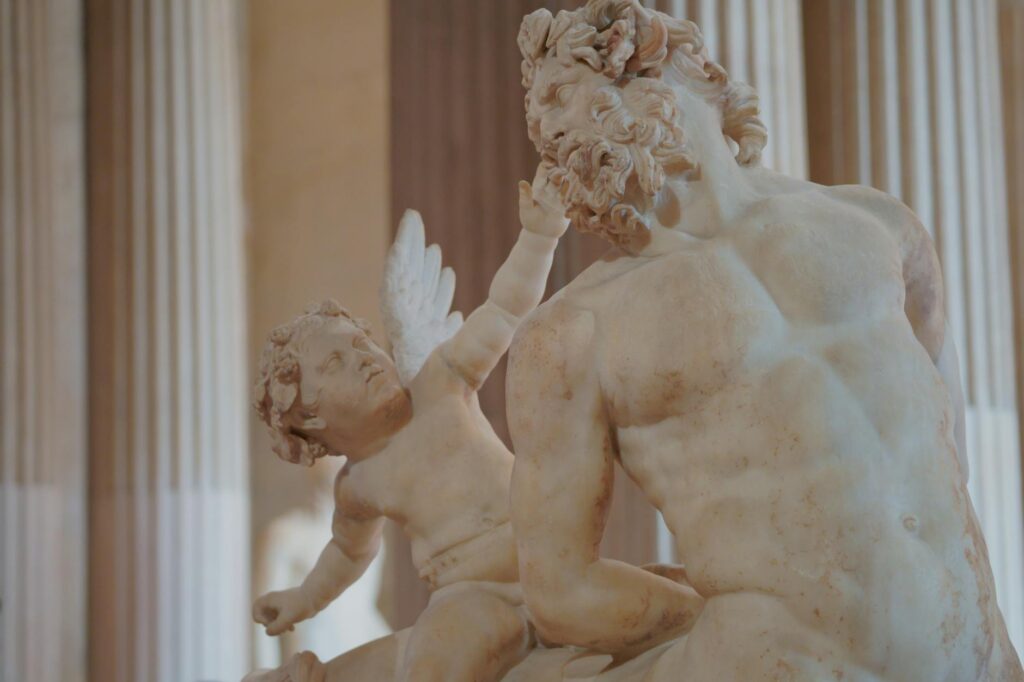
This Hindu preoccupation with inner processes would have been puzzling for the Greeks for whom the aesthetic journey began with the love of the beauty of the body, ascended to love of the beauties of the soul, and thence to the love of the beauty of the laws and institutions of the polis, culminating in a love for the beauty of every kind of knowledge which included a love for Philosophy. The experiences of the senses were, of course of singular importance for Greek artists, as is evidenced by their construction of beautiful temples and sculptures of Appollonian nudes. Campbell points to Hesiod’s Theogony in defence of his claim that Eros is the god of Love, and a member of the four original deities; the other three being Chaos, Gaea (mother earth) and Tartarus (the pit of hades). Hesiod clearly attributes the characteristic of immortality to Eros but also, paradoxically, a power that can overcome the rational powes of intelligence and planning. Campbell acknowledges that Eros does not appear in the writings of Homer because he belongs t the older pantheon of Greek deities. According to Hesiod, Eros is the son of Aphrodite but there are a number of different accounts of his parentage, including the anthromorphic account from the Symposium which claims that he was conceived at a drinking party by a father called Resourcefulness and a Mother called Poverty.
Campbell also claims that Greek Mythology distinguishes itself by a shift on the value-scale from the impersonal to the personal—the norms of the individual, he claims, were conceived to be more important than the norms of the group (Page 136). This claim, however, may ignore the extent to which the norms of the group were consciously and intentionally formed by the process of sublimating without repressing the norms of the individual. The common element of the norms of the individual and the norms of the group is arché, (principle), e.g. the freedom to live as one wishes on the condition that there is respect for others and ends-in-themselves. This would be part of essence of areté and diké, so important to Greek life.
Eros, if not a God, must, then, on the Philosophers view be some sort of principle that in the best case cooperates actively with the rational powers of human psuché, but it is the human pantheon of human rational powers that best assists in the building of the character of the individual in accordance with the universal criteria for “The Good.” Whether it is useful to characterise these matters as a move on the value scale from group norms to individual norms, is, of course, questionable.