Views: 80
“The Truth will set you free” are familiar words from the New Testament Bible (John 8:32) and they ought to be interpreted in the light of both what Christianity is, in its essence, namely a spiritual faith based movement and also in terms of what it did for the people who felt like slaves under the laws of their societies. So Truth and Faith can perhaps find each other in the spiritual rather than the academic domains, in the name of freedom.
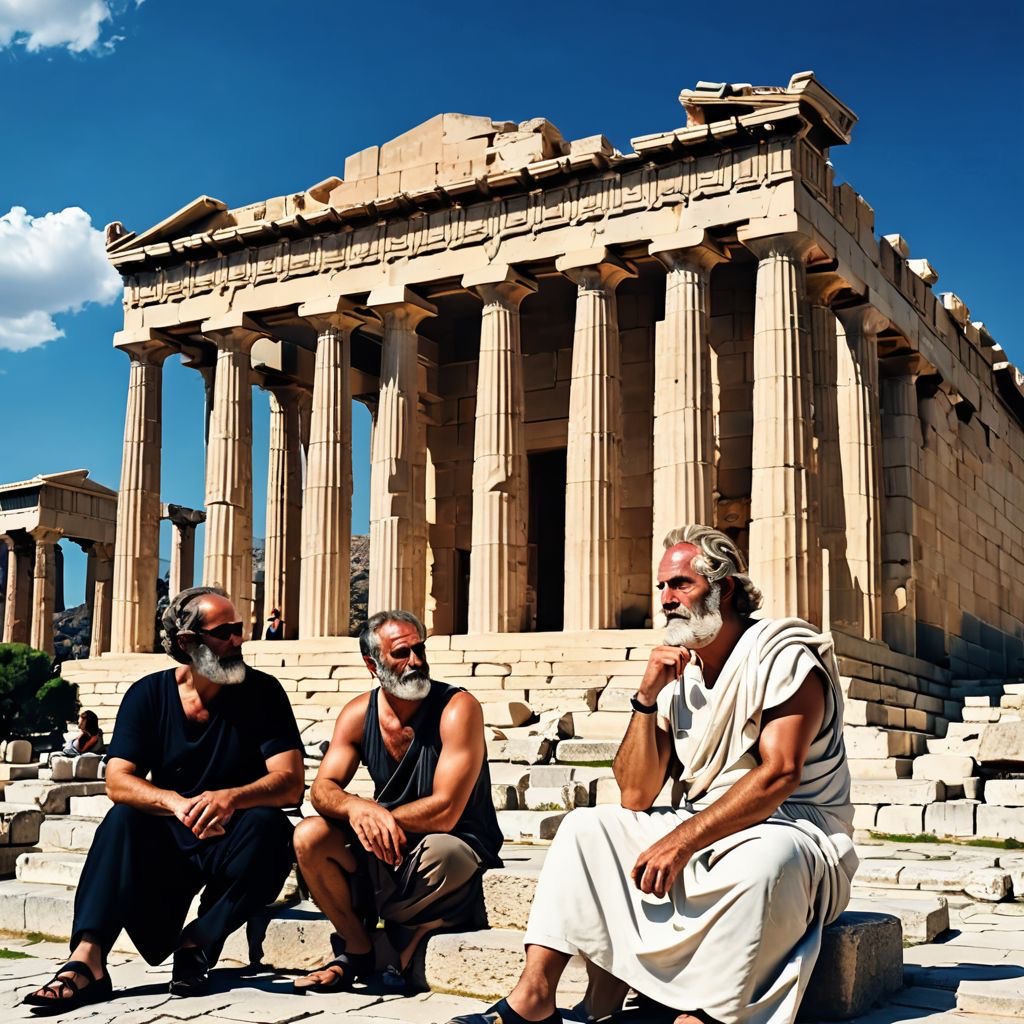
Campbell, in a section entitled “The Age of the Great Beliefs” begins by examining the relations of the Levant and Europe, claiming,that “The Pantheon is the earliest of all Mosques”, a paradoxical claim that is not fully defended. The Greek Temple with its columns(inside and out) had no interior, whereas, Campbell argues, the Mosque appeared to be all interior, thus, on certain views, modelling the mind. Campbell also points out that :
“for Classical man the Temple of the Body”, too, had no interior”.(Page 397)
As if the organs of our body, including the brain, were not inside our Temple. He continues:
“The cognate views of the individual in this world is not that of an individual at all but of an organ or part of the great organism:—as in Paul or Augustine’s view of the Living Body of Christ.”(Page 398)
Aristotles view of parts and wholes requires that parts must in a sense be partially defined in terms of the characteristics of the whole they constitute, if we are dealing with living organisms such as human psuché. Aristotles view of psuché, therefore is that of a constellation of specific organs including that of the brain:—a constellation that allows Aristotle to define the essence of man in terms of the essence-specifying definition of “rational animal capable of discourse”. Aristotles definition assumes that what man does, is much more important to his Existence and Being, than what happens to him, because he is capable of knowledge informed choices that assume a will striving for the Good.
The relation of Aristotle to Levantine Culture is well documented and begins with al-Kindi in the ninth century, continues with al-Farabi, Avicenna, and Averoes. Avicenna in particular eleborated upon Aristotle in ways that were not completely in accord with the central tenets of hylomorphic theory. It was, however, clear from these Arabic translations and commentaries that Aristotle appeared more concerned with Logos in the sense of Logic, than Logos in the Christian sense of the Word of God. Averoes was perhaps the commentator that best represented the spirit of Aristotelian Philosophy , but what he claimed in relation to the soul or psuché did not appear to be Aristotelian.
Encyclopedia Britiannica on-line, reports that Jewish Aristotelianism developed through the medium of the Arabic language and spread to the regions of North Africa, Mesopotamia and Spain. All translations of this period, whether Latin or Arabic did not meet the high standards of current linguistic scholarship, which really began to emerge with the work of Robert Grosseteste. Adequate tanslations of the most influential works were, of course, of vital importance, once the first universities were established, partly because they could form an important platform for the communication of Aristotelian ideas to a broader audience.
The University system, however, as both Kant and Spengler have observed, followed a principle of specialisation which did not appreciate the universal intentions of Aristotelian Practical Science. Studying Aristotle at University, however, must have left no doubt in the students minds in relation to the problematic doctrines pertaining to “revelation-through-miraculous happenings”. Yet, there were countercurrents carrying us in the opposite direction, when the metaphysical writings of Aristote were characterised as “dangerous” in spite of the fact that in Aristotle,there was no anthropomorphised alternative figure, competing for the term “God”, merely an abstract theoretical entity he called “pure Form which had the power of thinking about thinking. Form is an Aristotelian term for “principle” and his work on Metaphysics is only about the search for “first principles”, a search which was deemed sufficiently “dangerous” to result in a Papal Bull being issued at Paris University in 1210: lectures were banned and Aristotles texts were burned.
Aquinas, however, was more sympathetic to Aristotle and stayed within the orbit of Aristotles ideas in most of his commentaries, but when it came to the soul of human psuché, Aquinas could do no other than follow the dogma of the church and insist upon the separation of the body and the soul: a position Aristotle would have objected to. Condemnations of heresy in 1270 and 1277 did not specifically cite Aristotle, but his views on Psuché or the soul were anathema to many Christian scholars. The organisation of the teaching faculties contributed to the tension over Aristotles ideas because certain faculties defined “Truth” in terms of “revelation” rather than in terms of the more rigorous Aristotelian logos based- account.
Aristotelian Hylomorphism, and his Philosophical Psychology, thanks largely to the Universities and their faculties of the Arts, survived until the Renaissance and thereafter emerged as authoritative in various contexts in the succeeding centuries: for example, via the works of William Harvey, Francis Bacon, and Charles Darwin.
During the 20th century a small group of university based scholars existed which could be regarded as Aristotelians and Kantians. During this period the Philosophy of Wittgenstein, especially the later retreat from logical atomism, to the more social view of language based on instinct, and embedded in the hurly burly forms of social life, was an important influence in neutralising both materialistic and dualistic accounts that were circulating in the name of empiricism and Cartesian rationalism.
Ancient Greek democratic ideas and governmental infrastructure, which included an independent legal apparatus that focussed on the unity of the citizens of the polis in a spirit of diké and areté, continued to play important roles in the progress of civilisations in Western and Northern Europe. Freedom or “Eleftheria” had, since the Kantian Enlightenment, become more and more important as time went by. Campbell quotes Spenglers view that there were also difficulties with the correct interpretation of the significance of the Magian Culture:
“The Magian Culture geographically and historically is the midmost of the group of higher Cultures:—the only one which, in point both of space and time, was in touch with practically all the others. The structure of its history as a whole in our world-picture depends, therefore, entirely on our recognising the true inner form which the outer molds distorted. Unhappily that is just what we do not yet know, thanks to theological and philological prepossessions, and even more to modern tendency of overspecialisation which has unreasonably subdivided Western Research into a number of spearate branches:–each distinguished from the others not merely by its materials and its methods, but by its very way of thinking:–and so prevented the big problem from being seen. In this instance the consequences of specialisations have been greater perhaps than in any other. The historians proper stayed within the domain of classical philology and made the Classical Language frontier their eastern horizon, hence they entirely failed to perceive the deep unity of development on both sides of their frontier, which spiritually had no existence. The result is a perspective of “Ancient”, “Medieval”and “Modern” history, ordered and defined by the use of the Greek and Latin languages. The Persian world fell to the student of Iranian philology….and so disappeared absolutely from the field of vision of Chistian Theology.” (Pages 399-400)
Spengler does not mention in this context the “Ancient Greek Philosophers” and the “Philosophical and Cultural Revolution” that found voice in the historical figures of Socrates, Plato, Aristotle etc. The issues of knowledge (epistemé) justice (diké) and freedom (eleftheria) were certainy neutralised in the process of “cultural overlay” that occurred with the Romans and their engineering/military language which translated many Greek terms such as aletheia(truth), psuché (soul/life) and edudaimonia (good spirited flourishing life) problematically.
What had been established via the work of the above three Great “Ancients” was an “academic psychical distance” to the object of study that has been the hallmark of University study ever since. One of the consequences of the collapse of this “objectivity” was to compromise the very idea of objectivity itself via a bipolar view of the terms “subjective-objective”, reducing the former to a psychological state of mind and the latter to the sensory apprehension and manipulation of material objects. Not even the Philosophy of Kant would be able to mitigate the effects of “subjectivising” many important regions of knowledge.
Heidegger, in his writings, pointed to this phenomenon, claiming that Western Culture had been “weakened” by what he called a “forgetfullness of being”, which he mistakenly attributed partly to Aristotle. The Romanisation of Greek Culture and the Latinisation of the Greek Language strengthened processes of “overspecialisation”, resulting in the Empiricism of Hobbes, Hume etc, and the dualism of Descartes that paradoxically rested on the material substrate of the brain. Kant stemmed the tide somewhat, but the faculty specialisation of Universities, quickly neutralised via Hegel, his Enlightenment attempt to restore the Philosophical heritage of Ancient Greece.
The Aristotelian formula for a unified and prosperous polis which referred to a large middle class formed by, and following, the principle of the golden mean, also demands a Greek-style governmental infrastructure This infrastructure fell apart perhaps during the reign of Alexander the Great, but definitely afterwards as Zoroastrianism and Christianity vied for cultural supremacy. Campbell cites the work of Professor R C Zaehner (“The Dawn and Twiight of Zorastrianism”) In which it is claimed that other cults were not given sufficient freedom to express themselves owing to a sociological principle which:
“only grows in force and terror as the violated coerced factions become increasingly intractable through the operation of a second law, namely that gods become demons;which is to say, that psychological and sociological factors neither assimilated nor recognised by the consciously controlled system become autonomous and must ultimately break the system apart.” Page 405
This is the bipolar phenomenon referred to earlier which tore the polis asunder. Without the democratic and Philosophical infrastructure of the Greeks, no sociological principle or law could prevent the polis splitting into fragments. This might even have been true of Alexander the Great’s Empire.
Campbell, in his sub-chapter, “Byzantium”, illustrates well the cultural similarities and differences between Ancient Greece and the Levant during the period up to the 6th century AD, when he notes that the Roman Emperor Justinian (who closed all the Philosophical Schools and Academies) was experiencing the same kind of problems which threatened the existence of the Sassanian Empire of Chosroes I (531-579). Both rulers believed in the sociological principle of Absolute Rule, rather than the Aristotelian Principle of the Golden Mean.
Campbell alsonotes that the key mythological/religious questions of the two Cultures differed significantly with Zoroastrianisms concern focussing on the relation between darkness and light and the problem of evil, whilst the concern of Christianity focussed upon the relatively abstract problem of the nature of Jesus’ Incarnation. It is certainly no exaggeration to claim that this question of Incarnation split the Church. This recalls another academic question, namely, whether the Kingdom of God was coming in the future, or whether the Kingdom existed as the Gnostics claimed, right here and now and within us..
For Aristotle Noos was the home of Logos which the Christians identified with the Word of God. If, then, the Kingdom of God was within, as many Christian determinists doubted, given the doctrine of the freedom of the will, there followed the problem of the possibility of refusing to heed the word of God. Both Aristotle and Kant believed that the freedom of the Will was the real determiner of ones life,and if this was the case, then knowledge (epistemé) of the future Kingdom to come would be relevant in this context only if, as Aristotle claims, the will aims at the Good in all human activity: a thesis that of course runs contrary to the doctrine of Original Sin. Both Aristotle and Kant, claimed that the good will was the fundamental condition of all ethical action that is in accordance with the categorical imperative which amongst other things demands that we treat each other as end-in-themselves.
Moving forward in History it was this categorical imperative that became one of the foundation stones of Human Rights, which became the focus of the United Nations, the institution Kant suggested at the end of the 1700’s. We can see, then, a line of continuity running from Ancient Greece, to the Renaissance, to the Enlightenment, to the formation of the United Nations. The concern for our individual spiritual development that we find in Mythology and Religion then, appears to be less relevant in the above secular context where the burning question seems rather to be, how to avoid repressing the desires and activities of those that wish to concern themselves with their spiritual lives. We seem to have inherited the Socratic approach to The Good in the soul, searching for it instead in the soul writ large, namely the polis.
Mary, the mother of Jesus was also drawn into the clerical dispute over the issue of incarnation: a dispute that Campbell notes spanned over 4 phases lasting hundreds of years. This timeline takes us to the rise of Islam which Campbell claims is a continuation of Zorastrianism, Judaism, and Christianity, mythologially speaking. Abraham, it is noted, was the common ancestor of both Judaism and Islam. Islam was a religion of both revelation and revolution. Mohammed was an illiterate prophet that claimed to have visions whilst meditating in a cave. In one revelation Mohammed is informed that it was the Lord who taught man to use the pen. Apparently Mohammed was pondering the mortality of man when a vision intruded, described by Campbell as follows:
“Its author was God, its subject man, Gods creature; and its instrument, the pen, the sanctified Book, which men were to read, study, recite and treasure in their souls.” Page 424)
This is a curious vision for a man who, tradition has it, could not read, but was nevertheless proclaimed by family and friends to be a chosen apostle. Very soon afterward Mohammed was calling upon priests in Mecca to eliminate all pagan images from places of worship such as the Kaaba. Both Allah and Yahweh were Gods of semitic desert communities. One crucial difference, as Campbell points out is that whilst Yahweh was a specifically ethnic divinity, Allah was proclaimed with universalistic intentions, turning to all Humanity with his messages. For, as Campbell claims,
“in Mohammeds day the Alexandrian vision of humanity had reached even the peoples of the desert.” (Page 433)
There was, as Campbell points out, however, a problem with the laws proposed by Mohammed. These so-called divinely inspired laws did not grow naturally out of a particular society at a particular period in time, but rather had its source in revelations and visions occurring to Mohammed in a trance-like state. Universalising these visions to include commuities living in deserts, in the mountains, coastal communities, and communities in the rest of the world, some perhaps with long common-law traditions, was always likely to meet with insurmountable difficulties. Communities with a long tradition of common law focussed upon a universal idea of justice that was founded on the free will, a critical spirit, and people getting what they deserved. The first and second of these factors of course, were not reflected in the revelations and visions of the prophet. The critical spirit in particular was accustomed to evaluating divinities in terms of philosophical partly secular criteria such as the Principle of the Golden Mean exercised in the spirit of psuché and eudaimonia (the good spirited flourishng life). Given the typical attitude of critical minds to phenomena such as revelations and visions, it is not surprising that Islam was not successful in recruiting such communities to their cause. Also, given the Islamic conviction that once instituted laws were immutable, this added another dimension of difficulty to the mission of broadening the horizons of the Islamic Religion.Campbell quotes Spengler on this issue:
“Whereas the Classical law was made by burghers on the basis of practical experience, the Arabian came from God, who manifested it through the intellect of chosen and enlightened men….the authoritativeness of Classical laws rests upon their success, that of the Arabian on the majesty of the name they bear.” (Page 435)
There is of course a difference between commuities with traditions of common law based on the precedents of individual judges in a well educated core of judges, and laws passed by rulers who may or may not have had the appropriate education and may or may not have the ability to recruit those who have had the appropriate experience and education. Recall also that Mohammad could not read and therefore was probably not familiar with the History of the World that was available to scholars at the time. The History of Philosophy and Science may also have been provincial given that Mohammed relied on an oral tradition of communication of ideas. Just these facts may also have limited both the content and form of the “visions” he experienced.
Spenglers “burghers” were not of course an infallible standard by which to measure the efficacy and virtue of laws but, depending upon the inherited humanistic/democratic infrastructure, these burghers may be a far more reliable source of justice and the good life, then the visions of an illiterate man meditating in a cave. These burghers were, given their obvious relation to Ancient Greek conceptions, also a more reliable source of justice and eudaimonia then many literate Christian scholars.