
Views: 23
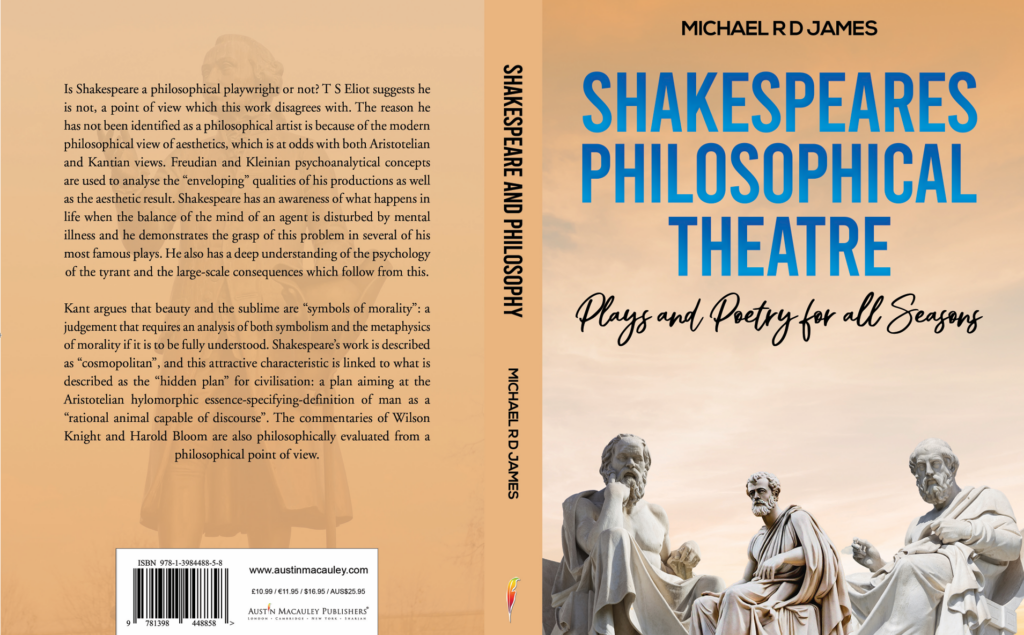
Here is a detailed review of Michael R D James‘s book Shakespeare’s Philosophical Theatre, based on the introduction to his work Philosophy and Shakespeare: Transcendental Spectacles for all Seasons in the Cosmopolitan Theatre of Life:
Review of Shakespeare’s Philosophical Theatre by Michael R D James
Context and Thematic Foundation
Michael R D James situates Shakespeare not merely as a playwright but as a profound philosophical creator who shaped an entire “season” or world of thought during the Renaissance—a period marked by the resurgence of Ancient Greek spirit and metaphysical inquiry. The introduction draws parallels between the seasons of Ancient Greek philosophy, Shakespearean theatre, Kantian Enlightenment, and the Freudian era’s moral treatment of patients, emphasizing how each period reflects a unique metaphysical and cultural awakening.
James highlights Shakespeare as a figure akin to Socrates, Plato, Aristotle, Kant, Wittgenstein, Arendt, and Freud—individuals who created worlds of thought that deeply influenced humanity’s understanding of life, metaphysics, and the human condition.
Philosophical and Historical Setting
The book underscores the historical backdrop of Shakespeare’s life, particularly the recurring plagues that ravaged Stratford and Europe, which infused his work with a palpable awareness of mortality and the fragility of human existence. This context of uncertainty and supernatural explanations for disease and misfortune parallels the Ancient Greek awareness of Thanatos—the inevitability of death and destruction.
James suggests that attending a Shakespeare play in this era was akin to experiencing the awe and wonder of ancient Greek spectacles, where the audience was invited to reflect on profound metaphysical truths and the “Form of the Good” through theatrical experience.
Artistic and Psychoanalytic Dimensions
Drawing on Adrian Stokes’s concept of the “oceanic feeling,” James explores how Shakespeare’s poetry and theatrical technique create an immersive, hypnotic experience for the audience. This “incantatory element” of Shakespeare’s work, combining metric, symbolism, and vivid imagery, serves not only aesthetic purposes but also a pedagogical function—engaging the audience in a transcendental spectacle that teaches about life, morality, and human nature.
James connects this to Freud’s psychoanalytic insights, particularly the infantile and fantasy-driven nature of the oceanic feeling, suggesting that Shakespeare’s theatre allowed audiences to temporarily escape the harsh realities of disease and violence by living vicariously through the characters.
Philosophical Questions and Poetic Responses
The book frames Shakespeare’s plays as poetic answers to Kantian philosophical questions:
- What is man?
- What can we know?
- What ought we to do?
- What can we hope for?
James emphasizes that Shakespeare’s responses are not systematic philosophy but poetic and theatrical explorations. For example, the famous “All the world’s a stage” monologue from As You Like It poetically encapsulates the human life cycle and the roles people play, resonating with later psychoanalytic theories of personality development.
Metaphysical and Linguistic Insights
James draws on Ludwig Wittgenstein’s philosophy of language, particularly the idea that language can “show” what cannot be explicitly said, to explain how Shakespeare’s poetic language reveals transcendental truths. This aligns with the Greek concept of Aletheia (unconcealment or truth) and Paul Ricoeur’s analysis of symbolism in sacred texts, highlighting the symbolic and logical form of Shakespeare’s poetic language.
The book also discusses the Renaissance as a period of freedom and protest against medieval dogma, with Shakespeare’s theatre embodying this spirit of intellectual and cultural rebirth.
Conclusion
Shakespeare’s Philosophical Theatre by Michael R D James offers a rich, interdisciplinary exploration of Shakespeare’s work as a metaphysical and philosophical spectacle. It situates Shakespeare within a grand historical and intellectual tradition, linking his theatre to ancient Greek philosophy, Kantian questions, psychoanalysis, and linguistic philosophy. The book reveals Shakespeare as a creator of a cosmopolitan theatre of life, where art, philosophy, and human experience converge in a profound and transformative way.
This work is especially valuable for readers interested in the intersections of literature, philosophy, psychoanalysis, and history, providing deep insights into how Shakespeare’s plays function as timeless philosophical inquiries and transcendental spectacles.