Philosophy, Politics, Education, Ethics, Psychology, Religion, Psychoanalysis, Aesthetics, Humanism, The Arts, Ancient Greek Philosophy, Enlightenment Philosophy. A site dedicated to the humanistic art of lecturing and the synthesis of Aristotelian, Kantian, and Wittgensteinian Philosophy: The Pre-Socratics, Socrates, Plato, The scholastics, Descartes, Spinoza, Hobbes, Hume, Heidegger, Freud, Arendt, Sartre, Merleau-Ponty, Ricoeur, Jaynes, Cavell, O Shaughnessy, Shields, Lear, S. Gardner, Korsgaard, P.M.S. Hacker, G.E.M. Anscombe
Objects exist and we can sense them, think about them, and the relation between them, and reason about them. The relation, however, between an objects existence and the activities of sensing them, thinking about them and reasoning about them, is a complex one that Kant believes neither common sense nor the rationalism and empiricism of his day can fathom. The ancient Greeks did not speak about reality in these terms. It has been noted, too, that the Latinisation of Greek Culture and Greek Philosophy transformed the term “hypokeimonon” into subjektum. This together with the translation of “ousia (primary being) into substantia set the stage for an epistemological interpretation of the being that underlies all appearance and all knowledge of it. Kant’s Copernican Revolution is an attempt to restore our relation to Being and give an account of that which remains the same throughout change: the enduring subject. This account takes the form of a metaphysical/transcendental inquiry in which the existence of reality is neither assumed by the subject nor constituted by the subject characterised by Kant in terms of the faculties of sensibility, understanding and reason. This is clearly neither a realist nor an idealist position and perhaps is best construed as an elaboration upon Aristotelian hylomorphism.
The First Critique is a paradoxical work in that it provides us with a very technical abstract account of experience (concepts and intuitions), but it nevertheless is very concerned to limit metaphysical speculation by principles of experience. Kant criticises all principles that transcend any possible experience, especially principles purporting to be rational. Experience is, of course, broadly defined, and includes not just what happens to us but also what we do, e.g. thinking. Insofar as we are dealing with the latter notion of experience, Kant focuses upon my understanding of reality in terms of the “I think”. In the course of the examination of the first person case of thinking the focus is upon not my sensory encounters with reality but rather my understanding of what is encountered–an understanding that is concerned with objects that:
“render intelligible the objective validity of its a priori concepts”(Immanuel Kant’s Critique of Pure Reason, Trans, Kemp Smith, N., London, Macmillan, 1929, P.12)
In this form of examination there is also a rejection of reference to examples which appeal to the faculty of Sensibility and a verdict in favour of conceptual clarity and distinctness. Concepts are a form of general principle and determine, therefore, the way in which an object is thought about. Logic is an important tool in Kant’s investigation and is applicable in both theoretical and practical forms of reasoning. The telos of these forms of reasoning is either epistemé (knowledge) or making something ( the object of the thought) actual. Galileo, Torricelli and Stahl are cited as examples of scientists who refused to be led by natures leading strings, and instead forced nature to answer questions formulated in a tribunal of reason. The tools of judges in such a tribunal are both logical reasoning and the experiment. The procedure of the tribunal ought to provide a guideline for metaphysical reflection (The Queen of the Sciences):
“Hitherto it has been assumed that all our knowledge must conform to objects. But all attempts to extend our knowledge of objects by establishing something in regard to them a priori, by means of concepts have, on this assumption ended in failure. We must therefore make trial whether we may not have more success in the tasks of metaphysics, if we suppose that objects must conform to our knowledge.”(P.22)
This is the famous “Copernican Revolution” initiated by Kant, and the difference between his Critical Philosophy and Aristotle’s hylomorphic Philosophy may be seen in Kant’s focus upon the idea of an object. This focus was a reflection of the epistemological discussions of his era– a discussion which , prior to Kant, disregarded the earlier integration of epistemological and metaphysical issues we encounter in Aristotle. Kant’s “destruction” of the metaphysical projects of his times aimed at a better integration of these two perspectives. Kant’s “revolution” also required a division of the mind into the faculties of Sensibility, Understanding, and Reason, and this in turn also encouraged a focus upon objects and what we can know of them via observation and experiment as well as what we can know of them via a priori knowledge. Objects. concepts, and principles are a reflection, then, of the activity of the above faculties but the focus upon the object is also an important consequence of Kant’s emphasis upon the importance of the principles of experience in his Philosophy. A priori knowledge was another important emphasis and also necessary to give an exhaustive account of scientific activity and theory in terms of the principle of sufficient reason. Kant criticises the metaphysical tendency to abandon all contact with experience and insists upon the role of the understanding and transcendental structures of the mind in determining what is possible, actual and necessary in experience. Critical thinking, then uses the principles of noncontradiction in the following manner:
“For what necessarily forces us to transcend the limits of experience and of all appearances is the unconditioned which reason by necessity and by right demands in things as required to complete the series of conditions. If, then, on the supposition that our empirical knowledge conforms to objects as things in themselves, we find that the unconditioned cannot be thought without contradiction and that when, on the other hand, we suppose that our representations of things as they are given to us, does not conform to these things as they are in themselves, but that these objects as appearances, conform to our mode of representation, the contradiction vanishes…..(P.22)
This mode of representation can be intuitive or conceptual dependent upon the faculty of mind involved and dependent upon the nature of the experience. The above makes it clear why sensibility or intuition as such is not co-extensive with what is real (in-itself). Kant will later claim that sensibility plays an important role in what we regard as “empirically real”. Kant further insists that things-in-themselves, as a consequence, cannot be known but that we can, however, think about them and reflect upon them.
The discussion of Practical Reasoning also confirms the above conclusion of theoretical thinking but its focus is upon action and the will that motivates it:
“there is no contradiction in supposing that one and the same will is, in the appearance, that is, in its visible acts, necessarily subject to the law of nature, and so far not free, while yet as belonging to a thing-in-itself, it is not subject to that law, and is therefore free.”(P.28)
So, we cannot know that we are free but are able to think this idea of practical reason, and it is critical for Kant’s ethical theory that this be so, because otherwise there would be no metaphysics of morals: merely a theory representing the determining causes of action. We must, Kant insists, ask not for the law-like causes of action, but rather for the reasons for action. Kant’s theory has distinct advantages over analytical theories which flatly reject the Aristotelian postulate that all human activities aim at the good, and probably also the Aristotelian claim that we praise people for the good that they do and blame them for the harm they cause by not doing what they ought to do. Unless, as Kant claims, freedom of choice trumped being caused to do these same things, praise and blame would be meaningless. There would be no general attitude in which people expected other people to do what they ought to do. On analytical views where the world is defined as the totality of facts, everything that is done is merely a fact, and there would be little point in praising anyone for anything–we do not praise reality for being what it is and not something else. Perhaps our regret or joy would then focus on the cause or causal chain that brought the event of the action about (and the associated “sensations”). For many analytical philosophers, the cause and the effect are neither logically nor conceptually connected and this leaves us in contexts of explanation with the refuge of many empiricists, the so-called “law of association”. Many attempts to construct psychological theories from such unlikely elements have been attempted, including the theory of the pragmatist, (and enemy of metaphysics), William James. Paradoxically, however, James’ definition of Psychology might have been found acceptable by the targets of his attacks (e.g. Aristotle and Kant):
“The Science of Mental Life, both its phenomena and conditions.”(Principles of Psychology, James, W, New York, Dover Publications, 1890, P.1)
James’ pragmatism is, however, grounded in materialism as is evident in his interpretation of the conditions of mental life:
“The experiences of the body thus are one of the conditions of the faculty of memory being what it is. And a very small amount of reflection on the facts shows that one part of the body, namely, the brain, is the part whose experiences are directly concerned.”(P.4)
One of the major laws of brain functions is of course the “law of association”. Given James’ admission that the boundary-line of the mental is obscure, and also his claim that:
“a certain amount of brain physiology may be presupposed as included in Psychology”( P.5)
we can but wonder whether the stage is not being prepared for another act in the drama or dance of the materialists and the dualists. James, however, mysteriously defines association in the following way:
“Association, so far as the word stands for an effect between things thought of—it is things, not ideas, which are associated in the mind….And so far as association stands for a cause, it is between processes in the brain–it is these which by being associated in certain ways, determine what successive objects shall be thought.”( P.554)
The only “things” in the brain, however, are neurones, and these are either connected with each other or not in various networks. We should recall that Psychological theory concerns itself with learning and one physiological definition of learning is:
“The facilitation of neuronal pathways such that, as a result, a type of experience is present that was not present before.”
James takes the example of a child reaching for the attractive stimulus of the light of a candle and as a consequence burning his fingers. The motor activity and the consequent sensation of pain (response) are associated in a network that now prevents the completion of the reflexive reaction to the light. A question that might arise here, given James’ earlier reflection is: “Is pain a thing?” It surely is an experience, but it is an experience that is undergone and the question then becomes whether the reflex operation of reaching for the candle is an experience? John Dewey in his work “Art as Experience”(Dewey, J., New York, Capricorn Books, 1958) defined experience both in terms of what is undergone, and in terms of what is done. The OED in its turn, defines experience as “practical contact with facts and events”, and this suggests that both sensory and motor events can be elements of experience. Yet in terms of the above quote by James, we still remain sceptical about the claim that a pain can be a thing. It certainly can be a fact, but it is not a fact that I observe in the normal case of my experience of pain. I can observe “things” and order them in causal networks. The act of reaching, and the feeling of pain, however, are not “things”, but the one event certainly causes the other, and the child would not have been transformed by the experience unless the events occurred in the context of a principle that prevented the effect of pain upon the next encounter with the exciting stimulus. Surely, one can insist, it is this kind of principle that we ought to be reflecting upon in a work entitled “Principles of Psychology”.
For Kant, pain is certainly something that we undergo and it is part of the activity of the faculty of sensibility which ought to be accounted for under the heading of “Physical Anthropology”. It is, however, “Pragmatic Anthropology”, Kant insists, that concerns itself with what we do and the principles behind what we do. In Kant’s view the ontological distinction between what we do and what we undergo is a key distinction that ought to be observed, and these ought also to be the concern of different disciplines. In Modern Philosophical Psychology, as we have seen, in our previous reflections on the History of Psychology, the sensation emerged as the postulated fundamental element of psychic life and consciousness. We argued that this was probably the result of materialist tendencies wishing to “atomise” and wishing to reduce the psychic whole to more comprehensible elements.
Merleau-Ponty, (MP) in a work entitled “Phenomenology of Perception.”(Trans Smith, C., London, Routledge, 1962) comments on the tendency to focus upon sensation:
“if we try to seize sensation within the perspective of the bodily phenomena which pave the way to it, we find not a psychic individual, a function of certain known variables, but a formation already bound up with a larger whole, already endowed with a meaning distinguishable only in degree from the more complex perceptions.”(P.10)
The brain, MP argues, is not a collection of contents (“things”) or facts, Rather its structures are ordered in terms of psychological functions or principles. The system of sensations of colour, for example, belong to a more comprehensive life-structure such that:
“The destruction of sight, whatever the injuries be sustained, follows the same law: all colours are affected in the first pace, and lose their saturation. Then the spectrum is simplified being reduced to four and soon to two colours: finally a monochrome grey stage is reached, although the pathological colour is never identifiable with any normal one.Thus in central as in peripheral lesions the loss of nervous substance results not merely in a deficiency of certain qualities but in the change to a less differentiated and more primitive structure. Conversely, normal functioning must be understood as a process of integration in which the text of the external world is not so much copied as composed”(P.10)
MP goes on to claim that physiological events obey biological and psychological laws. He does not however name these laws in the way Freud does. Freud regards the state of homeostasis the brain strives for, a result of the operation of the Energy Regulation Principle(ERP). This is the most primitive brain function for Freud. The next level up in the hierarchy concerns the psychological functioning of the entire organism and this occurs under the auspices of the Pleasure-pain Principle(PPP). It is at this level that the faculty of sensibility becomes the focus of attention for the Psychologist. Finally we arrive at the Reality Principle(RP) which governs the most complex aspects of mental functioning for human forms of life. This is the Kantian realm of the understanding/reason which for Freud is the field of operation for the agencies of the ego and superego. James does not directly appeal to any of these principles or laws but rather to the law of association between things, and the causal relations between them, thus succumbing to the reductionist strategies of the materialistically minded empiricists that MP, Freud, Kant and Wittgenstein rejected so convincingly. James does, however mitigate his empiricism with an interesting definition of the Mental:
“The pursuance of future ends and the choice of the means for their attainment are thus the mark and criterion of the presence of mentality in a phenomenon.”(P.8)
Here James is concerning himself not with the conditions, but with the phenomena to be studied and it is in this arena that he is at his best. In the above quote there is allusion to the Greek idea of telos, and by implication, an appeal to areté, since he goes on to evoke the idea of “intelligence” to explain what is meant by the above definition. This, however, if anything, is a narrowing (from a Kantian point of view) of what initially looked like a practical concern, to a theoretical concern, and it might be related to the earlier discussion of the laws of association in which “ideas” were replaced by “objects”. Of course there is no conceivable representation of an “association-relation” between ideas unless one “mechanises” what is essentially a logical or thought-relation. Perhaps such a concentration upon the condition of the possibility of experiencing an object is useful in the scientific process of exploration/discovery, but given the hypothetical nature of such activity, it would be problematic to characterise what is going on here as determined by a law or a principle. Such activity might assist us in the discovery of a law or principle but cannot itself be characterised as such. Moreover the unity of the “I think” we find in Kantian Critical Philosophy is missing from the account James provides us with. James, for example, claims that there is no unity of the self because we are constituted of a number of different selves and different kinds of self. This is empiricism at its most extreme. Once the unity of something that remains the same throughout myriad changes is compromised, the chances of producing a unified theory of Psychological Principles is diminished significantly. The pluralistic pragmatism James espouses is anti-metaphysical, and this is one explanation behind the move to give concrete and materialistic accounts of the conditions of phenomena. James’ discussion of the phenomenon of the “spiritual” self becomes puzzling and appears dualistic. We should recall that when the dualist Descartes was forced to answer mind-body relation questions he retreated to the materialist explanation of “brain activity”.
The Kantian metaphysical/transcendental investigation into the conditions of experience rests upon a priori knowledge in the form of intuitive representations (space and time) and the form of of the categorical framework of conceptualisation. James was familiar with this account and rejected it, but his grounds for doing so were unclear. In his work on Pragmatism we encounter an objection to metaphysics that, on inspection, turns out to be not a criticism of the Kantian account, but rather a criticism relating to a conceptual dispute over whether to say someone is circumambulating a squirrel when the squirrel is adjusting its position out of sight as we are circumambulating the tree in order to catch sight of it. This does not resemble the metaphysical disputes we usually encounter in criticisms of the major metaphysical systems of Aristotle and Kant. In his work on Pragmatism there is a reference to G K Chesterton, and James praises him for his claim that the most important thing about a man is his view of the universe. It is a pity that James did not pay attention to Chesterton’s fence-principle, which urges those who wish to tear down a fence to first ask themselves why the fence was built where it stands. James, however, is not alone in systematically ignoring metaphysical and transcendental logic in his Psychological and Philosophical investigations. Indeed it is almost a defining feature of our modern era that thinkers embrace some form of this anti-metaphysical attitude. Phenomenological thinkers, e.g. Husserl, believed, that one should abstract from the categories of the understanding and the principles of reason in order to “represent things as they are in themselves.” Many modern thinkers, would also object to the claim in Kant’s Critique of Pure Reason, that:
“We are in possession of certain modes of a priori knowledge, and even the common understanding is never without them.”(P.43)
The notion of cause, is an example of a priori knowledge that we impose upon representations as a category when we conceptualise experience. This category also contains, Kant argues, a relation to the modality of the necessary: a relationship Hume (the believer in the law of association) denied. Hume claimed, that we become acquainted with the idea of cause through the repeated association of causes and effects. Kant rejects this on the grounds that the mechanism of association could never produce the modality of necessity that is attached to causal judgements. Such judgements, Kant argues, cannot be negated without violation of the principle of noncontradiction and these judgements are further characterised by Kant as synthetic a priori judgements which he claims forms the nucleus of metaphysical investigations:
“Metaphysics, even if we look upon it as having hitherto failed in all its endeavours, is yet, owing to the nature of human reason, a quite indispensable science, and ought to contain a priori synthetic knowledge. For its business is not merely to analyse concepts which we make for ourselves a priori of things and thereby to clarify them analytically, but to extend our a priori knowledge. And for this purpose we must employ principles which add to the given concept something that was not contained in it… This metaphysics consists at least in intention, entirely of a priori synthetic propositions.”(P.54-5)
Kant then takes up a discussion relating to how such synthetic a priori judgements are possible. He points out that Hume did not realise that the propositions of Mathematics are synthetic a priori (e.g. the shortest distance between two points is a straight line). Had he realised this fact, Kant continues, he might have realised the importance of metaphysics for philosophical investigations. He would, that is, have realised the importance of the faculty of reasoning and its use of the principles of a priori knowledge. Kant also defines the transcendental in terms of reason:
“I entitle transcendental all knowledge which is occupied not so much with objects as with the mode of our knowledge of objects insofar as this mode of knowledge is to be possible a priori.”(P.59)
The principles of noncontradiction and sufficient reason are, then, the substantial core of transcendental knowledge. The role of experience in this context has two aspects and depends upon whether the part of the mind involved in the experience is the faculty of sensibility or the faculty of understanding. If it is the former:
“In whatever manner and by whatever means a mode of knowledge may relate to objects, intuition is that through which it is in immediate relation to them, and to which all thought as a means is directed. But intuition takes place only so far as the object is given to us. This again is only possible to man at least, in so far as the mind is affected in a certain way.”(P.65)
Kant also claims, in hylomorphic spirit, that sensation is the matter, and that which is responsible for ordering all representations into a unity is a “form”(principle). Sensibility, for Kant, has both an inner and an outer aspect. Outer sense enables us to represent objects outside of us in space (a form of outer intuition). Inner sense, on the other hand, is ordered in Time and this is an a priori form(principle) which underlies all kinds of representation. The key Aristotelian notion of change, for Kant, is only possible via the a priori inner intuition of Time.
MP argues that Time is:
“the most general characteristic of psychic facts.”(P.476)
and even though we are aware of the fact that events occur in time, they nevertheless, according to both Kant and MP presuppose Time as a necessary condition of experience. Moreover:
“The events are shapes cut out by a finite observer for the spatio-temporal totality of the objective world.”(P.477)
This also applies to the activity of observation. The Kantian ship, for example, steaming down the river, cannot be divided up into events in proximity to each other. Neither can this experience be reduced to a series of “Nows” juxtaposed and tied together by some form of causality. The subject that “constitutes” time in the Kantian sense does so, MP argues, not by projection of memories into the future but via a network of intentions operating continuously throughout a “lived” process centred in the present. MP characterises the role of Time in experience in terms of the “Logos of the Aesthetic world”(P.498).
Aristotle, on the other hand, defines Time as “the measure of motion in terms of before and after”. The advantage of such a definition is that it places man in an active role as a measurer existing continuously, not in a series of juxtaposed “nows”, but as something that endures through change and moreover measures this change in terms of before and after–making the “now” a nothing–a mere point or boundary between these aspects of change. In terms of Aristotle’s categories, Time is a Quantity that is related to any enduring entity capable of initiating any change witnessed . This entity is also something that itself is capable of changing. As something capable of changing, e.g. acquiring a sun tan, material and efficient causes/explanations will be appropriately appealed to. If we are dealing only with the “logos of the Aesthetic world” as MP maintains and Kant suggests in his claim that no judgements of the understanding are involved in intuitive representations, then Mathematics in its use of number may be a science dedicated to the measurement of the aesthetic world and “counting” may be an activity that primarily involves the faculty of sensibility.
Thought about objects, for Kant, is a function of the faculty of understanding which uses concepts that provide us with a power to know objects. In the context of knowledge both sensibility and understanding are equally important, and the role of reason is that of an organiser of the categories of the understanding/judgement in knowledge systems, e.g. the sciences. Logic is the science that we use to explain/justify our claims at many different levels of thought:
“Logic again, can be treated in a twofold manner either as the logic of the general or as the logic of the special employment of the understanding. The former contains the absolutely necessary rules of thought without which there can be no employment whatever of the understanding. It therefore treats of understanding without any regard to the difference in the objects to which the understanding may be directed. The logic of the special employment of the understanding contains the rules of correct thinking as regards certain kinds of objects.” (P.93)
The general employment of logic uses the principles of noncontradiction and sufficient reason (pure a priori principles). Mathematics and the Natural Sciences are examples of knowledge systems that focus on different objects. Number, for example, focuses upon Time, and its relation to change-in-general, and Natural Science investigates the efficient and material causes of the physical changes we see in the natural world: a world that contains inorganic stars ( df= gravitationally bound balls of hydrogen and helium made self fluorescent by internal nuclear fusion) and organic life forms(psuche). Similarly different kinds of objects will be focussed upon in the practical and productive sciences as defined by Aristotle. Psychology is specifically mentioned by Kant in this discussion:
“General logic is called applied when it is directed to the rules of the employment of the understanding under the subjective empirical conditions dealt with by Psychology.”(P.94)
Psychology as a discipline also makes an appearance in contexts of practical reasoning where we are dealing with both pure and applied ethics. Pure ethics relates to the constitution of the moral law by the principles of noncontradiction and sufficient reason. Applied ethics, on the other hand, is concerned with the limitations placed upon moral action by feelings, inclinations and passions. The activities of praising and blaming moral agents for their possession or lack of possession of the virtues is the empirical aspect of moral understanding. Insofar as rational demonstration or justification of an action is concerned this can only occur in deliberations in which principles relate to the moral law: it cannot occur in relation to the pluralistic sphere of the many and various virtues. In this context Kantian ethical theory is an elaboration upon and improvement of Aristotles pluralistic virtue theory.
The role of transcendental logic in Kant’s Critical Philosophy is partly as a regulator of the categories, and relates to the non empirical a priori origin of knowledge, its scope and validity. Insofar as experiential judgements are concerned, the role of transcendental logic relates to both the categories of the understanding and the principles of reason. In a discussion on the Nature of Truth, Kant adopts a position similar to that of Aristotle when he claims that a general definition of Truth cannot be given because truth claims carry specific reference to specific objects. Kant agrees, however, that we can “nominally” say that Truth is the agreement of knowledge with its object, but given the different realms of knowledge no universal formula is possible, and insofar as we attempt to apply the principle of sufficient reason, this is also limited to specific realms and their differing objects. Logic, insofar as it relates to the categories of the understanding, however, provides us with both universal and necessary rules, and here we use logic in its “special use”: a use which includes an understanding of the a priori elements of Space and Time. Kant calls the abuse of logic its dialectical use and he refers to this as “the logic of illusion”(P.99). The role of the concept in this system is clearly defined:
“concepts rest on functions. By “function” I mean the unity of the act of bringing various representations under one common representation.”(P.105)
Concepts are then used in judgements which have the structure of thinking something about something (a representation of a representation). Concepts are not in immediate relation to objects in the way intuitions are. They are, rather, that which we use to think about intuitive representations and they can also form conceptual and logical relations with each other in accordance with categories and principles. Pure concepts abstract from the content of judgement and form 12 logical kinds in accordance with 4 groups of categories. The most important question to ask in this context is “With what right is the concept used?” In other words, what is the justification for the use of the concept in the judgement. Kant calls this a quaestio juris, and distinguishes this type of question from one in which the answer expected is factual.
Consciousness as a phenomenon does make an appearance in Kant’s first Critique in the context of the deduction of the concepts of understanding:
“Intuitions are nothing to us, and do not in the least concern us if they cannot be taken up into consciousness, in which they may participate either directly or indirectly. In this way alone is any knowledge possible. We are conscious a priori of the complete identity of the self in respect of all representations which can ever belong to our knowledge, as being a necessary condition of the possibility of all representations.”(P.141-2)
This is Kant’s version of the more general Aristotelian principle of change whereby something endures throughout the change: if this change is to be understood and explained. Kant goes on to say that it is appearance of reality combined with this consciousness that produces Perception.(P.143). He further claims in a footnote:
“Psychologists have hitherto failed to realise that imagination is a necessary ingredient of perception itself.”.
It is the imagination that synthesises representations into the form of an image, which is the schema of the concept. In this context Kant speaks of the role of association not as a law but as a power of the faculty of Sensibility. This power rests upon the power of the mind to both synthesise and connect representations in an “abiding and unchanging I”(P.146). Once this power is exercised, a further power of the understanding in the form of the use of the categories is, then, also needed to provide the unity in experience required for knowledge. It is this combination of powers that allows us to view nature as law-governed. The activity of connecting or combining concepts, however, is not a matter for the sensible power of the imagination, but is rather an “affair of the understanding”(P.154), There is a difficulty which Kant acknowledges concerning the nature of the relation between the I that is conscious of itself (intuits itself) and the I that thinks (combines and connects concepts in thought). Kant points out that there is no difficulty in representing oneself as an object of intuition and inner perception. The “I” that thinks, on the other hand, is not a representation of an appearance but rather a representation of my existence. This is the region in which the difficult realm of knowledge of myself dwells. Kant is, in the context of this discussion, pointing to a distinction between the “phenomenal” self that “appears” in intuitions and an existential self which is not the same as the “noumenal” self and is the focus of activity in ethical action and reflection. All three notions of the self (phenomenal self, existential self, noumenal self) are aspects of the self-in-general that the Delphic Oracle had in mind when she challenged humanity with the imperative “Know Thyself!”. Kant insists that we cannot know ourselves except through the categories, judgements and intuitions of myself and my powers. The role of Judgement in the triumvirate of the higher faculties of knowledge (understanding, judgement and reason), is to decide whether something does or does not accord with a category and will therefore use special rather than general logic in an investigation that is in accord with the principle of sufficient reason. This opens up a space for the use of transcendental logic which will focus both on the category involved and an example that correctly exemplifies the category. The role of reason in this triumvirate is to be:
“the faculty of principles”(P.301)
The Principles of Logic, for example enable us to generate knowledge from a special principle, e.g. “All men are mortal”. The reasoning process in this case is familiar:
All men are mortal
Socrates is a man
Therefore Socrates is mortal.
Both the principles of noncontradiction and sufficient reason are at work in the operation of the above deduction. But the ultimate task of reason is to provide us with the totality of conditions for phenomena and also to focus on what is unconditioned. Kant gives us a very illuminating example of the use of reason by Plato to illustrate both the scope and limits of reason:
“Plato made use of the expression “idea” in such a way as quite evidently to have meant by it something which not only can never be borrowed from the senses but far surpasses even the concepts of understanding (with which Aristotle occupied himself), inasmuch as in experience nothing is ever to be met with that is coincident with it. For Plato, ideas are archetypes of the things themselves, and not, in the manner of the categories, merely keys to possible experiences. In his view they have issued from the highest reason.”(P.310)
Kant continues:
“Plato found the chief instance of his ideas in the field of the practical, that is, in what rests upon freedom which in its turn rests upon modes of knowledge that are a peculiar product of reason.Whoever would derive the concepts of virtue from experience and make (as many have actually done) what at best can only serve as an example in an imperfect kind of exposition, into a pattern from which to derive knowledge, would make of virtue something which changes according to time and circumstance…On the contrary as we are all aware, if anyone is held up as a pattern of virtue, the true original with which we compare the alleged pattern and by which alone we judge of its value is to be found only in our minds.”(P.311)
Sensibility, and Human Nature in general, which Kant elsewhere characterises as prone to antagonism because of a desire to rule himself as he wishes and obey the rule of others only when he wishes, is an obstacle in the way of the achievement of the archetypal idea of virtue (areté). At the level of judgement, virtue or areté is characterised in action-terms as “doing the right thing in the right way at the right time” but at the level of reason, virtue is characterised in terms of the three formulations of the Categorical Imperative. Kant, as is the case with Aristotle, extends his account of practical reasoning from the realm of ethics to that of Politics:
“A constitution allowing the greatest possible human freedom in accordance with laws by which the freedom of each is made to be consistent with that of all others—I do not speak of the greatest happiness for this will follow of itself–at any rate a necessary idea, which must be taken as fundamental not only in first projecting a constitution but in all its laws”(P.312)
This projected perfect state of affairs of course does not, strictly speaking, exist, and will not do so, Kant argues, for another 100,000 years. One of the obstacles in the way of the actualisation of this perfect state of affairs is mans nature: man is a being, Kant argues, in need of a Master in his current pre-rational state, but there is ambivalence in his attitude toward living in a society because he also desires to live as an individual free of all ties, deciding for himself in accordance with his own selfish idea of “The Good”(The Good-for-himself). In this “primitive” state there still exists a moral disposition urging him toward good deeds but this disposition will not be transformed into an absolutely good will until the moral law becomes a dominating force in this species defined by Aristotle as “rational animal capable of discourse”. Until man becomes more rational, wars will continue to plunge us back into primitive states of nature. Eventually, however, a combination of catastrophic experiences and rationality will allow a moral disposition to mature into the good will required by the Categorical Imperative. This in turn will have consequences for the societies man dwells in and a so-called “kingdom of ends” will supervene in which the laws will be fully rational: man will treat man as an end-in-itself, and maxims of action be willed to be universal laws. Societies, that is, will transcend earlier stages of civilisation and culture. This is “the hidden plan” (Kant’s Political Writings, Ed. Reiss, H., Cambridge, CUP, 1970 “Idea for a Universal History”, P.50) of nature that is operative in human history. The Enlightenment in general, and Kant’s work in particular raised the idea of freedom to a central place in the march of History in accordance with this “hidden plan” and this has been a central theme of the 4 volumes of this work. The Globalisation process and its end-state, Cosmopolitanism, where all races and notions are integrated, perhaps not geographically, but morally, may well have been submerged by the tsunami of totalitarianism in the 20th century. One century, however, in a span of 100,000 years is merely a temporary setback for “the hidden plan”. Three generations of the 20th century experienced two world wars and a cold war before a light appeared at the end of the 20th century tunnel and the journey toward Cosmopolitanism continued ( very tentatively). The idea of the end of Cosmopolitanism is largely the result of the work of three thinkers, e.g. Plato, Aristotle, and Kant, but many other thinkers have contributed toward the idea of the archetype of the ideal society. All three thinkers, for example, consistently criticise the empirical tendency to deduce what ought to be done in the name of morality from the experience of what is done. One cannot jump in logic from an is-judgement to an ought- judgement without presuming a major ought-premise which manifests a principle relating to an archetypal idea or action in ethics or politics. All three thinkers also see Education as a necessary condition of moral and political action, and all three thinkers see the Law as something freely constituted by the rational activity of man. Laws must meet the criteria of justice demanded by Glaucon in the opening books of the Republic, namely that justice be both what is good in itself and what is good in its consequences. Other virtues such as wisdom, honesty, self control, magnanimity etc also need to meet Glaucons criteria.
In practical reasoning we see reason relating not to the objects of sensibility but to concepts and the categories of the understanding and judgement. Kant argues in this context that the metaphysics of critical philosophy ought to deal not only with freedom but also with immortality of the soul and God, as well as the complex of relations that exist between these ideas.
Psychology again emerges as a theme of the first Critique in relation to the concept/judgement “I think” which Kant connects to the understanding and conscious thought. Kant categorises this kind of reflection as “Rational Psychology”. Thinking something about something whether that be as banal as “Socrates is a man” or thinking the “I” as (an immaterial) substance is attributed to what Kant terms “personality”( rather than “intelligence”). Personality is the bearer of both lower psychological and higher mental powers (cf O Shaughnessy’s ontology). The cogito argument is the starting point for rational psychology which, for Kant, but not for Descartes, extends into a categorical framework for all thought. The first consequence of this Kantian account is the proposition claiming that the I is an absolute subject, substance, or principle of thought. This substance or principle is furthermore that which endures throughout processes of change. There can be no trace of sensibility or intuition in the characterisation of this thinking I, and as a consequence:
“We do not have and cannot have any knowledge whatsoever of any such subject. Consciousness is, indeed, that which alone makes all representations to be thoughts, and in it, therefore as the transcendental subject, all our perceptions must be found; but beyond this logical meaning of the “I”, we have no knowledge of the subject in itself, which as substratum underlies this “I” as it does all thought.(P.334)
Beyond reference to the categories there is nothing more to say about the “I” and the form of consciousness Kant is speaking about here is:
“Self consciousness in general is therefore the representation of that which is the condition of all unity and is unconditional.”(P.365)
Rational Psychology, therefore, will contain no empirical predicates asserted of the soul, and will in no sense be doctrinal, but merely serve as a discipline assisting us in avoiding the rocks of materialism and the sandbanks of dualism. Personality theory is here being theoretically presented as a theory of the soul, and no reference is intended to the body or the nature of the relation between the body and the soul. In this sense it conforms to the requirements of transcendental reflection, and is only substantial in the sense of being a principle. A principle can only have an abstract timeless relation to what it constitutes or regulates. If, then, the soul is a principle and is timeless, this is the respect in which it is immortal. In this case “immortal” merely means “not mortal” in the categorical sense of not belonging to the category of mortal things. Rational psychology, then obviously deals with the intelligible world to the exclusion of the ever-changing fluxions of the sensible world in which boats steam downstream and befores are transformed into afters by the time constituting intelligible subject or personality. Even as a sensible being occupying the sensible world, this sensible “I” legislates by ordering world-phenomena into a spatio-temporal framework. Kant’s Copernican revolution thus reaches down into the depths of the “logos of the aesthetic world”. Even at the level of the act of apperception that unites representations into a timeless concept there is an I functioning as a principle. The “I think” that legislates for the intelligible world of thought, however, is closer to the noumenal supersensible that lies at the source of our moral personality. We see this I at work in the world via the medium of action embedded in a framework of “Reason-Action-Consequence”(RAC). In such contexts the I-principle formulates maxims which are constituted by the categorical imperative: the action and consequences that follow upon this rational law are logically and conceptually linked.
Modern Psychological Theory systematically ignored the moral aspect of personality presented in Kant’s “Anthropology from a pragmatic point of view”. The term “pragmatic” connoted for Kant two ontological aspects: a concern for what man makes of himself via his actions and deeds, and a concern for what nature makes of man. In the former case we are dealing with a telos of uniting the citizens of the world into a cosmopolitan unity.
Eysenck’s personality theory is a good example of a theoretical account of the human being based on biological descriptions and explanations of what nature makes of man. References to genetics, the sympathetic nervous system and testosterone occur in a spirit of materialism and atomism. The personality traits that Eysenck delineates in his matrix are all innately determined and peripherally influenced by environmental factors. The human and moral dimension of a man making something of himself, e.g. doing his duty, telling the truth, and becoming a citizen of the world, are not directly the concern of Eysenck’s theory. What we are presented with is, rather, a trait theory that is built upon the obscure foundations of materialistic and atomistic energy regulation principles and pleasure-pain principles. The moral personality is atomised into a number of traits whose relation to the “I” is obscure and whose relation to each other is largely determined by a position in a matrix.
Freudian trait theory may be rooted in Biology (oral, anal, phallic, genital) but these characteristics were embedded in a developmental hylomorphic actualisation process in accordance with Principles (ERP,PPP,RP) which are operating in humanistic contexts such as a children identifying with parents and authority figures. There is, therefore, no inherent difficult for Freudian theory to engage in criticism of civilisation. In such contexts Freud does not refer to the sympathetic nervous system or testosterone, but rather to aggression and wars and the moral depravity associated with such phenomena. Freud’s theory has both Hylomorphic and Critical aspects, whereas trait theory of the kind one encounters in the writings of Eysenck and Jung would be consigned by Kant to be theories explaining what nature makes of man, i.e. theories that belong to what he termed “Physiological Anthropology”. For Kant all attempts to root moral character in a matrix of temperaments rooted in biological functions would be misdirected.
We know today what Kant merely suspected, namely that the formation of hypotheses in the context of exploration/discovery and the truth value of these hypotheses are dependent upon probability theory which in turn builds upon Bayes’ theorem (The probability of an event is determined by the information we have about that event). The problem with investigations rooted in contexts of exploration/discovery is that we do not know whether we have arrived at the terminus of complete information . Determining whether an event is probable at a high level of significance is not possible in such circumstances. We may, that is, think we have complete information about the functioning of the sympathetic nervous system or testosterone in character formation, but this must remain an open question as long as we isolate such biological “parts” from the biological/psychological whole. The relation, that is, between the parts of a person may not be relevant to the formal and final relations constituting a holistic phenomenon such as the character of a person. The probability of the event of the withdrawing of a white ball from a bag of 10 black and 10 white balls is easily determined, because the information about the variables of this system is complete: this is a so-called closed system. The material composition of the ball and the relation between any possible “parts”, e.g. its atoms, is irrelevant to this calculation. Returning to the Psychological theory of Eysenck, defining the axes of the matrix in terms of neuroticism and stability, and characterising these ultimately in terms of the arousal of the sympathetic nervous system may be useful in terms of clarifying a possible material necessary condition but this is only a part of the whole story of a persons character (and probably not the most important part–many including Socrates would have thought it to be irrelevant). In this realm of reflection we are seeking reasons (formal and final causes) and not causes. As far as Kant was concerned reflections upon the physiological characteristics connected with temperament are a concern for physiological anthropology.
Jung’s theory is similarly biological and is related to a matrix of two types of orientations toward the world (extraversion, introversion) and 4 psychological functions (thinking feeling intuition, sensation). Jung once claimed in a film documentary that the reason his theory was so different to Freudian theory lay in the fact that he was very much influenced by Kantian theory which he claims Freudian theory was not. The above matrix and its psychological functions are reminiscent of some of the concerns we find in Kantian Anthropology and they have also proved useful in the construction of personality assessment tools such as the Myers-Briggs Personality Index. Many aspects of Jung’s theory, however, appeal to genetic mechanisms for their final justification and are therefore problematic. Jung’s theory of the archetypes of the unconscious mind, for example, are supposed to be innate and transmitted by genetic mechanism– a position that genetic scientists themselves disavow. This is of course merely another form of materialistic atomism, a position that fails to acknowledge the Kantian view of Human nature. The moral implications of Jung’s theory are obscure and it appears that this was a deliberate strategy on the part of Jung.
The Freudian superego, we know, is a result of an environmental actualisation process of identification with authority figures, and Freud would have rejected any suggestion that genetic mechanisms had any relevant direct explanatory connection to the character of a person, We know Freud claimed that his Psychology was Kantian, and there is much that speaks for this characterisation, especially if one agrees with the thesis that Kantian Critical Philosophy is intimately aligned with Aristotelian Hylomorphic theory. If this is the case, then the view that Freud was a strict determinist is problematic. Indeed it is difficult to believe that Freud would not have subscribed to the following Kantian reflection on human freedom:
“But any beginning of action presupposes a state of the not yet acting cause; and a dynamical beginning of the action, if it is also a first beginning, presupposes a state which has no causal connection with the preceding state of the cause, that is to say, it nowise follows from it. Transcendental freedom thus stands opposed to the law of causality… It is not to be met with in any experience.”(P.410)
Kant cites the example of a man rising from his chair and claims that, when this is a spontaneous action, it is due to a self-originating source that generates the action spontaneously. Pragmatic Psychology rests upon the foundation of freedom and the forms of psychological explanation/justification that are provided in the name of this kind of Psychology are formal and final. The desire to arise from my chair, that is, has no prior material or efficient cause (e.g. the arousal of the sympathetic nervous system or the increase in testosterone) . Rather, it arises from an “I” that thinks and exists. It also ought to be pointed out that Kant does believe that there is a role for research into the role of biological factors, insofar as the body is concerned. Such research, however, would be a matter for physiological anthropology and not of interest for pragmatic anthropology.
In the act of arising from the chair, viewed intelligibly, there would be a reason and an action and the reason would incorporate Aristotelian efficient, formal and final causes. This same action, however, according to Kant, has an empirical character and could be categorised by the understanding in terms of a chain of causes appearing in the sensible world. My non-observational knowledge of what I am doing, however, has less to do with the observational knowledge of the above gained by acts of perception and more to do with an apperception and the I that thinks and exists. A clue that we are in the intelligible realm of reasons and actions is indicated by the way in which we use the concept of ought in our reasoning about our actions. In arising from my chair I might have done so “in order to” or because I ought to take the dog for a walk. This would in turn determine the consequence of fetching the leash for the dog. Looking upon this action with observational intentions it would not of course make sense for any observer to negate this “reason” by claiming that I ought not to take the dog for a walk. Such observations of mans behaviour and explanation in terms of causation in the sensible world of appearances are, for Kant, at the level of the understanding rather than reason. Things are as they are in such a context of exploration/discovery and there is no logical space for the unconditioned condition of all voluntary acts, namely freedom. How these two forms of explanation/justification interface can be seen clearly in the following passage:
“Let us take a voluntary action, for example, a malicious lie by which a certain confusion has been caused in society. First of all, we endeavour to discover the motives to which it has been due, and then, secondly, in the light of these, we proceed to determine how far the action and its consequences can be imputed to the offender. As regards the first question, we trace the empirical character of the action to its sources, finding these in defective education, bad company, in part also in the viciousness of a natural disposition insensitive to shame, in levity and thoughtlessness, not neglecting to take into account also the occasional causes that may have intervened. We proceed in this inquiry just as we should in ascertaining for a given natural effect the series of its determining causes. But although we believe that the action is thus determined we none the less blame the agent, not indeed on account of his unhappy disposition, not on account of the circumstances that have influenced him, nor even on account of his previous life…..Our blame is based on the law of reason whereby we regard reason as a cause that irrespective of all the above mentioned empirical conditions could have determined and ought to have determined the agent to act otherwise.”(P.471)
In other words , the agent was free to act otherwise. For Kant all the virtues are ideas of reason with practical power that ultimately resides in our freedom to choose what ought to be done. Ideals, for Kant have less practical power but function as archetypes, e.g. the idea of the statesman as a “phronimos”, a great-souled man, is an example to be imitated. The Phronimos might even approach divine status and be thought of as a God. We are clearly dealing here with a transcendental idea. Trying to prove the existence of this idea or ideal may be, for Kant futile, because it is the telos that is important–what will exist in the future– not what has existed in the past. We should rather, insists Kant, attempt to show how this idea or ideal can be thought. On the Aristotelian account we are entitled to ask how the idea or ideal came to be , i.e under what conditions.
Now whether or not the ideal or idea of God exists, I can nevertheless think of God and the power of divine agency. This thought, however, is probably more remote than the thought of my own existence and powers, which Kant pointed out can in fact supervene in the experience of the sublime. Kant insists that the existence of God cannot be concluded from the mere having of the idea of God as some ontological arguments would claim. This idea cannot be constitutive and can only be regulative:
“which directs us to look upon all connection in the world as if it originated from an all sufficient necessary cause.”‘(P.517)
Conceiving of the cause not as a materialistic form of substance but as a substantial principle, as both Kant and Aristotle did, serves to refocus the entire debate and allows Kant to reason his way to a being/principle that will ensure that a good will and good action will result in good consequences for all, namely a good spirited flourishing life. Aristotles conception of a “pure form” or principle is somewhat more abstract and theoretical and tends to identify God with all forms of pure contemplative thought. For Kant, however, the freedom of man was the most important of the three ideas of reason (God, immortality of the soul, freedom) and practical reasoning was the most important aspect of his philosophical contribution to the Enlightenment:
“By the “practical” I mean everything that is possible through freedom. When, however, the conditions of the exercise of the free will are empirical, reason can have no other than a regulative employment in regard to it, and can serve only to effect unity in its empirical laws.Thus, for instance, in the precepts of prudence, the whole business of reason consists in uniting all the ends which are prescribed to us by our desires in the one single end, happiness, and in co-ordinating the means for attaining it. In this field, therefore, reason can supply none but pragmatic laws of free action, for the attainment of these ends which are commended to us by the senses; it cannot yield us laws that are pure and determined completely a priori. Laws of this latter type, pure practical laws, whose end is given through reason completely a priori, and which are prescribed to us not in an empirically conditioned but in an abstract manner, would be products of pure reason. Such are the moral laws; and these alone, therefore, belong to the practical employment of reason.”(P632)
As we have noted previously this form of reasoning is then used as a platform to argue for the importance of the idea of God on moral grounds. The question “Is there a God?” and “Is there a future life?” are, then, answered in relation to the questions that define the scope and limits of theoretical and practical reason, namely “What can I know?” “What ought I to do?” “What can I hope for?” and “What is a human being?” In the answers Kant gives us to these questions the idea of happiness is a secondary idea related to the moral issue of whether one is worthy of happiness. In a world designed by a wise architect or author there will be a logical relation between what one is worthy of, and a good spirited flourishing life.
The role of Psychology in such an architectonic system must therefore be that of a science that is connected to Ethics and Politics and the world views embedded in these practical sciences. Physiological Psychology is clearly situated in a context of exploration/discovery where the focus of the investigations is what nature has made of man. We have suggested that there is always a question mark hanging in the air over such investigations: questions relating to whether we have collected all the necessary evidence relating to the conditions of the phenomena being investigated. Questions which, if answered completely, are in accordance with the principle of sufficient reason.
Kant’s First Critique is a work that explores and explains the boundaries of the mind as a whole by delineating the structures and functions of parts of the whole Kant names the faculties of Sensibility, Understanding and Reason. There is no doubt that Kant largely subscribes to the hylomorphic definition of being human as being a rational animal capable of discourse. Kant, however, obviously advances the thought of Aristotelian metaphysics by claiming that there are two realms of metaphysics: a metaphysics of nature and a metaphysics of morals. Copernican revolutions aside the major contribution of Kant’s Critical Philosophy to the enlightenment was his emphasis upon practical rationality and the idea of freedom at the expense of theoretical explanation and its seemingly endless generation of hypotheses in search of the truth. There was, however, more to come from Kant on the topic of the nature of our minds in his third Critique on the power of Judgement.
This work built upon the threefold divisions of the mind by a threefold division of of our cognitive powers: understanding, judgement and reason. Kant thus provided a much needed convolution in the landscape of our theoretical characterisation of human capacities and powers. It is these powers that tear us away from a merely sensible contact with our environment: a process that in the case of conceptualisation begins with the act of the unity of apperception, or act of thinking something about something. Heidegger called the act of thinking or saying something about something, the veritative (truth-making) synthesis. The conditions for such synthetic truths are thus provided for us: conditions which enable us to use concepts or “principles” or “forms” as a consequence of the “act” of thinking. The act of conceptualisation occurs in the context of the a priori categories of the understanding which produce categorical judgements ( e.g. S is P) and not hypothetical judgements (e.g. Is S, P? or Assume that S is P). The latter may of course occur in the context of exploration in which concepts or principles are “formed”. The truth-making synthesis results in judgements such as “Men are mortal”. There is no experiential verification of this judgement which of course would involve surveying ones environment to find an immortal man( an impossible feat because the Methuselah we discover may die tomorrow). The function of the understanding is purely categorical (knowing what life is) and conceptual (knowing what a man is). This judgement is also a candidate for what Aristotle called an essence-specifying definition. The “form” or principle of psuche (life) determines how we conceive of the human form of life, providing at the same time a matrix for a number of other related judgements– a matrix that also forms the context for another essence-specifying definition of man, namely rational animal capable of discourse. Psuche would, of course, be the element that ties all the elements in this latter definition together.
In the aesthetic judgement, however, we still encounter the ” S is P” form of judgement, but in this case the something that is thought about is not related to the world nor is it conceptual. It is rather, a claim about the universal judging self and the harmonious play of two cognitive faculties: the imagination and the understanding. The aesthetic object that is the occasion of this judgement, e.g. a particular rose, is initially intuited by the faculty of sensibility but the manifold of representations is not categorised and conceptualised : it rather retains its particularity and uniqueness. Instead ,the understanding engages with the life form of the rose and an awareness of the interactions of the imagination and the understanding forms in the mind of the appreciator of the rose along with a feeling of pleasure. There is, however, a categorical element to the judgement “This rose is beautiful” because we spontaneously claim that the rose is beautiful with a so-called “universal voice”. The pleasure involved is not one related to the physical experience of a sensation, but rather the kind of pleasure related to the learning of something. This pleasure is also disinterested. Practical desires and interests are excluded and this to some extent accounts for the reflective form the judgement takes. In reflecting upon this power or capacity for Judgement, Kant is in search of an a priori principle that can account for the structure and function of both aesthetic and teleological judgements. In this respect Kant’s investigation is a transcendental one. In the case of the aesthetic judgement the principle of the finality of nature suggests itself:
“Now this transcendental concept of a finality of nature is neither a concept of nature nor of freedom, since it attributes nothing at all to the Object, i.e. to nature but only represents the unique mode in which we must proceed in our reflection upon objects of nature with a view to getting a thoroughly interconnected whole of experience and so is a subjective principle, i.e. a maxim of judgement”(Kant’s Critique of Judgement, Trans. Meredith J C , Oxford, Clarendon Press, 1973, P.23)
Involved in this process is an interaction of the cognitive faculties of the imagination and understanding which, in turn, is related to the supervening of a disinterested pleasure. The Aesthetic object that occasions this activity , e.g. the beautiful rose, of course has to have the appropriate “form” to cause the subsequent stream of events that eventually lead to the judgement “This rose is beautiful”.
The Critique of Teleological Judgement, on the other hand, argues Kant, is not capable of generating a constitutive principle and is, in contrast to aesthetic judgement, not a reflective judgement but a determinant judgement that attempts to use the cognitive faculties of understanding and reason to estimate the real finality of the object of attention in Nature. Here the aporetic question of the relation of reality to the categories of the understanding is encountered once again and standard realist and idealist(Berkeley) positions are rejected on the grounds of violating the principles of noncontradiction and sufficient reason. We are here witnessing the use of transcendental logic, but no principle emerges from the discussion. Rather this adventure of criticism focuses upon what Aristotle would have called the final cause or telos of Nature. Kant insists that this telos or end of Nature is neither in us (as is the case with the aesthetic judgement) nor is it really in the Object (because all we can know about the object is related to the categories). In the spirit of Aristotle, Kant asks whether we are dealing with a special kind of causality or order of nature (Critique of Judgement, P.4). Though it is not clear whether we can “project” real ends onto nature, Kant argues, we can:
“…picture to ourselves the possibility of the object on the analogy of a causality of this kind–a causality such as we experience within ourselves–and so regard nature as possessed of a capacity of its own for acting technically: whereas if we did not ascribe such a mode of operation to nature its causality would have to be regarded as blind mechanism. But this is a different thing from crediting nature with causes acting designedly.”(P.5)
It is important to note that Kant insists upon a difference between an estimate of reality in accordance with a principle of judgement and a determination by an idea of reason that derives effects from their causes. No principle emerges from this transcendental investigation into the relation of teleological judgement to nature–merely an analogous causality to that which we experience within ourselves, which of course neither acts technically nor blindly. Is this a form of “projection” or not?
In the Third Moment of the Critique of the power of Aesthetic Judgement, Kant elaborates upon the notion of purposiveness which he claims can be characterised in the following manner:
“the causality of a concept with regard to its object.”(Critique of Judgement, P.61)
He uses the term “imagine” in the above reflection. The reference to the work of the imagination allows us then to claim, not finality in the object (i.e. that they have “real” ends), but rather merely to estimate a finality of form in the object. We, who are familiar with 20th century aesthetics, are accustomed to discussions in which “form” or “significant form” is defining for analysing the formative arts such as painting, sculpture, architecture etc. This 20th century discussion was distinctly hylomorphic and referred to the organisation of the material medium the artist is working with. In some cases one also was claiming that involved in the creative process a causality was operating that was analogous to that at work in the harmonious play of the faculties (sensibility, understanding). What we see at work in the work of creation of an art object is the organisation of the material of the medium in an attempt to imitate reality. This aspect is a central feature of the design or composition of the work of art. This technical work however is not represented as such and it is rather the intentions of the artist relating to the point of the work that are perceived in the object (given of course that one has the requisite knowledge of the medium and its possibilities).
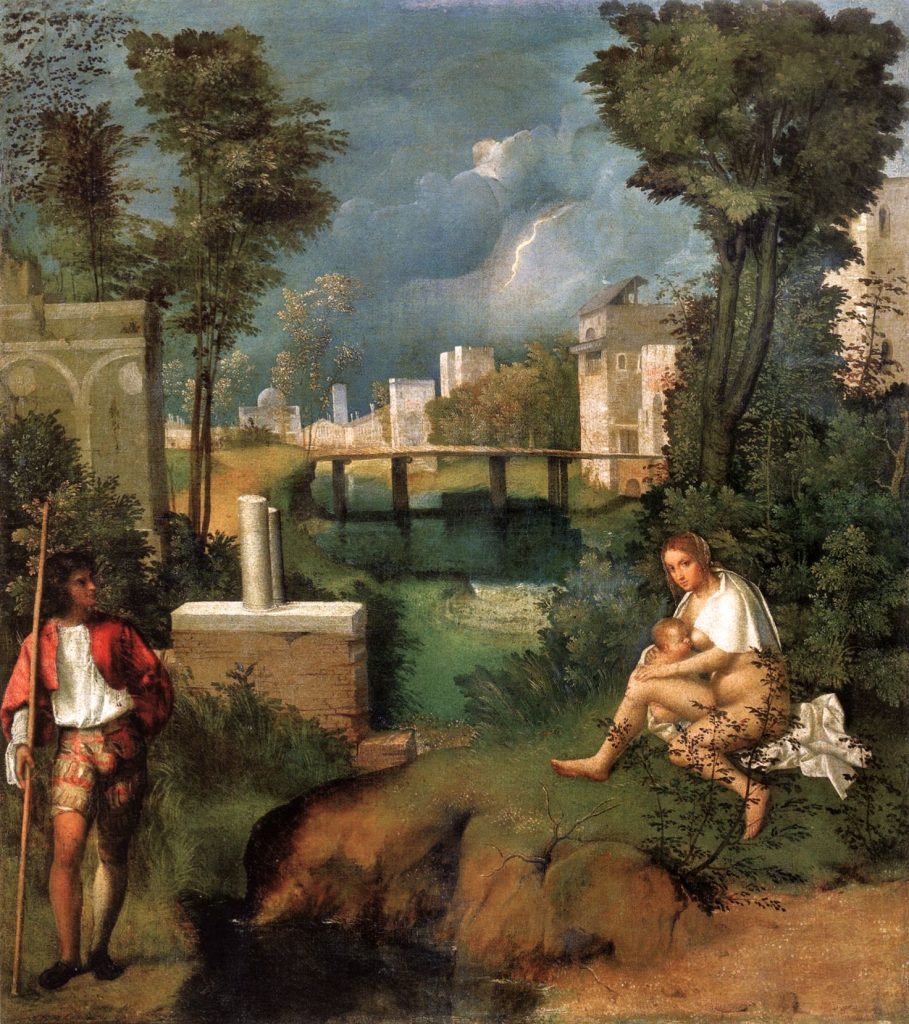
The beauty of the work of art, however, Kant argues , is different from the free beauty of the rose. He terms the beauty of a work of art a “dependent beauty” and he includes in this characterisation the beauty of animals and the human body. Both of these life forms, he argues are concept-dependent beauties and thereby carry an interest with them in any activity of aesthetic appreciation associated with them. The idea or form of The Good is the motivating force for the artists intentions insofar as their “works” are concerned. If a human being is represented in a painting or a sculpture, then, there must be some kind of reference to mans moral virtue. In the Giorgione Painting “Tempesta”, for example, the man standing in the foreground against the background of a brewing storm appears at peace with his surroundings and with himself:
Giorgione’s “Tempesta”
The causality involved in Teleological Judgement is illustrated in the idea or ideal of works of art which ought to be viewed, not in terms of any technical or “mechanical” causation, but rather in terms of a causation which is ideal or final. The contrast between technical/mechanical and final/ideal causes is characterised in the following manner by Kant:
“Thus a house is certainly the cause of the money that is received as rent, but yet, conversely, the representation of this possible income was the cause of the building of the house.”(Critique of Judgement, Part II P.20)
A house is an object nested in a network of instrumentalities but may also be viewed purely aesthetically in terms, for example of the mass-effect of its stone or the “blossoming ” of carved features on its walls. In this latter case we view all the parts of houses appreciated aesthetically as constituting a unity of the whole: a unity that is:
“being reciprocally cause and effect of their form” (P.21)
In these cases the formal and final causes of the whole are the primary organisers of the more technical and mechanical material and efficient causes. This kind of transcendental reflection is also important, Kant argues, in Political Philosophy in which the parts (the citizens, their character, and territory) are the material cause of the “form” of the organised state which they partially “constitute”. “Constitution” is an important political form for Aristotle which he conceived of in terms of “organic” form, thus linking the matrix of concepts linked with psuche to the estimation of political activity.
Kant’s discussion of teleological judgement and the necessity of teleological explanation to fully characterise the essence of a blade of grass rejects material and efficient “mechanical” explanation in his transcendental investigation. Involved in this rejection is appeal to the principle of sufficient reason and the matrix of concepts associated with psuche. The principle involved is, Kant insists, a reflective and not a constitutive principle, and this is a crucial difference between the forms of aesthetic and teleological judgement. Nevertheless, Kant argues, we are in need of this reflective principle in natural science but rational limitations ought also to be observed when using teleological explanations in the natural sciences. For example, introducing the idea of God from Theology will only destroy the integrity of both the natural sciences and Theology. Material and efficient causes, can, never be invoked in relation to the idea of God which is best characterised in terms of formal causation/explanation. This kind of confusion or transference of ideas from one domain of epistemé to another may have been responsible for the confusion that led to characterising God as the physical creator of the universe when the more neutral principle- related ideas of “architect” or “designer” would have been more appropriate. We have earlier in this work pointed to the fact that the Ancient Greeks did not succumb to this confusion and left the actual physical process of creation to the Demiurge. Nevertheless, the extent to which natural science ignores the importance of teleological explanation is the extent to which:
“…the nexus does not touch the constitution of things, but turns wholly on the combination of our conceptions.”(Part II, P.34)
Modern science has several times manifested the tendency to regard reasoning in terms of final or teleological causation, as a contradiction of the results achieved in “mechanical” explanation. The Scientist relies on a form of perception he calls observation, to ground his reasoning, and this appears to conflict with the more philosophical account of perception presented by Wittgenstein in his later work, where it was claimed that an ambiguous figure can be seen both as a duck and a rabbit depending upon the organising activity of the eye. If Wittgenstein’s account is correct then, observation may not be the royal road to understanding the essence of things because it requires some kind of organising principle itself: an organising principle that must be “formal”. Kant also takes up this discussion in relation to our manipulation of objects and events, and insists that there is no contradiction between the following claims:
“All production of material things and their forms must be estimated as possible on mere mechanical laws.
“Some products of material nature cannot be estimated as possible on mere mechanical laws(that is, for estimating them quite a different law of causality is required, namely, that of final causes)”(P.37)
Kant´s explanation for this is:
“For if I say I must estimate the possibility of all events in material nature….This assertion is only intended to indicate that I ought at all times to reflect upon these things according to the principle of the simple mechanism of nature, and consequently push my investigation with it as far as I can, because, unless I make it the basis of research there can be no knowledge of nature in the true sense of the term at all. Now this does not stand in the way of the second maxim when a proper occasion for its employment presents itself–that is to say, in the case of some natural forms…..we may, in our reflections upon them, follow the trail of a principle which is radically different from explanation by the mechanism of nature, namely the principle of final causes”( Part II P.38)
This, roughly speaking, is the position Aristotle adopts. Kant’s account is more elaborate and more complex, and rests on a conviction that explanations relating to the noumenal world of things in themselves, refer to a supersensible realm beyond what we can know. We can, however, think of this realm without knowing anything about its constitution. In the context of this debate it is worth recalling Christopher Shields’ essence-specifying definition of a star, namely:
“A star is a gravitationally bound ball of hydrogen and helium made self luminous by internal nuclear fusion.”(P, 98)
A number of materialistic scientific concepts are combined in this definition and we can be forgiven for believing that once we have studied the theories these concepts are embedded in, we must be coming close to knowing what a star is in itself. No one can deny that many misunderstandings may be avoided if one understands the above definition, but the suspicion remains, however, that if stars are the remnants of a cosmic explosion, they may yet be a part of a whole we only partially understand. Was, the universe a form of matter and energy at the inception of this explosion? What was the state of this universe before this explosion? These are questions that can be reflected upon in the spirit of Aristotelian and Kantian principles of noncontradiction and sufficient reason
Returning to the earlier discussion relating to whether we can be said to “project” ideal causality onto the world, we find Kant claiming the following:
“For strictly speaking, we do not observe the ends in nature as designed. We only read this conception into the facts as a guide to judgement in its reflection upon the products of nature. Hence these ends are not given us by the object.”(Part II P.53)
So we cannot say categorically, Kant continues, that “There is a God”– we can only represent the world we experience as the product of a divine architect, i.e. of a God. There is, therefore, no alternative but to think about objects exceeding the capacity of our understanding in terms of the:
“subjective conditions necessarily attaching to our human nature in the exercise of its faculties.” Part II P.58)
Such reflections cannot just assume the idea of an unconditioned original foundation of nature. Instead we read into nature a form of finality: a matter of judgement, not of understanding. The problem with the linking together of mechanical and teleological explanation, is partly the problem of finding a common source for both. Kant claims that this source is the supersensible substrate of reality. Being part of the noumenal realm of Being, we cannot form a conception of this source, though perhaps we can in some sense indicate or show what we are reflecting upon.
Kant asks the question “What branch of knowledge does Teleology belong to?”, and rejects the alternatives of natural science and theology in favour of claiming that teleology is better characterised as the “method of critique” used by the faculty of judgement. This method, Kant argues further, proceeds according to a priori principles. This continues to be a philosophy of limitation which is well expressed in the following:
“For the mode of representation based on final causes is only a subjective condition of the exercise of our reason in cases where it is not seeking to know the proper estimate of the form of objects arranged merely as phenomena, but is bent rather on referring these phenomena, principles, to their sensible substrate, for the purpose of recognising the possibility of certain laws of their unity, which are incapable of being figured by the mind otherwise than by means of ends( of which reason also possesses examples of the supersensuous type) (Part II P.91-2)
Kant refuses to regard man as the peak of creation in the light of his frailty in the face of the mega-forces of nature and also because we harbour destructive tendencies that are more than capable of bringing the species to ruin and destruction. The only characterisation of man’s telos that Kant is prepared to endorse is his freedom in his choice of ends, especially those cases in which the free action conceived of is aiming at “The Good”. Kant also distinguishes between civilisation and its instrumental works (means to ends) and Culture and its categorical works (focussing upon ends-in-themselves). What is highlighted in this discussion is the critical distinction between good works of skill (techné) and good works of knowledge (epistemé). The latter rely on an absolute of “the good will” which:
“consists in the liberation of the will from the despotism of desires, in our attachment to certain natural things, we are rendered incapable of exercising a choice of our own.”(Part II P.95)
There are in these reflections an echo of a distinct concern of Socrates who never directly endorsed the “fevered” city of Plato’s Republic. He never produced arguments to abandon the picture of the healthy city he painted in the early books of The Republic: a city obeying one principle–the principle of specialisation (a city without warriors or philosophers). In the “fevered city” we encounter desires out of control, and privileged individuals oppressing others less fortunate than themselves, chaining them to a form of existence that is undignified. Kant’s solution to this problem is not to conceive of a city ruled by philosophers telling “noble lies”, but rather to conceive of a culture whose constitution contains laws which prevent the infringement of the freedoms of any individual. This, Kant continues to argue, can only occur if we develop a system of states that is cosmopolitan– a system which prevents one state infringing upon the freedom of another state. Without such a system “war is an inevitable outcome”(P.96).
Kant further argues that the role of the arts and sciences in such a culture is to prepare man for the adventure of freedom. The utilitarian pseudo-argument that mans telos or final end is happiness is dismissed many times throughout all three Critiques. The Critique of the Power of Judgement uses the following argument:
“The value of life, for us measured simply by what we enjoy (by the natural end of the sum of all our inclinations, that is by happiness) is easy to decide. It s less than nothing. For who would enter life afresh under the same conditions? Who would even do so according to a new self-developed plan (which should, however, follow the course of nature) if it also were merely directed to enjoyment? We have shown above what value life receives from what it involves when lived according to the end with which nature is occupied in us, and which consists in what we do, not merely what we enjoy, we being, however, in that case always but a means to an undetermined end. There remains, then, nothing but the worth which we ourselves assign to our life by what we not alone do, but do with a view to an end so independent of nature that the very existence of nature itself can only be an end subject to the condition so imposed.(Part II ftnt P-97-8)
The implication of this argument is that everything in nature is conditioned by the supersensible substrate, including our internal thinking nature. Man, that is, has a supersensible noumenal aspect that is manifested in his freedom and moral action, and this is well illustrated in Kant’s “parable of the waterfall” (a discussion of mans relation to “the Sublime”). Confronted by “dunamis” or the power of a mighty waterfall, mans first response is awe and wonder in the face of this force of nature but this, however, is quickly displaced by a positive estimation of his own power of freedom to act as a moral agent. This for Kant is the sublime unconditioned noumenon that lies at the heart of all conditioned phenomena. Happiness, Kant points out, is variable, and cannot therefore be the true end of human existence: it appears to vary within the same individual at different times of his life. If I am ill, my health makes me happy, but if I am healthy but poor, wealth appears to make me happy until fear of losing my fortune forces me to pursue power to preserve my fortune. This fear, however, is then replaced with the fear of losing my power. Happiness also appears to vary between different individuals: what makes Bentham happy does not appear to make Kant happy. Nevertheless, Kant maintains, happiness is part of the summum bonum of life, but only if it is a supervening consequence of a good will and moral activity. It is in relation to these kinds of reflections that man forms an idea of an architect or author of the world: an idea which ensures that the good-in-itself is necessarily related to good consequences (eudaimonia–a good spirited flourishing life). These ideas embedded in these reflections are regarded by Kant as subjectively practical but emanating from our reason as they do, they are nevertheless important and necessary and resemble principles that can regulate our existence. These ideas are also practically real and transcendentally possible and related to the principle of sufficient reason. This matrix of ideas and principles then forms the conviction that becomes part of our faith in a transcendental Being. Transcendent objects of thought are apriori and also:
“mere matters of faith”(Part II P.142)
This true reflective form of faith differs from the kind of faith that is built upon historical narratives and personalities. It is also in this region that the philosophical distinction between facts and values lie. Faith is:
“the moral attitude of reason, in its assurance of the truth of what is beyond the reach of theoretical knowledge.”(P.145)
This is probably what Plato had in mind when he placed the idea or form of the Good above that of The Truth in the metaphysical reasoning he presented in The Republic. Kant elaborates upon this thought in terms of freedom, and claims that faith has its foundations in the practical reality and transcendental possibility of freedom. Christianity appears to lean very heavily on historical narrative and personalities but Kant has a great respect for this religion which also places emphasis upon mans moral life:
“But this is not the only case in which this wonderful religion has in the great simplicity of its statement enriched philosophy with far more definite and purer conceptions of morality than morality itself could have previously supplied. But once these conceptions are found, they are freely approved by reason, which adopts them as conceptions which it could quite well have arrived at itself and which it might and ought to have introduced.”(P.146)
Faith also relates to the idea of the soul, but there are great difficulties in the representation of this supersensible, noumenal aspect of ourselves which historically became characterised as “immortal” because it clearly is a representation that must be disconnected from the time-conditions of experience. This, however, does not entail that the soul is substantially timeless, unless by “substantially” one means “in principle”. One can claim that the soul is, in principle, timeless because its time conditions appear to be the same as the time conditions of ideas which must necessarily exist as long as there are humans thinking these ideas. Ideas, however, do not appear to possess the practical reality that actions do, and it is for this reason that Kant proposes that freedom proves its own objective reality:
“of the three ideas of pure reason, God freedom and immortality, that of freedom is the one and only one conception of the supersensible which(owing to the causality implied in it) proves its objective reality in nature by its possible affect there. By this means it makes possible the connection of the two other ideas with nature and the connection of all three to form a religion.”(P.149)
The surprising inclusion of freedom as an important component of religion has startling consequences when it comes to interpreting the historical narratives of the Bible. We discussed the parable of “The Garden of Eden” earlier in this work, and questioned the ecclesiastical interpretation which claimed that this was a story about “The Fall” of man from the Grace of God–a narrative about the disobedience of man partaking of the fruit of the tree of knowledge. On a Kantian interpretation, this story is obviously an anxious moment in mans history, because it is a moment in which instinct was left behind as an organiser of mans life, and a choice had to be made as to whether one ought to place ones faith in knowledge. This was clearly a moment of freedom, of emancipation, and characterising it as a fall from the Grace of God merely testifies to the primitive idea of God man must have had at this time. God is undoubtedly an important part of the supersensible noumenal substrate, and as such is going to present difficulties in the attempt to represent this form of Being. To recognise our duties as divine commands is testimony to the fact that whilst we are potentially rational beings, we are not as yet (as a species) actually so. Hence the command structure of the categorical imperative and ought matrix of concepts that lie at the foundation of our moral intentions and actions. Nevertheless it is still reasonable to pose the question “What is it that we have an obligation towards?”. There appear to be three possible answers to such a question:
Being
Ourselves
to the potentiality of the species
All three answers may be correct if elaborated upon in a Kantian spirit. Conceiving of God as a Prime mover as Aristotle does is criticised by Kant on the grounds of it requiring a definite conception of a form of Being in relation to the Category of Causality. This, for Kant, is a confusion of different aspects of the thinking process. Aristotle also, we know, used the term “Primary Form” in the sense of “Primary Principle” to represent God and this formulation of the power of the divine appears to be more in line with Kantian thinking.
Kant proposes using the term “intelligence” to characterise the being of God and his “activity” and there is a clear risk of anthropomorphising the principle that is being referred to : confusing an idea of reason with something that appears to be connected (at least in the modern mind) with the categories of understanding. Hughes in his work on the Critique of the power of judgement equates intelligence with:
“the teleological cause of the object”(P.49)
If however purposiveness is also implied in this telos, then there is a risk of it being reduced to concrete purposes and this will confound any thinking which sees intelligence to be a manifestation of a principle (e.g. areté). Any principle equated with the “intelligence” of God would, of course be far beyond the reach of human understanding and reason. Our understanding is limited to representing this Being in terms of formal and final causes and presumably material and efficient causes or any form of “mechanical” characterisation would be otiose (using the principle of sufficient reason as the logical standard)
The presence of “analogous thinking” in any characterisation of the telos of living beings is elaborated upon by Kant in his claim that living organisms are both cause and effect of themselves: they cause, i.e. both their own activity and the reproduction of their kinds. The difference between the telos of living organisms and the teleological explanation of the divine principle is that in the former case the principle is likened unto a plan or goal of action, whereas in the latter case, there can be no conceivable separation between a plan and its outcome i.e. no separation between God’s contemplation of a change and that change coming about: everything is actual and the potential dissipates and this is the explanation of our earlier point that God, the principle, is not subject to experiential time-conditions. Both Aristotle and Kant believe that the telos or natural purpose of the living organism is internal to that organism. Such organisms are actualising their potentials under sequential time conditions. Taking the example of a rose, the principle of the telos of roses is internalised, but the question is whether this is related to the aesthetic idea of the form of finality of the rose that we find beautiful. These two aspects are clearly different since in the aesthetic appreciation of the rose we are not exploring the properties of the rose with a view to classifying it as such. We may however be appreciating the psuche of the rose. Now whilst life itself cannot be said to have a telos, different forms of life clearly do. The activity of the harmony of the faculties occurs only in relation to objects manifesting themselves aesthetically and this is clearly happening when we appreciate the life form of the rose.
Does nature as a whole have a purpose? Well, life forms would have natural purposes on Kant’s account and together would constitute a “system of purposes”. The question that arises is how to characterise Gods role in this system of purposes. Is the principle internalised in the system or does it stand at the boundary of the system as the physical eye does to the visual field? Kant’s challenge is a reflective one and not directed at understanding what by definition lies outside. There can then, be no definition of God and we are then challenged to follow Plato’s example when he could no longer give an account in terms of the principle of sufficient reason. Plato’s response to this state of affairs is to present us with analogies or allegories, and this is what we must do in our attempts to represent the God-principle. We ought that is to look at both nature as a system of purposes and the role of God in this system in terms of metaphor or analogy. The Being of God ,for example, can be represented as if it were an architect or supersensible intelligence. This amounts to claiming that the God-principle is a regulative idea in our minds. This complex form of existence of the God-idea or God-principle clearly is a contributory factor involved in the difficulty of maintaining a large community in which this principle or idea is revered.
Modernist conceptions of the world are bipolar—whatever exists must be subject to observation or manipulation, and if ideas can neither be observed nor manipulated in such a relatively primitive sensory-motor system, such ideas have no form of existence. We can, on this account, only have knowledge of what exists. Thoughts are parsed in this sensory motor system as particular items that could vary depending upon which private chamber of consciousness they reside in. They might have a particular psychological relation to the chamber they inhabit but they have the quality of sensations which can only privately “felt”.
For many the acid test of teleology is in the experiencing of life forms and the above account seemingly makes it impossible to see the manifestation of these life forms in their activity. This may to some extent be so in the case of being a human form of life and also in our attempts to “read” the behaviour of other animal life forms: analogous thinking may be required to understand some aspects of what we are experiencing. We humans, from hylomorphic and critical perspectives, stand in the middle of a continuum of life forms. We certainly need to apply analogous thinking to activity connected to the God-principle or God-idea especially when it concerns trying to understand the role of such a principle or idea in natures system of purposes. It could be argued that in some respect we “participate” in the “form” of the divine via the actualisation of our potentiality for rationality in a similar way to the way in which we “participate” in the “form” of animality in the context of attempting to understand the behaviour of non human animal forms of life. Our attempts to understand pure matter and pure form as presented in the Aristotelian system are also problematic because in the former case our sensory-motor and thought systems may well “disguise” the true nature of what we are experiencing, and in the latter case we are encountering a form that is not physically embodied. The brain (the most complex object in the universe), for example, according to Gerald Edelstam in his work “Bright Air brilliant fire” is “merely” organised carbon, hydrogen oxygen nitrogen sulphur phosphate and a few trace metals. It is, Edelstam argues, the organisation of this material that makes a brain a brain.
That we are dealing with analogous thinking is manifested in Kant’s first Critique when it is claimed that insofar as our search for, and reliance upon knowledge, is concerned, we are organising our experience rationally for the purpose of acquiring empirical knowledge via observation and conceptualisation. “Construction” is involved in this activity of processing by two different cognitive faculties and as we pointed out above this might “disguise the true nature of “things-in-themselves”–the supersensible substrate. How can we, then, even think such a possibility? We do, Kant argues have some limited kind of contact with this noumenal realm in our moral activity–contact with people as ends-in-themselves and contact via thought with a future kingdom of ends which better manifests these ends-in-themselves. Given the structure of our sensory motor activity and limitations of conceptualisation activity, we have no choice, Kant argues, but to use analogous thinking in reflections about nature in itself and the God principle in itself. Conceiving of this principle as a primary form or an intelligent architect ought, then, to be conceived of analogously or metaphorically because we are dealing with a non material non observational a priori “principle”. Being a principle entails that God’s “thinking activity” is “deductive” “moving” from wholes to parts instantaneously. Whether one wishes to call this strategy related to analogy “projection” or not depends to a large extent on what one understands by this term. The form of existence of this divine form of intelligence is both beyond our knowledge and to some extent beyond our capacity to think something about this form. This is why many thinkers, in an attempt to explain exactly what it is they have faith in, end up throwing up their hands in despair and proclaiming “God must exist!” Kant’s explanation also arrives at this conclusion via an account that stretches over a number of works including one specifically aiming at the presentation of theological difficulties with the problem of the existence of God(Religion within the bounds of reason alone).
The ” new men”, Descartes and Hobbes, regarded life-forms as “mechanical” and Descartes barbaric experiments on unaesthetised animals indicate a form of disrespect for life forms we have not encountered by Philosophers before. Such examples also testify to the extent to which mechanical explanations with the aid of mathematics fail to meet the requirements of the principle of sufficient reason. We should recall in the context of this discussion Kant’s claim that mechanical explanations fail even to meet this requirement insofar as explaining the existence of a blade of grass is concerned.
Aesthetic reflection places us at a psychic distance from scientific investigation in general and mechanical explanation in particular, partly because it is disinterested and partly because of its refusal to think in terms of possibilities and necessities (categories of the understanding). In many respects aesthetic judgement manifests an interesting combination of two of the major cognitive faculties in its representing activity. The particular is perceived and the imagination is engaged in a search for a universal that is not categorical. In this process we intuit(sense) the form of finality of nature, e.g. we do not perceive the rose as a botanist might but rather see it as a life form striving to preserve itself in its form of existence. Involved in this process of reflection is also the seeing of the rose as being the manifestation of the “work” of a divine intelligence. This form of speculative reflection leads us back(via a different route) to God seen under the aspect of the beautiful(as compared with the aspects of the Truth and The Good). Reflective judgement thus bears some relation to moral judgement which provoked Kant to claim that beauty is the symbol of morality and furthermore prepares the mind for ethical understanding. The life-form of the human being is the most interesting aspect of one form of aesthetic judgement perhaps because of this intimate connection with our moral natures. In this respect humans are not simple beauties such as flowers but nevertheless “partake” of the form of the beautiful. In judging that a human being is beautiful we are estimating this part of nature as if it were a work of art. We cannot, however look at all nature in this way because we are well aware of the devastating impact of forces of nature on human civilisations: tsunamis, earthquakes, and massive volcanic activity regularly cause widespread ruin and destruction in relation to humans and everything created by humans. We spontaneously and naturally judge such events to be in some sense “evil” exactly because of the fact that we “project” the good onto works of nature and in an act of further reflection attribute these good works to the divine artist. We do not normally attribute natural catastrophes and disasters to anything divine, however.
One of Freud’s thoughts in the context of this discussion orbits around the idea of religion being a “delusion”: he claims namely that religion is the unhealthy projection of psychotic minds. In earlier discussions of this claim we suggested that it was not absolutely clear what the target of the Freudian attack was. The fact that Freud claimed his Psychology was Kantian would suggest that Freud would not place the Kantian interpretation of nature as art or the work of the divine artist, in the same category. Freud may, that is, have been talking about “patients” and their religious tendencies to “Project” their anxieties and wish fulfillments into a being that in the end is a substitute for the father they wish they had. These patients appear to dwell permanently in the realm of an imagination plagued by anxieties and desires they cannot control. It almost seems impossible for them to move reflectively toward the realms of understanding and reason and do the work of interpretation needed for genuine religious understanding.
Kant’s characterisation of the divine principle or law-giver is in terms of omniscience, being all-good, all-powerful, all knowing, absolutely just, absolutely wise, eternal, and One. This might be how Aristotle conceived of Primary Form. There may however be other aspects of the divine form that escapes us. Spinoza, we know, conceived of God in terms of a substance possessing an infinite number of dimensions. We humans, Spinoza claims only know of God under two aspects: namely thought and extension.
On Kant’s gravestone there is a quote relating to the two things that evoke awe and wonder in the human mind: the starry sky above and the moral law within. Scientists, when conducting their experiments are not reflecting aesthetically upon the parts of the world they are concerned with, and furthermore they would not know what to do with the result of an experiment with humans which resulted if the subjects responded with awe and wonder at the experiment. Kant, however much respect he had for science and the manipulation and measurement of dependent and independent variables was Philosophically less interested in the confirmation or verification of imagined hypotheses and more interested in investigating aspects of being that generate awe and wonder. In his transcendental investigations into human and divine existence, judgement obviously played an important role whether it be aesthetic or teleological.
The Enlightenment is an era in which the hylomorphic Philosophy of Aristotle transforms itself into a broader metaphysical view in which it is claimed that the practical reasoning governing our conduct is regulated by both principles and a moral law. One aspect of this transformation was a more formal reorganisation of the Aristotelian ideas of arché and psuche, in relation to the arts and sciences involved in leading the good spirited flourishing life( eudaimonia). In this reorganisation perhaps the biological determinants of psuche fell away in favour of the more psychologically oriented determinants. We maintain, however, that the essence-specifying definition of Aristotle, namely rational animal capable of discourse, is embraced by Kant, and this can be seen in the later elaboration upon Kantian Philosophy by Freud’s Philosophical Psychology. This aspect is best manifested in Kant´s work “Anthropology from a pragmatic point of view”. Kant’s reorganisation emphasises also the primacy of practical reasoning and a system of concepts orbiting around the theme of agency and the categorical activity of Action. Action for Kant, retains the quality of bringing about good in an environment of a world “worlding”, and subjecting oneself to events that happen: events calling upon the agent for action. In this arena of reasoning the account we are given, or the “logos” of the phenomena we encounter, refers to world-building instrumental actions that transmit the “forms” of children, artefacts(houses etc) and important ideas in the community. For Kant, as for Aristotle, Action and all forms of activity aim at goods-in-themselves such as health, courage, justice, and wisdom, (in the spirit of areté, arché, diké, eros, and eudaimonia). Kant’s Political Philosophy can also be seen to be a sophisticated elaboration upon the hylomorphic naturalism of Aristotelianism : one which, coming as it does millennia after the fall of city states to the empire-builders, proposes a view of a cosmopolitan fully global “kingdom” of ends lying one hundred thousand years in the future (a kingdom that will be based on universal human rights which could not exist without acceptance of the categorical imperative of a moral law). In this account Kant embraces the necessity of mans social/political nature, a necessity that requires “good” laws and public education to realise human potential to the full. Kant also shares with Aristotle an appreciation of the value of religion. There is perhaps a shift away from the centrality of the theoretical idea of God, toward the practical idea of the freedom but there is nevertheless a firm commitment to an idea of the divine and the sacred that sees man’s rationality as limited in form compared to the thought of eternal unchanging Being whose primary form surpasses our limited understanding. The good will, for Kant, is the will guided by the forms or principles of noncontradiction and sufficient reason and he often refers to this absolute in terms of the “holy will”. Man may be composed of the material of “crooked timber” (his animality) but he has sublime potential whch can be realised in actualisation processes that occur with the assistance of principles: processes that aim at the ultimate good of a kingdom of ends.
The focus upon the practical idea of Freedom was undoubtedly a Kantian contribution which to some extent revised hylomorphic ethical and political philosophy. The idea that “everything created by man was destined for ruin and destruction” was a reference by the oracle, not just to the crooked timber of humanity, but also to the way in which the potential to become a good being, with a good will, living in a good community was being stifled by the ways in which we were choosing to organise these communities. The Aristotelian focus upon justice needed to be complemented by an idea of freedom that respected universal human rights and this in turn required the political creation of an international institution whose responsibility it was to protect these human rights internationally(The United Nations).
Centuries of discussion of the idea of “I think therefore I am” enabled the construction of a very abstract and theoretical idea of consciousness and this discussion was certainly on Kant’s mind when he was formulating his critical Philosophy. Criticism of the Philosophies of the “new men”, e.g. Descartes and Hobbes, with arguments resembling those used by Aristotle to criticise the dualism and materialism of his time was a priority of the Kantian agenda. The Kantian “architectonic” of the canon of sciences resting upon a metaphysical and logical foundation, was also reminiscent of the Aristotelian project. Kant, however, does not seek to authenticate the proliferation of university subjects of his time and probably was suspicious of both the principle of specialisation that reflected the guild structure of the towns and cities of the time and the instrumental/pragmatic spirit in which many subjects were taught. The new men had certainly succeeded in launching a search for what was new and different at the expense of “first principles”. The Enlightenment spirit of “sapere aude” was, with the advent of Hegelian Philosophy, being diluted by a spirit in which some felt that everything was possible, and many felt that nothing was possible anymore. The real realm of possibility was obscured by the self obsessed fantasy constructions of a manic-depressive mentality.
The Spirit of the Enlightenment, up to the point of Hegel’s appearance, rivalled the Spirit of the Golden Age of Greece. Hegel, it can be argued constructed a form of idealism in which the retinal image of Culture was turned upside down and the world was seen through a pair of Stratton spectacles darkly—North became South in the name of dialectical logic. It would not be, however, until the World was ravaged by two World Wars in the twentieth century, that an attempt was made to remove the spectacles and see real possibilities again. In the interim, Freudian Psychology would chart the contours of insanity in the spirit of Kantian Psychology, and in a way that acknowledged mans instinctive endowment in hylomorphic terms. After the second world war an old Kantian “possibility” was realised with the creation of the United Nations and the war against totalitarianism was fought on the terrain of human rights. The metaphysics of Morality had condensed from a cloud of potentiality into the actuality of a global organisation. The metaphysics of Politics also began to return to the Aristotelian idea of the “Politics of the golden mean” and public education began the task of educating the “classical” middle class of men. Both freedom and justice were important ideas in the restoration of what had been lost. Restoration was also on the agenda of the later Wittgenstein when he retreated from his earlier position of reductive logical atomism, and began using Aristotelian phrases such as “forms of life” in the context of a Philosophy of Action that was neither behaviourist nor pragmatic, but shared some of the commitments of hylomorphic and critical rationalism. The unique focus of Wittgenstein was however on the medium of communication, namely language, but it nevertheless succeeded in providing the philosophical community with arguments against logical atomism, logical positivism, non hylomorphic forms of naturalism, instrumentalism, pragmatism, phenomenalism, existentialism etc. This reshaped the philosophical landscape sufficiently for both hylomorphism and critical Philosophy to reemerge as significant historical landmarks. Wittgenstein insisted that Language had a rational structure and thereby avoided the relativism associated with a blunt “language creates the world” formula. For Wittgenstein grammatical investigations were essence specifying activities and therefore presupposed the rational principles of noncontradiction and sufficient reason shared by both Aristotle and Kant. Language–for Wittgenstein–was an activity embedded in a form of life and had the teleological function of aiming at the good. Whether the concept of “language-games” embedded in these forms of life was a useful one or not remains to be fully evaluated. A game is minimally constituted of moves (e.g. Kn to QB4), rules, and principles(Protect your queen) but somehow the seriousness of the world appears to be missing in such an idea. Both life and the issue of the quality of life are serious matters and reducing them to conventional regulation by rules would not be taken seriously by either Aristotle and Kant. Neither Philosopher would for example consider viewing the laws regulating life and the quality of ones life in a society as arbitrarily conventional. The idea of the rule governed game does however have the advantage of closing down the number of real possibilities that can occur in the course of the development of sequence of events. The number of possible “moves” of possible “agents” is circumscribed and because it is so, is amenable to mathematical calculation using Bayes’ theorem (the probability of an event occurring is determined by the information we have relating to that event). If the field of variables to be calculated is indeterminate or “open”, no value can be calculated. The idea of a game(being a closed field of variables) therefore, is one way of introducing mathematics into the arena of the social sciences, but it is important to note that the introduction of this concept is at best hypothetical (if human activity is regulated by rules, then we can determine its value). Both Plato and Aristotle would regard the introduction of mathematics into the field of human action as problematic on the grounds that mathematics manipulates abstract images of things rather than those things themselves. Games and images. for serious philosophers concerned with Being qua being and first principles, do not engage with the seriousness of life and its catastrophes and calamities each of which is capable of bringing the ruin and destruction of all our hopes and desires. It is this latter aspect of life that is the concern of Ethics and the categorical forms of language that govern this region of our existence. Kant went in search of an absolute in the arena of ethics and found it in the form of the idea of the good will. To use a Wittgensteinian metaphor to describe this hylomorphic “move”, one could claim that a cloud of practical Philosophy was condensed into a drop of Philosophical Psychology. One needs, however, to detach the idea of a game from this reflection and insert the idea of a good will into a hylomorphic framework of first principles, thought, self-knowledge, and self-sufficiency for it to become completely intelligible. The essence- specifying definition of man as a rational animal capable of discourse also needs to be part of the apparatus of explanation/justification. Practical reasoning and first principles govern the “moves” that can be made in the ought-system of concepts we encounter in the arena of the explanation/justification of actions that aim at both the good in itself, and the good in its consequences. Universality and necessity are important features of reasoning in this system of concepts.
Needless to say, the introduction of a Cartesian inspired idea of consciousness into such a context of explanation/justification is merely going to destabilise the system. Kant in his willingness to divide the whole of the mind into the parts of Sensibility , Understanding, and Reason, does however invite a non Cartesian idea of Consciousness into the arena—an invitation that would later be accepted by Freud when he constructed a topography of forms of Consciousness differentiated into the agencies of the ego, id and superego. The three principles of Energy-Regulation, Pleasure-Pain and Reality could well have come from Freud’s reading of Aristotle earlier in his career. These are not first principles but rather domain-regulating principles that presume a self actualising process over a long childhood of living among the discontents of civilisation. Hughlings Jackson was also an influence on the Freudian neurological account of higher centres interacting with lower centres. The language centres of the brain and Language as an activity of the mind obviously stretches over the domains of sensibility and understanding and perhaps over the domain of reason too. It plays an important role in the Freudian system by being the medium through which preconscious and unconscious items are brought into the “light” of consciousness which itself, according to Freud, has an instinctive base and is in fact a vicissitude of instinct. Language for Freud engages with both sensibility and thought in its various forms and becomes not just the medium of disclosure of difficult to access thoughts and feelings, but is also connected in a complex way to the memory system which is used in the process of “the talking cure”. The compulsion to repeat traumatic events over and over again, for example, is partly caused by the inability to “remember” these events in the normal way ( which enables the thought of the event to fade in intensity over time).
For Kant the idea of a form of life stretches from the animal/instinctive to the rational animal capable of discourse, and to the divine will that is not limited by the lifetime of physical organ systems that can fail with trauma or age. This continuum testifies to the inherent tragedy of the human condition that can lose the gift that makes it what it is. The form of life of the divine is unchanging for both Aristotle and Kant.
The Gods of course were the subject of Homeric concern and Homer was on Plato’s mind when he considered excluding artists from his ideal Republic. Homer we know portrayed divine beings as quarrelling, deceptive beings, using humanity as a means to their selfish ends. This called into question one of the essence-specifying features of divine beings, namely, that they ought to be necessarily good. Aristotle too would have objected to the contamination of the idea of the divine with human qualities. Kant speaks of the divine life in terms of the holy will but does not attribute physical action to this form of life and thereby shares with the Greeks the idea that even conceiving of the divine as acting to create the universe is inconceivable and requires an intermediate form of life , e.g. the demiurge.
Aesthetic creations of artists are activities, therefore, that ought to aim at the good in the spirit of areté and this is one way in which “forms” are communicated in the polis. The other two types of forms that assist in the building of civilised communities are the reproduction of children for these communities and the transmission of “good” ideas in the name of education. These latter ideas are the most important and in this respect insofar as artists take upon themselves this role they ought to respect the integrity of these ideas. In aesthetic contexts, for Kant, we communicate ideas of reason using categories of judgement. The best forms of art will strive to produce objects that help to explain the mysteries of human life and existence, thus promoting a self understanding that is part of the Delphic project for rational animals capable of discourse, namely to “know themselves”. These objects are presented as goods-in-themselves in a context that requires a certain amount of psychic distancing from the everyday instrumental concerns of life. They also require a culture in which understanding of the media of artistic communication is an important part of the process of building a civilisation. Art, in the Aristotelian architectonic of his scientific curriculum is a productive science which nevertheless has necessary connections with Truth and the theoretical sciences as well as “the Good” that is aimed at by the practical sciences. It was the work of Aristotle that suggested the definition of Philosophy as the systematic understanding of the world as a systematic whole. Kant continued this tradition by claiming that reason seeks for the totality of conditions for anything that happens or requires explanation or justification.
There are differences between the projects of Hylomorphic and Critical Philosophy but we have argued in this work that the differences lie on a continuum at least insofar as basic principles and worldview are concerned. In the 20th century a contrary view emerged in relation to the Ethics of the above two systems. Let us examine this further by referring to a relatively recent work by Gerard J Hughes entitled “Aristotle on Ethics”(London, Routledge, 2001). Hughes confirms the connection we are proposing in his outline of the topic, structure and aim of Aristotle’s ethics:
“What do we aim at in life?What is it that would make living worthwhile? A worthwhile life must surely involve developing our specifically human characteristics to the full.How could we find out what those are?Upon reflection we can see that what is most characteristically human about ourselves is the way in which thought colours all our lives–not just intellectual pursuits, but also our feelings and emotions, our choices and relationships. So we start by considering the was which thought influences those traits of character which contribute to living a worthwhile fulfilled life…We need to think about choice and responsibility in more detail.”(P.11)
The conditions for understanding the meaning of these reflections are embedded in the Greek language: in the meaning of the words, areté, diké, arché. epistemé, eros, ananke, and eudaimonia. Responsibility and choice presuppose freedom as well as the right view of akrasia (weakness of the will) which, according to Aristotle, is a failure of rationality. The Nichomachean Ethics is crystal clear in its position that all activities aim at the good and the specific relation to epistemé insofar as ethical activities are concerned is that if we know the good we will do it. Akrasia, then, as a phenomenon, is characterised as a kind of confusion caused by the cognitive system being overwhelmed by intense desires , emotions etc, in a similar way in which the functions of the body are overwhelmed by the overconsumption of alcohol. This confusion can neutralise the activation of the knowledge we have of the premises constituting the reasons for the action concerned —so the knowledge lays dormant in the system because other systems relating to the sensible part of the mind are using all available energy for their purposes.
Ethics and Politics are both Practical sciences and aim at the good, not theoretically, but with the aim of becoming Good, i.e. to possess in Kantian terms a good will. Kant. like Aristotle, views this matter in terms of the principles of logic regulating premises, e.g.
Promises ought to be kept
Jack promised Jill he would pay the money back he borrowed from her
Therfore
Jack ought to pay Jill the money he owes her
The above argument mirrors the typical form of an ought argument that refers to the virtues of Promising and honesty. We see in this argument the integration of truthfulness and areté (doing the right thing at the right time in the right way). The ought major premise is a necessary warrant for the formulation of the intention to do a particular action. Promises, we know are not merely ethically important, they are of central importance to the process of ruling in civilisation-building political activity. Promising is the arché of Politics, and is intimately related to the demand placed upon the shoulders of politicians to take responsibility. The Greeks were the first to begin the understanding of these virtues in the context of Political Power. Dunamis is one Greek term for power and this concept is closely related to the hylomorphic ideas involved with the actualising of potential. It is also itself an idea that responds to Glaucon’s challenge in the Republic to prove that Justice (diké) is both good in itself and good in its consequences. Power in the Greek philosophical mind was related to the sacred and the divine and thereby possessed both a civic aspect as well as a divine aspect. Dunamus was therefore a characteristic of the divine being, and therefore something sublime and mysterious. Using the power of the law to bring Socrates to justice, for many intellectuals of the time, was a sacrilegious act because the power that brought people together was a divine power and it was clear at least to them that Socrates was aiming at the good in his philosophical activities in the agora. The Latin term religio contains an interesting reference to binding things together that might otherwise fall apart or fragment. The idea of diké, (Justice), on the other hand, contains the meaning of separating things that do not belong together–perhaps we can conceive of this as the drawing of a line between those possessing a good will (Socrates) and those that are weak willed (his accusers). Justice also carries with it a consequentialist idea relating to its recipients deserving what they get out of life, and here we can see the importance of the role of the system relying on agents of justice acting with a good will. That was not the case with the accusers of Socrates and a miscarriage was the inevitable result. Socrates was accused of bringing new Gods into the polis and corrupting the minds of the youth. The accusers of Socrates were, then, not just guilty of abusing a legal system but they were also defiling what was sacred.
The next great era of Cultural restoration after the Golden Age of Ancient Greece began with the Renaissance and culminated in the Enlightenment. In these centuries there was an intensification of all forms of human activity but particularly in the arenas of Aesthetics, Ethics, Politics, and Theology. Politics was becoming more and more important than Theology, and Aesthetics was also threatening to displace Ethics at the level of individual action. The science of physics was also growing in importance. Generally in cognitive terms there was a move away from justification in terms of the principles of reason and understanding, and toward explanation in terms of the principles of judgement. The Kantian response to this state of affairs was to shift the focus of Philosophy from Theoretical rationality to Practical rationality, to crush pseudo-metaphysical projects, and to initiate reflection into several central issues in the arena of Philosophical Psychology. In doing so he retained the relation of the Sublime to both Ethics and Theology. The practical idea of Freedom replaced the theoretical idea of God as the central metaphysical concern, and became a central focus of both cultural and political activity. Hegel, of course, was to destroy this web of relations with an idea of Spirit embedded in a form of dialectical reasoning best suited to contexts of exploration/discovery rather than contexts of explanation/justification. For Hegel, the development of mans Sensibilities became more important than the development of his intellectual powers of understanding and reason. Hegel’s criticism of Kant led eventually to a Romantic idea of man as sufficient unto himself, as long as he follows his instincts, emotions and passions. It was this “spirit” that was instrumental in forming the idea of heroic men for whom “everything was possible”, even if the vast mass of men were beginning to feel “nothing was possible anymore”. Kant’s Critical Philosophy along with its underlying hylomorphic commitments was submerged in this new form of populism that appeared to be able to create mass movements that would later play a catastrophic role in the political events of the 20th century where both fascism and communism found soil in which to flourish. The Aristotelian idea that Politics ought to concern itself with noble and just actions was washed away by waves of selfish pity and fear. The Aesthetic object and its descriptions of of the sensible activity of man (his feelings, emotions, passions) occupied the public stage and distracted attention from more complex explanations and justifications of world-events. The world lost its depth, and inner exploration and discovery supplanted external objective concerns. The relation between areté (doing the right thing in the right way at the right time) and eudaimonia (leading the good spirited flourishing life)was ruptured. One curious consequence of this state of affairs and the intellectual reaction to it was the elevation of a mathematical form of arché (axioms) above forms of explanations/justifications such as the principles of noncontradiction and sufficient reason. This, some observers have noted, may have been an inheritance of the Cartesian conception of the external world in terms of a system of coordinates( by a system of thought that confirmed the existence of man in the bare terms of the Cogito argument). God “saved” the whole Cartesian system from collapsing by guaranteeing that life was not a dream that we might at any moment awake from. At the beginning of the 20th century this commitment to mathematical forms of reasoning focussed upon German idealism as the source of fundamental confusions about the nature of reality. For some obscure reason both Kant’s Critical Philosophy and Hegel’s historical actualisation of world spirit were placed inside the same pair of brackets. The Kantian arguments against materialism and dualism of the Cartesian kind were disregarded and these oppositions unsurprisingly emerged in new forms. The idea of Consciousness also emerged as an organising principle of experience and the imagination was appealed to as an important power of thought. Heidegger’s reflections on this era of our history pointed to what he called a “forgetfulness of Being” but it nevertheless criticised Kantian appeals to Ancient rational principles and claimed that Kant had missed an opportunity to rest his whole critical philosophy upon the foundation of transcendental imagination. This forgetfulness included the forgetfulness of of the objective rational quality of the good but Heidegger failed to acknowledge this aspect of modernism: a forgetfulness that rejected the Aristotelian argument for the good-in-itself:
“If there is some point to everything we do, something we want for its own sake and which explains why we do everything else, then obviously this has to be the good, the best of all. And there has to be some such point otherwise everything would be chosen for the sake of something else and we would have an infinite regress, with the result that it would be futile and pointless to want anything at all.”(1, 2, 1094a 18-22)
On this account the good spirited flourishing life would also include the qualification that nothing was lacking in such a life and this contributed to making this the most worthwhile of all forms of life: a life that is deserved only by those who have led virtuous lives. Only organisms possessing the powers of discourse and rationality could lead such lives and whilst the power of the imagination might be important for the purposes of correctly conceiving of what is possible and what is not, it is nevertheless the case that the principles of rationality are of greater importance for determining the correctness of ones conceptions.
Aristotle’s requirement that men ought to lead lives of contemplation is partly shared by Kant, but it is not clear whether Kant shares the Aristotelian characterisation of the importance of “theoria” and its connection to thought and the activity of God. It is clear however that our theoretical understanding of this Primary Being that is the manifestation of Pure Form or Pure Principle is limited, and we have more access to this pure form via our practical activities that aim at the good in the realm of the noumenal.
Areté is connected to ethical action or “deeds” in accordance with the following Aristotelian formula:
” So a virtue is a habitual disposition connected with choice, lying in a mean relative to us, a mean which is determined by reason, by which the person of practical wisdom would determine it.”(11, 6, 1106b 36-1107a2)
The above disposition is not connected to the disposition to feel sensations occurring in the sensible part of the mind, because, as Aristotle maintains, no one is praised or blamed for having feelings. Agents are praised or blamed for their choices and their choices build upon the reasons the agents have for doing whatever they have chosen to do. One can praise or blame the agent’s reasons and we can also blame him/her for his/her character. The reference to the golden mean in the above quote is meant to highlight the processes involved in the acquisition of our habits–processes that occur primarily in the context of exploration/discovery. The reasons an agent gives in contexts of explanation/discovery differ significantly from the reasons given in a context of exploration/discovery that occurs largely in the mode of the hypothetical. Sufficient explanation or justification is praised and insufficient explanation/justification is blamed. Self-sufficient justification is of course a key to leading a worthwhile flourishing life. Habits can also have a technical character(techné) in which case we are praised or blamed for a skill we possess as measured by the quality of the objects created by those skills. This contrasts with the ethical case in which it is the reasoning leading to the intention or action that is praised or blamed and there is also an epistemic element related to our knowledge or lack of knowledge of what is good-in-itself. If we build good houses we are called a builder and this instrumental power is praised. The form of praise a man receives for his good will and good character however is a different form of praise and is more desirable because in our scale of values epistemé is more valuable than techné because the former is good in itself and good in its consequences whereas the latter has merely an instrumental value—good in its consequences.
Emotions such as carelessness or cowardice in the course of a battle are what they are, but the praise-blame system will introduce a willingness to transform ones responses into a more rational response. Areté is the key idea to apply here, and a part of its application to the behaviour of soldiers in battle is not just doing the right thing at the right time in the right way, but also perhaps having the right feelings at the right time and both of these can be shaped by discourse and rationality. The man whose character has been shaped by practical reasoning over a long period of time, is called a phronimos, a great-souled man, a virtuous man. He has become the master of the golden mean. The relation of emotions to knowledge is a complex matter involving objects we are concerned with, and ways of of being aware of the world that are regulated by the lower order principles of energy regulation, and pleasure-pain. We know that in emotional states, the world can take on the “colouring” of the emotion. In my anger, I am as likely to lash out at substitute objects as I am at the real cause/object of my anger. In such a state my perception is of a world that is hostile to my agency and intentions. Sartre calls this a magical transformation of the world, but a supplementary account comes from the work of the Later Wittgenstein which showed us how perception in the form of seeing something as something ( a triangle as “half a square” or as having “fallen over”) appears to be half sensibility and half thought. In such an experience, Wittgenstein implies that I can become conscious of myself as organising my experience, especially in those cases where I first see one aspect of the thing and then another. Seeing the triangle as half a square is of course less of a magical transformation than seeing it as having “fallen over”. The emotions, then, might also fall on a continuum of perception and thought and be subject to regulation by different principles. Courage, for example would be a more complex entity than anger and this might explain why we praise agents manifesting the former and blame agents for manifesting the latter. More thought obviously appears to be involved in the former “virtue”(areté). As we ascend the hierarchy of virtues to the wisdom of a phronimos, or ruler of a Republic, the principles involved become more abstract and require more complex explanations that may rely on the kind of knowledge we find in the architectonic of theoretical, practical, and productive sciences. These explanations/justifications will also rest upon “First Philosophy” and the higher order principles of noncontradiction and sufficient reason.
Wittgenstein once claimed in one of his earlier “Notebooks” that the world of the happy man is a different world to that of the unhappy man. Happiness is of course a precipitate of the good spirited flourishing life, and both Socrates and Aristotle bear witness to the way in which leading examined and contemplative lives are different forms of life to lives that lack these properties. The question “Why?” plays an important role in such lives, as does the accompanying forms of consciousness of awe and wonder at a world and a soul that appears to be susceptible to endless exploration. It is of course not difficult to think of the happy man leading a good spirited flourishing life as someone who systematically deliberates about the Good-in-itself , Good consequences, and Good means to ends. This kind of deliberation occurs naturally in the context of explanation /justification and begins with the arché of first principles, e.g Promises ought to be kept, and ends in a particular verdict/telos of a particular action that ought to be performed. The “attitude” involved in such a deliberation is that of a Kantian judge putting questions in a tribunal whose purpose it is to reason its way to a grounded judgement. The phronimos deliberates in this fashion, in the spirit of areté, proceeding from the arché to the telos.
Perusal of the Greek language used in Athenian courts reveals the use of the terms “hekon” and “hekousion” which Hughes translates as “willingly”. This is the fundamental condition required for holding someone responsible for their actions. Modern philosophical discussions of willed actions involves reference to “intention” which is technically defined (in Anscombe’s work on “Intention”) in terms of the agent seeing his action as falling under a particular description, e.g. “shooting a deer moving in the wood”. If, as a matter of fact, it turns out that I shot my father, it is the task of the tribunal to determine whether the shooting of my father occurred intentionally or not. The presumption is that an investigation will be able to reveal the relevant facts necessary to make such a determination. What I did immediately after ,during, and before, the act may contain decisive evidence, as may what knowledge I had, e.g. did I know my father was in this region of the wood. If I could not have known he was, there the tribunal must find me not guilty of murder, but may well find me guilty of some other criminal act relating to negligence, perhaps because sufficient precautions were not taken before the act of shooting occurred.
For Aristotle, Eros and Philia are the “bonding” conditions that shape families, villages and cities. Kant prefers the term “respect” for the attitude involved in treating people as ends in themselves, whether they be familiar figures or strangers that visit the agora. This respect even for strangers carries with it the expectation that these strangers will both understand and respect the laws of the city. The absolute of the good will that we encounter in the Kantian ethical system we can also encounter in Aristotelian philia toward strangers. Aristotle himself was a stranger in Athens as a young man. Philia is also Aristotles term for friendship and there are three forms of friendship: relations of utility, relations of pleasure, and relations involving the good-in-itself. In relations of utility the parties involved seek mutual utilitarian benefits. In relations of pleasurable transient interaction, the utilitarian relation to the external world is to some extent suspended, e.g. in the case of the meeting with strangers and people one knows in a symposium where the collected company enjoys discourse and feasting together. In the case of the deepest forms of friendship where two people care for each other as ends in themselves, there is in this latter case, as there may not be in the former, a preparedness to sacrifice ones own goods for the person who is ones friend. Here we are clearly dealing with the goods for the soul that are necessary to lead a good spirited flourishing life(eudaimonia).
The difference between Politics and Ethics insofar as Aristotle is concerned is partly due to the fact that political theory is a more abstract reflective elaboration upon ethical principles in the public context of justification we encounter in the arenas of justice. Aristotle’s “justifications” did not extend to arguing for the justification of the existence of the city-state, perhaps because for him it is the mark of an educated man to know when to require a justification and when one is not required because of the self-evident certainty of the issue. For Aristotle it is self evident that the idea of a state is both good-in-itself and good in its consequences as long as the laws governing that state are rationally constituted and respected, i.e they are just laws. Part of the essence of being human involves living in organised communities in which the laws can facilitate actualising processes that will provide one with a reasonable quality of life. We have a need not merely to live (survive) but to live well and this manifests itself in a commitment to public education (communication of knowledge of “the sciences”).
To argue as Hobbes does that the law is mere words unless these words are defended by swords, is to reject Aristotle’s political (hylomorphic) naturalism. The basis for such a rejection is usually based on the claim that the laws of a city are mere artificial conventions necessary to prevent internecine strife in a community. Aristotle’s political views rest on a view of human nature and cultural development that is historically constituted of structures building upon structures, in organic fashion. The family might well survive in a benign environment, if the family was large enough, but, as Hobbes claimed, life in a state of nature would be solitary, poor, nasty, brutish and short. Families that unite into a village will experience advantages that are both utilitarian and pleasurable but still lacking some of the goods of the external world and most of the goods for the soul that can be provided by a well functioning polis. The family and the village are social structures that are assimilated by the polis. These structures are transformed into a unit of self-sufficiency that provides a quality of life that only knowledge of the Good can bring with it. Our modern obsession with the private individual alone in his chamber of consciousness would have seemed a regressive concern for Aristotle.
Aristotle was very familiar with the political problems of his time partly via the works of Plato and partly via the research of his own school into a large number of constitutions of city-states (158). He develops as a consequence a schema of good and deviant states based on an idea of The Good that rejects “noble lies” and other questionable Platonic practices outlined in “The Republic”. Here “The Good” is characterised as “Aristos”(“the best”)(Shields Aristotle, P 365) and this conception combines the best elements of oligarchy and democracy into a so-called “aristocracy” in which an emerging educated middle class will unite the polis into a self-sufficient unit where peace reigns. It is this form of constitution, Aristotle argues, that will most likely provide the conditions necessary for its citizens to lead a good spirited flourishing life, a virtuous life.
Such a constitution would include respect for techné and allow a free cultural space for rhetoric and poetry. In these activities, which aim at the good, there will be a reliance upon areté, arché and epistemé. The telos of rhetoric, Aristotle argues, is political persuasion via enthymemes and related rational instruments. Rhetoric was of course used (abused?) by the accusers of Socrates to end the philosophers life, but Aristotle would not have regarded this use of pseudo-arguments as legitimate rhetoric. For him the measure of rhetoric was Truth, and this measure was discarded by the accusers of Socrates who were using rhetorical devices for their own utilitarian (technical) ends. This testifies to the weakness of all technical activities–namely, that they can always be detached from the knowledge of the good in itself, and used for evil purposes (consequences). So far as rhetoric is guided by the truth and the good, however, it is rationally constituted and will contain principles that may even be “first principles”.
Poetry for Aristotle, is connected to learning even if there s an element of “imitation” involved. The production of poetry is for the purposes of learning via the imitation of reality. Actors dress up in clothes, imitating real kings and strut about a stage amidst scenery imitative of castles or cities. The words they utter are also imitative of characters they are attempting to portray. This, for Aristotle, is a natural form of learning something about something, e.g. that flatterers are not to be trusted, that kings are not gods etc. Learning such things brings us a non-utilitarian form of pleasure connected to epistemé and the knowledge of the good. We are, in the above examples, clearly learning about the essences of things in practical contexts, especially if the creator of the production is a genius, a great souled writer like Shakespeare. The spirit of tragedy contains necessary references to Thanatos, suffering, and Ananke, all of which are capable of evoking powerful emotions in man, e.g. pity at undeserved suffering and fear of ruin and destruction at the hands of processes we do not fully understand. The question “Why?” looms in tragedies as it does in most other processes of change initiated by humans and if the semblance of an answer suggests itself in the work of the great souled artist this purifies the minds of the audience leaving them in a musing contemplative state. Presumably in such lessons we also learn something about the self that is thrown into the midst of events of considerable magnitude. Even if the tragic work is historical it is not facts as such that are important but rather universal “possibilities” that are suggested in the prophecy of the Greek oracle: “everything created by man is destined for ruin and destruction”. Learning that flatterers are not to be trusted or kings are not gods, then, is a matter of learning about the universal possibilities of tragedy.
Christopher Shields in his work on Aristotle points out in a chapter dedicated to the legacy of Aristotle that his works were not distributed for several hundred years after his death, and when they became available again, the Neo-Platonists dominated the means of production with their commentaries. When all philosophical schools were closed by order of the Emperor in the 6th century AD, Aristotle’s works were again “lost”, until Aquinas discovered a translation. Aquinas’ interest was largely religiously inspired and his interest at best could be described as perspectival. Shields insightfully comments upon Aristotle’s legacy in the following :
“Often enough the views rejected as Aristotelian in the early Modern period are not recognisable as such to anyone with a primary familiarity with Aristotle’s texts.”(P.401)
This is certainly true of the writings of the “new men” e.g. Descartes and Hobbes, and their rationalist and empiricist followers, who failed to understand the Aristotelian arguments against dualism and materialism. Shields notes that hylomorphism today is viewed as an interesting alternative to the extremes of reductive materialism and Cartesian dualism that continue to flourish in our universities (P.402). There is, however, no acknowledgement of either Hylomorphic or Critical theory in spite of the fact that these positions have been the most effective critics of the above extremes. There is also no acknowledgement of the relation of Aristotelian to Kantian metaphysics. Instead Shields focuses upon postulated differences between the ethical theories of these two philosophies. Elisabeth Anscombe and her followers are cited as lying behind this state of affairs. We believe, however, that the story of the relationship between these two philosophies is more complex and that the reason for this postulated opposition between the two ethical theories, the so called deontological and teleological opposition, rests upon misinterpretations of Aristotelian and Kantian metaphysics.
Aristotle’s work “Metaphysics” relates his earlier reflections on ousia (primary unchanging substance) to investigations in the realm of special ontology (the realm of the world of change) and relates both of these aspects to the investigation of “First Philosophy” into “to on he(i)”(general ontology). This latter investigation begins with the strategic aporetic advice, “Ask of everything what it is in its nature”.
The importance of essence-specifying definitions in Aristotles reflections are self-evident and these can be seen to serve as a bridge between special and general ontology. It is important however, to recall that we are only defining “substance” in terms of hylomorphic criteria (forms organising material) and not attempting a definition of material per se.
This becomes more apparent if the “substance” at issue is psuche (living beIngs, life) rather than the matter of the body (its tissues, bones, limbs and organs). There is no doubt that on hylomorphic theory the matter of the body underlies the organising form of the soul and this matter can be a partial cause of , for example, sensations of pain and other feelings. Moving to higher mental processes such as thinking and thought, however, requires a more complex approach and requires, reverting to Kantian language, for example, reference to an “I” that is a self causing agent (self sufficient in the sense of being able to cause itself to think or do things). In terms of the Aristotelian idea of psuche we are also dealing with living beings that are self causing beings. For Aristotle, asking of the soul what it is in its nature, requires the use of the hylomorphic matrix of 3 media of change(space, time, matter)4 kinds of change, three principles, four causes, as well as the mastering of three different realms of science.. The soul, Aristotle argues, is the essence of the body and its primary activity is thought: this thought activity aims at knowledge as a positive state which is able to pose questions relating to the nature of things and beings. In relation to this point, Aristotle in De Anima has the following to say:
“If thinking is akin to perceiving, it would consist in being somehow affected by the object of thought or in something else of this sort. It is necessary, therefore, that it be unaffected, yet capable of receiving a form: that it be this sort of object in potentiality but not that: and that it be such that just as the perceptual faculty is to the objects of perception, so reason will be to the objects of thought.”( De Anima 429a13-18)
Hylomorphism was partly developed as a theory to deal with the aporetic problem of characterising and explaining the life of living beings in terms of their essence. The essence-specifying definition of the human form of psuche, namely, the rational animal capable of discourse, is the result of reasoning in a hylomorphic categorical framework (special ontology) embedded in the general ontological framework of “to on he(i)”. There are 4 categories of change in the realm of thought and this realm is connected to three types of “form-communication” in the world, the most important of which is, education of a student by a teacher (the other two types of form-communication being sexual reproduction and the transmission of skills to materials or apprentices). This accords well with the Aristotelian claim earlier in De Anima that whilst change in what O Shaughnessy called the “psychological” realm of sensation, perception and feeling(which has to do with one state of mind being removed and being replaced with another(privation)), change in the “mental” realm, where thought occurs, takes place in accordance with a context of explanation/understanding which moves toward understanding the essence of things. In Plato’s Republic we are given one of the first accounts of the pleasure-pain principle in the “psychological” realm. Plato claims that pleasure in its more primitive form results from the relief that occurs with the fading away of pain or suffering but, he maintains, the pleasure of learning is not so constituted, and is essentially related to the understanding of thought and the forms. In such a journey up the psychological hierarchy of emotions, we encounter the form of truth on the way to the terminus of the knowledge of The Good. In the case of the more primitive form of pleasure we appear to be involved with a dialectic of opposites succeeding one another, and in the latter more complex form, we encounter a categorical end to a categorical process. This primitive form of pleasure-pain is obviously connected to the dialectic of wish fulfillments and anxieties Freud’s patients were experiencing. It was in this context that Freud introduced Thanatos, the death instinct, as an explanation of why the Reality Principle was not functioning in the lives of these patients. He encountered among other things an interruption of understanding by a repetition emanating from a past trauma: a repetition that appeared to be immune from the normal processes of forgetfulness.
The Metaphysics of Aristotle begins with pointing out that all rational animals capable of discourse desire to know(Met 980a1). This desire operates at both the psychological and the mental levels (using O Shaughnessy’s special ontology). At the higher level of the mental it is involved in the contemplation of knowledge. Contemplation is not purely theoretical for Aristotle, being unequivocally related to the practical idea of eudaimonia which we suggest is best translated in such contexts , not as happiness, but rather as the good spirited flourishing life. For Aristotle contemplation is concerned with the essence of being(onta).
Christopher Shields in his work on Aristotle refers to Anaxagoras who is mentioned several times in the Metaphysics. Anaxagoras and his claim that “All is mind” was responsible for the “Socratic turn” away from investigations of the physical world. Shields formulates the Aristotelian argument for the position that the mind is essentially a potentiality and actualises itself in thought. Shields extracts 4 premises from the argument presented in De Anima:
1. Mind thinks all things(DA429a18)
2.Hence, mind is unmixed(DA429a18)
3. Hence, the nature of mind is nothing other than to be something potential(DA429a 21-22)
4. Hence, mind is none of the things existing in actuality before it thinks(429a22-24)
(Shields, C., Routledge, London, 2007, P.307)
Metaphysics concerns itself with the many meanings of Being : with potentiality being an important aspect to consider in contexts of explanation/understanding. Politis, in his work “Aristotle and the Metaphysics”, claims that 15 aporetic questions delineate this realm of Being qua Being, and many “First principles” emerge in this exercise of “First Philosophy”. With the consideration of these first principles in this contemplative activity we have reached ground zero in the context of explanation/understanding. In most of the sciences the adventure begins with knowledge of a few categories of being and continues via sense perception (in a context of exploration/discovery). The next phase of the process generates basic general terms and moves to the next level of generalisation which may or may not be principles. In the science of metaphysics on the other hand we begin with puzzles generated by the contemplation of principles and use the first principles of noncontradiction and sufficient reason to untie the knots in our thinking about Being. Aporetic questions are posed and answered in the wake of mental activity occurring in the spirit of puzzlement and concern, and best expressed in the question “WHY?”. When we are contemplating at the level of first principles it is, of course, the case that there may be more than one possible answer to our question and the subsequent discussion may appear dialectical (thesis-antithesis). The answers given to our question at this level of reflection ought not to be the doxa (opinions) of the many, unless these opinions have been subjected to the contemplation of the issues involved via the principles of noncontradiction and sufficient reason. This becomes obvious when we peruse the 15 aporia from Metaphysics Book 3.
In previous volumes of this work we have characterised the Aristotelian architectonic in terms of the three “categories” of the sciences: Theoretical science(Theology, Maths, Physics, Biology), Practical Science(Ethics, Politics, Rhetoric, Economics, and Grammar), Productive science( Mimetic arts, crafts, medicine, psychoanalysis). Logic, in the form of the principles of noncontradiction and sufficient reason, are presupposed in all of these sciences and from the above list it is also apparent that sciences from different “categories” can be linked together: Psychoanalysis, for example can occur in the name of Medicine and Psychology. A number of the aporia in Book 3 aim at answering the question whether it is the task of Metaphysics (First Philosophy) to investigate all of the different kinds of explanations of things. The answer we have given to this question in the course of this work is that the task of First Philosophy is to investigate the changeless realm of forms in the three media of change(space, time, matter), the 4 kinds of change, three principles of change, and 4 causes of change. These investigations occur in the architectonic of sciences referred to above. First principles and logic will serve as the arché of the architectonic. The question we posed in the beginning of this chapter, namely, “Ask of everything what it is in its nature?” appears therefore to be the overarching question originating from the investigation into First Principles and will permeate the activity of all the sciences. The Theoretical sciences are concerned with substance in its various forms, e.g. in physics and biology and perhaps theoretically oriented psychology (situated in a context of events and causes). Practical sciences differentiate themselves from the Theoretical sciences via the concern with human actions in both categorical and instrumental circumstances: actions conducted in the spirit of areté and epistemé. Productive sciences are concerned with things produced in the spirit of techné for individual, family, and communal purposes. All these sciences are human activities and are covered by the opening words of Aristotle’s Nichomachean Ethics which claim that all activities aim at the good. This aligns Aristotle with Platonistic Metaphysics which also subsumed the form of the True under the form of the Good.
The beginning of Metaphysics Book 3 states that whilst it is important to refer to the history of the discussion of an aporetic question, the problem one is addressing is not necessarily in the thinking ( conceived as being logically disconnected from its object) but rather, as Aristotle, puts it, the problem is that of untying the “knots in the object”. Seen from the perspective of our modern conception of thought where there is no necessary connection of thought to its object, this appears to be a puzzling claim. We are here reminded of the discussion by Heidegger of the aporetic question “Why are there essents rather than nothing?” Heidegger is attempting in his reflections to untie the knots in the discussions of those that might affirm that we cannot know that there are essents. His aim is to demonstrate that modern man suffers from the malady of “forgetfulness of Being”. Heidegger claims that his question is the widest and deepest of all questions attempting as it does to embrace even our relation to nothingness. We are inquiring into something extraordinary: into a foundation made of first principles. Heidegger also addresses the concerns of the theoretical science of physics. He claims that physics is about the physical changes in the realm of things: including things that emerge in the course of change and linger on. Heidegger uses the term “power”(P 15) in the context of this actualisation process of emergence, and Aristotle is singled out. Unfortunately one of the results of this discussion is that Metaphysics and Philosophy are not sciences at all and it is also claimed that logic is somehow a secondary discipline of thinking. Thought for Heidegger has the primary characteristic of aletheia –revealing (undisclosing) essences which are present. It is not at all clear how the sciences can be held together by mere aletheia and Heidegger adds the complaint that all that unites the scientific disciplines is the technical organisation(techné) of the universities which have assisted in transforming mans “spirited existence” into “intelligence”. Even Language according to Heidegger has lost its moorings to what is essential in Life—language is no longer a safe harbour for the understanding of Being. It can no longer show the fullness of the permanence of being and its fundamental relation to, and difference from, processes of Becoming. Works of Language such as Oedipus Rex were works of unconcealment (aletheia)revealing the form of Dasein (Being there) we find manifested in many works of tragic drama. The journey of Oedipus terminates in the downfall of a great king. Both Greek Philosophy and Greek Poetry, Heidegger argues, are therefore ontologically significant and reveal Being qua Being in their different ways. Our forgetfullness of the aporetic questions connected with asking of Being what it is in its nature, is partly due , Heidegger argues, to the Latinisation of the Greek language and the Romanisation of Greek Culture in which thought, for example, is construed in terms of “intelligere”, allowing a form of intellectualism to emerge that is more in the spirit of techné than epistemé. In the same spirit Logos becomes logic and in that translation process lost its relation to the world. The task of untying the knots in the objects of thought became an impossible endeavour. The foundations were being laid for the theoretical distinction between subject and object, with Being situated on the side of the object, and thought situated on the side of the Subject. Heidegger argues against this state of affairs and refers to a fragment of Parmenides in which it is claimed:
“Thinking and Being are the same”(fragment 5, P.136 Intro to Metaphysics).
This, for Heidegger carries the true meaning of Logos. Unfortunately, in the context of this discussion, Heidegger claims(without textual evidence) that the process of concealing the true meaning of Logos began with Aristotle and his linkage of logos to the notion of truth as correctness. This interpretation of Aristotle, we have argued previously in this work, probably emerged when Aristotles works were translated into Latin by translators with a clerical interest in the use of his works. Aletheia was suddenly related to the struggle against the false or “pseudos”. Determining something as something in this process became the intellectual adventure of avoiding claiming something that might conceivably be false or misleading: aletheia became a technical issue. In this process values such as arché, diké, areté, and epistemé became factual matters to be determined by a subject grasping a dualistic correspondence of a thought to reality. Much was lost in this parsing of Greek Culture and this loss was exacerbated by the fact that the activity of Philosophy never found an institutional home until Kant appeared on the University and Philosophical stage during the Enlightenment era (Philosophy schools were closed in 5 AD). The guild system that dominated social institutions in the 18th century unfortunately contributed to what Heidegger characterised as the loose technical organisation of the universities. Latin had become the “academic language” and the guild principle of specialisation dominated these institutions. The principle of specialisation operating in Universities assisted in the marginalisation of the Aristotelian-Kantian tradition.
Aristotle’s Ontological architectonic of disciplines, on the other hand, provided us with criteria by which to distinguish groups of disciplines but it ought also to be pointed out that the proliferation of disciplines in universities is still today more in accordance with the principle of specialisation than philosophical principles. Aristotle , for example clearly distinguishes the science of nature(Physics) from the practical and productive sciences, at Metaphysics 1064:
“There is a science of nature, and evidently it must be different both from the practical and from productive science. For in the case of productive science the principle of production is in the producer and not in the product, and is either an art or some other capacity. And similarly in practical science the movement is not in the thing done, but rather in the doers. But the science of the natural philosopher deals with the things that have in themselves a principle of movement. It is clear from these facts, then, that natural science must be neither practical nor productive, but theoretical…And since each of the sciences must somehow know the “what” and use this as a principe, we must not fail to observe how the natural philosopher should define things and how he must state the formula of the substance–“
The theoretical formula of the substance we designate as human psuche, then, for Aristotle is “rational animal capable of discourse”. This is the formula that Aristotle believes will help untie the knots in objects related to psuche (forms of life) which modern science has, in the case of the human form of life, demoted to the realm of “the subjective”. Many commentators have failed to appreciate the scope and depth of this formula or essence- specifying definition, claiming, for example, that it lacks reference to the law of causality. The definition, however, is clearly teleological, instantiating or actualising the potentiality or form of the substance we designate as human psuche. The definition also designates the archeological origins of man by pointing to his animal nature, claiming that the powers of the human being are developments and modifications of animal instincts. Principles become paramount in the explanation and understanding of the substance of human psuche and its powers of language and rationality. Here rationality is manifested in all three domains of the theoretical, practical and productive. Both discourse and rationality are civilisation building capacities and powers. Every science, Aristotle argues, seek principles and causes in the realm of the 4 kinds of change.
Accidental happenings or phenomena have no cause or principle attached to them. Whilst there is no doubt that such phenomena exist there is no attempt on the part of any science to explain them. This applies also to superstitious correlations of happenings such as the act of the witch doctor piercing the head of a doll and the headache of the man in the next village. Accidental correlations can never occur necessarily.
Empirical Movement(behaviour) is the focus of behaviourist theory and this, together with other naturalistic theories of human activity is categorical and can be studied by the sciences, but Aristotle points out that substances as such cannot move: movement is confined to the categories of quality, quantity, and place. Subjects such as agents and patients are hylomorphic entities and phenomena connected to them are to be subsumed under the categories of activity and passivity. What “changes” in agents and patients is not their nature (rational animals capable of discourse) but rather their qualities, the place they are in, or their size, (e.g. they become musical by learning to play an instrument or sing, they move from Stagira to Athens, they become taller as they reach adolescence) The logical consequence of this argument is that if human nature could be changed by this form of activity we would no longer be dealing with human psuche. For Aristotle something must endure in a change occurring in accordance with his three principles: that from which a thing changes, that toward which a thing changes, and that which endures throughout the change. The death of a human being is an interesting topic to discuss in this context because of the Socratic witticism in his death cell. He is asked what should be done with him after his death and he replies to his friends, saying that they can do what they wish with his body, because they will not find him after the event of his death. What is meant by this is elaborated upon by Aristotle in the Metaphysics:
“But we must examine whether any form also survives afterwards. For in some cases this may be so: e.g. the soul may be of this sort–not all soul but the reason: for doubtless it is impossible that all soul should survive.”( Meta–1070a 24-28)
Aristotle goes on to claim that the ideas of the soul would disappear with the parts of the soul that do not survive, but rationality as a power, principle, or form, would not. We know that Socrates clearly believed that the essence of his soul was connected to his rationality–this was his substance and this in turn was the reason for his commitment to leading the examined life. This form of life, according to Aristotle is the prime mover of humanity. Desire will obviously die with the event of death and this may be why Eros, in Greek mythology, is portrayed not as a God but as a bare footed figure padding around the city, searching for what alludes him.
Psuche, then, is embedded in the larger Aristotelian matrix of matter, form, privation moving causes, and the eternal unmovable substance. In this matrix neither movement nor time can come into being–both are also eternal and unchanging–when regarded as principles–but they also can be conceived as the matter of experience waiting to be formed. They are not however to be identified with physical substances but rather with the processes of change in which these substances are embedded. They are categorical in the sense that they are what endure throughout change–not particular movements measured mathematically nor particular times measured by our clocks and calendars but rather movement as such and time as such (the absolute time of Newton?)
The soul we know moves itself, as do the heavens. For the soul the “starting point” is thought and this is partly why it is important to untie the knots in the object by leading the examined/contemplative life that is connected to the kind of pleasure that is not the consequence of privation (relief from pain). The principles are “that for the sake of which”. (Aristotle argues at Metaphysics 1072b1 2021) that thought thinks itself because it is the same as the object, and when it is active it possesses this object. Aristotle sometimes identifies this kind of thought with the divine and God–a being that is eternal, most good.
We humans tend to thunk of movement not as substance but in terms of change of place and quantitatively, which are minor categories of Being (which we ought to recall has many meanings). God is identified with primary being and primary movement. He is the unmoved mover and this is the closest Aristotle comes to a formula for the divine. The divine embraces the self movement of the soul as well as that of the heavens. God is such that his/her perfection demands that he/she is both thinking of the movement of the heavens or rational human psuche activity in divine time (one day= a billion human years?) and simultaneously thinking of him/her self. This contemplative activity ensures that eternal primary change is never a change for the worse but always a change for the better participating in the One, complete Good.
Non accidental movement and time as conceived by rational animals capable of discourse are ordered in terms of principles. The Kantian image which best illustrates this, is that of the ship steaming downstream. The Good order we witness here is that in which the before and after organise both the nows and the movement. Everything related to the primary first principle of God will be so ordered including life forms, since God is , according to Aristotle, alive. All things connected by principles manifest themselves as rational and divine and have some relation to divine time. The wisdom of this divine matrix is manifested in the forms which are primary and there is nothing, Aristotle argues(1076b120-21) which is contrary to the forms that constitute Primary Being. Primary Being orders the forms into One. There is only one ruler of the universe.
In Book 13 Aristotle raises the question f the nature of Mathematics. Plato in his Republic had already demoted Mathematics to an intermediate level of Being between the forms and sensible things. Aristotle continues in this vein and asks how it could be possible that anything such as the heavens, which are moved, could exist apart from our sensible experience of them and he also wonders how a line or a plane could be animate. Such mathematical objects appear to be wholly constituted by a formula, e.g. a straight line is the shortest distance between two points, but they nevertheless, Aristotle argues, do not exist separately from the sensible realm as “substances”. This is part of the argument that “existence” has many senses:
“It is true to say without qualification that the objects of mathematics exist and with the character ascribed to them by the mathematician…if its subjects happen to be sensible, though it does not treat them qua sensible, the mathematical sciences will not for that reason be sciences of sensibles, nor, on the other hand, of other things separate from the sensibles.”(1078a2 2-4)
Given the obvious fact that mathematics manifests order to a high degree we can therefore without difficulty attribute both the good and the beautiful to mathematical thinking. The order of the sensible world, on the other hand, according to Heraclitus, is in a state of flux, and the things in that world are many. In such circumstances non sensible ideas claim a degree of universality which gets expressed in definitions of these sensible things–such definitions aim at the unity of One Substance, and the definition provides us with knowledge of this substance. This knowledge also manifests its relation to the good because it is self sufficient and a good-in-itself. Both of these qualities are important characteristics of the examined contemplative life. All forms which share in this unity are therefore, on Plato’s theory, subsumed under the idea or form of the Good. Mathematics is clearly an activity of calculation and can be applied to the real concrete world of sensible particulars on the condition we make certain quantitative and relational assumptions and are prepared to deal with quantitative and relational abstractions of things (images). The formulae for these images function like principles. Mathematics therefore manifest both categorical and hypothetical aspects(e.g. Let x= 10)
Principles(non sensible things)”exist”, according to Aristotle, in a certain sense of “exist”. When principles are referred to in essence-specifying definitions, they “really” occur in contexts of explanation/understanding which in turn refer to particular things we have discovered in our inductive explorations in contexts of discovery. Both of these contexts are important for science in general but insofar as the scientific account of particulars like Socrates are concerned, the starting point is the definition, rational animal capable of discourse, but inductive investigations will reveal that he was born in Athens, annoyed some people in the agora, and died in Athens. This is the study of Socrates as “aestheta” and many other knowledge claims embodying principles emanating from different sciences, and even different kinds of science(theoretical, practical, productive)can also be made. In this context, a starting point for Aristotle, is not something that belongs in the context of discovery/explanation but rather something that belongs in a context of explanation/understanding. It is used to organise activity in the context of exploration/discovery. His starting point is more motivated by a quaestio juris than a quaestio facti. Inductive investigations hope that generalisations will emerge that go beyond the data. A merely inductive generalisation resulting from the observation of the death of Socrates: one which did not go beyond the data, however, might conclude with the generalisation “The state ought to put Philosophers to death”. Such a generalisation would be the result of an empirical assumption about the world that it is merely a totality of facts. Principles relating to the quaestio juris–how we ought to conceive of cases– are excluded. in such contexts of explanation. In these contexts it is the principle that is the starting point and the outcomes are the judgements– guilty-not guilty –and this is the telos of such justice-related activities. From the point of view of the quaestio juris one does not need an investigation into whether people murder other people–one already knows that fact. The law is normative, and there is no interest in the verification of such facts. One of the primary functions of the fact is to describe and not to prescribe. The different sciences use both quaestio facti and questio juris (prescriptive principles, in Wittgenstein’s language:”norms of representation”)to provide us with the answer to questions relating to what things are, where they have come from, and how these things are knowable. Prescribing takes the form of “Ask of everything what it is in its nature” in the context of explanation/understanding and it is certainly a more difficult endeavour in the case of Mathematics which appears to be primarily concerned with shapes and numbers. Different sciences: e.g. Biology( which concerns itself with living beings), e.g. Philosophical Psychology (which concerns itself with rational animals capable of discourse), and e.g. Metaphysics (which concerns itself with the whole realm of Being) will use the above prescription in various ways. Metaphysics will also ask the ontological questions relating to what something is and why it is so, as well as the epistemological question of how a rational animal capable of discourse is capable of knowledge. We should recall here that the Metaphysics opens with the epistemological claim that all human beings desire to know.
Aristotle’s idea of form differs from that of Plato, partly because of his rejection of the substantive dualism involved but also because Aristotles logical principles apply, according to Politis, to both things, and our statements or thought about things. In the context of this discussion, Politis in his work “Aristotle and the Metaphysics”, points to an important pseudo-distinction insisted upon by the “new men” of our modern age (e.g. Russell) between statements/thoughts about things and the things themselves. More accurately it is claimed in the name of Logic ( the discipline of which was the creation of Aristotle) and its principles that the principle of noncontradiction(PNC) is a principle about the thought or statements about things rather than about those things themselves. Russells philosophical program went in many different directions during his writing career but his idea of the separation of logic and metaphysics remained relatively constant over a long period of time. It can be argued that apart from sharing the widespread phobia for idealism common to the academics of the period, Russell also focussed upon a narrow sense of ” exist”, that we encounter in both his theory of descriptions and in his wider program of logical atomism. Metaphysics was anathema to Russell who appreciated neither Hylomorphic nor Kantian Critical Metaphysics. Politis formulates Aristotle’s metaphysical commitment to PNC in the following way:
“Evidently Aristotle thinks that PNC is true both with regard to statements and with regard to things. But he appears to be especially interested in the question of whether PNC is true with regard to things.”( P.123)
This is a wider and deeper conception of “existence” than anything we can find in Russell or the work of the early Wittgenstein. It could also be argued that one of the major differences in the different conceptions is that both Russell and Wittgenstein situate “existence” in a context of exploration/discovery, whereas Aristotle situates “existence” in a context of explanation/understanding in which PNC and the Principle of Sufficient Reason(PSR) are determining explanatory factors. Rationality is, of course present in both types of context but in different forms. The role of logic, for example, in the context of exploration/discovery is limited and confined with the logic of the relation of concepts rather than the logic of the relation of statements. All deductive argument is regulated by PNC and PSR. PNC, Aristotle argues, although necessary for scientific demonstration cannot itself be demonstrated by outside principles. His argument is basically a humanistic one appealing to the education of those that know what can and what cannot be demonstrated.
Politis’s discussion is important because it draws attention to a possible important difference between the views of Aristotle and Kant on this issue . He argues that Kant believes PNC to be a transcendental Principle but he does not provide textual argument or any other argument for the claim outlined below:
“Why cannot PNC be both a transcendental and a metaphysical principle?In a sense it can.That is to say, in so far as PNC, in its metaphysical formulation, is true simply about things, it is a metaphysical principle: and insofar as PNC is a necessary condition for the possibility of thought and language about things, it can in a loose sense be called a transcendental principle. The question, however, is whether PNC is true of things because it is a necessary condition for the possibility of thought and language about things.”(P.136)
One of the issues involved is the question of the type of idealism we may attribute to Kant. In the Prolegomenon it is clear that we are not dealing with the empirical idealism of Descartes or the mystical idealism of Berkeley:
“My idealism concerns not the existence of things since it never came into my head to doubt this: but it concerns the sensuous representations of things, to which space and time especially belong. Regarding space and time and consequently, regarding all appearances in general, I have only shown that they are neither things(but are mere modes of representation) nor are they determinations belonging to things in themselves.. But the word “transcendental”, which for me never means a reference of our cognition to things, but only to our faculty of cognition, was meant to obviate this misconception…Yet..I now retract it and desire this idealism to be called “critical”. (Prolegomenon 293)
The “loose” sense of “transcendental” referred to by Politis is not that employed by Kant in his work “Philosophy of Material Nature”(trans Ellington J. Indianapolis, Hacker Publishing)1985. Ellington in his introduction to the above work claims :
“Metaphysical and transcendental principles require a priori philosophical justifications showing how it is that principles which in their origin owe nothing to experience are nevertheless applicable to experience. For example, according to the transcendental principle of efficient causation, all things change in conformity with the law of the connection of cause and effect.”(PXV)
Another use of the term “transcendental” occurs later on in Ellingtons Introduction:
“The transcendental concept of substance is one of an unchanging subject to which changing predicates belong: this is the most general vision that we can have of a phenomenal object(PXV)
The Metaphysics of material nature requires the principle of the application of transcendental concepts to matter. We can see that neither of these uses of the notion of “transcendental” by Kant as reported by Ellington resembles Politis’s “loose” sense of “transcendental”. There is, in other words, nothing to prevent us from situating both Aristotle and Kant in the same philosophical territory insofar as their views of the relations between the metaphysical and the transcendental are concerned.
It is certainly true to claim, as Politis does, that if PNC is not valid, then one necessary consequence of this is that we would not be able to talk or think about things, but we should also add that the reason for this is that , for Aristotle, there is a logical relation between thought and object in contexts of explanation/understanding.
Rationality in the context of movement and action by animals capable of discourse is the subject of study by the practical sciences. Here too the logical relation of thought and object appears present according to Politis’s interpretation:
“Such animals, we are asked to recall, are directly moved by their own rational thought and desire, when they deliberate and come to recognise that something is good and worth pursuing. As Aristotle points out here:”reason(nous) is moved by the object that is rationally thought of(to noéson)”(1072a30). But while the thought and desire of an animal changes when the animal moves as a result of its thought and desire, the object of the thought and desire, i.e., what is recognised as good and worth pursuing need not change. For example, if I can reason that a certain kind of exercise is necessary in order to secure health, which I recognise to be a good thing and worth pursuing, then (supposing that I am sufficiently rational) my desires will change and they will cause me to change. But the object that I recognise to be good and worth pursuing, health, does not change, and it does not need to change in order to cause me to pursue it.”(P.277)
The “objects” of health, courage, justice, and wisdom are goods, both in themselves and in their consequences, and the above is Aristotle’s answer to Glaucon’s challenge to Socrates in the Republic. Socrates was urged to prove that Justice was both good in itself and good in its consequences. Both in Plato’s view and on Aristotle’s view the objects of knowledge are also Good. Perusing the pages of De Anima one might also want to insist that psuche is a good object in itself. Being alive is, of course connected to being healthy and the telos of eudaimonia (a good spirited flourishing life). Psuche, then, is both cause and principle of the forms of life we know about. Christopher Shield argues cogently for the souls being the telos or final cause of the body(P.276) and also for the essential unity and self sufficiency of the soul in the following argument(P.281):
A body is a unified entity, composed of several parts.
If it is unified, then it has a principle of unity.
If that principle of unity cannot be the body itself, then it must be the soul.
Hence the principle of unity for the body is the soul.
The soul itself either has parts or is simple.
If the soul has parts, then since it s a unity, it too has a principle of unity.
The soul either contains its own principle of unity(by being essentially a unity) or is unified in virtue of some external principle of unity.
There is no plausible external principle of unity for the soul.
Hence the soul contains its own principle of unity(by being essentially a unity)
If the soul is essentially a unity, the soul is a metaphysical simple.
Hence the soul is a metaphysical principle.
The soul is a metaphysical simple presumably because it is self sufficient (e.g self moving) and thereby essentially connected to “The Good”. Aristotle’s argument is directed both at the substantial dualism of Plato and the materialistic theories of his times which even then were seeking to eliminate metaphysical principles of the soul. The form and matter (soul and body)of a rational animal capable of discourse are one and the same in the same way in which a piece of wax and its shape cannot be separated. It is now easier to understand the hylomorphic characterisation of thought as something which is moving toward fulfilment in knowledge and action. Thinking and thought are both potentialities and become actualised when activated. Their form of existence when not activated is potentiality: actuality is their telos in the mode of contemplation that is situated fairly and squarely in a context of explanation/understanding. Shields does well to remind us, however, of the Delphic oracles complex challenge passed down to humanity, namely to know ourselves. This may be the aporetic problem par excellence and require a lifetime of contemplation of all the theoretical sciences including their metaphysical and logical aspects, all the practical sciences and perhaps some of the productive sciences.
When Psychology separated itself off from Philosophy in 1870 the major articles of divorce concerned methodology and the scope and limits of Psychological Theory. In Germany the focus was on structuralism and the search for basic structures, but in the USA William James embraced the opposing position of Functionalism based on a concept of “pure experience” and what he called “The pragmatic method”. Wundt, the Structuralist, settled for the definition of Psychology as “The Science of Consciousness” whilst James was moving away from the experimental method of Science and the structuralist substantive idea of Consciousness. Pragmatism and “Radical Empiricism” were the tools James was using in his attempt to establish “experience” as the foundation stone of all psychological theorising. His definition of Psychology was: “The Science of Mental Life, its phenomena and conditions”. This definition, given a broad conception of Science might have been one which both hylomorphic(Aristotelian) and critical(Kantian) Philosophers alike may have accepted as a starting point for their anthropological reflections. James was also very aware of the research that was occurring on the Continent of Europe and he was eager to tie the threads of many theories together under the heading of “Principles of Psychology”. His empiricism was radical because it refused to rest upon a theory of Humean and Lockean ideas and impressions being connected together by the “mechanism” of association, preferring instead to search for the conditions of a functional phenomenon such as memory. Radical Empiricism also dismisses spiritual reifications of the soul that regard the soul as a substance manifesting the presence of various faculties such as Memory. One of the conditions of the function of memory results in the claim that, firstly, the senses must be affected in some way and in turn affect the functioning of the brain. This reminds us of the Freudian Scientific Project in which one system of neurones (phi-system) are not changed in the process of their innervation and another system of neurones(psi-system) in which the neurones are chemically changed in the process of innervation(e.g. in memory). The latter system is connected with the preconscious memory system that records the effects of learning in the neurone system. The Psychologist, James argues, in the spirit of the early Freud, must be a nerve physiologist. James also notes in this context that when mental states are conditioned by bodily processes, the investigation of this must lead back to the body and its activity, perhaps to the phenomenon of voluntary deliberate action. The mechanical explanation of the movement of inorganic objects such as iron filings toward a strong magnet differs from explanations for living movement which are, James suggests, more complex. Romeo, James argues, is an example of a living organism that possesses a mental life. When in the course of this short life he chooses to overcome all obstacles in the way of his love for Juliet, he is exercising a freedom and intelligence that cannot be found in the determinate relation between the iron filings and magnet. James then proposes a criterion for the identification of organisms possessing a mental life:
“The pursuance of future ends and the choice of means for their attainment.”
(Principles of Psychology, Volume one, New York, Dover Publications, 1890, P.8)
Mechanical motions of course have no purpose in the sense of possessing the ability to choose between alternative ends or alternative means. A magnet cannot choose not to attract the iron filings. Whether this is due to the absence of agency or the absence of the right kind of principle or both is, of course a matter for conjecture. It is doubtful whether the magnet would ever feature in a Shakespeare tragedy as Romeo does. Romeo’s powers quite simply obey principles that we expect of an intelligent rational living being. His experiences are composed of doings and undergoings and they are organised in an architectonic of plot and character determined by Actions and their Reasons rather than substances(magnets and iron filings) and their transformations and changes.
James claims that Consciousness is necessary for the learning of intelligent performances which can then subsequently become pre-conscious and wait for activation by Conscious choice. He uses the example of an experiment on a hemisphere-less frog to illustrate the difference between spontaneous selection of ends and means and mechanical movement. He then links the hemispheres of the brain to the “representations of muscles at different levels in a hierarchically organised nervous system. In this system the spinal cord is involved in reflexive defensive activity and the hemispheres are the arena for bundles of sensory-motor representations. There is no direct reference to principles organising either the reflexive or the spontaneous activity but the description of the various functions of the nervous system certainly imply the operation of both constitutive and regulative principles.
Agency is not an idea or category that one can easily attribute to the brain, but it certainly is significant in the attribution of understanding, reasoning, and rationality to the doings and undergoings of a human being. Attempting to locate these “spontaneous” powers in a physical location such as a brain, risks committing to what P.M.S. Hacker called “the mereological fallacy”: claiming that what is true of the whole is also true of the part of the whole.
James does, however, specifically claim that the hemispheres of the brain are the physical location for consciousness–a different kind of claim that ought to be seriously considered. In his discussion of the issue “Does Consciousness exist?” (Essays in Radical Empiricism, (Lincoln and London, University of Nebraska Press, 1966). James questions the wisdom of characterising consciousness as a substantial entity and recommends instead that we characterise it as a “function”. Instead, we should regard what he calls “pure experience” as the substance of knowing and thinking. This “substance” when taken in the context of one set of associates will provide us with the thing known, and when taken in another set of associates, provides us with the consciousness of the knower. To illustrate his thesis James uses the analogy of paint separated from a painting-lying ready for purchase in a paint shop. This paint when purchased and applied to the canvas in relation to other paint is used to represent objects two dimensionally: when thus used the spiritual function of the painting is created(P.9) This is reminiscent of hylomorphic accounts of art and whilst James continues to appeal to “pure experience” as the substance involved in this activity there is paradoxically no appeal to “Principles” in this account. A surprising omission given the fact that James was the author the of the work “Principles of Psychology”. An incipient dualism emerges, however, in the following:
“If the reader will take his own experiences he will see what I mean. Let him begin with perceptual experience, the “presentation” so called of a physical object, his actual field of vision, the room he sits in with the book he is reading as its centre: and let him for the present treat this complex object in the common sense way as being “really” what it sees to be, a collection of physical things cut out from an environing world of other physical things with which these physical things have actual or potential relations.Now at the same time it is just these self same things which his mind, as we say, perceives: and the whole philosophy of perception from Democritus’s time downwards has just been one long wrangle over the paradox that what is evidently one reality should be in two places at once, both in outer space and in a persons mind. The puzzle of how one identical room can be on two lines. It can, if it be situated at their intersection.”(Essays P.11-12)
The two lines referred to above represent the personal biography of the reader of the book in the room and the physical history of the house of which the room is a part. James points out the obvious fact that the conscious experience of the book cannot, as such, catch fire but the actual book can, if the house catches fire and burns down. The personal biography of the reader will include memory of the meanings of the words once learned and other books that have been read. The house, the room and the physical book do not possess the power of memory, or the powers of understanding and reason and these physical objects are not conscious of anything. There certainly seems to be no reason to object to the “common sense” view of the physical world as composed of parts that can be divided up in various ways–ways which in turn do not deny the possibility of the conception of a universe as a continuum of mass and energy. All that is needed to sustain such a conception is the scientific assumption that the physical world is a spatio-temporal continuum. Such a conception allows us to characterise doings or actions arranged temporally into the unity of an action. This unity refers to principles behind the formulation of the maxims of such actions. In the above case the difference between reading the book in the present and the conceptualisation of an action stretching into the future of the temporal continuum, manifests the difference between the world “seen and felt”, and the world thought about in the absence of the thing being thought about. The “knowing” involved in these two alternative scenarios takes a different form. In the former case what we are dealing with is primarily a description of an event in terms of “is-concepts and judgements”, and in the latter case the maxims contain principles that are normative and belong in the “ought-system” of concepts. The world seen and felt and the world thought of both constitute, under different aspects, the spatio-temporal continuum of a world whose primary components are percepts, concepts and principles. Indeed James specifically claims in his essay “Does Consciousness exist?” that there is no difference in the degree of certainty involved in an object presently perceived, or an object conceived of in the remembered past or the anticipated future.There is, he mysteriously adds, no transformation of “an object known into a mental state.”(P.19)
James criticises the Kantian notion of an “I think” that accompanies all my representations on what appear to be Cartesian grounds, claiming that Kant is attempting to substantialise thought. He does not, however, discuss the role of the Categories or Principles of reason(noncontradiction, sufficient reason) in the organisation of acts of apperception. The Kantian architectonic regards thinking as an Act–something that is done–not an event occurring in the privacy of an individuals mind. Consciousness is involved in the act of apperception that takes the form of discriminating and selecting what should and what should not be subsumed under the concept being formed with the assistance of the Categories of the Understanding and the Principles of Reason. The Aristotelian perspective also disappears in James’ radical empiricist approach, especially when appeal is made to the structures and functions of the brain which he regards as the fundamental condition for the functions of life, consciousness, and mentality(the ontological levels proposed by O Shaughnessy).
Sensations, James maintains, are related to the functions of the lower centres of the brain whilst perception, memory, and thought appear to be connected to the higher centres and the hemispheres. The motor system located in the frontal lobe hemispheres is represented at all levels of the nervous system. Appetites, and the activity associated with them when connected with desires , memory and our belief system, are all situated in the higher centres of the nervous system. Abstract ends and complex means-end solutions are also situated in the memory-belief systems of rational animals capable of discourse. Even within the scope of this genus, James articulates a hierarchy of human life forms stretching from the tramp living from hour to hour, the bohemian living from day to day, the bachelor building his lonely individual life, the father building for the next generation , and the patriot who builds for whole communities and coming generations.(Principles, P.23). The role, however, of concepts, categories and principles in this hierarchy of forms is unclear. There is much talk of “currents”, “loop-lines”, “discharge”, “stimulus” and “response” , “groupings of sensory-motor elements” in relation to ideas, and memory, and belief systems. The proposed “model” for action initiated by the hemispheres is a reflex model illustrated by the example of a child whose fingers are burned by an attractive candle flame and who subsequently learns to retract his fingers the next time they reach for the flame. The grasping reflex is then inhibited by a sensory memory of the pain and a motor memory of retracting the fingers: both memories are located in the hemispheres.
James also provides us with an empirical account of language with Aristotelian elements:
“Take, for example, the “faculty” of language. It involves in reality a host of distinct powers. We must first have images of concrete things and ideas of abstract qualities and relations: we must first have the memory of words and then the capacity so to associate each idea or image with a particular word, that, when the word is heard, the idea shall henceforth enter our mind. We must conversely, as soon as the idea arises in the mind, associate it with a mental image of the word, and by means of this image we must innervate our articulatory apparatus so as to reproduce the word as physical sound. To read or write a language other elements still must be introduced. But it is plain that the faculty of spoken language alone is so complicated as to call into play almost all the elementary powers which the mind possesses, memory, imagination, association, judgement, and volition.”(P.28-9)
Many of these elements, e.g. association, memory, imagination are the typical array of powers promoted by empirical theorists, and the powers of understanding and reason are conspicuous by their absence from this account. The principles constituting and regulating this linguistic activity are also absent from the account. On this empirical view, ideas are copies of impressions related via the “mechanism” of association. The “Process” of discrimination so important for the act of conceptualisation is also not mentioned. The mimetic aspect of language is referred to, but not its expressive aspect as encountered in contexts of interrogation(“Lo!”) or prescription(“So act…!”). It is clear that the mechanism of association arises in connection with an obsession over the naming process and the possible “association” of the parts of brain involved in this process. The claim that a correlate of this process and mechanism both occur at the higher levels of consciousness and mentality is surely however a fallacy of some kind( the fallacy of projecting lower functions onto higher functions?)
Empiricism dogmatically views language in the light of the above obsession with the naming process: logical atomism then becomes the strategy for justifying the dogma. The Wittgensteinian “turn” from a logical approach to meaning to a more pragmatic approach in which the use of a word becomes crucial in determining its meaning, then becomes a crucial landmark in the history of modern Philosophy. Wittgenstein, we know read both Freud and William James with considerable interest. The use of a word is more easily connected to agency, action, and the good reasons given for activity in this domain. The reasons we give for holding a belief are more related to truth and knowledge. A rule in the later Philosophy of Wittgenstein can appear to be a regulative “mechanism” for discourse and can appear to be a mere “fact”, but the fact of the matter is that when we emphasise the normative aspect of rules we then see rules as signposts that we “ought” to follow. We then place rule following in the grammatical category of imperatives rather than descriptives. There is also a distinction between types of rule ranging from the “mere” mechanical level of exercising a simple skill (The King can only move one square at a time) to the more abstract and complex strategic level(do not leave your Queen exposed). James largely ignores the expressive function of language and its normative role in our communal language related activities.
In drawing the distinction between the higher and the lower centres James wonders whether the lower centres can possess a primitive form of consciousness. He discusses hypnosis and its implications:
“If there be any consciousness pertaining to the lower centres, it is a consciousness of which the self knows nothing.”(Principles P.67)
This implies a higher thinking capacity located in the hemispheres: one in which knowing is occurring whether it be the knowing that the King can only move one square at a time or knowing that is it dangerous to allow ones Queen to become exposed to attack. Both of these knowledge items are learned in a state of consciousness that occurs at a higher level compared to the kind of learning that is occurring when the child learns to inhibit a grasping reflex. Yet we should, in this context, not forget that James’ criterion for mentality is pragmatic and related to the pursuance of ends and means and “intelligent action” (P.79).
Consciousness, for James, as it is for O Shaughnessy(OS), is a power intimately related to Attention, a power that is exercised in the act of apperception. Attention is a voluntary self-initiated activity and James outlines a scenario in which a sequence of acts or what he calls “nervous events”(P.114) are consciously chosen! What actually happens is a consciously chosen beginning of the sequence which then continues subconsciously until the end is reached and consciousness emerges again. The start and the end of the process are, according to James conducted at a high ideational level. Should anything go wrong in the subconscious section of the sequence, consciousness will emerge and the ideational level will once again regulate what is to be done next, either abandoning the project as a whole or making smaller regulatory adjustments. This suggests that habits(on Freudian theory) occur principally at the preconscious level and there is a transactional relation with the system of Consciousness(Cs).
In a section entitled “The ethical implications of the law of habit”, James points out that habit:
“dooms us all to fight out the battle of life upon the lines of our nurture or early choice.”(P.121)
A prophecy of doom if there ever was one, and a suitable fate for a creature that did not possess ideas of what he was doing and the will or freedom to choose to do something different. The message of the importance of rationally based Freedom was of course an Enlightenment message, but by the time we reach the 20th century this message has been submerged by the instrumentally and technologically minded “new men” for whom literally “everything was possible”. The categorical ethical end of the prescriptive normative idea of “The Good” had been all but lost, and pragmatism and utilitarianism were embraced by many scientists in the spirit of “modernism”. The Aristotelian rational end of virtue and the importance of character for the normative task of areté(doing the right thing in the right way at the right time) had also been marginalised by the time of the Enlightenment, and Kant’s attempt to restore categorical ethics in the arena of Philosophy only lasted up to time when Hegelian and Marxist Philosophy presented itself. Fortunately for us, the above Prophecy of doom is not a categorical prophecy but merely a hypothetical judgement which presupposes that we continually fail to exercise our powers of understanding and rationality. What is important to note here is that philosophical discussion since Aristotle’s hylomorphic shift from epistemological substance to metaphysical principle has preferred to focus on the former position which obscures the fact that ideas are not merely related to true beliefs but also to normatively structured good beliefs about good actions. Different principles regulate beliefs directed at the Truth and beliefs directed at The Good. Consciousness plays an equally important role in the learning process involved in the acquisition of concepts and truth-related beliefs, as it does in the learning process connected with actions. In the latter case we are not dealing with habits alone but also with a realm of explanations and justifications that are related to the imperative that has been handed down to us from the Greek oracles, namely “Know thyself!”. Both Aristotle and Kant believed that this form of knowledge transcended the scope of any one science and stretches over the domains of theoretical, practical and productive science. The task of Philosophy is then, to coordinate the judgements emanating from these different sciences and arrive at the essence of the self-principle.
James attempted to suggest that Habit plays the part of a principle in ethical life and the following maxim could well have been used as a formula for becoming one of the “new men” of the age, Arendt complained about:
“Seize the very first possible opportunity to act on every resolution you make, and on every emotional prompting you may experience in the direction of the habits you aspire to gain.”(P.124)
The evaluative, reflective and critical tribunal of areté has disappeared and the question as to whether the habits are good is not even raised. This question of course in turn requires an answer to the ethical question that can be raised in relation to the action concerned about the ethical value of the action: whether, that is, the action is Right. Keeping the flame of will and effort alive appeared to be more important to James than the Kantian absolute of the “good will” or the Aristotelian absolute of “the virtuous man”.
Consciousness is, at all levels, for James an agent of selection driven by its interests and instincts. Ends and means are selected. For James it appears that thinking about an end must always involve conscious ideation unless we are dealing with the subconscious thinking that occurs in a habit. The man who has formed the habit of punching people who disagree with him is of course consciously surprised when he is arrested and tried for his crime. Hopefully the tribunal will install an equivalent tribunal in the judgement system of the defendant: one which will question the wisdom of responding violently in contexts of disagreement. The defendant obviously has a long road to travel on the journey of knowing himself. What has to happen on this journey is that the responses initiated from the lower parts of the nervous system need to be regulated by the higher centres(the hemisphere, according to James). Ideational centres need to prevent impulses from colonising the motor system for violent purposes. The impulse needs to be inhibited and the question needs to be raised as to whether the violent response ought to occur. Here one imagines the language centres and the power of language needs to be engaged in this process. If, however, the impulsive response has become an ingrained habit, the question arises as to whether this impulsive complex has been split off from the self of the hemispheres. The will needs to be regulated by the belief/knowledge system and maxims need to be formulated that are rationally justified.
The brain is composed of lobes and the cortex of the occipital lobes is the site of things seen, whilst the temporal lobes is the site of things heard but Consciousness itself, James argues:
“is itself an integral thing not made of parts, “corresponds” to the entire activity of the brain, whatever that might be at the moment.”(P.177)
So, whilst the object thought of, e.g. the room in the house I am reading in, obviously is a complex made of parts and this is also the case for the brain related activity , it is not the case for the thought. The distinctions between consciousness and its objects and thought and its objects are both important for James, because he argues that “The Psychological Fallacy” is a form of reasoning that confuses what is true of the object with what us true of consciousness or thought. We should add that many Philosophers and Scientists are also guilty of this form of fallacious reasoning. James elaborates upon this point:
“If to have feelings and thoughts in their immediacy were enough, babies in the cradle would be psychologists and infallible ones. But the psychologist must not only have his mental states in their absolute veritableness, he must report them, and write about them, name, them, classify and compare them and trace their relation to other things. Whilst alive they are their own property: it is only post mortem that they become his prey….No subjective state whilst present, is its own object: its object is always something else.”(P.189-90)
So the Psychologist must distinguish between the mental state and the act of talking about that state. This is obvious in our understanding the difference between an act of anger(punching someone) and the act of saying “I am angry with you”! In the process of naming the mental state, James reflects, a common mistake is to assume that the thought must have the same ontological and epistemological structure as the objects that are thought of. He admits that the relation of thought to its object is ultimately a mysterious matter and though we can know of the existence of this relation we can say very little about it. The only “universal conscious fact”(P.226) we can know about thoughts and feelings, argues James, is related to the necessary presence of a personal self, i.e. an “I”. It is the same I that thinks , feels, remembers, forgets, acts, judges understands, reasons etc. It is what endures in the change from feeling to thought. It is the stream of consciousness that carries all these activities to their telos or end, and although a stream theoretically could be measured in terms of a large number of coffee spoons of water, the stream re-composed in this form of measuring would have little to do with the entity of the stream flowing toward the river which in turn is flowing toward the sea. A more natural division of this stream would be in terms of its origin, extension and end.
According to James, Reasoning is also a selective agency and denotes the power of the mind to analyse and synthesise the totality of conditions of phenomena reasoned about and reason ones way to logical consequences.(P.287). Practical reasoning is a selection centre for whether one ought or ought not to perform a particular means-related action, whether or not one ought to pursue a particular end. James also refers to the way in which the human race as a whole selects means and ends and thereby regulates agreements and disagreements in relation to these. No specific mention is made of principles in this process but one presumes they will be playing an important role.
There is, however, no doubt about the fact that James does not embrace the Kantian Copernican Revolution insofar as knowledge and the synthesising activity of the “I” is concerned. James would claim that the reality of pure experience and the pragmatic method will suffice to ground our knowledge, and further that there is no need to refer to a Reality underlying appearance that no-one can know anything about. On Kantian assumptions we can think about the realm of the noumenal and to that extent we can have faith in its existence as the ground for the phenomena we experience. Kant however rejects any claim that reason can know anything about this underlying condition and he would reject any attempt to project what can be known about the objects of experience onto this noumenal realm. James and Kant would appear to be in agreement with this kind of attack on metaphysics. Otherwise James espouses an empirical approach to investigating the role of the self in our lives. Four forms of self are postulated: a material self, a social self, a spiritual self and what he calls a pure ego. This latter entity(the pure ego) resembles accounts of the transcendent self we find in Kant and others. It also resembles the metaphysical enduring self of Aristotle. If we ignore the radical empiricism and its methodology there is much in James that is suggestive of hylomorphic theory but the absence of a resting point or terminus of reasoning in “First Principles” is conspicuous by its absence.
The idea of “selection” James uses, might however be a psychological consequence of hylomorphic and critical thought. Selection is also operative at the level of the lower psychological processes:
“Attention, implying a degree of reactive spontaneity would seem to break through the circle of pure receptivity which constitutes experience”(P.402)
Interest and desire are present in the above in the form of choosing what I attend to. James does also agree with the Kantian distinction between objects of Sensibility and objects which are more abstract and intellectual. In the latter category of objects, interests and ends are more remote and distant, more abstract and ideal.
Attention, according to James has its effects in perception, conception, discrimination and memory. The act of conception for James has an ideal categorical character that tears us away from concrete reality. A white piece of paper burned black by a fire has changed but the concept of “white” and ” black” have not changed and remain the same(P.462). Indeed these concepts provide us with a kind of standard to be used to navigate through processes of change involving coloured phenomena: a standard that is not merely a matter of “convention” and cannot easily be abandoned. On this account we can extrapolate that the role of these concepts is to assist the voluntary operation of attention in the organising of the sensory manifold. James, however, also claims that concepts form an essentially discontinuous system that is “petrified” and “rigid”(P.468). Nevertheless it is clear on the Jamesian account that the purpose of the concept in this process of conceptualisation is to transform the perceived world into the world conceived. There are, however, on James’ account no categories or principles binding the elements of the conceptual world into a whole (cf Kant): a whole that normally manifest the ideals of “The Truth” and “The Good”.
The relation of James’ work to the work of O Shaughnessy is interesting in several respects. Firstly, both are in a certain sense physicalists although James is a radical empiricist and OS is clearly more inclined to embrace the ideal of the a priori that we find in many rationalist positions. Secondly, both thinkers wrote voluminously about The Will and Consciousness from their similar, though differing, perspectives. Thirdly, both thinkers agree that Consciousness is not to be analysed in terms of the category of “Substance”. Fourthly, both thinkers appear hesitant to adopt any position that resemble hylomorphic or critical metaphysical positions. OS appears to be more willing to speak of consciousness in relation to a priori concepts and he also is more willing to explore the truth orientation of this aspect of our psyche. OS also shares with James the belief that consciousness is intimately and necessarily connected to the having of experiences. Experience in the architectonic of OS’s ontological system is at the level of the psychological, above that of “life, and below that of the “mental”. OS also points out that beliefs, intentions and memories are not “experienced”. Experience for OS has objective reality and whilst we know that we are experiencing something, when we do so, it is unanalysable. It can however be situated in a classification matrix which defines it as belonging to the genus of what is necessary and psychological. James associated experience with the stream of consciousness which itself is in a constant state of change and flux. OS claims that experience is occurently, and continually, renewed.(Consciousness and the World,P.43)
OS also notes the important bond between experience and temporality. Experience picks out the present as a “now” and a passage of time as a continuity of nows(P51). This is in accordance with the Aristotelian definition of time which is “the measurement of motion in terms of before and after”. This definition refers to an activity, the doing of something, as distinct from the bare paying of attention to motion occurring, which of course is also a “possible experience”.
OS discusses animality in this context and a distinction is drawn between animal intention and action and its human form. The former is undoubtedly directed toward the future and suggests an animal can have expectations although perhaps not expectations it can think about. OS claims that the animal possesses no power or capacity to think about the future but it is capable of a mental posture or attitude toward an experienceable future. OS notes the important fact that in the context of explanation, human beings use future phenomena to explain present phenomena. For us, one phase of time logically relates to another. This fact is important for the account of intentional action which occurs, according to OS at the level of mentality where thinking connects a “now” to a matrix of past-present, and future: for this form of human mentality the past and the future meet in the present(P.55). Time is both psychologically and mentally structured in intentional action and this structure is manifested in the ethical schema of “Reason-Action-Consequence”: a schema that also stretches across the past-present-future continuum. This schema might be implied by the Heraclitean reference to a “Logos” of change.
The Kantian ship steaming downstream is Kant’s image of the relation of consciousness and Time and the seamless continuity of before, now, and after appears to be captured in this one image. This continuity, however is also manifested at a practical level by the above schema of Reason-Action-Consequence in which perhaps the presence of consciousness is more obvious than it is in the ship steaming downstream. In the case of the R-A-C schema it is obvious that agents engaged in action, experience the passage of time. In the act of speaking, for example, there is a consciousness of what has been said, what is being said now and what will be said. The agent involved in such action “inhabits” time. OS points out that time is not a principle or form of consciousness because two sensations of pain located in different bodies are, of course, psychological phenomena but they are not temporally related in one consciousness. Experience and Consciousness in the writings of Freud are regulated by the ERP(Energy regulation principle) which regulates life sustaining functions and the PPP(Pleasure-Pain Principle) which regulates what OS refers to as the psychological level of psuche. The higher the form of life, the more complex are the pleasures and pains experienced. The “man of experience” is of course acquainted with Ananke, and as a consequence approaches the world and his life with more than a hint of resignation as old-age approaches. This testifies to the important role of the Reality Principle(RP) in the organisation of his experience. It was in the spirit of the RP that Socrates defined his own death as a necessary good, whether it would take the form of a dreamless sleep or an after-life form of existence. Socrates was the rational man of experience par excellence–a fact well illustrated by his philosophical activities in the agora.
OS claims that in terms of experience Time is a more important dimension of existence than lived-in space:
“time is closer to our essential nature than is space.”(P.66)
The life of an organism obviously proceeds essentially in time, and the notion of process assumes an importance at the same level as state. Processes are the very stuff of experience and consciousness, but states of consciousness are also important milestones. There does not, however, appear to be any important use for the term “states of experience”. An animal that is asleep is obviously not conscious but if it is capable of dreaming it is surely experiencing its dreaming.
In his analysis of whether the term “state of consciousness” possesses a real or an a priori determinable essence OS claims that Consciousness is a basic fundamental state and all other states are privative or derivative(P.73) The arguments for this position are four-fold:
There are no necessary and sufficient conditions for states of consciousness.
States explain the properties of these states.
There are techniques for causing a loss of consciousness and to assist someone in an unconscious state to regain consciousness.
Properties form syndromes or constellation.
OS also maintains that sleep and comatose state-conditions are states of consciousness and the question then arises as to whether these too can be classified as “psychological” states. Sleep appears to meet the conditions necessary but a question mark hangs over the latter condition. Beings in a comatose state are certainly alive and if they are human they still possess potentialities that can be actualised in a waking state. The term “state of consciousness” helps us to remember that though Consciousness may perform the important function of opening a window onto the world it is not as such directed at objects in the way perception is. This fact may force us to look for its origins not in any psychological state but rather in the brain(P.80). This is a non-psychological cause and the principle involved in the regulation of cerebral states can only be the ERP. We also need to rely on explanation of mechanical kinds to describe such activity. This may help us to distinguish consciousness from experience, although it will still remain true to say that the stream of consciousness is something experienced. Consciousness, regarded from a hylomorphic perspective, is constituted both by its material substrate operating in accordance with material/mechanical principles and by a set of psychological powers that also have their origin in a body composed of a constellation of organs and limbs that in turn form the physical substrate of the human form of life. There is also the Critical view of Consciousness which consists in assembling the necessary and sufficient conditions of its phenomena in accordance with the principles of noncontradiction and sufficient reason. It does appear as if OS is using some form of the critical approach in his attempts to sketch the outlines of Consciousness. Kant, however, also emphasises the use of practical reason and its contexts of justification. The Kantian architectonic would, of course, require charting the role of consciousness in relation to both types of reasoning.
The Consciousness we have of the fact that the lightning has struck the tree is a more complex matter than the bare intuition of the phenomenon of the lightning striking the tree, but the former could not occur without the latter, thus affirming the Kantian axiom that concepts without intuitions are empty. Conceptualisation in both Kantian and Aristotelian theory is an important element of all higher forms of consciousness in which Sensibility and Understanding are preparing true beliefs of the kind “The lightning struck the tree”. True beliefs also are integrated into a larger scale thinking process that possess the aims of explanation and justification. With this larger scale venture we are definitively placed in the ontological realm of the mental.
Practical reason orbits around the actions of man rather than his beliefs, and in this respect is closer to the reality it is constituting and regulating. Aristotle in his Nichomachean Ethics argued that every activity aims at the good and this ought to suffice to place all discourse and all forms of reasoning about action high on the list of the defining features of human life. Willing, as OS points out, can be both bodily(intimately related to the body-image) and mental. The goods of animal strivings involve only the bodily will and their body-image and consequently a psychological lower form of consciousness. Animal consciousness is not self-determined in the way human consciousness is and the mere fact that we have consciousness in common as life forms does not in any way guarantee that the forms of consciousness are the same. The behaviourists have perhaps discovered this fact but continue to either claim that consciousness does not exist, or alternatively, that it has no role in the explanation of the highest life forms.
OS claims that there is a mutually supporting circle of powers helping to constitute consciousness and actualise it in accordance with the life-form that has generated it. These powers are situated in an architectonic ontological matrix of life-consciousness–mentality. Perception and Action lie at the input- output thresholds of this matrix, at the thresholds leading in from, and out to, Reality. On Freud’s hylomorphic/critical account of Consciousness there is an important link to external reality but there are also links to the Preconscious and Unconscious systems that form the context of id, ego, and superego activity. These systems and agencies have a developmental history and telos best described in hylomorphic terms. The Reality Principle largely determines the actualisation of the powers of understanding and rationality and also crucially determines a state of self-consciousness that is based on the knowledge of the activity and the power of ones mind.
Aristotle widens the scope of concern we moderns have in relation to reality by relating knowledge to desire and making the universal claim that we all necessarily desire to know. He embedded this desire in an attitude of awe and wonder in the face of the world: an attitude that can only be dispelled by asking and attempting seriously to answer questions posed in contexts of explanation/justification(Why-questions). Accompanying this awe and wonder at the external world is an awareness of a power of self consciousness.
OS paradoxically approves of both the Freudian and Cartesian accounts of self consciousness. He wishes to combine knowing the nature of my existence through “thinking”, and an understanding of the self , that ranges from an understanding of the body regulated by the ERP and the PPP, to an understanding of the human psuche via the activities of the agencies of the Ego and Superego. For Freud we know these things because we are aware of truths about our selves under various aspects. OS shares the Freudian conviction that the mental health of the subject is crucial for actualising the potentiality for the above kind of self awareness. The Reality Principle plays an important role in the constitution and regulation of the kind of self understanding required for “knowing oneself”.
OS illustrates the truths that an animal knows ,e.g. a dog knows it is about to be fed, but the dog is not aware of the higher order fact that it is True that it is about to be fed. The reason for this state of affairs, OS argues, is that the animal is unable to compare the “thought” “I am about to be fed” with the reality that makes it true. It is a familiar psychological observation that animals are tied to their environment in a way that we humans are not. Our thought is capable of psychically distancing itself from reality and this is evident in its activity of linking concepts in veritative(truth-making) syntheses e.g. Categorical judgements distinguishing what is possible from what us actual. The psychical space created by categorical judgements is formed in a voluntary self-constituted logically structured(with principles of noncontradiction and sufficient reason) space. From this perspective knowing hypotheticals such as not-P might be false but is in fact true is a part of our belief systems. OS in fact appeals in the context of this discussion to Kantian Categories of Judgement. Self-consciousness or self awareness is conditional(i.e. related to necessary and sufficient conditions). They are therefore potentialities that can fail to be actualised. The predominance of this kind of awareness, OS argues, reveals a Cartesian bias in the account of the so-called “state of consciousness”– a bias that claims we need to be conscious of the present specific contents of inner consciousness but no such condition applies to the contents of outer reality.
OS does in fact specifically discuss psychotic states of mind and points to the way in which the products of the imagination tend to invade the experience of reality, creating a dream-like state in which, according to Freud, the ERP and the PPP distort both the spatial and temporal aspects of Consciousness. The problem with states of mind in which this invasion occurs is that the psychotic does not know that his experience is being partly determined by his imagination. This condition is similar to that of the dreamer who believes he is perceiving something rather than knowing that he is imagining what he is experiencing. The psychotic giving a speech to cows in a field does not, OS claims, “know what he is doing”. He elaborates upon this by claiming that of course the psychotic knows that he is speaking but what he does not know is that he is addressing imaginary beings(the seraphim). It is this kind of “occurrent delusion” that if presented as a defence in a court of law can excuse the man prosecuted for a crime. Insanity alone is not a sufficient defence. What the schizophrenic experiencing an occurrent delusion lacks, which other insane people do not, is the possibility of distancing themselves in thought from their actions and reasoning about whether they are right or wrong. There is, in such cases, a significant failure of insight or self-knowledge linked to a failure to choose freely for oneself what ought to be done. Even if there do exist veridical beliefs in the belief system of the psychotic suffering from an occurrent delusion, e.g. “I am speaking here and now”, these are tied to fantastically delusional beliefs of being divine(“I am the alpha and omega”). The total experiential product suffices to destroy the texture of reality otherwise sustained by belief systems whose task it is to cognitively represent the world as it is and as it can be. The belief system of the normal person evolves and transforms itself in accordance with the powers of perception and reasoning but this natural evolution and transformation is not available to the psychotic partly because his anxiety saturated memory system is compelled to repeat the same trauma over and over again without significant variation. Even experiencing himself speaking is so structured that it does not form a normal memory in the psychotics memory system. A normal memory over the course of time can dissipate large amounts of anxiety and allow the traumatic core of the memory to embed itself in contexts of many different kinds of associates. It is learning that is largely responsible for the transformation of the normal persons belief system and pleasure supervenes as a consequence: in sharp contrast to the painful state of mind of the psychotic. It is the former state of consciousness that is best equipped to produce knowledge. In such states the concern is not merely for the truth(what is happening, has happened) but also with explanation/justification(why it happened or ought not to have happened). It is this structure that enables actions and beliefs to be justified/explained in terms of their reasons.
OS appeals to Cartesianism in this work but he might equally have appealed to the role of thought in Kantian Critical Philosophy and its architectonic of Sensibility, Understanding, and Reason. Needless to say the Kantian account of thought is far more complex than that which we encounter in Cartesian accounts. The scope of the Kantian architectonic certainly can sustain a discussion of dreams without an appeal to God and it can also provide many of the concepts required to correctly characterise a difference between normal and psychotic states of consciousness. It can also provide us with a justification of scientific explanation across the domain of the three kinds of science Freud refers to in his account of mental health. Cartesianism contributed to the epistemologisation of Philosophical thinking in a way that Kantian Critical Philosophy did not. Descartes’ obsession with mathematical forms of reasoning also contributed toward the acceptance of mechanical forms of explanation for the phenomena of life-forms, preferring to dismiss important categorical distinctions that we inherited from the more biologically oriented Aristotelian accounts of psuche. For Descartes, as we have indicated before, the cries of unaesthetised animals were merely sounds or vibrations of the air(manifestations of energy). For OS on the other hand, the consciousness of these suffering animals and the suffering of human beings were indistinguishable and any attempt to harm animals would certainly have met with a Pythagorean response by OS(the yelp of a dog kicked was the cry of a kindred spirit). For Descartes it was clearly the case that the exactitude of the measurements of physics and the axiomatic certainty of physical laws made more of an impression on Descartes’ thinking than did Aristotle’s De Anima.
Experience, for OS, is inextricably linked to the concepts of “process” and “event” and this once again raises our earlier question as to whether the concept of “event”(that which happens) suffices to characterise agency and action in a context of explanation/justification. This in turn raises the further question as to whether the concept of “event” could contribute anything positive to ethical discourse in the wider sense envisaged by Aristotle who rested his system on areté(doing the right thing in the right way at the right time). Surely, many would argue an event just happens and is what it is: it cannot make sense to claim that it ought not to have occurred. An event just does not seem to possess the right form of universality(of the ought) to be of any use in ethical or religious discussions or indeed any form of discourse involving values. House-building is one activity but does it make sense to say that it is one event? Housebuilding causes the existence of its product: the house, but if we introduce the concept of event it seems that the category of cause and effect is implied, especially if we are called upon to describe or explain the phenomenon as it appears to us. What was clearly one logical activity suddenly becomes two, namely the process of the building and the finished product.
John Dewey in his work “Art as Experience” characterised experience in terms of undergoing and doing, without addressing the essential ontological distinction between the two as noticed by Kant: the distinction between what happens to one and what one does. It certainly, at the very least, appears to strain the requirements of grammar to claim that events are something that is done. The safer option here would appear to be to align experience with doing and situate it in a matrix of power, agency, possibility, potentiality and purpose. It is, of course undeniable that physical processes/events underlie experience and this materialist connection might account for the appearance of compatibility between the normal language of experience and the language of events. The language of processes/events serve thus to focus on the material and efficient explanations of the phenomena concerned rather than on the more relevant final and formal explanations that are of central importance in hylomorphic theory. It is these latter forms of “cause” that are more relevant to determine the essence of the actions we engage in.
OS partly rests his argument in favour of the reduction of experience to events upon the position which claims that mental processes must transform themselves into mental states–the processes of forgetting, for example, result in a state of forgetfulness. OS admits that this transformation takes place “out of sight”(P.178) but he also adds that he agrees that forgetfulness cannot be an experience because experience as per his definition cannot be a state composed of states. Similarly the states of belief and intention are non experiential. His argument for this is the following: I can go to sleep with the intention of buying a house and wake up believing that it is not a good idea to buy a house(P.178). A non-experiential process has occurred in the interim he claims–a process outside of the realm of consciousness. The question to raise here is whether the description “I have changed my mind” is a relevant thing to say about this phenomenon. If the answer is that it is, then a further question arises as to whether, in changing my mind, this is something that has happened to me or something that I have done. If experience is best defined as Dewey claimed, a matter of both undergoing and doing, then perhaps we can say of the case under discussion that we are dealing with an activity that was outside the scope of consciousness. This approach, however raises other problems which may require an architectonic as complex as that of Freud’s theories to resolve. The agency of the Ego, we know has conscious, preconscious and unconscious dimensions. The conscious ego is, for Freud the primary vehicle of our contact with reality but the preconscious system uses our knowledge and the meaning of words as part of its contribution to our transactions with reality. This account does not sit comfortably with the Cartesian account of experience as something that is somehow “infallibly known”(P.181). For both Descartes and OS there can be no category of phenomena that can be termed “unconscious experiences” because by stipulation all experience occurs within the confines of the “stream of consciousness”. OS notes in passing that Freud never postulated the existence of unconscious emotions, but what are we to say about those learning processes that occur in the run-up to the formation of a belief, e.g. after the learning process involved in building house– I now believe that I can build a house? On one account all that is required is the conscious idea of the house and the will to engage in the building process. This in its turn requires that I have insight into my own intentions. Is this insight a more stable phenomenon than my belief that it is raining? This latter may in the end require meteorological knowledge if I am called upon to justify the truth of my belief– I felt a drop but did it fall or was it hanging in the air? Might it be the case that once self actualisation processes have mobilised the necessary and sufficient conditions for insight, that this inner self-knowledge is more stable? Knowing that it is raining does not make me a meteorologist but knowing how to build a house does make me a builder, knowing how to do mathematics does make me a mathematician and knowing oneself might similarly make one a wise person or a philosopher. Is the difference then between a builder and a wise man a matter of the difference between inner(insight) and outer knowledge? Are these different aspects of experience or does insight transcend experience?
In a section entitled “Principles of Insight”(P.189) OS launches an investigation into Insight in terms of aims and principles. What emerges from this discussion is the importance of self knowledge for the form of consciousness we encounter in the human life form(the rational animal capable of discourse).OS also highlights the importance of thinking for the constitution of the condition of consciousness(P.200). The quote that follows touches upon our earlier discussion of the logical difficulties involved in identifying active experience with the analytically motivated reductionist concept of “event”:
“One interesting fact about the conscious is that their experiential life is active in character. I do not just mean that it is eventful, I mean that it is actively or intentionally or willingfully eventful”.(P.200)
In the context of this discussion OS claims that the stream of consciousness contains essentially active phenomena. The focus upon a substance like phenomenon such as a stream and focusing upon its contents, however, does make it easier to look at the contents of the stream as something that happens to it. Kant in his First Critique did speak of the possibility of characterising human activity in terms of cause-effect and events, as well as in terms of self-initiated activity : different forms of reasoning, e.g. theoretical and practical are however involved and the question then is raised as to whether theoretical reasoning necessarily falls upon the ontological psychological category of “that which happens to man” rather than “what man makes of himself”.
Desire of course, becomes more complex as the experience of the animal form of life concerned becomes more complex. Powers build upon powers and the integrated result forms a self-conscious form of consciousness that is capable of even accepting the extinction of its own life. Complex attitudes such as this emerge from an actualisation process in which the first actuality of the human form of psuche is the actualisation of the power of discourse in terms of its systematic exercise. The next level of the actualisation process results in the systematic exercise of the power of reason in both its theoretical and practical forms. OS points to the importance of the ontological condition of being active in the achievement of the condition of Consciousness and he argues insightfully that there is an interdependence between the executive and cognitive functions of life forms. He further maintains that the linguistic power of the self conscious form of consciousness is dependent upon this interdependence rather than vice versa.
OS emphasises that activity per se is not sufficient to generate what he calls the “charmed circle” of mutually supporting powers that actualise in a human form of psuche. Activity can take two forms it is argued, firstly the explorative activity of attention and perception in the construction of objects in relation to a spatio-temporal continuum. Secondly, the internal activity of synthesising past-present and future in the context of action. These different forms of activity have different aims, namely The Truth and The Good and different metaphysical conditions underlie these different forms. Different kinds of knowledge are involved in the performance of what can be regarded as a determinate theoretical task as compared with the practical tasks that manifest choice and freedom. Observation is obviously involved in theoretical explorative, object-constructing activity and non-observational forms of awareness are involved in idea-guided bodily movement: the body-image will also be involved in this latter kind of activity aiming teleologically at its purpose with the assistance of both maxims and principles.
OS refers to the mental will and its connection with the power of reasoning activated by an agent. The action produced as a consequence originates internally but is consummated externally when a desired/intended state of affairs is brought about. Wittgenstein in his later thought claimed that an inner process always stands in need of outer criteria and the bond between these is obviously in one sense causal and in another primarily logical and conceptual. On both the Aristotelian and Kantian accounts less emphasis is placed on the exchange between inner and outer events/processes and more attention is paid to principles capable of operating as major premises in practical argumentation: principles which form a foundation for the reasoning which concludes that a particular action ought to be done. As far as OS is concerned the bond between the will and reason is mysterious and this is perhaps tied to an assumption that inner mental events need to be related to outer behavioural events. There is, however, we are suggesting, an alternative interpretation of Wittgensteins thought and that involves seeing the behaviour as manifesting or revealing something logically connected with it. There is, in such circumstances no call for invoking a possible material/efficient causal explanation. The roll of thought events in this context are called into question. Thought in the form of a principle that is self constituted may be a more reasonable characterisation of such a state of affairs. If Kant was correct in his claim that “every event must have a cause” is an a priori truth, then applying this in practical contexts where action is involved appears to be a dubious invitation to divide a logical whole into material entities and relations. Accepting such an invitation then neutralises the operation of the principle of sufficient reason.
Refusing to accept such an invitation, however, allows us to regard thought as agent constituted entities that aim at the True: these entities can then be seen as parts of a belief system that as a whole aims at “The Truth”. Obviously false beliefs can be a part of this system but there is a question as to whether deluded beliefs such as
“I am Napoleon”
can be a part of the system. Such a belief ruptures our ideas about life, death, History and individuality and also seriously threatens our relation to Reality.
OS in a section entitled “Perception and Truth” discusses the role of Perception in Consciousness from what is clearly an analytical point of view. He discusses the distinction between the waking state and the state of being asleep and the role of consciousness in both . He admits that there is a persistence of the stream of consciousness in sleep that manifests itself in dreaming activity. This latter state however has a questionable relation to reality in that the dreamer believes falsely that he is engaging in actions. This is a misapprehension, what is “experienced” is a product of the imagination(e.g. wishes engaging with the memory system). In the waking state the stream of consciousness assists in generating our waking experiences via the use of the will and the “mechanism” of attention.
OS raises the classical analytical question of whether we are aware of facts or of things. He claims that noticing that the tree was struck by lightning does not only engage the attention but is a more complex cognitive “event” that has the “aim” of forming a belief. The attention appears to be operating at the psychological level of the human psuche but beliefs that aim at truth appear definitely to be operating at the higher level of “the mental”. The true belief that the lightning struck the tree is, of course, logically related to the psychological activity of noticing. The memory in its cognitive mode also needs to be engaged for the activity to become a “mental” activity. The pure noticing of the lightning strike is of course also a possible “experience” but engaging with the conceptual system certainly appears to take the activity out of the realm of Sensibility and move it into the realm of the Understanding. Claiming that in the simpler case of noticing, that we “notice” facts is confusing one kind of apprehension with another. In the course of this discussion OS once again claims that perception is an “event”. Whether this way of describing the matter is compatible with the involvement of the will is a question we raised earlier. Critical Philosophy refers to the role of the transcendental imagination operating intermediately between intuition and understanding to form what Kant calls schema-images of concepts as part of the preparation for thinking conceptually about a phenomenon. The imagination uses non conceptual rules for the formation of these schema-images.
OS deals with the imagination in a section entitled “The Imagination” and he invokes a diverse number of contexts in order to illustrate the wide scope of the exercise and products of imaginative activity. There are three different modes of exercising the imagination:
Imagination that as is engaged in by the construction of a fictional narrative by an author
Imaginative perception employed when we engage with representations such as photographs or film
Perceptual imaginings, e.g. hallucinations or mental imagery.
OS is conducting an analytical investigation, an analytical exploration into the activities of the imagination in an attempt to see what they may or may not have in common. The goal is a definition that does not have to meet the requirements of providing the necessary and sufficient conditions of what is being investigated. The “defining marks” of the phenomena being investigated appears to be satisfactory outcome although OS does acknowledge the difference between relational(causal) and constitutive(essence specifying) properties.
Propositional imagining is probably the most interesting sub-species of the genus being investigated, containing as it does the widest literary and philosophical implications for our cultural lives. Imagining is also a sub species of thinking, OS maintains (p.344). There is, in OS’s account, however, no opposition of the kind we encounter in the writings of the positivists and atomists, namely, that between objective thinking and subjective imagining. Indeed, OS even allows for the possibility that dream beliefs can be accidentally true and claims further that dreams have a “robust relation to reality”(P.345) given the fact that the memory system assists in providing the content. If, for example, I dream that I am in Paris the dream scene is provided by the memory system and knowledge that it is I and not someone else that believes they are in Paris. Of course one can have this dream and wake up in Bogna Regis and it then becomes clear that I was not in Paris but merely imagined that I was, but it is still however true that it was I and not someone else that dreamed I was in Paris : and I know this in some sense.
Fiction has a structure that is partly constituted by the imagination and the product we are confronted with may be a product of both our knowledge about the world and our knowledge about ourselves(about the self and its transcendental features). The “experiences reported in fictional narrative are of course in some sense “unreal” and “imagined” but they are tied together by an aesthetic idea that unifies and guides the content in a way analogous to the way in which principles and laws govern content in the Theoretical and Practical Sciences. The Productive Sciences in general communicate ideas that relate conceptually and logically to their products, but poetry and theatre aim not at knowledge about external reality or action but at the worthiness of the Agent behind the actions via a plot construction that meets the criteria of areté(doing the right thing in the right way at the right time). Productive science is thereby more intimately linked to ethics and Practical science than it is to the Theoretical sciences. The plot of tragedy clearly has ethical intentions via the medium of aesthetic ideas. Imagining someone murdering his King and then as a consequence losing his mind by degrees over a period of time may well be an aesthetic way of thinking about Justice(diké) and Ananke. It is a way of consciously imagining that justice is an end in itself both good in itself and good in its consequences.
Imaginative seeing for OS is imagining a landscape via the photograph of it. Here the imagining is occurring without the use of concepts. It is to be distinguished from visual imaging which manifests itself in the form of hallucinations, dream perception and mental imagery. After conducting his survey of the forms of imagination and their products OS arrives at the insight that the best that can be achieved is not a constitutive essence specifying definition of the phenomenon but rather only its defining marks which indicate that imagining of all forms are “imitations” of reality that can have different causes and different purposes. The “normal” relation to reality in this mode of “thinking” is short circuited and a form of thinking that is only analogous to The True emerges, constituted by practical and productive ideas of the Good. If, as in the case of dreams, the mental powers required for narration are inoperative, we then find ourselves confronting a phenomenon where even space and time can be ruptured in dream scenes that appear to defy logic. Any plot requires at least an intact time structure of a beginning a middle and an end and is thereby a more complex imaginative creation than the dream.
Perception is on some theories regarded under the ontological aspect of “What happens to us rather than under the aspect of “What we do”. If, as Kant claims, the ontological distinction between what happens to us and what we do is an absolute distinction then it becomes problematic to claim that we can will our perceptions and perceive our willings. But surely we must be aware of our willings. Even in the extreme case of having lost a limb and trying to move that limb, I must be aware of having tried to move that limb. But could it not also be the case that in looking at a landscape I am non observationally aware of moving my eyes(as part of the awareness of my body-image). Is this what we mean by self-knowledge at the level of perception? According to OS self knowledge is part of our rational condition(P.409). This a condition in which the relationship between the potentiality for rationality and its actuality is a complex matter. The degree of self consciousness associated with the actualisation of the rational powers will probably correspond to the extent to which the rational condition has been actualised in the individual concerned, which in turn is conditional upon the extent to which powers have been integrated with other powers in the developmental process, e.g. the power of perception and the power of action. Attempting to characterise the relation of experience to both of these powers without recognising the ontological divide within the stream of consciousness merely seems to confuse matters. John Dewey in his work “Art as Experience is aware that the ontological divide can only be unified against the biological background of the interaction of a living creature with its environing conditions. Dewey chooses to use the term “Art” solely in relation to the doing of something or making of an art object. He uses the term “aesthetic” to describe the experience of appreciation. Art, for Dewey is emotional, to do with a self:
“concerned in the movement of events toward an issue that is desired or disliked.”(P.42)
(Art as Experience, New York, Capricorn Books, 1958)
Dewey refuses to connect experience with object-events and instead insists that we are dealing with a more complex phenomenon of “events with meaning”, For Dewey it is the power of the imagination in an emotive mode that creates “meaning”. Part of this meaning is related to the way in which knowledge is both used and transformed in the work of art. For Dewey, a bare awareness of events, would be an insufficient characterisation of the kind of knowledge that is meaningfully employed. Emotion, for Dewey, in a work of art, functions in very much the same way as the aesthetic idea does in Kant’s aesthetic theory. In Kant we are not dealing with nature divided into events and causes but rather with a nature that in contrast to its causal relations has its finalities(nature as a final end). For both Kant and Dewey, the aesthetic idea of feeling is not an empirical sensation-like entity but more like a complex feeling of life. The perception of the landscape for Dewey might, that is, be construed as an event with meaning generated by a similar event with meaning, namely the willed movement of the eyes. In modern Psychology the role of the eyes is a life function that is even involved in the generation of dream images(REM). Both the landscape and the dream become then, events with meaning in the “feeling of life”. Both events, however, are different because they incorporate forms of awareness that are different–in the case of the landscape we are dealing with an observational form of awareness but in the case of the dream the awareness obviously has to be of a different kind. Dewey claimed that the Kantian “feeling of life” involved in aesthetic situations ought to be characterised as the “sense of moving tendencies” that is generated by the imagination operating in an emotional context–a sense rooted in the biological relation one has to ones environment, culminating in an object that is constituted not causally but in terms of being a final end of nature in itself created not by another separably identifiable event but created by an agent with an intention to create a sense of contentment. This is the structure, then, that gives rise to the aesthetic judgement made in the spirit of universality and necessity.
OS in his discussion of visual perception notes the importance of the fact of depth perception. In perception of a landscape the eyes can focus on an object lying further away and the landscape can form around this new figure. Depth perception is a universal characteristic of perception and is partly responsible for the objectivity of perception. If we were to attempt to translate this transformation of the first perception of the landscape into the second perception of a landscape further away, into the language of event or object, it is not certain that the above mentioned objectivity and universality can be maintained. In the end even Dewey’s concept of an object as an event with meaning fails to provide us with the means to correctly characterise visual experience and the peculiar kinds of knowledge involved(e.g. spatial intuition).
The Being of seeing, according to OS, cannot be related to causal conditions but must rather be related to constitutive non causal conditions. Seeing is, as Kant envisaged, not full blown knowledge in itself because in its raw form it is a mere power with a particular essence. In its raw form it is exercised in acts of attention, e.g. in focussing upon parts of a landscape. What happens after this initial moment in time is dependent upon whether other powers, e.g. the understanding or language become involved or not. Causal conditions such as the invisible light beams which play a crucial role in making the visibility of objects possible, obviously belong to the material and efficient conditions for the formation of visual phenomena. Were the sun to explode and light eventually to disappear from our solar system this might well as a matter of fact cause the extinction of many life forms. Those life forms that survive(not perhaps for very long) would possess sensory motor fields in which sound waves would replace light beams. Memories of light would persist and be an important part of the cultural heritage and perhaps if we were ingenious enough to replace the biological life enhancing effects of light, life would persist under the conditions of artificial light. OS points out that we do not need to engage in explorations to find the source of light as we do with sounds that present themselves more ambiguously. OS argues in his analysis of sound that there can be no “sound representative” account of the perception of sound(P.447). Sound obviously travels more slowly and may in special cases have ceased at its origin when it reaches its destination but this does not hinder us from perceiving the direction the sound emanated from. This is also true of light over great distances(e.g. light years): the arrival of light from a star that has gone out of existence is intelligible on a Kantian account and on the accounts given by science. Light is obviously a more complex medium than sound bringing with it the shape of the object and immediately causing colour under the right conditions. Sound may also, in particular circumstances bring with it some indication of the texture of the surface it emanated from to the discriminating listener. The fact that the appearance in my telescope of the orange light originating in a position in space many light years away is exactly the same whether the source of the light exists or not indicates that our contact with objects is primarily epistemological. This fact also testifies to the importance of sense perception in the generation of knowledge about what really exists. The articulation of the phenomenon of light would also suggest that we can objectify the light beam into an orange cylindrical form, into an object whose meaning is of course partially dependent upon the nature of light but also dependent upon the form of its source. If all of this is true, Moore’s proof of the existence of the external world: “Here is one hand”, “Here is another hand” does not fully meet the requirements of an unambiguous proof: is Moore referring to the hand that is part of the body-image and whose movement has its source in the motor system of the brain, or its sense-data or both?
There is no doubting the importance of the scientific investigation of phenomena under the condition that it refrains from reductionism, respects more modest metaphysical presuppositions, and understands the categorical framework and the operation of principles involved in the investigation of all forms of phenomena: i.e. physical phenomena and organic phenomena such as the movement of a hand might well require different methods of investigation, different categorical assumptions and determination by different laws even if the principles of noncontradiction and sufficient reason apply across the whole range of phenomena. The differences between the material and efficient conditions of auditory and visual phenomena for example ought to be left to the scientist to investigate. There is of course an obvious phenomenological difference between seeing and hearing that ought also to be investigated. Sounds, phenomenologically, are more diffuse than sights and do not press on the attention in the same way: they do not spontaneously build “fields” in the form of landscapes although a concert may be an artificially constructed exception to this rule.
What the above scientific excursion into the sensory world may reveal is that there is in fact a case for sense-data in the analysis of sensory phenomena. This claim cannot obviously rest on a commitment to atomistic theories of the so-called psychological primitive of sensation that we have argued against throughout these volumes. Attention, for example, is as vital to the psychological equation constituting sensory-motor forms of life, as is voluntary movement. Sense -data obviously fall on the retina and the orange form I saw through the telescope after having been processed by the rods and cones of the eye generate an image on the retina. OS provides us with the following account:
“..assume that the retinal area under consideration is sufficiently central to permit full perceptual colour differentiation. Then given these background considerations,(a quotum) light of colour C1 at point P1 on the retina is in such a conscious being a causally sufficient condition of colour C1 being present at a corresponding point P1′ in the visual field. Now let us make one more innocuous assumption. Let us assume that the C1 light at point P1, effects the appearance of C1 in the visual field through locally generating some chemical (x). Why not? It must do it in some way. Accordingly (x) at P1 must in the assumed standing conditions be a causally sufficient condition of colour C1 at point P1′ in the visual field…It is in my view already weighty argument in favour of the view that when in normal vision C1 light impinges at P1 on the retina, it causes a visual sensation of colour C1 at P1′ in the visual field.”(P 467-8)
It is important to note that in the above account of what occurs prior to the visual sensation, reference is made to physical conditions(light, chemical(x)) and this reference is on OS’s account non-psychological. The visual sensation of orange, on the other hand ,is psychological in accordance with OS’s ontological architectonic. This separation of ontological domains correlates very well with the Aristotelian separation between material/efficient conditions and formal/final conditions. The consciousness of orange that ensues after the physical chemical transaction is of course available as an individual phenomenon to no one else but the possessor of the body that is affected and generates the chemical but the sensation as such only becomes conscious under psychological conditions. With this kind of reflection we leave the realm of physical events and causation behind and enter into the domain of the psychological. The sensation, OS argues is the only psychological item that can become the material object of attention(P.534).
The role of language as a mediator in the production of knowledge is also dealt with in OS’s account. He proposes an evolutionary account of knowledge in which there is an initial stage where language( in a hypothetical mood) singles out for linguistic attention items in the physical world without necessarily knowing very much about their essences. He cites as evidence the first namings of metals and diseases. This, it could be argued, given the above abstruse account of visual perception, might be true of the phenomenon of perception, although if one for example examines the ancient greek words for auditory phenomena much of the essence of the phenomena appears to be captured by Greek vocabulary. The scientific account however is even more complex and provides us with the following chain of phenomena: the transitivity of attention travels down a chain extending form the psychological(non-mental) part of the mind to the lighting of the landscape to the snow on the surface of the mountainside situated in space. This analysis also suggests a characterisation of the phenomenon of perception into the perceptual “given”( a visual field composed of two dimensional points) ordered in accordance with colour values. Such a visual field (under a certain description) will contain no shapes or structures of any kind(P.546). So, it is not sensations but these two dimensional colour points that are the atoms of the system OS describes. Analysis as a philosophical method is required because, contrary to the claims of some realists we never perceive material object particulars directly but only via mediator items, i.e. we only perceive some particular X in virtue of seeing something else, a Y, which is not identical with the X. For example:
“I see Mt Blanc through seeing its south side, its south side through seeing its south surface, its south surface through seeing a patch of snow thereon.”(P.549)
Yet the seeing of X and the seeing of Y is in some sense conceptually related . There are multiple descriptions of the particular of Mt Blanc and each description will relate to a different Y mediator. The two dimensional colour valued point system never as such becomes a phenomenon of experience that can be singled out by the attention. It is in fact the mediators that live epistemologically closer to the perceiver. The first item in the chain of mediators will provide a description that is not a matter of interpretation, e.g. the two dimensional pointillist visual field.
But what then is a material object, e.g. a mountain? Is it the matter of the mountain that is its essence? We know that the matter must be formed(organised) before any essence can be attributed to it. Matter in itself and without form is mysterious and its inner constitution is not given to us in any way. For OS the material object necessarily has an inside, sides, surfaces, a shape, and parts. We may not be able to perceive the inside of an object depending upon the disposition of the surfaces. The inner density of an object is such that it can have many aspects and perception alone cannot reveal these aspects. It might well be that it is through Perception that Consciousness opens a window out onto the garden of the real but it is a surface based phenomenon and cannot plumb the depths of the matter of an object.
Perception, especially visual perception as a power, takes us on a journey outside of our bodies. The power of attention is a part of this journey and seeks a two-dimensional colour value resting place for the eyes and mobilises other powers to impose a structure on this field, constructing, for example, shapes in space initially independently of any activity of conceptualisation that emanates from the understanding. The question to pose here however, is whether the understanding may be involved in the non-observational awareness the agent has of his own bodily position in space and across time. Bodily awareness uses the media of proprioception and touch. Touch as we know has been appealed to historically as the sense that finally verifies the presence of a seen or heard phenomenon but it too is a surface based phenomenon. We know that Macbeth reaches for the dagger and the absence of contact with the object suffices to remove his hallucination–so much for Moores proof –but it may be improved if the hands could simultaneously touch each other. Kant would of course claim that any such “proof” is impossible and in Socratic spirit would claim that we ought to know what we cannot in principle know and reserve the request for proof to the domain of what can be known.
Proprioception must be related in some way to body-image but as we have seen there are problems with conceptualising this idea of a body-image. OS argues that it is possession of a body-image that enables us to experience two qualitatively identical pains simultaneously in two different hands. He concludes:
“the possession of a body-image must on a number of counts be rated as part of the very foundation of absolutely every form of perception and thus ultimately of consciousness itself.”(P.626)
A conclusion that would not look out of place in the phenomenological work of Merleau-Ponty(Phenomenology of Perception) which of course is a tribute to the depth of OS’s account. The lived conscious body is certainly the hylomorphic foundation of everything animal and human and the condition of eudaimonia (living a flourishing life). Piaget once proposed a stage theory in which sensory-motor schemata are formed as a preliminary to the operation of thought at both concrete and abstract levels, but this account contained no specific reference to the body-image or proprioception. For Aristotle, the organ and limb system of the animal would be the basis of all perceptual powers but proprioception and body-image are nowhere directly invoked in the way OS envisages. We know OS appears to prefer the Freudian stage model in the creation of his idea of body-image. To the extent that Freud’s reflections rest on hylomorphic grounds this may allow appeals to Aristotelian metaphysics in the justification of OS’s account.
Some theorists have claimed that we have an immediate perceptive knowledge of limb presence and posture(an awareness that does not extend generally to the organs of the body but does extend to the movement of the eyes). It is interesting to note that this awareness of limb posture does not in any way interfere with our visual attendings. Attending to the path of a ball in the context of intending to catch the ball and moving the hand into the correct position is a coordinated integrated undertaking. The attention function of these two different systems do not compete with each other. OS poses the interesting question as to whether, as a result of the above considerations, we have to rule out the possibility that we are conscious, via an act of perception, of the position and posture of our bodies. OS argues that this is not the case and that there is no contradiction involved in the idea of the non observational form of awareness we have of our body position and posture. He wonders whether proprioception is a sixth sense given his argument that proprioception cannot be reduced to touch. From an earlier work on the Will we recall that proprioception does not involve any introspective involution of visual attention upon the limb engaged in an action: this form of attention, we saw served to destroy the structure of the action. These different types of attention cannot be coordinated and integrated. OS argues in his later work that the coordination of attention is best illustrated in the example of playing a stroke in tennis. Here he argues most of our attention is focussed upon the speed and direction of the ball but there is also some left over for the proprioceptive awareness of the moving arm: an awareness that would be registered in the short-term memory system of the tennis player. What we encounter here is a unity of the elements of looking, proprioceptive awareness, and the striking of the ball.
OS distinguishes between an experience related short-term body-image associated with a kind of primitive self he terms “i” and a long term body image that is associated with an “I” or a more complex self that has innate characteristics(presumably of a hylomorphic kind). It is not clear, however, whether this I is “psychological non mental” or “psychological mental” insofar as his architectonic is concerned. OS appears to rest his case(as William James did) on focusing upon the cerebral cause rather than at the level of what he termed the “psychological”. The isolation of the brain from the other organs such as the eyes and disregard of the fact that the brain does not in fact belong to the body-image leaves this question hanging in the air. Psuche is the root of our word psychological. The moorings to the Kantian “I think” also seemed to have been loosened. on OS’s account. Kant’s account of the unity of apperception and the will placed our human form of consciousness at a different level to the consciousness of animals(who also have brains). The dawning of a psychical distance between oneself and the environment was attributed by Kant to the “I think” actualising in a developmental process. The implication of this reflection is that affective impulses on their way to the motor system are hindered by a will in the spirit of “I ought not to..” and thus appears to allow the space for an “I” that possesses a long term body image. We are not provided with any reflections relating to ethical actions and judgements in OS’s essentially analytic presentation.
The brain, argues the brain researcher Edelman, is the most complex object in the universe. Surely, it can be argued that this could be the site of the “I” considering its relation to the limbs, thought and language. Language centres have been mapped in the brain and we can see the trace of ancient reptile and mammal brains in our brain suggesting once again the hierarchy of levels of activity Hughlings Jackson proposed. These “lower structures” might have brought some innate knowledge with them. Chomsky suggested that the language centres of the brain also were related to innate knowledge , e.g. universal grammar. He was fascinated by the phenomenon that we appear to be able to produce completely unique sentences that we have never heard before. He raised the question of whether one could have learned to structure sentences into subject-predicate without some kind of predisposition toward extracting rules and algorithms from the stream of discourse we are exposed to early on in life. The form of the sentence in which I think something about something, e.g. “Athens behaved unjustly toward Socrates” has a categorical structure that we do not find in the naming of something: this structure expresses a thought about something when we are thinking conceptually. The name Athens is either used correctly or not and whilst it may summarise a manifold of representations it does not express any truth about Athens. We know that theoretical rationality as expressed in arguments rests upon the truth of the components of those arguments, namely propositions. We also know that practical rationality as expressed by Aristotle in the act of the implementation of laws also rests upon certain truths, e.g. “All activity aims at the Good”(Opening of Nichomachean Ethics). For Kant the categorical structure of judgements follow the principles of logic(noncontradiction, sufficient reason) and these are a priori(independent of experience). How these categories relate to Language is however not clear. Wittgenstein claimed he was engaging in grammatical investigations and he used logical principles in these investigations as well as categories such as potentiality and actuality. The Wittgensteinian “turn” however involved emphasis upon practical forms of life in which language is embedded, and in this respect it became obvious that Aristotelian Categories such as “Having”, “Acting” and “Being Affected” became more relevant when determining the meaning of practical judgements. The relevance of the “I” in relation to such categories emerges as an important element. Truth is perhaps converted to truthfulness in the context of first person avowals and the issue of self-knowledge is raised. Human beings as agents that “have” or possess powers and that can have the status of being potential or actualised becomes one important focus of Wittgensteinian Philosophy. Kant, we know found Aristotle’s categories to be essentially rhapsodic and spent much time revising them with his “tables of judgement”. There is in fact a partial acknowledgement of the importance of Kantian Philosophy in Wittgenstein’s claim that his method had much in common with the method employed in Critical Philosophy. Theoretically, the role of language in relation to thought and the “I”, perhaps in the light of our current knowledge, is not clear, and perhaps the best articulation of our present knowledge was given above by James:
“But it is plain that the faculty of spoken language alone is so complicated as to call into play almost all the elementary powers which the mind possesses, memory, imagination, association, judgement, and volition.”
Its essential relations to rationality also ought to be mentioned. Language was certainly the medium of thought for those ancient Greeks who claimed that thinking was essentially speaking to oneself.
In his work “Anthropology from a pragmatic point of view” Kant reiterates his view that animals do not possess an “I” that thinks. We know that on OS’s account animals have a body-image but the questions then arises as to whether they only possess a short term body image which is connected to a more primitive “i”. This would mean that the animal “i” is more instinctive. From Freud we learned that the instincts express the body to the mind and one of the first tasks of the Ego, we know was to protect the body. Animal instincts have sources. objects and aims but a question arises as to whether the aims of their instincts can be changed or whether they are immutable. There is also the question of the death instinct which could aim at the extinction of the life that sustains all activity and builds civilisations: is this a contradiction that complex beings such as humans “suffer” from or do they “will” to destroy what is Good. Is this a characteristic of the “I” that thinks?
O Shaughnessy is an analytical Philosopher with broad ranging interests in the realm of non-analytical and continental Philosophy: a realm that includes the thoughts of Freud, Schopenhauer, Heidegger, Sartre, Spinoza, Kant, the later Wittgenstein, Descartes, Kierkegaard, Aristotle and Aquinas. This broad ranging interest, however, is grounded in Analytical Philosophy and we shall attempt in this chapter to situate O Shaughnessy’s thought in relation to Aristotelian Hylomorphic Philosophy and Kantian Critical Philosophy.
O Shaughnessy however does not, as many Analytical Philosophers of the past have done, conflate the activities of Science and Philosophy, although there are ontological commitments that align these two concerns in ways unacceptable to both Aristotle and Kant. There is certainly no attempt to seek refuge in mathematical logic and logical atomism in order to justify his alignment of the above elements. Indeed, his concern is with how a particular resolution of the mind-body problem will impact upon the problem of the relation of physical action to the Will. In his characterisation of these issues we find surprising and refreshing references to the Freudian Project:
“The prevailing metaphysical conceptions of human nature in nineteenth century European thought tended on the whole to involve the assumption that the mind, no less than the body is a natural and indeed living phenomenon. This was, for example, an unquestioned tenet for Freud who charted the development of the mind of the entire human species as one might the growth of a particular plant.”(P. XXII)
The presence and influence of the Greek/Aristotelian notion of psuche is unmistakeable in the above reflection. O Shaughnessy continues his Freudian reflections by elaborating upon the relation between mental activities such as “internalisation” and the bodily function of feeding. Melanie Klein and her Freudian theory of object relations in relation to the Platonic theme of “The Good”is also taken up in the context of this discussion.
The picture of the mind as containing action-driving forces that are essentially impulsive and that perhaps need regulation is part of O Shaughnessy’s brilliant analysis of the mind body problem and the relation one has to ones own body. These problems were thrown down like a gauntlet by Descartes in his anti-Aristotelian reflections on Thought and Existence.
On this account, the will appears to be both operating on its own and being used by its owner in a complex operation that aims at a world partly constituted by a priori forms. The will, O Shaughnessy argues is an “ego-affirmative phenomenon”(P. XXII), using once again the language of Freud against the background of Aristotelian hylomorphic Philosophy. It is important to note in this context, however, that both Aristotle and Freud would have been more committed to a principled approach which in Freud’s theory took the form of three principles: the energy regulation principle(ERP), the pleasure-pain principle(PPP), and the reality principle(RP). This latter principle demanded a relation to the world and oneself which constitutes the human form of Being-in-the-world.
One of the responses to Cartesian bi-polarism (dualism) was a naturalisation of the mind and the emergence of the organ of the brain as the domain where different kinds of substance interact. One of the problems that flowed from Cartesian idealism was a mechanical view of life forms that transformed the “phenomenon of life” into something “technical”(techné). This disturbed the Aristotelian continuum of being, a continuum that moved from inorganic forms, to plant-life, to animal forms of life and thereupon to the rational animal capable of discourse. Mechanical principles and biological/psychological principles were being conflated in the Cartesian account. We ought to recall in this context that the mind-body problem did not naturally emerge as an aporetic problem for either Aristotle or Kant because neither philosopher made the mistake of viewing the mind as a kind of substance. For both Aristotle’s later work and for Kant, the mind is constituted by concepts and principles(noncontradiction, sufficient reason). There is no ontological one- sided commitment to the world seen through the eyes of a causal network of events, processes and resultant states. Such a world would be an impersonal world without human agency, human desires, human beliefs, human intentions, and the freedom of the will. There is no attempt in the work of either of these philosophers to reduce complex powers and phenomena to simpler events, processes or states.
O Shaughnessy claims that the obsession with the mind-body problem has tended to overshadow other important philosophical questions such as “What is the epistemological relation of a person to his body?” The relation , it is asserted, is not an observational form of awareness but is an awareness or consciousness of some non-observational kind. We know Freud regarded Consciousness as a vicissitude of Instinct and this relation might provide food for thought for how to account for the relation between desire and the will: could the will be a vicissitude of more primitive desires? We have in earlier chapters pointed to the importance of Hughlings Jackson in the work of Freud, especially his reworking of a higher lower hierarchical system of neurones into higher and lower regions of the human psyche. Instead of beginning at the materialistic end of the life-continuum Freud began at the level of the representations of the instincts, e.g the life instincts(Eros) and worked his way up from feeding to the higher mental processes of learning and acquiring knowledge. Later in his career he also boldly suggested an important role for the death instinct(Thanatos) in the affairs of human beings: thus aligning himself with the ruin and destruction prophecies of ancient Greek oracles. The knowledge of the consequences of the workings of these instincts, we know from Aristotle, would be assembled in the canon of sciences contained under the broad headings of Theoretical Science, Practical Science, and Productive Science. The genius of Freud’s Psychology is that it extends over the boundaries of all three sciences, thereby illustrating the complexity of the challenge of the Delphic oracle to “Know thyself”. The emphasis of both Aristotle and Kant on Metaphysics and Practical Science, and the importance of the telos of the flourishing life (eudaimonia), that is to say, the freedom of the agent to act in accordance with areté (doing the right thing in the right way at the right time)—points to the growing significance of Action and Will in any account of human nature. O Shaughnessy argues that this focus necessarily takes us into a realm of meaning and the Philosophy of language, and this accounts for the Wittgensteinian ring to many of his arguments, especially those related to privacy and the picture of the mind as an “inner theatre” of events, processes and end-states. This Wittgensteinian approach seems to encourage using the language of “events” and “processes” in the mental realm. This in turn licences philosophical investigations into the relation between bodily action and the role of the inner theatre. Given their commitment to the principles of Reason and the concepts of the understanding neither hylomorphic nor critical Philosophy would sanction referring to a mind constituted of concepts and principles in terms of concrete inner events. The concept of “event” for them would belong to discourse grounded in methodical observation. For Kant it would be possible to conceptualise the observation of physical action in terms of events and subsequently launch a search for the material and efficient causes of these events, but this would constitute a theoretical account of something whose essence is best represented in a priori terms of Agency , faculties or “powers” of the mind and “ends-in-themselves”. Without such a categorical framework, Kant would argue, the appearances of life would not make any practical sense.
O Shaughnessy prefers an empirical idea of freedom to the a priori term Kant uses. We are free, O Shaughnessy argues, in agreement with Wittgenstein, to unite any intuition with any other intuition to form a concept and this then does not commit us to anything other than an investigation into the use of the linguistic term. Wittgenstein however omits the Kantian restriction of the Categories which limit this freedom by the boundary of a categorical mistake which would definitely result in the confusion of the categories of theoretical reasoning with practical reasoning. O Shaughnessy discusses the Sartrean notion of character determining our choices in action contexts, and argues somewhat in the spirit of Wittgenstein that the development of character is as open-ended as the choice to change the use or meaning of a word. No personal history, O Shaughnessy argues, guarantees a particular future or character-outcome. Neither Aristotle nor Kant would agree with this position. The starting point of any investigation of humanity must, O Shaughnessy argues, use the royal road of physical bodily action. Action for both Aristotle and Kant was the central focus of the practical sciences but both would insist that the forming of good habits of action were necessary for the formation of a virtuous character. O Shaughnessy wishes to attempt to establish that there are what he calls de re necessities attached to action which Philosophy attempts to articulate, but it is not clear that the logical necessities he is out to elucidate fall into the domain of practical reasoning which may be more concerned with justification than explanation, at least insofar as Kant is concerned.
O Shaughnessy voices regret over the passing of what he called the Absolutes of the dogmatic idealists(does he place Kant in this category?) in favour of the sceptical nihilists inspired by the followers of Hume, but he does not mention the Kantian contribution toward the retention of the truths of dogmatism and scepticism in the formulation of his Critical Philosophy. Instead he congratulates Wittgenstein for introducing the theme of a language-using form of life into a discussion that was rehearsing ancient philosophical dilemmas. We should recall in this context that Wittgenstein’s later position was meant to correct his earlier commitment to both a logical atomism and a sceptical solipsism that postulated a solipsistic act of projection of meaning into dead signs. The animal form of life with its obsession in relation to survival certainly highlights the importance of bodily action in a world where only the fittest of the species survive. This is a very different scenario to the universe of discourse where beliefs are exchanged under the condition of truthfulness and perhaps also discussed rationally in terms of their worth.
O Shaughnessy presents us with a view of the psychical apparatus reminiscent of that which we find in Chapter 7 of Freud’s “Interpretation of Dreams”. The model presented is an input-output schema modified by precipitates of analytical Philosophy of mind-discussions. Sensation, Perception, and Knowledge feed into Desire, Intention and the output “mechanism” of bodily action. Environmental stimuli and responses lie outside the “model” of the psychic apparatus and form part of the schema. The model is a model of the activity of any life form(psuche):
“Significantly, the direction of psychological causality in this diagram is anti-clockwise, from inner to outer, from awareness to bodily action. One great half of this primaevally bare and simple mind seeks to perpetuate the other half which proceeds to transform the environment–which in turn repercusses within. Thus the rudimentary of the knowing half must be to generate events in the willing half which utilise the cognitive contents of the knowing half, for all that is known in this primitive context is either acted on or else treated with the practical response of indifference.”(P. XXXV)
The above schema is to be applied to all animal forms of life and when applied to the human form of life all that is needed is a more complex relation of the elements. Knowledge, we assume will be subject to the principles of noncontradiction and sufficient reason and Reasons for Actions will play a decisive role in determining the ontological nature of action whether it be, for example an instrumental act of survival(feeding, fighting) or a categorical act aimed at living a flourishing life. O Shaughnessy argues in this context that the will takes as its first target the part of the body that will be used to bring about the action and change in the environment the agent desires. If the action is the instrumental action of building a house, the idea of the completed house will of course determine the large number of acts necessary to bring the house into existence. Beavers and bees engage in this kind of instrumental action but human dwellings are not done instinctively but by consciously using technical knowledge(techné): a product of a complex belief system and a complex set of intentions situated in a matrix of rationality steered by a form of consciousness that can begin with an idea and end with a house. Apart from the talk of “events” in the mind(and fixations upon material and efficient causes) both Aristotle and Kant would not see much to quarrel with in O Shaughnessy’s schema except perhaps the possible absence of “forms” and principles. Otherwise the schema could also be seen as a defence of behaviourism and its insistence that experimentation upon animals is sufficient to provide adequate evidence for the functioning of human mental activity. The primary task of O Shaughnessy’s schema is to represent the role of the Will in our transactions with the World. Given this qualification Freud would probably have viewed this schema positively in spite of its emphasis on the dualistic division of the mind into sensory and motor compartments. Instrumental action is the primary focus of the schema. The role of discourse and rationality are not immediately clear but their presence is presumably implied in the elements of Knowledge and Desire. We are, as Aristotle rightly claimed, social/political animals and this implies knowing and desiring in a communal context: the context of a polis. The schema also leaves a possible space for contemplation and the examination of ones beliefs, desires, intentions, and actions. In this space the validity of ones reasons can be subjected to a principled examination.
O Shaughnessy claims that it is the function of Consciousness to generate intentional bodily action and the more primitive the form of Consciousness the less likely it is that one can adopt the above form of reflection required for civilisation-building and culture constituting activities. O Shaughnessy asks what the function of such a complex psuche could be and gives himself an Aristotelian answer:
“What is the function of the mind in a developed animal like man?…for what does awareness do for life in the rational? Or have we by now managed to transcend the primitive good of our ancestors?Are our final concerns now something else?Such as death? Heaven? The Good Life? Nothing at all?…..Rather as the Freudian libido retains its primal objects even as the resources of symbolism enable it to be deflected in ever widening circles of sublimation outwards into the world, so it seems to me that the developmentally original function of consciousness must be retained as it ramifies into wider horizons.”(XXXVI)
The interesting reference to sublimation raises questions of the psychological activities required for widening the circle of activity dedicated to the furtherance of life: activities that appear to require building civilisations and creating cultures. Sublimation was defined by Freud as a non-sexual form of substitute satisfaction. This defence-mechanism obviously refers to the Pleasure-Pain principle but it also takes us beyond its scope into the realm of Reality and the Reality Principle: a realm that includes the Aristotelian practical principle of areté and its importance in the construction of a flourishing life. Given the complexities of living in a civilisation/culture it is difficult to conceive of Knowledge and Rationality not playing significant roles in the achievement of the human summum bonum. O Shaughnessy points in the context of this discussion to the importance of the roles of intentional action and Consciousness in the generation and integration of the powers necessary to to do what we ought to do in the spirit of areté. He also insists on the importance of physical action that could in principle be observed as an event in the creation of cultural works such as Shakespeares King Lear: without a quill moving physically across a parchment, he argues, we would never have had access to the play. This of course was a necessary material/efficient condition of the existence of the work but we also require reference to the weight of Shakespeare’s knowledge and life experience to appreciate the full cultural significance of the work of Shakespeare. What we encounter in this context of explanation/justification is the presence of different kinds of explanation/causality in the search for the totality of conditions demanded by the principle of sufficient reason.
O Shaughnessy’s concentration upon physical bodily action in the context of the presence of other conscious minds does, however, reveal the fact that my actions have a natural function of expression in a natural organic manner in those cases when my body becomes the organ of expression of my desires and intention. It is this expressive function that otherwise ought to close the sceptical abyss which is opened up by atomising this expressive action into an inner and outer event.
The way in which the Other Consciousness is introduced into the Psychological Theory of Freud is via the agency of the Superego: a critical social agency internalised as a judging function. Maxims, intentions, desires, and actions are submitted to critical standards embodying principles that have helped to build our civilisations and create our cultures. O Shaughnessy argues that it is the concept of another person that is responsible for forming the vicissitude of Consciousness we refer to as Self-Consciousness. He claims this concept is innate but the empirical existence of others is required if this form of Consciousness is to be actualised. Language is obviously also an important power that also requires this innate concept and its empirical conditions that are to be found in the community of language users. Language for Freud was Janus faced with one aspect turned toward the sensory world which it names and describes and the other toward the world of thought which it expresses. There is the I that speaks, and the I that thinks, and the soundest approach to describing and explaining this state of affairs is to refuse to atomise the self into compartments but rather regard the expressive self as logically identical with the thinking self that expresses thoughts in a public realm of discourse–thus realising the social and political intentions of a rational animal capable of discourse. O Shaughnessy’s view is that Self Consciousness is a secondary phenomenon, the primary phenomenon being a vital expressive animal interacting with a demanding environment.
Heidegger’s contribution to this debate was to question the above prioritising and to regard Being-with-others and ones own Dasein as equi-primordial phenomena:
“Being-with is such that the disclosedness of the Dasein-with of others belongs to it; this means that because Dasein’s being is Being-with, its understanding of Being already implies the understanding of others. That understanding, like any understanding is not an acquaintance derived from knowledge about them but a primordially existential kind of Being which, more than anything else makes such knowledge and acquaintance possible. Knowing oneself is grounded in Being-with, which understands primordially”(Being and Time, trans Macquarrie J and Robison E, Oxford, Blackwell, 1978, P.160-1)
This Being-with is characterised by a fundamental ontological attitude of solicitude, and this attitude is part of the structure of Dasein for whom Being as such, and in particular its own Being is an issue. This raises the question of our Being-in-the-world as a whole and the question of Being in general. Solicitude is an attitude related to Dasein’s basic state of mind and Anxiety–an anxiety that can take the form of fleeing from oneself. The public “They”, the empirical others, encourage this way of Being and also encourage a fleeing in the face of ones own death. The origin of Anxiety lies in the fact of our having being thrown into the world, but amid the chaos there exists the possibility of authentic ways of Being, disclosing itself for Dasein, e.g. the holistic existential characteristic of Care for the world in all its forms, including the instrumental ready-to hand, and the solicitude the other person demands of us. “Being-in-the-world”, Heidegger argues “is essentially Care”(P.193). No attempt shall be made, he continues, to reduce Being-in-the-world to special acts or drives and this might be a rejection of both Freudian Psychology and the Psychology of Behaviourism. Willing, Heidegger argues, is essentially teleological, implying a disclosedness of “that for the sake of which” and a disclosure of something to concern oneself with. Underlying this state of affairs, however is the ontologically prior necessity of Care. This Care is ultimately a Care for all Being or Reality. It is, however, difficult to care for Reality independently of the judgments that one makes of its nature. If, as Freud argues, our relation to Reality is ultimately one of acceptance against a background of discontentment, the question arises as to whether this can be construed in terms of caring for Reality. Indeed it may be that the combination of the state of mind of Anxiety and the Ontological way of Being-in-the-word we characterise as Care may in fact be best characterised by the Freudian attitude of resignation. The wisdom of the prophesy of the Greek Oracle that “everything created by man is destined for ruin and destruction” is also raised as a counterpoint to the philosophical point that categorises man as a rational animal capable of discourse. In the light of the History that was flowering around both Freud and Heidegger one may well ask what the best response to this prophesy was–the Heideggerian Romantic idea of Care, or Freuds attitude of resignation in the face of Ananke. Both this idea and this attitude seem important and not necessarily mutually exclusive. The Ancient Greeks Cared about their Cities and protected them from ruin and destruction by passing laws in the spirit of areté, arché, and diké. If metaphysics is the study of first principles of Being then this search for first principles was certainly present in the search for and the passing of laws worthy of praise by the oracles. The virtue of the past, instantiated by war heroes like Achilles, had been courage and was being replaced by a broader virtue of wisdom thus facilitating a transformation of the bestowal of dignity upon the wise men of the city rather than its warriors.
Heidegger, in his Opening remarks in his work “Being and Time” claimed that we moderns have become forgetful of the question that Being raises for us and we no longer are struck by awe and wonder at questions such as “Why is there something rather than nothing?” Heidegger refers us back to Aristotle:
“Aristotle himself knew the unity of this transcendental universal as a unity of analogy in contrast to the multiplicity of the higher generic concepts applicable to things.”(P.22)
This universalising of the concept emptied the idea of Being of all content and resulted in a turning away from first principles. For Aristotle aporetic questions about the unity of Being and its many meanings evoked awe and wonder in a realm of contemplation that evades us moderns. We find in Aristotle no reference to anxiety, and the concept makes but a brief appearance in Kant’s account of the Sublime when, in the face of an overwhelming physical force of Nature(a powerful waterfall) we experience a momentary powerlessness, only for an awareness of the power of our freedom and worth to immediately emerge and produce a state of mind of awe and wonder. Neither Aristotle nor Kant saw Anxiety to be of primary significance in our philosophical investigations. Heidegger also sees the absence of anxiety and the presence of awe and wonder emerge in considering the question “Why is there something rather than nothing?” In this adventure of reflection Man’s Being(Dasein) is raised and defined as having a necessary relation to Being as such. Heidegger concludes:
“Understanding of Being is itself a definite characteristic of Dasein’s Being”(P.32)
He continues by claiming that man understands his existence:
“in terms of a possibility of itself; to be itself or not itself.”(P.33)
In other words Man’s Being is an issue perhaps because our modern understanding of Being is vague. This issue includes our comportment toward entities that exist in different ways to the mode of existence of Dasein. Deficient modes of comportment towards Being can, Heidegger argues be detected in the opinions and behaviour of the masses, for example, over the issue of our death or ceasing to exist. Death is an issue that is avoided, distorted, or denied by “They”. Obviously there is a sense in which we cannot “care” about death because it is something that happens to us and is largely beyond our control. In Kant’s Anthropological ontology this would place any concern for death outside the scope of the will. Perhaps it was this feature that contaminated the contentment man tended to feel in the use of his knowledge and reasoning. Both of these elements of mans nature must have led to the realisation that all life forms cease ultimately to exist. Freudian resignation appears then to have no serious alternative unless it is the Kantian alternative that is offered to us in his account of the Sublime in which our response to being overwhelmed by the power of nature is to respond not with the passive attitude of resignation but rather with a positive thought activity invoking a positive evaluation of mans moral worth.
Temporality or Time is an issue of fundamental importance for Dasein or the human form of Being-in-the-world. The method Heidegger uses to investigate these matters is the phenomenological method which he characterises as a method which reveals “things themselves”. We should remind ourselves in this context that the Greek word for “phenomenon” designates a verb–“to show itself” that in turn relates to another important Greek term, namely “aletheia” which is a name for our access to Being in the mode of comportment Heidegger calls “unconcealment”–a noun or substantive which according to Aristotle is a part of speech that contains no indication of time. Time, for Aristotle was by its nature a relational intuition that is a consequence of the measurement of motion in terms of before and after. This “measurement” does not necessarily have to be connected to number but can be spatially presented in perception as it is in Kant’s example of a boat steaming down a river. In this perception the motion of the boat is tied together by the unity of before and after. This is “shown” to us in the “phenomenon”. The influence of Temporality in thought however may be more important than its influence in the synthesis of perceptions. In thought we can use reasoning to organise a Heraclitean matrix of change in accordance with a Parmenidean strategic vision of truth in relation to “The One”. In volume one of this work we characterised the role of the truth and mans forgetfulness of Being in the following terms:
“Our understanding of man quite rightly may, in the end, be more Parmenidean than Heraclitean because Parmenides is the first philosopher to write about “The One” in terms of the goddess Aletheia. Aletheia, according to the continental Philosopher Heidegger is the greek term for truth that he translates as “unconcealment” and he contrasts it to the Greek term for “The False” which is “Psuedo”. Pseudo is in turn translated by the Latin “falsum” which carries the meaning of “bringing to a fall”. Heidegger, in his essay on Parmenides points to the fact that this “bringing to a fall” is in the realm of the essence of “domination”. of overseeing. “Verum” in Latin has no connotation of bringing out of unconcealment and simply dogmatically means “to be not false” and thereby leading us once again into the domain of domination, the domain of the imperial dogmatic command.”(Volume one “A Philosophical History of Psychology, Cognition, Emotion, Consciousness, and Action, (Mauritius, Lambert Academic Press, 2019), P. 115-116
This is amongst other things a historical look at the process of our modern forgetfulness of Being and alludes to the notion of historicality which Heidegger regards as an essential aspect of Dasein. This vision is not an attempt to characterise Tradition as we conceive it in modern consciousness because historicality is part of what is concealed for us in our forgetfulness of Being. “Pseudos” in Greek is dissembling, which lets something appear differently to its real nature. The ethical/anthropomorphic connotation of the term is unmistakeable and stands in sharp contrast to the Latin inversion of the original meaning of aletheia in favour of the more politicised connotation of “bringing to a fall”. Heidegger maintains that the Greek term for “phenomenon” contains the connotation of “semblance” and this has little to do with our modern interpretation of the term as “appearance”. “Appearing”, Heidegger argues in this context is precisely that which does not show itself but dissembles. So, for Heidegger phenomena are never “appearances”(Being and Time P.53). Rather Phenomenology for Heidegger, is connected to both historicality and Logos whose primordial function is : “to let something be seen by pointing it out”(P.56). Logos also, on this account, has an important role in leading to the “things themselves” via ones discourse and its primordial relation to aletheia. Phenomenology, for Heidegger thus becomes the royal road to the ontological understanding of the Being of beings and Being itself. Heidegger’s Phenomenology emphasises the Aristotelian power of discourse in the process of clarifying the vague understanding we moderns have of the Being of Dasein:
“The phenomenology of Dasein is a hermeneutic in the primordial signification of this word, where it designates this business of interpreting…..this hermeneutics also becomes a “hermeneutic” in the sense of working out the conditions on which the possibility of any ontological investigation depends….Then so far as this hermeneutic works out Daseins historicality ontologically as the ontical condition for the possibility of historiology, it contains the roots of what can be called “hermeneutic” only in a derivative sense: the methodology of those human sciences which are historiological in character.”(P.62)
The Kantian telos of transcendental knowledge is one of the aims of phenomenological aletheia which he then paradoxically characterises in Latin as “veritas transcendentalis”. Philosophy is for Heidegger:
“universal phenomenological ontology”(P.62)
O Shaughnessy’s account of the Will has its transcendental dimensions and can be construed as in some respects Aristotelian but it is not in agreement with Heidegger’s concerns especially insofar as the equi-primordiality of Being-with-Others is concerned. One would hesitate to characterise O Shaughnessy’s reflections as phenomenological or hermeneutic but there does seem to be similarities to Kantian transcendental reflections upon the nature of Time and its relation to intentional action:
“First it is because any intentional project whatsoever is a cognitively synthesising force: it unites as one acts the multiple changing cognitions acquired during action. The commitment across time, both past and future which is internal to intentional action, guarantees the retention in memory of the fruits of the cognitive synthesising capacities put to use during the course of action: it guarantees to the agent a knowledge of his experienced active past. After all a self conscious being cannot be engaged in intentional action if he harbours absolutely no knowledge of his immediate active past.” (Consciousness and the World(Oxford, Clarendon Press, 2000) P.204-5.
The Kantian ontological distinction between the active, what one does, and the passive, what happens to one, is very relevant to understanding the perceptual intuition of time and the active measuring of what is happening. Time can be said to “measure” in the sense of synthesising intuitions into a perceptual unity in the case of the ship steaming down the river. Yet the transcendental commitments of Kant are very different to the commitments of twentieth century Phenomenologists. Merleau-Ponty falls into this latter category. He, unlike Kant, regards Science as a second-order expression of the life-world. His phenomenological “reduction” reduces Science to a form of body-world experience. Kant, on the other hand, defines science in terms of matter in motion conceived of in a matrix of event, substance and material and efficient causation. James Ellington’s essay “The Unity of Kant’s Philosophy”, contained in “Immanuel Kant:Philosophy of Nature, trans Elington J, (Indianapolis, Hacket Publishing, 1985) provides us with insight into Kant’s approach to phenomenology:
“In phenomenology matter is regarded as movable insofar as it can be an object of experience. Here the concern is with the relations matter has to the mind that knows it. Now the fundamental determination of a something that is to be an object of the external senses must be motion, for thereby only can these senses be affected…..Accordingly , the discussions in phenomenology centre primarily on motion itself. We have seen that representations can be regarded as merely the contents of a consciousness or as referring beyond themselves to the objects which they purport to represent. The representation of motion is given to us merely as an appearance, i.e. as an undetermined object of an external empirical intuition.”(P.211)
Kant’s account refers to appearance that might or might not become determined by the concepts of the understanding. If, in the process of thinking the “I” thinks something(conceptually) about something(the appearance) there is what Heidegger called a veritative(truth-making) synthesis and, to take the above example, the predicate of motion is asserted of this change of relation in space. Both matter and space are involved in this account. The intuition of time is obviously also involved as it is in the experience of the Kantian ship steaming downstream, but in this case whether sensibility links up to the understanding and whether the truth is aimed at, depends upon whether the “I” that thinks, thinks something about something in terms of the Categories of the Understanding.
The above is clearly a very different account of phenomenology than that which we encounter in the 20th century. these reflections do not aim at the “things themselves” in the noumenal realm because by Kant’s definition this realm lies beyond determination by the Categories of the Understanding. Yet it also ought to be pointed out that Kant’s account is well synchronised with both Aristotles hylomorphic theory of change and the Greek terms for phenomena. Kant’s account is also partly synchronised with Newton’s Natural Philosophy (Kant has hylomorphic criticisms of the Newtonian account.)
Heidegger locates the positive view of Science we find in Kant in Aristotle’s claim that the care for seeing is essential to mans being. The care for thinking and its fate may be more embedded in the temporality of Historical thought and this is to be distinguished from the care for seeing located in the realm of space and matter. This “seeing” however for Kant is logically connected to that noumenal something that “appears” for the senses. Heidegger calls this “care for seeing” pure “beholding”(P.215). Logos and its operation in discourse “points out” what is seen in this “pure beholding” in an act that must have more ontological significance than the act of ostensive definition we find in the writings of analytic philosophers and logical positivists.
Merleau-Ponty is one of the spokesmen for the phenomenologists that deny the above Kantian metaphysical account of phenomenology. The Phenomenal Field for Merleau-Ponty(MP) is a field of meaning(a field O Shaughnessy also appeals to): a field in which the thing experienced is not to be reduced to a bundle of dead properties or variables. The Phenomenal field for MP is rather constituted by an active act of perception which changes the significance of what is seen, e.g. the child burned by the flame of the candle that attracted his hand is now repulsed by the same flame. The world, for MP, is not a spectacle to be passively observed by a pure observer with his notebook and ones own body living in the life-world is not a bundle of causal “mechanisms” surrounded by a bundle of variables signifying a network of general properties. Rather, the living body, for MP, is the location for a centre of expression:
“But this reciprocal relationship of expression which presents the human body as the outward manifestation of a certain manner of Being-in-the-world, had, for mechanistic physiology, to be resolved into a series of causal relations.”(Phenomenology of Perception, trans Smith, C., (London, Routledge, 1962) P.64-5.
Mechanistic physiology reduced perception to sensation observed by a pure observer and the mechanism of connection for these sensations was “association”. This violated the integrity of the phenomenal field as far as MP was concerned. This atomisation resulted in
“..the living body becoming an exterior without an interior and subjectivity becoming an interior without an exterior, an impartial spectator. The naturalism of science and the spiritualism of the universal constituting subject, to which reflection in science led, had this in common, that they levelled out experience: in face of the constituting I , the empirical selves are objects.”(P.64-5)
Empirical perceivers and thinkers became objects to be incorporated into the scientific matter-oriented matrix. The phenomenological response to this was to criticise Science without distinguishing between the metaphysically grounded science of Kant(and Aristotle) and the modern mathematically inspired methodological pursuit that relied on hypothetical theories or “models”. For MP, Kant was a dogmatic rationalist and is regarded as “worldly” because he refuses to banish science from the human life-world in favour of a phenomenological reduction that attempts to situate meaning at the level of lived experience. Heidegger, in spite of his criticisms of Kant is more Kantian, acknowledging the role of transcendental a priori logic which concerns itself with, as Kant defines the matter, with the mode of our knowledge of objects insofar as that mode is a priori.
On the other hand, Heidegger regrets the fact that Kant did not explore the question of the meaning of Being in general and its a priori conditions. This criticism is against the background of Heidegger’s rejection of the metaphysical distinction between noumena and phenomena. Given that Heidegger thinks that the central issue involved in the issue of the meaning of being is that of Time( which is intimately connected to Care) he must believe that the Kantian account of time is inadequate. Somehow Kant’s account belongs to a project Heidegger calls “Destroying the History of Ontology” because he shrank from investigating the transcendental imagination which Kant had himself dubbed “an art hidden in the depths of the human soul”. Kant is accused by Heidegger of aligning himself with Descartes and thereby assisting in the shrouding of the relation between time and the “I think”(P.45). Interpretation and criticism of Kant by empiricists, rationalists and phenomenologists alike have failed to appreciate the extent to which Kant’s Critical Philosophy is an attempt to restore Aristotelian hylomorphic thinking in the arena of philosophical reflection. This together with the “domination”(“bringing to a fall”) of modern Science over all areas of thought and investigation relating to the humanities and the human sciences, has led to the submergence of Kant’s Critical Philosophy beneath the advancing waters of Modernism. The perpetuation of interest in Hylomorphic and Critical Philosophy was left in Post-Kantian times to a university system formed on the principle of specialisation that we found determined the Guild system of The Enlightenment.
The question to pose in the light of this phenomenological diversion is whether O Shaughnessy’s essentially Analytical account of the Will and Consciousness contains Hylomorphic and Critical elements. The surprising reference to Freud certainly suggests that some principles from Aristotle and Kant are being used in contexts of explanation/justification.
O Shaughnessy points out, for example:
“that Freud believed that consciousness developed out of , and was as such an agency for the expression of that part of the mind that is entirely inhabited by psychic forces that are closely akin to “will” in its broadest sense”. P. XLV
The Subject for O Shaughnessy is no passive observer or spectator but rather a subject in charge of the contents of his own mind and this in a similar way to the way in which a playwright assembles the words of the play he is engaged in writing. One of the aims of Freudian therapy was to put the patient back in charge of his experiences. Insofar as consciousness is related to this wakeful active state of mind, it is, O Shaughnessy argues, connected to the non-psychological cause of the lived-body and this is clearly a hylomorphic position. On this position, man is an instinctive animal that is unconsciously attracted to a world that he Cares for. O Shaughnessy’s unique elaboration upon hylomorphic/critical accounts of human activity involves focussing on the Will and intentional bodily action. The focus on action brings the sense of touch to the forefront of the phenomenal field(cf Berkeley’s theory of vision). The desire and care for the world obviously also echoes Jonathan Lear’s view of the work of Aristotle as containing the essential feature of a “desire to understand”. We are rational animals capable of discourse and in the process of the actualisation of our potentialities to become social/political beings, the tie between knowledge and intentional action becomes less easy to discern. We need, however to remind ourselves that it is man, the person, that is the bearer of the will and not his mind–man, that combination of form and matter(lived body)
O Shaughnessy signals his Kantian view of Action by maintaining that it is not as many rationalists and empiricists would maintain, a mode of causation, although action does instantiate causation in the physical external world. Action proceeds from the depths of a soul that “moves” a lived body. This movement is “spiritual” and instantaneously responsive to the Agents intentions, judgement, understanding, and reason. This is an expressive movement that is happening in one actively but is not happening to one passively via a play of causes that give rise to “events”. Intentional action is poised on the threshold of a part of the mind that contains the principles of action and a lived body that can be immediately activated by a will operating in accordance with these principles. In simple animals, intentional action operates in relation to a will moved by instinct and impulses and a system of powers that constitute the form of the animal concerned. In such simple animals there is no ability or “psychic space” to delay the action in order to “think about alternatives”–only more complex animals capable of discourse and rationality have this power. That is, there may not be an “I” that thinks but rather a form of consciousness that is bound to stimuli in its environment. Consequently animals are less capable of the phenomenon of “Work”: a phenomenon that expresses complex desires connected to more complex forms of life manifesting the temporal property of historicality.
Sometimes we may have difficulty in separating the Aristotelian and Kantian aspects of O Shaughnessy’s work from his more materialistic and dualistic concerns. The ideas of the will and freedom are not of course naturally connected in dualistic positions and this is probably due to the “royal” category of “substance” determining events via mechanisms of causation. On such accounts deciding to move ones foot and the actual movement appear as two “events” and the relation between these events of course becomes problematic. We see this problem surfacing in O Shaughnessy’s work when, in discussing this relation he refers to a “magical force”(P. xlv). Kantian Critical Philosophy would refuse to embed the phenomenon of action in a matrix of categories containing substance, causation, and event and insist that the correct context for the phenomenon of action is a network of concepts containing power, agency and freedom.
That there are a priori limits to the will could well have been a Kantian position but we find this claim in O Shaughnessy. It is, he claims, a fact that there are actions which it is logically impossible to will, e.g. the relation between the chemical interactions that is occurring in an arm. I cannot be conscious of these chemical interactions but this does not entail that such processes are not to be counted among the material and efficient conditions of any action such as raising my arm. There are other further Kantian elements in O Shaughnessy’s reflective process. Firstly, in Kant’s “Anthropology from a pragmatic point of view”, Kant draws attention to an ontological distinction that O Shaughnessy appears to accept in some key elements of his account, namely, that between what a man does and what happens to a man. Secondly, whilst there are reservations, O Shaughnessy appears to accept the metaphysical distinction between causality and the freedom of the self-initiation of the will. An involuntary raising of the arm due to cramp, connected to certain chemical processes in my shoulder and arm is an event that happens to a man. The voluntary raising of an arm/hand in a lecture is an intentional voluntary action that is self- initiated and freely chosen by the agent. Sensations receive the status of “passive” in O Shaughnessy’s account and are also among the phenomena that cannot logically be willed. The sensation of pain, for example, is given an “Inactive” will-value yet it is a psychological phenomenon of significance. The arguments for this position refer back to origins. Pain has its origins in the physical lived body– a psychological but non-mental realm of our lives. Intentional bodily actions, on the other hand, have origins in the realm of the mental which is a vicissitude of the realm of the psychological. This reflection is perhaps an elaboration on the Wittgensteinian grammatical observation that I cannot be said to know that I am in pain. I must however know that I am raising my arm/hand to ask a question. The above distinction helps in constituting an ontological identity for Action,
So, on the ontological schema O Shaughnessy provides us with, some psychological events can be actions and some are not and it may prove useful to raise a Kantian caveat here. According to Kant one can conceptualise actions both as events that happen and as willed mental activity. In the former case we are dealing with an observer/spectator relation to the phenomenon and a cognitive attitude that is interrogative. In the latter we “live” or inhabit the phenomenon and “know” what we are doing non-observationally. I do not, for example “notice” that I am raising my arm/hand in the lecture. This caveat clearly questions the wisdom of speaking as O Shaughnessy does of “events of the mind”. Aristotelian hylomorphic Philosophy also would question this description given Aristotle’s later characterisation of “form” as “principle”. The principle may well originate in the mind for Aristotle but it would be misleading to characterise this as an “event”. The mind is not an inner theatre with events occurring on a mental stage, but rather something which springs into existence(self-initiated) when we think. Reasons are then provided for this activity and these reasons will contain reference to principles. For example, if someone hallucinates that they are an angel of God delivering a speech to the inhabitants of earth(whilst addressing a group of cows) it is difficult to conceive of this in terms of a will-active phenomenon, and the conception of this phenomenon happening in and to the agent appears a more rational ontological characterisation. The reasons given for doing what one is doing are in Kantian terms “maxims” and maxims embody principles which in themselves have different ontological values. The pleasure-pain principle behind the experience of pains and hallucinations, for example, are explanatory principles relating to what Aristotle referred to as material and efficient causes and what analytical philosophers refer to as “events”. Confining explanation to the psychological realm regulated and constituted by the pleasure pain principle risks limiting the scope of the reality principle and its use in constituting and regulating instrumental and categorical ethical action. The scope of the rational idea of freedom also risks being limited in its use. The Kantian approach to this discussion is to distinguish “behaviour” which, as an event, appears as physical motion, from “action” which is constituted by maxims that are formed rationally and in accordance with the knowledge of the agent. O Shaughnessy sees in the mind a division of import that can be construed hylomorphically or dualistically:
“It corresponds to a major divide running through the phenomena in the mind, comparable in significance to the great divide that marks off these phenomena that owe their existence to the faculty of reason(beliefs, desires, actions, etc) from those that cannot(dreams, emotions, sense impressions, etc) “(P.19)
The above quote also aligns well with the Kantian architectonic of sensibility, understanding and reason and the implied metaphysical distinction between phenomena and noumena. There is a significant difference between regarding the above phenomena as events or as acts of mind. The schema O Shaughnessy presents, divides belief and desire, and both are unwillable yet both have an interesting relation to Reason which has no obvious place on the diagram. Irrational beliefs and desires are also an integral part of the psychology of the human individual. Belief in the epistemological mode, when it is self consciously believed by self conscious believers, occurs under the aspect of Truth, but it is nevertheless on O Shaughnessy’s account of the will-value of mental phenomena, essentially inactive. One of the aporetic questions one encounters in hylomorphic and critical Philosophy is the question of the relation between The Good and the True. The truth, it is said colloquially, will set you free and both “forms”, “ideas”, or “principles” are what Kant would call “ends-in-themselves, but the exact nature of their relation remains to be investigated. The logical validity of practical arguments have of course been investigated and for Kant the primacy of practical reasoning has been clearly established, whilst for Aristotle there is at least a relation of equi-primoridiality between the two forms of reasoning. Plato, in his “Republic” also testified to the primacy of the form of the “The Good” and in his architectonic of ideas truth plays an important but subordinate role to “the sun” of his system. O Shaughnessy(OS), position thus resembles the Platonic position in that it is claimed that willing is a primary phenomenon and consciousness a secondary phenomenon.
An important logical limit of will is placed upon its terminus in the lived body. We know some parts of the body, e.g. limbs and their tendon and muscle systems are movable by the will but once the work of moving bodily targets is done, OS argues, the wills work is done. Control of movements that fail to achieve their purpose, e.g. trying to turn the television on with a remote control whose batteries are dead, are not under the control of the will. Nevertheless orders such as “turn the television on!” make sense, because actions can in principle make statements relating to the television being turned on, true. The action, that is, can make statements true. There is no doubt that there is an intimate relation between Truth and The Good. The power of language also makes itself felt in the context of discussions relating to the will and OS’s account is not afraid to use the Kantian tools of a priori ideas of the mind regulating our Being-in-the-world:
“Like a vine on a trellis our very minds are moulded by a conceptual edifice that is structured out of Time, Action, Consciousness, and Reality…what is innate is the particular endowment, what is experienced is language and the items of the world, and what takes place when these concepts are acquired is the product of the interaction of these factors.”
Freud’s acceptance of the description of psychoanalysis as a “talking cure” may well be related to the power of language to contribute to the process of setting his patients free of their maladies. We know that Wittgenstein at one point in his career regarded himself as a disciple of Freud and this may be related to the important role that language plays in forming thoughts in the mind. Curing patients and preventing philosophers from talking nonsense obviously have something in common with each other.
So, even if it is true that the will terminates in certain target areas of the body, action itself shall not be restricted to bodily movements, and whilst the language of action may not be philosophically transparent, it is clear that it is intentional and extends out into the World, allowing one human to order another to turn the television on. The relation between external and internal factors constitute the inner and outer face of the phenomenon of action and this must also partially determine the active use of associated linguistic terms. Both these dual aspects are present in the linguistic demarcation of intentional actions. Actions, OS argues, can be both mental and physical. A number of factors coalesce in this linguistic demarcation process, e.g. inner factors such as desire, intention, non-observational knowing, and the selective process involved in determining the choice of the region of the body to use in the intended action.
OS discusses so-called volitionist theories of the will which refuse to extend the scope of action beyond the movements of the lived body. He claims this theory to be a false metaphysical theory because it fails to demarcate the proper scope of the a priori concept of action. Such volitionist theories, OS argues, end up by falsely construing physical actions as mental events which stand in some kind of magical relation to their objects. The mind, on such theories, instead of being occupied by maxims and principles is transformed into a private theatre housing concrete events that come and go. This is the picture that has become embedded in the minds of the “new men” of our modern age: amongst these new men we find scientifically inspired philosophers who have, since the Enlightenment, deliberately jettisoned the metaphysical reflections of Aristotle and Kant.
Now whilst the role of knowledge in action is obviously connected to knowing, for example, that I am raising my arm/hand to ask a question, it is not so obvious to find a role for sensation in this phenomenon. Do I, for example, know that I am raising my arm/hand because I sense a sensation in the limb? That would place my relation to my action in a category resembling the category of events that have happened to me and if the Kantian account of action is correct, jeopardise the agency involved in this activity. OS locates sensation in this activity by claiming that were it to be the case that the limb were anaesthetised I would not be able to raise it even if all the knowledge conditions were present. So, on OS’s account, the sensation in my limb is some sort of condition for the power of agency involved in arm-raising. This sensation-based awareness of my limb is, then part of the mechanism involved in the raising of the arm. One of the material conditions for the operation of this mechanism relates to the material constitution of the limb, the fact that my arm is composed of bone, tissue, nerves, tendons and muscles connected to a nervous system. Now if we were dealing with a mere bodily movement of the arm caused by a reflex, that in turn was caused by the cramping of muscles in the limb, it is quite clear that because we are dealing with a non psychological causal event, it would not make sense to request a reason embodying desires, beliefs and intentions. It would, in such circumstances, not be grammatically correct to say “I raised my arm”. The “I mentioned here is not the cognitive “I think” but rather the “I ” of the personality–the person or the agent. One of the conditions of my saying I raised my arm is the non-observationally based knowledge referred to earlier. The aforementioned “mechanism”, of course, has to be “on-call” and subject to initiation by the “I” of personality. OS points out that were my arm to cramp and raise reflexively there would be an element of surprise attached to this event(P.115): no such surprise ought to occur when the movement is self-initiated and flows from knowledge I possess. The purpose of the action of raising my arm is obviously the reason for the action, and this reason is to be distinguished from material and efficient conditions and causes, and this reason will also be connected to the formal and final forms of explanation referred to by Aristotle. The sensations experienced in this process are then connected to the mobilising of the limb by the “I” of the personality.
Action for OS has a dual aspect, an interior aspect connected to the psychological conditions that we find related to the “I” and connected to first person reports of actions, and an exterior aspect connected to third person observation based reports. Either aspect may serve as a corrective to the other but it does appear to be more difficult to be mistaken about the first person report, e.g. “I thought I raised my arm but was mistaken” would be a very puzzling thing to say and require abnormal circumstances involving perhaps the loss of a limb and the fantastic postulation of “phantom” “actions”. Contrariwise someone who upon being truthfully told that I had raised my arm/hand was met with a sceptical retort “But could it not have been a muscle spasm?” would respond with incredulity to such a retort. This is testimony in favour of the priority of the psychological conditions which are admittedly not completely inviolable. This however should not encourage volitionist accounts in which the whole activity is divided into two kinds of event, one interior event and one exterior event. Both of these aspects are synthesised in an action, and although it is not certain OS would agree to describing this in Aristotelian terms, namely, of form organising matter, this nevertheless appears to be the best way of avoiding the atomisation of the action into two events. Plato’s metaphysical dualism was a far better theory than the epistemological dualism of Descartes, but both would be the target of neo-hylomorphic theory: a theory in which, in the case of action, it is a principle and not a ghostly event that is organising the movement. In hylomorphism the mechanism is mobilised not by a ghostly pilot governing a floating machine but rather by a principle “governing”(in the political sense) a living body.
Spinoza claimed in his Ethics, that the first idea of the mind is an idea of the body and this is also registered in Freud’s claim that the first task of the agency of the Ego is to protect the body. OS refers in similar vein to an epistemological relation to the body: a state of affairs that enables the will to utilise the power of the body for its purposes. Involved in this relation is a non-observational form of awareness of the parts of the body that are potentially utilisable. On this view these parts are “present” from a first person point of view. Undoubtedly it is also the case that from a third person point of view the matrix of substance, event, causation can become a relevant perspective, but the question remains as to whether this is the perspective one ought to use in describing and explaining/justifying the maxims that lie behind willing an action. According to Kant it is these maxims that provide us with the essential aspect of the action. Willing is perhaps better conceived in terms of an actualisation of the potentiality of the principle embedded in the maxim. The action from this perspective is a self initiated phenomenon located within the confines of the lived body-image. We relate to the world via this image and the action that flows from its activated parts. OS claims that the Freudian Ego provides an interesting framework of theories of body-image. The Freudian account begins with an oral centre which then spreads in accordance with the ERP and PPP to the entire body via other regions. For Freud it is the Ego that is the nucleus of the will, an ego whose sensory-motor idea of the body can be instinctive, connected to memory and associated knowledge centres. The Principles that constitute this ego are the ERP, the PPP, and the RP. The ID is one of the more primitive agencies of the Freudian account being the locus of both the life instincts and the death instincts that play their part in the unleashing of aggression. Death is the end of life but it is never present to the dead person. Dying by its very nature is painful and this is the best evidence for the truth of the Aristotelian claim that all human activity aims at the good–when activity is no longer possible the anticipated end of all activity can only be painful.
OS warns us in his later work, “Consciousness and the World, of the danger of unnecessarily splitting the mind up into psychological forces that never reach the realm of representation(the forces of the id) (P.170-171). The risk one takes with embracing wholly and completely Freudian and Schopenhaurean theory is that man can be characterised as a non rational being. In Freud’s case this is less likely given his claim that his Psychology is essentially Kantian. The Freudian Reality Principle must at the very least operate in accordance with the principles of noncontradiction and sufficient reason but it is also a fundamentally practical principle regulating mans action normatively with the aid of laws and looking forward in time to the flourishing life and the flourishing city. One may be worried about the ultimate unity of the mind as characterised by Freudian theory but given the fact that the “parts” of the mind are defined(in accordance with Aristotelian recommendations) holistically and not atomistically, the unity of the Freudian mind is guaranteed by the hierarchy and interrelation of the three principles(ERP, PPP, RP) and the interaction of the agencies of the id, ego and the superego in their relations to the external world. These principles are tied irrevocably to the phases of actualisation of the human psuche: phases in which first consciousness, and then higher mental processes, arise as a consequence of the actualisation of powers rooted in the system of organs that constitute the human lived body. In these phases we encounter psychological processes such as identification and sublimation and these appear to be invaluable additions to Aristotelian and Kantian theory. The organ limb system of the human form of life begins with zones of activity and the production of pleasure in relation to certain kinds of object. As these zones of pleasure expand and are integrated with each other, powers emerge that allow a wide range of substitute satisfactions related to a wide range of objects. These powers and objects form constellations in various psycho-sexual stages. The instincts involved in these stages can even change their aims. The “defence-mechanism” of sublimation uses the power of the life instinct to change the aim of the instinct and construct objects necessary for a flourishing life. This change of aim is fundamental–from aiming to survive /reproduce, to a quality of life that sustains more abstract forms of satisfaction and contentment and also abstract attitudes such as resignation because one is discontent with ones civilisation. This more abstract aim and attitude contribute to the attempt to construct a cultural environment worthy of a rational animal capable of discourse. A strong Ego sublimates its more primitive impulses, redirecting the energy connected with them instead of denying or repressing it. One of the purposes of the Freudian RP is to regulate sensory impulses so that the motor system is not used detrimentally. In practical reason thought sublimates these impulses with the idea of the Good. For Freud , the motor system (in practical contexts) is the telos of thought processes. The telos of the sensory system on the other hand is feeling which , according to Spinoza informs the experiencer of whether the body is faring well(pleasure) or ill(pain). When the body expresses to the mind that it is not faring well we experience anxiety which is a disintegrating force for the mind whose aim is unity and harmony. It is this force that motivates a possible battery of defence mechanisms which reduces the activity of thought and inhibits the wise use of the motor system.
OS distinguishes between a short term body images and a long term body image: between an “i ” interacting with the environment and changing with the changing circumstances and a more permanently constituted “I” . This latter I is not however an “I think” but rather an “I intuit” or “I represent”. The latter, intuitive I, however is a material and efficient condition of the “I think”.
The body-image is, for OS the “iron in the soul” that enables the will to remain rooted in earthly limits. Here there is no desire to soar out into the external world magically. This body image is the target for the will: it is pre-attentional, pre-conceptual, and intuitively constituted: it is “felt”. The logical space of thought, on the other hand, has its origins in a thinking process in which one weighs up whether or not to act in accordance with impulsive urges. This, when developed at the conceptual level, provides us with a type of discourse reminiscent of Hamlet’s soliliquy: a conversation that occurs at the doors of the motor system which is itself keyed into the body-image. The question to raise here is whether the categorisation of the above state of affairs ought to be in terms of event and causation–or whether, rather, this is indeed a logical space constituted of a pure potential of activity activated by activity from other realms of the mind. OS, however, might conceivably consider this an unnecessary ontological elevation to a metaphysical realm: a realm too far to be defended by his dual aspect theory. It is undeniably the case that we consider our acts as part of the realm of action but the question remains as to how we ought always to categorise these acts : whether it is nobler to classify them in terms of actuality: in terms of facts and the truth, or whether actions conceived of in this logical space of thought is best characterised in terms of ought premises and the categories of potentiality and possibility and the telos of the good.
OS claims that the act is formed in thought but he also claims that when we act, the phenomenon of action is like that of a substance leaking from one world into another! His account of a man making a chair in the presence of a physicalist noting the movement of material from one location to another, might be able to invoke physical laws to explain the motion of the material, but such a form of explanation will never be able to provide us with the ontological principles that determine the chair to be the kind of artefact that it is. Such principles will be instrumental in character and these are also expressed in terms of ought-premises in an argument culminating in a concrete particularistic ought -conclusion relating to the commitment to do the action in question. The forming of the intention to make the chair will eventually involve choosing to do the first action in a chain of actions that will lead to the construction of the chair. Involved in this choice will be reference to that part of the body image that will be mobilised in this first action, e.g. chopping, sawing, or buying the wood. A series of directing imperatives will result from a series of ought judgements designed to transform the potential idea of the chair to its actuality. Amongst this series one might find: “buy the wood” “Cut the wood” “Make the chair stable”, “Make the chair comfortable”. Different kinds of principles will be involved in the performing of these different kinds of actions. Whether the description given by OS relating to the leaking of one substance from one world into another is appropriate for this situation is a matter for conjecture. The body is the vehicle for change in the above instrumental act. It is also the vehicle for the actualising of the knowledge of the chair-maker.
OS also uses the image of the intervention of one realm into another in relation to an action which carries the possible interpretation of being designed or created. For Aristotle the idea of dividing the whole of the creation of chaos into events of different types to be connected by a linear mechanical idea of causation, would, to say the least be a questionable strategy. For an observer that has absolutely no knowledge of what is happening in an environment, perhaps atomising the chaos into events until it becomes clear what is happening is a possible strategy, but if in this process one atomises actions into events one might never get clear about what one is doing, .e.g. , if one is making a chair out of the chaos of wood-pile. Such is not the world of the chair-maker who is engaged in the world via a series of maxims directing acts which form a different kind of entity to events. These acts can, for the observer be condensed into “events” via hypothetical judgements but they can also be a chair-series which is linked to knowledge driven activities aiming at making a good chair in the spirit of areté. In this latter case the observer “participates” in the situation in a different way involving the sharing of knowledge. Perception is, of course, involved in this process of chair-making but it is not of the observational interrogative kind (Lo! What have we here!) but is rather of the circumspective kind referred to by Heidegger, and to be found in the realm of the ready-to-hand (to be related by “In-order-to” judgements). Observation for Heidegger is a different kind of concern. It is not situated in our life-world in the same way, but is a more theoretical kind of activity. The world of work(chair-making), on the other hand, for Heidegger, is a practical world in which the context of equipment and material form a practical whole. The chair is produced “in order to” provide equipment for different kinds of activity. Observation is not “work” in this sense even if it is done in the name of theoretical science in the spirit of exploration/discovery. For Heidegger the chair belongs in a context which he defines “ontologico–categorically”(P.101 Being and Time). For Heidegger “work” is not a series of events but a series of phenomena: the chair only presents a theoretical problem for its user if it can no longer be used, perhaps because it has been broken. In such circumstances the chair presents itself for interrogation of a theoretical kind(Can it be fixed?). We are not “absorbed” in this activity in the same way in which we are when we are involved in the world of equipment. The state of affairs in which we atomistically confront the broken chair is a world containing the event “The chair is broken” and this is not the life-world that interests the phenomenologist. Now whilst the Heideggerian reflection above suffices to distinguish a change in the world as an event from a change in the world that involves a process of work, or a product of such a process, is not sufficient to distinguish a technological instrumental work of labour(making a chair) from the more disinterested process of producing and appreciating a work of fine art. This latter form of “work” rather is not “rule-governed” in the same way but rather is a free work of genius involving faculties and powers of mind striving for a mental harmony. The beauty of art, in other words, pleases neither via sensation or concept, Kant claims:
“Now art has always got a definite intention of producing something. Were this “something”, however, to be mere sensation(something merely subjective), intended to be accompanied by pleasure, then such a product would, in our estimation of it, only please through the agency of the senses. On the other hand were the intention one directed to the production of a definite object, then, supposing, this were attained by art, the object would only please by means of the concept. But in both cases the art would please not in the mere estimate of it, i.e not as fine art, but rather as mechanical art.”(P.167)
Kant goes on to suggest that in order to avoid these possible responses, the talent of the artist ought to include the ability to disguise the intentionality of the work, and present it as something natural.. The requirement of originality or uniqueness is thus important in the production of fine art. Kant then makes a fascinating observation relating to Science and the ability of scientists to imitate the Genius of Newton. This is not the case, however, with fine artists of genius who most of the time are unable to say exactly how they produced their finest art. Their genius is free and cannot be imitated in a process of labour. We lesser mortals require Taste to form an estimate of the value of the work of the genius. We do not, for example, necessarily need to understand the final end of the work but satisfy ourselves with its formal cause. This, from the point of view of the genius is a soulless form of appreciation. The presence of soul in the process of appreciation is evidenced by understanding all the causes of the work(material, efficient, formal and final, in a holistic act of appreciation. Soul, Kant argues:
“..in an aesthetical sense signifies the animating principle in the mind”(P.175 C of Aesth Jud)
In such contexts we are dealing with aesthetic ideas freely presented and not deterministic rule-governed concepts. Aesthetic ideas, Kant goes on to argue, are the counterpart of rational ideas–and are related to our freedom. The imagination obviously plays a key role in this process of estimation in which we arrive at the experience of the Beautiful via a free play of representations of the imagination.
The equation of the “genius ” of Newton with the technological ability of a craftsman, suggests the predominance of an instrumental form of rationality and its hypothetical form of necessity. Kant also points to the importance of freedom in a cultural life-world context, aligning this aspect of Culture more closely with ethical goods than with the “scientific truth”: a position that Plato articulates in the Republic.
OS does not consider intentional aesthetic action in his account of willing. Clearly the play of the imagination in the selection of representations is better characterised as an act of selection rather than as an observer-constituted “happening” or “event”. Events are more difficult to characterise as expressions of an agent, and are more likely to demand evaluation in terms of the categories of substance and causation(material and efficient causation). Acts, on the other hand are the natural form of expression of an agent. Such acts fall more naturally under the notion of self-initiation. This concept of self-initiation, if inserted in to a substance-causation matrix, is more likely to result in the kind of speculation that gives rise to strange supernatural phenomena such as spontaneous generation. A car that bursts into fire is of course not an event that has been spontaneously generated. Looking at the car as an agent in the context of such an event rather than at some prior underlying cause is a pointless investigation. Similarly , characterising the act of willing as an event rather than an activity of an agent seems also to invite confusion.
In volume one of his work on Willing OS has been resting his analysis upon a notion of sensory-motor integration that he has not explained or justified. In volume two, however, we provided with a brilliant hylomorphic analysis of the foundational state of his reasoning. He begins by claiming that our ascription of visual powers to one another requires a behavioural foundation and vice versa:
“The concepts of physical action and perception naturally require one another.”(vol 2 , P.4)
This move of referring to the mutual implication of items inhering in a circle of fundamentally necessary items is a phenomenological tactic used with great effect in Merleau-Ponty’s work “Phenomenology of Perception”. In another earlier work, Merleau-Ponty provided us with a fascinating account of a moving light in a dark room attracting our attention. He claims that what we have here is a holistic phenomenon gifted with both intention and meaning that is incorrectly analysed by science into two kinds of event–an inner and an outer event–the light is both in us and also a vibrating outer phenomenon–the latter causing the former which is degraded into a “subjective” effect. For the scientist the real effects of this vibratory movement occurs on the surface of the retina and then subsequently in the nerves leading away from the eye and toward the brain. What the scientist presents us with here is, instead of the phenomenon of the movement of light as experienced, a classical reflex classified in terms of the hybrid category of action-reaction. In this matrix the experiencing organism is passive, and the account we are given is of something happening to the organism. In this form of description the light ceases to be an entity invested with intention, human value, and meaning. The “figure” of the moving light against the background of the darkness of the room is the form of phenomenon that engages with the living organism by attracting its attention and dragging this attention along with it. There is no “event” of attention merely “happening” but rather the activation of a perceptual element of the stream of consciousness of an agent: a form of life that expresses its interest in the light by actively following its path across the wall of the dark room. This power of seeing or sight is a fundamental power of an agent that is a free self initiating entity causing itself to act in an act of expression whose form is not decomposable into events that are mere responses happening in a particular segment of the spatio-temporal matrix.
OS’s analysis also displays psychoanalytical characteristics. He analyses the actualisation of the potentiality of “seeing something” in the new born infant.. An infant, it is argued, can see and his visual field is:
“more or less continuously inhabited by visual sensations(without necessarily implying that they engage his attention)”(P.6)
But, we might wonder, would the infant necessarily follow the moving light in the darkness. OS doubts that this is possible because all we know about infants is that they can see but not necessarily see something(e.g. as being closer to or further off than something else). On this account the visual sensations the infant experiences have not got formal objects, i.e these sensations do not mean anything to the infant until he develops the capacity to see “something”. Indeed until the infant begins to show in his actions that he sees something, e.g. by reaching for it–it is doubtful that his visual field is even three dimensional. For OS we can only say that the infant sees the world three dimensionally when he can act in relation to the object that he sees. Depth perception is only possible for this who have sufficiently structured visual fields:something that is possible only when a certain level of integration of sensory-motor powers has been achieved. Both of these powers in turn are connected to an awareness of space as something that is not merely external to me, but is organised in a form that can be explored by other senses such as touch. Space itself is not constructed bit by bit in such an exploration but is taken to be an apriori given for all life forms. This space cannot be said to be a purely visual phenomenon because an animal that was totally paralysed and enable to act in the world or actively touch the world would not be able to know very much about this world. OS also argues that a being without any sensation of touch but could move, would be inconceivable. The possession of the powers of sensation and the ability to move without any capacity to organise ones perceptions and actions in time would also, OS argues, be inconceivable for any life form. Here the Aristotelian principles that connect the before and after of the action-sequence are the following: that from which a thing is changing, that toward which something is changing, and that which endures as the same throughout the change. These are three central principles of hylomorphism and suffice to explain and justify the role of before and after in the constitution of objects in an environment of development and change.
Freud’s use of these principles is in relation to the bodily ego that emerges with the help of the integration of the sensory-motor activities of the human life-form. OS claims, for instance, that the infants “kickings” are meaningless until they can be integrated into his bodily ego–a structure that is of central importance for intentional action and willing. Consciousness also has its role in the actualisation of the sensory-motor powers. Consciousness, is, namely, a state in which sense experiences and instrumental intentions give rise to instrumental actions that emerge from some region of the body-image. All of these phenomena are interdependent and ultimately constitute the defining conditions for the activities of a rational animal capable of discourse:
” a tightly meshed grid of psychological concepts of type “see”, “want”, “pursue” etc(p.15)
Perception and action, on this account, are a priori conditions in animal life, but this in itself does not justify using the third person form of perception(observation) to define type conditions of action. For OS is very clear on his position that the type of awareness involved in action is non-observational. Furthermore the idea of agency and powers(e.g. action, perception, language etc) assume epistemological attitudes that are non explorative and non interrogative and not part of any context of discovery which seeks to arrive at knowledge of what is happening. Rather we are dealing here with contexts of explanation/justification in which knowledge of the principles and ends of action are assumed. In thus kind of activity and possessing the appropriate epistemological attitude we use principles to change nature and do not wait for events in nature to happen and help us form principles.
OS then provides a proof of how the process of involuting ones attention onto ones action destroys the inner structure of the action(the intention and meaning). The normal role of action, OS argues, is circumspect. Circumspection engages with a dynamic ready-to-hand world in a different way to that which occurs when we are observing the world. In the latter case the world is a static world of present-at-hand events. OS uses the example of watching ones hand while throwing a ball at a target. The moving hand is thus transformed from a dynamic instrument dynamically connected to a target to a passive entity to be explored with an interrogative attitude.In the ethical mode of the imperative mood the dynamical world containing the dynamically moving hand is both intentional and laden with meaning. This world is a world of action governed by imperatives, e.g. “The road up the hill is the road leading to the Professors house” and the same road(according to logos) leading down the hill is the road leading to the policeman’s house. OS uses the example of the imperative “Pick me!” guiding the hand toward the orange. The world of the observer, on the other hand , is a world that is being questioned rather than being forced to respond to a knowing intervention. The world of the observer is a world in which we are wondering where this road up leads and where this road down leads. If, OS argues in the midst of the action of reaching for the orange, I begin to observe my hand in motion, the unity of the world collapses into two present at hand objects–the hand and the orange(no longer tied together by an intention). The knowledge that I was going to pick the orange dissipates and the meaning of the movement becomes unclear until the attitude of exploration dissipates in confusion and the intention is renewed, thus renewing the unity of the hand and the orange.
As an observer watching someone else act, I wonder if his hand is moving toward the orange hanging on the tree. The hand and the orange remain unconnected categorically but there may well be a postulated hypothetical connection awaiting confirmation at the terminus of the movement. This is not the dynamical categorical world in which the agent is imposing a form upon the world motivated by the knowledge of what he wants to do. In the case of observing someone else I do not even know whether they want the orange. In this case I impose a number of hypotheticals on the world and await their verification/falsification. OS asks whether in the case of involuting my attention upon my own hand in an interrogative manner, I have lost the will to act, or whether I have merely lost my orientation toward the object. Obviously I still want the orange so neither of these are true. It is rather, OS insists, that I am in this case trying to do two things at once and the diffIculty is that I am one person and not two and the different attitudes demand the agent to engage totally in accordance with them. I cannot both circumspectively act, and observe hypothetically at the same time, OS argues. The hypothetical and categorical attitudes are logically distinct in that they both require the active presence of the personality–both attitudes give rise to different intentions. If one does try to do both of these things at the same time the result OS argues is a dispersal of the self. On Aristotelian principles, observing ones actions then becomes impossible, because there is no one enduring self throughout the change from active agency to the more passive activity of observation.
The major problem with a reliance upon first person reports of intentions, beliefs, desires etc is the Freudian problem. Under certain circumstances, perhaps because of a certain causal history, the mind may not be conscious of these intentions, desires or beliefs. If this is the case we are forced to rely on third person hypothetical reports which are embedded in a matrix of substance, causation and event and the method of observation in contexts of exploration/discovery. In so doing we marginalise the third person attitudes connected to “reading” or “interpreting” (not substances interacting causing and being caused by events but rather changes involving agents, actions, beliefs and desires embedded in a life-world). Here, the reading and interpreting will involve an explorative hypothetical attitude and a “logic of probability”. An enduring agent is the Aristotelian necessary condition of understanding the change that is occurring in this human life-world. Kant in his account of ethical action guided by the categorical imperative adds another a priori element that demands practical action toward each other in the sprit of treating each other as ends-in-themselves—in the spirit of respect.
A problem occurs however in the interpretation of particular action situations in which it is difficult to conceptualise the action I am witnessing. In such a context of exploration we need to use powers of observation and the testing of hypotheses to establish the intentions, desires and beliefs of the agent. Yet even in such cases I am a priori aware that the agent is attempting to make something true and establish some form of the good in the world, even if it is egocentrically connected to his own life-world. Sometimes, in circumstances where the agent does not have full control of his intentions, desires, and beliefs, the “motives” of the agent may only become apparent via the use if special Freudian techniques, e.g. free association, analysis of transference relations, Freudian slips, or the interpretation of dreams, symptoms etc. OS claims that in such circumstances the Cartesian thesis of consciousness being transparent to itself does not hold.
One of OS’s theoretical goals is to integrate the Cartesian and Freudian theories into one account. Freud, OS argues, has definitely proved that in certain circumstances there is no privileged access to ones own mental world that is “infallibly guaranteed”(Vol 2 P.75) OS categorises 4 types of mental phenomena( forgettings, motives, pains, and mental images) and on the basis of this claims that a limited form of Cartesianism must be true. Forgettings dwell in the Freudian unconscious and motives too can be forgotten(as can beliefs, desires and intentions). Pains can both elude consciousness and be brought into consciousness. Bodily sensations obviously cause conscious knowledge of themselves under certain conditions, e.g sanity, and wakefulness.. The marginalisation of pain from conscious awareness also obviously requires special conditions. All of these facts enable us to construe sensations as a type of phenomenon that definitely falls into the Cartesian category of translucence. This reasoning also applies to some tryings but here too there are qualifying conditions, e.g. wakefulness. Now trying to open a door is not an interior event in the mind given that it is occurring in the space in the vicinity of my arms and hands, and thus(when successful) has universal and sufficient and necessary psychological truth- conditions. It is, OS argues, however unlikely that we will ever be able to provide a full list of these truth conditions given the differences that exist between individuals, species and forms of life in general. These conditions can however be condensed into the following formula:
“the immediate active event effect of a desire to act. It is the will moving in a certain direction.”(P.115)
This applies over a whole range of types of action including basic act striving, instrumental strivings and sub intentional basic act strivings(e.g. seemingly idle tongue movement).
OS continues to insist, however, that we can without confusion identify an act with an event(P.127). The argument OS provides for this position appears to be “grammatical”. He claims that acts are often singled out by event terms, e.g. swimming, lifting, murder, rape, etc(P.128) but it is still not clear that we can perform an event of swimming or that an event can be linked to the power of agency. Events appear to be more akin to states of affairs than the active bringing about of change in the world. Can an event support a moral property such as “wicked”? Surely moral principles apply only to actings, e.g. “So act…”)?
OS claims that:
“All action necessarily have metal causes.(P.133)
But is a reason for doing X, a cause? The Greek word for cause us aitia which is often translated as “explanation”. Explanation, however, can take 4 different forms for Aristotle, the primary form of which is “the principle” constituting the phenomenon. The issue being discussed here, of course, is that of the ontological status of events and actions and perhaps also that of the ontological status of events and mental activity. The discussion becomes more convoluted when OS claims that physical action is “the most primitive manifestation of consciousness”(P.134) along with three other items, namely perception, desire, and belief. Now these three latter items are clearly psychological, which in OS’s mind raises the question as whether in dealing with physical action we are dealing with something that belongs to the category of the psychological. OS maintains that we can see the above quartet of terms at play in the phenomenon of a crab moving along the sand on a beach. We see, he argues, the crab striving and giving expression to desire. OS has no hesitation in attributing consciousness to this form of life. Could we then argue that the crab possesses a primitive ego? OS does not say. Perhaps Aristotle may have agreed to the use of the term consciousness for such a form of life(Psuche)? Certainly Descartes’s denial of the pain and suffering of animals on the ground of them being mere “mechanisms” is questionable. The crab when kicked does not if course squeal like the dog kicked in the presence of Pythagoras, so it does not give “voice” to its suffering, but perhaps its struggles suffice to convince us that it does not want the pain we are inflicting upon it–it wills to carry on expressing its desires.
The counterargument to the claim that actions are psychological, involves reducing action to the same category of biological events as digestion and this for OS is inconceivable. For Aristotle there us a hierarchy of life-forms which are embedded in one another. The functions constitutive of these life-forms are nutrition, reproduction, sensation(including the feeling of pleasure and pain), movement, memory, imagination, and reason. When all of these functions are present in one life-form the result is also expressed in terms of a particular constellation of limbs and organs. The human form of life is obviously the most complex life-form because it integrates all of the above functions into one unity. There is therefore a hierarchy of functions such that “soul” is the actualised potentiality or first actuality of the living body. The exercise of “soul” is a further actualisation of a potentiality or a second level actuality. So a man who is asleep possesses a soul but is not actualising its potentiality. In the state of sleep the human psuche most resembles the lowest plant-like form of psuche. The distinguishing potentialities and actualities that differentiate man from all other life forms are the power of discourse and the power of rationality. These are connected to the power of thought which contains intellectual principles. Thought, according to Plato and Aristotle is entirely independent of any physical substrate such as a physical body and it only comes into existence in actual thinking activity. It is in thought that we grasp the essence of what we are thinking about. Mind, on such an account, is independent of any material substance. The soul, however, according to Aristotle, is intimately connected to both particular memories and particular images from the imagination. This us, for example, evidenced by geometrical images which are used in our reasoning about shapes in space. Geometrical reasoning seeks to establish relationships between images. For Aristotle too, then, reason when conceptualising is blind without the presence of intuition.
For Freud, the interpenetration of practical powers was connected to three principles which are recognisably Aristotelian: ERP, PPP, RP. The Reality Principle(RP) covers both the first principles of nature and the first principles of morality. There is, however, in spite of the integration and interpenetration of these powers a recognisable hierarchy that ends in the rational ideals of Truth and The Good. Reducing the rational ideal of The Good(an a priori of action, according to Aristotle) to a biological event like digestion is as OS claims, inconceivable, but it does nevertheless seem easier to conceptualise digestion as an event. It is less easy to conceptualise thinking in this way, as an event that self- initiates because thinking is nothing until there us an act of thinking. Does the crab scuttling across the sand think? Does it have a will? It is not capable of discourse or reason and might this suffice to differentiate the crab from the human life-form? Is the behaviour we observe sufficient for an attribution of consciousness? The crab is certainly alive and functioning in accordance with the ERP and PPP but does it possess the psychical power to act for the ideal of the Good? Can it make something true by acting? More exploration of these questions is required. When the crab remains still for a long period, is it awake or asleep? Aristotle had this discussion in relation to fish and decided that when it was dark and the fish remained still for a long period of time the fish were probably asleep. Many of Aristotle’s critics jested at this judgement and asked what grounds there were for saying such a thing. Subsequent evidence from fishermen proved him correct. So perhaps if a crab sleeps during the night and comes back to consciousness when it is light we can attribute consciousness to the crab? Other questions also arise in the light of this discussion, e.g. if there are forms of life, are there forms of consciousness? Certainly possessing the power of thought could suffice to make perception, desire, intention, and action more complex powers but is the difference we discover one of degree or a difference in kind? If the crab lacks thought, how far down the hierarchy of powers must we descend before we arrive at the highest power of it’s being? Does a crab remember its hunts and when it gets old does it forget them? Aristotle clearly conceived of a chain of being that included a complex continuum of life forms. If a crab can “remember” things does this occur as a content of its stream of consciousness? If so, is this content best conceived of as an event, or as an act? Sensations, we know would seem to be the most likely occupants of such a stream. For us humans, on the other hand, we can be at one end of the continuum when we sleep and at the other end when we philosophise about the human psuche. The question that remains hanging in the air, however, is “How ought we to characterise action?”: as involving mental activity, (perception, intention, belief and desire) and physical movement linked into the unity of an action? Or as something primarily mental and psychological?
OS wishes to demarcate the psychological in terms of a lower realm of mentality containing sensations and sub intentional activity and a higher realm that he designates as “mental”: a realm that contains thoughts, listenings etc.(P.148). I can notice sensations occurring in the lower of realm of mentality but not in the higher realm, i.e. I cannot notice my thoughts and mental images.
Perhaps the key issue to raise in any attempt to establish the ontological status of action is related to the idea of the body which we have in our minds. Mental activity such as tryings to remember, and forgettings, are obviously in the realm of the mental( a higher realm than the psychological non-mental realm). Bodily action may then be placed in the psychological non-mental realm. If, as OS claims, all physical tryings are actions and if we have the same kind of epistemological relation(of knowing) to them, then perhaps there is no doubt that physical actions are psychological non mental activities. This realm of the psychological is not physically confined to the substrate of the brain but can be extended to the limbs of the body and its outer skin and tissue covering. The organs of the body, however, do not fall into the realm of the psychological but must rather be construed as material and efficient causes of “the psychological”. They will therefore play a role in sub-intentional and intentional limb and tongue movements. Reflexive arm raise due to muscle spasms fall within the scope of the ERP but outside the scope of the will. As a consequence of such spasms the connection of pain with the spasm must however be some kind of necessary connection. OS argues that the mental realm is independent of causal laws relating events. On this account phenomena such as belief are holistically related to the contents of the mind(P.217). This, however, creates difficulties in accounting for Freudian phenomena such as hysteria in which a patient can in fact lose sensation in his limbs or alternatively feel pains where there are none. OS makes the following Freudian claim:
“The hysterical symptom is a disturbance of that part of the ego-function that relates to the sub mental(psychological non mental) part of the mind. This is so even though the trouble lies, not in the “frontier post”(of the body) itself but in the sector of the mental that links the “frontier post” with the Mental receptor centre that is geared specifically to the frontier…..for hysterical symptoms are the fruits of attacks on the thinking ego-function.”(P.219)
Examination of the paralysed limbs or painful area reveals no physical ailment. OS’s theory, then, is that hysteria is a mental non psychological dysfunction. This is a good illustration of OS’s thesis that the “mind has a body”(P.222) and this fact in turn illustrates how the past evolutionary history of homo sapiens has left its traces in the system of the human mind.
In a section entitled, “The Evolutionary History of the Self-Conscious Mind” OS charts the developmental of that part of the mind he calls the “Mental”. First, he claims, there was a physical universe out of which life emerged. OS is a physicalist and life for him is a matter of brute fact for him an organisation of the materials of this physical universe(e.g. carbon, hydrogen, oxygen, nitrogen, sulphur phosphate and a few trace metals). The next momentous ontological differentiation occurred in later forms of life when the brain differentiated itself from the rest of the lived body and perhaps changed its function. This in turn led to the self conscious form of life:
“and with it the coming into being of rational general modal concept dependent truth sensitive thought, i.e. f anything really worthy if the title thought”(P. 231)
We are not informed of the roles of discourse and language in this actualisation-process. For this we may need to turn to Psychologists like Julian Jaynes. Language, he argues began as an expressive phenomenon partly connected to events of importance in the external world(e.g. hunting and gathering). By a charted series of functions this developmental sequence eventually reaches the level of representative thought in which we find the names for animals developing into a more complex stage in which names are given to individual people. At this stage it would be fair to say that we are definitely thinking something. As group life evolved we then find language evolving into more complex forms via the use of sentences with subject-predicate structures which illustrate the fully mental power of thinking something about something, which Heidegger called the veritative(truth-making) synthesis. This, however, is not the final level of the Mental which is achieved only when the principles of Logic and Truth tables begin to constitute and regulate the field of sound argumentation–the field of rationality. These higher mental operations are undoubtedly inhabitants of the realm of the mental being essentially connected to the telos of self-conscious thought.
When such a form of thought begins to operate in practical reasoning about the maxim of actions and an ought system of concepts and principles begin to be formed, we are then dealing with another form of higher mental process. The Greek/Socratic idea of defining thinking in terms of “talking to oneself” belongs in this arena of higher mental activities. In the case of the Kantian ideal of the universalisable maxim we are obviously dealing with “arguing with oneself” in the initial actualising processes of embracing the moral law, e.g. “Promises ought to be kept, I promised Jill I would pay back the money I owed her, Therefore I ought to pay Jill..”
In the above example “Promises ought to be kept” is a universalised maxim that holds necessarily of all promises made . It is of course a generally known fact that not everyone who makes a promise with good intentions fulfils the promise made. It is not however, a universal fact. Just because it is a fact does not prevent anyone from adopting a critical position in relation to this fact, and arriving at the universalisable maxim “Promises ought to be kept.”. OS, however, continues to insist upon using the terminology of “event” and “cause” to determine the essence of the realm of “the psychological” but it is not clear whether appeal to material and efficient causation is enough to satisfy the logical demands the principle of sufficient reason makes upon the argumentation we encounter in such investigations. Whether we, in fact , on every particular occasion, reason in accordance with the principle of sufficient reason is, of course, irrelevant. Anyone that fails to do so is still subject to the criticism that one ought to organise ones life and arguments rationally.
The question of Mental Causality is in fact taken up at the end of volume two of OS’s work on the Will. OS gives us a description of what he calls the causal sequence involved in action:
“A particular act-desire springs up in a man. Whereupon he begins to wonder whether to perform the act . He engages in a procedure of trying to decide whether to do so, which necessitates reaching a decision on some matter of fact. Then the instant in which resolution of his factual uncertainty occurs, is the instance in which a certain intention takes up residence in his mind. Now the instance in which he judges the time ripe for the expression of that intention, is the instant in which both the intention and the act-desire begin expressing themselves: and their expression consists in a striving. Finally, the process of striving is one that in the body tends naturally to lead to the occurrence of the willed event. Then most of these phenomena stand in a causal, and for the most part mental causal, relation to one another.”(P.289)
The argument above us curiously circular. He claims that all that is required of the connection between phenomena in the mind is that they not be mediated causally by non-mental events or states. This he claims, is in accordance with the principle of sufficient reason. Yet this is clearly not a sufficient reason for the application of the category of actuality to an area of reality defined by the category of potentiality. OS goes on to claim that the relation between phenomena in the mind possess “certain peculiarities”(P.291). Now it is true that we experience mental phenomena as they occur in time in terms of before and after, but do we also experience a causal relation? Hume’s argument certainly appears more appropriate here than it does in the case of one billiard ball causing another to move into the pocket of the table. Aristotelian argument explains this mental phenomena relation in terms of formal and final causes in the context of the category of potentiality. The reason we give for our actions in both instrumental and ethical cases is given in the form of ought-premises in an argument structure, but the whole experience may well need all 4 types of Aristotelian explanation if the principle of sufficient reason is applied. In such a case the sole appeal to the material and efficient explanations or conditions will not provide us with a complete explanation for the relation between the agent and his reasons for acting. In such an explanation we might find ourselves talking about an actuality that is an actualising of a potentiality. The future state of affairs contained in the formulation of the intention also supports this account. Beliefs are also held for reasons, and these can also be characterised in terms of a syllogism that presents the concluding belief as a justified true belief. I can, that us, have a good reason for believing that every event has “a cause” but the reason for believing that not every action, desire, and intention are events, may lie, not in the realm of theoretical reason, but rather practical reason as defined by Hylomorphic and Critical Philosophy. This issue, namely, concerns the principle of sufficient reason related to both the ideals of “The Truth” and “The Good”.
OS defines action in terms of striving for an act fulfilment and this, on Hylomorphic and Critical accounts places any such definition in the arena of the actualisation of a potentiality, that OS describes in terms of expressing a desire, an intention, and a decision. He then claims that that striving is an expression of act-desire and this he further claims is a psychic force. Now, no one will deny that desire is a power we possess, a potential that under certain circumstances can be actualised, but perhaps the only reason for using the term “force” may be connected with the categorical requirements of the matrix of actuality, substance, causation, and event. If we focus upon the moment of making up ones mind as to whether to do X or not, the question arises of whether it may be preferable to use the matrix of potentiality, agency, power, action/activity.
OS claims that Will takes a back seat in the process of the forming of cognitive attitudes(ratiocinative activity) such as the forming of a belief. It can be argued that this is an act for which one is required to take responsibility and thus is further strengthened by the claim of practical reasoning that universalised ought premises are not statements of universal fact but rather statements of law: normative, prescriptive statements. OS refers to the process of actualising the potential practical rationality of the agent as “cognitive crystallisation”, again using a physical inorganic process to model psychic processes. This in turn invites mechanistic descriptions/explanations. We are, of course, not denying that where the issue is a physical one and the intention is to view a series of phenomena under the aspect of “The True”, reference to material and efficient explanations is necessary. The same phenomena, however, can be thought of under the aspect of “The Good”, i.e. is crystallisation a “good” thing. What we must not do, however, us to confuse the one aspect with the other. OS discusses the case of a juror deciding whether to cast the vote of guilty on the base of evidence produced in the course of a trial. He claims that the making up of the jurors mind on the basis of the facts and the deciding to vote guilty are identical enterprises.(P.300) Are they? We raise a doubt here because it seems as if even if it is difficult to separate these two aspects of this enterprise, the mere fact that the separation makes sense, indicates that there is a difference to be considered here. Aristotle would claim in relation to this case that two different powers or functions of the mind are involved: firstly, calculating whether evidence falls under the law in an act of conceptualisation of the evidence, and secondly, whether the juror is doing the right thing in voting guilty. This latter feature of the activity may involve knowledge of oneself and ones prejudices against the defendant. OS softens his position somewhat by referring to the two different aspects as “milestones” along the same road, because the completion of the calculation as to whether the defendant is guilty is the onset of an intention-state(P.301). The whole discussion becomes murkier when OS then claims that we ought to characterise deciding to do X as an activity. Deciding is a process. Processes have beginnings and endings where the end comes after the beginning in time. If there is one thing remaining the same at the beginning and at the end throughout the changing process, it is the presence ,namely, of the agent that is engaging in the process of deciding what is the argument against conceptualising this as an activity of the agent concerned. In the concrete case of the juror presented by OS it is difficult not to understand that what is at stake in this decision-process is the dignity and worth of both the juror and the defendant(even if he is guilty–he is still potentially rational). The moment of the forming of the intention after the completion of the process of deciding what to do, e.g. vote “Guilty”, is a mental “phenomenon” that is preparing to make an entrance into the physical world in the form of an action. This action will of course actualise the intention practically, and also make it true that one juror voted “guilty”. OS asks the aporetic question “What is an intention?”(P.305) and considers three alternatives: an un-analysable psychological entity, an analysable psychological entity, or a mere combination of psychological entities. OS asks in relation to these alternatives whether intention, for example, ought to be analysed into the components of belief and desire or whether these two entities are merely combinations in the complex of intention—the belief sorting under one heading and the desire sorting under another. Again, it is not clear whether this kind of substantive analysis is situated in the appropriate conceptual system. Is the forming of an intention by an agent a substantial event?— a qualitative transformation of a thought process, or is it rather the result of an actualisation of a potential connected to a number of powers of a rational animal capable of discourse? P.M.S. Hacker in his work “Human Nature:A Categorical Framework” would not necessarily agree to the above form of analysis because Agency and Powers for him are situated in a framework of potentiality best explained in terms of hylomorphic powers:
“To say that a human being moved his limb is to subsume behaviour under the category of action. It earmarks behaviour as being of a kind that is in general under voluntary control, as something of a kind which a sentient agent can choose to do or not to do ad hence indicates the propriety of asking whether there is an intentionalist explanation of the deed. The attribution of the movement to the agent is not causal.”(P.158)
Action, for Hacker, require teleological explanations situated in a web of ought judgements. He appeals to two-way powers in the account he gives. There is no doubt that the statement “his arm rose” is a statement about an event because the implication present is that he did not intentionally or voluntarily raise his arm. An action is not being referred to in this statement–rather it is something which happened that was not under his control–not within his power. The powers referred to in this example are not substantial, causal, functional forces, but rather related to purposes requiring teleological forms of explanation. Hacker clearly relates purposes and teleology:
“Only living beings and things related in various ways to living beings have a purpose. Teleology is accordingly at home in the sciences of life, a study of living beings and their forms of life, and in the study of man ad his works.”(P.169)
Both discourse and rationality as it occurs in discourse and the arena of judgement are, of course, primary purposes for the rational animal capable of discourse, in spite of the fact that the instinctive/reflexive behaviour of the animal part of our nature can also be actualised on occasions when rationality and the power of discourse fail to regulate or sublimate these tendencies. The goods involved with these primary purposes differ, of course, from the more biological “goods” of nutrition and reproduction. The telos of human nature involves so much more and reaches into the realms of both the psychological and the mental as conceived by OS. Rationality in the works of man requires cultivation in the soil of a Culture where knowledge of ones world and ones self are important and dignified achievements. The summum bonum of a life according to both Aristotle and Kant is connected to knowledge and the ideal of Reason that makes one worthy of the happiness one hopes will follow from leading a flourishing life. Asking of events, what they are good for, is likely to confuse many issues, simply because whilst Kant might agree that conceptualising actions as events is theoretically possible, the consequences of such an activity would never satisfy the completeness demanded by the principle of sufficient reason:
“As regards the absolute totality of the ground if explanation of a series of these causes, such totality need suggest no difficulty in respect of natural existents; since these existences are nothing but appearances, we need never look to them for any kind of completeness in the synthesis of the series of conditions.”(Immanuel Kant’s Critique of Pure Reason, trans Kemp Smith N, London, Macmillan, 1963, A 773, B801)
Kant goes on to argue that practical reason insofar as the idea of the freedom of the will is concerned does not seek for the laws of nature determining that which happens(events) but rather it:
“provides laws which are imperatives, that is, objective laws of freedom, which tell us what ought to happen–although perhaps it never does happen–therein differing from laws of nature which relate only to that which happens.”(A802, B830)
For Kant, then, there is a clear logical distinction to be drawn between the uses of reason that respectively answer the questions, “What can I know?” and “What ought I to do?”. Kant furthermore states that in relation to this latter question and the follow-up question “What can I hope for?”, knowledge is attributable to us. All hoping is directed at happiness, Kant argues, and is connected in turn to a law of morality that determines the dignity and worth of the agent concerned. This position refers back to the ancient Socratic account that demanded of justice that we ought to get what we deserve in our lives. Kant aligns himself with this position unequivocally. The formulation of maxims during ones life, whilst aiming at happiness, can only hope for thus consequence on the grounds of having done ones duty when it was required.
Paul Ricoeur using a hermenutic/phenomenological approach, defines human existence in terms of a desire to be and an effort to exist, and here too, we encounter a refusal to reduce mental phenomena to mental events. In a work entitled “Memory, History, Forgetting”(trans Blamey, K., and Pellauer, D.,Chicago, University of Chicago Press, 2004) Ricoeur analyses mental phenomena into the act(the noesis) and the intentional correlate(the noema)(P.3). Ricoeur points out that the Greeks had two words for memory correlated with firstly, passively remembering something(mneme) and secondly actively recalling, recollecting(anamnesis). In this latter case a necessary question relating to an agent(Who?) must be answered. This follows the Kantian line in the conceptualisation of action in the light of practical reasoning. The key question for Kant related to whether the agent involved is a worthy man, an end-in-himself.
For Aristotle aitia, or “cause” was a formal kind of explanation that responded to the question as to why something is as it is. Sometimes the cause of the change being explained is a physical mover or a substance–but even in such situations the context is one of explanation/justification and not a more concrete context of exploration/discovery. When, on the other hand, the question “Why?” is directed at human activity, what is being asked for, is instead “that for the sake of which” the activity in question occurred. It is also clear insofar as Aristotle is concerned that one and the same phenomenon will have several different complementary explanations. If a mental event is categorically a state of mind then Hacker would claim that neither belief nor desire are states and he would also maintain that neither of these items could be identified with brain states.
OS persists on his physicalist course when he insists that the intending of something “causes” the belief in that something. Certainly there is a sense in which the intending of X entails the belief in this X. The defence of his causal claim appeals to the Cartesian cogito and OS states that were it not for the state of mind I am in here and now I would not here and now know that I exist. The appeal is to facts such as that the state of consciousness I find myself in here and now, could in fact be removed by the blow of a hammer to the head.
When Freud spoke of Consciousness as a Vicissitude of Instinct he is, of course, not implying that consciousness is a particular concrete event but is rather attempting to provide us with part of an essence-specifying definition. The question also arises in this context as to whether Descartes was attempting to give an account of consciousness as experienced here and now at a particular moment or whether he was attempting to characterise it in more universal terms. It would appear that Descartes must be committed to the proposition “everything that thinks knows that it exists”. Kant too, in his account of the “I think” is not referring to a particular “I” but rather the universal act of apperception which is a power all rational animals capable of discourse possess: a power moreover that will play an important role in actualising the potentiality of rationality in such a being.
Now nothing that has been said contains an objection to the relation of mutual entailment that OS insists holds between action, intention, desire, and belief. What has been claimed is that this logical relation requires a practical architectonic of concepts and principles that orbit about the basic term “Action”. The premises of arguments generated in this architectonic are, of course, ought-premises(in the major premise and the conclusion). Later in Volume two of his work on the Will OS specifically denies that intention is an event and claims that it is a state which endures and is directed towards performing a particular act–although he also later maintains that this “enduring intention can be replaced by another intention”(P.310). What is missing from the above architectonic account is the necessary attribution of the intention to an agent: for surely if one intention can evolve into another that is not logically or conceptually connected, the only enduring thing in this process of change must be the agent. The language of causation is still present on P.318 when OS maintains that it is the agents reasons that cause him to intend to do X. It is also clear from the above reasoning that OS reifies the intention into a substantialised supervising agency and in this context he once again declares the intention to be a higher order mental state that is caused by its reasons. For OS it is this agency, rather than the “person”(Hacker) that is endowed with the power of reason to cause action(P.320). Hacker would claim this reasoning to be an example of what he called the mereological fallacy–the fallacy of attributing to a part a property that is only true of the whole.
OS, in some respects, shares the concerns of Ricoeur’s account of existence, defined in terms of the desire to be and the effort to exist:
“Therefore both the “active) genus of which intentional action is a species and the very forces (of desire) which bring them into being, on the final analysis owe their being to the item they encompass and engender, viz, intentional action…it is only because such a life-enhancing phenomenon as intentional action came to be that desire and will came to be, i.e. “selection” reveals their roles in nature.”(P.323)
OS goes on to argue that the having of needs and the organisms response to these needs is a primary phenomenon and will and desire are the psychic representations of these life-fulfilling needs. He also argues that the use of knowledge is what lifted will and desire out of the matrix of primitive need and elaborated need as a higher order phenomenon. Consciousness also played a role standing as it does at the threshold of higher order psychological phenomena. In his “causal” discussion of these phenomena OS resorts to the idea of statistical significance. This discussion is only possible on the condition of events becoming once again the focus of the discussion: intention, it s argued is a statistically given power” , whatever that is.
At the end of Volume two OS presents himself less as a physicalist and more as a dualist in his discussion of the mind-body problem and its relation to two levels of being. This context permits the mind-body relation to become a causal relation(P.332). Two domains are tied together via a nomic bond that somehow forms an entailment relation.
OS discusses the phenomenon of “paralysis of the will” and claims that we have no reason for believing in the phenomenon but we do know that anxiety can have curious effects on the Will. He speaks of anxiety affecting both the will and the spirit of a man. Anxiety causes us to abandon projects(P.338) but it does not directly effect the will. It affects the will via affecting desire(a chain reaction). Self determination is also discussed in relation to agency and OS insists that desire cannot alone play a role in this state of affairs since desires happen to one–one suffers from ones appetites and primitive passions. This is the reason why desire is characterised as both an event and a force. Desires can however be what Freud called ego-enhancing(P.345) but it is on OS’s account part of a causal event chain running from one end of a continuum to another across several domains.
The legacy of Kant is manifold because both dogmatism and skepticism have been, and are, present as general attitudes in many areas of philosophical discourse. Aristotle in his attempt to synthesise the dogmatic and skeptical influences of his time proposed a contemplative attitude of mind which experienced change, attempted to understand it, and then reasoned about it with a view to knowing oneself and the world that surrounds one. Kant’s Critical Philosophy is designed to embrace and elaborate upon hylomorphism in ways that would partly aim at the restoration of an Aristotelian spirit in the arena of Philosophical debate. This Aristotelian renaissance was also intended to capture the spirit of intellectual and moral “progress” in accordance with a “hidden plan”, that Kant claimed was present in thousands of years of development leading up to the Enlightenment. The Modern Age is traditionally defined by the demarcations of Hobbes and Descartes: demarcations that involved both a general sceptical attitude toward Aristotelian Philosophy and a dogmatic belief in the substance-oriented science of the day. Kant would attempt to synthesise the ideas of substance and form into a principle-based Critical Philosophy that contained a virtue based moral Philosophy resembling Aristotelian virtue ethics. The Greek terms areté, arché, diké, phronesis were embodied in the Kantian approach which also incorporated Newtonian Physics and Christian Ethics (all men are brothers and thereby equal). The Enlightenment approach to Freedom, paradoxically surpassed the negative view of man being “evil” (in comparison with the goodness of God), with a positive view that we can view the species through its potential to be rational and thereby call man (as a species) “good”. This was also a positive enhancement of the ancient Greek prophecy that “Everything created by man is destined for ruin and destruction”. If, in accordance with Enlightenment attitudes man “Dare to be Wise!”/”Sapere Aude!”, the eventual outcome (weighed in terms of one hundred thousand years) could be expected to be Good (resulting in a Kingdom upon earth, a perfectly just cosmopolitan society). Even the eagle eyes of Freud may have missed this aspect of Kant’s Critical Philosophy if we judge him on the basis of his work “Civilisation and its Discontents”. Perhaps it is just too much to ask of man to fix his eyes/mind upon a point one hundred thousand years in the future. At issue in the difference between the Freudian and the Kantian views may be the difference Kant drew between a Civilisation and a Culture. Activities guided by the instrumental goods of instrumental imperatives where the concentration of the mind is upon the means to an end rather than the inherent value of the end, constitute the realm of civilising activities. In this instrumental realm the bringing about of an end is viewed as a consequence for which one is responsible, and the ruling category is the causality between events which in turn can be analytically separated. Activities that are categorically constituted, on the other hand, are unconditionally done in the spirit of being “good-in-themselves”, and are responsible for the cultural advancement of man. Civilising activities are examples of rule-following behaviour that is important for the maintenance of order in society, and the provision of everything that meets what Maslow calls the Maintenance needs that are necessary for survival and safety of human forms of life. Maslow’s growth needs are obviously also connected to higher values that no longer are merely instrumental for the physical activity of the building of cities, but rather are connected to the ideas and rational methodologies constituting the ideals of “Culture”. For Kant these two types of activity, the instrumental and the categorical, can dwell together in harmony side by side, as long as there is no “colonisation” of the one domain by the other: no dogmatic idealism denying the role of experience or sceptical realism denying the role of rationality. For Aristotle all activity is guided by the idea of its good, and this, can either be the instrumental activity of building a house serving the goods of the body and its relation to the external world, or the activity that is done unconditionally because of its intrinsic value in the spirit of areté (doing the right thing in the right way at the right time)–in service of the goods for the soul. It is of course also an ultimate good for the soul that both civilisation building/maintaining activities, and cultural constitutional unconditional activities, are in harmony with one another and the citizens living in the community. One of the differences between the Platonic and Aristotelian Political positions is that the latter believed in the rule of the Golden mean in the realm of all activity in the polis. Political activity came into existence for the preservation of life but its continued existence was tied to the provision of the conditions necessary for leading the good life, and ultimately the good spirited flourishing life (eudaimonia). The mechanisms for the actualisation of the complex ideal of the city-state that Aristotle presents is connected to the developmental phases of social activity from firstly, the family unit to, secondly, the unit of the village, and finally, to the terminus of the city-state (callipolis). The growth through these different phases of social activity is “organic”. The process, that is, resembles the phases of the growth and development of living organisms, but also perhaps resembles the evolution of one animal form of life into another. Teleological forms of explanation, therefore, are important in such contexts of explanation/justification. Aristotle believes that the 4 “causes” or “kinds of explanation”(together with the principles of change, the 4 kinds of change, and the three media of change) build some kind of unified totality of conditions that alone can satisfy the principles of noncontradiction and sufficient reason. The materialistic concentration upon explanations that seek conceptually independent causes which are the “movers” of change, transform necessity into random contingency. In such a context, attempts at unification into a totality of conditions consequently appear arbitrary and contingent. The so called “formal cause” when combined solely with the material and efficient causes takes the form of a mechanical deterministic principle that forces life forms into confining strait jackets and limits both description and explanation of the telos of organs and organisms. (Telos ought rather to focus upon what the organs and organisms are good-for).
The structures of civilisations and cultures require the totality of conditions referred to in a 4-fold schema of explanation, building as they do primarily upon action and production. This implies that it is primarily the practical and productive sciences that provide us with the knowledge we require to build civilisations and actualise Cultures.
The successful interaction and integration of hypothetical and categorical imperatives is, of course, essential for the organic development of society toward the Kantian end of a Kingdom of Ends built upon morality and human rights. The “replacement” of categorical cultural attitudes by the more technical (techné) hypothetical civilisation building attitudes is problematic, and raises once again the spectre of the Ancient Greek Prophecy claiming “Everything created by man is destined for ruin and destruction”. The condition for the actualisation of such a prophecy is, however, that the social activity of man is “colonised” by instrumental forms of activity which focus continually upon means without seriously evaluating ends.
Kant is very clear over the importance of categorical attitudes in the “Progress” of society towards its telos. He is also very clear over the importance of the categorical structure of theoretical science for civilisation building. What he would have thought about the technological “achievements” of putting a man on the moon and the invention of atomic bombs is, however, unclear, but the suspicion is he would have reasoned in a similar manner about these events as Arendt did–seeing in them something ultimately regressive given the importance attributed to them.
Kuehn’s biography underscores the importance of Kantian teleological explanation in his search for the totality of conditions for phenomena. The Cartesian “revolution” aimed at regarding animal life-forms, for example, as subject to mechanical description and explanation, and also viewed the human psuche dualistically, ( as a kind of substance that could interact with material substance via mechanical processes in the brain). On this view matter was “inert” and Kant characterised this Cartesian “picture” in terms of a “dead force”. Kant in his early work entitled “True Estimation of Living forces”, sides with Leibniz who, Kuehn argues, appeals to Aristotelian concepts of “form” or “entelechy”. There is, on this view, a force locked up in a body that constitutes its inertia to change : a force that is expressed in the impenetrability of the object, a phenomenon related to the force of attraction. Kant’s argumentation for this characterisation centred around the mathematical calculations relating to experiments doubling the speed but having to more than double the force to achieve this result. This asymmetry pointed to a limitation of mechanical calculation of momentum (speed times weight of the the object). Kant concludes that the force of attraction belongs essentially to all matter. This force , Kant argues also has to be complemented by a counter-force of repulsion of external matter/objects (the possible original form of an energy regulation principle). It is this latter that explains why matter does not contract into one point of unfathomable density. What is important to note in Kant’s early account is the fact that these forces are not “dead” or inert, but rather are “active”, and the original creators of free motion. This, argues Kant, is a rejection of the Cartesian idea of dead matter being tossed about by mechanical forces. There is, an established harmony regulating these two forces (ERP). This regulation principle probably sufficed for Kant to “locate” the soul in the body and to conceive of the combination of soul and body to move other things. The “soul” for Kant is clearly a hylomorphic unity and “mechanical” explanation emanating from a Cartesian matrix of space-time brain causation which connects disparate contingent “events” will, on Kant’s view, fail to pass the tests of the principle of noncontradiction and sufficient reason. The ontological assumption is that in the realm of action–a realm in which movement is freely self initiated–the categories of agency and the “forces” of “Powers” are more relevant than the categories of substance and causation. Kant’s early work suggested that matter or substance has power which he described as “living force” but later work throws these remarks into a different context which is closer to Aristotle than it is to Leibniz and Newton . The title of the early work referred to above , “True Estimation….” indicates the hypothetical nature of his reflections upon the events of the physical external world. The same uncertainty that plagued the reflections of the early Socrates hovered over the mind of the youthful Kant and this lack of certainty may have been the cause of his so-called “Copernican Revolution”, in which he sought for categorical certainty no longer in the arena of ever changing experience, but rather in a categorical form of reflection involving structures and powers of the mind. The choice of Kant to write his first major work in German rather than the traditional Latin of the Academics testifies to his independence as a thinker. The fact that he wrote in German might also be due to the fact, as M Kuehn points out (Kant: A Biography(Cambridge, CUP, 2001), that Kant’s genius, at this point in time was not appreciated in the academic world of Königsberg.
In his earlier work Kant also investigated the relationship between matter and space. The first basic term of this early system was that of Prime Matter which was regarded as the consequence of the Being of God. This Prime Matter extended throughout the universe possessing the potentiality of both attraction and repulsion, causing the actuality of moving matter and the consequences of collision and rotation. These were the elements of the planetary systems. God stands to some extent outside this chain of events given the fact that Kant did not believe that God gave Prime Matter a shove–the potentiality for movement was in the system from the beginning. Kant also shared the Aristotelian assumption that the universe was an infinite complex of material, space, and time which could be the source of awe and wonder but whose origins were not as easily investigated as were the origins(the natural history) of life-forms. Kant clearly did not share the Socratic concern that physical investigations into origins might blind the soul, but he did share the Socratic conviction that such investigations into origins were more speculative than, for example, investigations into the origins of the Idea of the Good. Whilst conducting both types of investigation did not lead Kant to turn his back upon speculative metaphysics, they did contribute to the important phenomenal-noumenal distinction that permeates Kantian Critical Philosophy.
In his Metaphysics lectures of 1765 we encounter the following remarks about Space which :
“must be the first actus of the divine all-presence of God, through which the things come into connection(nexus).The status post mortem is very probable, the entire world would equal nothing without rational beings.”(P.132 in Kuehn)
We see here an early Aristotelian move, but this kind of metaphysical thinking, according to Kuehn, drove Kant’s friend Herder toward reading poetry or Rousseau. Kant himself in his later work also followed Rousseau at least insofar as Education of the Young were concerned (Emile). In his early work, Kant distinguished between rational logic and the real reasons we look to in the course of causal investigations. In these latter reasons we find even the early Kant locating these reasons in the activity of our minds. The issue of God’s existence was also an early concern, but theological investigations gave way to ethical investigations into “The Good” and its rational conditions. Agency became the central focus, and character was conceptualised as a good form of agency to be tested by the Greek idea of areté (doing the right thing in the right way at the right time). Character was principally concerned with what was good in itself and what was good for the soul. The dignity of man and his freedom to choose his destiny was placed at the centre of Kant’s reflections, but not in abstraction from the polis and the Ancient Greek prophecy relating to the potentiality for life in society to descend into war, chaos, ruin and destruction. Kant, like Aristotle, was pessimistic about the young under 40 understanding the responsibility that accompanies freedom and the potentiality for rationality. He embedded the Christian concept of rebirth or conversion in his account of an actualisation process that is moving toward the telos of rationality. The lynchpin in this process of man becoming, amongst other things the “political animal” is the duty to tell the truth expressed in Kant’s later work: “Anthropology from a Pragmatic Point of View”:
“That someone has a character can only be proved by his having adopted as his highest maxim the principle to be truthful in his inner confession to himself as well as in his dealings with anyone else”( Anthropology 7, 294f)
Kant believed the age of 40 to be the beginning of this process of the dawning of a new form of consciousness which may also be connected to the psychological fact that, according to him, this is the point at which our memory, the building block of cognitive processes, begins to wane, allowing us to expand our knowledge but not, allowing us to learn anything new.
The key element of character are our maxims or the general policies that we have learned from significant others or influential books. A maxim is a principle of practical reason that guides both civilisation-building and culture-constituting activities, but it can also, for Kant, be related to happiness which is the principle of self-love in disguise. Such a principle is reflective and examines ones desires in a reflective spirit. The will is involved in such reflective processes which principally are directed toward civilisation-building and culture- constituting activities. Such activities require a strong will and character, that, in their turn, require self-knowledge–the most difficult of all knowledge to acquire, but nevertheless something demanded by the oracles in the name of eudaimonia. For Kant it is the intention and the maxim that are critical for determining whether the will is worthy of praise, for it is these elements that constitute the essence of ethical activity. Kantian reflection in this area, as in all other areas, was partially formed by English empiricism and its criticised limitations in the field of ethics. Hutcheson, for example, spoke of the moral sentiment and Kuehn quotes Mendelssohn in this context–moral sentiments are
“phenomena which are related to rational principles in the same way in which colours are related to the angles and refraction of light. Apparently they are of completely different nature, yet they are basically one and the same.”( Kuehn, P. 184)
We should recall the great respect that Kant had for Mendelssohn and the fact that both thinkers entered an essay competition announced by the Berlin Academy of Science:
“Whether metaphysical truths in general and in particular the first principles of Theologiae naturalis are capable of the same clear proof as geometrical truths, and if they are not capable of same said proof, then what is the real nature of their certainty, to what sort of degree can one bring their certainty and whether this degree is sufficient for complete conviction.”
Mendelssohn’s essay won the competition narrowly, probably because the judges were predisposed toward the metaphysical approach taken which was also presumably more mathematically inclined than Kant’s contribution. Mendelssohn’s work might also have been less inclined toward the hylomorphic view of human nature Kant favoured. One of the philosophical issues of the time was that which involved a search for a unified theory of sensation and reason. For Kant the starting point of any answer to this question was Hutcheson’s theory of moral sense, and initially Kant placed both elements on a continuum, but even in 1763 Kant did not believe that moral judgements were based on feelings, even if these may have been some kind of material base for the more formal judgements. Kuehn reports that Kant’s thinking underwent a change insofar as the continuity thesis was concerned in 1770, when he claimed that the faculties concerned with reason and sensation (sensibility) were separate entities.
In an essay entitled “Concerning the Ultimate Foundation of the Differentiation of Directions in Space”, it is clear that for Kant, Space is a fundamental concept which is not a consequence of external sensation but rather a concept which makes the experience of space possible. It is not an idea of reason or even what he would later refer to as a category of the understanding. The bipolar account of this time did not include the faculty of the understanding and its categories but referred instead to sensibility and intelligence. The former was defined accurately in the above essay as :
“The receptivity of the subject through which it is possible that its representative state be affected in a certain manner by the presence of an object”
Intelligence was more controversially defined as:
“The faculty of the subject through which it is able to represent things which cannot by their own nature come before the senses of the subject.”
The account appears somewhat dualistic, presupposing a mundus sensibilis and a mundus intelligibilis, both of whom exhibit forms of object peculiar to themselves. Kant points here, in defence of the above separation, to the ancients, who apparently distinguished between phenomena and noumena in relation to these two different kinds of object. Space and time begin to be identified with subject-centred yet a priori conditions of experience.
Wolff embraced the continuity thesis which in Kant’s view prevented him from producing an intellectually based moral Philosophy based on Pure practical reason. Kant thus situated himself in the camp of the “ancients” and Wolff in the camp of the “moderns”. Kant’s Project was clearly to establish ethics in an intelligible world in which actions have a rational form and essence. Principles ruled in this world (the forerunners of the categories of judgement/understanding?) e.g. possibility, necessity, actuality, agency community, causality. Moral perfection was constructed from these a priori elements and the concept of a good will moved to the centre of a metaphysical system aiming at explanation and justification of noumena. This account is a clear rejection of Hutcheson, and all empirical accounts relying on the theoretical notion of abstraction from experience. Practical reasoning takes precedence, and will in fact move to becoming the central pivot of Critical Philosophy. This coincides with the move toward acknowledging synthetic a priori judgments as the founding elements of the sciences. Wolffian Metaphysics is replaced with transcendental forms of inquiry that resemble the investigations of the ancients and those modern concerns that lean more towards mathematical reasoning and the methodology of science, are dismissed. Kantian investigations are explorations of the powers of the rational animal capable of discourse–powers of sensibility, understanding and rationality.
Kant drew the boundaries of the limits of the understanding and reason with the help of the Categories which were a priori notions that organise our experience. Kant argued for instance, that viewing God in terms of the category of causality became problematic, given the necessary relation of these categories to space and time. Principles such as the axioms of intuition, the anticipations of perception, the analogies of experience and the Postulates of Empirical Thought have no room for the rational/theoretical idea of a God. We know something holds the world together as a systematic whole, but our powers are limited to knowing just that: they can reach no further into the realm of things in themselves at least insofar as theoretical reflection is concerned. We can have a negative conception of this realm and know that it cannot have spatial/temporal characteristics or perceptual/experiential characteristics, but it is at this point that our theoretical understanding of the matter ends. Theoretically, according to Kant, we cannot know ourselves as we are in ourselves because we are an animal form of life confined to the power of discourse in our philosophical investigations into the nature of space, time, causation, and reality. When we discourse about ourselves, the subject of our discourse is the self as it appears phenomenally and conditionally in the matrix of sensibility and in accordance with the categories of the understanding. The self that is doing the discoursing or the thinking, the “I think”, appears to be a second self that is independent of experience and this is the self the Oracles and Philosophers of Ancient Greece were urging us to explore. Theoretical investigations, however, are problematic, because thought does not appear to have the power to think about itself and this non-empirical self therefore cannot “find” itself. This , however, is not a recital that is doomed to end in negation. Another form of causality, that of freedom, allows us access to both God and our noumenal selves.
Kant lined up the theoretical arguments claiming to prove the existence of God and demolished them all, but then in his discussion of the human journey to moral perfection allowed space for faith and hope in relation to both God and our moral futures.
Kuehn points out that the first reviews of the “Critique of Pure Reason” viewed it as belonging to the British tradition of idealism and scepticism: a product of the Philosophy of Berkeley and Hume. Hamann’s criticism was particularly interesting, because it was to foreshadow the work of the later Wittgenstein, which was also attempting to respond to the threat of continental idealism and scepticism. Hamann claimed that we are misled by the language we use and that we should inquire more systematically into the functions of language rather than inquire into the use of pure reason. Kant, in a later work entitled “Prolegomena”, protested at the false characterisations of his work and criticised both Berkeley and Hume, but his phenomena/noumena distinction was still regarded with suspicion. This distinction in its turn required the use of transcendental logic applying a priori principles and laws to nature, and this too was sceptically received. This illustrated not just the limitations of pure theoretical reason, but also the scope and depth of pure practical reason where communities of rational animals capable of discourse were free to form and combine concepts in ways that would serve a diverse set of purposes. Moreover it was in the practical sphere that the strategy of stepping outside these categorical and conceptual systems would be subject to philosophical criticism via the Socratic methodology of elenchus, or the Aristotelian methodology of logic determined by the principles of noncontradiction and sufficient reason. This form of criticism would not, however, destroy the object of faith, namely God, and would reject all attempts at anthropomorphising the idea. Hume’s scepticism, in Kant’s view, risked rejecting too much and thereby failing to realise the fundamental limitations of experience. Philosophical aporetic questions often transcended the boundary of experience and revealed an ideal realm of thought constituted by principles of reason. Morality and Religion occupied a realm that the events, substances, and causality of science did not regulate or constitute. The function of transcendental logic in this realm was not just the negative function of transcending experience, but also the positive function of providing us with the conditions necessary to both conceptualise experience and organise it into bodies of knowledge. Science was for Kant hylomorphic: every science had both a material aspect and a formal aspect in which principles organise the subject-matter. The forms of Synthetic a priori judgements constitute the foundations of the different sciences.
The categorical imperative, for example, constituted the fundamental form of justification of both the maxims of actions and those actions themselves.: making the actions both good in themselves and good in their consequences, because they were deeds flowing from a good will. Such Synthetic a priori judgements reach into the realm of noumena and all that can be claimed insofar as our understanding of such judgements are concerned, is that they are used as justifications but cannot themselves be fully comprehended in their intention. This means that the ultimate conditions of the possibility of morality cannot be fully understood. What we do understand is the brute fact of our freedom where it is clear to us that we are free to give ourselves laws because we are a law unto ourselves so long as these laws are valid for every rational being in an ideal intellectual realm constituted of noumena.
Kuehn, in discussing Kant’s first moral work “Groundwork for a Metaphysics of Morals” claims that this work and the following works on Practical Reason are “one of the greatest achievements of the history of Philosophy”(P. 287). We can concur with this judgement with a clear conscience because it respects the intellectual integrity of the other sciences of mundus intelligibilis. History too is respected as a universal discipline with Cosmopolitan intentions, and its use of teleological explanation is praised as a necessary justification for the Progress of humanity through historical ages. Transcendental logic is the tool Kant uses to situate freedom and the categorical imperative at the centre of these processes of the actualisation of the telos of the “kingdom of ends”. Historiography merely charts the sequence of events throughout the ages, but Transcendental History transforms this mechanical recording process into a narrative of significance that confirms Aristotle’s hylomorphic claim that all activities aim at the good. Kant claims:
“If it examines the free exercise of the human will on a large scale it will be able to discover the regular progression among freely willed actions”(Kant’s Political Writings, Ideas for a Universal History from a Cosmopolitan point of view”, Reiss, P.41)
Kant is clearly in search for a principle that guides us toward the cosmopolitan kingdom of ends. The account we are given obviously assumes that it is nature itself which ensures that all that is good ends well for humanity–even if the journey is a long and tortuous one. The journey, requires good and just government–an Aristotelian requirement. Such a journey obviously requires the courage to think freely for oneself–to dare to be wise!(“Sapere Aude!”)
Kant also theorises about Conjectural History and the beginning of the human race. A state of nature in which human nature was guided by instinct and could be described as “happy”. In such a state the imagination begins to construct a myriad of objects of luxury and the famous “fevered city ” from Plato’s Republic becomes a reality. In Christian History this stage of transformation of our life was identified with “a fall” from from the Grace of God. From a moral point of view, however, the “choice” to feed ones appetites in accordance with the demands of the imagination is the beginning of the good works of man which will require the acquisition of large bodies of knowledge if his journey, as a species, to a good end, is to be not just a possibility but a real actuality. Freud promoted an oracular vision of the discontents of Civilisation and pointed to the state of affairs in which man must of necessity be discontent with the active and free powers that are governing the course of the world as a whole. Kant thinks that this form of discontentment is absolutely necessary for man if, as a species, he wishes to transcend this state of discontentment. He believes that such a problematic state of affairs has been brought about by a misuse of mans rational powers which must be corrected. One of the sources of discontent may well have been an irrational belief in the existence of an anthropomorphised God, the craftsman. Situating Freedom at the centre of his theory and deriving a faith in a Good being from such a source is, for Kant, the kind of correction needed in our use of reason. God is undoubtedly a supersensible Being, and therefore lies beyond the reach of human knowledge, but not beyond the reach of human faith and hope. If this thesis can be maintained, virtually all of religion remains justified on the condition that God is not anthropomorphised. The nature of the presence of evil in the world is still an issue which needs accounting for. Kant’s solution is to postulate that man is conscious of the moral law but chooses to make himself an exception to it. The evil man thus freely chooses a deviation from the Good. Kant clearly does not view the universe as the battleground for two dualistic Manichean powers. Evil is a subordinate principle in Kant’s system. Man is by nature Good and his activities aim at the good, unless….something causes man to deviate and then man subsequently chooses to follow this deviant path.The decision to follow the correct path for Kant, was a duty, and such a duty was far easier to understand than any obscure principle of happiness. Kant and Kantians throughout history have argued for the simplicity of doing something to increase ones worth rather than to make one happy because it is in fact very difficult to decide what will make one happy. We all know that what makes one man happy will not necessarily make another man happy unless it is because these two men know that they are worthy of being happy. In the context of this discussion the Greek principle of areté (doing the right thing at the right time in the right way) is the principle one ought to follow in doing ones duty.
The Kantian system is almost unique (among modern works) in that its teleological justification of action is both a religious and a political state rolled into one: the kingdom of ends is both a just and a holy state of affairs. The civil law and the holy law meet under the umbrella of the categorical imperative and in the arena of practical reason in which major premises of practical arguments are in the mode of “ought-statements”, e.g. “Promises ought to be kept”, “One ought to tell the truth”. Governments are bound by teleological justifications and they ought to keep promises and tell the truth to the people they govern. Failing to do so however does not, according to Kant ever justify revolution. Kuehn points out that Kant only approved of the French “Revolution” because it was not technically a revolution:
“Legally Louis 16th had in effect abdicated when he called the Estates-General. So, legally, the French Revolution was not a Revolution”(P.375)
Otherwise governmental activity is to be regarded in the light of the perspective of the good. The breaking of key promises and lying might well compromise this fundamental attitude of the governed toward their governors but otherwise in most circumstances, we assume a good will and good intentions. Kant was in favour of anyone freely criticising their government but on general grounds he felt that violence was an irrational form of response in human affairs, and becomes even more irrational and irresponsible when turned upon those who are trying to serve the people. Kant himself wished that those that governed were better educated, but he was probably more Aristotelian in his politics than Plato and would not have recommended that Philosophers rule the Republic. Government is only ultimately justified by the consent of the ruled and the idea of an inalienable human right is systematically addressed in terms of the idea of freedom:
“For right consists merely in limiting everybody else’s freedom to the point where it can coexist with my freedom according to universal law, and the public law in a community is no more than a state of actual legislation in accordance with this principle and combined with power.”(Kant, Practical Reason, On the Old Saw, P.60)
Human Rights would be fundamental in the Kingdom of Ends which would regulate interaction between states by a League of Nations or United Nations. It is important to note however, how the statement of rights above is an elaboration (in the form of an essence- specifying definition of a political concept of duty) upon the categorical imperative, an elaboration that uses the foundational idea of freedom in a way that explains or justifies the categorical imperative, thus taking us to the very outer boundary of what can be thought. The reference to power is an interesting one and raises the question as to whether such an exercise of coercion would be necessary in a kingdom of ends which, to avoid the tyranny of the instrumental imperative, ought to rest upon the categorical unconditioned duties connected to virtue. Obeying the law just because it is the law and not knowing why, i.e. not knowing why the state needs regulative laws which ought to be constitutive of ethical action in the minds of citizens, is heterogeneous, and compromises the autonomy of the free choice to do what is right and good. The definition does, however, articulate the close relationship between the duties of virtue and the political duties connected to rights. The Kingdom of Ends for Kant is more like a moral entity in which virtue reigns and one cannot help but wonder whether the State will wither away when the potential rationality of the human species becomes an actuality.
Kant’s relation to Religion is both positive and critical. Miracles and supernatural events are not to be believed or used to trick people into believing and hoping for a moral Kingdom on earth some time in the future. The Bible for Kant, as it was for Spinoza, must be interpreted in terms of practical reason. The dialectical progress of metaphysics from dogmatism to scepticism to the criticism of pure reason must be reflected in this “modern” interpretation of the Bible, which aims not just at the worthiness of ones character, but also at a cosmopolitan world in which cosmopolitan law will replace nationalistic laws: cosmopolitan law that constitutes and regulates the human rights of citizens of the world. Obviously in such a world inner moral legislation will be more important and prevalent than external juridicial legislation and the good will, moreover must have a “holy” religious dimension. For Kant, the laws we find in the Bible, are those that logically specify our duties and build character via a conception of the worthiness of being human. The “transgressions” of Adam and Eve in the Garden of Eden, for example, will, in the science of Anthropology, be a narrative that highlights the move away from animal instinct into the world of the human, where the search for the knowledge we need to lead our lives begins with an act of freedom. The rational animal capable of discourse that is the subject of investigation, in Kant’s Anthropological investigations, is a knowledge bearing creature for whom the Socratic ideal of wisdom (knowing what one does not know and what one could never know) is acknowledged as the model of Oracles.
There will be moments that are difficult to interpret such as God’s presence in the Garden of Eden, and those too ought eventually to be interpreted anthropologically without anthropomorphising a mode of Being that does not occupy the space-time matrix. This hermeneutical exercise will, Kant insists, need to be in accordance with a metaphysics that has engaged in a critique of pure reason and all putative so called “proofs” of the existence of God.
The details of our political development on the way to a Kingdom of ends is given in Kant’s work “Perpetual peace” from 1795. Direct democracy is regarded as a despotic system. Kant’s preference is for a Republic in which representatives (presumably with political knowledge and political skills) ensure and uphold a constitutional system in which the executive and legislative branches of government are separate from each other and possess genuine independence. Such government would protect property as part of human rights. It is rightful that one ought to be able to enjoy the fruits of ones work and that what is yours is yours and what is mine is mine. Ones possessions, rightfully and deservedly gained are protected under the infringement of freedom principle articulated above. Obviously under such a principle a person, being an end-in-themselves–cannot be owned or used without their consent. We do not “own” our children Kant argues, they are bearers of rights toward which parents have duties which are not reciprocated. Even in marriage the ideal of the person as an end in themselves means that one does not own the partner but rather consents to giving the partner rights over oneself. For Kant it is the Promise that is the central issue of this commitment. Talk of contracts both here and with respect to the relation the citizen has to the government must be placed in this ethical context: a context in which the notion of quid pro quo is a subordinate notion to that of rights and promises. Any allegiance to any government must be predicated upon the reciprocation of duties that build upon a moral foundation of treating people as ends in themselves, and a legal foundation of rights and freedom. The Enlightenment “revolution” was a repeat of the Socratic attempt to introduce a new set of values that replaced the stronger with the wiser. The Enlightenment twist that Kant added was that of the political wisdom of a phronimos who envisaged a peaceful cosmopolitan world ruled by moral values and human rights: a community of peaceful nations on earth. Forcefully occupying the lands that were being newly discovered was problematic for Kant and an enterprise filled with bad faith.
Education was of central concern to all the Enlightenment thinkers of importance. Kant believed in a method he described as catechism, by which the teacher does not dogmatically preach his subject or engage in a dialectical dialogue where the discoursing parties are contesting to win an argument. Rather the teacher engages the pupils in a form of discourse involving the kind of questioning Socrates engaged in with Meno, the boy-slave who then “recollected” a principle of geometry. This form of education is particularly important in moral education and this must precede any form of religious education. Religious education shall, when it occurs later in the educational process, not attempt to neutralise a fundamentally autonomous attitude with something more heterogeneous such as an attitude that emphasises duties to God. The question of what sort of moral relation we have to God may, Kant argues, be beyond the scope of our understanding and reason. The duties we have to man on the other hand are clear and comprehensible and easily understood by everyone.
Hacker’s work “Human Nature:The Categorical Framework” is an attempt to widen the perspective of his earlier grammatical investigations into that area of Philosophy Aristotle described as “First Philosophy”. The first part of the title “Human Nature” obviously reaches back to the Hylomorphic conception of man as a “rational animal capable of discourse”: a definition implying a synthesis of living matter and organising principles. The second part of the title “The Categorical Framework” echoes one of the major concerns of Kantian Critical Philosophy, namely the crucial role of the Categories in contexts of description and explanation. The combination of these two concerns flags this work as belonging in both the Classical and the Enlightenment genre of Philosophical Projects. Whatever its ultimate intention it assists in the cultural task of reestablishing hylomorphic and Critical Philosophy on the stage of “Modern” Thought.
Hacker wishes this work to be in the name of establishing a “Philosophical Anthropology”(P.10). Part of his concern is to construct the above discipline with the aid of a grammatically established framework. The major categories of the investigation are “Substance, Causality, Agency, and Power”. There is a greater degree of commitment in this work firstly to metaphysics and secondly to a limited version of rationalism. Non-empirical investigations into language-use in everyday and theoretical contexts is the chosen methodology. The aim is both to describe and explain but there is an interesting classical reference to the Socratic insistence that we philosophers are only midwives in a process of recollection or recall of what we already know. The focus of these investigations are highlighted in the following:
“we are interested in the concepts of agency, mind, body, person, consciousness, self consciousness, and so forth.”(P.16)
Hacker also clearly wishes to distinguish between the above form of philosophical investigations and scientific investigations, between the forms of rationally and empirically-based knowledge. This Project of Philosophical Anthropology surprisingly, however, pays scant attention to Kant’s “Anthropology from a Pragmatic Point of View”, claiming that there are only two great paradigms for this discipline, namely the Platonic dualistic paradigm and the Aristotelian biologically/logically inspired hylomorphic paradigm. Psuche is rightly identified with the principle of life and levels of principle (correlating with forms of life) are not specifically named, but are implied by the following:
“What is distinctive about the human soul is that it incorporates not only the vegetative powers of growth, nutrition, and reproduction, and the sensitive powers of perception, desire and motion, but also the uniquely human rational faculties of the will and intellect. The soul is not an entity attached to the body but is characterised in Aristotle’s jargon as the “form of the living body”(Human Nature: The Categorical Framework, Oxford, Blackwell, 2007, P.23)
The above quote delineates the physical/anthropological grounds for a hierarchical differentiation of different “principles” in a complex life-form such as the human being. These principles are of course present in Aristotle but not named as such. They are: the Energy Regulation Principle(ERP) which constitutes and regulates all physiological activity of tissues, organs, and limbs, the Pleasure-Pain Principle(PPP) which regulates the behaviour of attraction and repulsion to objects of experience, and the Reality Principle which regulates all behaviour, cognition, emotion, and consciousness in a person. A person, according to Hacker, is the moral/legal vicissitude of the biological/psychological human being. The Powers of a man are obviously related to more than one principle. Desire, in the form of appetite relates to both the ERP and the PPP. The power of reasoning relates principally to the RP but is regulative of Desire.
How these powers relate to the will and its striving activity finds articulation to a great degree in Freud’s later work. The agency of the Ego, for example, whose primary areas of concern in life are to Love and to Work operates over the biological/psychological domain of protecting the body from damage and danger(ERP, PPP) up to the more intellectual concern with the moral law and the more strategic “work” of integrating the superego into the Ego. The agency of an integrated ego for Freud is the key to a healthy person-ality. Its concern is not merely with the demands of the superego but also the demands of the id and the external world. The ego,then, strives to work in accordance with the RP in relation to both our belief and actions systems: the ancient concerns of the Truth and the Good are the overarching concerns of these systems that are committed to Civilisation via the activities of discourse and Reason. Surprisingly there is no reference to Freud in this work of Hacker’s.
Hacker pays much attention to the way in which the Cartesian concept of res cogitans redefined thought and marginalised the biological aspects of mans existence, and he points to the empirical commitment to materialism as manifested in the reflections of Hobbes, La Mettre, D´Holbach and Diderot(P.25). The Kantian synthesis of Cartesian Rationalism and Empiricism is, however, completely bypassed in this description of the historical development of “Modern” Philosophy. He attributes to Wittgenstein the successful refutation of Cartesianism overlooking the fact that Kant had previously directed decisive critical arguments at the Cartesian position. These Kantian arguments against both materialism and dualism have largely been overlooked by British Philosophers because of the suspicion that Kant was a “German idealist”. This is a curious omission especially given the title of Hackers work, “The Categorical Framework” and Wittgenstein’s praise for the Kantian approach to metaphysical problems.
Hacker begins his “investigations” into the category of Substance by pointing out the central importance of “purpose”. He argues that Science demands a determinate unambiguous system which is not necessary for the classification systems we use in everyday discourse. For example, in the case of ordinary everyday discourse it may not matter if we have no clear and distinct criteria for distinguishing “trees” from “shrubs”. This lack of clarity would not be acceptable in many scientific areas. Hacker wishes to claim that rigorous classification of particular substances is necessary for the later activity of explanation and this might be true but it neglects to take into consideration explanations of the kind “All life forms are mortal” which require an understanding of the relation of concepts to each other, rather than a relation of a concept to a particular. Insofar as ordinary everyday discourse is concerned there is clearly a sense in which the concepts of “trees” and “shrubs” are generalisations for use on more than one occasion, but the presence of a small middle ground of uncertainty does not prevent the concepts from having a purpose and representing significant sectors of this form of life. In such usage, however, it is important to note that usage is more concerned with description than explanation. Hacker approves the Aristotelian account of Substance and points to the various distortions of this Category of Existence(logical category) by Descartes(largely in the name of Science). In this discussion of Substance we are also provided with some insight into why the Kantian account is neglected. It is clear in Hackers reflections on this issue that the extent to which Critical Philosophy is committed to Aristotle’s hylomorphic account is underestimated. This oversight might be connected to a belief that Substance is best conceived of in terms of “particulars”(a position adopted in Aristotle’s early work on the Categories). The focus upon what is termed “special ontology” of the later work(“Metaphysics”) was marginalised on the above interpretation of Aristotle. On this latter account “substance” is one kind of Being and Being is the major area of concern for an account of “General Ontology” that regards “Substance” as related to “Prime Matter”(about which nothing can be known except that it remains what it is throughout a process of change). Prime Matter lies on a continuum which reaches through “forms” to the Pure Form of God which is one terminus of explanation/justification. “Substance” , for both Aristotle and Kant, then, is a theoretical category to be distinguished from other categories such as “Agency” and “Power”, both of which are practically oriented categories, carrying their own “meanings of Being” and related to rationality in very different ways. A reason why a being is as it is, is a very different kind of reason for a form of life that is in the midst of a process of becoming what it can be by means of the use of its agency and powers. It also needs to be pointed out that there is no great difference between the Aristotelian and Kantian accounts of substance, especially if one bears in mind the distinction between special and general ontology. Substances interact very differently if they are animate living substances with powers of life and consciousness. This interaction can of course be characterised in terms of an ontology of event subsumed under the category of causation but this kind of explanation does not answer all the aporetic questions that can be raised about this kind of interaction.
Hacker points to the interesting fact that the Greek “aiton” was translated into the Latin “causa” which he claims is connected with “guilt”, “blame” and “accusation”. This may be an interesting translation of the use of “aiton” that is related to the interrogative “Why did you do X?” in a context where it is obvious that the questioner was clear over what was being done but did not approve of what was being done. There are many meanings of “aiton” that are not connected to contexts of guilt, blame, and accusation. For Aristotle this term could also designate the material and efficient explanations(aitia) of what is happening and why. Asking, for example, why the tree burned upon being struck by lightning is, according to Aristotle, requesting a material explanation of what happened, e.g. “The tree burned because it was made of wood”. Similarly, upon encountering a burning tree(if one had not witnessed the lightning strike), posing the question “Why?” expects the answer “Because it was struck by lightning”: this is an efficient cause/explanation. This leaves one wondering how the Latin translation of “aiton” dealt with such meanings. The complexity of translation from Greek to Latin was compounded by , firstly, the Scientific rejection of Aristotelian metaphysics by Descartes and Hobbes, and secondly, the Humean account of “causation”, (specifically directed at the rejection of the rationalist position which enabled seeing the cause-effect relation in terms of one global necessary change). The Humean account of “causation” encouraged regarding causal change as an interaction between two contingently related events which are logically independent of each other. Hume as we know accused rationalists of “projecting” necessity into what are essentially contingent relations in reality: a state of affairs that he diagnosed as a consequence of expectations that are contingently associated in the mind. He appears otherwise to have argued in his Treatise that if there was a necessary connection between these two events it would lie beyond our powers to discover such a connection. Hacker points out that this account was rejected by Kant, who, like Aristotle, appreciated that the relation of global necessity was not projected but rather categorically “thought” in our judgements about events that are related in accordance with our categorical judgements. For Kant, as for Aristotle, the Categories were powers the understanding possessed to organise reality and these categories were appealed to in particular in contexts of explanation/justification. These categories were “independent of experience” and were regarded as a priori forms of thought by Kant. The Kantian idea of the thing-in-itself or noumenal reality was “ideal” in the sense of not being empirically determined by experience. It was also part of a polarised continuum between Prime Matter and Primary Form that bracketed what was empirically real in our experience. The so-called formal and final causes/explanations are tied logically to the ends of rationality(nexus finalis) whereas efficient cause/explanation are tied to real events in nature(nexus effectivus). In the former nexus the parts of the whole are reciprocally cause and effect of their “form”. When power and agency are situated in this realm of ideal ends the context changes from a context of exploration/discovery to a context of explanation/justification.
In Aristotle’s hylomorphic theory the tissues, organs and limbs of an animal are part of a nexus finalis and it is this structure that constitutes them as parts of a being that is a self organising entity. One can atomise the parts of a whole if one wishes to, and investigate their properties in order to accumulate facts that may or may not be relevant to the concept of the whole organism we possess, e.g. the properties of the tissues of human beings provide us with facts about rational animals capable of discourse but such facts about tissue composition, relating to the ERP, will have little to do with the rationality and discourse elements of the above essence- specifying definition: these latter elements are principally constituted and regulated by the PPP and the RP. According to Kant in his “Analytic of Teleological Judgement”:
“Organisms, are, therefore, the only beings in nature that, considered in their separate existence and apart from any relation to other things, cannot be thought possible except as ends of nature. It is they, then, that first afford objective reality to the conception of an end that is the end of nature and not a practical end….they supply natural science with the basis for a teleology…”(P.24)
(Kant’s Critique of Judgement, trans Meredith J. C., Oxford, Clarendon Press, 1973)
A better defence of hylomorphic Philosophy would be difficult to find. Kant goes on to claim that the above teleological principle cannot rest on empirical grounds of observation and experimentation. He presents us with a dialectical exchange over the power of reason in relation to the empirical mechanisms of external nature. In his introduction to the solution of the above antinomy,Kant writes:
“We are wholly unable to prove the impossibility of the production of organised natural products in accordance with the simple mechanism of nature. For we cannot see into the first and inner ground of the infinite multiplicity of the particular laws of nature, which, being only known empirically are, for us contingent, and so we are absolutely incapable of reaching the intrinsic and all sufficient principle of the possibility of a nature–a principle which lies in the super-sensible…”(P.39)
Kant underlines the above argument by claiming that natural laws and mechanical explanations would never suffice to explain the origins of a simple blade of grass. Reasoning about this state of affairs leads us to the threshold of the super-sensible realm of noumena which our human minds cannot comprehend fully, neither by intuition nor by the categories of the understanding, nor by the principles of noncontradiction and sufficient reason. The world as a totality refuses to show its origin and essence to human beings. Appealing thus to a single category, namely causation, as science does in such discussions is therefore otiose. Kant does not in any way intend to diminish the importance or underestimate the value of mechanical explanation via material and efficient forms of explanation. Indeed he uses this form of reasoning to provide us with a pre-Darwinian hypothetical theory of evolution:
“It would be as if we supposed that certain water animals transformed themselves by degrees into marsh animals, and from these after some generations into land animals. In the judgement of pain reason there is nothing a priori self contradictory in this. But experience offers no example of it.”(P.79)
In this context Kant also refers to the role of teleological explanation in this reasoning process. The origin of the above processes is mother earth:
“Yet for all that he is obliged eventually to attribute to this universal mother an organisation suitably constituted with a view to all these forms of life, for unless he does so, the possibility of the final form of the products of the animal and plant kingdoms is quite unthinkable.”(P.79)
What is the nature of this attribution? It is clearly not a matter of Humean “projection” given the presence of rational argumentation throughout this section of the Third Critique. Projection is a power of the imagination. The psycho-physiological power of the imagination is discussed by Kant in a section on dream activity:
“For when all the muscular forces of the body are relaxed dreams serve the purpose of internally stimulating the vital organs by means of the imagination and the great activity which it exerts–an activity that in this state generally rises to psycho-physical agitation….Hence, I would suggest that without this internal stimulating force and fatiguing unrest that makes us complain of our dreams, which in fact are probably curative, sleep, even in a sound state of health, would amount to a complete extinction of life.”(P.29)
This is a Freudian reflection: a reference to the life instinct and the wish to sleep Freud thought so important in his theory of dreams. Imagination, is, of course, an inner power regulated by the ERP and PPP and this distinguishes the imagination from reason which is a two way power related to the RP–a power which is directed outward and conscious of itself.
For Kant, man as the only being possessing understanding and rationality, is therefore entitled to be regarded as the “lord” of Nature. These powers enable man to willfully set ends for himself and employ nature as a means to such self determined ends. The ultimate end of such activity is Culture(P.94). Part of the essence of cultural activity involves the Greek idea of liberating man from his unnecessary desires. Cultural processes of this kind for Kant, however, requires postulation of a cosmopolitan totality in which nation-states submit to a discipline of international law and order: a state of affairs in which war is prohibited and diplomatic activity strives for a “perpetual peace”. The capacities for discourse and rationality obviously play an important role in the establishment of the rule of phronesis that is the aim of the phronimos. In a Culture the civilising activities of skill regulated by areté as well as esoteric activities aiming at the goods for the soul together help to constitute that Culture.
Kant also points to the tension that exists between lower level ERP and PPP activities relating to the survival of the species and the more “cultural” activities involved in actualising the potential of rationality in humanity(P.97). Such an actualising process uses discourse as a medium and in this medium we can speak sometimes with a universal voice about our desires and feelings of pleasure and pain. Kant elaborates upon the tension between life and Culture:
“The value of life for us, measured simply by what we enjoy(by the natural end of the sum of all inclinations, that is, by happiness), is easy to decide. It is less than nothing. For who would enter life afresh under such conditions? Who would even do so according to a new self-devised plan(which should, however, follow the course of nature; if it also were merely directed to enjoyment?….There remains then nothing but the worth which we ourselves assign to our life by what we not alone do, but do with an end so independent of nature that the very existence of nature itself can only be an end to the condition so imposed. “(P.97-8)
These are, the three constitutive phases, to which are attached three regulative mechanisms articulated in the above reflection: life, the enjoyment of life, and the contentment associated with leading a worthwhile life. There is also the suggestion of the presence of a theoretical attitude involving the comprehension of Nature as an end-in-itself. This attitude is tied to a super-sensible principle that in turn is connected to an attitude man has toward himself(as noumenon):
“Now we have in the world beings of one kind whose causality is teleological, or directed to ends, and which at the same time are beings of such a character that the law according to which they have to determine ends for themselves is represented by them themselves as unconditioned and not dependent on any thing in nature, but as necessary in itself. The being of this kind is man, but regarded as noumenon.”(P.99)
The chain of beings existing in nature as inorganic states of affairs stretches past organic forms of life of various kinds up to the terminus of man for Kant. Kantian metaphysics to some extent regards God as a Deus absconditis in relation to this natural chain but the divine being is omnipresent as a factor in our ethical reasoning about the good flourishing life. “One gets what one deserves” is an ancient Socratic reference to the consequences of diké(justice), and this element is present in the Kantian account in the form of a purely ethical judgement rather than as a religious fear of Judgement Day.
Hacker’s position on the issue of man the noumenon, is ambiguous. His view of teleology is clearly Aristotelian with a Wittgensteinian twist, maintaining that discourse and thought manifests a concern for what things are for, and does so in a way that gives them the status of what is real. In this discussion Hacker criticises the above Kantian account of the teleology of Nature on the grounds of maintaining that it forms part of a Design argument. Hacker claims that the Darwinian appeal to mechanism of nature undermines teleological explanation and thereby any appeal to an architect of Nature. This is a puzzling claim given the earlier “theory” of evolution presented by Kant and also the following:
“if the name of natural history, now that it has one been adapted, is to continue to be used for the description of nature, we may give the name archeology of nature, as contrasted with art, to that which the former literally indicates, namely an account of the bygone or ancient state of the earth–a matter on which, though we do not hope for any certainty we have good grounds for conjecture. Fossil remains would be objects for the archeology of nature, just as rudely cut stones, and things of that kind would be for the archeology of art. For as work is actually being done in this department, under the name of a theory of the earth, steadily though, as we might expect, slowly this name would not be given to a merely imaginary study of nature, but to one to which nature itself invites us.”(P.90 ftnt)
We can see from the above reasoning that there is no rush to an argument from Design for God or a creator. In fact there is an open-mindedness on this question that is quite unusual for a pre- Darwinian thinker:-
“But now it is an open question, and for our reason must always remain an open question , how much a mechanism of nature contributes as means to each final design in nature.”(P.73)
If Kant is a hylomorphic Philosopher as we maintain, then, the essence or nature of a thing is best explained or justified by reference to the notions of “form” or “principle”. Primary Form, or God obviously lies beyond the full comprehension of human understanding and reason, and for Kant this part of the noumenal ream must be the most difficult to access via theoretical reasoning and its categories of judgement/understanding. Resting at non-primary forms or principles is , however, possible for us who use the categories and principles of noncontradiction and sufficient reason. Hacker points out that contrary to popular opinion, Darwin did not eliminate teleological explanations of nature (P.193). He also points out, however, that Darwin did intend to eliminate all forms of design explanations. Given what we know biographically about Darwin’s life and times and his initial reluctance to publish his work during his lifetime for fear of religious repercussions we may remain sceptical about this claim by Hacker. Darwin described himself in 1836 as a “orthodox Christian”. Also, towards the end of his life we find him saying:
“It seems to me absurd to doubt that man may be an ardent theist and an evolutionist.”
This would have been a fair description of Kant’s relation to both Natural History and God. We should pause to mention in this context, however, that the ancient Greeks also felt uncomfortable with postulating natural creative powers on the part of the gods, allocating all such materialistic activity to the demiurge whose powers are clearly inferior to those of the superior beings of the gods. Hacker, would appear, therefore to be unnecessarily exaggerating the differences between the accounts of Kant and Darwin. Hacker also problematically rejects using the term “cause” for teleological explanation. He states the following position:
“Citing it(efficient causation) explains not by identifying a cause, but by pointing to an end.”(P.197)
Hacker is here clearly succumbing to the temptation to reduce Greek terms to their (problematic) Latin translations. Different kinds of explanation are, for Aristotle, different kinds of cause. All the different kinds of cause are answers to the question “Why?”. “Why did the tree burn?”–“Because of the lightning strike on the tree”. “Why are you cutting the tree down?”–“Because I wish to use the wood for my fence”. Both of these responses to “Why” questions are “Reasons for” the phenomena that need to be explained. The relation between the fact and the reason is logical or rational. The question “Why?” also appeals to the understanding and the capacity to categorise phenomena in a context of processes of actualisation. In the case of material and efficient forms of explanation there may be an ontological commitment to “Events” in order to explain changes in the world but universalisation of these forms of explanation is limited. Event designations also presume a framework of something remaining constant throughout the process of change and appeal to principles therefore seems necessary. In contexts of human action it is human agents with a battery of intellectual and moral powers and dispositions that bring about various kinds of change. Conceiving of change in such a framework entails that one cannot logically separate the product of an agents power(e.g. a completely built house) from the process of producing the object(the building process). From this point of view the building of the house and the house are one and the same in logic(Logos). When we are considering an agents moral dispositions we are talking about a different kind of non-instrumental, categorical power but the logic remains the same with the reservation that building houses may be civilisation-building activities, whereas on the other hand, doing what one ought to do because it is ones duty aims at a state of future social existence that is “Cultural”, e.g. A Kingdom of Ends lying one hundred thousand years in the future. Of course, we are not slaves being dragged about by such an idealistic vision but rather feel a sense of worth in making our small contribution to this “Cultural Project”. This project is, for Kant, the telos of mankind:
“Have we any ground capable of satisfying reason, speculative or practical, to justify our attributing a final end to the supreme cause that acts according to ends?….such a final end could be nothing but man as subject to moral laws, maybe taken a priori as a matter of certainty; whereas we are unable to cognise a priori what are the ends of nature in the physical order and above all it is impossible to see that a nature could not exist apart from such ends. “( Critique of Teleological Judgement, P.112)
This supreme cause is not necessarily a creator or a designer(craftsman) but rather the supreme condition of all that is conditioned. In other words, for Kant, the supreme being is a Moral legislator and not a craftsman like the demiurge. This is as close as Kant comes to a proof for the existence of Deus–a moral proof that appeals to the principle that man is subject to moral law. This kind of proof is not the concern of theology. There is, in Kant , continual and consistent references to man striving for moral perfection and we see this also in his account of the Sublime. Standing in the presence of a powerful waterfall, Kant argues, we are at first overwhelmed by the magnitude or power of this natural phenomenon only to recover from this experience via the power of thought that involutes the awe and wonder we experience onto ourselves–onto our moral nature. This tendency is also present in our experience of the beauty of nature:
“in all probability it was this moral interest that first aroused attentiveness to beauty and the ends of nature.”(P. 129)
For Kant, it is the practical use of reason that is the royal road to the super-sensible realm of noumena and God. From a theoretical point of view we must content ourselves with not knowledge but faith in the existence of Deus. From a practical reasoning point of view the rational idea of Freedom transcends the theoretical ideas of God and the immortality of the soul. These two theoretical ideas form the focal points of the “science” of Theology.
For Hacker the practical use of reason is a power that a person possesses to actualise the potentiality that defines the human form of life. In this context Hacker discusses the categorical judgements of the potential, the actual, and the necessary. His discussion is very Aristotelian but it does not recognise the important distinction Aristotle draws between capacities(lower level dispositions) and dispositions. Aristotle tends to use the term disposition to designate virtue-related activities. Hacker discusses the concept of disposition in relation to the major ontological difference that exists between organic and inorganic beings:
“It is striking that, unlike distinctively human dispositions, an inanimate substance may, and most commonly does, possess natural dispositions which are never actualised. Obviously not every poisonous substance(thing, or partition or specific quantity of stuff) poisons anything, not every brittle substance breaks, and not every soluble thing dissolves.”(P.94-5)
Hacker goes on to claim that insofar as human potentialities are concerned it is the case that, human dispositions are theoretically achievable and practically actualised, e.g. the capacity for discourse is necessarily actualised in the human form of life as is theoretical and practical reasoning. An animal’s prime concern is life(to survive). We do not know what capacities and dispositions are important for the gods given the fact that we do not think as they do. The telos or disposition for rationality, although a distant goal, contains the idea or form of the Good, which (according to Aristotle’s work the Nichomachean Ethics) the human form of life strives for. In the context of this discussion Hacker makes the important point that many human powers are so-called two-way powers. These powers are tied to the Freedom to choose to discourse or to reason and thereby to actualise an essential human potentiality(P.95)
Rivers may flow and watches may tick but these activities are not actions or deeds. The active powers of inanimate substances are not self-initiated. The kinds of explanation we encounter in relation to the powers or capacities of inorganic forms usually fall into the classes of material and efficient causes. Watches that tick on until they stop are obviously to some extent dependent for their most important function on human beings to wind them up, unplug them, or change/charge their batteries. Watches have been designed by human beings to perform the functions they do. As a consequence of this “human” connection we say of them that they “tell the time”. The appeal to a designer of the whole universe may well be a category-mistake that involves the imposing of this craftsman analogue upon more natural organic and inorganic processes. This kind of attribution, indeed appears to be a case of “Projection”. The attribution of the form of the good upon all human activity that we find in Plato, Aristotle, and Kant, would not appear to be an imaginative projection but rather a rational attribution of a super-sensible form to organic forms of life of a human kind. This super-sensible form is superior to that of the form of a demiurge which embodies a subordinate instrumental principle.
Hacker, in his discussion, does not refer to the Kantian categories of the potential, the actual, and the necessary, nor does he invoke super-sensible rational principles but prefers instead to characterise these matters in terms of grammatical investigations into what we say and do. Hacker points to the obvious fact that we cannot see the powers of a thing when they are not being actualised and he also refers to three kinds of confusion that he attributes to this fact: scepticism about the existence of powers, reduction of powers to their actualisation, and the reification of these powers(P.99). The first two confusions are encountered on a regular basis in the work of scientists in the fields of Anthropology/Psychology and Ethics: the scientific obsession with observation, measurement and observable causal transmission contribute to these confusions. In the above realms of concern we often encounter this viewing of the relation between a power and its actualisation as a causal relation between two kinds of substance rather than that of the relation between a principle and its application.
Hacker also refers to the confusion caused in reducing a power(principle, conceptual entity)to its vehicle(body, brain etc). This is confounded by an unfounded agency attribution, e.g. the brain becomes the agency behind the power. Hacker calls this confusion the mereological fallacy. According to Hacker two way powers belong to every capacity that is subject to voluntary control of an agent.
O Shaughnessy in his work “Consciousness and the World” discusses one form of these two-way powers, namely Perception:
“For Perception is the epistemological bridge conducting us to the phenomenal occupants of the World(with the sole exception of our self and mind). It is the “royal road” to physical reality, indeed to the World in its ultimate ontological form. …If Physicalism is true, then a self conscious being is a part of physical reality which epistemologically is in touch with a special part of physical reality, namely its own mind…then only in perception does consciousness make epistemological contact with Reality in its true or ultimate(i.e. physical) form”(P.7)
Hacker claims that Perception as a power has both voluntary and involuntary aspects. Seeing, feeling, and hearing “happen to one” in accordance with the Kantian ontological schema and this category of activity is not subject to the control of the will. Observing, looking, scrutinising, gazing, peeking, watching, listening etc, on the other hand are ontologically on Kant’s schema what we make of ourselves and our world using a repertoire of two-way-powers amongst which are to be found understanding and reason: these powers are paramount in forming the relations to the goods of the external world, the goods of the body, and the goods of our soul. One can of course regard Perception epistemologically, describing its activities and explaining its mechanisms in isolation from these powers. If this “analytical” procedure is followed the relation of perception to thought will in such a case be purely theoretical and object-directed. The side of the mountain, its shape, and surface radiate light to the eye and in such a mechanical process a number of processes relating to the colours perceived “happen”. Of course, the presence of the mountain announces itself and as a consequence many practical tasks may suggest themselves to consciousness thereby activating the will and desires rooted in our practical understanding of what is possible and necessary.
Hacker criticises the Cartesian strategy of extending the concept of thought to sensible forms of experience that include sensations, perception(seeing a mountain) and mental images. Now whilst there is an interesting relation between sensibility and understanding and sensibility and the will, it may be important in our theorising about these relations to emphasise the differences between these faculties of the human mind. The Neo-Cartesian “picture” of the mind was the consequence of what remained when both Descartes and Hobbes dismantled the metaphysical structures of Aristotle in preparation for the advance of the Juggernaut of Science and Economics that would flatten the Philosophical landscape. The Greeks would probably have referred to the prophecy of their oracles to describe what happened in the name of “Modern Philosophy” and in doing so would undoubtedly have taken up the differences between techné and epistemé, between Thanatos and Eros, between diké and Ananke.
The English term “Consciousness” with its emphasis upon sensible forms replaced the concern with intellectual forms and intellectual objects. We argued in previous volumes that Kant attempted to stop the Juggernaut in its tracks only to be subsequently marginalised by Hegelian and Marxist Philosophy on the one hand, and materialism, pragmatism, and existentialism/phenomenology, on the other. One of the consequences of of Neo-Cartesianism and its conflation of the sensible and the intellectual was the claim that one can look into ones own mind in the spirit of an explorer and discover its contents. Some called this process introspection. This concept was the direct result: not appreciating the differences between perceptual and intellectual forms, between experiences and the principles that constitute and regulate experience. Introspection was then tied to the issue of Self Knowledge and Hacker makes the salient point that it was not the intention of the Ancient Greek Philosophers to use any inner monitoring process to grasp the meaning or objects embedded in the stream of conscious states and events. Understanding and Reason(Categories and Principles) are obviously involved in all intellectual work. It is also important to remember that this intellectual work takes two forms that are manifested in two different realms of metaphysics: the metaphysics of nature and the metaphysics of morals. Sensibility obviously plays some limited role in both these domains. In the work of coming to know oneself(self-knowledge), the conceptualisation of sensible intuitions will be important, as will the categorisation of these intuitions. The process will also involve principles that constitute and regulate these concepts and categories. Intellectual work of the above kind is undertaken methodically in the activities of elenchus, dialectical reasoning, and transcendental and metaphysical reasoning of the kinds we encounter in the works of Aristotle and Kant. Hacker criticises introspection from a grammatical perspective:
“There is no such thing as my seeing that I see something or perceiving that I hear, smell, taste or fell. I can no more look into my own mind than I can look into another’s, and we often have more insight into the mind of another than into my own. The perceptual metaphor bound up with “introspection” is misleading….We confuse the ability to say how things are with us with the ability to see how things are with us.”(P.246)
Saying is not seeing but is rather a case of acting, giving expression to something that needs to be said. In saying how I feel or think about things I manifest or show my feelings or thoughts in relation to others. Such utterances are then grounds or conditions for any conceptualisation or judgement made about the expression. For Hacker the concept of introspection was a consequence of Cartesianism and its rejection of Aristotle’s more coherent Philosophy of mind:-
“The Cartesian mind is an aberration. It was offered as a more correct representation of human nature and the principles that guide explanations of human thought, feeling, and action than the Aristotelian notions it displaced. In fact, it is not. And it has foisted on us a wholly inadequate framework for the representations of human nature.”(P.247)
It is possibly true that the domain of reflection we currently refer to as “Philosophy of Mind was born in the Cartesian matrix of description and explanation which proceeds from a materialistic interpretation of substance. Out of this matrix Consciousness, introspection and an immaterial concept of substance emerged. The mind became an agency which flies in the face of common sense (which insists that only a person can be an agent that is responsible for its deeds). Hacker is in no doubt that the Aristotelian hylomorphic matrix is a better context for discussing the concept of mind: a context in which the life form we call human gives rise and expression to a number of powers, abilities and dispositions that actualise in the course of such a life. Hacker puts the matter succinctly when he claims that psuche(life) is not merely a part of our life(P.254).
Consciousness is obviously a vicissitude of life and thereby must be a power that we humans and perhaps some animals possess. Thought is a higher level vicissitude of both life and consciousness and there may be a sense in which one interpretation of the Cartesian argument “Cogito ergo sum” is defendable as part of both Aristotelian and Kantian accounts of Thought. This interpretation requires regarding the “I think” in the formal way in which Kant suggested in his accounts of firstly ,the unity of apperception and secondly in his account of how thought dawns upon a young child learning the language of the “I”. This, Kant argues in his “Anthropology from a Pragmatic Point of View”, prepares the child for further vicissitudes of life and Consciousness: prepares the child for exercising the capacity for discourse and the disposition to reason in various ways about his world and himself. Hacker appears to appreciate the Kantian position relating to the characterisation of the role of thought and the formal role of the self in the higher forms of the thinking process. He does not however, appreciate the Kantian distinction between the empirical and the noumenal self, which he claims may violate the principle of noncontradiction. The noumenal self is both unknowable in a theoretical sense but can be accessed in the context of thought in relation to the moral law. On the Kantian account noumenal reality cannot be known ,but can be theoretically thought in the sense of “thought without contradiction”. The question arises of course as to why Kant wishes to draw this distinction between knowledge and thought. God is also an issue in this discussion: as an idea of theoretical reason God cannot be known but can be thought without contradiction in both contexts of theoretical and practical reasoning. Kant refers to the commitment relating to this form of thought in terms of “faith”: one cannot know that God exists but can have faith that God exists. Similarly there would appear to be less difficulty in accepting the idea of faith in the existence of a noumenal self striving to actualise the moral law. Hackers reluctance to engage in these kind of metaphysical discussions may be partly explained by the tendency of many British Philosophers of the time to place Kant and Hegel in the same category of “German idealism”. Hegel, we ought to recall in this context described his own philosophical endeavour in terms of “turning Kantian Philosophy on its head”. There is a fundamental difference between these two Philosophers. Hegel could never be recognised as a Critical Philosopher given his commitment to the constitutive role of dialectical reasoning about aporetic questions which require resolution by the principles of noncontradiction and sufficient reason.
Descartes was a mathematician attracted by the scientific possibility of reducing the world to a totality of variables and causal relations. It is not therefore surprising that in Cartesian reflections upon the life of the body there is no understanding of the concept of psuche as presented in Aristotelian Hylomorphism. Descartes’ “experiments” upon live animals–dissecting them without anaesthetics– testifies to a practical lack of moral concern with animal life forms. A live body, for Descartes, merely moves because there is a mechanism responsible for such movement. His youthful experience of the animated statues of the Royal Gardens in Paris may have contributed to a belief in telekinesis as the prime mover of live movement. The idea that life “moves itself” would have been problematic for the Cartesian theoretical matrix. The causal mechanism of telekinesis was of course connected to the brain on this account–that part of the brain where mind and the physical world meet, namely, the pineal gland. The body, of course cannot think but it is sensitive, responding to and expressing sensations of various kinds. And yet there must be some sense in which this bundle of live processes and states can give rise to the vicissitudes of consciousness and thought, and the brain plays no small role in both the attribution of sensibility and thought to the person or agent who feels and thinks. The relation of the person to his feelings and thoughts may require different accounts. I have my feelings and thoughts but the first is a power of the body and the second is a vicissitude of a power of the body.
Is language, then, a power of the body or vicissitude of such a power, namely thought. It seems to stand at the threshold. We do speak of the language centres of the brain and we also know that without a certain level of actualisation of the power of language in discourse connected to the learning of language(Helen Keller) there is no “I” that thinks. The mind-body problem appears as an aporetic problem unless it is embedded in a hylomorphic or critical matrix of Principles and Concepts.
Phenomenology, we know was inspired by Cartesianism and to that extent it can prove to be a useful partner in the mind-body discussion, especially if it retreats to the lived body in a Lebenswelt. The phenomenology of Husserl and Sartre were more clearly identifiable as Cartesian positions but Merleau-Ponty, on the other hand deferred more to Heidegger than to his teacher Husserl. There were Cartesian elements in Merleau-Ponty’s(MP) seminal work “Phenomenology of Perception” but there was also in MP’s earlier work an acknowledgement of the importance of an Aristotelian structure of an ascending/descending hierarchy of principles of ontological forms. John Wild in his introduction to MP’s “The Structure of Behaviour” makes the following assessment of the work:
“The French thinker is just as clear as Heidegger that the world in which we exist cannot be reduced to the objective variables and functional relationships which physical science reveals. The life-world has a meaningful structure of its own which must be approached in a very different way if it is not to be radically reduced and distorted. But the perspective of physical and biological sciences also reveal distinctive orders and structures which the philosopher needs to understand. In a way that reminds us of Scheler, M-P shows, without accepting any traces of vitalism, how a higher order is founded on a lower and in a sense contains it, but at the same time takes it over and integrates it into new structures which cannot be explained by those that are taken over.”(P.XIII)
The tension hinted at in the above reflection is that of the seeming contradiction between the characteristics of the body as observed and the body as lived in its “Being-in-the-world”. Before the catharsis of the work of the later Wittgenstein there was a tendency to characterise mans life in terms of Hegelian Spirit, in terms of a vital psychism that appeared to have only mystical and dialectical defences. The argument of M-P is that this realm of the life-world needs to be characterised in terms of meaning that refers to a basic level of experience of which science is the “second-order expression”(Phenomenology of Perception). This is part of the famed “Phenomenological Reduction” and it has more in common with Cartesianism than Aristotelian Hylomorphism. The Phenomenological rejection of Kant ‘s transcendental and metaphysical Philosophy prevented investigation into transcendental and metaphysical ideas and principles that formed the conditions of experience. Phenomenology, we have been told, seeks to describe and not to explain and to that extent the essences it reflects upon need to be more concrete than the abstractions of principles and laws. There is, for example, nothing in the phenomenological method that can adequately characterise the moral law or ideas such as freedom. Phenomenology ties this latter idea to the concrete choices an individual makes. It cannot conceive of a noumenal “I” moved by an idea of freedom in the realm of Reason.
In Kant we find an acceptance not just of the abstract rational idea of freedom but also an acceptance of the order and structures of Science. Kant criticises the mathematical assumptions of Newton’s laws but accepts the attempt to organise experience from a transcendental/metaphysical perspective. In his Preface to “Metaphysical Foundations of Natural Science”(Kant’s Philosophy of Nature, trans Ellington J., W., Indianapolis, Hackett Publishing Company, 1985), Kant makes his Aristotelian position clear:
“Every doctrine, if it is to be a system, i.e. whole of cognition ordered according to principles, is called science.”(467-468)
Natural Science properly so called presupposes metaphysics of Nature: for laws, i.e. principles of the necessity of what belongs to the existence of a thing, are occupied with a concept which does not admit of construction because existence cannot be presented in any a priori intuition.”(469-70)
This last paragraph aims to dismiss the mathematical attitude in the process of the formation of principles or laws. Kant does not, however deny the importance of Mathematics in the measuring of what is observed and in characterising the functional relationships uncovered in physical investigations. When it comes to the investigation of the thinking being and his capacities, dispositions and powers he does however, deny the role of Mathematics:
“But the empirical doctrine of the soul must always remain even further removed than chemistry from the rank of what may be called a natural science proper. This is because Mathematics is inapplicable to the phenomena of the internal sense and their laws, unless one might want to take into consideration merely the law of continuity in the flow of the senses internal changes”(471)
Aristotle expressed this law of continuity in the form of three principles in his hylomorphic system: that from which a thing changes, that toward which a thing changes, and that which is preserved throughout the change. These principles may of course lie among the totality of conditions necessary for mathematical activity but they are in and of themselves not mathematical.
In Wittgenstein’s later methodology and Hacker’s elaboration upon this aspect, the concept of meaning obviously plays an important role simply because of the presupposition that something has to make sense in order for it to be either true or false. Grammatical investigations in this context aim at mapping the boundaries of sense for our various forms of discourse. In these Philosophical Investigations there is no trace of any Hegelian influence as there is in M-P’s work where the influence of Hegel’s “Phenomenology of Mind” and its dialectical Philosophy of the ambiguous is clearly present. Perception without the presence of Conception to organise what one sees was also ambiguous for the later Wittgenstein. We can experience something and then conceptualise what we have experienced in various ways, e.g. see something as either a duck or a rabbit. This is a variation of the Kantian war-cry that intuitions without concepts are blind. Neither Kant nor Wittgenstein would agree with putting the world as conceived by science in brackets in the explorative search for descriptions of basic forms of experience. For both Hylomorphic and Critical Philosophy, experience is organised by concepts, categories and principles and the commitment of reason to provide the totality of conditions of “conditioned” experience.
In the opening to his work “The Structure of Behaviour”, M-P describes a luminous spot moving along a wall in a dark room, dragging the attention of the perceiver with it. This, he claims, cannot be correctly described by science because it will decompose the experience into elements that will then be coordinated in a matrix of functional relationships. This system of external relations will forever overlook the internal intention and meaning which are constitutive of this experience. Wittgenstein’s later work was also fascinated by the first person experience of a person, but in Kantian spirit he claims that in simple kinds of experience such as pain, this intention and meaning is “something” about which nothing can be said. It is not a “substantial” thing but it is not a “nothing” either. Some forms of science would characterise the experience of the moving spot or the pain as a reflex, a response “caused” by a stimulus but it would consistently refuse first person references to an intention and meaning. M-P goes on to argue that in the subsequent cleavage of argument a rift appears between what is subjective and what is objective, and he further claims that this is not a useful distinction. M-P might be right in this judgement but all his fascinating work on the phenomenon of Perception leads us to the same terminus Wittgenstein arrived at, namely that without situation in a conceptual framework the “experience” never takes us beyond what may be claimed is the “Philosophy of the Ambiguous”(Alphonso De Waelhens–Foreword to the second edition of “The Structure of Behaviour”(trans Fisher A.,L., Pittsburgh, Duquesne University Press, 1963). For the Neo-Kantian Philosopher M-P’s reflections would be explorative excursions into the Sensible Mind insofar as this part of the mind was incorporated by the Vicissitude of Consciousness.
Sensibility for Kant is a power a person possesses. Hacker concludes his work “Human Nature:The Categorical Framework” with an important reference to Kant’s Metaphysics of Morals:
“The concept of a person is central to our thought about ourselves, our nature and our moral and legal relations… “A person” , Kant wrote, “is a subject whose actions can be imputed to him. Moral personality is therefore nothing other than the freedom of a rational being under moral laws.” “Whereas”, he added, “psychological personality is merely the ability to be conscious of ones identity in different conditions of ones existence”. Self-Consciousness and awareness of ones diachronic identity, in his view, are pre-conditions of being a person, but they are not sufficient conditions.”(P.285)
Hacker praises this approach and notes that the Latin origin of the word(persona) means “mask”. The theatricalisation of life we moderns have experienced in relation to discussions about Consciousness and Thought marked a shift from reflecting upon mans virtuous ethical nature: a shift to man in the process of becoming something, playing different “roles” in society. In Volume One we referred to Boethius who refused to associate the notion of a person with this role playing persona. Boethius insisted upon regarding man as an individual substance possessing a rational nature. The reference to “substance” was perhaps unfortunate given its association with scholastic misinterpretations of the texts of Aristotle. Hacker refers to grammatical confusions that aided and abetted the subjectivization of the concept of “person”. Hacker notes that third-person ascriptions of psychological predicates are done on the basis of observation in accordance with communally established behavioural criteria. First-person ascriptions, he also noted, are criterionless. What arises from this process of subjectivisation is the “picture” of a mind as an inner theatre which the subject has privileged and private access to. This, according to Hacker exacerbates the confusions abounding in relation to this popular “picture”. Descartes, then, further compounded this confusion by claiming that there can only be mechanical-like causal connections between the inner and outer mind and body elements of a person. It would not be long before the body was conceptualised as being nothing but a bundle of mechanisms and processes no different to those of a watch. The only difference being the presence of a control centre such as the brain. The use of the word “I” rapidly became ambiguous(it was termed a “shifter” by linguists) referring sometimes to a body and sometimes to a mind. Materialists reacted in their characteristic manner by retreating form subjectivism to the fortress of “neurones in the brain”, a temptation that we saw even the great Freud succumbed to, in his earlier reflections.
Hacker notes in his chapter on “The Person” that these incoherences were:
“brilliantly criticized but not satisfactorily remedied by Kant.”(P.301)
There is no trace however of an acknowledgment that part of what Kant was attempting to do was to revive hylomorphism and its view of forms of life and deny the modern concept of a person propagated by the “new men” of civilisation. The concept of psuche is critical to any theoretical determination of the concept of a person. Neither Aristotle nor Kant, however believed theoretical reasoning to be of primary importance in Hylomorphic or Critical Philosophy. The critical consideration for both philosophers was to characterise the human form of life in its practical dealings. The actualisation of this process of becoming something led to a virtuous rational flourishing life in accordance with the Platonic ideas of Justice and The Good. In the contexts of such concerns theoretical rehearsals of brains in vats and brain transplants is modern(not Shakespearean) theatre, and they have an air of wild science-fiction confabulations that literally astound the critical faculties of understanding and reason.
Hacker ends his account with a list of descriptive characteristics of human beings that appear to have both Aristotelian and Kantian sources:
“Human beings are living organisms of a given type.We are language-using, culture creating, self conscious creatures that have a mind and a body….Being self moving creatures with cognitive and volitional two way powers we can voluntarily act, take action, and engage in activities…Being rational we can reason and act for reasons. So we have intentions , plans and projects that we pursue. Having a language our cognitive powers endow us with the ability to retain the complex forms of knowledge that we can and do acquire. So we possess an autobiography–we can tell the tale of our life as we remember it.”(P.311)
Hacker concludes by pointing out that the concept of a person is not a substance concept as is the concept of a human being. He adds:
“To be a person is not to be a certain kind of animal of one kind or another with certain kinds of abilities. The nature of a person is rooted in animality, but transformed by possession of intellect and will.”(P.313)
Wittgensteinian grammatical investigations have led us to the above significant description of the rational animal capable of discourse. The metaphysics implied by this description has both Aristotelian and Kantian aspects but perhaps it would never have been presented without the presence on the philosophical scene of the enigmatic mercurial man from Vienna, Ludvig Wittgenstein.
Wittgenstein was an enigmatic figure. Mercurial brilliance combined with a Viennese pessimism that rivalled Freud’s, confounded his Teachers and fellow- students at the contemplative centre of Excellence at Cambridge. In notes taken by some of his students(Some notes on Conversations with Wittgenstein”(Acta Philosophica Fennica 28 ed J Hintikka(North Hill, Amsterdam , 1976) Wittgenstein is reputed to have claimed:
“My type of thinking is not wanted in the present age. I have to swim so strongly against the tide. Perhaps in a hundred years people will really want what I am writing” (P.25).
An Insightful comment. We have, in these volumes claimed that the work of Wittgenstein marks a departure from the thread woven by the “new men”(Descartes, Hobbes, Hume, Rousseau, Adam Smith etc): a departure that aligns itself with the thread of tradition leading from Aristotle to Kant and on to a Cosmopolitan future thousands of years in the future. This image of swimming against the tide of contemporary Philosophy may in fact provide Wittgenstein’s answer to the question we posed concerning why he and his followers refrained from engaging more directly with the rationalism of Hylomorphism and Kantian Critical Philosophy. That the starting point for Wittgenstein represented in his earlier Philosophy was a form of mathematical intuitionism may also provide part of an answer to our question. We ought to recall that he came to England to study Engineering and his fascination with Mathematics brought him to Cambridge to study with one of the the authors of Principia Mathematica.
We know also that Wittgenstein was struggling to put his later thoughts into writing . Hacker claimed that the mastering the form of the Philosophical essay or paper did not come easy to him:
“to be forced to think sequentially is torture for him”(An Analytical Commentary to Wittgenstein’s Philosophical Investigations, Vol 1, Baker, G., P, Hacker, P.,M.,S(Oxford, Blackwell, 1980).
So, Wittgenstein instead relies on a numbering system and continual editing and re-editing of remarks he probably made whilst lecturing, to present the intuited connections between his thoughts. In his early work Wittgenstein believed that how Language relates to the world cannot be represented in Language and that therefore the limits of my language are the limits of my world. In his early work he also appears to believe that Mathematics does provide us with truths about the world and his theory of meaning in the Tractatus is primarily referential and directed at Reality conceived of as a totality of facts. On this view (which he later characterised in terms of the Augustinian view of language) he believed that to grasp the meaning of a sentence was equivalent to grasping what the sentence describes. This dominating thought marginalised all other forms of discourse: interrogative, imperative, expressive, etc. Augustines. view, Wittgenstein argued, was connected with a Philosophical Psychology that viewed the mind as an immaterial medium in which inner events occur. Learning a language according to Augustine was a matter of learning how to associate words with objects so that words then struck a note on the keyboard of the imagination. “Correlation” of words with objects becomes then the central feature of learning a language. This might have been an implication of Wittgenstein’s early view of the solipsistic linguistic soul that mysteriously “injects” meaning into language. For the later Wittgenstein these “objects” become a part of language: become “linguistic samples” that are used in a language-game. They have now become a part of language because they have become part of the process of communication: part of the telos of language.
The Aristotelian concept of “form of life” that we find in Wittgenstein’s later writings, Hacker argues, may originate from Spengler who claimed that language cannot be reduced to “utterances” or “events” but is rather embedded in a culture or human form of life. Involved in such a view is the claim that words and concepts no longer “mirror” or “picture” our life but rather stand in the middle of it as part of the hurly burly of human activity– human activity that includes people expressing their pain, asking each other questions and commanding each other to do things. Many different forms of language occur in such a form of life. This reflection of Spengler’s influenced Wittgenstein to transform inner mental acts and activities into more publicly accessible human intercourse. In Wittgenstein’s later work it is this concept of “form of life” that plays an important role in the justification of psychological and linguistic activity. The idea of “picture” is also jettisoned on the grounds that a picture of a boxer standing, for example, has not clear meaning until we know its intended use and context, e.g. this is how you ought to stand in attack mode, or, this is how you ought not to stand in defence mode. We now find Wittgenstein, in his later work turning toward psychological explanations and explanations of language-meaning that refer to the natural history of being human rather than solipsistic psychological/atomistic judgements embedded in commitments to science and positivism. Hacker refers to Wittgenstein’s comment §199 in his “Philosophical Investigations”:
“To understand a sentence is to understand a language”
Language is now regarded sub specie humanitatis in terms of a pattern of activities that constitute complex forms of life that have a particular natural history and the general telos of communication. The limitations of condensing the use of a name into a mere relation to the external world now becomes obvious to everyone. The idea steering Wittgenstein’s thought at this point is that the meaning of a word is best accessed by “recalling” its use. So a fictional name such as “Gandalf” has meaning, but not in relation to anything in our natural history, because the name has never been allocated to a living human being. It suffices however to differentiate Gandalf from real people like Napoleon that no longer exist but also from other fictional characters such as Bilbo.
Does this new conception of Language have an essence specifying definition? Wittgenstein specifically says (and this point is endorsed by Hacker), that every explanation of something does not require an essence-specifying definition of that thing. In several places, Wittgenstein also points to the difficulty of providing a synoptic view (“uno solo ochiata”) of what otherwise looks like a motley collection of language games. He speaks of the similarity between these “activities” in terms of a “family resemblance”. This however does not mean that we cannot explain/justify these language-games/forms of life. The final justification–the final answer to the final “Why?” question is, “This is what we do!”. At this point, as he puts it, our spade is turned, and there is no further explanation/justification. Language-games may all differ but speaking a language is a fundamental power involving many other powers which we all possess and these are rooted as much in our natural history as in our human nature. The question that needs to be put once again is whether these Wittgensteinian reflections by Hacker are consistent with Aristotelian and Kantian Rationalism. In Hackers later work “Human Nature: A Categorical Framework”, the title makes it clear that there will be, as far as he is concerned, a positive answer to this question. We wish at this point to explore the extent to which Wittgenstein is engaged in the same kind of project as Aristotle and Kant in the domains of Philosophical Psychology, Epistemology, and Metaphysics.
The Tractatus is clearly at odds with much of what Kant stands for in the name of Science and Metaphysics, even if parts of it were inspired by Schopenhauer. In this work we are presented with a solipsistic, metaphysical self that injects meaning into language. This is clearly a position that Kant would have raised doubts about in the name of what he regards as clearly delimited boundaries of pure reason, and what can and cannot be thought. Wittgenstein claims in the context of this discussion that “The limits of my language are the limits of my world.”(5.6). This is one of the grounds for his claim that logic does not describe the world but rather “shows” the scaffolding of the world: a scaffolding about which nothing can be said. In other words, language is a means of representation and its nature is such that we cannot meaningfully represent this state of affairs in language. Both the World and the “I” are mystical elements of the account we find in Tractatus. Phenomenally there is no “I” because it stands at the boundary of the world in much the same way in which one will not find the presence of the eye in the visual field. Similarly, that the world exists is mystical but we do know somehow that it is the totality of facts or states of affairs. Both of these abstract and mystical positions were to be abandoned in the later work. We pointed in volume 2, Chapter 17, P.239, that the Copernican Revolution in Wittgenstein’s shift from the earlier to his later position may have been partly caused by a lecture given by Brouwer(the so called father of mathematical intuitionism). In this lecture Brouwer spoke about the primacy of the will in Schopenhaurean terms. The importance of the role of action in the activity of calculation with numbers and counting was argued to lie at the source of mathematical intuition. For Wittgenstein, there subsequently dawned a new understanding in which justifications, even in Mathematics, must occur not sub specie aeternitatis but rather sub specie humanitatis. This may have been the key step in a process which would move Wittgenstein closer to Kantian Critical Philosophy. This move toward action also brought with it a re-conception of the role of human judgement in human arenas of activity. The focus is now upon “good judgement” about what we do when we follow grammatical rules: intuition becomes a secondary phenomenon in such an account.
We pointed earlier to Hackers mistaken view of Kantian synthetic a priori judgement. For Kant it was obvious that different objects and different principles required characterisation in terms of the special rules of the understanding (to be distinguished from the more general rules of logic). Practically oriented judgements for Kant are attended by different “categories of judgement” relating to “Agency” and “Community”. Aristotle too would have distinguished between theoretical judgments relating to substance and practical judgments relating to “Having”, “Acting” and “Being affected”.
Wittgenstein’s new method also rips us out of the context of exploration/discovery and we then find ourselves in a context of explanation/justification in which Socratic recollection is the methodological animus that replaces analysis into simples. The new method rests upon the Platonic/Aristotelian ground of action and good judgement, and agreements in judgments. Actions and Judgements are “recalled” and not discovered. In a murder trial, for instance, we do not discover a murder but rather recall the judgement that murder is wrong and also recall the accusation of the accused by the state prosecution at every phase of the trial. “Murder is wrong” would in Wittgenstein’s terms be a “norm of representation” in this context: a rule of the proceedings which we need to remind ourselves of. Many have pointed to the “conventional” nature of court proceedings and also Wittgensteinian Philosophy. There is a claim in Wittgenstein that in dealing with grammatical remarks we are dealing with “conventions”, but this needs to be viewed in the light of the following interesting claim in the work “Remarks on the foundations of Mathematics”:
“Conventions which are not causal, but stricter, harder, more rigid, are always conventions in grammar.”(P.88)
So, the “conventional” law against murder is “harder” and more logical than the law of gravity which is a causal law. Similarly, turning to Psychology, the “Principles” ERP and PPP have causal aspects and must therefore be regarded as less logical and rigid than the Reality Principle(RP). The Reality Principle, for Freud, certainly imposes the kind of necessity upon the judgements and actions of humans, resembling the kind of necessity Kant claims the categorical imperative imposes upon us. The categorical imperative is the moral law that regulates Socrates and his “knowledge” that murdering others is wrong. We know, Kant argues, both rationally and non observationally, that murder is wrong, and because we know this we are duty bound by this knowledge–bound by a rigid logical necessity. Calling this phenomenon “conventional” is acceptable if the term preserves the force of the universality and necessity of Socratic elenchus and Aristotelian logic. For all Philosophers committed to the power of ethical argumentation, practical contradictions such as using ones life to take another life unlawfully, devalues ones worth to such an extent in other peoples eyes that it is to be avoided at all costs: the ultimate price for murdering someone is of course ruin and destruction for oneself. Treating people as ends in themselves in the Kantian system is more than a recommendation(which some claim is the mark of a “convention”) and is part of the long civilising process that leads finally to a kingdom of ends. The term “Conventional” has the meaning since Hume of being less of a justification for a judgment or action than the term “Natural” which was a term associated with “law”. In Wittgenstein’s eyes it achieves more of the status of a bond, e.g. “The Geneva Convention” may not be a law, but it carries the full force of a categorical imperative in the chaotic conditions of War.
Hacker, in his early work, “Insight and Illusion: Themes in the Philosophy of Wittgenstein” points to the Kantian synthetic apriori truth, “Every event must have a cause” and claims that this is not a truth about the world but rather a “rule” or norm of Newtonian Physics and its systematic description/explanation of Nature. Kant is well aware that Physics is a discipline on the frontiers of exploration and discovery of the physical universe and that the “law” of cause an effect is an indispensable tool for these “explorers”. Once found, the cause itself can then be subjected once again to this law, and the search continues up until that point when we arrive at the terminus of possible observation and then we can either postulate an uncertainty principle, or a “First Cause”(that actually contradicts the law of causation). This gives the whole enterprise of science an air of uncertainty and this has led many into different forms of retreat ranging from firstly, science is not after “The Truth” but only particular truths, or secondly, scientific theory provides us with “models” which we can jettison as soon as a better model presents itself. Kant would not subscribe to such scepticism given his commitment to a Metaphysics of Material Nature in which he outlines the general conditions under which the categories can be applied to material nature. This endeavour has both quantitative and relational aspects. The latter law “every event must have a cause” reworks any sequence of subjective impressions into an objective order in accordance with Aristotelian “efficient and material causes” : a process involving a priori forms of intuition. For Kant there are three kinds of laws operating in his architectonic conception of science: firstly, those arising from generalisations accumulated in experimental situations, e.g. rocks when thrown describe a curvilinear parabolic path back to earth. Experience generates these kinds of laws which requires the assistance of mathematics for complete description and explanation. The application of mathematics requires, as far as Newton was concerned, the ideal postulation of a constant, e.g. every object continues in a state of rest or of uniform motion in a straight line unless acted upon by some outside force. This is obviously an ideal intuition required by mathematics if it is to be applicable.
In the two other kinds of laws neither ideal postulation of “constants”(uniform motion, uniform state of rest, straight line) nor experience based experimentation are present. The “transcendental law of efficient causation” according to Kant is formulated thus:
“All things change in conformity with the law of the connection of cause and effect”
This is neither an idealisation nor a generalisation grounded in experimentation. Here the unity of apperception(“I think”) plays an important role. This in its turn is also a different law to the Metaphysical law that “All change must have a cause”(including the “Internal” cause” of desire that propels a lion towards its prey.) The Kantian architectonic is obviously more systematic than the architectonic of science we find in Aristotle and it is therefore simpler to compare Wittgenstein’s position to the Aristotelian position. The atomistic/analytical conception of “cause” is that logically, the cause, is distinct from the effect: we are dealing with two distinct events here. This is a very different kind of answer to the question “Why?” compared to that question we ask in relation to an agent when we ask him why he believes or judges “Murder is wrong”. In this latter case, the judgement and the justification belong logically(in the context of practical reason) together in one argument that uses the principles of noncontradiction and sufficient reason. On Wittgenstein’s account we could point out that we all agree with such good judgement because we “know”(non-observationally) what is right and what is wrong. If, for example, a murderer stood up in court and sincerely claimed “Murder is right”(not this particular murder but murder in general) he will probably be subjected to a psychological investigation before sentencing. He is not merely saying something false but rather something nonsensical. There may well have been investigations prior to the trial and even events during the trial that are designed to explore the possibility that the murderer is innocent of the charge. Everyone accused is presumed innocent until found guilty in a due process. Such investigations will be in accordance with the judgement every event must have a cause. These are physical, forensic investigations that are exploratory requiring either physical or observational evidence. The question we pose is the following: which of these two types of investigation is best conceived of as “psychological”? Kant would argue that both types of investigation could be conducted in relation to human activity of the kind we find in the courtroom proceedings. He called one type of investigation “Physical Anthropology”. This deals with “events” that happen to man and this kind of investigation occurs best in the conceptual framework of substance and efficient causation where the focus is on a physical rather than a conceptual connection. The second type of investigation occurs best in a framework of Agency, Action, and Aristotelian final and formal “causes”(aitia= explanations). Kant calls this second type of investigation “Pragmatic Anthropology” and describes it in terms of what man makes of himself and his world. There is a metaphysical difference between these two kinds of investigation that related firstly to the ontological difference between “events” and “actions” and secondly to the differences between material/ efficient causation and formal/final causation. In the latter we are dealing with the idea of reason Kant refers to as Freedom and in the former we study how the categories of the understanding organise experience. There is, that is, in the one case of Physical Anthropology a reliance on the method of observation that assists us in transforming the matter of appearance into experience where concepts are formed in the realm of the unity of apperception(“I think”). Examples of concepts that are formed in this kind of of investigation are given in Kant’s work “Metaphysical foundations of natural science”. Motion, for example, is “explicated” in the following terms:
“matter is the movable insofar as it can as such be an object of experience”(P118)(Philosophy of Material Nature, trans Ellington J., W.,(Indianapolis, Hacket Publishing, 1985)
Theoretical Ideas of reason are also involved in the formation of the concept of absolute space that is required to makes sense of motion that occurs in a straight line: this motion occurs in accordance with the forces determining the position and composition of matter in the universe, namely the forces of attraction and repulsion. Material and efficient causation are the forms of explanation/justification used in relation to events that “happen” in experiences whose knowledge is then determined by observations. When one moves to the realm of the “pragmatic” and what man makes of himself we move not just into the realm of agency which causes itself to act by desire and freedom but also into a realm in which cause and effect(action and consequences) are conceptually linked. Both Hacker and Wittgenstein seek explanations and justifications in this categorical realm where the end of a flourishing life(eudaimonia) is a fundamental constitutive factor of much that is “happening”.
It is not a simple matter to claim that Psychology/Anthropology should have both Physical and Pragmatic aims. This is clearly recommended by Kant and we can also see the outlines of this ontological distinction in the work of Freud. What happens to one in ones childhood and infancy can have serious consequences for the actualisation of ones potentiality to become fully human: thereby possessing the powers necessary to makes something of oneself and ones world. Freud’s case studies are adequate testimony to this fact. To lead ones life fully and consistently in accordance with the Reality principle is no easy task and requires a large number of enabling conditions that Freud is referring to in his theorising. We know that Freud was one of the few Psychologists Wittgenstein spent time reading, speaking at certain times of being a disciple of Freud. Like some disciples he was of course critical of the master. In particular he presented a criticism of Freud’s “determinism” which is not wholly clear. Freud certainly appealed to Principles but these were not characterisable in terms of material and efficient causation requiring the collection of experimental evidence. We should recall in the context of this discussion Freud’s destruction of his “Scientific Project”. The ERP and probably the PPP were certainly principles regulating the activity of children and the patientsFreud treated, and one can without contradiction say that in many cases we are dealing with what “happened” to these patients(Physical Anthropology). The psychoanalytical proceedings, however, like the above court proceedings were largely governed by the Reality Principle and the failure of the agent to make this principle constitutive of the kind of life they “choose” to lead. Psychoanalysis, then, has theoretical, practical and productive elements. Therapy is designed to install(techné) the Reality Principle in the lives of his patients. Is this determinism, given the emphasis in psychoanalysis of the maxim “the truth will set you free”? Freud’s idea of “causation” was undoubtedly tied to the Greek concept of aitia, which also means “explanation” and there is no doubt that Freud was not manipulating the will of his patients but rather strengthening it for a future, better, hopefully flourishing life. In this endeavour everything had meaning including “dreams” which he defined as wish fulfillments following both the ERP (the wish to continue sleeping) and the PPP(the desire to experience pleasure and avoid experiencing pain and anxiety). Wittgenstein complains about this “explanation” or explication of dreams but his criticism, again, is not wholly clear. There are transitional states between waking and sleeping when experiences in the form of images occur, and for some of these it would be difficult to explicate these in terms of the Pleasure-Pain Principle, but I can see no objection to regard these as types of “dream”. These images may be caused by the wish to sleep that is largely regulated by the ERP.
Many different kinds of dream are recorded in Freud’s “Interpretation of dreams”. Those that he describes in the transitional states between sleeping and waking appear to resemble hallucinations caused perhaps by the very specific wish to carry on sleeping when there is an active attempt by a part of the system to awaken. Waking upon missing a step whilst descending steps is an example that may be thought to be caused by the impulse to awaken, but an alternative “interpretation” would refer to to the creation of the image as part of the wish to sleep. These latter kinds of dreams are not usually associated with REM dreams which usually occur in the steady state of a sleep that is not deep but neither is it in the dynamic state of awakening. Freud’s thoughts in this work, it needs to be said, stands on the cusp of his “turn” toward the more philosophical kind of theorising that we find in the writings of Plato, Aristotle, and Kant. What is clear is that whether we are experiencing images falling asleep, or we are in the process of experiencing images whilst awakening, the best description of this activity is that this experience and process is “happening to us”. In spite of the putative counterexamples of lucid dreaming these activities are not subject to our will. The Category of “Wish” for Freud is therefore Psychologically regulated by the ERP and PPP. I “have” my dreams in a similar way to the way in which I “have” my pains (sensations are by definition not will-active phenomena(to use a concept of O’Shaughnessy)). Images are constituted of sensations. Even in the case of my saying to myself “I am going to wake up now” and then doing so, there is still room for doubting the description of what is happening here if I claim that I have willed myself to wake. The wish to stay asleep for a moment longer may well have given rise to the “image” of my saying these words. The dream scene does not occur in a spatio-temporal continuum where the world and my expectations mesh harmoniously. On the contrary my expectations seem to change randomly as do my surroundings but there are probably ERP and PPP explanations behind these changes. Wittgenstein complains about the Freudian insistence that there must always be some explanation to the “changes” he is witnessing. We also find Wittgenstein complaining in the notes taken by his students entitled “Conversations on Freud”, that he doubts the veracity of the claim that anxiety is a repetition of the birth trauma. He re-describes this position as an appeal “to something that happened long ago”. Birth is an “event” that “happens to us”. In a psychologically oriented organism where the death instinct(a phenomenon connected with a compulsion to repeat) can be represented in a memory system which according to Freud never forgets anything(at least if an experience is registered by the psi neuronal system and a physical/chemical change occurs), it surely is not unreasonable to attribute the more traumatic forms of anxiety to this origin. There may be objections to this explication that Wittgenstein has in mind but he does not present them, and it must therefore be said of this objection that, as it stands, it is at the very least incomplete. There are Aristotelian considerations to bear in mind too: the “trace” of other earlier animal forms are to be found in the physiological development of our bodies in the womb. The life and death instincts obviously reside in this physiological matrix, and any explication of such a “hidden” process must necessarily be speculative.
In Freud’s works we are dealing with a cross-over of three forms of Aristotelian science: Productive(therapy), Practical and Theoretical, and a cross-over of two different kinds of Kantian “Anthropology”(Physical and Pragmatic). The discipline of Psychology as it presented itself after its grand divorce from Philosophy in 1870 has suffered from “conceptual confusion” for most of its history, if Wittgenstein is to be believed. We have in these volumes mapped out the development of its key concepts. Freud may be an exception to this criticism, if Wittgenstein’s criticisms are incorrect or incomplete. Freud did not, however, succumb to the demons of materialism or dualism in his later waves of theorising.
Wittgenstein shares with Kant the conviction that Reason cannot be the only court of appeal for all contexts of explanation/justification. He sees, that is, a logical space for a special use of understanding/judgement which can be accessed by grammatical investigations. Concepts for Wittgenstein, and for Hacker, are explicated in terms of the rules for the use of the word expressing that concept. There are remarks on ethics in Wittgenstein but there is no specific commitment to separating the metaphysics of morals from the metaphysics of material nature, as there is in Kant. We know that for Wittgenstein the worth of a person was an important issue which he dealt with both religiously and privately. This stands in contrast to the major metaphysical Philosophers, Plato, Aristotle and Kant where religious reflection was specifically integrated into their metaphysical positions. There are indications that Wittgenstein believed that grammatical investigations alone would not be able to give a perspicuous representation of what religious people have faith in, and in this respect his position resembles the Kantian position which maintained that belief in God is not an epistemological matter but rather a matter of having faith in the theoretical ideas of God and the soul. There is a feeling that even in Wittgenstein’s later work that what he could not speak about he would consign to silence.
In his lectures on Religious Belief recorded in the notes of his students Wittgenstein says:
“These controversies look quite different from any normal controversies. Reasons look entirely different from normal reasons…..the point is that if there were evidence this would in fact destroy the whole business.” (P.56)
He goes on in these lectures to object to the anthropomorphisation of the idea of God when we are being taught the use of the word “God”. He insists however that this concept is understood by those who can consistently answer questions put to them in different ways. He, like Kant, also dismisses supernatural phenomena produced in evidence for the existence of God. It becomes clear in these conversations that the “form of life” of a “religious” man like himself, is the decisive “ground” for his belief system. Religious people who lead their lives “as if” there is going to be a day of Judgement is, Wittgenstein argues, sufficient reason to believe in the validity of their belief system. Neither Wittgenstein nor Kant would agree to the counterargument that there is any contradiction in organising ones life in this fashion.Such a form of life, for Wittgenstein, was a consequence of human natural history. In this form of life, a certain form of anxiety is a result of the death instinct receiving representation in such a natural history( which in its turn gives rise to a seeking after safety and comfort). The repetition of both this anxiety and the response to it , namely, believing in God, might then also involve believing in the power and efficacy of the life instinct, and it is this element of our psychic apparatus that gives us the hope to transcend all compulsions to repeat old traumas. Freud is an interesting author to refer to in this debate because he is regarded himself by others as an atheist in spite of indications in his work to the contrary. He describes himself as a Kantian Psychologist, for example. Freud certainly saw in mass religious movements something pathological and delusional in particular when it came to the blind acceptance of authoritative influences. He “interpreted” this behaviour in terms of an infantile longing for a father figure: a desire for safety and comfort. Saying, however, that religious belief/judgement/action falls into the category of “wish-fulfilment” does not necessarily carry the same critical weight. Freud claims that religion promises a happiness it cannot deliver, but both Aristotle and Kant realised that there is another dimension to the hope for happiness than an actual flourishing life. There is, namely, the knowledge that ones form of life is such, that one is worthy of happiness on ethical grounds(areté, duty). Wish-fulfilment need not necessarily be tied to the form of anxiety connected to early trauma. For Wittgenstein, as we noted, the connection between early trauma and late delusional activity was too speculative. He clearly believed that the source of this form of pathological activity does not necessarily have to lie so far back in ones history.
Elisabeth Anscombe was herself a Catholic who pointed to the relation between the collapse of religious authority and the collapse in the belief of the importance of virtue and duty. Kant, whilst not being an atheist, in his writings regarded God as a theoretical idea of reason, and there is the suggestion that this idea is more fragile as a source of Good than the practical idea of Freedom. Indeed we find in Kant a withdrawal from the idea that the source of our idea of the Good is in the theoretical idea of God. This might be that even if this idea is the source of the Good-in-itself this lies outside the bounds of knowledge. What appears to lie within the bounds of our practical knowledge is the practical wish/hope that God will provide us with a flourishing life if we are worthy of it. Indeed the primary argument for the existence of God presented by Kant is that enlightenment believers believe in the humanistic ideal that if the good-in-itself is present in their lives in the form of good judgement and good deeds, good consequences will follow(eudaimonia–a flourishing life). There is in, other words, in Kant a necessary(logical) conceptual(grammatical?) connection between the happiness of a flourishing life and the life of virtue and duty.
There is also in Kant an account of a hypothetical form of practical thinking that produces a hypothetical idea of God as a possible cause of my safety and comfort. Here the categorical thought that God is a good in itself , is absent, and the principle of self love is the putative “good-in-itself” that such religious believers embrace. Extreme forms of this self-love(narcissism) may indeed the consequence or “effect” of early trauma. The principle of self-love, for Kant is not a good- for- the -soul. Such a narcissistic imperative for Freud is a causal determinant of the form of life one leads and here one can certainly use the Kantian psychological ontological description of “something happening” to the agent, rather than the description of an agent freely choosing their destiny.
Wittgenstein may share much of the Kantian animus insofar as his account of religion is concerned and we should add that he denied being a religious man but claimed that he could see everything from a religious point of view. Secondly, he found Tolstoys, work “What I believe”, to be a very interesting and satisfying account of the role of religious writings in a religious life. Thirdly, the dedication chosen for his work “Philosophical Remarks” reads “To the Glory of God”. So, in conclusion for Wittgenstein, and perhaps also for Hacker, Religion was not a soft “conventional” choice that has been made in the natural history of human being or a pathological deviation in mans actualisation process. Religion is rather a grammatical choice taught to me by my elders in a categorical spirit of “The Good”– a choice that will help me to determine the goods for my soul, the goods for my body, and the goods of the external world. If Religion is conventional, it is so in the way in which concepts are conventional. Rules must be followed in the use of concepts. It is grammar that tells us the essence of things/objects: tells us, that is, the category of the object conceptualised. This in, Hackers view is one of the seminal achievements of the later Philosophy of Wittgenstein. The special rules of the understanding that Kant refers to, is, according to Wittgenstein , to be investigated grammatically in accordance with his Critique of Language. In his earlier work Wittgenstein claimed that logic “showed” us the scaffolding of the world. In his later he is more cautious and we are provided with an “album” of grammatical sketches which condense clouds of Philosophy into drops of grammar but leaves the answers to many aporetic questions open, especially in the arenas of ethics and religion.
Wittgenstein argues that we are taught the meaning of the word “good” via explanations relating to why something is good–explanations given to us by our elders. Wittgenstein insists that we cannot give an essence-specifying definition of “the good” because there are a “family” of meanings involved. In this respect this idea resembles the idea of “language” where the terminus of his account rests with the family resemblance of language games. This point was illustrated in his analysis of the name of Moses. Russell’s analysis had claimed that one description or a conjunction of descriptions will give us the “meaning” of a name. Wittgenstein questioned this account and claimed that concepts and names are not determinate in this way and even the name of Moses is constituted of a family of meanings. Saying that “Moses does not exist” for Wittgenstein can have many different meanings. This does not however, entail that all terms possessing this kind of indeterminacy have no meaning. The meaning of the terms “God” and “good” are given in the explanation of these meanings and these are the same explanations we were taught when we were taught the meanings of these words.
Hacker in several places in his various works, points to the importance of not arbitrarily imposing one grammatical form upon another, e.g. not imposing the form of the thing named upon the “I”. Believing that “I” is a name generates conceptual confusion in the hands of what he calls “rational psychologists”(An Analytical Commentary on Wittgenstein’s Philosophical Investigations, Baker G., P., and Hacker P., M., S.,(Oxford, Blackwell, 1980, P.228). This is the kind of “metaphysics” Wittgenstein aims to dismantle with his grammatical investigations. Hacker in this work points out that Wittgenstein maintains that:
“We are concerned here with the Kantian solution of the problems of Philosophy.”(P.231)
This suggests that these two Philosophers to some extent share a Weltanschauung. The consequence of the conceptual confusion of these “rational psychologists” is the creation of a “picture” of the mind as an inner theatre where performances occur, where scenes are displayed. This is one aspect of the substantialisation of the so called “immaterial substance” Descartes conceived of. On such accounts knowledge, understanding and imagining are inner activities rather than publicly manifested powers, abilities, and dispositions. Many other mental phenomena also become “contaminated” with such a view of the mind. Curiously, in spite of their considerable differences and disagreements both Émpiricists and Cartesian Rationalists embrace the above “picture”, assisted by both Science and some forms of Analytical Philosophy.
“Pain” is a state of consciousness that comes and goes, the first person account of which is learned by replacing ones groans and pain behaviour with the utterance “I am in pain!”. Here no name is being used to pick out an actor in the inner theatre. When this model is not just generalised to sensations but also to the will and action we are in danger of misunderstanding completely the roles of various mental powers, capacities, and dispositions in the human form of life. In his Notebooks 89 Wittgenstein had correctly pointed out that the will is not a phenomenon. Hacker clarifies this on P.308 of his work:
“For an experience is a phenomenon, which an act of will–following a rule, doing thus and so for the reasons such and such–is something we do–not something we observe.”
Here we note the full force of the Wittgensteinian “turn” from the solipsist of the Tractatus touting an account of intuition requiring a linguistic soul injecting meaning into propositions, toward the Cultural Philosopher carefully distinguishing between many meanings of Being(Aristotle), and many categories of Being(Kant). If the mind was a private theatre of parading phenomena that are “observed” or “introspected”, there could not, on Wittgenstein’s account, be the agreement in the judgements we publicly manifest. To demonstrate this we have Wittgenstein’s private language argument which claimed that if everyone possessed a beetle in a matchbox in the way in which we possessed “phenomena in our minds” there would be no means of determining whether everyone had the same beetle in their matchbox or a different one. This of course is a standard objection to the solipsistic position. Some modern Philosophers have thought of this beetle as Consciousness. Hacker reflects on this problem in the following way:
“For are living beings, animals and human beings, not physical objects? And how can a mere physical object be conscious(Cf., PI §283)? I experience my own consciousness one is inclined to say, but how can I transfer this experience to objects outside myself? How can physical bodies in a physical world have something as alien to physical phenomena as consciousness?And if one thinks as many philosophers and psychologists do, that it is the brain that is conscious this exacerbates the mystery. For how can mere matter inside the skull be conscious?”(P.234-5)
Hackers proposed solution to the problem:
“The first step toward clarity is to remind ourselves that it is only of a living human being and what resembles(behaves like) a living human being that one say that it is conscious or unconscious(PI §281). We do not attribute consciousness or lack of consciousness to stones, tress or machines–not because they are insufficiently complex in structure or physical constitution but because they are not living creatures that behave like us in circumstances in which we attribute consciousness to each other.”(P.235)
The above are clearly grammatical investigations into the term Consciousness”. The above is also an explanation of what Consciousness means. Hacker also refers to the remark below from Wittgenstein’s “Zettel”:
“Consciousness in another’s face. Look into someone else’s face, and see the consciousness in it”( §220)
Wittgenstein continues this line of reasoning with:
“Grief one would like to say, is personified in the face. This belongs to the concept of emotion.”(§225).
In other words there are public criteria for the attribution of consciousness to other beings. There is no “inferring” from behaviour to Consciousness–the connection however is conceptual. The facial expression is not a symptom but rather part of the context of exploration/discovery. These remarks demonstrate a wider emphasis upon the concept of Action. It is, in other words, what people say and do in particular circumstances that is important for the ascription of psychological predicates. These activities do not logically entail the judgement made about them, but they are nevertheless logical criteria. Behaviour is also a logical criterion for that most private of events, namely being in pain, which is of course not an action but rather something that happens to one. Saying that one is in pain on the basis of observing the behaviour of pain or hearing the words “I am in pain” is as certain as 2 times 2 equals 4(PI P.224), Wittgenstein argues.
Consciousness is, however, intentional. It is about the world whether that access occurs via perception or conception. It is surely correct to argue with Kant that it is representational. Intuitive representations, however, are different to conceptual representations which are more complex and fall into the categories of understanding/judgement. Wittgenstein’s account looks suspiciously pragmatic but it would be wrong to regard it as a pure behavioural account. It does leave one wondering whether it was correct to abandon the epistemological quest to examine the relation of Consciousness to the world in favour of a more active conception of Consciousness that is engaged in saying and doing things.
O Shaughnessy is of the opinion that the relation that Consciousness has to Reality could not occur without the presence of some form of knowledge in the mind. For him, as is the case with Freud, Consciousness is a vicissitude of human life systems– a vicissitude that is not a singularity but rather evolved into existence via the various processes of evolution(natural selection, sexual selection). The higher ontological state of Mentality, in its turn, is a vicissitude of self-conscious being. For O Shaughnessy (cf Freud) the final end of consciousness is motor activity but this presupposes knowledge of the good of the activity. Plato, we know in the Republic, regarded knowledge of the Good as the most important form of knowledge. O Shaughnessy claims, however, that this knowledge rests naturally upon an orientation in the world that is fundamentally of an epistemological nature. His argument is as follows:
“The property of intentionality, of being directed or “about___” which characterises mental phenomena generally, characterises the experiences that are analytically necessitated by the state consciousness. This property carries the implication that a conscious subject must know something of the World in which he finds himself. How could a person have experiences with determinate content if he knows nothing of the world towards which they are directed. A self consciously conscious subject–more, anything that is the bearer of a self conscious type of mind–must be acquainted with certain general properties of the world; for example, with the character of the overall framework, the rules of individuation and explanation that prevail in the World.”(P.6).
This quote has a Kantian atmosphere about it that we shall explore in a later chapter. We shall also explain in the next chapter the extent to which P M S Hacker subscribes to the above characterisation of Consciousness.
Hacker’s Wittgensteinian approach undoubtedly contains both Aristotelian Hylomorphic and Kantian Critical elements. His work entitled “Human Nature: A Categorical Framework” is an account that aims to produce a perspicuous representation of the aporetic problem of Human Nature in the spirit of “Philosophical Anthropology”. In this work Hacker clearly demarcates the arena of concern connected to scientific investigation from the arena of concern connected to Philosophical inquiry and reflection. This latter activity obviously critically involves a perspicuous representation of the concepts we use to characterise/explain/justify ourselves and our activities.
Concepts when combined in propositions/judgements that have an explanatory/justificatory function are categorical and to that extent they are not merely recommending that we see a particular phenomenon “in a certain light”, but demand that conditions for making these judgments are intimately tied to essence specifying concepts. Categorical judgements can be universal or particular. Universal categorical judgements would be classified as Principles in Aristotelian Hylomorphic theory, irrespective of whether they were theoretical statements made in the spirit of justified true belief or whether they were practical judgments made in the spirit of the Good and the Just. The Goods of the soul (rather than the goods of the external world and the goods of the body) were obviously intimately related to Truth and Justice.
There is, of course, a fundamental difference between the statements “This rod is one yard long” and “All rods have a length”. In the former we may need to justify the particular truth with particular activities, and in the latter the justification becomes in the words of Hacker and Wittgenstein, a grammatical justification (Kant would have called such a universal truth synthetic a priori). What is clear is the difference between the two forms of explanation/justification. In the case of the Universal judgement “All rods have length” there would be no trip to Greenwich or reference to Greenwich, neither would there be any observation or manipulation of elements of my environment, or description of the results of such activity. Hacker argues that “All rods have a length” cannot be descriptive of any possibility because the contradiction of this proposition is not a description of a possibility. Hacker’s position here is that “All rods have a length” is a “norm of representation”(Human nature: A Categorical Framework, Oxford, Blackwell, 2007). A norm of representation for Hacker characterises the concepts of “rod” and “length” in relation to each other and embedded in categories of substance and quantity. The rod is a kind of substance that can be both observed and manipulated(measured) mathematically. The constitutive concepts we use to characterise human nature, on the other hand, belong in a different matrix of categories which include substance, causation, powers, and agency. Out of these categories emerges the rationalism that governs our thought about agents and their powers. This kind of thinking will, according to Aristotle, be governed not by rules but principles.
It was Wittgenstein that opened up the logical space for Neo-Aristotelian and Neo-Kantian reflections by stating that many disciplines, including Psychology, suffer from Conceptual Confusion. The origin of this claim was probably to be found in Wittgenstein’s early work on “The Picture Theory of Meaning”, to be found in his “Tractatus”. This theory, according to Hacker in his book entitled “Insight and Illusion”(1989) was inspired by Hertz’s investigation into the logical nature of scientific explanation. Hertz in his work “Principles of Mechanics” provided a “Picture Theory” of his own which claimed that the point or telos of science was to anticipate events or happenings in nature, the data of such science was the knowledge of past events, the method was theory construction and the mode of reasoning to be used was deductive. The theory is composed of pictorial conceptions that must match the facts or states of affairs they picture. Any theory that meets these criteria will be best able to detect conceptual confusions(contradictions). Frege also probably contributed to Wittgenstein’s position with his claim that ordinary language with its subject-predicate structure was disguising the correct logical form of judgement which was a truth functional form composed of the truth value of arguments.
The final abandonment of this “Picture Theory” came when Wittgenstein realised that facts are not spatio- temporal occupants of the world standing and waiting to be described/explained. Instead what needs to be described, he now argues, is the use of language with understanding. Understanding here is not a psychological process but rather a power to use language in accordance with grammatical rules in a grammatical framework. Conceiving of an ability as a psychological process or state was one of the conceptual confusions that led Psychology astray.
The divorce settlement between Philosophy and Psychology in 1870, left Psychology with a questionable definition, namely “The Science of Consciousness”. which, when subjected to confirmation by the experiments of Wundt resulted in a schism between the activity of science and the concept of Consciousness. This schism was caused by paradoxical results from a series of experiments involving sensation/perception. Gestalt Psychologists, such as W Köhler attempted to explain away the resultant confusion by claiming that Psychology was a “Young Science” and to be compared with the state of affairs which once prevailed in the early years of the development of modern Physics. The methodology of Physics required that qualitative observations be “translated” into quantitative measurements and manipulations of “variables”. This kind of procedure was embraced by the behaviourists that made it a part of their mission to diminish the integrity of the direct qualitative experience of the subject(an experience that included expectations and reactions to “demands”). Köhler experimented with apes but he soon found that adherence to the strict methodology and language of science prevented him from adequately describing the behaviour of his apes: he seemed to be forced to go beyond the data given in order to make senses of the behaviour. In these descriptions we find psychological terms such as “want” and “believe”. Later research by neurophysiologists would suggest the complete elimination of all so called “subjective” terms from generalisations, demanding only “pure” quantitative and causal terminology linked with the Energy Regulation Principle(ERP) and the “reaction” of neurones in the brain to stimuli. More careful researchers, influenced by Gestalt theory adhered to a weaker position in which analysis included reference not to causality but to “correlations” between neural activity and so called “subjective” experience. Yet even if it was the case that “subjective” experience was not always “eliminated” in a “reduction”, the generalisations connected with this research certainly focussed upon patterns of neural firings in the sensory motor systems(in accordance with both the ERP and the PPP(Pleasure-Pain Principle). The philosophical aspect of the intentionality of the experience was not investigated. The final justification rested on the activity of the neurones in the material substrate of the brain : patterns or groupings of perceptual stimuli were then “connected” either by causality or correlation to firing patterns of neurones. The prevailing assumption was that theoretical science ought to provide us with the paradigm of investigation and explanation even in the analysis of practical action-related contexts. This was of course prejudicial to both the logic of practical reasoning and the aims of the architectonic of practical science as conceived by both Aristotle and Kant.
Hacker and Baker in an early work entitled “Language, Sense and Nonsense”( Oxford, Blackwell, 1984) pointed to the above “prejudice” and its consequences:
“The crucial question to be faced is whether law, morals and etiquette, games, logic, mathematics, and (the case that concerns us) language are an appropriate subject matter for theory- building and theoretical explanation of the form involved in physics. Certainly rules and normative phenomena associated with them give rise to a multitude of questions, puzzles, and difficulties. Observing unfamiliar normative behaviour immediately generates questions that seek for an interpretation of the behaviour. The observer strives to understand the meaning of what he sees and hears.”(P.308)
Normative behaviour is by definition behaviour that is not explorative(trying, that is, to discover the rule of the behaviour in the spirit of the hypothetical). It is rather categorical behaviour/action that knows its own justification. When I restrain myself from doing something I know to be wrong I know unconditionally that it is wrong(My restraint is not hypothetical–designed to find something out, or waiting for something). This knowledge in a court room is the test of sanity, e.g. knowing that murder and robbery is wrong. This kind of categorical awareness of arché is practical and not theoretical. The discussion above, however fails to recognise this Aristotelian/Kantian distinction between the theoretical and the practical. “Observing unfamiliar normative behaviour” is therefore a curious formulation and may be confusing theoretical behaviour with practical behaviour. We called attention in earlier volumes to the fact that observation of an activity is driven by an interrogative attitude directed at the external world. Anthropologists studying primitive societies approach the objects of their study with this attitude. We, on the other hand, who have grown up and live in our familiar societies approach behaviour with a more reflective attitude, e.g. “Ought X to be doing A”. Here we are reflecting upon the goods of the soul indirectly ,and directly upon the worth of the agent engaged in doing A. In this kind of reflection the principles of morality are not being “discovered” but are a condition of asking a higher level practical question of justification. Here the “meaning” of the question can be articulated firstly, in terms of the maxim of X’s action, and then subsequently(upon being asked for a further justification) reference to a higher principle/justification. Using one of Elisabeth Anscombe’s examples: if one is male and married and sexually tempted by a choir boy the maxim of such an agents action is hypothetically driven by the principle of self love which can be expressed thus, “Whenever my sexual desires for an object arise I am strongly attracted to that object”. Agents functioning in accordance with the PPP, have no qualms about acting out in accordance with such a principle which Kant would claim is the principle of self love in disguise( Freud might claim the agent has narcissistic tendencies in such a context). The reason, insofar as Kant is concerned, for this maxim failing to fall into the class of ethical-categorical statements is that is cannot be universalised in accordance with the formula of the categorical imperative. There is, that is no avoiding the fact that the choir boy is being used as means to a selfish/narcissistic end.
The tendency of some Philosophers to view the rules of language in the same way as Kant views the moral law of course raises the question as to whether there may be some kind of category-mistake occurring here–a mistake similar to that referred to by Stanley Cavell in his work “The Claim of Reason:Wittgenstein, Skepticism, Morality, and Tragedy”(Oxford, OUP, 1979) when he differentiated clearly between rule of chess that allows the move Kn to QB4, and a principle that justifies the move, e.g. the principle of controlling the centre of the chess board thus limiting the options of ones opponent. Both the rule and the principle are normative but the meaning of “normative” is distinct in these two cases. Rules, of course, specify what ought to be done under the hypothetical “If you want to play the game”. Principles, on the other hand, specify what ought to be done in a categorical spirit. Principles also demonstrate that they dwell in another realm of meaning in that they presume both the knowledge of the basic rules of chess and the more abstract knowledge of chess-strategy. The primacy of the importance of knowledge of the principles of chess is demonstrated in the intention with which we put the “Why?” question in this context, e.g. “Why did you move your Knight?”. Answering such an inquiry with “I am following the rules of chess will show that I have misunderstood the nature of the inquiry. A similar point can made in relation to the rules of language. In this context Why-questions relating to assertions are often best answered by justification in terms of principles or categories:
E.g. Why did you claim that we are different to animals?
Answer A: Because animals do not engage in discourse in the agora
Answer B: Because we argue with each other in the discourse using our knowledge of principles.
In such a context focussing upon the rule for the use of the term “animal” will not take us into the higher reflective realm of explanation/justification. The linguist focuses on this lower level of activity in the spirit of “modern science”. Baker and Hacker comment on this state of affairs in the following way:
“But the linguists “grammatical theory” is a calculus of rules. Its applications produces theorems not hypotheses and it neither has nor could not have(until it becomes a theory of performance) any room for factual initial conditions. To this, it will, of course be replied that the grammatical theory predicts that a given sequences is grammatical, and this is confirmed or confuted(just as in physics!) by experience, vix, the grammatical intuitions of the speaker. But this is wrong. The grammar entails that a sequence is according to its rules, licit or grammatical.”(P.314)
The authors then elaborate upon this claim of the theoretical linguist:
“His investigations, he contends, go deeper than those of the psychologist. He outstrips the Philosopher in conceptual clarification.”(P.314)
The above, the authors claim critically, is a tale full of sound and fury signifying nothing(P.315).
What this discussion illuminates is a commitment to a reductionist program which reduces linguistic phenomena to various pragmatic conditions. Reductionism, in many respects fails to appreciate the fact that “causation” in the form of explanation/justification runs in two directions: bottom-up from social to moral and top down from the so called formal and final causes(forms of explanation) to lower-level material and efficient causes. In Psychology the lower level explanations are genetic and biological and the higher levels that are often “eliminated” by the lower level explanations are perhaps what is of most interest in psychological investigations. On Aristotle’s view a higher level explanation/justification is embodied in the definition of a person as a rational animal capable of discourse. We suggested in volume 2 of this work that Freud combines the principles of ERP, PPP, AND RP in an architectonic structure ranging from the lower levels of the biological(ERP, PPP) to the higher psychological levels that regulate our belief and action systems. Knowledge is obviously important to rational animals capable of discourse and there can be knowledge of many different kinds of thing at different levels of abstraction, e.g. the rules of chess v the principles of chess. A good game of chess is more likely to be related to principles than to rules. Given the kind of architectonic account that seeks in Kantian fashion to unify the totality of conditions of our Being-in-the-world into one system of epistemé, appeal to the theoretical, practical, and productive sciences is obviously important. Given the above assumptions one can be forgiven for seeing in reductionism, some form of category mistake (a kind of irrationality).
Hacker prefers the term “conceptual confusion” and points to Wittgenstein’s claim that the attempt to “reduce” arithmetic to logic illustrated the kind of conceptual confusion we encounter in a variety of disciplines with “psychological” concerns. Given the shifts in meaning of the term “psychological”, and given Kantian consent to two kinds of inquiry into the phenomena of psuche, the program of reductionism appears problematic. One kind of inquiry is based upon the synthetic a priori truth “Every event has a cause” and one kind of inquiry is based upon the logical principles of noncontradiction and sufficient reason. Kant’s complex architectonic is the foundation of all disciplines, not of the Mathematical Logic of Russell and Frege, but of the philosophical logic of Aristotle and the above two Aristotelian principles. It is, in fact these two principles that make sense of the top down movement in mathematics from concepts to intuitions. For Kant it is the categories that allow us to construct a table of of principles or rules for the objective employment of the categories:
E.g. All intuitions are extensive magnitudes(synthesis of space and time)(P.197)
Experience is only possible through the representation of a necessary connection of perceptions(P.201)
That which agrees with the formal conditions of experience is possible, actual and necessary.(P.239)
From Immanuel Kant’s Critique of Reason, Translated Kemp Smith N., London, Macmillan Press, 1929).
The above is part of the Kantian matrix that subsumes rules under categories. Given this matrix it is difficult, if not impossible, in philosophical investigation, to detach concepts from their categorical framework and talk merely of conceptual confusions as Wittgenstein does. Hacker, on the other hand, especially in his later work(e.g. Human Nature: A Categorical Framework) is sensitive to the importance of the categories of understanding/judgement.These Kantian categories and tables of principles/rules must also be subject to the metaphysical principles of logic, namely the principles of noncontradiction and sufficient reason. This Kantian framework or matrix in turn helps to constitute the context for the division of the mind into the faculties of sensibility, understanding and reason. This division obeys the Platonic imperative that “parts” or faculties must retain relations to the characteristics of the “whole” which in this case is the person. In Kant’s case the metaphysical principles apply throughout the architectonic structure all the way to the bottom which is composed of the functions of sensibility where sensation and perception occur relative to the categorical and metaphysical aspects of the architectonic.
The Aristotelian architectonic or matrix of 3 media of change, 4 kinds of change, 3 principles of change, and 4 causes of change embedded in the reflective structures of his three branches of science, namely theoretical(including metaphysics and therefore the discipline of logic), practical and productive, is compatible(from a Kantian point of view) with the Kantian architectonic/matrix. The latter however differs to the extent it is an elaboration(in Aristotelian spirit) of the Aristotelian position.
Hacker is an important representative of the late-Wittgensteinian position which helped to criticise dualism , materialism, pragmatism, naturalism, logical atomism and positivism thus creating the logical space once again for Neo-Aristotelian and Neo-Kantian positions to re-emerge in the stream of philosophical debate. Ancient and Enlightenment commitments to the kind of rationalism that forms an important relation to experience, and various principles of organising experience, were reaffirmed. Hacker was part of the Wittgensteinian “turn” away from a narrower conception of science with commitments to reductionism, materialism and dualism, and toward a more social/humanistic broader conception more in line with the views of Neo-Aristotelians and Neo-Kantians. There were significant differences between the concerns of the later Wittgensteinians and these Neo-Aristotelians and Neo-Kantians. The focus of concern for the Wittgensteinians was on the critique of language and its grammatical structure: a structure that is more concerned with the sense of language rather than its truth function even if the former was an important condition of the latter. This characteristic was behind the insistence that this search was not a theoretical exploration aiming at a theoretical discovery: grammar, Wittgenstein insisted is not a theory about anything.
The pendulum of reaction to Hegelian dogmatism had obviously swung too far when it embraced forms of anti-rationalism and extreme scepticism in relation to the programs of Aristotelian and Kantian metaphysics.
In a work entitled “Philosophical Foundations of Neuroscience” written together with M R Bennett, a neuroscientist, the conceptual confusions associated with neuroscience are examined by Hacker and Bennett. The focus in this work is upon the theoretical temptations of materialistic and dualistic arguments and positions. In a Foreword, authored by Dennis Noble, this issue is addressed:
“The central appeal of this book is to throw off the remaining legacy of the Cartesian confusions, first expressed as a duality of mind and body, but lately expressed as a duality of brain and body. The authors show that, although the first required belief in a non-material substance, while the latter is wholly materialistic, many of the conceptual problems are the same.”(Philosophical Problems of Neuroscience, Bennet, M., R.,Bennet, Hacker P.M.,S.,(Oxford, Blackwell, P. XIV)
The authors define the task of neuroscience in the following way:
“to explain the neural conditions that make perceptual, cognitive, cogitative, affective, and volitional functions possible”(P. 1)
So-called “conceptual questions” do not fall into this empirical domain where the investigations are primarily situated in a context of exploration/discovery in which the intention is to collect data and move to a more abstract level of generalisation. Concepts are generalisations and assume a fixed meaning and relatively determinate content which introduces a commitment to explanation and justification. When the focus is on individual concepts and their relations, categories form part of the matrix for the inquiry. When Principles are the focus of attention, the principles of logic(noncontradiction, sufficient reason) are the points of reference leading us from premises to conclusions. The authors claim that conceptual questions concern our “forms of representation”(P.2). This appears to be an acceptable characterisation if the inquiry is explorative, but it ought to be pointed out that the move to the level of generalisation requires the involvement of categories of understanding/judgement. It is important also to note here that at this level the inquiry is not purely rooted in phenomena(moving from the solution of a problem to a new problem). Inductive inquiry assumes the use of concepts whose structure and content is clearly and distinctly understood. The authors, in this connection, refer to the brain research of Adrian, Eccles, and Penfield, which they characterise as brilliant, but riddled with conceptual confusion. The central confusion, it is argued is over the following characterisation of human nature which the above researchers fail to grasp:
“Human beings possess a wide range of psychological powers which are exercised in the circumstances of life when we perceive, think, reason and , feel emotions, want things, form plans and make decisions. The possession and exercise of such powers define us as the kind of animals we are. We may inquire into the neural conditions and concomitants for their possession and exercise….But its discoveries in no way affect the conceptual truth that these powers and their exercise in perception , thought and feeling, are attributes of human beings, not of their parts—in particular not of their brains. A human being is a psycho-physical entity, an animal that can perceive, act intentionally, reason and feel emotions , a language-using animal that is not merely conscious but also self-conscious–not a brain embedded in the skull of a body”(P.3)
Aristotle’s essence-specifying definition of a human being is “rational animal capable of discourse”. This is embedded in an architectonic/matrix of the media of change(space, time, matter), kinds of change, principles of change, causes of change, all monitored and reflected upon by the productive sciences, practical sciences and theoretical sciences. This matrix is then at the conceptual level expressed by the Greek concepts of areté, epistemé, arché, techné and phronesis. The element of consciousness is, of course, of more concern for modern science than it was for either Aristotle or Kant. Given the Kantian imperative of reason to search for the totality of conditions of everything conditioned, the above largely descriptive list of characteristics of being human would appear to be acceptable to a Kantian Philosopher.
Thinking in its fully actualised mode is thinking about something. Both what is being thought about and how it is being thought about must be possible, actual, and necessary for Kant. It is in this fully actualised mode that we encounter so-called conceptual judgements that in theoretical contexts aim at Truth and in practical contexts aim at “The Good”. Both forms of reasoning are logical and can therefore embed themselves in sound argument structures. This means that in the case of practical judgements the premises have to be True even if the primary purpose of the reasoning is to determine what action ought to be done.
The reductionist strategy of modern Science(dictated by its methodological obsession) is committed to the appeal to material and efficient conditions(causes/explanations). This approach changes the subject of thought and begins to speak instead of these underlying material and efficient causes by “eliminating” or “explaining away” the explanandum. Colour may well be materially and efficiently electro-magnetic radiation and stars similarly may be essentially defined in terms of “Gravitationally bound body of helium and hydrogen made self fluorescent by the process of nuclear fusion.” Yet it is not the material conditions of colour or the efficient causation that helps to produce light that is at issue when we stand in awe and wonder looking at the night sky or a sunset. What underlies these phenomena is not the object of attention.
In the descriptive quote above relating to human nature we notice a lack of reference to Principles although there is a clear intention to present the essence of being human. These Principles have emerged from Aristotelian, Kantian, and Freudian investigations. We should recall, in the context of the discussion of Hacker and Bennett’s work, that Freud was one of the early brain researchers, and in his Unpublished “Scientific Project” he discussed three categories of neurones in the brain: Phi, psi, and Omega neurone systems. He related these categories in various ways to the Psychological functions of perception, memory and consciousness. Freud, as we know, ended up burning this work as part of his “Socratic turn” away from the external world and toward the world of thought as characterised by Plato, Aristotle, and Kant. Freud made his mistakes(and admitted to them) during a period of 50 years of writing but he cannot be accused as he was by Cartesians of contradicting the idea of Consciousness. From the point of view of an Aristotelian and Kantian account of the principles of noncontradiction and sufficient reason there was no contradiction(if one excludes Freuds earlier “reductionist” writings). There is in Freud no reduction of Consciousness to the Unconscious but rather a teleological/formal explanation of Consciousness as a vicissitude of Instinct (in Aristotelian terms Consciousness might be regarded as an actualisation of the human potential of the human life instinct). The “Categories” of the potential, the actual and the necessary is the framework for Freudian reflections upon the nature of Consciousness, The Pre-Conscious, and the Unconscious as topographical systems. The Category of “Agency” is then superimposed upon this topographical structure via the “systems” of the Id, Ego and Superego. This Architectonic/Matrix is then constituted and regulated by the ERP, PPP, and RP. This architectonic is also by its nature intersubjective and objectively related to the structures and systems of Civilisation and its Cultural activities. Freud names two of his categories of Instincts, Eros(the life instincts) and Thanatos(death instincts) and this testifies to the Greek spirit of his reflections. Ananke appears in this spirit and there are clear references to the Delphic prophecies that “All things created by man are destined to ruin and destruction” and “Know thyself”. Freud was hoping of course that his own work would do something to mitigate the pessimism of this message and hinder the descent of humanity into the abyss of destruction and perhaps it did partly succeed in this by restoring both an Ancient and Enlightenment Spirit in our Culture. Kant’s Critical Philosophy was relatively quickly neutralised in its influence by Hegelian Philosophy. Freud’s Philosophical Psychology was also destined for negation by the modern spirit of Science inherited from the Cartesians committed to mind/body dualism and English Empiricists committed to an anti-rationalist program. These “Modern Scientists” or “new men” as we have called them in earlier volumes viewed the world through the lens of variables to be observed in order to be manipulated in a largely technological spirit(techné).
Hacker and Baker identify a long list of conceptual errors in Psychology, that are taken to be facts by neuroscientists, e.g. that perception involves harbouring an image in ones “mind”, that memory is always of the past, that memories can be stored like substances in the brain in the form of neural connections, that inquiries into the instinctual realms of sex, hunger, and thirst are inquiries into typical emotions.
Much is made of the idea of a perspicuous representation by Hacker and Bennett and the controlling image of this idea appears to be that of “uno solo ochiata”–grasping a view of the world vaguely characterisable as a “picture” or “world-view”. These are terms taken from the later writings of Wittgenstein and they are static image-like terms that perhaps are more “mathematical” than dynamic, to use a Kantian distinction drawn from his third critique. These terms certainly sit uncomfortably with the more dynamic Aristotelian idea of “form of life” that Wittgenstein also embraces. A picture can of course be synoptic and like Giorgione’s “Tempesta” capture the essence of mans rationality in an image, i.e. by showing how man is calmly situated in a busy and threatening environment. Language for Wittgenstein, Hacker and Bennet is a medium for change–the principles/rules are grammatical and there are kinds of use, e.g. interrogative, descriptive, and imperative. Language also has moods and tenses but perhaps the most important feature of its essence, insofar as its relation to reality is concerned, is to represent the world in its absence. Its dynamism is a vicissitude of both sensory-motor, and thought operations. A word is a stand-in for reality in the realms of discourse and thought. Discourse brings distant places and spaces, the past, and the future into the agora. If there are language games being played in the agora they are perhaps less important than the rational world view the visitors to the agora expect of each other. Games can be won or lost but there is a feeling that much more is at stake than personal wins and losses in the dialectical interplay of thesis-antithesis in such discourse. Socratic elenchus was designed to restructure this dialectic via the rational use of an early form of the principles of noncontradiction and sufficient reason. Winning and losing debates(techné) subsequently took second place to areté measured by arché, diké and phronesis .
One of the most important definitions of psuche claims that life is the first actuality of a natural living body that has organs. The Latin translation “anima” does not quite capture the full Greek intentions of this term and renders it more substantial and confined to the modality of actuality. Life, in the light of this translation, became substantialised in the form of ones breath or ones blood which in the one case when it ceased marked the end of life and in the other also marked the end of life when enough of the substance of life-blood was shed. Here the senses were sufficient to establish death with the minimum of knowledge. For the Greeks, life was a vicissitude rather than an actuality and the controlling framework of thought was developmental in accordance with the modalities of possibility and necessity. Forms and principles entered into this dynamic scene and their task was primarily to explain or justify changes such as the end of life. Logic was paramount in this process—something had to remain the same throughout the change if it was to form the subject term of our discourse. The Latinisation of Greek transformed this something into an actual substance, materialising it in a way not intended by the Greeks. For the Ancient Greek Philosophers the most important aspect of this something was not its matter but rather the principle organising that matter. The powers a being possesses were for them obviously important to the essence of this being–the power of life–the power of discourse, and the power of reason. These are the powers of a human form of life, a form of life that is organised hierarchically with the lower powers being related in complex ways to the higher powers by principles(ERP, PPP, RP).The ERP rests on the functions of the organs and the limbs which in turn both partly constitutes and is subject to regulation by the PPP which in its turn partly constitutes and is regulated by the RP. The highest level of existence for Aristotle was that of contemplation– a state in which the Reality Principle (RP) demands rationality of all the vicissitudes of ones life: an aim mirrored in more abstract and complex manner by the organised discourse of all the sciences(Productive Science, Practical Science, Theoretical Science). It is worth remembering in the context of this discussion the Freudian early reliance on the hierarchy of brain functions proposed by Hughlings Jackson in relation to his studies on Aphasia. The Freudian “turn” of course, involved a turning away from studying the neural substrate and toward studying the conditions necessary for the human being to be mentally healthy. The Psychic apparatus presented in the famous Chapter 7 of Freud’s “Interpretation of Dreams” retains clearly the trace of the influence of Hughlings Jackson but at the same time it also points the way forward to the Freudian “turn” where principles rather than substance will dominate both concept formation and theoretical and practical justifications. In Freud’s last wave of theorising nothing is “reduced” to anything else, nothing is “eliminated” and what we now find is the presence of principles in a hylomorphic and critical framework. Recall here Freud’s own claim that his Psychology was Kantian. Freud was throughout his career combatting Cartesianism and its commitment to Consciousness via a certainty grounded in scepticism. This scepticism, we need to remind ourselves, urged us to meditate far from the madding crowd of the agora and in the process think away our own physical bodies. Descartes approached Aristotelian Philosophy in the same spirit of scepticism and accused him of dogmatic rationalism without fully understanding the complexity of the hylomorphic framework. The Cartesian form of certainty that emerged was certainly a dogmatic form of rationalism that a Freudian might become suspicious of, considering the facts relating to Descartes own earlier mental problems: we know that Descartes suffered at least one mental breakdown in his youth. The removal of the body from the realm of the Cogito left Descartes with a form of dualism which in the opinion of many was inferior to the form of dualism we encounter in Plato. Both were rationalists but it is not unreasonable to assume that Platonic Rationalism was more sympathetic to hylomorphism than Cartesian rationalism was.
Hacker and Bennet in their discussion of Aristotle discuss the nervous system in relation to the Aristotelian idea of sensus communis. Aristotle we know had no idea of the exact function of nerves in the brain. Hacker and Bennet note the functions of temporality and the ways in which imagination and memory organise time and images into a unity(P.18).
There is also reference to Cicero’s account of the lost works of Aristotle in which the mind is regarded as a fifth element of the universe(complementing earth, air, water, and fire). This fifth element had the function of thinking and is also in a state of eternal motion. The Greek term “endelecheia” is referred to in this context and its meaning is contested amongst critics but it in all probability refers to the power of nous, the active intellectual aspect of psuche. Hacker and Bennett claim that the term is the same as the term “entelecheia” which connects the general term energeia to the developmental and actualisation processes.
With Descartes (the combination of scepticism and an epistemology resting upon God for its justification), thought and thinking was transformed into consciousness. Unfortunately the dominant category Descartes used in his reasoning about consciousness was that of substance. The Primary premise of Cartesian reasoning begins with the axiomatic claim that the substance of the mind is immaterial. Thinking, is, of course, an activity rather than anything substantial. Activities are logically linked to agents–there cannot be dancing in the street without anyone dancing in the street. The “I” on the Cartesian position is an immaterial substance and eventually forced Descartes into defending his position by agreeing that thought(immaterial substance) and extension(material substance) interact in the material matrix of the brain. An alternative way of conceptualising the “I think” is in terms of “I can” where the “I” at the source of the activity is a “lived body”(Merleau-Ponty”). This “lived body” or “form of life” for Freud was best characterised as a vicissitude, or a function(William James) or an operator(Julian Jaynes).
It is, of course a person who thinks and not a brain or a body and to deny this fact is to commit what Hacker has referred in several different works as the Mereological Fallacy. This fallacy involves attributing a predicate true of the whole to a part of the whole, e.g. a predicate true of a person is used to claim that the same predicate is true of his brain or his body. Hacker and Bennet then draw up a long list of authors who have used this form of fallacious argumentation. The list includes names such as Sperry, Crick, Edelman, D Marr, J.Z. Young, Le Doux, C. Blakemore, Helmholtz, and Damasio. Many of these authors claim in various ways that neurones have knowledge or intelligence(P.69)
Sensation is obviously a form of consciousness that has a close connection to the body. Wittgenstein, in his later work, focuses upon pain and the language game associated with it. To say “I am in pain”, he argues, is not a descriptive claim as many have maintained but rather an expression of the speakers pain(sometimes in the form of an exclamation). This expression is learned perhaps as a substitution for the primitive cry of pain. In both cases I am directly conscious of the pain. In the case of reporting someone else’s pain I am not in the same non-observational way aware of his pain but rather in a sense observing his suffering and in so doing I take his expressive behaviour to be a call for attention and appropriate forms of social activity that aim at alleviating the suffering. Wittgenstein argues that I cannot be said to know that I am in pain because I “notice” or “observe” the pain in myself. Rather, as he puts it ” I have my pain”(a form of non observational awareness). It is also important to note that I am not here naming my pain in expressing it. Naming requires criteria and such criteria are necessary of course when it comes to the third person use of pain. Saying “I am in pain” becomes for the observer, a criterion for saying “He is in pain”. Similarly, in the case of “I intend to have a shower”, is a criterion for saying “He intends to have a shower”. Here the idea of moves in a language game certainly appears as an illuminating way in which to avoid conceptual confusion involved in assimilating the third person use of a psychological predicate to the first person use. But a sceptic may interject, “What if he is not telling the truth?”. Wittgenstein does not explicitly say this but playing such a language game assumes truthfulness. As a language user playing this kind of language game, I also am aware that particular agents( not everyone) are, for certain particular reasons, not to be trusted, and in such cases it is best to see what they do before believing that they are in fact in pain. This however is a convolution of the language game and not a central defining feature. We learn that sometimes there can be “mitigating circumstances”. If someone is known to be a pathological liar it is only prudent to not believe what one hears but rather see what he does.
Intention is of course future directed and the primitive expression of this language game is founded upon the expression “I am going to…” (have a shower). The game ends when the agent expressing the intention does what he intends to do. There are in these games no appeal to inner observation or introspection no search for a sensation, no search for a characteristic experience of pain, or intending or wanting. There is merely activity in accordance with an underlying maxim of “I can”(express my pain, intentions, wants). The responder also responds in the spirit of “I can”, e.g. by sympathising, helping, etc. Activity is the dominant category and the concepts of areté and entelecheia embedded in a hylomorphic or critical framework are part of the matrix the above forms of life.
Many philosophers of mind have fixated upon the term “mind” and substantiated it in various problematic ways. Hacker consistently points out that the agent of activity is the person, the “I”, and if we wish to use the term “mind” as a synoptic means of referring to the intellectual and moral powers of the person there is no problem with doing this as long as one does not fall down the rabbit hole of attempting to solve the pseudo-problem of the relation of an immaterial substance of mind with the material substance of body.. Persons have brains, minds cannot have brains, and brains cannot have two “selves” interacting(corresponding to the neuronal interaction of the right and left hand sides of the brain). Indeed there is every reason to doubt that there is such a thing as a self which is an inner owner of experiences. The person owns his experiences and the inner-outer polarisation may not be the most appropriate conceptual representation of the relation of a person to his experiences. The Kantian “I think” has no such problematic implication. Kant with this expression is indicating the ability one possesses to conceptualise ones experiences: an ability that is, according to Hacker, an expression of a two way power plus the ability to use personal pronouns and other person-referring expressions. Saying “I am in pain” after having learned to use the concepts of “I” and “pain” is a ground for other persons or “I’s” to say of me “He is in pain” . The “I” Hacker claims, is an essential condition of the whole language game. Hacker appears here to be in agreement with the Kantian more schematic account of the child learning to use the word “I”:
“The first person pronoun is one piece in a complex game in which the other personal pronouns and person referring expressions are other essential pieces. Like the king in chess it is the pivotal piece for each player, but without the other pieces one cannot play the game.”( Philosophical Foundations of Neuroscience, P.348)
Self-Consciousness is thus not a state but rather connected to an ability to think of oneself. The mastery of all first personal pronouns and psychological predicates in the first person case are learned together with criteria related to the observation of other persons: criteria are necessary to master third person usage of psychological predicates. This means that the usage of first person predicates are criterionless. We recall that Kant’s schematic account of this phenomenon referred to a stage of using language where the child uses its name to express its wants etc: “Karl wants ice-cream”. For Kant the advent of the usages of “I” “You”, “Me”, “He”, “She” etc transforms the consciousness of the child to a self consciousness that involves the ability to take a reflective step back and psychically distance oneself from ones actions and beliefs. This reflective step back is also a step into the territory of the context of explanation/justification. One can, for example, after a period of learning, ask of ones own beliefs “Are they True?”: and also ask of ones actions “Are they Just?” . Self-Consciousness, then, is a complex vicissitude of Consciousness. The space of self consciousness, according to Hacker and Bennett is created partly by a disposition to say that “I am in pain” and thereby the disposition to think that one is in pain. This space is the space in which the activities of explanation and justification arise. Reasons are asked for and given and understood in the demand for Truth and Justice. It is in this space, for example, that one can become conscious of ones motive for doing something(an important aspect of “knowing oneself”). Such knowledge is vitally important for knowing ones efficacy and worth as an agent and this knowledge is an important aspect of the operation of the Reality Principle in ones life. Ones knowledge of oneself may not of course necessarily be shared by others and this is part of ones Stoical appreciation of the role of Ananke in human affairs.. The Goods of the Soul are known by the phronimos who knows himself and these far outweigh the goods of the body and the goods of the external world: an attitude well reflected in the Christian warning that one may gain the whole world but lose ones soul in the process.
Hacker and Bennett correctly point to the importance of the role of language(discourse) in the actualisation process of becoming self.conscious. They also point to the unfortunate tendency of many thinkers to focus on the theory of language rather than the practice or mastery of language. Psychological concepts are of course not merely theoretical technical concepts but rather concepts that stretch over the domains of all three sciences(productive, practical, and theoretical). Rules are practical activity-related entities. When, for example, I am uncertain of someones motive in doing something this is not only a theoretical uncertainty even though I am in a sense in search for the Truth–my search is also related to the practical sphere of activity and action. The authors in making this point maintain correctly that “Science is not the measure of all things”(P.374). In purely theoretical scientific investigations if a term fails to to explain what it intends to explain it can be jettisoned. If the term concerned was a central term of the theory, indeed the whole theory may be jettisoned. This cannot happen with psychological concepts, according to Hacker and Bennett because they are partly constitutive of the human life forms they characterise. Suffering, intending, and wanting do not merely reveal what we are experiencing but play a role in our becoming or being the kind of form of life we are.
Hacker and Bennett claim to be writing under the banner of of analytical Philosophy and this is a reasonable claim given the omnipresence of the Philosophy of the later Wittgenstein(a reformed analytical philosopher?). The boundaries of sense rather than the division of the world into referential facts is the new North Star. Clarification of concepts alleviate the effects of the virus of conceptual confusion. Not just the use of language but its mastery(areté), becomes an important part of the new methodology. Hacker and Bennett agree that there are different forms of analytical Philosophy but they fail to engage with our principal question in this work which is “What roles can hylomorphic and Critical Philosophy play in the future of Philosophy?” There are aspects of both forms of philosophising in Hackers largely Wittgensteinian account but the question of its relation to both rationalism and Metaphysics remains unanswered.
Hacker in his work “Insight and Illusion” supports the view that there is a “family resemblance” between the Kantian and the later Wittgensteinian positions when he says:
“Both Kant and Wittgenstein shared a conception of philosophy as concerned with the bounds of sense… both sort to curb the metaphysical pretensions of Philosophy”.
This however merely forces us to once again question why there is a failure to engage with forms of rationalism and metaphysics we find in Aristotle’s and Kant’s works.
Anscombe, we have claimed, is an enigmatic philosopher. Sometimes she appears in the guise of the Catholic medieval scholar logic chopping her way to conclusions. Sometimes she appears in more “modern” guise, conducting so called grammatical investigations in relation to the very modern concerns of Philosophical Psychology and Epistemology in the spirit of Modern Philosophical Logic.
We have argued in earlier works for the idea that it is only Ariadne’s thread that can lead us out of the labyrinthine cave of our ignorance. The question to raise in relation to Anscombe’s work is the following: “Where should we place her work in relation to a thread that divided our minds into two. Ought we to place her work alongside the Philosophy of Descartes and Hobbes and the “new men”, (Hume Rousseau, Adam Smith, Hegel, Marx, the early work of Wittgenstein, and Russell)? She certainly sides with the work of the later Wittgenstein, which, we have argued, created the logical space for the restoration of the Philosophers of the Greek and German Enlightenment manifested best in the works of Aristotle and Kant. Yet we have also pointed to an anti-metaphysical or a-metaphysical scepticism in Wittgenstein’s work that prevents us from classifying him as a rationalist. Anscombe, to some extent, shares this animus. Her work, however, appears sympathetic in relation to the metaphysics of Platonism that many medieval scholars embraced. The preference for the work of Plato over the work of Aristotle is evident in her assertion that Plato is the Philosophers Philosopher. In this claim she clearly has the work of Aristotle in mind and this is puzzling given the fact that one of the key concepts of Wittgensteinian philosophy is the very Aristotelian sounding idea of “forms of life” which is a hylomorphic idea that Plato would have difficulty embracing in his earlier metaphysical systems. Platonic forms do not relate naturally to the categorical idea of psuche or soul. Anscombe refers to Plato’s relation between the soul and the forms, via the interesting idea of “like knows like”. The key role for Plato’s eternal unchanging forms was to provide a philosophical tool to investigate the Heraclitean idea of panta rei( reality is in flux and subject to continuous processes of change). The forms of “The Republic” were certainly less like Aristotelian “principles” than Plato’s later conceptions. The identification of the forms of the Republic with “substance” and “kinds of substance” is a reasonable interpretation. Indeed we encounter this move from substance to principle even in the developing work of Aristotle.
Aristotle claimed that Being has many meanings. This is not merely a thesis concerning the plurality of substances or kinds of object in one realm of Being, but also an argument for a plurality of principles over the whole domain of Being. The “like-knows-like” principle is still understandable on an Aristotelian account. For Aristotle it is principles that best explain the reasons for change . In volume one of this work we characterised Aristotle’s overall position in the following way:
“For Aristotle, the world-creating forms occur in the media of change(space, time, and matter) and they find their explanation in a theoretical matrix of 4 kinds of change, three principles, and 4 causes.”(A Philosophical History of Psychology, Cognition, Emotion, Consciousness, and Action, Volume one, P.76)
The forms of life(psuche) manifest their essence in universal life-determining powers, which combine and integrate with each other to produce, for example, the human essence which Aristotle captures in his essence-specifying definition of rational animal capable of discourse. Principles also both constitute and regulate a domain of changing reality in ways that are presented in three different sciences using the above 4 kinds of cause/explanation. The powers of sensibility, understanding and reason all interact in various ways in our acts of perception, conceptualisation, and reasoning. Given the complexity of this account it is therefore surprising to find Anscombe designating Plato as the Philosophers Philosopher.
In Anscombe’s essay “The Origin of Plato’s Theory of Forms” reference is made to Mathematics. The dialogue of the Meno is discussed and it is acknowledged that Mathematics as a discipline contains only a “dream” or an “image” of the forms. Wittgenstein’s contribution to this debate is to fixate upon one of Plato’s criteria for the forms , namely that one must be able to predicate the form of itself, e.g., The form of the good must itself be good. Wittgenstein in the spirit of Russell and Mathematical logic contests this property on the grounds that the class of men is not a man(Russell’s paradox). We cannot say of the Greenwich standard yard that it is one yard long in the language game we play with non-metric measurement. It is rather the final context of practical justification for disputes arising about whether something is one yard long or not. The language game clearly distinguishes, then, between the context of exploration/discovery(measuring something) and the context of explanation/justification. Whether this is a sufficient argument to generate a paradox over saying that the Greenwich yard is one yard long is an open question. The Greenwich standard yard is certainly shorter than the Paris standard metre and does not the fact that we call this yard, a yard, serve to distinguish it from a metre? This is certainly a good illustration of the like-knows-like principle suggested by Plato and if it flies in the face of mathematical logic and the theory of classes so much the worse for mathematical theory. This principle, indeed, might be a good indicator of the metaphysical limitations of Mathematics recognised by Plato, but not by Russell.
Anscombe also claims in relation to the slave example in the Meno, that mathematics cannot be taught. She apparently asked a 9 year old child the same questions Socrates asked the slave of the Meno and was given the same answers. The principles of logic obviously played a role in the questioning process and it does not seem to be paradoxical to suggest that one is not taught the principle of contradiction or the principle of sufficient reason, but rather that the understanding of these principles appears to “dawn” upon one in the same way in which the Kantian “I think” dawns upon the young child. What is not acknowledged in Anscombe’s essay is that both Plato and Aristotle agree upon the overall role of mathematics in logic and metaphysics, which is that Mathematical reasoning works towards the establishing of a principle in exploratory fashion via the manipulation of mathematical variables. This is to be contrasted with Philosophical reasoning which occurs in the context of explanation/justification where the reasoning proceeds from a principle toward the manipulation or understanding of a reality that is constituted or determined by that principle. Our standard example of this position is that of the proceedings of a court of law where we are, for example, working from the principle “Murder is wrong”(against the law) to the judgements “X is a murderer”, “X has committed murder” or “X is innocent of the charge”. The court room procedures contain, of course, an exploration of the evidence but it is important to note that this is not an exploratory scientific activity designed to establish whether people murder each other, but rather activity that is determined by our knowledge of the law. There would, for example, seem to be nothing to tie the preceding judgments relating to X, and the sentence or innocence verdict, into a unity, except the law. The law too, it has to be admitted at some point came into being–it was passed–and this may have involved a process of exploration that was driven by the principle or form of justice. A form which for Plato would have had to possess the characteristics of being both good in itself and good in its consequences. One of the key consequences of this “form” is that everyone ought to get what they deserve, e.g. a judgement of guilty, where that is appropriate, and an appropriate sentence or a judgment of innocence and the restoration of ones freedom, where that was appropriate.
As mentioned above the unity of these legal proceedings are reminiscent of the kind of conceptual unity of the “I think” that Kant discussed under the heading of the relationships of the faculty of Sensibility with the faculty of Understanding/Judgement. Representations were unified and differentiated in an act Kant called the “unity of apperception”–an act that resulted in the forming of a concept. Anscombe, in an essay entitled “Plato, Soul and the Unity of Apperception”(From Plato to Wittgenstein,Exeter, Imprint Academic, 2011) claims that Plato appeared to propose two theses which appear at first glance to be antagonistic, namely, that the soul is a unity but that it can also be divided into parts. Plato claims that there is no contradiction between these theses as long as the parts retain some kind of logical connection to the unified whole. The “parts” Plato proposes are the appetite, spirit, and reason. These parts coexist in a hierarchical relation in which the highest power of reason is the power that produces the harmony in the soul. On this account it is acceptable for someone to give in to the temptations of appetite as long as a measure of self control is exercised and we are not narcissistically consumed by the “thousand headed” monster of desire. Anscombe ignores this aspect of Plato in her essay and chooses to focus instead on the epistemological issue of the relationship of the different sensory systems to each other and the kind of knowledge we have of this activity:
“Plato introduced the topic called ” the unity of apperception” in his Theaetetus. There Socrates asked Theaetetus whether we see with our eyes or rather through them: whether we hear with our ears or through them. Theaetetus answers “through”, and Socrates commends him for his decision, saying how odd it would be “if there were a number of senses sitting inside us, as if we were wooden horses, and there were not some single form(soul or whatever we ought to call it) in which all of them converge, something with which, through the senses as instruments, we perceive all that is perceptible.”(P.25)
What is being obliquely referred to is the relation of the body to the soul. There are many ways to interpret the above text. The Aristotelian interpretation, which it is not clear that Anscombe intends, is a hylomorphic interpretation in which the form organising the matter is like a principle organising change in a realm of Being. Anscombe’s emphasis appears to be instrumental and therefore does not quite capture the interesting Aristotelian conception of a power that is aware of itself and capable of opening onto a world and disclosing the Being of the world. The principle constituting this power has been dubbed the Reality Principle in earlier volumes: this principle helps to reveal both that things are and also why they are as they are. P.M.S. Hacker calls this a “two-way-power”. This interpretation stretches the Platonic idea of like-knows-like to its limits. Yet the Platonic idea of a physical realm of reality “participating” in the realm of the forms remains coherent. The major difference between the Platonic Theory of Forms and the Aristotelian hylomorphic theory is that the latter is tied to the idea of forms of life physically rooted in a system of tissues, organs and limbs. The body that is formed by this system, on the other hand, is also regulated by other principles, e.g. the Energy Regulation Principle, and the Pleasure-Pain Principle. These two principles contribute to what Ricoeur called the effort to exist or what Darwin called the survival of the organism. Our existence is certainly at stake insofar as the efficient operation of these two principles is concerned. It is the quality of life, on the other hand, that is at issue with the operation of the Reality Principle. Ricoeur refers to this aspect of our lives in terms of “the desire to be”. These three principles, we noted in earlier works formed the foundation of Freudian Psychoanalytical theory. This theory appealed to the rationalism of Plato, Aristotle, and Kant. Anscombe systematically avoids Aristotelian and Kantian forms of rationalism in her interpretations of Wittgenstein’s work, preferring instead a more Platonic interpretation. Hacker chooses in contradistinction to focus on Aristotelian concepts in his interpretations. Plato’s reference to the sensory powers, however, is less instrumental than Anscombe supposes as is evidenced in the following quote:
“if I am right in my understanding of the matter, the difference between the legs and the sense organs is that the legs do walk and are not instruments by means of which the soul walks: the eyes on the other hand, do not see but are instruments by means of which the soul sees”(P.28).
Are organs, instruments, one can wonder? Instruments are normally regarded as extensions of our organs or limbs, e.g. the telescope and the hammer. They are embedded in other systems of instrumentalities that can repair damage as and when it occurs: instruments require external agents if they break and cease to perform their function. It appears as if Anscombe is falling prey here to the reductionist tendency to divide reality into independent causes and effects–the soul being the cause and the eyes being the effects. This is certainly not in accordance with the Aristotelian hylomorphic theory of the unity of the body and the soul. Wittgenstein makes two claims that are relevant to this discussion. Firstly, he maintains that our attitude towards a person is an attitude towards a soul. This ought to be considered alongside another claim he makes, namely, that the human body is the best picture of the soul. Is this an Aristotelian hylomorphic theory or is it more Platonic, as Anscombe appears to suggest? Anscombe in her writings criticises Wittgenstein’s early picture theory of meaning by claiming that a picture is ambiguous and the picture of a boxers stance, for example, could illustrate both how one ought to stand and also how one ought not to stand. A number of questions immediately present themselves. Firstly, If the soul is a principle of movement and rest, as Aristotle proposes can one have an attitude toward a principle? The only kind of relation we appear to have towards principles are the theoretical attitude of understanding them or the practical attitude of respecting them. If Wittgenstein means to suggest with this pair of statements that we ought to respect other persons, then he places himself in the Kantian territory he seeks to avoid. Secondly his claim that the body is the best picture of the soul has a phenomenological ring to it. Phenomenology we know seeks to investigate the essences of things but the mere citing of the body without specifying whether it is moving or at rest invites a hermeneutic theory of interpretation which “reads” the expressions of a body or “interprets” its physical expression or activity in accordance with some attitude. But what attitude is that? The attitude of respect again suggests itself. What rules of interpretation does this attitude use in its investigative activity? The problem with the Wittgensteinian idea of following a rule is that the concept of a rule for Wittgenstein seems to belong in the context of games such as chess. Rules certainly determine how I move pieces on a board. But is strategically controlling the centre of the board a rule or a principle? Stanley Cavell has drawn an important distinction between following a rule that allows us to play chess and playing in accordance with a principle that determines how well we play a game of chess. This latter activity in Greek minds would be associated with the term areté(doing the right thing at the right time in the right way). Epistemé(knowledge of principles of chess such as restricting the options of the opponents pieces by controlling the centre of the board) would also be involved. It is not quire clear how the notions of attitude, picture, and rule(embedded in an “album of sketches”) can do the same kind of work as the ideas of psuche, areté, arché, epistemé embedded in a complex hylomorphic theory.
Anscombe is very categorical in her philosophical investigations into human life(its origin and extinction). She unequivocally, on more than one occasion via the media claimed that abortion was murder. Her primary argument was an epistemic argument. In cases of human abortion, she claims we know it is a human life in the womb that we are extinguishing. Human conception does not give rise non-human forms of life. This knowledge, for Anscombe means that we are intentionally taking a human life which she claims has a fundamental value or is an end-in-itself. There is, however, an important question as to exactly at which point in time in the developmental process human life emerges. She points to the zygote stage in this process: This she claims is the first new unified cell and we can already call this cell human because it has the individual human tissue, organ, limb system inscribed in its DNA. These in their turn will give rise to the distinctive powers of being human that are constitutive of human psuche. Anscombe, however chooses to discuss this matter in terms of a “new substance” that has been created:-
“I was once a sperm and an ovum. That is the sperm and the ovum from whose union I came were jointly I.The objection to this is just that the sperm and the ovum were not one substance. That is, on a count of individual substances they came out at two until they have formed one cell. I do not mean that each cell is a substance: most are only parts of substances. That they are so is proved by cell differentiation which soon begins to happen as they multiply by dividing. Cell differentiation is for the sake of the kind of structured organised living material whole that gets formed through it.”(Human Life, Action, and Ethics, Exeter, Imprint Academic, 2005, P.42-3)
So, the zygote is a new human substance and any human intervention which brings about the extinction of its life is an act of murder. This, in spite of the fact that the animal life of movement and sensation is not yet present at this stage of the developmental process. Anscombe uses the epistemic argument here too and claims that we know that both self caused movement and sensation will occur at later phases of development. What we are provided with, on Anscombe’s account, is the criterion of identity for the zygote that eventually actualises into the form of a human individual. She argues that even if it is true that the zygote can give rise to twins, triplets etc, this is no argument against the form or essence of the human zygote. There is an analytical focus on the notion of substance but there are also traces of Aristotelian hylomorphism: the latter type of reflection, however, appears to stop at the threshold of Aristotle’s Rationalistic metaphysics. It must be admitted that she has a powerful argument, but it is unfortunately embedded in an “instrumental” context in which the most effective counterargument is claiming that a woman’s body is her “possession”, hers to do with what she pleases. On this counterargument this possessive woman is free to dispose of parts of her body. Engaging with this particular debate in the way in which she does is part of her refusal to engage with the metaphysics that could support her argumentation in a context of explanation/justification. The above idea of freedom would be highly questionable on any Kantian interpretation of this rationalist idea of reason. The role of principle in this discussion is not clear, probably because of the focus on both “substance” and “instrumentalism”. It is not clear that Anscombe can successfully defend her categorical position on abortion and also adhere to her interpretation of Plato’s “unity of apperception” argument. The hylomorphic interpretation of Plato’s argument is that the form or principle of the soul is constitutive of the human body which has obviously been brought about by physical principles associated with material and efficient causation. The way in which these physical principles(Energy Regulation Principle, Pleasure-Pain principle) operate is similar to the way in which the law of gravity acts upon an arrow shot into the air that finally returns to the earth. We use principles not to describe, but to explain changes in the many realms of Being we are dealing with. The principle, that is, provides the unity of all representations and the propositions relating to these representations. Construing the principle of psuche as substance is misleading. Anscombe, in defence of her position, claims that Plato regards the form as immaterial substance. Whether it is this that Plato has in mind when he maintains that the soul is like the form is not entirely clear but it is certainly a possible interpretation of the content of some Platonic dialogues. Plato’s thought, we know, developed over time to include even a criticism of his own theory of forms which some commentators have claimed moved him closer to Aristotelian positions, away, that is from the idea of form as substance and toward the idea of forms as principles.
The key metaphysical idea of psuche as a form of life for Aristotle was that life is a principle of motion and rest in all life forms. Kant’s metaphysics added to this the notion that life forms were self-causing entities, i.e. entities capable of bringing about change in the world. Neither in Aristotle nor in Kant’s case is it appropriate to think of the relation of the soul to the body in instrumental terms, e.g. as a pilot in a ship. A better descriptive picture of this relation is to be found in phenomenological Philosophy where the concept of “the lived body” is articulated in various ways, e.g. in Merleau-Ponty’s work “The Phenomenology of Perception”. In this work we find the claim that my hand does not lie beside the cup on the table but rather “inhabits” the environment it is in. The cup and the table belong in a context of instrumentalities that is different to the “lived space” the hand inhabits. My hand is not merely at the end of my arm waiting to be used but rather helps to constitute the field of instrumentalities that contains the cup, the spoon, the candle, and the table. The hand is part of a body-image best conceived of non-substantially, and non instrumentally, in terms of a constellation of principles of physical activity. Underlying this image is of course the Aristotelian hylomorphic material matrix of tissues, organs, and limbs. For us the principal organ of this matrix has become the brain but whilst this organ is certainly a necessary condition for human life it is not sufficient to explain all human forms of activity. The organs as a whole provide both the physical conditions necessary for activity and representation but they are first order functions that form the matrix of second and tertiary order functions. It was William James in a work entitled “Does Consciousness Exist?” that proposed that consciousness was not any kind of substance but rather resembled a function. Consciousness is of course importantly connected to representation and its relation to representations resembles the relation of the eyes to the visual field. For Kant sight was to the eyes as thinking was to the mind, which for him housed both conscious and unconscious functions. It is surely clear, in the context of this kind of discussion, that the brain is not an instrument to be used just because it is part of my body. For Anscombe the woman’s relation to her womb is similar to the intimate non-instrumental relation of sensory-motor activities to the brain. The relation we have to the idea of freedom is also very different to the way in which it is represented by the instrumentalists. For the Greeks, for example, free choice was bound by the condition of areté which bound the agent to doing the right thing in the right way at the right time.
Aristotle, we know believed that abortion before the 40th day was acceptable,(a period of time in which neither life nor sensation was present in the collection of cells we find in the womb). After the 40th day, Aristotle would have objected to taking the right to live of this little human in the womb, away. Even within the time frame of 40 days there had to be good reason for the termination of the life of the life-form within the womb. Such reasons could include not being able to physically support a certain number of children or reason to suspect a serious physical deformation. Aristotle, on the basis of these reflections, then, may well have agreed with Anscombe that we certainly know at an early stage of the actualisation stage we are dealing with a rational animal capable of discourse. In Aristotle’s time, abortion cannot have been a risk free procedure so perhaps there were additional arguments against performing this procedure. Aristotle would, however, have agreed with the epistemic argument presented by Anscombe. For him it was the essence of this form of life to actualise into a being that reasoned and conversed in the agora. Whether Aristotle would call abortion “murder” is not at all clear. Anscombe is perhaps in this respect more extreme in her position than Aristotle would have been. Anscombe’s position entails seeing the human in a platelet of shapes that has neither animal nor human shape. Her argument for this would probably be that we know that this platelet of cells will eventually roll up into a tube that will be the material basis of the human spinal cord.
This judgment, on the basis of potentiality, suffices for Anscombe to pass judgment in accordance with the moral attitude she referred to earlier. Whether this attitude is consistent with the Aristotelian idea of psuche as a principle of movement or rest, a causa sui, is not clear from her account. It is Kant that introduces the idea of causa sui into the discussion of the human form of life, and it is Kant that also claims that the act of taking ones life when committing suicide, is a practical contradiction(using life to take life). In this context we ought to note that we do not in the case of performing an abortion speak of “committing” abortion, but Anscombe nevertheless insists on using the term “murder” to describe what is happening here. Murder is, of course, a crime that is “committed”.
Anscombe is recognised by many commentators to be an analytical Philosopher, but given the poor record of these philosophers insofar as contribution to the fields of ethics and politics is concerned, her everyday practical position on these fronts shines like the beacon of a lighthouse in the darkness. We recall that when ex-President Truman was to be awarded an honorary degree by Oxford University, Anscombe stood up in a formal assembly to denounce the proposal in English(rather than the customary Latin–the language of Academia). Her objection was of course grounded upon Trumans decision to drop two atomic bombs on civilian populations. On her political account, being at war, requires respect for those who have not actively chosen to fight in the war: ignoring the freedom of these people to carry on leading their lives as normally as they can and dropping weapons of mass destruction on them is a crime against humanity. This accords with the Kantian view of war which saw the activity to lack meaning. Kant claimed that there were two kinds of argument against the activity of war: firstly it is wrong because one can know via reason that it is both morally and instrumentally irrational. Secondly, it is wrong because one can know through experiencing the concrete consequences of such activity that it is entirely pointless. Kant points out that, in spite of the fact that both reason and experience are opposed to this activity, the antagonistic nature of man prevails and we are periodically thrown into this cataclysmic abyss. Anscombe’s objection to Truman’s degree was therefore Kantian. There is , however, a very interesting essay contained in the work “Human life, Action and Ethics” entitled “Knowledge and Reverence for Human Life”. In this essay Anscombe appears to argue analytically for “two kinds of knowledge” that we can possess, namely what she calls mysteriously “indifferent knowledge” and another form of knowledge she calls “connatural knowledge”. The decisive category involved in the characterisation of these forms of knowledge is that of value. In the first form of knowledge we are concerned with knowledge whose truth is indifferent to value and the second form we are concerned with knowledge whose truth is intimately connected to value. The essay cites Hume’s notorious assertion that “Reason is and ought to be the slave of the passions”. At first it looks as if Anscombe wishes to contest this assertion but subsequently there is a retreat from any form of rationalism and a tentative advance toward a form of knowledge which is related to value in virtue of being connected to our inclinations or attitudes:
“inclination itself is a sort of perception of the meanness of acting even without the judgement being formulated”(P.60)
Reference is being made here to both “seeing the action in a certain light” and the “unity of apperception”. In a later passage Anscombe continues:
“Connatural….it belongs to a just way of looking at things, and it cant be called a good of fortune. The spirit of such knowledge is what is called a gift of the Holy Ghost: the light of it a light to enlighten everyone who comes into the world. I do not mean that everyone actually has this light in his mind, for it may have been extinguished or never allowed to come on. It may be there as a mere glimmer whose sign is the understanding of the human language with all its multifarious action and motive descriptions, its machinery for accusing others and excusing oneself.”(P.62)
It is not clear what Anscombe means by a “gift of the Holy Ghost” and it is also not clear what the sign connected to the understanding of language might be unless this is a reiteration of the point that language enables one to see things in a certain light. She elaborates upon this train of thought by referring to the “inclination” toward a good will, Such an inclination apparently arises as a consequence of acquiring the habits of a lifetime and the suffering of a lifetime. Curiously, however, Anscombe claims that this kind of knowledge is theoretical. Knowing the worth of a human being is certainly not only a theoretical matter. Anscombe , at the very least, owes us a more detailed discussion of the kinds of knowledge involved in theoretical and practical reasoning. One can wonder here whether and how a mere “inclination” toward a good will could ever suffice to pass judgment upon a murderer: whether and how “inclinations” could ever result in the imperatives of duty Kant refers to.
For both Kant and Aristotle the only possible defence a murderer could have for killing someone is that this someone deserved to die. This obviously cannot be said of the little human being inside the womb. The arguments for and against abortion are familiar territory for Anscombe and she is well aware that she owes an answer to the question relating to how one can avoid the Aristotelian scenario of conceiving too many children. Sexual abstention is her answer, and this fits well with the Greek virtue of self control. For Anscombe, in an essay entitled “the Dignity of the Human Being”, sexual abstention is the only dignified response to the temptations of sexuality and its possible consequences. She appeals here to freedom of choice and the free will but also to reverence for the creations of God. Her final judgment on our current attitude toward abortion is summed up in the following quote:
“I have observed something of the celebrations of VE day, celebrations of the victory of the allies over Nazi Germany…. “Fools!”, I thought. You talk of being armed in spirit against possible future threats of evil. You seem all unconscious of living in an actually murderous world.” Each nation that has liberal abortion laws has rapidly become, if it was not already, a nation of murderers.”(P.72-3)
The judgment is severe but it has its argumentative ground. It is surprising that given the categorical nature of this judgment that the only metaphysics(Kantian metaphysics) capable of justifying such a severe judgment is not actively embraced by Anscombe. It is not even clear whether Anscombe can be called a rationalist retreating as she does to talk of “inclinations” and “attitudes” which appear to be more appropriate to sensible contexts of exploration/discovery than rational contexts of justification. “Description” and “seeing things in a certain light” appear to confirm the above diagnosis. This is puzzling because she clearly uses the principles of noncontradiction and sufficient reason in her deliberations but her reluctance to discuss either Aristotelian or Kantian metaphysics in relation to her argumentation must amount to a rejection of these forms of rationalism. The closest she comes to embracing some of the concepts of rationalism occurs in an essay entitled “Practical Truth”. In this essay she refers to Aristotle’s discussion of decisions arrived at in practical contexts yet requiring a form of reflection Aristotle calls “deliberation”. She quotes a passage from the Nichomachean Ethics:
“So that, since moral virtue, i.e. virtue in actions and passions, is a disposition of decision making, and decision is deliberative will, this means that for decision to be sound the reasons must be true, the will right, and the same thing mist be named by the one and pursued by the other.”(P.152)
Practical thinking, she adds is :
“truth in agreement with right desire”(P.152)
The thoughts in this essay, however, do not quite mesh with the thoughts we encounter in the essay entitled “Knowledge and Reverence for Human Life” in which we pointed out she refers to “connatural” knowledge(knowledge intimately related to value) as a “gift from the Holy Ghost”. The humanism of Aristotle stands in stark contrast to this account. Throughout Aristotle’s work we find reference to the difference between lower level capacities and higher level dispositions. The terms areté and arché especially occur in these latter contexts. The Nichomachean Ethics must be, for Aristotle, one of the key documents of Practical Science, containing all the forms of explanation and justification relevant to the kinds of change we encounter in the arenas of action and passion. This work begins with its basic assumption that all forms of human activity aim at the good. Knowledge, of course, according to Aristotle’s Metaphysics, is a good in itself and this must be a universal and necessary truth because “All men desire to know”. Knowledge in the Metaphysics is defined in terms of the principles of what he calls “First Philosophy”. These principles attempt to provide us with a totality of conditions that help to constitute essence-specifying definitions such as “rational animal capable of discourse”. Sound practical choices are obviously decisive in the matter of whether such an animal will lead a flourishing life or not . The telos of such a rational animal is, in Greek, eudaimonia which in turn is a consequence of living in accordance with the notions of areté, arché, diké, epistemé, and phronesis. This battery of terms indicates that we are dealing with so much more than mere inclinations or attitudes. Eudaimonia was, for Kant, the summum bonum of human existence, a state of existence that rests upon the above charmed circle of Greek ideas and dispositions.
Anscombe, in her essay on Spinoza, once again approaches tentatively and with caution, the practical idea of freedom, reflecting upon Aristotelian hylomorphism. The title of this essay sounds Kantian: How can a man be free?” but she focuses upon the Aristotelian idea of the production of truth. She points out that this idea in modern Universities causes a sense of outrage:
“Admittedly, the idea of production of truth does not seem to fit very well. My own experience has led me to outrage philosophical audiences by maintaining that i can produce truth. E.g., I may say “I am going to stand on this table”, and then I produce truth in what I said by doing that. People protest “You cant talk like that. Truth is eternal. If you do stand on the table, it is always true(before you did it) that you would stand on the table when you did”. I understand this impulse about truth. Nevertheless in such a case I do make something true, which I had said I would do.”(From Plato to Wittgenstein, P.92)
When the primacy of action is the issue it is the telos of the action that becomes the constitutive function of the particular truth describing the activity “standing on the table”. Particular truth belongs in the context of exploration/discovery in which material and efficient causation is regulated by final causation(the why of the action). Particular truths have particular relations to particular sensory-motor systems and it is probably only particular truths that are “produced” in the sense referred to by Anscombe. One cannot “produce” essence specifying truths such as “Man is a rational animal capable of discourse”. Such truths are not in any sense “instrumental” (hypothetical) but are rather categorical or unconditional truths. The categorical imperative is an example of the latter kind of truth relating to Action and the Will, e.g., “So act that you can will that the maxim of your action be a universal law.”. Such a categorical unconditional imperative cannot be indifferent to Truth and must be capable of occurring as a major premise in a practical syllogism. One of the purposes of this class of syllogism is to demonstrate the categorical characterisation of a good will, which is a will that operates both within the domain of categorical understanding(being self causing, causa sui) and in accordance with ideas of reason such as freedom(so important in the realm of ethical virtue) .
Anscombe in the above essay does not refer to areté but rather to the Greek concept of eupraxia. This may be appropriate given we are dealing with particular truths relating to action. The more universal and necessary idea of eudaimonia is not taken up in her discussion. She merely claims that eupraxia ´relates to a general idea of “doing well” which she claims is an objective of rational life. Eupraxia is obviously a concept that belongs in the productive sciences relating to techné rather than in the realm of practical science and the conceptual system constituted by eudaimonia, areté, diké, and arché. The will and action is obviously relevant in both domains but a will regulated by hypothetical imperatives is a different matter to the will acting categorically. In other words there may be a world of difference between “doing well” and flourishing(eudaimonia).
Elisabeth Anscombe’s work is not easy to characterise. It is clearly influenced by the later work of Wittgenstein but it also manifests a resemblance to the work of medieval scholars working in the Neo-Aristotelian tradition. The Greek idea of “psuche” underlies some of her reasoning about our human nature. There is also clear reliance on the classical principles of noncontradiction and sufficient reason in her treatment of philosophical arguments. The presence of a spirit of Aristotle, is, then, clearly present in her writings but there is a question-mark hanging over her relation to Kantian metaphysics. There is also a clear and concise commitment to the Wittgenstein methodology of examining the intricacies of the grammar of our language which can be found in the writings of Aristotle but not in Kant who thought language to be nothing but a medium for the presentation of ideas without any commitment to their truth or rationality.
In an essay entitled “The Intentionality of Sensation”, we are presented with Anscombe’s views on Logic and Language but her relation to Metaphysics remains unclear. “Sensation” is, of course a key concept in Psychological Theory and Anscombe submits the concept to a logical and grammatical critique. In connection with this discussion Anscombe discusses the changes in meaning of the terms “subject” and “object”. One common sense approach to the meaning of the term “object” is to think of it as denoting:
“the objects found in the accused mens pockets” Metaphysics and The Philosophy of Mind, G. E., M., Anscombe, Oxford, Blackwell, 1981(P.3)
Objects are at the very least sensory-motor entities that naturally insert themselves into spatial contexts of perception and manipulation. They can also be the abstract entities of thought discussed by scholastic thinkers and they can be the entities discussed by Freud under the category of “object of desire”. Anscombe approaches the discussion about the nature of objects strategically via reference to the grammatical idea of an object. Here the question “What?” dominates the discussion. “What did John give Mary?” is a question asked in a grammatical parts of speech lesson whilst analysing the sentence “John gave Mary a book.”. Anscombe points out in this discussion that we are not dealing with a piece of language and here she does not mention, but is clearly relying on the Wittgensteinian claim, that the concept of the essence of “objects” is provided by grammatical remarks and investigations. Anscombe, like Wittgenstein is eager to steer a course that does not sail too close to metaphysics. She claims that the direct object is not merely a part of the structure of a sentence but also “gives”(pictures?) the object(the book). In Philosophy a book is a physical thing, an artefact, and a cultural object communicating thought for various purposes. In grammar the term “book” is classified or categorised as a “noun”, Wittgenstein claimed that much of ones language has to be understood(mastered) before one can understand fully the use of a term, whether it be a noun or a proper name. From an Aristotelian point of view spoken words are affections of the soul which in turn are likenesses (pictures?)of what they are affections of. Written language symbolises these spoken words, though we should note with Ricoeur that the logic of a book is that it explodes the dialogical face-to-face context. Many Hylomorphic Aristotelian powers, capacities and dispositions are implied by Aristotles claim that the subject -predicate structure is analogous to the thought structure of thinking something about something. The term sumbolon is a designation of the expressive power of voiced sounds in relation to affections of the soul. For Aristotle the complete meaning of a sentences is its logos and may require hermeneia or interpretation, whether it be a declarative, an interrogative , an imperative or a sentence expressive of wants or wishes. For Aristotle this hermeneutic activity cannot occur at the level of the name/noun. It is the verb that brings additional mental powers into the picture via its reference to time and of being an indication of something said about something. It is this latter indication that allows the true and the false to emerge as an element of logos in the declarative case. The imperative case also allows the good and its opposite to emerge in the relation of actions and intentions to the agents of these actions and intentions. Aristotle , of course added another dimension to this discussion when he claimed that Being is said in many ways and articulated his 10 categories of existence which Kant felt was rhapsodic(possibly because it appeared to be merely a prologue to his own categories of judgements). Wittgenstein for his part, at least in his later work, fixated upon the expressive function of language and spent much time exploring the philosophical consequences of the role of language in philosophical thought. Anscombe’s account appears to regard the object of the book as having an intentional existence, a form of existence that has a complex logical relation to the material existence of the object referred to. On the other hand, objects related to actions(e.g. giving) have a clear and obvious relation to the action. This relation is not as clear and obvious when it comes to thought. Upon being asked “What are you thinking?” and being told “I was thinking of Winston Churchill” no one for example will ask if this is possible given the fact that he is dead. This possibility of referring to non-existent objects becomes more controversial if one answers instead “I was thinking of Apollo” or “I was thinking of Zeus”. These “objects” may never have existed in the way in which Winston Churchill did. All names can be described, e.g. “The sun-god” or “The son of Chronos”. Neither the names nor the descriptions have any obvious relation to present or past sensory-motor experience, even if they can be brought to life in the sensory dream-like scene of the imagination. In these latter cases there is no possibility of consulting relatives of Apollo or Zeus, reading their letters, documents that they have signed, or documents containing facts about them (as one can in the case of Winston Churchill). Zeus and Apollo may well be literary creations(fictions) and no less important for being so. The meaning of these names terminate therefore in the use of their names and descriptions in literary documents. Anscombe also takes up the issue of the worship of fictional objects such as “the sun-god” in the light of her discussion of the hylomorphic distinction between formal(intentional) and material objects. The sun-god worshippers are clearly not worshipping a gravitationally bound body of hydrogen and helium gas made self luminous by an internal process of nuclear fusion. What then are they worshipping? The role of the sun in their lives, both real and imagined? Zeus in particular was imagined to be a standard bearer of wisdom, courage and self control–a sort of demiurge of the ethical values and moral space of humankind, acting in the mysterious ways in which supernatural agencies act. So, if to the question “What are you thinking about?” I respond “I am thinking about Zeus, the son of Chronos”, there may well be an epistemological question to raise concerning whether there is a material object of my thought, but this does not for Aristotle disturb the logos of the thought because there is certainly an intentional object located in the realm of ethical discourse that is the subject matter of the discourse. Anscombe does not appear to attribute too much significance to the epistemological concern that may be raised about the status of fictional intentional objects. This might be because this is of no import for the connection between the being of a subject of discourse and the rules connected to the categories of grammar. In this universe of discourse there is no validity to the distinction between subjective and objective entities as construed by science and analytical philosophers. Why, one can wonder, does the subject-object distinction focus upon a putative primacy of the material object locatable by sensory motor encounters and locatable in a space-time continuum. Intentional objects such as the debt of five pounds that Jack owes Jill appears not to be a sensory-motor object or locatable in space(open to ostensive definition). Instead what we appear to be dealing with is a transactional exchange of money and a promise to repay the money. These are indeed sensory motor activities locatable in a space-time continuum but it is the promise that appears to be the most important element of the transaction, conferring as it does the obligation upon Jack to repay the debt. When he does so it is not the physical money but the act of repayment that is the element that makes the promise meaningful. The honouring of the obligation is also connected to the truthfulness of the promise and actualises Jack’s intention. The act of the promise and the act of the repayment fall under both the aspect of the true and the aspect of the good. For Aristotle both aspects are connected to Logos.It is not clear that Anscombe would go this far in her account of what is happening in the case of the incurring and the discharging of the debt. The above account transcends the kind of account she gave in an earlier essay(“OnBrute Facts” in Ethics, Religion, and Politics” (Blackwell, Oxford, 1981) relating to a grocery bill for potatoes. In this essay she speculates upon the relation of the intention to discharge the debt and its relation to brute facts such as delivering some potatoes and the institution of buying and selling. Here we are clearly in the realm of the hypothetical imperative: “If you buy potatoes, the act suffices to generate a debt that you have an obligation to discharge”. There is clearly in this context an implied promise to pay the money given the facts. Were I to refuse to pay and this matter ended up in court, the case would consist of a rehearsal of certain brute facts such as whether I intended to buy the potatoes and they actually came into my possession. In this case where no explicit promise has been made its truthfulness will not be an issue. The transactions themselves will determine the judgement of the case. For Anscombe, the intention is the pivot of the generation of the debt and this is not an interior private matter but an external public matter that is justified in terms of the hylomorphic distinction between the material and the intentional object of the action in question. Truth is an important part of this account because the intentional object is “given” by the description which the agent or a judge and jury would accept as truly describing ones intention, e.g. “I shot at a moving dark object in the foliage believing it to be the deer I was stalking”. Given the fact that my father was shot, the other facts obviously have to bear this description out. It has to be clear what was mistaken for what, and the universal element in this process is, that anyone could have made the same mistake in just these circumstances. The focus here is obviously upon a particular action in particular circumstances and this was neither the case for Aristotelian nor Kantian moral Philosophy. The problem with Anscombes account is that it would appear that the philosophical account of the promise or the debt appears almost instrumental, a matter of following a rule in a way that can be compared with following the rules of chess. For both Aristotle and Kant, the term Logos is related to categorical necessity, a type of necessity connected with the attempt to generate the goods for the soul in which we treat each other as ends. rather than as means to personal ends, a type of necessity related to the general attitude toward being both the potential legislator of a law or principle as well as being subject to this law or principle. The emphasis Anscombe places on intention is a descriptive emphasis and it does not appeal to the necessity specified in the Kantian Categorical Imperative in which it is asserted that it is our duty to act so that we are able to universalise the principle lying behind the maxim(the intention) of our action. It is this appeal to duty that in fact suffices to generate the expectation that we have a right to be treated as an end in ourselves and not as a means to some other persons or institutions needs. This is the metaphysical realm of moral law: a realm far removed from the transactional accounts where appeal is made to “following rules” in moral situations.
It would seem, then, that neither the categories and processes of the external physical world nor the categories and processes of normative moral activity and judgement are easily translatable into the categories and processes of grammar: but all three categories and processes are characterisable in terms of the Greek idea of “logos”, even if parsing sentences is a rule following activity, resembling the game of chess more than the moral creation and discharging of a debt by means of a promise. The grammatical and linguistic investigations of Wittgenstein have philosophical substance because they are grounded in the Aristotelian notion of forms of life but even these failed to provide satisfaction for Wittgenstein who described his own work in the “Philosophical Investigations” as an “album of sketches”. Pointing out, however, to his analytically minded colleagues that the language-game we play with imperatives is different to the language game of reporting was an important milestone in loosening the grip the “new men” of Hegel, Science, and Analytical Philosophy had on the throat of our cultures. These new men dedicated themselves to the questioning the validity of intentional objects of worship, claiming the demise of the notion of “form” that philosophy inherited from Aristotelian and Kantian Philosophy. Worshipping is an activity embedded in a general attitude of reverence and awe for “forms” or “principles”. The disappearance of this activity is clearly linked to the disappearance of this contemplative attitude and the powers of mind connected to it. Worshipping of the sun is intentional to its core and is so partly because it is an activity embedded in a system of ought concepts and principles that has an important relationship to a source of light and life that has helped to shape all life forms of the planet.
Anscombe claims that perception also has an intentional aspect in which objects are given in sensory experience. The description of what is seen plays a very important constitutive role insofar as the identity of objects of perception are concerned. In perceptual situations it is also the case that the object phrase can be taken materially and indeed this might even be the primary use of the verb “to see”. The secondary use of this verb is also important, e.g. “He who sees must see something”(Plato). This something can be a physical external object but also a formal intentional object. In the latter case there does not have to be a material or physical something to be seen. Anscombe interestingly situates perceptual activity in a wider context of aiming at something such as a dark patch(figure) against a background of lighter foliage. Shooting at the object and subsequently finding out that I have shot my father is the example used by Anscombe to distinguish between the intentional object aimed at(dark patch against background of foliage) and the material object(my father). The intentional object is given via the question “What were you aiming/shooting at?”. This is a particularly illuminating discussion of a distinction important to the law in its consideration of whether any crime has been committed in the performance of this action in relation to the “material object” of my father. So, I aim at this dark patch and shoot and it turns out to be my fathers deer stalker hat. I have undoubtedly shot my father irrespective of what intentions I may have had. If I land in court over this mistake and am asked the question “What were you aiming/shooting at?”, my truthful answer will pick out the intentional object of the act. My defence is obviously that it was not my intention to shoot my father because I did not know that it was him I was aiming at. This highlights the importance of knowledge for the correct attribution of intention to an agent or an action.
Anscombe also raises the question of inner perception and asks whether there is any such thing as an inner perception of myself in which I become aware of myself, become conscious of myself. Kant, we have argued, claimed that prior to spontaneously using the term “I”, the child relates to himself via the medium of feeling. The use of this personal pronoun announces, Kant argues, the dawn of thought in the user, announces the beginnings of the use of a higher mental power. How does Consciousness fit into this account? Animals, for Kant, are conscious beings but are not able to reach the level of self-consciousness achieved by the higher level of thought referred to. Kant is, in the context of this discussion, presenting a personality theory as well as a cognitive theory relating to the battery of cognitive powers, capacities, and dispositions that a “person” possesses. These powers, capacities and dispositions build a circle of conditions that are in a logical relation of mutual implication. O’Shaughnessy has the following contribution to make to this discussion:
“When we speak of “persons” we have in mind beings endowed with a distinctive set of properties, consisting mostly of capacities such as thought and reasoning, but also in the knowledge of certain fundamentals like self, world, time, truth.”(Consciousness and the World, P.103)
In this account, there is an incipient commitment to many of the assumptions of hylomorphic Philosophy, in particular to the bodily conditions that support this circle of relatively abstract conditions. For O Shaughnessy this circle evolved into existence with the assistance of principles and laws of sexual and natural selection over very long periods of time. All forms of life have the principle of psuche in common, driving actualisation processes through different stages of development. The essence specifying definition of the human form of life, namely rational animal capable of discourse, undoubtedly implies reference to a form of self consciousness. Kant referred to this aspect of the human form of life in transcendental terms, to an “I” that thinks truths, to an “I” that knows both the world and itself. We should recall in the context of this discussion that the Ancient Greeks believed that the search for self-knowledge was the most difficult kind of investigation. Wittgenstein and Anscombe contributed to this kind of investigation by claiming that the Philosopher could use the medium of language to assist in this search.
Anscombe’s contribution to the task of condensing a cloud of the Philosophy of self consciousness into a drop of grammar in the quest for self-knowledge is firstly, to classify the term “I” as an indirect reflexive pronoun(what Paul Ricoeur calls a “shifter”). Grammatical analysis reveals that this grammatical category does not share the properties of proper names or demonstratives. In this investigation the idea of truth is used but these truth conditions are not inextricably tied to the technical concept of reference. Rather there is in these reflections more than a passing resemblance to Aristotelian reflections upon language conceived in terms of thinking something about something. For Aristotle the subject-predicate structure is characterised in terms of a subject being designated and then something is said about that subject, thereby creating that synthesis Heidegger called a veritative or truth-making synthesis. The subject for Aristotle is tied to his ten categories of existence that provide a context for this synthesis. Aristotelian “forms” or principles also help to determine what he calls the logos or the account of the sentence.Should the sentence contain the subject “I”, a Kantian extension of this analysis would refer to the operation of thought and the idea of a something that is a cause of itself(not an even caused by something else). This causa sui is not then directly accessible to the exploratory operations of observation and introspection.
The Wittgrnsteinian notion of the self being at the limit of the world and not an object or entity in the world, ought also to be considered in this discussion. As a causa sui, the self in its relation to the world is analogous to the relation of the eye to the visual field it “causes”. The eye is clearly no part of that visual field. The kind of causation involved is formal-final causation as outlined in Aristotelian hylomorphic theory. The difference between these accounts is that in the case of the eye it is natural, if one is a biologist, to also immediately ask why- questions relating to the material and efficient causation of this organ and arrive at the Darwinian theory of evolution(its principles and laws).
In an essay entitled “The First Person” Anscombe seeks to combat the view of many logicians that the term “I” names an entity in the same or a similar way in which proper names name an individual located phenomenally in space and time. She rejects immediately the Cartesian notion of an ego that can coherently doubt the existence of its own body and also the Cartesian idea of consciousness being certain of itself in all its forms. She refers instead to St Augustine’s account of the mind knowing itself in its thought and of its being certain of its own being(De Trinate, Book X(De Civitate Dei)). Anscombe explores the nature of self knowledge by reference to the psychological verbs connected to:
“thoughts of actions, posture, movement and intended actions”(P.35)
Because:
“only those thoughts both are unmediated, non-observational, and also are descriptions which are directly verifiable or falsifiable about the person.”(P.35)
Description, of course, is an important element of discourse. In terms of action, description of what one is doing, is of primary importance for Anscombe. Description in this context is connected to the interrogative activity of questioning, e.g. “What are you doing?”–“I am standing here”–“Why?”–“Because I am waiting for X to come”. The former question on Anscombes account is perhaps what she means by posture and the latter means to inquire into a persons intentions. The former question is definitely requesting a description, but the latter appears to be requesting an explanation with a logical connection to the description of what one is doing: perhaps there is also a logical relation of the explanation to the body and its way of disposing itself in relation to its world. Augustine’s account refers to the mind, and the concept of mind we encounter here is more Platonic than Aristotelian. If this is a correct reflection then, we are probably involved here with a problematic dualistic relation of the body to the mind. On the Aristotelian account “forms” inhabit the body as they do all matter, but only in the way in which the soul “inhabits” a body by providing us with the principle of all the movement and activity of the body. But what then am I doing by saying or thinking “I am standing here”? According to Wittgenstein’s later work I am drawing attention to myself in this act of discourse in much the same way as I do when I am in pain, groan and perhaps say “I am in pain”. In neither of these cases is it true that I am attempting to name or identify anything. The substratum of my sayings and thinkings in these contexts is grounded in my learning or being initiated into the technique of language that enables me to make true statements about my state or condition. The result of this learning is that we can say or think things that were not possible prior to the learning process. So, the grammatical notion of an indirect reflexive pronoun is a way of speaking or thinking about myself that helps to illuminate the mysterious operation of an entity that can will itself to will, or in other words “causes” itself to actualise various powers or capacities. Anscombe ends this essay by claiming that self knowledge is knowledge of the (human) form of life that one is, and that of course is no simple matter to characterise correctly. Neither is it a simple matter to acquire this kind of knowledge.
When we are drawing attention to ourselves, this activity is less like pointing to oneself and more like waving to someone else to attract attention. This is a form of activity not shared by other life forms. The wave is a gesture that begins discourse and the words “I am in pain” may well be related to the gesture of the wave. Here it is not the reference of the word “I” that is at issue but rather its use–a use which the grammarians categorise as the work of an indirect reflexive pronoun. The Kantian “I think” may well be drawing attention to the activity of thinking, which in this case is the combining and differentiating of representations at the same time as drawing attention to the operation of mental powers and capacities that constitute the activity of the understanding. The activity of the understanding is clearly distinguished from the activity of the faculty of Sensibility(affection, perception, imagination) in the critical Philosophy of Kant. The faculty of reason is the third of the faculties of Kant’s personality theory or “theory of persons”. Kant delegated the concrete investigation of these faculties and their relation to each other to the discipline of Anthropology which divides Psychological investigation into two ontological types, namely what the world makes of man, and what man makes of himself . The former is the concern of what Kant calls Physical Anthropology and the latter the concern of Pragmatic Anthropology. The I that thinks obviously plays a larger role in the latter ontological type of investigation. For Aristotle, the search for self knowledge probably extends over a number of mental powers and capacities explored by a number of disciplines spread over three forms of science: theoretical, practical and productive.
In Kant’s critical Philosophy there is very little role for Cartesian first person certainty in relation to the knowledge we have of ourselves. The truth that Kant extracts from the Cogito argument is that the spontaneous use of the term “I” signifies the dawning of a kind of thinking directed at truth and knowledge and the role of consciousness in this account is obscure. For Wittgenstein, the claim that human beings are conscious and knowledge bearing animals are grammatical remarks. My attitude towards a person, Wittgenstein states, is an attitude toward a soul. An attitude is not an experience but rather part of a power or capacity. Such an attitude is obviously tied up with an “I think” that provides us with forms of representation that in turn provide us with “pictures” or narratives related to the being of a human being. It is important to remember that in our grammatical investigations we are not dealing directly with phenomena but rather with what he calls the “possibilities” of phenomena(i.e., the concept of the phenomenon). There is no place for observation or perception(an activity of Sensibility) in such investigations because the issue here is not that of identifying a phenomenon but rather one of understanding a phenomenon. In such a context of explanation/justification rationality or the operation of reason is a better tool than that of the sensory based imagination insofar as both Aristotle and Kant are concerned. It is not clear however, that rationality is the primary tool of understanding for either Wittgenstein and Anscombe.
It is possible, it has been argued, that human beings can be imagined to be automatons. Critics of this position have doubted whether this kind of characterisation contributes to the understanding of the human form of life. Life, it has been argued, is a necessary condition of consciousness and machines can not be conceived to be alive. Perhaps doubting that one has a body as Descartes recommended is the beginning of creating such a science fiction scenario. The Aristotelian idea of a soul as a principle or set of principles motivating the human form of life appears to do much to clear away the philosophical smog surrounding this issue. This idea of the soul as a principle is also a central element in Kant’s investigations into the logic of metaphysics and its relation to experience and thought. For Kant however, the drop that condenses from the Philosophical cloud of Aristotelian hylomorphism is the good will causing itself to act freely as part of an interrogative attitude of awe and wonder at the size of the universe and the moral law residing within. For Kant, the “substance” of our soul was neither something nor something about which nothing could be said. The soul was a “form” manifesting itself in all forms of conscious and mental activity in the faculties of sensibility, understanding and reason. O Shaughnessy’s contribution to this discussion comes in the form of the claim that:
“self-knowledge is a functionally active necessary condition of both rationality and self determination or “freedom”. In short I surmise that self knowledge operates causally at a relatively deep level in the setting up of the circle of developed traits.”(P.103)
Presumably the above reflection also has implications for our relation to others as part of the account of the attitude we have towards other persons that Wittgenstein provides us with. O Shaughnessy cites the translucence of the Cartesian cogito and the Freudian unconscious (a vicissitude of instinct) as important testimony for the proclamation of the significance of self knowledge or self consciousness in relation to the circle of conditions underlying our human form of life. He discusses the limited insight into the workings of our mind when we are dreaming. In the dream we may well believe that we are seeing a figure in a white shirt approaching but the limitation consists in the fact that we are unaware of the fact that this seeing is an imagining. In waking life, O Shaughnessy argues, there is natural insight into the mind which manifest itself in the fact that if we see a figure in a white shirt approaching, we know that we are seeing this phenomenon and not imagining it. We know of the existence, character and content of our mental processes non-observationally, it is argued. This extends the range of psychological verbs relevant to our self knowledge beyond the range suggested by Anscombe. O Shaughnessy further argues that self consciousness of this kind is necessary for grasping consciousness of the world under the aspect of the truth. Seeing lightning strike a tree on this account, immediately and naturally leads to the belief that “lightning has struck the tree”. This is even the case with the use of the indirect reflexive pronoun “I”. I know that I am standing here non-observationally in the same way in which I know “I am hungry”. The child, O Shaughnessy argues, knows that he is hungry because he knows that it is true that he is hungry. Animal forms of life and consciousness lack both an understanding of language and an understanding of its categories and truth conditions. We, humans, on the other hand desire understanding of the form of “the truth, the whole truth and nothing but the truth”. Consciousness “aims at the truth” not in terms of external observation and correctness but rather in terms of aletheia in terms of the revelation of the nature or essence of things. The truth of “I am standing here” or “I am hungry” is not then a matter of impressions I am having which refer to something else or some object. Anscombe argues that the impressions I experience are not cognitively “correct” but rather possess a self evident incorrigibility. She argues that my sensation of the secondary quality of colour is an appearance concept(p.47) and we know of this concept because of the function of colour language which operates in accordance with the following rule:
“Colours that keep on looking the same to the same eye against the same backgrounds, and in the same light and orientation are the same.”(P47)
An attempted justification for this rule is given by the example of doctors matching blood samples with a colour chart to determine the degree to which the blood examined is anaemic. Anscombe argues that this kind of judgment is not objectively certain but is nevertheless subjectively incorrigible. She notes interestingly, that we are in the realm of Aristotelian “proper sensibles” but fails to note the Aristotelian distinction between the different kinds of change implied by perception and thought respectively . Sensible changes registered by perception relates obviously to particular sensible objects whereas thought relates to more generic intellectual objects. The judgement “This red here” is obviously a very different kind of judgement to the categorical essence specifying judgement “Colour is a function of the interplay of light and darkness.” The former judgement is obviously related to the occurrence of an event in the context of exploration/discovery and the latter refers to no particular event but rather to a category of experience in the context of explanation/justification: a context in which principles of noncontradiction and sufficient reason play decisive roles in the truth of the judgement. Matching a blood sample to a colour chart is obviously a perceptual activity at a level higher than the “This red here” judgment, but it is not a judgement requiring the kind of contemplation Aristotle claims is present in rational thinking. On the other hand, determining whether and how a colour is a form of electro-magnetic radiation does require contemplation in a context of explanation/justification. A different region of the mind is required for determining universal truths about objects. All that may be required in the case of “This red here” kinds of judgement may be an opening up of the windows of the soul and the receiving of impressions of particulars. In such cases we let nature take its course with the possible help of the sensible power of attention.
Memory is a higher form of sensible function which Locke regarded as a vicissitude of consciousness. For him individual memories determined the identity of individual human beings: Nestor was Nestor in virtue of his individual memories. The continuity of these memories and their relation to each other guaranteed the identity of Nestor but des not suffice to guarantee (without the presence of other conditions) the fact that Nestor was a rational animal capable of discourse. That Nestor’s form of self consciousness is regulated by the three hylomorphic Freudian principles (ERP, PPP, AND RP) is more concerned with the being of Nestor than his identity. Aristotle’s Metaphysics confirms this account or Logos of Nestor’s being with the opening remark that “All men desire to know”. A condition for this striving is that there is both a form of life and a consciousness that is striving to both understand the world and itself under the aspect of the truth and the good. Nestor fits these conditions being a person with knowledge of the world, other people and the organic form of the City. This knowledge was understood by the Greek mind via areté, arché and diké.
The Juggernaut of War and Economics has flattened our philosophical landscape—transformed it into a cultural wasteland in which facts and information lie strewn about the world like dead bodies. The mother of the Juggernaut was the Minotaur from the Platonic cave and the father was Janus, the two faced four-eyed monster that guarded the territory of Roman tyrants. A number of Philosophers throughout the age have complained about our forgetfulness of the many meanings of Being. We seem, as a consequence, no longer able to view the world “uno solo ochiata”in contemplative mood. The philosophical attitudes of awe and wonder of the Ancient Greeks and the Enlightenment Philosophy of Kant have been inverted into the “modern”moods of terror and boredom. Volume three charts the meandering course of 20th century philosophical history in search for a name for what we otherwise call “Modern”. Hylomorphic and Critical Philosophy are our guides on this tour in search of signs of the Progress Kant claimed is present on our cultural journey. At stake in this journey are firstly, our human souls, conceived of metaphysically, and secondly the fate of our Civilisation conceived of in terms of the Kantian Kingdom of Ends. Consciousness is a power that opens onto the external world via the powers of attention and perception. It is a necessary but not a sufficient condition of reason and understanding which are the doors leading to a world in which we can roam and transform into a Cosmopolitan Kingdom of Ends.
“God will not be tested”. The application of proof in the non deductive setting is what we must use to prove the existence of God, Grayling claims. The question is whether there is more wisdom in the Biblical words than in Graylings analytic/positivist claim.
Aristotle claims that the issue of God is a metaphysical aporetic question and that there is a divine element equivalent to the potentiality of rationality residing within us.
Kant’s arguments against all the current proofs of his time and his insistence that existence is not a predicate places the idea of God outside of the categories of our understanding yet Kant continues to insist that God is a theoretical idea of reasoning(that emerges from our theoretical and practical reasoning): an idea that we can think without contradiction but not know. The justification for God in Kantian Philosophy is a matter of faith connected to a practical expectation of leading a flourishing life if ones will is sufficiently engaged with ones duties. God is a condensed drop of a cloud of practical reasoning.
My thesis is that agnosticism is partly a consequence of the dominance of empiricism and science and leaves space for Aristotelian and Kantian arguments for the non-phenomenological, non phenomenal meaning of the idea of God
Excellent lecture on the early work and the later work and the contribution of Wittgenstein to the religious discourse debate and the refutation of 1. the reductionism of natural and social science, 2. the starting point of private episodes of consciousness
Grayling is a master of the lecture format and condenses clouds of Philosophy into drops of wisdom about a controversial figure of 20th century Philosophy.
Grayling is an analytical Philosopher and shares with this movement the animus of scepticism toward religion thus risking missing an important element of Wittgenstein’s Kantian commitment to the relation of the ethical and the religious. In a lecture entitled “Setting Prometheus free” he separates religion from the facts about us as social beings and wishes to rest his case on the totality of these facts which as lovers of Kantian practical reason acknowledge can never lead to an understanding of the spiritual value of striving to be worthy of being human, (of, in Aristotelian terms, actualising our potential in accordance with ought judgements). We all possess this organised form of consciousness we call will, thus releasing the angels within whose lives transcend not just appetites but appeal to the world as a totality of facts. Grayling complains about the reductionism of social science but engages in his own form of reductionism of the spiritual to the social world thus truncating the History of much of our most important Philosophy.
R S Peters is an important figure in any account of the progress of Ariadne’s thread throughout the ages, because, firstly, we are a long way away from seeing the sunlight and secondly, because he understood the central importance of Philosophy of Education for the progress of Society toward more enlightened times. The progress of the thread towards the light awaits the events to record that will assist in the naming of this provisionally so-called “Modern- Age”. Neither the Industrial Age nor the Technological age will suffice on philosophical grounds to characterise the Spirit of the time from the Age of Enlightenment because firstly, both are so called “revolutions” and therefore lack the necessary moral references to characterise the event of the progress of civilisation: and secondly, civilisation-constructing activities and culture constituting activities have difficult logical structures. The events of inventing atomic bombs and the landing of a man on the moon are “modern achievements”. The intentions behind both projects were of course very modern but they were not in Kantian terms displays of good will. Neither activity has its sites set upon treating men as ends-in-themselves dwelling in a just and peaceful kingdom of ends that has a Cosmopolitan character.
Reading Peters and Hirst during a time when International Education was being discussed amongst educational experts around the world raises the obvious question as to their Cosmopolitan commitments. This question arises because there are elements in their theorising that suggest a commitment to Philosophy of Education which was obviously present in Ancient Greek and Enlightenment Philosophy. Science obviously played a role in the above revolutions but it is important to point out that “Modern Science” is not the science envisaged by Aristotle, Kant and a number of Post Enlightenment Neo-Aristotelians and Neo-Kantians. The spirit of exploration and discovery dominates modern science to such an extent that the roles of both explanation and justification are significantly diminished. Science differentiated itself out from the realm of philosophical explanation and justification very early on in Ancient Greece (with the exception of the Philosophy of Aristotle). Science since Descartes has continued to lead an independent life, whilst actively criticising Aristotelian science. Science after Hegel also distanced itself from the Philosophy of Science we find in Kant. In these movements there has been a systematic commitment to differentiating particular events from each other by perception and observation and connecting particular events with each other via a Humean concept of causation. Perception and observation are obviously involved in all scientific activity which needs to differentiate things and events from each other, but these forms of consciousness are also used to see something as something. Perception, according to O Shaughnessy(Consciousness and the World) opens a window onto the world. Perception is one of the most important tribunals of justification in the tribunal which examines the question “Why is there Something rather than Nothing?” It is a function of consciousness that allows the things of the world to appear and be experienced. The conscious function of attention can be directed by the rues of concepts to organise manifolds of representations and intuitions and both concepts and intuitions are required in the more complex experience of seeing something as something. These operations can also be situated in a context of awe and wonder: a desire to understand a world that is in turn partly formed by discourse in which we do not merely say something but use subject-predicate constructions to say something about something. This latter activity is one of the building blocks of knowledge and reasoning. According to Heidegger, this activity involves the truth-making synthesis or what he calls the veritative synthesis. The question “Why do you say that Socrates is wise?”, takes a judgement as its object of concern in a context of explanation/justification that supersedes the form of awe and wonder connected with the context of exploration/discovery that is dominated by our perceptual interactions with the world. This reasoning also applies to the actions we perform and the judgements we make about them. Actions do not always carry their character on their sleeve but very often require explanation/justification in terms of intentions and acts of will expressed in discourse. The question “Why did you do X?” is not of the same kind or category as “Why do swallows migrate for the winter?”. This latter question clearly situates itself in a context of exploration/discovery requiring the particular methods of the theoretical science that concerns itself with such events. In this domain there is a relatively well defined realm of investigation in which basic terms organise representations that have relations to other terms in accordance with principles such as noncontradiction and sufficient reason. In such explorative investigations theoretical methods are related to forms of life and powers associated with discourse(e.g. reason) and these are used to ask and answer questions.
Peters, as we have pointed out in earlier essays, is reluctant to entangle himself in metaphysical discussions whether they be of the kind we find in Heidegger or of the kind we find in the works of Aristotle and Kant, but he is prepared to offer transcendental arguments to support his method of conceptual analysis. Analysis of the concept of education is obviously one of his major concerns. Issues of Justification(quaestio juris) are of greater importance than issues of attempting to form a new and competing concept in a context of exploration/discovery. There is, however, in Peters, a reluctance to be guided by the Kantian recommendation that we approach such matters much us a judge in a tribunal would:- in the light of the knowledge of the law.
The Concept of Education, according to Peters, articulates itself in two linguistic categories, firstly, that connected with the processes of education and secondly, that connected with its telos( its different forms of achievement-using different principles from the domains of theoretical science, practical science and productive science). In his essay “Aims of Education– A Conceptual Inquiry” Peters argues that the concept of education functions as a principle for specific kinds of activities in which teaching and learning occur. Peters points to criteria that are different depending upon whether one is discussing the processes or the achievements(outcomes) of education. The most important holistic outcome for Peters was the educated man, but this outcome, of course, presupposed the processes of teaching and learning which in their turn were directed to acquiring knowledge and understanding. Peters, in his essay entitled “The Justification of Education”(Peters,R., S., The Philosophy of Education, Oxford, OUP, 1973) characterises knowledge in terms of belief for which adequate reasons for its truth can be given. Here it is what a language user says or thinks, that is the central concern, and understanding is involved insofar as a general principle is used to explain(particular events, for example). Mysteriously, in Peters’ discussion, the context of action is omitted. It could perhaps be assumed that it is implied that actions have their reasons and principles.
Education also has an important normative aspect, Peters argues in his early work “Ethics and Education”. This aspect has two significant related functions: firstly, the activity of teaching is concerned with intentionally transmitting knowledge that is worthwhile. Secondly, it is a practical contradiction to maintain that someone has been educated but in no way changed for the better. We are clearly dealing here with an intrinsic aim of education. Extrinsic aims of education, such as its use for society(e.g. economically) or its usefulness to the individual insofar as earning a living is concerned, rely on characterisation in terms of the language of causality, which in turn requires the reduction of action to physically observed and measurable/manipulable events. Skills obviously differ from knowledge in that they are more easily characterised in terms of causal networks, and as a consequence given explanations referring to causal relations between events. In Ethics and Education Peters has the following to say:
“For a man to be educated it is insufficient that he should possess a mere know-how or knack. He must have also some body of knowledge and some kind of a conceptual scheme to raise this above the level of a collection of disjointed facts. This implies some understanding of principles for the organisation of facts. We would not call a man who was merely well informed an educated man. He must also have some understanding of the “reason why” of things.”(P.30)
This is interestingly related to different types of learning in the practical sphere of activity. In the skill situation we have to learn (imitate?) what to do when, without necessarily having the understanding of the principles behind the activity(e.g. building a house). These principles can be found, for example in Aristotles canon of the productive sciences. For Aristotle, skills are mainly concerned with the goods of the body and the goods of the external world, and do not necessarily transform the soul of the learner for the better. Some Knowledge connected to the theoretical and practical sciences, on the other hand, are connected with the goods of the soul that transform the learner for the better and in accordance with the aims of education connected to the idea of the educated man. Skill is also relevant in the theoretical sciences if one for example has a good memory of historical facts. Here the learner appears to know what has happened when, but may not know why . Some skills involved in the productive sciences can be expressed by instrumental imperatives and these can be theoretically disconnected from the principles that are operating in these skillful performances. The Greek term areté(doing the right thing in the right way at the right time) refers to the principle behind the skill rather than the ability of remembering what ought to be done in such circumstances. Areté, in contexts of practical reasoning, refers to what categorically ought to be done as a matter of practical necessity or duty. Areté obviously refers to a concern for standards in a field of knowledge, for example, and it also refers to the Greek philosophical ideal of an educated man. An ideal that would demand firstly,knowledge and an understanding of the principles of theoretical science in a broad sense(including metaphysics) , and secondly, knowledge and understanding of the principles of practical and the productive sciences. The Statesman(Phronimos) and the Philosopher were regarded by Plato and Aristotle as great souled men: lovers of the examined and contemplative life respectively. The principles being referred to, would be connected to essence specifying definitions such as the definition of man(rational animal capable of discourse). These forms of life were manifested in the judgements of objects, events and human deeds, compelling nature to bear testimony in response to questions which were clear an unambiguous and could be judged in accordance with the principles of noncontradiction and sufficient reason.
The goods of the soul are also intimately connected to the understanding we have of ourselves and the world we dwell in. This power of understanding is part of an architectonic of powers operating in harmony to produce the good of the soul, Kant called the harmony of the faculties. This harmony is particularly manifested in Ethical Practical Reasoning and ethical judgements that possess the same universality and necessity that we encounter in the justification of Newtonian Laws. There is a difference between the forms of universality and necessity found in practical reasoning, compared with that found in theoretical reasoning. In the former, for example, we are not called upon to reduce “what appears” to events that can be observed, manipulated, and measured in a context of exploration that seeks to uncover the effects of causation for the purposes of mathematical description. Practical reasoning is about action which is conceptually and “logically” connected to its effects or telos via intention and mental acts of will. The same movement of my hand, signalling to someone in a cafe detached from its intention, becomes a mere movement, a mere transitory event in the world with no more meaning than any other movement in the world. The intentional activity of signalling, on the other hand, in Aristotelian language, has 4 causes (explanations) in accordance with 3 principles of change which can be of 4 kinds. In describing and explaining this change there will be no application of the scientific method of resolution-composition that begins by dividing wholes of activity into parts that do not have a logical relation to the whole. Just as the principle of the house being built precedes and endures through all actual activity of building the house, so does the intention in general of all activity both precede and endure throughout that activity. This building activity proceeds in accordance with the idea or ideal of a house that is being actualised in the world- an ideal that in the language of Gestalt Psychology is a whole that is more than the sum of the parts. This concept of a system and its parts is discussed problematically by R S Peters in a discussion of understanding or “Verstehen” in the realm of the human sciences:
“I am more interested in “understanding” than in “knowledge” and partly because there is another approach which is likely to be of pertinence in a conference between psychologists and philosophers. I refer to the sort of approach pioneered by William Dilthey who was impressed by the methodological differences between the natural sciences and human studies. He thought that the sciences of man would get nowhere if the methodological paradigm of the natural sciences was copied….Dilthey claimed, first of all, that Psychology is a descriptive science whose principles can be extracted from what is given to the individual in his inner perception. Secondly, he claimed that inner perception reveals not isolated units of mental life such as sensations, feelings, or intentions but a unity of cognition, affect and conation in a total reaction of the whole self to a situation confronting it. This unitary reaction constitutes the general rhythm of mental life, and is called the “structural system”. Psychology is an elaboration of this system which is given to us in “lived experience”. Thirdly, our understanding of others is not, in essence, an inferential process. We are able to understand the expressions of the mental states of others because of the psychological law that expressions have the power, under normal conditions, to evoke corresponding experiences in the minds of observers. We feel in ourselves reverberations of grief, for instance, when we see another human being in a downcast attitude, with his face marked by tears.”( Peters, R. S. Psychology and Ethical Development, London, Allen and Unwin, 1974, P 390)
That Peters regards the above parts in a materialistic spirit is evidenced in the above reference to “structural systems”, “units” and a “grand rhythm”. Unfortunately, a clock would meet the requirements of such a system. This risks conceptualising intentions and thought as internally inaccessible, private events only discoverable in a context of exploration similar to the opening of a clock to examine its inner workings. In a later discussion of Michael Scriven’s views, Peters specifically references a clock and the springs and levers that constitute it. Of course, understanding how a clock works has little to do with, for example, how Newtonian laws explain phenomena, e.g. how the law that every action has an equal and opposite reaction is operating in relation to the workings of the clock. The reason for this discrepancy probably relates to the intentional difference that exists in the contexts of exploration/discovery and the contexts of explanation/justification. In the latter case there is no intention to describe the relation of the parts of the system of the clock to each other. Both kinds of context would be involved in fully explaining why the clock could be a trustworthy device to measure time but the description of the parts of the system of the clock would do nothing to give us an account of time in the way in which Newtons laws do. This mechanical view is the view that Scrivens supports in his account of the psychological account of the understanding of other persons. He uses systems theory, which was originally used to explain changes in fish populations, to explain human personality! Scrivens argues that we “understand” other systems via the system of our own personality. This contradicts both hylomorphic and Kantian theory. Both theories would claim that personality is a complex idea requiring a number of different principles operating in different regions of the mind.
Peters reject Scrivens’ account but not in the above terms. Peter’s argues that our minds are “social products”(P.392). He elaborates upon this by claiming that our understanding is “programmed” by our social experiences but immediately backtracks on the implications of this machine analogy by maintaining that most forms of human learning presuppose consciousness(p.393). He then points to the categories of the understanding which cannot be taught. Piaget, rather than Kant is referred to, but both thinkers would have subscribed to the position that the principle of noncontradiction is not merely a product of social experience. This principle is a principle of reason and is responsible for extending our understanding without any assistance from sensible experience. Peters brings Chomsky into the discussion and refers to the categorical concept of “purpose” and ” means to ends”, as concepts that are not connected to the learning of rules. Peters still, however, uses the unfortunate machine analogy when he claims:
“both our behaviour and our understanding would be programmed in terms of these universal categories.”( P.394)
Peters also fails to embrace the idea of categorical imperatives that are distinct from the instrumental imperatives we find associated with “purpose” and “means to ends”. Moral purposes have a different logical structure in comparison with instrumental utilitarian purposes. Peters also discusses our animal nature and points to the “mechanisms” involved in the empathic transmission of emotions: he claims that the mechanisms involved are more primitive than imitation. The terminology of being programmed is replaced with “being wired”. We see in these meanderings among the language of machines and mechanics, the absence of the role of knowledge that Plato and Aristotle thought was so important in the realm of action where the purpose is to change the world in a known direction. Peters does, however acknowledge the role of knowledge in his essay on “The Justification of Education”, but here too, the emphasis is not on its categorical structure but rather its social utility. He does, however, discuss the non-instrumental attitudes that are involved with the intrinsic values of Education. The pursuit of truth is obviously an important element in the learning process: a truth conceived of non-instrumentally. For Peters, the virtue of truth telling and of justifying moral actions categorically with reasons, are “aims” of education. Truth telling as a value obviously extends over the whole range of the “sciences” in the broadest sense of this term(a term with for Aristotle and Kant would include ethics and metaphysics). Peters points out that an educated man is not a specialist in any of the sciences–he must in a sense master the essential or principles of most areas of knowledge. That is, this great-souled person must know, or be able to, recognise the reasons for many of the truth claims we make about our world. Peters is much concerned , however, with how this state of mind comes about and he focuses on imitation and initiation etc. He draws attention to the fact that, in this process, some principles responsible for the organisation of concepts and facts are acquired and some are not(in line with Aristotles claims that powers are not all acquired and in line with Kant’s a priori forms of knowledge). How one describes these principles that are not acquired is, of course, a key difficulty that Peters does not directly address. Kant would merely say that certain principles are a priori, meaning that they are in some sense independent of experience. Aristotle is more useful in this context because he does address the nature of these a priori principles: they are the result of the exercise of our powers of understanding and reason. They are potentialities or forms, awaiting actualisation. For Kant, we do not learn that objects are in space outside of us or that changes in the external world and in our thought processes are organised in terms of before and after(time). Piaget extends this sensory form of organising the world to objects continuing to exist when no longer in ones visual field, and later in the developmental process to the power of seeing the same object from another point of view. Peters, in the context of this discussion, adds that consciousness is one condition of the form our social experience takes, and perhaps he means to suggest here that the above operation/power of decentring from our own point of view is an important sensory power to be taken into consideration, especially insofar as our social life is concerned. Another sensory power that is a condition of our perception of objects, is that of seeing something as something, a disposition that rests on the Aristotelian capacity and principle of seeing something enduring as something throughout a process of change. Behind this principle lies the psuche principle which, in terms of human Psychology, is the actuality of a body endowed with a set of human organs from which similar powers systematically emerge to produce similar experiences and behaviour. This, then, for Aristotle, is the sensory ground of the agreement there is between the forms of consciousness that belong to the same form of life.
Kant in his work, “The Critique of Judgement” refers to the role of common sense in our sensory transactions with the world. This common sense gives rise to representations that, according to Aristotle, have two aspects, firstly as phenomena with no reference beyond themselves, and second, representations that do refer beyond themselves(representations which are essentially symbolic). It is common sense, according to Kant, that lies behind judgements of taste, in which it is claimed that experienced objects are beautiful. Judgements of taste are not conceptual representations, but rather sensory representations embodying a subjective principle that communicates universally and by necessity, a harmony of the sensory and intellectual faculties. The common sense as a mental faculty also lies behind what displeases us, i.e. whatever diminishes our existence or the quality of our existence. In its connection with the Judgement of Taste, however, it communicates only what pleases us universally and by necessity. Whether the object concerned be a natural object, or an art object that requires aesthetic ideas and genius to produce, the faculties harmonise (though in the latter case both ideas of the beautiful and the good combine in a way that is not the case in the former experience). Aesthetic judgements are therefore based on the Pleasure Principle, and this principle underlies the communication of all knowledge claims, given the fact that knowledge increases the quality of our existence necessarily. Kant also specifically says, in relation to this capacity, that common sense is not learned or acquired by experience, but is rather a condition of experience. The perception of what is beautiful is obviously also connected to to the furtherance of life that gives rise to the pleasure principle. Kant claims that the imagination is involved in the representations we have of the beautiful. In the case of representations relating to the Sublime, however, the intellectual faculty makes its presence felt because, in the presence of a waterfall which represents a superior physical power, the imagination is eclipsed in its function and requires the faculties of understanding and reason to assert their power in order for the feeling of the furtherance of life to reestablish itself. In this transition from anxiety to pleasure, the playfulness and freedom of the imagination is surpassed by a sensory evaluation of life that is more serious. It is not the waterfall that is per se sublime but the emergence of Eros in a mind overwhelmed by forces that indirectly suggest physical destruction(Thanatos). Here, the mind moves from the mode of sensibility, to the mode of the intellectual, into the real mode of ideas of Reason presented in sensible form, presented symbolically. We are not dealing with representations acquired by experience in this latter phase, but rather a priori forms of mentality. When the mind moves away from the perception of the waterfall and towards the idea in us of our moral power there is “an awakening of a feeling of a supersensible faculty within us “(P.97 C of J) Kant calls this a supersensible intuition.
The issue of modernism lies behind our reflections upon the work of Peters which so often suggests a classical intent only to return to more modernist concerns when attempts at justification are made. Stanley Cavell in a work entitled “Must We Mean What We Say?” characterises Modernism in the following way:
“The essential fact of(what I refer to as) the modern lies in the relation between the present practice of an enterprise and the history of that enterprise, is the fact that this relation has become problematic.”(Foreword xix)
We shall in a later chapter take up this issue of the disruption of continuity between historical reasoning and practices by modern and contemporary attitudes and experiences. Cavell’s position, however is very relevant to the theorising of Peters because, especially in his reflections upon the Philosophy of Education, Peters oscillates between modernist attachments to anti-rational and anti-metaphysical sentiments and a concern for classical ideas and arguments. Peters in his later work became aware of the ambiguity of his earlier positions in relation to Ethics and Education. R Barrow in his essay entitled “Was Peters nearly right about Education? writes:
“he feels his earlier work(particularly in the seminal “Ethics and Education”, 1966) was flawed by two major mistakes: firstly. a too specific concept of “education” was used which concentrated upon its connection with “understanding”…..while the second flaw was a failure to give ” a convincing transcendental justification of worthwhile activities”. He goes on to say that the concept of education is “more indeterminate than I used to think. The end or ends towards which processes of learning are seen as developing, e.g. the development of reason which was stressed so much are aims of education, not part of the concept of “education” itself and will depend on acceptance or rejection of the values of the society in which its takes place” “(P.14)
The above quote rings true especially when considered in the light of Peters’ own words in his Introduction to Ethics and Education:
“For during the twentieth century philosophy has been undergoing a revolution, which has consisted largely in an increasing awareness of what philosophy is and is not. Few professional philosophers would think it is their function to provide such high level directives for education or for life: indeed one of their main preoccupations has been to lay bare such aristocratic pronouncements under the analytic guillotine. They cast themselves in the more mundane Lockian role of under-labourers in the garden of knowledge. The disciplined demarcation of concepts, the patient explanation of the grounds of knowledge and of the presuppositions of different forms of discourse has become the stock in trade. There is as a matter of fact, not much new in this. Socrates, Kant and Aristotle did much the same. What is new is an increased awareness of the nature of the enterprise.”(P.15)
Whereas we wish to maintain that that the thread of continuity from the philosophers mentioned has been bifurcated unnecessarily in the name of modernism. In relation to the modernist spirit Cavell claimed that there is, in the realm of Modern Art, the impulse to shout “fraud!” and walk out. Examine the language that Peters uses: “revolution”, “aristocratic”, “guillotine”, and one can see that the spirit of Peters’s criticism is to create an academic environment in which metaphysical ideas and transcendental deductions of the kind we find in Kant’s Critique of Judgement(and elsewhere) are not welcome in the garden of knowledge where analytical underlabourers are at work. Underlying these reflections of Cavell is the academic spirit of Freud which does not imply a rejection of what is metaphysical or transcendental, but perhaps questions the value of working in the calm retreat of the English garden of science.
The Peters of 1983 does not fully embrace metaphysical or transcendental logic but his “Justification of Education” does go a long way in the right direction. In this essay Peters claims that the educated man distinguishes himself from the skilled man in that he possesses a considerable body of knowledge which presumably includes not just understanding of the principles of the productive sciences, but also the principles of the theoretical(including metaphysics) and the practical sciences(including ethics and politics). The understanding of these principles transform the way in which the world is seen through organised and systematic conceptual networks. All such theoretical and practical knowledge and understanding have not been acquired in an instrumental spirit, but instead in the spirit of viewing knowledge as an end-in.itself: in the spirit of Plato’s Republic where knowledge of the good was the end of the whole Platonic system. This categorical view of knowledge encouraged a pursuit of knowledge independent of any benefit it may bring to the knower. The processes of learning the educated man has participated in, have contained conceptual and logical links between the means of acquisition of the knowledge and the ends. Peters discusses in connection with this point the Aristotelian paradox of moral education, namely, that:
“in order to develop the dispositions of a just man the individual has to perform acts that are just but the acts which contribute to the formation of the dispositions of the just man are not conceived of in the same way as the acts which finally flow from his character once he has become just…..doing science or poetry at school contribute to a person being educated. But later on, as an educated person he may conceive of them very differently.” ( The Philosophy of Education,P.242)
The underlying Aristotelian justification of the above paradox is not at all paradoxical, involving as it does the metaphysics and epistemology of hylomorphic theory. In this theory certain kinds of explanation pertaining to how something comes to be something is distinguished analytically from formal explanations of the principles relating to something being something. All of these explanations, however, are required in the name of the principle of sufficient reason, and are also important in tribunals of explanation/justification. Causation of different kinds will be essential elements to consider in these tribunals. Both the Aristotelian and Kantian accounts of Knowledge, defined as “Justified True Belief”, will be involved in epistemological investigations relating to both what we believe and why, and what we do and why. Reasons for believing will not necessarily be observationally based, but rather related to the principles that guide our observations, and also our experiments with reality. In the process of acquiring knowledge, and understanding principles, the educated man transforms his powers or capacities into ordered dispositions in domains of belief and action. Reasons for doing what one is doing are also grounded in moral dispositions embedded in the concept of justice. Moral dispositions include moral imperatives as part of their justification, as well as the idea of Freedom. Here, concepts such as “right”, “good”, and “ought” determine both how we view actions as well as their teleological results. Even the irrational uneducated man has his reasons for acting, argues Peters(P.254), and these will not fall into the category of “events that happen to him” but rather into the category of what was in his power to do. Peters here contrasts falling off a cliff with jumping off a cliff. In his criticism of Peters, Barrow claims to find a “confession” of insufficient justification in relation to the work “Ethics and Education”. He finds this confession very “odd” but Peters explains his “mistakes” himself when he maintains that he relied too heavily on the method of conceptual analysis which he criticises thus:
“criteria for a concept are sought in usage of a term without enough attention being paid to the historical or social background and view of human nature which it presupposes.”(P.43-44).
This criticism is not rooted in either Kantian or Aristotelian philosophy both of which would have referred to the principles implied by Peters’ own account of the educated man. Reference to historical and social background may or may not suggest illicit reference to causes that bring about the educated state of mind:causes that are not logically related to that state of mind. Peters may be using here a Wittgensteinian appeal to the natural history of linguistic practices to explain the mastery of the techniques of language and may also thereby be violating his own insistence upon non instrumental forms of justification of what is occurring in the name of education. There is, of course, an Aristotelian interpretation of Wittgenstein’s appeal which suggests that the principles of causation that are instrumental in bringing about a state of affairs can be relevant in a context of exploration/discovery, but they are nevertheless not identical to the principles which explain what a thing essentially is.
Barrow’s argument dos not proceed along the above lines but instead curiously adopts the anti-metaphysical and anti-transcendental attitudes of analytical Philosophy, Barrow paradoxically claims in this context that there are no assumptions behind analytical philosophy. He agrees that Philosophy is defined by its questions which he claims are :
“generally imaginative and reflective rather than technical and calculative”(P.17)
Barrow curiously also claims that these philosophical questions are “hermeneutical” but it is not clear that this means to include the kind of aporetic question we find, for example, in Aristotle’s “Metaphysics”(First Philosophy or First Principles). Barrow notes with regret the decline of the influence of the analytical school of Philosophy in relation to issues that arise in the realm of Philosophy of Education, and again paradoxically claims that analytical philosophy is not just another “school of thought”. Barrows argument here is that we have failed to do the necessary conceptual work needed to provide the philosophical foundation needed for the Philosophy of Education. He suggests further that we lack the necessary cultural background but it is not clear how analytical philosophy with its commitment to science and causality, method and observation, can provide us with what is culturally needed.
M J Laverty, in an essay entitled “Learning our Concepts” raises the relevant question as to whether Peters’ principles were too like Wittgensteinian rules to function adequately in our explanatory frameworks. This criticism bites deep, especially when we note that Peters does appear most of the time to be working at the level of the Concept rather than the level of the Judgement(which Kant defines as a categorical combination of concepts). Laverty has this to say about Peters on the issue:
“Since the experience of grasping a principle is so subjective he feels justified in not giving it any sustained serious attention.”(P.29)
The above criticism does gain traction when one considers Peters’ emphasis upon the privileged role of the spectator observing any proceedings(irrespective of whether the spectators intentions are to explore or to judge). This prejudice against the first person form of the use of language in favour of a third person anthropological reporting of ones observations, obscures many philosophical nuances. Laverty also notes the decline of the influence of analytical philosophy and he too wishes more attention be paid to the definition of concepts. He appeals not to Aristotle and Kant but to Nietzsche and Foucault.
Peters uses the pragmatic/anthropological concept of “initiation” very much in the way in which an anthropologist would, in a context of exploration/discovery of the unknown habits and rituals of a primitive tribe. Initiation may well transform the initiate but the philosophical issue is not the scientific problem of discovering the cause that brought about the transformation, but rather an investigation into the principles constituting the resultant state brought about by the transformation. Here Peters himself is not paying sufficient attention to his own key distinction between the processes of education and the achievement aspects of education. We should also recall that Peters has written an article on the role of ritual in education. In this 1966 article he defines ritual as:
“a relatively rigid pattern of acts specific to a situation which constructs a framework of meaning over and beyond the specific situation meanings.”
Rituals when they are socially sanctioned serve the “sociological function” of unifying the community, even a community as small as a school. This reference to this strange concept of justification is probably a consequence of the anthropological emphasis we encountered in the early theorising of Peters: a period of theorising in which he abandoned transcendental deductions, metaphysical reflections and rationality. in favour of the spectator equipped with a power of imagination capable of varying the object of his investigation hypothetically. One of the more interesting aspects of Peters’ investigations contains a reference to one of the principles of imaginative activity, namely the psychoanalytical concept of identification. This principle, Peters argues, explains what is happening in the learning-teaching transaction between the learner and the teacher. Freud taught us that identification only occurs in very unique emotional contexts, involving wishing to be like someone, or identifying with the aggressor, and whilst this might sometimes be happening in education it certainly does not happen universally or necessarily. It is also difficult to equate the educational content of a lesson or a course with the kind of limited conceptual content that is transmitted in a ritual, but this is nevertheless what Peters is inviting us to consider.
Aristotle would have conceded that in the initial phases of education, during the earlier years, imitation plays a central role in the process, but it is doubtful whether he would have insisted that identification is necessary for imitation to occur. Imitation also plays less of a role in the later phases of education where the point of the whole process for Aristotle would have been a self sufficient thinker, an autonomous thinker equipped with knowledge of the principles of all three kinds of science including metaphysics which contains hylomorphic theory. Critics such S. Warnick in his essay “Ritual, Imitation and Education” points out that appeals to ritual violates one of the key requisites for a liberal education ( Reading R S Peters Today, P.63)
Rituals assuredly emotionally transform participants if they are initiates, but the required intellectual actualisation of rational understanding necessary for understanding the world intellectually, does not seem to be present. Emotions may transform us, in the sense of changing our state of mind, but the mere experiencing of emotion does not necessarily possess any normative value: that is we are not transformed for the better into a more worthwhile person( the achievement aspect of education). The role of reason, knowledge and understanding must be, for the later theorising of Peters, an important aspect of the dispositions of the educated man. It is difficult to see the positive role of ritual in the pursuit of the goals of forming worthwhile persons and worthwhile societies. It is in this region of the discussion that Kantian Philosophy becomes important, because it examines this issue in the right context, namely the context of philosophical explanation/justification. Reason, knowledge and understanding are all involved in transcendental arguments. The context of such arguments is the context of “right”–e.g. with what right is this or that judgement made. This kind of argument is at a higher level than the kind of argument we find in relation to the method of conceptual analysis. Knowledge and understanding are certainly involved at the conceptual level in the early stages of learning, but when we approach the later stages of what Piaget called the stage of abstract operations, the teacher is assessing not knowledge of concepts, but rather what judgments are made, and how they are justified. This tribunal of justification is very like that of legal proceedings. In such proceedings the judge is less interested in the justification of the legal concept of murder, and more interested in firstly, the facts of whether the accused did murder the victim, secondly, whether he intended to murder the victim, thirdly, the reasons the accused murderer had for his actions, and subsequently the judgment of guilt in accordance with the law, The questions involved in such a tribunal are both factual and normative, to do with both truth and right. Rights, however, are related to Laws that ensure the reality of rights by giving responsibility to an authority to actualise them. Subsequently both the murderer and the victim have rights under this system, even if, in the latter case of the murder-victim, these rights are only experienced by family and concerned parties. At issue in the tribunal prosecuting the case against the accused, is his/her freedom or in extreme cases in extreme systems his/her life. The entire proceedings rest upon the truthfulness of the parties involved and various oaths are administered and agreed to in order to ensure both the reliability and the validity of the proceedings and the judgements made in these proceedings. The Principles of Practical Reasoning are assumed , including the law of the categorical imperative in all three formulations. (including the third formulation where ideals of a kingdom of ends , rational lawgivers and rational citizens abide by the laws unconditionally). The ideal of a kingdom of ends for Kant, we know, included a peaceful cosmopolitan world that only emerges once rationality actualises itself in the human species. In Kant’s opinion the crooked timbre of humanity would ensure that this ideal end was at least one hundred thousand years in the future.
Knowledge is of course one of the key elements of this actualisation process, and this in turn required the presence of an Educational system that is both transcendentally ideal and empirically real. Peters, it can be argued, in his earlier work was more concerned with what for him was empirically real, and this can be clearly seen in his systematic avoidance of the metaphysical questions that naturally arise in relation to the study of Philosophy of Education. His later work attempted to grapple with the transcendental aspects of teaching and learning, and this can be seen in the shift from seeing the achievement aspects of education in terms of the processes, to evaluating the processes in terms of the achievement or telos of these processes: a shift from viewing education in the context of exploration/discovery to viewing education in the context of explanation/justification. Unfortunately the focus is still on Language, rather than reason: language has meaning, is embedded in forms of life and is both variable and “conventional”. There is a manifest commitment to the kind of grammatical investigations we find in the work of Gilbert Ryle, Austin and Wittgenstein, and these investigations are used for the purposes of addressing conceptual confusion of various kinds. Even though these investigations discuss ideas such as freedom and respect for persons, and the “holy ground” of education these discussions do not remind us of the Greek or Enlightenment positions. The term “liberal Education” is presented, but it is Hirst in his essay ,”Liberal Education and the Nature of Knowledge”, that most reminds us of the above positions. Hirst characterises the Greek position as follows:
“The fully developed Greek notion of liberal education was rooted in a number of related philosophical doctrines: first, about the significance of knowledge for the mind, and secondly about the relationship between knowledge and reality. In the first category there was the doctrine that it is the peculiar and distinctive activity of the mind, because of its nature, to pursue knowledge. The achievement of knowledge satisfies and fulfills the mind which thereby attains its own appropriate end. The pursuit of knowledge is thus the pursuit of the good of the mind, and, therefore, an essential element in the good life.”( in Peters, The Philosophy of Education,Oxford, OUP, 1973, P.87)
For Aristotle the good life was the flourishing life(eudaimonia) a state that could only be achieved by living a life constituted by areté(doing the right thing in the right way at the right time) and sophia. What distinguishes this Greek position from our own modern view is that knowledge of the good, and the desire to know and understand, are intertwined themes. Aristotle’s metaphysics best illustrates this position in his work entitled Metaphysics(a term that Aristotle in fact never uses). Aristotle refers to what he is aiming at in this work as “First Philosophy” or “Wisdom(Sophia). The work opens with these words:
“All men by nature desire to know”
Aristotle then takes us on a tour around the mind, beginning with perception which enables us to know the differences between perceived particulars, continuing with memory which connects perceptions, experience which is of particulars and contains a form of non-explanatory general knowledge, art(universal judgements based on induction, e.g. medicine), science that seeks knowledge as an end in itself, e.g. mathematics and metaphysics. First Philosophy is then used to explain the first principles of things. This latter is what Aristotle regards as Sophia. This is the preferred knowledge of the wise man and it may be that this is the knowledge Peters is evoking in his discussion of “the educated man”. The wisest man, however, for Aristotle is he who teaches First principles or causes. He knows , for example that this kind of knowledge is furthest from the senses, and also that the knowledge of the good is one of the first principles or causes, thus agreeing with his teacher, Plato. Here we see examples of the aporetic questions that concerns the great souled man. It is the awe and wonder in the face of such questions that provoke the activity of Philosophising. This is not to be confused with curiosity that we find involved in the sensory activity of exploration and discovery, which is largely a journey amongst the particulars of experience. Curiosity searches for the what, awe and wonder searches for the why. Aristotle discusses the structure of mathematics in this work and suggests that Pythagorean theory, together with Platonic theory, focuses upon the material and formal causes of phenomena, thus omitting firstly, the efficient cause needed to study all forms of change, and secondly, the final cause or telos that is necessary to study forms of life and action. It is in relation to this discussion that hylomorphic theory is presented to account for the final cause of the Good that is necessary to refute the universality and necessity of Pythagorean and Platonic dualistic theory. Hylomorphic theory, we argue is the nucleus of Liberal Education: a nucleus that was articulated and improved upon by Kantian Critical Theory.
In Kant’s work “On Education”(Kant, I., On Education, New York,Dover publications, 2003) Kant begins with a comparison of the life of man with the life of animals and compares these forms of consciousness with each other. Both forms of consciousness possess instincts, but humans possess law and reason to discipline these instincts. Man desires to know and to lead a flourishing life, and these are the reasons why discipline is needed to transform the consciousness of man. This is done via the instruction of one generation by another. It is in this process of education that man discovers the laws and principles governing all forms of existence. This discipline of submitting instinct and sensibility to organisation by understanding and reason is important early on in life, for it is at this stage that our minds are most formable. No animal needs culture, Kant argues, but man is literally what education makes of him. This observation fits in well with Freudian theory which claims that both consciousness and repression are vicissitudes of instinct. Presumably sublimation is also a vicissitude of the life instinct or a form of Eros. This Kantian idea of discipline meshes well with the Greek notion of areté, which also suggests the important idea of moral discipline or duty. Kant in his work “On Education” goes so far as to suggest that “Neglect of discipline is a greater evil than neglect of culture”_(P.7). Here, we are clearly in the realm of teleological explanation: the form of explanation patented by hylomorphic Philosophy, but systematically rejected by generations of modern scientists. The central duty of man, Kant argues, is to improve himself(P.11) and Kant elaborates upon this theme by claiming that Providence reveals the secret of the nature of man in the following words:
“Go forth in the world! I have equipped thee with every tendency towards the good. Thy part let it be to develop these tendencies. Thy happiness and unhappiness depend upon thyself alone.”
Some philosophers (e.g. Anscombe) have claimed that there is no logical connection between God and his creation, between the theoretical idea of God and the practical idea of human freedom. According to Kant, however, there is an indirect connection between these two ideas, because he who does his duty systematically and possesses a good(holy) will has the right to expect to lead a flourishing life. This diminishes God to an idea in the mind, but as long as the mind is not diminished into a private subjective cauldron of feelings and ideas perhaps this is of no consequence.
The Greeks avoided the obvious problem of conceiving of the relation of God to something as worldly as matter and life, by postulating an intermediary, the Demiurge, that controlled the fate of man and justice in the human sphere of existence. Nevertheless, for Kant, Education is “the greatest and most difficult problem” together with perhaps the problem of “the art of government”. Both education and government require discipline, a good will, and good judgement, exercised in accordance with sound principles. The idea of the humanity of man lies behind the exercise of these arts that both aim at the good, aim, that is, at a better condition of things that will hopefully terminate in a Kingdom of Ends. Kant hints at one of the obstacles standing in the way of reaching such an ideal Kingdom, namely, the fact that “Sovereigns look upon their subjects merely as tools for their own purposes”. This hint takes us back to the classical confrontation between Socrates and Thrasymachus over Justice in book one of the Republic. Aristotle’s concept of justice is clearly reflected in the Kantian idea of a Kingdom of Ends. This idea is a more formal variation of the Socratic claim that justice involves each person getting what they deserve. Roughly, Aristotle’s formal principle of Justice is that we should treat similar people similarly, i.e. we should treat equals equally and people who differ significantly from equals, differently. The key to exactly how, and in what circumstances, to apply this principle requires knowledge of the virtues (areté), which great souled men have acquired. The Phronimos, i.e. acts virtuously(in accordance with areté). Aristotle of course believes that the great souled man is a wise scientist, in the broad sense of the term, and his judgements are in accordance with the principles of political science, the Queen of the practical sciences insofar as Aristotle was concerned. The Queen of the practical sciences for Kant is Ethics. This shift reflects a state of distrust for politicians during the Enlightenment period which we can see reflected in the above judgement relating to Sovereigns using citizens for their own ends. For Kant it is clear that the Kingdom of ends is an ethical Kingdom and sovereigns are not even mentioned.
Aristotle criticised Platonic Political theory for its artificially imposed uniformity claiming that a principle of pluralism ought to be exercised in the name of phronesis. Kant’s Kingdom of Ends embodied this principle by postulating that the citizen of the Kingdom of Ends is a Cosmopolitan citizen(a respecter of different forms of life in accordance with principles laid down in the Metaphysics of Morals. This implies that the arts of education and government share Cosmopolitan aims or a Cosmopolitan telos.
Religious concepts such as the concept of Evil have motivated Kingdoms of Hell for many theologians. Such a conception would be a practical contradiction for Kant:
“for the rudiments of evil are not to be found in the natural disposition of man. Evil is only the result of nature not being brought under control.”(P.15)
In this context Kant comments upon the poor education of our rulers. Even for rulers, then, it is necessary to subject oneself to the discipline of education. The task of a society is to construct a better civilisation, a culture. A culture which includes moral training as part of the educational system: a state of affairs that was not the case during Kant’s time where moral training was left to the Church. A culture which focuses upon utilitarian goals of wealth and comfort results in material prosperity, but spiritual misery, and Kant, like Freud, asks the uncomfortable question whether all the effort involved in building our culture is worth the effort. This is an evaluation which is only valid if it is in accordance with the idea of the Good.
The nurturing of pupils autonomy or freedom is of course a central element of the culture Kant envisages. The success or failure of the educational and political systems of a society will of course determine how one answers the Freudian question “was the effort worth the result?”. A negative answer to this question obviously produces the discontents of civilisation that Freud is referring to. These reflections enable us to postulate(as Aristotle did not) that there are at least three stages to pass through if one is to actualise a Kingdom of Ends, namely, an animal like state of nature, a civilisation characterised by utilitarian principles, and a deontological state we call Culture with well functioning educational and political systems. A Liberal Education, that is, would be an important part of this process leading to the “achievement” of a Cosmopolitan Kingdom of Ends. Discipline is an important part of such culture-building activity. Discipline is manifest in the culture’s attempts to instill the habit of Work in children. Kant claims that man is the only animal that is obliged to work(P.69) and that although there shall be time for play, the pupil must be made to realise that work is a serious pursuit, and a duty. The sensible faculty of the imagination is obviously critically involved in play but Kant insists that it should be cultivated only together with the cultivation of other intellectual faculties such as understanding and reason. A similar point is made with respect to memory where it is claimed for example , that understanding a word must build upon memorising a word but can never be reduced to the rote production of a word. Also memorising of facts may be necessary for the study of History, but it is not sufficient for understanding and reasoning insofar as these are a part of many Historical Judgements relating to Politics and Ethics.
Schooling, Kant argues, should attempt to construct what he calls an “orbis pictus” via the study of botany, mineralogy, and natural history–modelling and drawing will also be necessary in this process together with some knowledge of mathematics. Geography ought to follow and be gradually extended to political and ancient geography. Ancient History should then follow. In this process the pupil will be taught to understand the difference between knowledge and opinion/belief. This prepares the way for an understanding of principles with full consciousness. This latter will prepare the learner for making judgments with understanding, and in accordance with the principle of sufficient reason. Kant recommends in the context of this discussion the training of reason via the Socratic method as exemplified in the Platonic dialogues containing Socrates.
In the educational process the teacher should seek to transmit ideas of right and wrong by focusing upon maxims of action. Here it is important, Kant claims, to understand that this kind of discipline must not be associated with punishment. The maxims in question must contain an understanding of the nature of man as part of their content. Punishment therefore is conceived of narrowly and merely amounts to a manifestation of dissatisfaction with the conduct of the child. No anger shall be connected with this expression of dissatisfaction. The ultimate aim of this discipline is the development of character:
“if a man makes a promise, he must keep it, however inconvenient it may be to himself ; for a man who makes a resolution and fails to keep it will have no confidence in himself.”(P.99)
Character is constituted by a number of duties toward oneself and others, and these duties such as telling the truth are categorical, i.e. will always to be actualised:
“there is never a single instance in which to lie can be justified.”(P.104)
It is almost as if, for Kant, telling the truth is a duty to God, but young children will not understand fully an idea such as divine law: at least not until they understand the idea of the laws of men. Divine law will include the laws that contribute to the design of the world e,g, the state of equilibrium amongst all life forms, and the regularity/continuity of natural events.
A child’s imagination(before the development of the powers of understanding and reason) can be terrorised by the imagined power of God. The knowledge of God can be problematic even for adults with a developed moral conscience. The more the faculties of rationality and understanding mitigate the power of the imagination the less fear as an emotion is involved, and the associated anthropomorphism of this very theoretical idea will dominate our belief and action systems. The God of our imagination becomes a more particular phenomenon with particular characteristics which detract from the universal characteristics of this very abstract idea. The gravitas of the idea of God obviously increases with its association with principles and laws rather than with individual and emotional characteristics. The idea of a Phronimos might be tied up with this divine gravitas.
Kant asks himself the question “What is Religion?” and he gives himself the following answer:
“Religion is the law in us, insofar as it derives emphasis from a Law-giver and a Judge above us. It is morality applied to the knowledge of God. If religion is not united to morality, it becomes merely an endeavour to win favour and but preparations for good works and not the works themselves: and the only real way in which we may please God is by becoming better men.”(Religion within the Bounds of Mere Reason, P.111-112)
Such is the role of education in a Liberal Education that insists upon a Religion within the bounds of mere reason. The limits of Reason obviously prevent us from directly conceiving of the existence of God because as Kant pointed out, existence is not a predicate. This difficulty may lie at the root of the tendency to represent God in our imaginations, but for Kant such representations are in bad faith. We should also be aware that Kant claims that we might not be able to prove the existence of God, but neither can we prove God’s non-existence. This is the logical space in which faith is born: faith in an idea of God grounded in knowledge of the moral law. This kind of philosophical theology belongs then, not to theoretical knowledge(which by definition cannot access the noumenal world or the supersensible substrate of our minds), but rather to practical knowledge that operates in accordance with the practical idea of Freedom. There is, consequently much in traditional Christian Religion that is not in accordance with the above reflections, but perhaps the most radical idea that Kant rejects is that of original sin and original evil: this is the idea that we are to be held responsible for acts committed by other members of the human race. Evil, for Kant, is not actually present in humans, but is, instead, a hylomorphic potentiality that may or may not be actualised. Evil is, when actualised, only an empirical reality and not transcendentally ideal. This latter logical possibility is reserved for actualisation of actions done with good intentions or a good will.
Kant would, in the name of rationality reject the religion of revelation but there is nevertheless a role for what he refers to as the “true church” and “ecclesiastical faith” in religious belief systems. Basically anything that does not contradict the tenets of reason and thereby contributes to the actualisation of the ethical kingdom of ends is a part of the “true church” and “ecclesiastical faith”. Historically-based rituals that do not meet the above criteria should be abandoned, in Kant’s view. Historical faith is subordinate to philosophical faith, but both are necessary, and historical faith plays the role of an empirical motivator striving for the same rational telos via the empirical installation of the “judge within”, or the religious conscience that judges not merely the rationality of the action but also the worthiness or the justification of the person. In this context religious belief relies on historical facts relating to the lives and judgments of the prophets(including Jesus).The judge within, operating in relation to empirical feelings of guilt, attaching holistically to both particular actions and the agent or personality is fundamentally important to Kant, irrespective of the answer to the question pertaining to the existence of God. This is clearly an anti-utilitarian position. On this account, the good will is an intrinsic first person good. The feeling of guilt, however, is not a consequence of ones self-love, but rather a consequence of the objectivity of the inner judge, who does not judge in accordance with any utilitarian happiness principle(the principle of self-love in disguise), but rather on the grounds of a moral law that relies on a principle of practical noncontradiction. Forgiveness for what has already been done, also has a role in this system, but only if there is progress toward worthiness. Here we have the shift from the ethical question “What ought I to do?” to the religious question “what can I hope for?”–a shift from knowledge of the good, to faith in the good. In this connection Kant speaks of a feeling of awe and wonder rather than dread. This is a feeling related to the voice of conscience within, which in turn:
“rouses a feeling of sublimity”(Religion, P.48)
It is this constellation of awe and wonder and the feeling of sublimity that perhaps defines the state of Grace that we encounter also in Greek contexts, e.g., the response of Socrates to his impending death. Here the noumenal self emerges in all its dignity and freedom.
Kant in his first Critique criticised Pure Reason for its pretensions to soar in a stratosphere disconnected with our knowledge. Sceptical metaphysics, Kant claimed, brought the Queen of the Sciences down to earth where it belongs, but in doing so compromised the tribunal of reason needed to provide the difficult to achieve self knowledge that metaphysics was striving for. Reason, and its pure thinking, in accordance with the principles of logic(principles of noncontradiction and sufficient reason). Through the continued use of reason we are enabled to enumerate all the acts of reason completely and systematically(Critique of Pure Reason, P.10). In this type of categorical investigation, hypothetical thinking is contraband–absolute necessity is the only acceptable philosophical standard. Reason requires the deduction of the categories of the understanding if the above result is to be achieved. It also requires a methodological commitment toward the Kantian Copernican revolution in which:
“Hitherto it has been assumed that all knowledge must conform to objects. But all attempts to extend our knowledge of objects by establishing something in regard to them a priori, by means of concepts, have, on this assumption, ended in failure. We must therefore make trial whether we may not have mire success in the tasks of metaphysics, if we suppose that objects must conform to our knowledge. This would agree better with what is desired, namely, that it should be possible to have knowledge of objects a priori determining something in regard to them prior to them being given.”(P.22, First Critique)
Here we are presented with a justification for metaphysics and its possibility, as well as the kind of reasoning we must encounter in the tribunals of explanation/justification: tribunals that feature a judge putting questions to Nature in accordance with the understanding that principles and laws lie behind all change in Nature. This is not the context for the student of nature aiming to conduct his observations and experiments or futile attempts to “discover” these principles and laws (that inevitably go beyond the information given). One should not forget, however, that in the above quote the focus is upon objects and not the powers of the mind.
P H Hirst, after discussing Greek Liberal Education, refers to the relatively modern Harvard Report on Education(1946). He notes that there is a shift in focus to regarding knowledge as necessary to develop the mind in various desirable ways. He points out that such an approach requires the ability to state these desirable qualities of mind. Kant stated above that concentration upon faculties of mind, independent of objects of experience, leads only to subjective justifications that can become problematic if one uses a cause-effect schema in the analysis of this experience. Hirst comments upon the Harvard report as follows:
“The report attempts the definition of a liberal education in two distinct ways: in terms of the qualities of mind it ought to produce and the forms of knowledge with which it ought to be concerned. What the precise relationship is between the two is not clear. It is asserted that they are “images of each other”, yet there is no escape from “describing general education at one tie as looking to the good man in a society and at another time as dictated by the nature of knowledge itself” “(Peters, The Philosophy of Education, P.91)
Hirst points out that is is clear that the focus of the report is on the characteristics of mind that general education values. The dualistic character of the above quote is clearly manifested in the term “image”: forms of knowledge are characterised in terms of “image” rather than the categories of the understanding and principles of reason contained in Knowledge claims. Three phases of “effective” thinking(cause-effect schema?) are identified by the Harvard Report: logical, relational, and imaginative, and these in turn are linked to three arenas of learning, namely natural science, social studies, and the humanities. Hirst responds in Kantian spirit to the Harvard proposals, and argues that characterising mental abilities independently of specifying the forms of knowledge involved is false. Effective thinking must carry with it an achievement criterion that is not confined to consciousness of different kinds of mental processes. The achievement criteria of these different forms of “effective” thinking are Hirst argues, logically connected with what he calls the public features of forms of knowledge: public features that must include truth conditions and be in conformity with the essence specifying definitions we find in forms of knowledge. These essence specifying definitions further meet the Platonic and Aristotelian definition of knowledge in terms of justified true belief. These essence specifying definitions are also an acknowledgement that there are different kinds of explanation/justification that belong to different areas of knowledge. The Harvard committee dogmatically claim that logical thinking is only developed by the natural sciences, relational thinking only by social studies and imaginative thinking by the humanities. Hirst correctly points out that all three forms of thinking are present in most examples of thinking. One could add to this criticism that there are logical relations between different natural sciences and also between different areas of study outside of the natural sciences. The above classification system merely obscures these obvious facts. Hirst correctly concludes from his criticisms that liberal education requires a more logical characterisation f forms of knowledge. His attempt at characterising them, however, is questionable:
“Each form of knowledge if it is to be acquired beyond a general and superficial level, involves the development of imagination, judgement, thinking, communicative skills etc, in ways that are peculiar to itself as a way of understanding experience.”(P.96)
We see no reference here to either laws of nature, laws of logic, other principles or essence specifying definitions of the kind one would expect to see in Aristotelian and Kantian accounts. Hirst refers to the “rational mind” in his appreciation of Alex Peterson’s “Art and Science Sides in the Sixth Form” which he claims comes closer to meeting his criterion for Liberal Education, but again we see in the quote below only a very vague reference to the role of rationality :
“Whatever else is implied in the phrase, to have ” a rational mind” certainly implies experience structured under some form of conceptual scheme. The various manifestations of consciousness in, for instance, different sense perceptions, different emotions, or different elements of intellectual understanding, are intelligible only by virtue of the conceptual appearances by which they are articulated.”(P.97)
Principles are not mentioned in the above, but perhaps they are implied in the expression “elements of intellectual understanding”. Principles, as we noted earlier, were an important part of what it is that the educated man understands, insofar as R S peters was concerned. Hirst appears in the above to be more concerned with consciousness and the privacy issues that arise in relation to characterisations of the various forms of consciousness. This tendency is emphasised later in the essay when Hirst claims:
“To acquire knowledge is to learn to see, to experience the world in a way otherwise unknown and thereby come to have a mind in a fuller sense.”(P.98)
For Hirst it appears as if he is seeking to restore the earlier Greek condition of a Liberal Education, namely the relation of knowledge to reality, which he claims is a conceptual matter. Categories of the understanding and principles of logic may be involved in this reasoning, but it is not clear that this is the case. Hirst in the context of this discussion has a curious argument against transcendental justification, e.g.:
“To ask for the justification of any activity is significant only if one is in fact committed already to seeking rational knowledge. To ask for the justification of rational knowledge itself, therefore, presupposes some form of commitment to what one is seeking to justify.”_(P.100)
This is a puzzling argument which appears to remove the possibility of transcendental and metaphysical justifications/explanations. Later in the essay, Hirst then seems to admit that rational knowledge demands a higher level of justification, as long as it is not backed by what he calls “metaphysical realism”. It is not, however, clear what he means with this expression, or whether he believes that Aristotle and Kant are committed to this form of metaphysics. Having engaged in this inconclusive theoretical discussion, Hirst then asks what the implications are for the concept and conduct of education. He then attempts to outline the different forms of knowledge and the practical consequences for the school curriculum. Forms of knowledge are not defined in terms of the objects of knowledge as is the case with Aristotle and Kant but rather in the following puzzling terms:
“by a form of knowledge is meant a distinct way in which our experience becomes structured round the use of accepted public symbols.”(P.102)
What distinguishes , for example, the science of physics from the practical science of ethics must of course be connected to the concepts of these sciences as Hirst claims, e.g. “gravity”, “acceleration”, “hydrogen”, etc vs “ought”, “right” “god” etc. Kantian forms of knowledge are only partly determined by essentially defined central or basic terms that are formulated and constituted by true judgements about objects and events subsumed under the concepts concerned. It is not only concepts that have logical relations with each other, but also judgements, especially those belonging to the categories of the understanding specified by Kant in his First Critique. Kant would acknowledge the validity of the so called “category mistakes” highlighted by linguistic philosophers like Gilbert Ryle, who were indeed concerned with the public criteria for concepts linguistically presented. These are not exactly the same as categorical mistakes of the kind we encounter in, for example, the confusion of attempting to found the validity of ought judgements upon the truth of is- judgements. This kind of problem is situated at a higher level than that of the conceptual: the level of the logical relation between judgements. The mastery of a language of course requires an understanding of the criteria for concepts(e.g. Ryle’s example of a university being more than a collection of buildings and sites). It also requires an understanding of the principles of logic and the categories of the understanding. Hirst acknowledges this point but does not alter his puzzling definition of a form of knowledge. He adds to the confusion by claiming that scientific forms of knowledge, moral forms of knowledge, and artistic forms of knowledge are all testable against experience, referring again to the criteria for concepts alluded to earlier. The judge uses his knowledge of the laws and principles of procedure to organise the events that are the concern of the court. In a law court both the moral law and the law of the country have a similar logical structure. The inner judge and the external legal judge both use their knowledge of the law in order to judge whether an action such as killing someone is right or wrong(murder). The testing of experience does not occur here as it does in the context of discovery (which might have occurred earlier in relation to the criminal investigation). In the court, the context has changed, and the law is not going to be tested but rather used to make a judgment. the judge will not explore nature in order to discover if there are murders occurring and then and only then formulate a law against murder. If there was no idea of what is right and wrong controlling the experience upon discovering that murders actually do occur why should not the judge argue that murders are happening in the world therefore they ought to be happening in the world? Normative Knowledge is obviously a condition of the testing or organising of experience. The fact that murders occur is expressed in factual language-in is-statements. The judgements that they ought not to occur is expressed in ought-judgements/statements. The observation that murders as a matter of fact occur does not suffice to falsify the universal generalisation that “Murder is wrong”. This is merely a rehearsal of the is-ought debate that was occurring at the time both Peters and Hirst were writing. Is-statements belong in the context of discovery and ought statements belong in the context of explanation/justification. The is-statements involved in action situations divide up the reality of the situation into observable events that have been caused, and in turn may be the causes of other events that are subject to observational and experimental investigation. In the context of explanation/justification where “deeds” are the issue, reality is selected and divided up in accordance with relatively abstract ideas such as the good will and intention, each of which is defining for human deeds: converting action from a mere event into a deed which actualises knowledge in the world. In ethical forms of knowledge change is brought about in the world not experimentally in the context of discovery but rather in a context of explanation/justification: in a spirit of “This is the right thing to do!”
The full difference between scientific forms of knowledge and ethical forms of knowledge will obviously require recourse to metaphysics–of the kind we find in Kant’s writings about the metaphysics of nature and morals. In Kant’s reflections, for example, we will not find any reference to mathematics in the ethical form of knowledge. In Natural Science we will find the claim that a natural science is only fully a science to the extent that it uses Mathematics. Political science and knowledge will obviously be logically related to ethics and not at all to Mathematics. These points are made by Hirst and he elaborates upon them by suggesting a classification system. He claims, that is, that forms of knowlege can be classified in the following way:
“(1)Distinct disciplines or forms of knowledge(subdivisible): mathematics, physical sciences, human sciences, history, religion, literature and the fine arts, philosophy. (11)Fields of knowledge; theoretical, practical(these may not include elements of moral knowledge)”
The obvious hesitation over the issue of whether practical knowledge will include elements of moral knowledge, is puzzling. For both Aristotle and Kant there is no hesitation over the relation between practical reason and moral knowledge. For Kant the human/social sciences could both divide reality up into events in order to explore causal relations as well divide reality into intentions and deeds. Both of these aspects are supported by metaphysics in different ways: a metaphysics that supported the division of ultimate reality into the phenomenal and noumenal world. There is no sign of any acceptance of these lines of reasoning in Hirst’s essay. For Kant the understanding of this underlying metaphysical distinction between the phenomenal and the noumenal is critical for the forming of a program of Liberal Education. We should recall in the context of this discussion that the period during which Hirst wrote this essay was a period of opposition to Hegel which manifested itself in a general academic rejection of metaphysics and transcendental argumentation and a preference for different forms of scientifically based materialistically oriented explanations such as logical positivism and logical atomism. These waves of change brought with them a suspicion of Kantian philosophy. Simultaneously, after the second world war, many educationalists formed part of the wave of globalisation that was gathering to sweep across the world in the name International Education. Alex Peterson was the first Director of an International Organisation(IBO) financed with a start up grant from the Ford Foundation. There are currently ca 900,000 International Baccalaureate students studying around the world. The beginning of this movement , according to Peterson began at a Nato conference around the time of the Harvard Report. The participants were discussing the causes of the two world wars during what Arendt called “this terrible century” and the consensus amongst those connected to education was that the school curriculums of many countries were too insular, too provincial . The interesting question to pose here is whether in the light of Kantian Cosmopolitanism and the implied Cosmopolitanism of Aristotelian Political Philosophy, International Education would firstly meet the criteria of Liberal Education, and secondly, whether it would meet Kantian and Aristotelian criteria. Hirst claims that Liberal Education requires a:
“sufficient immersion in the concepts of logic, and the criteria of a discipline for a person to know the distinctive way in which it works.”(P.106)
Certainly seeing reality in different ways is importantly referred to but the categorical distinctions we find in understanding and judgement are conspicuous by their absence in the above account. Such categorical distinctions are of course critical for correctly describing and explaining agency and action, but they are also important for explanation and justification in the theoretical realm of physical science in which categories will be involved in how we characterise the phenomena of change we encounter in the world of events and causation. Hirst disagrees with the Kantian view of how one ought to introduce Science to young minds. Kant claimed that in the name of constructing an “orbis pictus”, botany should be one of the first subjects. Hirst claims that physics is the better beginning point:
“Many sections of physics are probably more comPrehensive and clear in logical character, more typical of the well developed physical sciences than, say botany. If so, they would, all other things being equal, serve better as an introduction to scientific knowledge.”(P.108)
The concept of a life form which is present in botany but not in physics is, of course an important concept to introduce early on in education, and botany is a discipline dealing with one of the simplest forms of life. Its strategic value lies in the central and basic term of psuche(life) and the manifold forms of its variation.
The symbolic tale of the thread of Ariadne and its journey through the labyrinth was evoked in volume two for the purpose of picturing a metaphysical and epistemological postulated continuity linking the Philosophical attitude of the Greeks of the past with the Minotaur(of modernism?) of the present and finally with the future Kantian Kingdom of Ends. This future is of course predicated upon the slaying of the Minotaur and the successful exit from the labyrinth. This picture of slaying a Minotaur may be a figure of ridicule for the species that has constructed the atomic bomb but insofar as the Labyrinth is concerned the words of Stanley Cavell seem more than appropriate: “In the dark is where we ought to know we are”.
Socrates tempted the furies of the fates by attempting to expose the false convictions of “those who claim to know” in his society. He did this by using a method relying on principles of reasoning(the principle of noncontradiction and the principle of sufficient reason) to partly restore confidence in the prophecies of the oracles. The scope and limits of knowledge was not yet on the agenda of Philosophy but was soon to be in the form of his pupil Plato’s attempted synthesis of prophesy and Philosophy via theory and allegory. Plato’s and Aristotle’s works created the epistemological and metaphysical space needed to know what it is that we do not know and Aristotle began the tradition of exploring this space systematically in the spirit of philosophical and scientific investigation. As a result of such exploration we also became aware of what cannot be known by exploration alone. Socrates ceased his explorations of the physical world upon reading in Anaxagoras that “All is mind”. Aristotle broadened this investigation by systematically investigating all forms of life. In this way Plato and Aristotle continued laying down the thread of all forms of reasoning in an attempt to establish the direction of travel of the thread. This direction of travel, was, however, to be questioned first by Religion, and then by Science in the succeeding centuries. Religion, for example questioned the idea of man being by nature Good, and claimed to have discovered a fundamental flaw in human psuche: a flaw that could only be healed if man could achieve a vision of De Civitate Dei, a city of God in which man becomes whole with the aid of divine assistance. Post Aristotelian Philosophy and Philosophers standing at the gateway of the “Modern” tradition of Philosophy also challenged the direction of travel of the thread of continuity and divided it, taking their half in a new direction (Descartes and Hobbes). The thread leading from Ancient Greek Philosophy continued on its journey with the Critical Philosophy of Kant that criticised dogmatic rationalism in all its forms(including mathematical rationalism), religious rationalism, and sceptical empiricism in all its forms( solipsism, scientific skepticism, experience based aestheticism). Kant did this very clearly in the name of arché, areté, epistemé, diké, phronesis and in the name of reunifying the thread. It has to be admitted that Kant’s project did not meet with even short-term success. Hegel’s spiritually inspired philosophy once again emphasised the division of the thread and headed off in a new and different direction to that of Descartes, Hobbes, and Hume. This state of affairs persisted until Wittgenstein appeared on the Philosophical stage in England. At first Wittgenstein followed the direction of the thread laid down by the “new men” but eventually retraced his steps and began to question the direction of Philosophy in general and Culture in particular. This questioning had the effect of reviving interest in Greek and Kantian philosophy currently hibernating in the University system of Europe. Wittgenstein himself felt that in his later work he could not contribute more than an album of sketches to this ongoing project and this fact prevents him from falling squarely into the schools of either hylomorphic or critical philosophy. His focus was primarily on language as a medium or tool for the clarification of philosophical problems. His work, however, together with that of Ryle and Austin inspired philosophers such as R S Peters to address the more obvious conceptual confusions that as a consequence of the theorising of the “new men” existed in the realms of Psychology and Education. Peters’ reflections were sometimes expressions of the disease of thinking he was attempting to mitigate but they were mostly in the spirit of Socrates using a combination of the methods of elenchus and ordinary language normative usage. Peters investigations in the domains of Psychology and the Philosophy of Education were the reflections of a philosopher aware of the unhappy metaphysical/epistemological implications of the modern variations of the assumptions of dualism and materialism. Sometimes, however this concentration on the methods of ordinary language Philosophy in the realm of his political and ethical investigations led away from Greek and Kantian contexts of explanation/justification and generated its own kind of blindness to this tradition of philosophical reflection. In illustration of this point, we find, for example, in Peters´ early writings on Social and Political Philosophy a curious discussion of what the term “society” means and what it means to say that man is a political being. Peters writes:
“Man, said Aristotle, is a political animal. He lives in society and is thereby able to survive, to talk, and to develop a culture.”(Benn, S., I., and Peters, R., S., Social Principles and the Democratic State (London, Allen and Unwin, 1959, P. 13)
Peters and Benn go on to suggest in a sceptical spirit that we might not be clear about what we mean when we say that man lives in a society because there is, “no such thing as society”(P.13) in the sense of it being something extended with recognisable boundaries. They go on to analyse what we mean with this problematic expression:
“when we speak of societies we are using language to pick out types of order which make an intelligible pattern of the activities which people share with each other.”(P.13)
The authors go on to suggest that we need in social contexts to learn or be initiated into social and political forms of life because, presumably, there is a large element of what the authors call “construction” involved in terms that are not given to us in simple sensori-motor contexts. We should note that the above work is entitled “Social principles” and from the point of view of the assumptions of this work we could be forgiven for expecting either a hylomorphic or a Kantian/critical notion of “principles” to appear somewhere. The engineering term “construction” poses the question as to what kind of construction the authors are referring to. Are we speaking here of a formal mathematical construction in accordance with mathematical-like principles, e.g. the definition of a straight line as the shortest distance between two points. Mathematical constructions retain some connection to reality because both geometry and arithmetic have schematic relations to space and time as well as intellectual relations with hypothetical propositions, e.g. if X then Y. Such propositions also share a cause-effect structure with instrumental and hypothetical imperatives. Mathematics is no doubt an excellent tool that we use in the quantification of processes and it is also useful to describe and explain relations between elements within these processes. End states of processes that participate as beginning states of new processes, however, are both difficult to quantify and characterise in pure mathematical terms. Such states are of course typical elements in growth and development processes. In organisms such as frogs the matter of the frog is is changed in its form in accordance with principles that actualise the state of the frog so that other principles become responsible for the next stage of the growth and development process. Both of these principles are subordinate to the psuche principle(life principle/instinct) that seeks the best end for the organism given its circumstances. In this sense an organism is teleological in its very essence. What this means in Aristotelian terms, is that when we are observing processes of change in living organisms, the psuche principle is of prime importance and is decisive in defining the essence of the living organism. This essence has primarily a categorical status in the sense that, as Spinoza put the matter, every organism must strive to maintain itself in existence. It also has secondarily a hypothetical character expressed in the hypothetical propositions, “If you want to continue living then you must drink, eat, stay healthy, not expose yourself excessively to danger etc.
Alternatively the sense of “construction” Benn and Peters are referring to, could be the same as that which is involved in the construction of a house by a builder. Here, the builder builds the house in accordance with the principles of building. Everything that we see the builder doing is determined by the end product of the house which in its turn is determined by the qualitative form of life humans expect to lead whilst dwelling in the safe comfortable house. Aristotle in his hylomorphic theory commented upon the forms or principles that a builder uses, by pointing out that the builder builds “organically”. Aristotle means here that were nature to engage in the process of “forming” houses in the natural cycle of its activities the same principles of construction would be used and we would find the heavier materials used for the foundations and the lighter for the walls and the roof. For Aristotle, then, both the “constructive” activity of nature and the “constructive” activity of the human builder are teleologically determined. This means that material and efficient causes will be determined by final or teleological causes. Concentration, therefore, upon only the material and efficient causes of change will result in explanations that are only partially complete: result, that is, in necessary but not sufficient conditions of that which one is attempting to explain. Isolating material and efficient causes often occurs in an archeological form of explanation that is commonly found in contexts of exploration/discovery. The principle of sufficient reason demands, however, that all four forms of Aristotelian explanation is required if one seeks to define the essence of the phenomenon that one is investigating. This principle requires a tribunal of explanation/justification situated in a context of philosophical investigation.
Sartre’s account of “construction” would probably be given in relation to his postulated “hodological map” of the world contained in a thought system that enables us to see objects and events in the world in terms of what they are “for”. Perceiving a road on this kind of account contains no general idea but rather particularities such as “This is the road leading to the Professors house”. In this account there does not appear to be any space for the Heraclitean striving to understand the “Logos” of the road in terms of the road up and the road down being the same road. There is however, a clear reference to a means-end structure in this hodological map even if it is particularised in terms of “You need to take this road if you want to visit the Professors house”. Heidegger’s account of the role of instrumental activity located in a matrix of a context of involvements is also relevant in this discussion. In this account there is space for generalisations: the road is for travelling up and down, for journeys to and from the village, and for cars, buses , lorries, agricultural vehicles horses and donkeys to use. We can not, however, encounter any Aristotelian or Kantian principles in either Sartre’s hodological map or Heidegger’s instrumental context of involvements.
Benn and Peters attempt to emphasise the differences between natural processes such as storms at sea and social activities such as the building of houses and the passing of laws. Aristotle, we have pointed out earlier in this work, saw a city state to have a natural telos of an ultimate context of involvements that passed through several stages of growth and development very much in the same way in which a tadpole becomes a mature frog. Peters and Benn, refuse however to see any form of universality or application of universal principles involved in the building of houses or the passing of laws. The principles involved in these latter phenomena, it is argued by Benn and Peters, are not universal, because they are not objective and they are not objective because they are conditional upon human desire and human decision. Universality and objectivity is best exemplified in “the constitution of a crystal or a sponge, the rotation of the earth around the sun, the way in which lead melts at a certain temperature”(P.15)
The underlying implication of the above reasoning is both anti-Aristotelian and anti-Kantian and the assumption lying behind the above account is that only physical laws governing physical events can give rise to a world that is a totality of facts regulated by physical laws (which are the only truly “universal” principles). It is clear that the Kantian moral law is not a fact, if by that is meant that Promises are never in fact broken. Whether it follows from this fact that Promises are therefore not principles of action is a questionable inference. Ordinary language Philosophy is called to the tribunal to testify for the position that moral judgments are prescriptive, prescribing what ought to be done. It is argued that the use of language is normative, but there is no concession to the Aristotelian position that the major ought premise of action-prescribing judgments is a universal judgment of principle. Neither is there any concession to the Kantian major ought premise involved in the formulation of the moral law that prescribes how one categorically ought to act in particular situations. The specific argument presented by Benn and Peters is that whilst laws may prescribe what we ought to do it is still up to the individual, in fact, to decide what to do. This for both Aristotle and Kant would be an example of a category mistake, a misunderstanding of the function of the moral judgment which is to prescribe what we ought to do. For Aristotle people are praised for being virtuous and blamed for disregarding the principles of virtue. Aristotle would not abandon this position because of the fact that people in fact disregard what they ought to do and neither would Kant abandon his position in the face of such argumentation. This form of modernistic argumentation is in fact an example of the use of the neutral gear of science when it comes to choosing between good and evil. For the scientists the argumentation that man is essentially sinful(Christianity) or essentially good(Aristotle, Kant) is equally valuable and there is no reason to choose the primacy of one form of argumentation over the other. The world is the totality of facts is the Procrustean bed all argumentation must submit to in the neutral context of exploration/discovery. This, of course was the position of the early Wittgenstein that was abandoned in favour of a world composed of a plurality of forms of life manifesting essences that can be discovered by grammatical/conceptual investigations. What we say and what we do, as a community determines the normative character of forms of life and language-games. In this change of position we encounter a move away from the context of exploration/discovery aiming to discover the essences of crystals and sponges and toward a context of explanation/justification that manifests the normatively determined activities of a social language learner and user. The focus is less on the scientific method and more on the constructive activity of mastering a technique(techné). The unresolved question that lies behind the Wittgensteinian “turn” is, “What is the relation of Wittgenstein’s later work to the Philosophy of Aristotle and Wittgenstein?” In answering this question we should bear in mind that the later work occurred in England during a period of the 20th century in which there was an academic anti-theoretical movement directed at all Hegel’s form of idealism, but this attitude, mysteriously, was also directed at the transcendental Philosophy of Kant. We ought to remind ourselves in the context of this discussion that Hegel expressly stated that his intention was to turn Kant”s Critical Philosophy on its head. This modernist approach was repeated again in the work of Marx where the intention was to turn Hegel’s work on its head and move from purely theoretical arguments to putative practical concrete facts such as that the ruling class control the means of production and further that the class that controls the means of production of a society controls that society. This for Marx was an observation based fact that also served to define his category of social class. The Proletariat on this account was the class that sold their labour to the master class. Marxism was anti-theoretical in its mood and therefore rejected the Neo-Aristotelian legacy of defining class in terms of occupation and education: two social institutions determined in their constitution by the theoretical sciences, the practical sciences and the productive sciences.
Benn and Peters respond to this discussion by using an ordinary language objection to the effect that the terms “nation-state” or “class” have no determinate meaning or definition. It is claimed, for example, that “Words are only tools for communities” and further that there may not be one use of the above terms that is correct from a universal point of view. It is highly doubtful that the later Wittgenstein would ever have suggested such a relativistic position considering his insistence that the laws of logic must apply to all activities including our use of language. In this respect Wittgenstein clearly displayed an Aristotelian concern with the principles of noncontradiction and sufficient reason. Language connected to all activities must have necessary and sufficient conditions for its use. Wittgenstein clearly outlined a view in which breaching these conditions that constitute normative usage would result in facing a tribunal of explanation/justification questioning the reasons for the suggested new way of using the word. Wittgenstein also points out that what one person does in a particular situation at a particular time is not sufficient to create a new norm. The new suggested usage would need to face many tribunals of explanation/justification.
Benn and Peters in the context of the above discussion claim that:
“Every system of social order grows up on a foundation of human nature”(P.16)
But this they argue is something that needs to be discovered in a context of exploration/discovery:
“The problem is to discover which properties of human nature are universal and unalterable”.(P.16)
The context of exploration/discovery, that is, presumably must search for generalisations in accordance with the old fashioned Baconian “Book of Nature” view that maintains our theories must contain only facts and strictly derivable generalisations. When adopted by sociologists this activity ends with the presentation of laws that are largely descriptive of the phenomena and conditions they are related to. On the “unity of science” view these laws will be very similar to the natural laws discovered by the natural scientists. Presumably these laws will also describe how people use language. As a kind of footnote to this discussion, Benn and Peters maintain that when it comes to the actions of human beings these must be defined by man made standards, meaning that they are related to subjective decisions and desires. Actions, it is argued , can be performed more or less intelligently(William James, “Principles of Psychology”), more or less correctly(areté). Areté is obviously a principle of both action and judgment about action. The discussion in Benn and Peters, however, veers off in a sociological direction and the concept of “authority” is examined. A social system is defined in terms of the normative structure that remains after the members of the society over generations and centuries have passed away. Max Weber is invoked in order to testify to the different kinds of social regulation that include both moral guidance and political power. This latter form of regulation requires an authoritative figurehead and the former kind of regulation(like science) requires no such figurehead. Lurking behind such remarks is the presence of the Philosophy of Karl Popper. Popper was of the opinion that the objectivity of an everyday judgment such as “The chair in the living room” would require the institution of a language-use contract amongst a large number of language users. This is the correlative in the world of common sense to his claim that a new recommended usage of a scientific terms required the meeting of minds of a number of scientists that agree with the reform. This background assumption was combined with an empirical view of social control that had developed from the view that custom was the major regulating mechanism of social norms. This mechanism was however being eroded by the rise of internationalism and printing in the 14th and 15th centuries. Individualism was both identified and embraced by Thomas Hobbes, an individualism characterised by a spirit of Protest that in Religion manifested itself in the mass-movement of Protestantism. Nations states subsequently arose and statute law began to replace common law as a mechanism of social control. The tribunals of explanation and justification were changing their character as the centuries rolled by. The Hobbesian Leviathan replaced the Machiavellian Prince. Hobbes was one of the first in a generation of “new men” that based their theoretical programs on an unvarnished rejection of Aristotelian Philosophy in general and Aristotelian Philosophical Psychology, Political Philosophy, and Ethics in particular.
Benn and Peters interestingly claim that the focus on individualism arose during the Renaissance period. This is a complex claim, difficult to evaluate, because of the complexity of the Renaissance period which according to the Art Critic, Adrian Stokes, was characterised by being a period of intensification of all forms of activity including QuattroCento Art that had the ambition of establishing architecture as the mother of all Art. QuattroCento artists were renowned for exploring the materials of their art in search of the form or principle of the medium: a search that included a search for the essential properties of the medium. True, the stone used in a building producing mass-effect and the stone used for a wall producing a flowering effect are different effects, but both areté and epistemé were involved in this search and this was the reason why for many the Renaissance period was the period of the rebirth of the Greek spirit, or as Stokes put it, in his psychoanalytical terminology, the rebirth of the Greek Ego.
In a discussion relating to Natural law, Benn and Peters take up the work of Aquinas and the Stoics. The underlying assumption of this discussion that includes the Roman idea of the Law of Nations, Stoic and Christian Cosmopolitanism, is a negative view of human nature that runs contrary to the Aristotelian and Kantian more positive view. Indeed, it would be left to Kant to detach the theoretical notion of Natural Law Theory from the practical ideas of a Good Will and Freedom. In Kant’s account the negative characteristics of evil, guilt, and fault would be attributed to a failure of an actualisation process that involved the development and integration of a number of life-giving and sustaining powers. Evil on such an account is not a transcendental characteristic of mans being bur rather merely an empirical reality. Benn and Peters write:
“The heyday of natural law, however, was the post-Renaissance growth of individualism. The Renaissance, as has often been said, focussed interest on man as an individual. The law of Nature was thought to be rooted in man as an individual rather than derivative from his ecclesiastical or civic status…..The law of Nature was also a godsend to those ageing representatives of the middle class who feared the absolutist ambitions of the rulers of the developing nation- states, for the law of Nature provided a system of universal principles binding on king or subject alike to which appeal could be made in calling in question the justice of laws. It was in this kind of context that moral philosophy grew and flourished.”(P.28)
The above quote contains both an insightful description of the evolving status of law, morality, religion, and politics. It also, however, contains and anti-Aristotelian and anti-Kantian interpretation of the meaning of the historical events referred to: an interpretation that is in the spirit of “modern Philosophy”. We need, therefore, to submit the above quote to a tribunal of investigation. Firstly, as we claimed above it is too simplistic to claim that individualism was a central theme of Renaissance Culture. Adrian Stokes writes about the work of two of the major Artists of this period, namely Michelangelo, and Giorgione with the suggestion that these artists aimed at transcending individualism via an invitation to integrate vastly variegated and differentiated emotions and attitudes in one created unity. This period, Stokes argued is characterised by both a quantitative intensification of all forms of cultural activity and a substantial and qualitative integration of varying and diverse emotions. This focus upon the whole object rather than what Stokes called the part-objects of Culture, does not atomise into the relativism of individualism but rather universalises the individual in a matrix of arché, areté, techné, epistemé, and phronesis. Giorgione characterises this spirit of Eros in painting and Michelangelo in both painting and stone. The Kantian eye (uno sola ochiata) browsing amongst the objects of the Renaissance would undoubtedly pause in encountering the work of Giorgione and Michelangelo and appreciate the way in which the imagination and the understanding express aesthetic ideas. Authoritative sources of custom, law, and government do not obviously appear in the works of these artists but rather like the figure of Eros lingers ambiguously in the background. Michelangelo’s loves of stone is there for all to see in his work “Times of the Day”, standing guard over the de Medici family tomb. One will not find here grandiose Roman scenic ambition or Northern preoccupations with rhythm. Custom and law do not hang in the air like daggers for these classical men but are integrated seamlessly and silently into their lives as a whole. In fact individualism and the spirit of Protest lay further North, in men who manically loved the method of technological activity that was focussed upon, often in isolation from the understanding of its teleological aspects. The New Men came from the North: Luther, Descartes, Hobbes, Hume, Rousseau, Adam Smith, Hegel, Marx, and Nietzsche. The view of psuche as a whole was passed down to us via the words of Socrates, Plato, and Aristotle, but this thread was constituted by a thread of continuity which later was divided. Part of the thread led to Kant and his Critical Philosophy, but part led to the birth of the new men. The Renaissance was not named for these new men, but rather for the rebirth of the classical spirit which these new men rejected for their different reasons and agendas. The mark of the classical is a focus on the universal and speaking with a universal voice about spatial and temporal particulars such as art-objects. This is clearly an example of the transcendence of the individualism, dogmatism, materialism and skepticism in general that presents itself as so many forms of false images.
According to Benn and Peters, the role of Christianity in this historical process is ambivalent. On the one hand, it brought into the Renaissance a sense of the brotherhood of man and the suggestion a spirit of the Cosmopolitanism we find philosophically expressed in the secularly inspired Humanistic Philosophy of Kant. On the other hand, Christianity manifested itself in a father-child matrix of safety and obedience. The institution of the Church played an authoritative role in a life that had more than a suggestion of the tragic surrounding it, owing to the Christian assumption of the flawed being of a Man that was subject to a fleshless superior being possessing an ambiguous form of existence(as conceived by the “new men”). Hylomorphic Philosophy and Kantian Philosophy had clear ideas of the role of religion and the theoretical idea of God in the life of man conceived of in humanistic terms. God for both of these Philosophers was a pure form or principle that explained and justified certain aporetic aspects of mans life. The Renaissance period was a period in which this attitude was restored in Art and perhaps also in the spread of Aristotelian Philosophy in academic contexts such as the newly formed Universities (especially the English and Italian Universities).
The suggestion of the new men that the laws of Society and the laws of Nature are fundamentally different is, in a sense correct, if interpreted correctly, that is in the spirit of the context of explanation/justification rather than the spirit of the context of exploration/discovery. As laws constituting our understanding and judgment about different realms of phenomena, there is no essential difference between their constitutive function but with respect to the domain of application of these laws, these domains are ontologically different: with one set of laws relating to events that happen and another set of laws relating to what has been created. The Renaissance period obviously celebrated the freedom of the artists creativity: a creativity that spoke with a universal voice, in its great works of art, thus competing with the theoretical universal voice the scientists were striving to acquire.
The notion of law, conceived of instrumentally, in the sphere of human normative activity has the form of an instrumental imperative. The categorical operation of freedom in action contexts, for example, means that with respect to such action, agents can choose to do those actions that have categorical characteristics manifested in the categorical nature of the reasons they give for such action. These agents are of course free not to do what they categorically ought to do but in such cases authorities may exercise coercive power on the grounds of tribunals of explanation/justification. To the extent that such coercive force is used arbitrarily is the extent to which we are dealing with the Hobbesian Leviathan that will eventually be consumed by its own power because it does not understand the requirement of the universality criterion insofar as its own prescriptions are concerned. Government , like individuals, may be acting in accordance with instrumental imperatives that focus on the means to bring about ends which need a separate tribunal of justification than that which seeks to justify means to ends in a way reminiscent of theoretical justifications of causes to bring about specifically desired effects. This latter form of rationality is formed by the calculating part of the mind which, for Aristotle, was a different part in comparison with that part which concerns itself with deliberation or contemplation.
The critical spirit of the Renaissance included a questioning of the assumptions of religion, a Sceptical spirit that would have left Aristotle bewildered and also prompted Kant in his critical philosophy to find a golden mean position between the dogmatism of authority and the scepticism of the new men. Neither Aristotle nor Kant would have shared the view of Benn and Peters that religious prescriptions are not related to reasons in the same way in which ethical prescriptions are. Indeed, for Kant, the questions “What ought I to do?” and “What can I hope for?” are intimately integrated in his critical Philosophy. The ideal of the Kingdom of Ends, for instance is the final purpose or end for both religious and ethical contexts of explanation/justification. Both questions relate the logical relation of an end to the ought-system of concepts and premises that constitute reasoning in these contexts. Neither in Kant nor in Aristotle will one find in their religious reasoning any reference to the will of God. There is also no trace of sympathy for the idea that religious authority operates in a matrix consisting of father-child relations and safety-obedience expectations. There is, however, in the work of Benn and Peters a clear recognition of the role of parental authority in the transmission of values to children. In a section entitled “Morality and Rational Justification”, Benn and Peters refer to Piaget’s transcendental stage of child development in which there is no questioning of what they call the “rules” of morality. Young children, it is argued are generally obedient (but sometimes not) and do not challenge the rules. It is only at the ages of 7-8 that children come to understand that moral rules have a “point” and are the result of mutual accord and agreement. It is difficult to know exactly how to conceive of this agreement , whether in theoretical terms or whether in terms of practical tribunals of justification that are immersed in social and communal forms of life, but this is the stage in the child’s development at which ideas of justice emerge and when comprehension of the consequences and implications of action become more apparent(e.g. in lying). Submission and obedience is replaced by a new form of organisation of morality which will later be connected to speaking with a universal voice in ones discourse about ethical action. Respect for ones peers also emerges at this stage. It is at this stage that the child’s emotions are organised and the will as a mental phenomenon emerges as a regulator of mental equilibrium. The will presides over potentialities and tendencies and is called into operation when there is a conflict of tendencies between , for example egocentric pleasures and socio-centric duties. Here it takes the form of a tribunal that uses practical rationality rather than emotional motivation or causation to decide possible conflict. The autonomy of the will referred to in Kantian Philosophy begins at this concrete operations stage of development. A heteronomous will steered by emotions existed prior to this emergence at the pre-operational stage.
It appears that Benn and Peters accept Piaget’s Psychological account of Cognition, Emotion, Consciousness, and Action and this may be one source of the concept of subjective individualism we encounter in their work. This concept of subjective individualism is undoubtedly behind the differentiation between laws of Nature and Laws of Society that also finds itself on either side of the subjective-objective divide. The concrete operations stage is one stage in the actualisation process(a process that is sometimes referred to by sociologists as “socialisation”) and one of the key operations is the operation of seeing or imagining something from a point of view other than ones own. This is a moment in which a form of understanding critical for ethical judgment dawns. The “I think” is no longer egocentric once this dawning moment occurs and this is probably one of the major conditions necessary for the operation of a good will.
Prior to the concrete operations stage, during the pre-operational stage, the play of the child is symbolic or imaginative involving a form of thought that engages with reality in terms of what one desires rather than in terms of what is real. Involved in this use of what Freud would have called the “Reality Principle”, is the mechanism of “assimilation”: a form of thought that assimilates the activity of phenomena into schemas of action. The imagination operates differently in these two situations. In the pre-operational stage the imagination is engaging in the activity of projecting egocentric desires onto the world as if it were an artifact, thus magically transforming it with the aid of emotional schemas we possess in accordance with what Freud and Aristotle would have called the Pleasure-Pain principle. This imaginative activity is part of the transcendental stage of obedience in which morality is largely a matter of customary forms of activity in this matrix of safety-obedience. In this stage there is no distinction between theoretical and practical necessity insofar as the power of rationality and understanding are concerned, and there is no power of the will operating autonomously to regulate egotistical pleasure-pain tendencies. The power of memory reigns in the pre-operational stage in the form of transcendental solipsism, anxious about safety and obedience and magically wishing that everything is possible. It is the concrete operational stage that brings the desire for the understanding of truth and the operation of reason to bear on the world and on the agents actions in the world. It is at this stage of the actualisation process that the activity of thought seeks to transcend the transcendental stage by operating in the context of explanation/justification in which the ideas of the Truth and the Good are in the process of actualising. The “I think is organising the memory into a higher form of consciousness replacing “affection” with understanding. In this process, assertions and judgments are transformed from hypotheticals (If only this broomstick was able to fly) into categoricals (brooms lack the power to fly). These categorical judgments being true, form arguments, which in their turn also form logical relations with each other with the aid of reason. It is these transformations that enable the tribunals of explanation/justifications to operate and begin thinking in terms of the categories of judgment and the principles of noncontradiction and sufficient reason. The telos of the concrete operations stage, namely, the abstract operations stage, might be somewhat differently conceived by philosophers influenced by Kant and Aristotle. The difference between Piaget’s Psychological account and the philosophical account is best represented by the difference between the two contexts of exploration/discovery and explanation/justification. In the former the search is on for assembling the totality of conditions for a phenomenon, but in the latter case there is no longer any hypothetical inquiry but rather a categorical starting point from unconditioned categorical premises that enable one to arrive at necessary truths about particular events and objects in the phenomenal world. Piaget refers in this context to theoretical mechanisms such as firstly, interiorisation(this has ben questioned as a mechanism on the grounds of the spatial form of the characterisation of a process that may require the notions of temporality and principles to define), and secondly reversibility of operations. Both of these mechanisms play a significant role in the characterisation of abstract operations. Nevertheless Piaget can be regarded as a Hylomorphic Psychologist, partly because he focuses on real transactions with reality in which powers of mind are continuously and successively structured into more complex and abstract structures. Even the primitive powers of, firstly, thinking that an object continues to exist even though it is not presently perceived, and secondly, the power of the child reenacting something witnessed yesterday, both play their parts in later stages of development. Powers of assimilation and accommodation over long periods of this developmental process complement the initial sensory-motor powers of the early years. The accommodative power is a transcendental function tied to stimuli of the environment whose purpose it is to decentre the child from an action-reaction schema. The power of the imagination, on the other hand, is a sensory-motor schema for Piaget, the image being a symbol of the eye movement involved in the perception of the aspect of reality that is perceived.
Language is also a symbolic system, with each word also being a more complex sensory-motor schema symbolising the use of the word either in an occurrent speech-act or in thought. Events and objects in the external world that are assimilated in the context of language-involvements, are transformed into objects of knowing and become, according to Wittgenstein, part of the linguistic system. The schema used in this knowing thus represents known events but one ought not to substantiate this representative function because it is always someone with the appropriate powers(sensory-motor schemata) that are the real source of the representative power. Detaching the symbols from the use of language, as Wittgenstein did in his earlier work, is only one of many problematic attempts to characterise a principle as something tangible and external. Such attempts abstract from the operation(which by definition for Piaget is a reversible action) and the Aristotelian powers the operation is an expression of. In this case, the act of knowing derives from the active structures. In Wittgenstein’s later work we encounter the active relation of knower to representations but not the transcendental linguistic solipsistic soul of the earlier work. Powers are active Aristotelian structures and not passively conceived properties of a solipsist. In the later work there is no underlying reference to a context of exploration/discovery in which observation is used to discover causal associative relations of things(and their relations) to symbols. There is rather, an active, constructive relation of knower and symbol. This constructive activity, moreover, is motivated by the Aristotelian desire to understand (epistemé) as well as a desire to justify ones existence in terms of areté. Piaget prefers in his psychological account the terminology of “intrinsic” motivation. Of course involved in this “constructive” activity there is considerable “accommodation” to the real properties of the external reality that is the subject matter of assimilation. Indeed, one can categorically say that the older the child, the greater the occurrence of accommodation in his transactions with reality. At the pre-operational level of development(between the ages of 2-7) there is a limited understanding of cause-effect relations, and law like generalisations. This understanding, however, is largely behavioural and tied to external happenings in the here and now. The knowledge involved is firmly anchored in the perspective of the child and has yet to achieve what Piaget calls symbolic decentration. Language is involved here in that its telos is to symbolise action schemas that are more complex than the signalling systems animals use to communicate. In such signalling systems it is sound that functions as an activating stimulus, designed to cause a response which is essentially emotional. There is, in such systems, no element of the learning and mastering of a technique in a system of schematic involvements. The symbols involved here are “sedimented” (to use Merleau-Ponty’s language) in a culture where one of the tasks is the transmission of knowledge.
Piaget´s theory embodies the Greek idea of psuche embedded in a matter/form matrix in which powers have both a motivational and a learning/cognitive aspect. Knowledge arises as a consequence of both of these aspects and involves desires and beliefs. Learning that London is the capital of England is, however, a different matter to knowing that tomorrow what is called today will be called yesterday. In such cases we are not dealing with the learning of the meaning of words via a process of imitation. Kant would point to the a priori intuition of time in order to explain what is occurring in the above example of knowing. In the early work of Wittgenstein, the atoms of the Tractatus system were so-called logical names that were combined to represent atomic states of affairs and the model used for the learning of language was St Augustine’s theory in which ostensive definition of the names was the condition of knowing the meanings of these names. Piaget, on the other hand, offers us a less mechanical, more Aristotelian, picture of the process of learning a language. Hans G Firth, in his work on Piaget argues that action and the actualisation of inherent potential is a key element in the kind of knowledge that is fundamental to Piaget’s account of learning:
“Piaget distinguishes action derived knowledge from environmentally derived knowledge. He sees in action-derived knowledge the essence of biological intelligence which is the basis to any knowing. However, it is quite obvious that environmentally derived knowledge presupposes the framework of some previous action-knowledge. Thus a three year old child can learn the name of a capital because he had already reached the intellectual stage that makes him capable of learning names. In every learning situation, according to Piaget one can theoretically distinguish an operative action aspect and a figurative learning aspect….The adult’s knowledge of the general concepts country and capital imply a large component of operative understanding of which the three year old just is not capable.”
The three year old can learn words and concepts and think figuratively with the assistance of the imagination, but is not yet capable of explaining or justifying what has been learned. This power of understanding and reason will develop much later as his explorative capacities and moral powers are increasingly structured by the demands of explanation and justification. In Freudian terms what we are witnessing in the transition from Piaget’s pre-operational stage of thinking, to the Concrete Operational stage, is a shift from thinking being determined by the pleasure-pain principle to determination by the reality principle: this latter principle will include reference to categories of judgement, and principles of reasoning(noncontradiction, sufficient reason).
Piaget’s hylomorphism clearly has Kantian characteristics and combines a philosophical view of science with a philosophical view of social science that Benn and Peters are attempting to apply in their political reflections. It is worthwhile recalling in this context the interesting meeting at Princetown between Einstein and Piaget: a meeting that clearly illustrates Piaget’s Aristotelian/Kantian rejection of the modernistic separation of these two areas of Science. Piaget was giving a lecture on Child Psychology attended by Einstein. It is reported that Einstein commented publicly that “This stuff is really difficult!” After this amusing intervention Piaget was asked to comment upon Einstein’s theories of space and time and suggested that there may be a contradiction present. The Psychology of the Time also artificially separated the factor of the maturation of physiological systems from the development of psychological/social structures. Piaget’s explanation/justification of how these very different kinds of system are related are clearly reminiscent of the type of explanation/justification we find in the philosophies of Aristotle and Kant.
The Wittgesteinian “turn” from natural science toward the social sciences was also part of a “wave of change” that was part of Wittgenstein’s reaction to modernism and its obsession with a form of techné far narrower than that we encounter in Ancient Greece. Logical atomism and logical positivism both played significant roles in determining the form modernism took in the 20th century. Wittgenstein’s “turn” away from these forms of natural philosophy actually brought us closer to a restoration of Aristotelian/Kantian thought.
The philosophical role of learning in a social environment was a part of Wittgenstein’s account and it was also a part of Piaget’s project of the widening of the scope of Psychological theory:
“In sum, far from being a source of fully elaborated “innate ideas”, the maturation of the nervous system can do no more than determine the totality of possibilities and impossibilities at a given stage. A particular social environment remains indispensable for the realisation of these possibilities. It follows that their realisation can be accelerated or retarded as a function of cultural and educational conditions. This is why the growth of formal thinking as well as the age at which the individual starts to assume adult roles–remain dependent upon social as much as and more than on neurological factors.” (Inhelder, B., Piaget, J., The Growth of Logical Thinking from Childhood to Adolescence( USA, Basic Books, 1958, P 337)
The above reference to social conditions in the context of conditions that relate to stages of development is Aristotelian. The above is also ambiguous, however, insofar as the role of determinism is concerned. The primacy of physical Humean billiard-ball causation could lead one to believe in either physiological or social determinism. For both Aristotle and Piaget, each stage operates on principles that are subsequently transcended by complex interactions between maturational and motivational factors. Inhelder and Piaget speak in the context of this discussion of formal structures and “laws of equilibrium”(P.338). Concrete operational thinking begins preparing the ground for the structuring of logical systems of thought that use the principles of noncontradiction and sufficient reason in a context of explanation/justification. Included in this process of change are the psychological “mechanisms” of interiorisation, reversibility, assimilation and accommodation. For Piaget the desire to understand the world, and the activity of theorising about it, is an important part of the development of the adolescent. His/her theorising is, it is argued, both idealistic and unrealistic. The authors refer to this, anachronistically as “the metaphysical age” and this categorisation betrays a not so obvious commitment to naturalism and pragmatism under the influence of the positivism and atomism of their time. It is, for example, a pragmatic criticism of logic, that it cannot be “isolated from life”(P.342) This is mitigated somewhat by Piaget’s developmental view of logical operations embodied in comments such as that logic “is no more than the expression of operational coordinations essential to action”(P.342). Logic, however, according to Kant was also a regulator of thought, a condition of thinking which Kant would not have claimed was something that was “interiorised” in some metaphorical “thinking space”. Logical principles are not “located” anywhere.
Simple observation of actions in the context of exploration/discovery will not of course reveal the interior concerns of adolescents. For this we need to consult the traces of their their actions (essays written in school, personal diaries etc) in the context of explanation/justification. What we will discover is undoubtedly a form of idealism that ought to be admired and not criticised: a form of idealism that begins with the conviction that the world can be transformed by the right ideas. Kant’s critical philosophy was partly aimed at the problem of what he called “heteronomous” justification: a form of justification that placed reliance on external authorities in the “transcendental” spirit of the pre-operational stage of thinking. For the emotional attitudes connected to the desire for safety and obedience to dominate an adult intellect was for Kant a form of enslavement of the intellect. A heteronomous reliance, for example, on the axioms of mathematics connected to a Cartesian form of rationalism where all the sensory-motor properties of wax could disappear without the disappearance of its mathematical properties was an object of criticism for Kant’s critical theory. The Cartesian claim that one could be certain that one was thinking because no Good God would deceive us into falsely believing something to be true when in fact it was not, was also a heteronomous justification that does not stand intact in the Kantian tribunal of Critical Philosophy. The Autonomy of Reason, of course, has the consequence that individuals thinking rationally, believe the principles of logic to be self evident, but it is not this consequence that is the ultimate justification of these principles that rather justify themselves in a total context of the relation of conditions to the unconditioned.
Benn and Peters prefer to speak pragmatically and empirically about rules and the following of rules but it is important to point out as Stanley Cavell did in his essay “Must We Mean What We Say?” that there is a world of difference between a rule that tells one what to do and a principle which is concerned with areté, with doing something well. Here the principle carries with it the rational justification for the rule. Rules are descriptive. Principles are normative and therefore function as a standard by which to measure the efficacy of a rule. Following a rule can be done heteronomously and instrumentally but following a principle is done categorically and autonomously. The choice of acting autonomously involves a form of action that is constitutive of doing what ought necessarily to be done.
The questioning of Cartesian rationalism was balanced in Kant by a questioning of Empiricism in general and Hume in particular. Hume was one of the heroes of the positivist and atomist movements because he questioned the rationalist interpretation of metaphysics. In this process a ground had to be found for Ethics, and Hume settled for the position in which morality is reduced to sentiments expressed by moral agents. In expressing moral sentiments an agent is also simultaneously intending to command or condemn particular actions. Now whilst there is something to this in the light of the fact that Aristotle claimed that moral judgments are related to what it is that the community wishes to praise or to blame, there is also much more to Aristotle’s account than can be found in Hume. Aristotle we know also claims the existence of principles that explain or justify these judgments by the community.
Benn and Peters wish to give a utilitarian account of Hume’s position which reminds us of the logical positivist position adopted by Charles Stevenson in his work “Ethics and Language”. In this work we are invited to believe that ethical judgments are, according to the first pattern of analysis composed of the “atoms” of, firstly, expression of sentiment, and secondly, an imperative directed at others. The second pattern of analysis appeals to the utilitarian “principle” of happiness. Kant, many centuries ago pointed out the problem with this happiness principle, namely that it is the principle of self-love in disguise, an egocentric principle that would not have been accepted by Piaget.
There is in the theorising of Piaget a clear systematic integration of values in an intellectual cognitive grouping regulated by a rational will. This grouping is organised into an autonomous system that contains both rules and principles which constitute some kind of life-plan that is of course dependent upon the moral cooperation of others who on the affective level speak with a “universal voice” in relation to these rules and principles. Reversibility which implies causation of the linear kind will not be an essential element of this autonomous system which will be best referred to in the context of explanation/justification where an essential aspect will be the totality of conditions and the unconditioned that will include the teleological “justification” of a Kingdom of Ends”. This teleological reference is not a self-centred principle but rather a universal principle that refers to the unconditional good that founds the whole autonomous system. Happiness of course relates to the principle of pleasure and pain, that, according to Bentham are the two sovereign masters of human behaviour, and Utilitarians like Mill fail to meet the Aristotelian objection that agents cannot be blamed or praised for their feelings(desires for happiness). Implied in this Aristotelian objection is the Kantian requirement that moral agents be blamed or praised only for the worth of actions guided by a good will desiring a kingdom of ends.
Unfortunately Social Science has never been confronted with a choice between the modernist position(Positivism, Pragmatism and Utilitarianism) and the more classical Aristotelian and Kantian positions. Hegel and Marx and their “modern” followers have largely determined the theoretical agenda of Social Science.
The moral law binds us to it in a way that compels thought to formulate judgements in relation to actions that we ought to do in non-utilitarian terms. The consequentialist descriptions of such actions fulfil a different function to the judgments we encounter in the context of the explanation/justification of these actions. These descriptions, of course, have a conceptual and logical relationship to the principles that explain and justify the phenomena referred to in these descriptions. These latter principles do not in their turn invite a demand for further justification. If every explanation/justification demanded a further explanation/justification, there would be no such thing as explanation/justification. It was in response to this aporetic question that Wittgenstein claimed that one’s spade is turned at this point and the final justification is to appeal to what a community does. It is not clear whether Aristotle or Kant would have accepted this as the final resolution to the problem of the infinite regress of explanation/justification, but it is clear that they would appreciate the “spirit” of Wittgenstein’s attempted resolution of an essentially aporetic philosophical problem.
Parallel to the positivistic view of ethics and morality there is a positivistic view of the law offered by Sir Ernest Barker(in his work “Principles of Social and Political Theory”(1951). In this work we encounter an appeal to “common conviction” as part of the foundation of justice in a community. Benn and Peters approve of this appeal and argue that this perspective is the result of an “experimental search for the external conditions for a good life and the fulfilment of personality”(P.60). This appeal to the happiness principle and personality is obviously rooted in the Psychology and Philosophy of the times. It is clear in this reference to rules and personality, that we are in the descriptive context of exploration/discovery, and have left the context of explanation/justification where the concern is with how principles relate to reality. For Benn and Peters the academic issue here is to formulate and verify hypotheses about what has happened, even though it is obvious that we need here to appeal philosophically to assumptions that inevitably embody principles. The question that needs to be answered is not a what question but a related Why? question. When, in this context of exploration/discovery scientists deny the truth and universality of those “hypotheses” that are in fact “principles” and claim the status of “models” for their theories we are witnessing “context confusion”. The context of theory formation and the context in which we use the principles of theory to explain phenomena are clearly different kinds of context.
We should also bear in mind that there are different senses of the question “Why?”, one of which requires reference to causation. Benn and Peters claim that the question “Why do men generally obey the law?” is a sociological question requiring reference to the category of causation whereas the question “Why ought people to obey the law?” requires reference to the power of Reasoning and metaphysical assumptions relating to the good will and the telos of the Kingdom of Ends. If, for example, one obeys the law because an authority demands it, this is a causal explanation of why we do what we do. This kind of explanation cannot be a moral justification. Reference to “Natural Law” is also a form of causal explanation that appeals to the “theorems” of natural law which in turn are “theoretically” related to an axiom of human nature. Such a theorem might be related to the Aristotelian definition of “human nature”, namely, “rational animal capable of discourse”, but the explanations and the justifications of this definition reside in the matrix of hylomorphic theory and its four kinds of change, three Areas of Science, three principles and four explanations/justifications of every kind of change. This definition would also be defended by Kantian Critical theory and its matrix of powers of judgment, understanding and reasoning that seeks for the totality of conditions and the unconditioned arché of every phenomenon. In both accounts the focus is on the powers of the intellect and the telos of such powers from the point of view of a tribunal that represents the interests and principles of a community dealing with processes of change. In Kant’s case, the emphasis of the account would be on the good will, action, and the moral law that is the arché of all forms of justice. Natural Law theory is not necessarily running contrary to the theorising we find in Aristotle and Kant, with one qualification. Natural Law theory cannot be predicated upon man being a rational animal capable of discourse, rather it must be related to man becoming fully rational and fully capable of discourse(meaning what he says). Natural Law theory must, that is, be practically rational and not theoretically rational. Theoretically rational accounts inevitably require causal explanation and justification.
Human Rights is a concept that has been connected to natural law. Human Rights can be regarded as “natural” if by that is meant that rights are universally valid and ought to be universally respected. These rights moreover, determine how we naturally ought to behave toward one another in situations where they are at issue. It is not clear, however, what relation hylomorphic theory has to the concept of Human Rights given the fact that the central concept required to defend human rights, namely freedom, is not thematically present in Aristotle’s practical reflections, even if it is operatively present in much that he has to say. There is, that is, nothing in Aristotle that speaks against freedom as an idea of reason. It is also the case that we know the Greeks as a people valued the freedom of their nation in comparison with other nations, e.g. the Persians.
Realists prefer to regard rights in terms of expectations and actualities rather than in terms of powers and potentialities. For the Realist the normative judgment rests on the fact rather than the condition of this fact or the unconditioned ground of the fact. This reaches into the realm of the Aristotelian concept of justice which to some commentators suggest that every citizen in pluralistically constituted societies have political rights and there is therefore no reason to treat any citizen differently to any other. Given the modern concern with the distribution of economic benefits, it is worth qualifying this modern practice by drawing attention to the one logical consequence of living in a pluralistic society, namely, that there can be reasons for treating different people differently especially insofar as economic benefits are concerned. If Jill in fact can carry more buckets of water up the hill than Jack and they are engaged upon an economic project that provided them with economic benefits for their work, Jill, on Aristotle’s theory deserves a greater economic benefit. For Aristotle the gender difference between Jack and Jill would not be relevant in this situation. It is considerations such as these that perhaps lie behind the theory of Rawls and its claim that governmental distributive responsibility in the sphere of economics is limited to the distribution of economic opportunities rather than actual benefits: equality that is relates qualitatively to opportunity rather than quantitatively to concrete reward. This conceivable differentiation between opportunities and actual benefits relates to the Socratic/Platonic principle of specialisation and the sub-principle that everyone is expected to contribute to the economic activity of the state in accordance with their ability or power to do so. The application of these principles demands that each individual is entitled to reward for their activity in proportion to what their activity is worth to the society. Part of what is involved in this scale of worthiness is given by the three categories of philosophical good: the goods of the external world, the goods of the body, and the goods of the soul. Also involved in this scale is the transmission of three major kinds of forms or principles relating to firstly the reproduction of the species, secondly, the reproduction of the utilities of the society, and thirdly the reproduction of ideas in educational contexts, all of which are obviously important to the maintenance and improvement of society. The goods of the soul and the reproduction of ideas in educational contexts are perhaps the most worthy of our praise in the Aristotelian terms. Focus upon the goods of the body and the goods of the external world at the expense of the goods of the soul from the Greek perspective is regulated by the concern that such focus might lead to the ruin and destruction of the society. Aristotle, like many other Greek thinkers believed that oikonomous or striving after economic benefits is a secondary art in relation to primary arts related to the goods of the soul and the importance of education.
Kant’s concept of justice builds upon this hylomorphic position by pointing to the importance of the instrumental-technological imperatives versus the categorical imperative, both of which obey different principles. Involved in the differentiation of these two different kinds of imperative are different kinds of rationality. Instrumental imperatives use what Aristotle and Kant would refer to as the calculating part of the mind: the part of the mind that calculates means to ends or causes of effects. Categorical imperatives, on the other hand require rationality of a different more contemplative kind where the focus of the soul is on ends-in-themselves.
The motivational theory of Maslow’s hierarchy of needs is undoubtedly inspired by the Aristotelian hylomorphic matrix. The instrumental importance of meeting ones physiological and safety needs requires of course, given the fact that we dwell in societies, the presence of economic means that govern the goods of the body and the goods of the external world. The goods of the soul are more relevant to the higher growth and development needs of the individual striving to become a rational being capable of discourse, striving that is not merely to exist, but to experience the complex goods available in society. Involved in this striving process is the development and integration of a number of intellectual powers. Maslow’s needs of love and belongingness fall on the boundary between growth and maintenance needs. From one point of view therefore these needs are instrumentally necessary for achieving minimum levels of realising the potential of human nature. Conditional love, for example may not be sufficient for the actualisation of the next level of needs namely esteem and mutual respect and it may not be sufficient to facilitate the meeting of cognitive and aesthetic needs. The highest need to self actualise is of course the universal individual goal which all strive to achieve. It is the categorical necessary condition for leading a flourishing life. It appears to follow from this model of one need building upon another, that the responsibility of governments of society is to provide economic opportunity as well as political freedoms connected to human rights. The former factor of economic responsibility is also obviously connected more to the Greek Socratic/Plato principle of specialisation than it is to the Principle of utility of the pragmatic utilitarians. The Principle of specialisation as we pointed out above is pluralistic and this can be expressed by the phrase “each according to their ability”. This is a major significant or relevant difference between citizens and is in accordance with the Aristotelian claim that everyone ought to be treated equally unless there are significant or relevant differences to motivate a different treatment. This of course does not apply to the categorical realm of political freedoms and rights where there can be no relevant or significant differences between beings in full possession of their powers of rationality. Someone who is in danger of harming themselves or others because the balance of their mind has been disturbed obviously can be deprived of their freedom and housed forcibly in an institution.
Maslow’s theory of needs are also important because needs are obviously connected to rights. Property rights, for example, are obviously connected to the hierarchy of needs related to the goods of the external world. Intellectual property rights are obviously an extension of the concept of property to the realm of ideas and this might be a confusing extension insofar as the goods of the soul are concerned. Property such as a safe comfortable dwelling-place is obviously of instrumental importance to higher level needs being satisfied. Frustrating another persons needs in this respect(by stealing their property) is obviously disruptive of the actualising process. Here we are dealing with the goods of the external world which do not of themselves constitute a flourishing life but are at the very least a necessary condition for such a life. Laws are obviously important in this context for the purpose of binding man(in various ways) to dong what he morally ought to do. The law of society is undoubtedly an idea or ideal but it is not on this ground “subjective” or “merely conventional”. The moral law, too, is in the realm of ideas and ideals. It cannot like a physical law determine the shape, form or structure of a physical entity like a crystal or an electron simply because there is a conceptual gap between an idea and what that idea is an idea of. The pragmatic Hume’s attitude toward moral ideas is that these are in actuality feelings or sentiments. The feeling most commonly associated by Psychologists to morality is the feeling of guilt. The concept of guilt also plays a significant role in legal contexts. For Kant, it can be argued that the feeling of guilt is connected(consequentially) to the feeling of unworthiness that necessarily results from not respecting another human form of life or another end-in-itself.
The law, therefore is connected to virtues, which are ideals involving ideas or knowledge(epistemé) of what is right or wrong. This form of knowledge is related to understanding of what we ought to do, and this in turn relates to principles we can find in both the practical and productive sciences. Aristotle would claim that the theft of property is unjust, and he would point to two negatives to support his position. Firstly there is a failure on the part of the criminal to exercise their responsibility or the virtue of temperance or self control. Secondly there is the failure of the criminal to exercise their choice to do what is good by regulating other emotionally grounded attitudes by their rationality. It is this early linkage between freedom and rationality that prompted Kant to speak of freedom as an idea of practical Reason. The role of theoretical science in this fundamentally practical context is ambiguous. For theoretical science, predicting events in the future, is a major criterion of achievement. Given a causal law and a specification of initial conditions of the environment, it is argued an event can be accurately predicted. A causal law presupposes the metaphysical claim that every event has a cause and this in turn implies that an event cannot cause itself. A rational animal capable of discourse can, however, either cause himself to break a promise or keep a promise and it is this condition that prevents the reign of determinism in the affairs of men. That men ought to keep their promises is a moral universal. That Jack continually breaks his promises to Jill is largely irrelevant to the nature of this universality. Jack will be blamed for breaking his promises and his dignity or worth as a moral agent will be called into question. Claiming that practical science is subjective, as many positivists do, because we cannot predict Jack’s actions is misunderstanding the role of both metaphysics and practical rationality in the life of man. The explanation of why Jack does not keep his promises is probably a causal explanation requiring discovery, and the explanation/justification of the action of keeping a promise is not a causal type of explanation but rather a rational type of justification common to the tribunal of explanation/justification. For Kant both types of explanation are possible: the keeping of a promise, for example, may also have its cause in the act of making the promise.
In this case we are motivated in dividing the logical unit of promising into two , (in a sense ) logically independent events, on the grounds that these events are theoretically separably identifiable in separate acts of observation. The institution of promising, however, is categorically one process of change for the tribunal of explanation/justification. The “deed” of promising is the subject of the praise or blame that will determine the judgment relating to Jack’s worth or dignity. In this case we understand the deed or the action not because we understand the cause but rather because we understand the principle or reason for the deed or action. The praise or blame is directly related to the principle or the reason. Man, on this account, appears to live in “two worlds”, the phenomenal world of causes and effects, and the noumenal world revealed by principles or reasons. Common sense and hylomorphic philosophy appears to be committed to only one lifeworld. Nevertheless the above Kantian arguments that we are at the very least dealing with two distinct universes of discourse.
Promising is obviously an important social activity because it reveals the complexity of the relation between the phenomenal and the noumenal worlds, the relation between the law of causation and the moral law. Promising also plays an important role in the political life of man. Authority is as important for the political life of a society as is the role of education. We find in Plato, for example, the idea and the ideal of an enlightened class of rulers whose knowledge of the good is the basis for the natural authority that flows from these great-souled men.
Benn and Peters draw an interesting distinction between de jure authority and de facto authority. The former is exercised by those who find themselves in positions of authority because they were active in systems whose rules determined who should occupy various roles in these systems. These roles demand of them that they determine the activity, as well as the quality of the activity, associated with the domain of their influence. De facto authority on the other hand is interestingly illustrated in the example of someone who stands up in a cinema and directs people to safety in the course of a fire. This “natural authority” is not questioned and inspires in those affected by it the appropriate activity. In such activity there is, of course no sanctions that can be applied to those who might question and disregard the orders issued. Sanctions, however, are part of the situation in which de jure authority is exercised, and this is testament to the fact that we are dealing with institutional power. The reasons why we obey authorities exercising their power and authority figures exercising natural authority in the name of the common good, are in fact very different. In the realm of rationality it can be reasonably claimed that the ideal situation is one in which we “ought” to obey authorities willingly, whilst retaining the freedom to question the validity of the orders issued and the power used. Indeed questioning the validity of the orders is tantamount to questioning the legitimacy of the power, partly because occupying positions of power usually occurs in the context of promises made. This context can then be characterised either in causal terms where one expects the effect of the kept promise, or, alternatively, in terms of the moral law. In this latter case we especially blame those authority figures who make promises without any intention of keeping them. Authority figures in power are also expected to respect procedural rules of justice that are tied to both contexts of exploration/ discovery and contexts of explanation/justification. Part of the ideal situation referred to above also includes the Platonic assumption that authority ought to be obeyed naturally, in the same way in which we see how orders are obeyed in the case of the fire in the cinema: the common good, that is, ought to be evident in all authority and exercising of power.
Benn and Peters would reject the above Kantian claim that when authority figures systematically do the right thing at the right time in the right way, including keeping promises, this is a manifestation of the metaphysical moral aspect of authority: a happy combination of de facto and de jure authority. Such an ideal authority structure does not exist at this stage of our cultural development but according to Kant lies one hundred thousand years in the future. The problem many commentators experienced with Kantian reasoning in this domain is that it was seen to be an uncomfortable continuation of earlier religious claims for the legitimacy of authority that appealed to divine right, rather than moral and human law. Kant’s humanistic secularisation of divine right was not sufficiently appreciated by these commentators who rather interpreted Kantian metaphysics as an argument for individualism at the expense of the common good: these views obviously ignored the second and third formulations of the categorical imperative.
This distorted focus on individualism was later to result in the hubristic cult of the authoritative personality which would devastate Europe some centuries later. This together with the Hegelian claim that there is an entity called the state that possesses ultimate authority over the activities of man, contributed to the chaos and catastrophes of the “terrible 20th century”(Arendt). It is important however to put the above in its correct historical context. The process of the losing of faith in natural authority probably began with the skeptics and dogmatics questioning the work of Aristotle, a work which was arguing for the natural authority of understanding and reason. Both religion and science participated significantly in this process. This skeptical/dogmatic matrix then allowed the emergence of what Weber called charismatic leaders who mobilised the masses with “popular” messages and promises.
We now know that the influence of Science on the 20th century was total and decisive. In the three volumes of this work we have illustrated our arguments with two images that are allegorical of the philosophical and metaphysical aspects of the Philosophical history of Psychology, Cognition, Emotion, Consciousness, and Action. Firstly, the image of Janus with one profile surveying the past and perhaps focussing upon events of significant magnitude and the second profile looking into the future toward the Kingdom of Ends where presumably de jure and de facto authority is integrated in the ways specified by hylomorphic and Kantian Critical Philosophy.
Secondly there is the Greek image of the continuity of Ariadnes thread leading from the darkness of the cave to the light of the sun, which in Plato’s allegory symbolised the knowledge of the Good that surpassed even the knowledge of the True and the Beautiful. Science, on the other hand throughout the ages rejected this knowledge on dubious grounds, and thereby discarded the authority of the tribunals of explanation/justification. The Context of exploration/discovery of the external physical world became the primary focus of intellectual activity. Investigations began, not with knowledge of the law, but rather with the experience of particular events, and thinking was directed at the formulation of generalisations that did not go beyond the data given, thereby tying us like animals to the awareness of the present that is here and now. One can argue that this activity is essentially conceptual, that is, the point of the activity is to formulate a concept, but given the focus on the quantitative and relational aspects of a physical reality that was conceived of by the Greeks in terms of an infinite continuum, we are left with the residual question of whether the scientific method is the best determiner of how to divide this continuum up. Science itself is unsure of its own methodical rather than categorical approach, and therefore rests its case on a theory containing hypothetical judgments. In other words it remains in the cave of doxa(opinion), too frightened to venture out into the sun where the truth, the good and the beautiful are the subjects of the discourse in the Academies and the Lyceums.
Karl Popper was one of the most influential figures of twentieth century Science. He was openly critical of all attempts to discuss the good and the true without reference to the method of science and its grounding in quantitative and relational reality. All other attempts to conceptualise reality were termed metaphysical, and this attitude spread throughout the scientific world until all ethical and psychological judgments were deemed to fall into the category of metaphysical judgments and all those who defended such judgments were spirit seers. Poppers view, in other words, became authoritative and infected even our view of History. Popper insisted that Historians who searched for the laws of History were ignoring the complexity of the context of exploration/discovery and the complexity of reality. His eyes, like the eyes of Janus, were of course fixated upon the works of Hegel and Marx who were attempting via the method of dialectic logic to discover the laws of History. In such a context, Popper’s views are perhaps more comprehensible. Confrontations with non dialectical contexts of explanation/justification resulted in comical exchanges such as that with Wittgenstein over Ethics where apparently a poker was used to illustrate what we ought not to do.
Poppers claim, that the aim of Historians was to discover these laws of History, is the result of a flawed conception of “law” and the sidelining of the principles of noncontradiction and sufficient reason. The descriptive content of historical activity obviously relates to particular events of significant magnitude(in the Aristotelian sense). What is at issue here, however, is not these hypothetical judgments, but rather those explanatory/justificatory judgments that are answers to aporetic “Why?” questions. The Scientific bottom-up approach that focuses upon the isolation of particulars, abstracting from their differences and concentrating upon what they have in common is a description of one method of constructing concepts. Such a procedure is not yet at the more complex level of relating concepts to each other in judgments in which something is said about something in judgments with a subject-predicate structure. It is this latter “synthesis” of concepts which in Heidegger’s view “constructs” the truth.
Benn and Peters comment upon the search for laws in the following way:
“But these laws state only functional relationships between variables and must always state the limiting conditions within which alone they would be true. Unlike prophecies therefore which are unconditional forecasts of particular events, predictions based on such laws could always be upset if factors emerged which were not covered by the limiting conditions.”(P 305)
The above limiting conditions are obviously characterised in terms of hypothetical judgments:If X then Y. What this suggests paradoxically, is that if in answer to a question an oracle declares “that laws ought to be obeyed”, the subsequent discovery of people not obeying the laws is sufficient to question the prophecy. This, of course, is not the case. The whole point of the prophecy is to suggest what ought to be done. Not doing what ought to be done, namely following the laws, could result as per the “prophecies” of the Republic, in the establishment of a tyranny.
Benn and Peters further claim(P.305) that what they call sociological and economical generalisation/conceptualisation ought to be compared with the metaphysical claims of religion, e.g. that there is such a thing as Divine Right. This tactic is in line with the scientifically oriented anti-metaphysical view and activities of the Vienna Circle during the times when masses were being mobilised by charismatic leaders of the greatest powers on earth. One of the charismatic leaders of the Academic world during these times was Ludvig Wittgenstein. His work “Tractatus Logico-Philosophicus”, in the spirit of the times, was intended to be the “final solution” for all the problems of Philosophy. The sole redeeming feature of this work that claimed “The world is all that is the case” is that it adopted the strange position of maintaining that ethical and religious truths were important but could not be stated(they could only be shown to be true). Wittgenstein was forced to abandon this earlier position in the eyes of many commentators, and in his later work his view of the importance of a truth-functional language changed to include the importance of its imperative and psychological functions. In this context logic continued to lay an important role but the Aristotelian sounding idea of “forms of life” was also introduced as part of his context of explanation/justification. These forms of life lie at the root of another novel concept he constructed, namely “language-games”. What we witnessed here was a “turn” away from natural science and toward the social sciences and the humanities which in turn enabled Philosophy to return to its mission of providing forms of explanation/justification in the social/human sciences. This also enabled Philosophers of Education to once again refer to the work of Ancient Greek and Enlightenment Philosophers. R S Peters was one of the leading figures in this return to the thread of tradition leading from Socrates, via Plato, Aristotle and to Kant and beyond. Part of this return involved a renewed attention to the field of Education and the debt it owed to Aristotelian Metaphysical and Scientific Philosophy. Our next essay will focus on this aspect of Peters’ work.
Two-faced and four eyed Janus was the way in which the Romans chose to portray the guardian of History. However one chooses to conceive of this strange Roman symbol it should be recalled that Janus was at the very least a Shakespearean gatekeeper or watchman guarding the interests of the Romans. It is possible therefore to regard this figure as simultaneously gazing at activities occurring inside the city wall and watching the landscape outside, scanning for friends or enemies. The Greeks had no equivalent symbol but this does not testify to the poverty of their gallery of symbolic figures but rather to the rationality of their categories of thinking about reality. For the Greeks the presence of two faces and four eyes may have signified the nervous animated gaze of a superstitious obsessive compulsive image of the Roman Spirit.
It is possible to interpret Janus as a symbol of History, given the difficulty of portraying an essentially temporal process that defies the imagination because of its lack of spatial characteristics. The closest the Greeks came to a portrayal of historical processes was the myth of Ariadne’s thread, that insofar as it has a beginning, a middle and an end that stretches over different regions of space, can be conceived allegorically as a process in time that has a beginning, a duration and an end. The story of the thread journeying from the darkest recesses of the dark labyrinth of the Minotaur to the light at the entrance of the labyrinth carries the symbolic significance of the importance of the light of knowledge and the freedom of man. Ariadne was the GrandDaughter of Zeus who inflicted a Freudian injury upon his father Kronos (Time) whose crime might have been the crime of all fathers, namely, allowing our children to die when the thread of their life comes to an end. Tracing Ariadne’s thread back to its origin not to a labyrinth but rather to a grandfather who defeated the Titans and was born of the union of the earth and the sky, suggests we have reached the limits of our imagination: a limit that has already been tested by some ancient myths. The tale of Ariadne is obviously in Ricoeur’s terms symbolic, and refers both to our experience of Time and contains a symbolic (rather than a philosophical) response to the question “What can we Hope for?” Kant’s Philosophical response to this question was to postulate a distant “Kingdom of ends” one hundred thousand years in the future. If every mile was a year we would need to imagine a thread one hundred thousand miles in length. And yet it is not the length of the thread that has philosophical significance but rather its continuity. At the end of the thread, it is proposed, we will find ourselves in the light where cosmopolitan citizens of the world dwell.
In Volume one of this work we proposed the thesis that in 1870 there was a parting of the ways between Philosophy and Psychology. The thread of continuity was divided. This was not just a sign of the times but also a sign of the triumph of Dialectical Logic over the Hylomorphic Sciences of Aristotle (Theoretical, Practical, and Productive) and the Critical Sciences of Kant(Pure Reason, Practical Reason and Judgement). The dividing process of the thread began with the Philosophies of Descartes and Hobbes in which the Aristotelian content of the thread was sceptically challenged. The figure of Janus, representing dialectical logic, presided over this process of division of the thread. We interpreted the meaning of the two pairs of eyes of Janus in volume one as being directed toward the past of our History and the future of Philosophy, but it has to be said given the fact that Hegel lay in the field of the future, it was an inevitable consequence that division of all kinds occurred including the dividing of the ways of Scientific Psychology and Aristotelian and Kantian Philosophy. Psychology attached itself to the metaphysics of materialism and dualism and deserted the metaphysics of Hylomorphism and Critical transcendental Philosophy . Subsequent to the divorce proceedings in 1870 we have witnessed the construction of a web of eclectic theories blowing in the wind. The thread of Psychology has been used to construct an academic web of ideas that are suggestive of anxiety rather than the awe and wonder we find at the centre of Aristotelian and Kantian theorising.
In volume one of this work we attempted to trace the history of the continuity of the thread before the construction of the above convoluted web of ideas. The seeds of discontent were of course also present in Greek thinking but we find in this era the presence of oracular Ariadne-like figures such as Socrates, Plato and Aristotle that succeeded in sublimating this discontentment with theories of the good, the true, and the beautiful. Our modern web of psychological ideas seems neither to provide us with a narrative of our historical journey nor a philosophical answer to the philosophical question “What can we hope for?”
In Volume one we also provided the reader with an Introduction to Greek Philosophy course in order to provide a categorical framework for the reflections that followed. These reflections included the views of Spinoza, Kant, Freud, Wittgenstein, Heidegger, Arendt, Sartre, Merleau-Ponty, and Ricoeur. These philosophers in their respective convoluted ways produced a response to the developing situation in which academic spiders were being bred for their specific modern academic task in the darkness of the labyrinth. The problem we focussed upon was the following: Heraclitus, Parmenides, Socrates, Plato, and Aristotle were located in the bowels of the labyrinth. The qualities of the thread that would lead seekers after the light toward their goal were the ideas of arché, areté, epistemé, techné, diké, phronesis, and eudaimonia. A refusal to succumb to the assumptions of materialism and dualism also assisted in the journey outward. This refusal was manifested most clearly in Aristotle’s hylomorphic theory. Political conditions did not favour the journey toward the ideal Republic that the Greek philosophers were reflecting upon. Whether the route lay via Alexander’s vision of a Greek Empire which would cause the collapse of the city state system or whether the route lay instead via a more philosophical vision of a political system that released the potential of rationality in man was a serious question with no clear answer. On the political journey of the thread, the Greek city state system collapsed and the Greeks were defeated by the Romans who had their own idea of Empire and world-rule. The fall of Corinth in 146 BC was the last cataclysmic event of a chain of events that began with the Macedonian wars in 214 BC. The Political and philosophical consequences of these events were not apparent to many at the time. Suffice it to say that these events too, put the goal of the journey of the thread in question.
Volume Two begins with an Introduction to the topics under discussion, an introduction constituted of seven chapters outlining the Philosophy of Kant and stretching into the 20th century. Kant’s Philosophy is a landmark in the process of the continuity of Aristotelian Hylomorphism. It is regarded as a landmark because it attempted to restore many of the central assumptions of Hylomorphism at the same time as attempting to address obvious weaknesses. Kant began his philosophical career as a traditional rationalist. Living as he did in the exciting time of the enlightenment in the Cosmopolitan port of Königsberg he experienced an atmosphere of open-mindedness that permitted the development of his Critical Philosophy. The process of his maturity was a lengthy one that finally actualised in the form of his Critical Philosophy when Kant was in his late fifties. This Critical Philosophy had many aims but one of its primary purposes was to bring some order into the arena of debate between rationalists and empiricists, whilst at the same time rejecting central assumptions of dualism and materialism. One of the major issues of epistemological concern was that of accounting for the relation of universal thought to the experience of the particular. There were also ethical and religious concerns that were supported by a hylomorphic Philosophical Psychology that built upon a desire to understand the world rather than a desire to explore the world of particular existences. Kantian ideas of God and the soul were, for example, embedded in an ethical framework of thought: a realm of what we call the ought system of concepts which needs to be articulated in terms of the Greek notions of arché, areté, epistemé, diké, techné, phronesis, and eudaimonia. In all instances the tribunal of reason relatesin some fashion to particular experiences for particular purposes in contexts of exploration (or the gathering of evidence), but the proceedings in the Kantian tribunal are primarily dedicated to the context of universal explanation/justification.
Mathematics is often regarded as the Queen of universal explanation/justification. The question to raise in relation to Mathematics, however, is whether the central mathematical activity of constructing the universal in the particular via definitions focuses on only particularised aspects of reality (e.g. quantitative and relational dimensions). There are “qualities” in mathematics such as the quality of a circular space which are never intuited passively but are rather the result of a process of construction. This is a Kantian position that is reflected also in Aristotelian Philosophy.
The above reflection on the nature of Mathematics is significant because there are mathematical logicians who claim that mathematical logic is the navigational star for philosophical investigations. This position seeks to dismantle the more traditional beliefs in Aristotelian metaphysical Logic or Kantian Transcendental Logic. For both Aristotle and Kant, the continuum of a noumenal reality about which nothing can be said but which can be divided up in accordance with various principles can obviously be divided up in quantitative and relational terms but such a procedure would never, for example, suffice to characterise the principle of the life form of a rose with all its causes and effects. Mathematics is simply unable to engage with the empirical reality of a rose or indeed with any form of life. It is claimed that Mathematicians agree upon their concepts and procedures and we therefore do not witness tribunals set up to examine whether or not the shortest distance between two points is a straight line. We do, however witness disputes over whether the system of Euclidean concepts is consistent with the system of Non-Euclidean geometry. The way in which these disputes are resolved may include a philosophical interest in which system best represents the intuitions we have of space.
The realm of application for Mathematics includes both Science and our experience of physical phenomena such as the transmission of light. Light travels in straight lines except when caused not to do so by the pull of objects with considerable gravitational mass. Light travels through the medium of space and space itself was deemed to be curved by Einstein. Non Euclidean Geometry is obviously needed to describe the quantitative and relational aspects of such phenomena. The axioms of the system belong clearly in a context of explanation/justification.
Mathematics is vital in the area of techné (technology) where material and efficient causation is operating but it has limited application in the realm of human action where formal and final causation(aitiai=explanations) are essential in defining the phenomena that raise different kinds of questions. This is especially the case in the realm of ethical action where the reasons why one wills to do something are essential for explaining why the action was done. In this realm the form of the phenomena are more important than the material( the energy of the light) and whatever causes the material to change. There is however a material aspect to ethical striving, namely an empirical attitude to ones striving for an end that we call happiness: the true nature of such happiness is, however, obscure to us. This aspect may be well characterised by Paul Ricoeur’s formulation “the desire to be”. Characterisation of action in the realm in which we cause ourselves to make something of ourselves( an important aspect of Philosophical Psychology) necessitates, in our opinion, the use of the categorical concepts of actuality/potentiality, matter/form in both the context of exploration and the context of explanation/justification. According to Kant, Anthropology concerns itself with what man makes of his world and himself and here too there is a clear distinction between contexts of exploration and contexts of explanation/justification. These contexts manifest themselves at the empirical level where man is presumably is engaged in the task of striving for the goods of the body and the external world in accordance with the principle of prudence. The goods of the soul can also be involved in this striving insofar as Kant is concerned, if the striving involves the desire to be worthy of the flourishing life. Here Kant is clearly demarcating the realm of the empirical (the phenomenal world) and the realm of the noumenal world. This is done in Kant via an important distinction between instrumental and categorical imperatives in the system of ought-concepts and principles. Reason has an important role:
“the whole business of reason consists in uniting all the ends which are prescribed to us by our desires in the one single end, happiness, and in coordinating the means for attaining it. In this field therefore reason can supply none but pragmatic laws of free action, for the attainment of those ends which are commended to us by the senses: it cannot yield us laws that are pure and determined completely a priori and which are prescribed to us, not in an empirically conditioned but in an absolute manner would be products of pure reason. Such are the moral laws, and these alone, therefore, belong to the practical employment of reason and allow of a canon.”(A 800)
Philosophical Psychology concerns itself with with the will and the practical form of reason that organises the ought-system of concepts and its constituting principles/laws: Philosophical Psychology, that is must contribute an answer to the question “What can I hope for?”. The ontological question “What can make of himself and his world?” is also a major concern for Philosophical Psychology. This question is also connected to the question “What is man?” and in the context of this discussion Kant’s position appears somewhat surprising in that he claims that the potential we have to be free must be weighed against the crooked timber of humanity that is manifested in a tendency toward laziness and cowardice. Man, with the calculating part of his mind has reckoned with the fact that the free life is not necessarily correlated with the comfortable life he desires. The free life, that is, entails a critical attitude toward all authorities whether they be religious, governmental or military, all of which have the tendency to either treat their subjects as lazy, cowardly individuals or alternatively treat the people they are concerned with as cogs in a huge machine. One of the key virtues of the free man, as was the case with the Greeks, was the virtue of courage.
Kant’s hylomorphic commitments become very apparent in his discussions of psuche or life:
“the faculty of desire is the faculty to be, by means of one’s representations, the cause of the objects of these representations. The faculty of a being to act in accordance with its representations is called life”(PR P. 373)Practical Reason
The connection between desire and mans life-world is just as important for Kant as it is for Aristotle. Kant is also interested in the origins and the ends of life from not just a biological perspective but also in the context of religion. In his work on “Religion Within the Bounds of Mere Reason” Kant discusses mythology and the theme of the beginning and the end of humanity. The beginning is, according to our mythology, the product of divine creation, and must therefore be good. This beginning is often thought of in terms of a “Golden Age” which degenerates further and further into evil until a Day of judgment arrives:
“All allow that the world began with something good: with the Golden Age, with life in Paradise, or an even happier life in communion with heavenly beings. But then they make this happiness disappear like a dream and they spitefully hasten the decline into evil (moral evil, with which the physical always went hand in hand) in an accelerating fall so that now (this “now, is, however, as old as history) we live in the final age: the Last Day and the destruction of the world are knocking on the door and in certain regions of India the Judge and Destroyer of the world Rutra (otherwise known as Shiva or Shiwa) already is worshipped as the God now holding power, after Vishnu, the Sustainer of the World, grown weary of the office he had received from Brahman the Creator, resigned it centuries ago”(“Religion within the Boundaries of Mere Reason(RBR P. 45)
Kant’s response to this pessimistic view is not a vision but rather an argument in which we are moving from a worse human condition to a better condition. He does not that is respond with an imaginative construction but he instead reasons about action in terms of an actualising of a potential that resides in the crooked timber of humanity. For Kant the operative assumption here is teleological, it is the end that is good and not its beginning. Man is steered by his discourse and reason on a course that aims at the goods of the world(the goods of the body, the external world and the soul) and the source of his action is a good will that wills in accordance with a principle that is not to be regarded as any kind of substance.
Phenomenologists question the Kantian approach to both epistemological and metaphysical issues. In terms of the question of evil they maintain a position that diminishes the importance of the knowledge of evil and focus instead on the lived experience of evil in mans life-world. There is considerable scepticism on the part of the Phenomenologist insofar as reasoning about judgments in this arena of discussion is concerned. There would, for example, be considerable resistance to the rational process involved in analysing the logical relations between the following three propositions:”God is all powerful”, “God is absolutely good”, “Evil exists”. Ricoeur in particular would oppose this kind of propositional analysis on the grounds that it was too abstract and too formal. Kant’s approach to this discussion is not traditionally theological. Indeed his analysis of the logical relations between the above three propositions results rather surprisingly in a secular Republic that respects “the holy” or “the sacred”, but is equally concerned with human rights, freedom, equality and ethical relations between individuals living in what he called a “Kingdom of Ends”. Such a Kingdom is, however, one hundred thousand years in the future, such is the crooked timber of humanity. The man living in this kingdom is a cosmopolitan citizen of the world free to criticise all authority that does not reason in accordance with the principles of noncontradiction and sufficient reason. Kant is clearly a rationalist but a rationalist who believes that Evil is only empirically real. This is the aspect of his position that endears him to the humanists of the Enlightenment period. The will cannot on Kant’s account be transcendentally evil because the absolute in this Kantian rational system of concepts is the absolute of the good will. Kant also, like Aristotle who believed that the universe has no beginning and no end, refused to speculate about the creation of the universe though he did speculate about the design of the universe. This speculation was not in terms of visions of the beginning and ends of things but rather referred to principles that organise both the world and our experience of the world. One phenomenological response to this state of affairs(in the shadow of Hegel’s dark opinions about the Philosophy of Kant) was to reflect upon our experiences of good and evil and attempt to synthesise a concept of the good from the dialogical conflict of interpretations of our life-world experiences. Kant’s response to this would have been in the form of the judgment : “Man is empirically evil and transcendentally good”. Areté (doing the right thing in the right ay at the right time) is of course an important concept to bear in mind in this discussion. Kant’s hylomorphism forces him to consider the animal origins of man and the principles governing this animals form: principles determining his efforts to exist and desire to be where the instrumental imperative is to survive. Causality plays a fundamental role in this process until the dawning of self consciousness (the “I think”) introduces the power of freely choosing in accordance with areté. At the zenith of this power lies obviously the decision to lead a life of a particular kind–the examined life. This decision transcends instrumental strivings after happiness or the flourishing life with a desire to be worthy of the valuable life one leads. It is not certain that one can find space for this kind of examined life in phenomenological systems such as Ricoeur’s, in which the act of reflection studies the traces of mans actions. Such study reveals, according to Ricouer, the quality of his existence in terms of his empirical efforts to exist and desires to be.
Kant introduces the notion of a “deed” into his discourse on reality. This notion is intended to create a psychical distance to the more materialistic and empirical interpretations of mans actions, focussing upon the subject and his free choice rather than upon man as an object situated in a causal web of events. This focus is part of the context of explanation/justification in which Kant rejects the logical consequences of man, the object, tossed about in a causal world. He does this by logical argumentation and the use of the principles of non-contradiction and sufficient reason in a practical reasoning context. Man would not be a being that could be held responsible for his actions/deeds unless free-will existed is the truncated form of Kant’s argument here.
On Kant’s account it does not make sense to claim that “The human being is essentially evil”(Religion Within the bounds of Mere Reason, P.55) because evil is merely the power that man possesses to make himself an exception to the law that he understands is good. Animals, cannot be regarded as evil simply because they possess no moral personality (a result of a number of powers they do not possess) for which they can be praised or blamed. The myth of Adam Eve can be interpreted as a story about man living in a state of nature, and on one reading of the myth we see two objects, Adam and Eve, classified as “sinful” by the divine Subject of Genesis. These beings were clearly capable of discourse (but so was the serpent!) and also capable of making themselves an exception to the law of Eden owned by the Subject of Genesis. The temptation offered by the serpent was indeed powerful. On one reading the attraction was that of being able to acquire the knowledge of good and evil. On an Aristotelian account what we are witnessing here is an actualising process in the Garden of Eden, a process that resulted in a decision by Adam and Eve to become knowledge bearing subjects instead of causally manipulated objects in a state of nature. For the Philosopher (especially for Kant) the moral lesson to be learned from this myth is that of the value of freedom and knowledge. The moral of this myth for the theologians is of course very different, referring as it does to a “Fall” from the state of grace into a state of sin. For Philosophy on the other hand we are dealing with an “elevation” in mans status from a blind follower to a free “knower” and master of his world. Kant would have affirmed the latter interpretation and would have dismissed all involvement of supernatural causes or events deemed to lie outside the scope of Reason.
Kant is, despite Arendt’s claim to the contrary, a Political Philosopher par excellence. The arguments for this position are manifold. Firstly the concept of Human Rights was a logical consequence of the ethical Philosophy to be found in his works, “The Critique of Practical Reason”, The Groundwork for a Metaphysics of Morals” and “The Metaphysics of Morals”. This Philosophy was not just a product of the Enlightenment but rather burned incandescently in an already darkening environment in which the dignity of the moral personality was being questioned by the materialists and mathematically inclined dualists. Secondly the concept of the United Nations is a Kantian idea from the late 1700s: an institution designed to limit the extent to which sovereign states can exercise their sovereignty in declarations of war. The condition for the existence of a Cosmopolitan Kingdom of ends was obviously perpetual peace and the redirection of expenditure from war to education of the citizens This education would begin with giving the citizens what Kant called an “orbus pictus” and end with encouraging them to lead examined lives.
We can only speculate on what Aristotle would have made of the idea of a “citizen of the world”. We should bear in mind he was the tutor of Alexander the Great and what ambitions that young man had. The politicians of Athens of the time could no doubt be overheard in the agora proposing that Greece should rule the world. Whether Alexander was listening to them or whether he drew some Kantian conclusion from Aristotle’s thoughts is something to think about. Aristotle was one of the first proposers of Public education and, like Kant, acknowledged the role of the divine in his contemplative form of life. In the realm of practical action is where we see the most startling similarities, between Hylomorphic and Critical Philosophy, a fact that often passes unnoticed by many commentators. There are of course differences that require explanations we do not as yet have. Aristotle, for example, in his discussion of incontinence, pointed to the importance of practical knowledge and practical reasoning in the performance of all kinds of action. He discusses the following syllogism:
Everything sweet ought to be tasted
This fruit is sweet
Therefore This fruit ought to be tasted
The above syllogism contains both descriptive and explanatory elements in the process of reasoning about whether to eat a piece of fruit. The experiential aspects of the above process of reasoning are obviously less important than the more formal aspects. Several features are important to note. Firstly, we have, in the major premise, an action, and the judgment has an imperative form(ought). In the context of action this imperative form in this universal mode suggests that we are dealing with a principle: a principle in the universe of discourse related to prudential action. The minor premise in the above argument is a particular judgment where epistemé is involved in the statement of a particular fact(assuming the fruit is sweet). The conclusion again is in the imperative form and carries the weight of a principle applied to reality. The conclusion, that is “counsels” that in the light of the principle and a fact ,a particular action ought to be done. Logic is clearly involved in the above reasoning: firstly in the form of the law/principle of identity(something is what it is and not something else). Secondly logic is involved in the form of the law/principle of noncontradiction (something cannot be something and something else at the same time or in the same respect). Thirdly, logic is involved in the form of the principle of sufficient reason (the criteria for something being something must be both necessary and sufficient).
It should also be pointed out that the normative character of the above reasoning in the ought system of concepts would in general be accepted in the arena of the regulation of thought by logic, i.e. logic is normative in the sense of being a regulator of how people ought to think and therefore belongs clearly in the imperative domain of discourse. The message of logic is simple: one ought to think and operate in discourse in accordance with the above principles. These principles must obviously also be applicable to our thought about action: the reasons for our action and the description of our action. Aristotle called the above form of reasoning “deliberation” or “proairesis”. Jonathan Lear, in his work “Aristotle:the Desire to Understand” characterises this kind of reasoning in the following way:
“A deliberation begins with a wish for a certain end. The wish itself is both a desire and a piece of consciousness. The wish motivates a deliberation in which the agent reasons back from the desired goal to the steps necessary to achieve it. The deliberation is both conscious reasoning and a manifestation of the desire for the end. It is also a transmitter of desire for the wished-for goal to the means. The last step in the deliberation is a deliberated decision to act in a certain way. The decision is at once a desire and a state of consciousness. Indeed it is essentially a self-conscious state: for the awareness that I have decided to act in a certain way constitutes the deliberated decision. This entire process is at once a manifestation of practical mind and a manifestation of desire.. Thus Aristotle can speak of desiring mind. Practical wisdom is just what the desiring mind of a virtuous person exhibits: he wishes for the best goals and reasons well how to achieve them.”(P. 174)
In this quote we encounter an interesting descriptive reference to consciousness which although relevant to Kant would not be his primary focus. Kant would be more concerned with analysing ethical action in the context of explanation/justification. In Kant’s discussions we are more likely to encounter the question of whether or not the maxim of the action we are considering can be universalisable. It is in the ethical realm that the principle of noncontradiction is especially important. Consider the following “deliberation”:
Promises ought to be kept
Jack promised Jill he would do X
Therefore Jack ought to do X
The major premise in the above syllogism is a universal justification of the particular promise Jack made to Jill. Failing to honour Jill as an end in herself in this context and reneging on his promise would for Kant be a violation of the practical version of the principle of noncontradiction. It is so because such a practical contradiction has serious implications for both the institution of promising and the institutional practice of truthfulness in discourse. The interesting difference between these two examples of “deliberation” is that in the former case(of the desire to eat some fruit) we could well imagine the deliberation to occur in a context of exploration where the agent of the action although being counselled that he ought to taste the fruit, might do so with a questioning attitude because the grapes might turn out be sour (just as the fox predicted). The latter ethical form of deliberation is clearly situated in the context of explanation/justification and in all such contexts the conclusion of such deliberations carry with them the weight of the ´values of institutions such as promising and truthfulness rather than the concern for pleasurable sensations: not to mention the weight of prohibition and punishment that is a measure of the value of the institutions for the human form of life.
Popular discussions of ethics are prone to emphasise the difference between the virtue ethics of Aristotle and the deontological ethics of Kant. There are differences but these can be explained and even justified in spite of the fact that serious consideration of their respective ethical positions will reveal many essential similarities. This alone suffices, in our opinion to motivate the thesis that Kant is essentially a hylomorphic Philosopher. Kant would in hylomorphic spirit, agree with the Aristotelian idea of the many meanings of the word “Good”. In relation to the deliberation relating to tasting sweet fruit Aristotle would have pointed out that there are three categories of good:the goods of the body, the goods of the external world, and the goods of the soul. He would also have drawn attention to the fruit not falling into the category of the goods of the soul and pointed to the contrast with the deliberation over keeping a promise. For Kant, eating fruit is in the domain of the instrumental imperative and keeping promises in the domain of the categorical imperative. The instrumental imperative reigns over the calculating part of the mind that concerns means to ends and the categorical imperative is connected to the part of the mind that contemplates ends in themselves in the form of people or the Kingdom of Ends.
There are interesting implications relating to the process of contemplation that is involved in deliberating on the goods for the soul such as the making and keeping of promises. Such promises transform the external world into a good place and insofar as the deliberation involves phronesis and epistemé (as is the case in the deliberation over making and keeping promises) the person who deliberates and acts in accordance with their deliberations consistently is hylomorphically characterised as a Phronimos. This is a similar state of affairs to the theoretical case of the man who has the knowledge (epistemé) of geometry: we call people with knowledge of geometrical principles “Geometers”. Presumably the man with the knowledge of the principles of all the sciences (theoretical, practical, productive) is to be regarded as a great souled man. It is not clear, however, whether Aristotle would have demanded that a Philosopher be such a great-souled man. The soul of a Phronimos would be in harmony which means that his powers would be well adapted to bringing about the goods for bodies, the goods for the external world and the goods for the soul. On Aristotle’s view such a man would lead a flourishing life but on Kant’s view all that could be said is that such a great-souled man is worthy of leading a flourishing life.
Hannah Arendt accuses Kant of confusing the principles of bios politikos with the principles of bios theoretikos. There are a number of counterarguments against this position but suffice it here to refer to the characterisation of Kants political position by Höffe who points to an essay entitled “Perpetual Peace”. Höffe claims that this essay of Kant’s contributes substantially to both our understanding of human rights and the law. Our arguments support this position through pointing out the close relation between Kant’s ethical position and his final vision of a political/legal Kingdom of ends. It can also be argued in further defence of Kant, that Höffe omits to appreciate Kant’s contribution to the understanding of international law via the arguments produced for the installation of the institution of the United Nations.
Kant’s Philosophy of Aesthetic Judgment is clearly situated in a context of explanation/justification rather than an empirical phenomenological context of exploration. This can be confirmed by attending to the structure of Kant’s account in which the discussions resemble less an aesthetically constructed narrative and resemble more the arguments we could encounter in a legal tribunal. The deductions that are an essential part of the Critique of Judgment are deliberative, designed to prove that someone has the right to use a particular concept or a particular judgment. The kind of investigation we encounter in this work is philosophical. It does not, that is seek to uncover evidence but rather to see if the evidence under consideration is, or is not, in accordance with a known principle or law. Kant would call this kind of procedure a transcendental/metaphysical investigation. The precise domain of concern in the Third Critique is the realm of reflective judgment which in fact is a type of judgment that is closely aligned to particular judgments based on particular experiences. Hannah Arendt and a number of Philosophers following Hegel, including Schopenhauer, and a number of phenomenologists, refer to this kind of reflective judgment as a model of explanation/justification. The arguments in the following chapters question whether a dialectical approach to logic will suffice to justify the universality and necessity required to organise particular experiences and judgments into a system of knowledge.
Pragmatists(Dewey) and Existentialists(Heidegger, Arendt) have united in criticising the above formal deductive approach to Aesthetics that we find in Kant. It is argued by these critics that the role of empirical experience and emotion is not sufficiently considered in the above transcendental/metaphysical investigations. The faculty of the imagination is often evoked as the mechanism responsible for organising these experiences and emotions. Kant demonstrates how the imagination can harmonise with reason in the case of the construction of mathematical definitions and concepts: he also demonstrates how the imagination can harmonise with the understanding (the schemata of the categories of judgment) in the case of description of the powers involved in Judgment that use concepts( in accordance with the categories) rather than constructing them. The attraction of the role of the faculty of Sensibility as a whole is also a focus of concern for critics of Kant from many different schools of Philosophy. A non-hylomorphic concept of “life” appears to emerge in contrast to that found in the Critique of Judgment where Kant argues that the feeling of life:
“forms the basis of a quite separate faculty of discriminating and estimating, but contributes nothing to knowledge.”(P.42)
The characteristic of not contributing to knowledge indicates that the faculty is discriminating intuitively without the presence of concepts. Kant also in this section refers to “the feeling of life” in aesthetics, a feeling that he claims possesses a “disinterested” quality in which we somehow abstract from the normal interest we have in objects and instead focus on the meaning of our aesthetic representations. Aesthetic feelings are not, then like the pleasant sensation(feeling) we get when we eat sweet fruit where there is clearly an interest in the cause of the feeling. The feeling in aesthetic contexts is however, connected to the faculty of the understanding and its categories of thought: deliberation is involved because although we are not focused in the mode of material desire on the object we are representing, we do desire to understand our representations and the understanding makes itself felt through a process of non-conceptual universalisation. In this process we demand that anyone experiencing the object that gives rise to the representations ought to also experience the meaning of these representations, on pain of being accused of lacking feeling or being insensitive. When in such contexts we insist that the rose or the landscape is beautiful, this aesthetic judgment refers only to what Kant called the form of finality of the object, i.e. its suitability for being conceptualised without actually being so. The feeling, involved here then, is not a feeling causally connected to the object of our representations but is rather attached to the harmony of the faculties of the imagination and understanding that are involved in this process. The form of the imagination involved in the enjoyment of a piece of fruit or a glass of wine is designated by Kant as the “reproductive imagination”, a form that obeys the principles or laws of association where the end of the experience, namely a temporary pleasure of the body is the point of the whole context. Aesthetic pleasure is not of this kind and is more connected to the goods of the soul. The form of imagination that is involved in this experience is designated by Kant as the “productive imagination” obeying principles related to the categories of the understanding. The form of finality of a work of art requires, according to Kant, the productive imagination of an artist who needs to be a genius to create objects that give rise to representations whose meanings possess the property that Kant designates with the words “purposiveness without purpose”. These geniuses work with aesthetic ideas that Kant characterises in the following way:
“In a word, the aesthetic idea is a representation of the imagination, annexed to a given concept with which, in the free employment of imagination, such a multiplicity of partial representations are bound up, that no expression indicating a definite concept can be found for it–one which on that account allows a concept to be supplemented in thought by much that is indefinable in words and the feeling of which quickens the cognitive faculties, and with language, as a mere thing of the letter, binds up the spirit(soul) also. The mental process whose union in a certain relation constitutes genius are imagination and understanding….. genius, properly consists in the happy relation, which science cannot teach nor industry learn, enabling one to find ideas for a given concept, and besides to hit upon the expression for them–the expression by means of which the subjective mental condition induced by the ideas as the concomitant of a concept may be communicated to others.”(S 49 P. 179)
The artistic genius certainly in the societies of the 20th century in the civilised world may have been regarded as a great-souled man in spite of not meeting all the Aristotelian criteria. Genius is required for the work of art to meet the demands of areté. But genius is also interestingly manifesting what Kant refers to as the “super-sensible substrate of the mind” . The condition of such manifestation is of course that all three faculties of mind, namely sensibility, understanding, and reason are in harmony with one another. Insofar as the appreciator of such works of art are concerned, we find them making aesthetic judgments that possess special qualities. The appreciator “speaks with a universal voice” and although this is a subjective judgment and does not apply to external objects in the world, it nevertheless, as was claimed above, refers to a super-sensible principle operating in our minds. It is in the context of discovery that we seek the universal qualities of objects(essences), or alternatively seek to establish the facts and the causes of the facts . The universal voice of the appreciator of the work of the artistic genius is the voice that echoes in the tribunal: it is a judgment and it is authoritative occurring as it does in a context of explanation/justification. At this moment of the judgment the facts are no longer relevant. The point of the judgement is to apply principles to the collected “facts”, or in this case, collected “representations”. The aesthetic judgment, apart from being subjective, resembles in many respects the moral judgment (which also has a relation to the super-sensible substrate of the mind) insofar as it claims to be in possession of principles(organising representations rather than as in the ethical case, actions). Both judgments are operating in the realm of the ought system of concepts and principles and therefore are transcendentally ideal.
In the course of the creation of the artistic genius there will of course be contexts of exploration in which either dialectical logic will be operating in his choices and rejections, or alternatively some variation of the Aristotelian process of a search for the Golden Mean will be steering the actualisation of the artists potential.
The indeterminacy of aesthetic ideas is a characterisation that touches upon not only the super-sensible substrate of the mind but also the super-sensible substrate of the phenomenal world, namely the noumenal world. Adrian Stokes, the art critic, illustrates this well in his remarks on the work of the painter, Cezanne (Stokes, A.,The Critical Writings of Adrian Stokes, Vol. 2, London, Thames and Hudson, 1978, P. 259-65). Stokes fixates upon Cezanne’s own conviction that with the use of colour and the reproduction of planes and surfaces Nature as it is in itself can be represented. Cezanne expressed this by the gesture of the interlocking of the ten fingers of his two hands and saying:
“They(colours, lines, planes, surfaces) become objects, rocks, trees, without my thinking about it. They take on value. They acquire value….My canvas joins hands…it is full”( Stokes Critical Writings, P 26)
Here we are perhaps seeing idealism in action: a form of mathematical idealism. Idealism obviously transcends experience. It is not clear, however, that Cezanne has accurately characterised the reason why his representations might be in contact with nature as it is in itself(the super-sensible substrate). For this we might need to visit the remarks of Stokes on the defining characteristics of QuattroCento Art, namely its ability in works of architecture to create a sense of “the mass-effect” of the stone. The mass of an object is obviously a scientific conception but it is one which QuattroCento artists clearly exploit in their works of genius. Here we cannot be talking about the meaning of the representations(as might be the case with Cezanne) but must be talking about the stone itself. It might therefore be true that Cezanne’s work does have a quattroCento character: that is his colours, lines, planes and surfaces might be reproducing(imitating) the mass effect of the mountain he is painting.
Humanism is for Kant an obligation in the Age of Enlightenment. Kant himself in this age needed to be taught to respect the dignity of man but this was undoubtedly the centrepiece theme of all three Critiques. Morality and Fine Art are both celebrations of the humanity of man. Fine Art we saw in the reflections above put the truth to work as illustrated in the mass-effect of QuattroCento stone. The Greek idea of Aletheia (as explicated by Heidegger) obviously suggests itself in this context. The Aristotelian and Kantian accounts of this idea will however be significantly different given Heidegger’s insistence that it is the transcendental imagination that creates what he calls “the veritative (truth-making) synthesis. This aspect of Heidegger’s work obviously severs itself from the accounts of both Kant and Aristotle.
There is an interesting connection between Morality and Fine Art that Kant refers to in his claim that “beauty is the symbol of morality”. This connects with an interesting observation made by Wittgenstein in his work. Wittgenstein pointed to the relation that obviously exists between the language we use to describe aesthetic objects and the ethical terms we use to characterise the dignity of man. In both cases, as we pointed out, we are dealing with the normative use of language: what Austin called its performative function which in turn suggests the analogy with the builder who uses his hands normatively(in accordance with the principles of building) when he builds a house. Areté is involved in all of these normative processes and this questions the claim of some Wittgensteinians that man is merely a rule following animal. Stanley Cavell pointed out in his work “Must We Mean What We Say?(Cambridge, CUP, 1969), there is a fundamental difference between merely playing a game of chess according to the rules and the way a Chess Master plays the game in the spirit of areté. Language for Wittgenstein is embedded in Aristotelian forms of life and although the favoured way of thinking about Language is in terms of language games, much of what he says also allows us to view Language as both a tool and a medium for the expression of judgments that are made with understanding and judgements that are rational. Wittgenstein also interestingly draws attention to the first person use of language which is regarded as equally signifiant as its third person usages ( connected to reporting the results of our methodical exploration of the world). We express ourselves in language and when we do so we use what we know(epistemé) and when challenged we can say(with first person authority) what we meant, and why we meant what we said as a form of explanation/justification of what was said. The question of fraudulence can arise in such subjective contexts but it is important to correctly describe what is occurring when someone fraudulently claims to have meant something he could not have meant. The fraudulence of this kind of first person expression could not have existed were it not for the fact that the primary function of language in the first person is to be truthful. In such situations the answer to why the person behind the fraudulent expression is doing what they are doing, will refer to the personal gain or advantage that attaches to their “performance”. This issue of the important distinction between first person usage of language and third person usage is taken up in Kant’s “Anthropology from a Pragmatic point of view”. Kant discusses the usage of the “I think”. Contrary to the popular view of many empirically oriented analytic Philosophers the first person usage is not to be characterised as a subjective expression in contrast to an objective third person observationally based report. Kant maintains that when a child first begins to use the expression “I think” it is a manifestation of a significant advance in that child’s mental development, compared to his earlier third person forms of self expression(Karl wants to eat, Karl wants to go out, etc., ) On Kant’s account therefore first person usage is an advanced form of language-use compared with that of third person reporting. In fact, Kant argues, the “I think” accompanies all of my representations and it unifies all my representations into some form of either intuitive unity or conceptual unity. It is this universal intent of the “I think” that gives it philosophical significance and caused Kant to characterise this event in the process of the child’s actualisation process as a new form of consciousness. In the conceptual form of the unity of representations, the concept abstracts from the differences between the representations and focuses upon what they all have in common. The unity thus produced is both related to the objective world and universally necessary. This act of abstraction is also an expression of the practical aspect of the freedom of the agent. Subjectivising this moment as Hume, for example is prone to do when he claims that no self can be found to observationally correspond to this “I”, is merely part of an attempt to reduce all meaningful language to truth-functional third person observationally based reports. It is ironic that that this form of language should lead to a sensory search for a self that in both Kant and Aristotle is not a substance or at thing but rather an intangible principle. The observational concern with the self differs radically from the transcendental conceptual concern we find in Kant where the emphasis is upon an act of freedom in which man constitutes himself in very much the same way in which a principle is, in a sense, self-constituting.
Freud characterises the “I think” as a vicissitude of the instincts: a vicissitude that is part of the task of an Ego that has been forced to abandon its narcissistic concern with itself and pay attention to other aspects of its life-instinct that are concerned more with the external world and the tribunal presided over by the superego. The abandonment of self love appears to be connected with avoidance of personal ruin and destruction. In this system Consciousness is a task of the life instinct or Eros. Eros is an expression of the transcendental X of the instincts which of course includes the very mysterious death instinct(Thanatos). Freud’s approach reminds us very much of the Kantian approach which Professor Brett expresses in the following way :
“the mind must be regarded as a structure regulated by principles which are ultimately its own activities”(Brett’s History of Psychology, P. 544)
This in turns reminds us of the role of “principles” in Aristotelian Philosophy. Attempts to impose a materialistic view of substance onto activities of the mind inevitably results in either a materialist theory of the mind or alternatively the reaction to this which is a dualist view of the mind. Focussing upon Consciousness in such circumstances is problematic. Kant rejects both materialism and dualism but does focus upon Consciousness as something that that is a stage of the actualising process, something that emerges as different powers build upon and are integrated with other powers until some kind of homoestasis or harmony of the mind is achieved.
Hegel, however, failed to appreciate the hylomorphic content of Kant’s position and attempted to displace Consciousness both from Critical theory and from its general role in the process of understanding and reasoning. This project , it must be said was suggested by Descartes and has fascinated modern man well into the twentieth century. Part of Hegel’s criticism involved attacking the idea that Reality is to be construed from the point if view of principles (because, in his view, it is not clear how these principles constitute themselves). Reality is better understood, Hegel argues, in terms of the teleological march of Spirit in which meanings succeed each other and reveal the meaning of the previous meaning. Consciousness is thereby displaced in favour of the nebulous notion of “Spirit”. Involved in this succession of meanings is the transition from individual psychology to more “objective” spheres that reveal themselves when, for example, in the struggle between masters and slaves, a recognition of value emerges. In this struggle we are confronted with an unhappy consciousness that is destined to participate in more objective spheres of meaning.
The context of explanation in the arena of Philosophical Psychology cannot be restricted to a succession of spheres of meaning where the only mechanism available to explain the changes that are occurring is the very abstract “mechanism” of negation. Hegel promised to turn the Philosophy of Kant upside down: a promise that was fulfilled. Kant’s “Anthropology” referred to an ontological distinction between firstly, what man makes of himself and his world and secondly, what happens to man. With respect to this last category of action one can wonder whether spheres of meaning mysteriously transforming man could only be counted as a part of this latter ontological category. It is not clear, however, whether Hegel would have either accepted this ontological distinction, much less been committed to it.
Wittgenstein’s later work has its Hegelian moments, if one disregards its hylomorphic characteristics. Wittgenstein, it is clear from his remarks on the will and the emotions, is committed to the above Kantian ontological distinction. Insofar as the emotions are concerned the remarks in his later work also share much of the animus of Aristotle. The emotions are an area of discourse where very different kinds of explanation can be relevant, ranging from the causal that is clearly operative in the ontological realm of things that happen to man to the conceptual that is operative in the realm of what man makes of himself. In the fear we feel of the face at the window during a storm, the form of explanations for what is happening here are clearly causal in the Humean sense. There are here two events linked by a causal mechanism: the face at the window causes the draining of the blood from the face and the trembling of the hands. These are indisputably events that happen to my body, as is the event of my dropping my cup of coffee. If someone asks me why I dropped my cup of coffee, my answer will not be conceptually related to something I intended to do. I will, that is , not claim that this is something I did or willed.
Hegel’s view of History is paradoxical in the sense that it appears to reject the reality of an archeological investigation into causes as a form of explanation of an effect we are presently confronted with. This may not be the major task of history but it certainly is what common sense expects of historical explanation, whatever the view that History has of itself. An example of the “archaeological” approach to History is given by Elisabeth Anscombe’s example of Henry Eighth’s Act of Supremacy, separating the Church of England from the Rome. She cites the cause of this as being King Henry’s longing for an heir to the English throne. This “political” act does not meet the criteria for an ethical act which includes the necessity of universalising the maxim of Henry’s action. Henry’s action was done in the spirit of self-love, and not in a Kantian ethical spirit where the aim was treating all who would be affected by the action as ends-in-themselves. The end aimed at, namely, was the act of divorce from someone Henry had made promises to. Thomas more’s refusal to participate in the King’s scheme, however was a categorial action that met Kantian ethical criteria: this refusal caused no immediate effect in the external world. In Kant’s terms the refusal was a “deed”. Here we have in Hegelian terms two “World-historical” figures engaged in different kinds if action. Hegel could, of course ,claim that the fate of Thomas More and the subsequent condemnation of his King’s action is a kind of negation of tyranny that could well be accounted for in the dialectical movement of World-Spirit.
World Spirit, according to Hegel is also expressed in artistic activity. Here too there is a modernist inversion of the theory of Art presented by Kant: a theory that began by dividing Fine art into different forms that express aesthetic ideas in different ways. Kant suggests that we use the model of discourse in order to classify artistic activity. Art is a form of communication as is Language whose Logos is connected to the communication of thought, intuition, and sensation. Implied in this classification system is commitment to the cognitive powers of judgement, understanding and reason, all of which are connected to discourse. The arts of speech such as Rhetoric and Poetry, in other words, are the highest forms of Fine Art. Architecture and Sculpture are connected to presentations of the imagination that concern themselves with sensuous truth (Critique of Judgement, P.186). Painting concerns itself with what Kant calls sensuous semblance.
There is, in Hegel, no direct appeal to the rule of experience as there is in another Kantian critic, Schopenhauer. In Schopenhauer we find an emphasis, firstly, upon a psychological mechanism of the imagination, secondly on the form of the aesthetic experience, and thirdly an underlying suggestion of a religious view of suffering and death. Schopenhauer’s account is more closely aligned with Hegel than it is with the principles of non-contradiction and sufficient reason that we find in the works of Aristotle and Kant. Schopenhauer was, we know critical of Hegel, but without any commitment to Aristotelian and Kantian rationalism, his criticism lacked the possible power of Aristotelian or Kantian criticism.
Schopenhauer claims that the power of the imagination is such that we can imagine the non-existence of our world. Such a proposition would, for both Aristotle and Kant, be a violation of both the principles of non-contradiction and sufficient reason. Even the great Hegel would have balked at endowing the imagination with such power. Hegel may have turned the world upside down with his thoughts but he would have rejected the idea of imagining this world to be non-existent.
Schopenhauer attempts to unite all his forms of experience into one General Will. According to one commentator, Bryan Magee, Schopenhauer is influenced by both Hinduism and Buddhism in his philosophical response to suffering and death. Meditation is the Eastern religious response to suffering and death. Referring to this activity, Magee argues that we are “taken out of ourselves” in a “timeless experience”. We contrast this experience with an aesthetic experience on Pages 158-9:
“Let us try to apply the above claims to a QuattroCento work of art in which we experience the “mass-effect” of the stone of a building we find beautiful. Now such an experience is clearly spatial even if there is an “air” of the timeless, an “air” of time coming to rest in this singular object that has clearly been created with the intention of being responded to (meaning that the category of judgment Kant calls “Community” is very relevant here—a category in which agents relate to patients). To say in this situation that patients (the appreciators) have been taken out of themselves, is highly problematic. How would we characterize such a state of affairs in terms of the fundamental Kantian ontological differences of that which someone does and that which happens to someone? If the appreciator becomes the agent in taking themselves out of themselves how is this done given what O Shaughnessy claims are the logical limits of a will? A Wittgensteinian grammatical test to determine whether the will is involved in something that happens is the so-called imperative test. Can you order someone to take themselves out of themselves? Even if a Buddhist monk responds to this by a meditation process in which he is “at one” with his slow breathing body and thought has been shrunk to a pinpoint of activity, it is not clear that this description even applies here. Does he not intend to continue meditating? He must be doing something, simply because the process is rigorously controlled and takes years to perfect. The aesthetic experience is clearly much more complex than Magee’s description of it indicates. A master can order his pupil to meditate but this process requires self-control and it appears perverse to insist that we are being taken out of ourselves. This must fall into the category of events that O Shaughnessy claimed: “it is logically impossible that they should be willed”(Volume 1, P. 1). It seems, that is, that if such an event as “He has been taken out of himself” can occur it must necessarily be something that happens to a man and not something he actively does, If it is something that happens to a man we will then need to explain the agency involved. One possible “agency” is a God, but, reference to a God, in this context, would be rejected by Schopenhauer.”
We argue, namely that “both intention and desire are necessary for the operation of the will”(P. 159). It surely cannot be denied that works of art are intentionally(willfully) created with the purpose of being responded to: and even if the creative process over many years of actualisation may be described in terms of the Freudian defence mechanism of Sublimation (a mechanism that has the effect of transforming the desires and intentions of the artist), there is also sense in which we may say that the artist is transforming himself(making something of himself). Here there is no other agent involved in this process other than the artist himself in a context of Aristotelian principles of change.
Adrian Stokes elaborates upon the above Freudian theme with Kleinian concepts. We characterise this elaboration upon page 160:
“Stokes interestingly agrees (perhaps congruently with Schopenhauer’s metaphysics) that there is a mystical element in the work of art that seeks to unite everything into one in an experience reminiscent of breastfeeding where the whole experience is “oceanic”. We are meant by the artist to feel at one with the world in the way in which we may feel at the deepest points of sleep, when, like Socrates, we have truly accepted death, or perhaps in deep meditative states. This oceanic feeling is related to what Stokes calls the manic trend in art and he claims it is present in the work of Michelangelo. Counteracting this manic aspect is the self-sufficiency or independence of the object we are contemplating. Here space is critical in the experience (contrary to Schopenhauer’s characterization of aesthetic experience). Space, Stokes claims, is the matrix of order and distinctiveness for separated objects. A mother, in Klein’s theory, is a separate independent object, for the mother may spatially disappear (go her own way at any point in time), perhaps never to return. This is the source of the Freudian reality principle that seeks to sublimate manic and depressive tendencies. We can see this aspect of the work of Art in Michelangelo’s “Times of the day” where each of the times of the day asserts their presence with a suggestion of a realistic sublimation of the manic-sexual which was also on display for all to see in the Classical nudes. The oceanic and rhythmic world of flesh has come under the control of the work and thought of the artist. In other works of art we can see this oneness in, for example, the block of stone that is then carved by a work process into the singularity of an unfinished Slave or Giant. This particular work we refer to, is unfinished and leaves us with an impression that the figure is bursting out of the stone thus testifying to the presence of both of the above aspects of a work of art. Michelangelo is the action artist par excellence.”
Stokes extends his reflections by referring to the work of Michelangelo. An interesting elaboration considering the resemblance of the personalities of these two geniuses. Michelangelo’s life was led in an atmosphere of mourning and melancholia, the dominant mood in Schopenhauer’s life. There is the suggestion above in relation to the discussion of meditation that the time condition of the whole experience was removed. The question that hangs in the air with this characterisation is whether the time condition is merely being pathologically denied in an elaborate exercise of self-deception. Michelangelo does not in any way attempt to deny the time conditions of life but instead places this condition before our eyes in his work “Times of the Day”. He demands of us that we bring our intuitions of time to bear in our attempt to understand the full meaning of this work. Tragedy is in the air around this work (standing as it does at the entrance to the tomb of the De Medici’s) but there is here a demand that the appreciator understand the meaning of the work, engage that is, in a work of understanding of his own that seeks to replicate that of the artists. Such work requires the presence (not the absence) of not just the intuition of time but also many of the powers of Consciousness. Perhaps in a spatial work such as this sculpture, the work of understanding requires more reflection than would be the case in the work involved in interpreting a Greek tragic play filled with Aristotelian pity and fear. The reason for this might be connected to the therapeutic/cathartic function of language. If this is correct then the Kantian decision to base a classification system of Fine Art on the basis of the presence or absence of language may have more to it than immediately meets the eye. What meets the ear in the form of a narrative in a Greek tragedy may, however, engage more interestingly with the intuition of time in a learning process that is spread over time, a process that has the structure of a beginning, a middle, and an end (the structure of a life), using the medium of actions on a stage representing actions of considerable magnitude in the real world. There are aesthetic ideas relating to the noumenal world in play in both these mediums. We know that Schopenhauer referred in very theoretical terms to the noumenal world, and Bryan Magee tries to explain away many of the tensions we encounter in the work of Schopenhauer by appealing to Platonic theory. In Plato’s theory of forms, the particular “participates” in the universal in a timeless fashion. Aristotle criticised this theory and claimed that the forms were “part of the world” and not situated in some timeless zone of spiritual entities. Being part of the world does not of course mean subsistence as some form of essence or substance, but rather part of the world in the way in which the law of gravitation is part of the world. The Platonic idea of the soul obviously also suggested a form of dualism of body and soul that Aristotle would not have found rational or understandable.
Freudian theory has been evoked several times earlier. We suggest that the most fruitful approach to the Freudian account is to relate this theory to the principles of the three Aristotelian Sciences. Freud prefers to refer to his Psychology as Kantian. If Kant was a hylomorphic Philosopher, as we argue in this work, then there must be some connection between Freud and Aristotle. We can sense the importance of epistemé and a concern for principle in Freud’s texts, but we also are given a sense of the importance of techné in the concern for his patients. Freud was an explorer of the depths of the human mind but he also ought to be famous for the “moral” treatment of his patients. This moral treatment suggests the importance of the practical and productive sciences for an understanding of what was happening in therapy where rule number one was openness and truthfulness–saying whatever comes to mind during the therapy session. Consent to this “principle” was vitally important for a wider understanding of concurrent and historical symptoms. Allied to this rule was the tribunal of the “interpretation” of the material which, at the appropriate moment was presented respectfully to patients who may in their turn behave in an insulting manner in the grip of anxiety attacks(the Rat man). It is in this tribunal that the principles of all three Aristotelian Sciences are integrated.
Criticism of Freud usually takes the form of accusing him of being “Unscientific”. We should bear in mind that Freud was one of the leading scientists of his time and initially attempted to explain and justify his therapy in terms of the physical systems of the brain. Freud, like Socrates, came to the point in his theorising when he could not give adequate explanations for the phenomena he was confronted with in his consulting room. Freud as a consequence, embraced Hylomorphic and Platonic ideas in order to satisfy himself that the tribunal of interpretation was guided by principles. One of the more important “moments” of this Freudian “turn” was that of Consciousness and the activity of exclusion of anxiety-laden experiences from Consciousness: both of which were vicissitudes of our Instincts. Instinct in its turn was defined in terms of its source in the body, its aim and its objects as well as in terms of the Energy regulation and Pleasure Pain Principles.
Freud’s relation to Phenomenology is also discussed in one of our chapters on Freud. Merleau-Ponty in a work entitled “The Structure of Behaviour” discusses a phenomenological idea of the operation of the primary process of repression in the mind:
“Development should be considered not as the fixation of a given force on outside objects which are also given, but as a progressive and discontinuous structuration of behaviour. Normal structuration is one which reorganises conduct in depth in such a way that infantile attitudes no longer have a place or meaning in the new attitude: it would result in perfectly integrated behaviour, each moment of which would be internally linked with the whole. One will say that there is repression when integration has been achieved only in appearance and leaves certain relatively isolated systems subsisting in behaviour which the subject refuses both to transform and to assume.”(P. 177)
Dreams also played an important part in the interpretation-process in which manifest content was related to underlying latent content that appear to be the anxiety-laden wish-fulfilment psychological equivalent of aesthetic ideas in the artistic process. The presence of the context of explanation/justification is to be found in the famous chapter seven of Freud’s work “The interpretation of Dreams”, where the epistemé of the psychical apparatus is discussed systematically. Freud announces in this work that the psychical apparatus has no anatomical location. This “apparatus” is then described in hylomorphic terms where he describes the role of different powers. Page 169-70 contains the following discussion :
“Consciousness is clearly an important structuring agency in the process of actualising the potential powers at our disposal and Freud’s account is, in our opinion, far more interesting than his account of the unconscious. Firstly it is important to point to the outline Freud gave of the psychic apparatus in his “interpretation of Dreams. There are two “ends” to the apparatus, Firstly, the perceptual end that is juxtaposed both to the stimuli of the external world that stimulate it into activity, and memory systems (short term and long term) which preserve and record the activity but also associates memories with each other (different principles of association will be stored in different memory systems). Secondly, the motor end of the psychic apparatus re-engages with the external world. The natural direction of the flow of energy in the apparatus is from the perceptual end to the motor end. Juxtaposed to the motor end is the preconscious system that possesses what Ricoeur calls a critical function and immediately behind the preconscious system (that contains our knowledge which includes the knowledge of the meanings of our words) lies the unconscious system.”
The following are Freud’s words from “The Interpretation of Dreams”:
“It is the Pcpt (perceptual) system, which is without the capacity to retain modifications and is thus without memory, that provides our consciousness with the whole multiplicity of sensory qualities. On the other hand, our memories–not excepting those which are most deeply stamped on our minds are in themselves unconscious. They can be made conscious: but there can be no doubt that they can produce all their effects while in an unconscious condition. What we describe as our ” character” is based on the memory traces of our impressions and moreover the impressions which have had the greatest effect on us–those of our earliest youth–are precisely the ones which scarcely ever become conscious.” P. 688-9)
In this account Thought becomes a secondary process that arises as a more refined and efficacious response to the haphazard nature of our wishes and the recalcitrance of Reality to these wishes. Freud talks in terms of a hyper-cathexis of the neuronal systems associated with the secondary process of self conscious thought. This thought process is obviously very much integrated with both the use of language and reasoning. The unpleasure involved in the Freudian triangle of agency-demand, refusal of demand, can have two possible outcomes, according to the Freudian ontology of mental health: either a wounded ego or an acceptance of the refusal. Consistent acceptance of refusal without exclusion from Consciousness contributes in the actualisation process to a new regime, a new form of organisation of our powers(to use Aristotelian language) or a “new dawn”(to use a Kantian expression). Anxiety associated with this actualisation process works by disrupting the balance of the mind, either by the primary process disrupting secondary process function(thought), or by uncontrollable eruption into the field of Consciousness in the form of hallucinations or impulsive behaviour. This is a fascinating advance in our knowledge of the role of Consciousness as a dynamic surface phenomenon. This dynamic view also regards the preconscious and unconscious systems of our minds as dynamic phenomena:
“This takes us to what Freud calls his “mythology” namely the instincts and their vicissitudes. The instincts have aims that originate in the biology of the individual but these aims can change. Two of the most important vicissitudes are connected to the aims of becoming conscious and exclusion from consciousness. These vicissitudes will be regulated by the three Freudian principles. That is to say that the instincts or Desire are defined teleologically in terms of their aims that will paradoxically, in the case of the death instinct, include the ending of all conscious, preconscious and unconscious activity. The objects of instinct are obviously variable: they are the means the instinct uses to achieve its aim. The Freudian notion of instinct is clearly not a biological concept obeying only the energy regulation principle. Instinct is rather the basic building block of Freud’s Psychology. Freud referred to his theory of the instincts as his mythology but we are claiming that the basis has a claim to be called “Philosophical”. The ego itself is a product of instinctive activity or Desire and its choice of objects relates directly to the instincts and their vicissitudes. The ego can also be determined by the preconscious system and its “knowledge”(memories etc.). Insofar as the ego functions in accordance with the energy regulation principle and the pleasure-pain principle, it is narcissistic (what Freud would describe as a weak ego) and all object choice in this state will be narcissistic. Instincts, therefore, underlie these subject-object exchanges. The strong ego judges in accordance with the reality principle (in accordance with the Kantian categories). Judgment of this kind is a displacement of narcissism but not necessarily a displacement of the instinct of becoming conscious. The displacement of narcissism will obviously be part of the setting up of the agency of the superego. Here the “principles” involved will be first, the pleasure-pain principle regulating the narcissism of the agent and secondly, the reality principle regulating the economics of pain as a consequence of the loss of a loved object (the narcissistic “I”). The “mechanisms” involved are the work of mourning, or the masochistic work of melancholia depending upon whether the reality principle successfully “structures” the ego. In the work of mourning, it is the object that is the focus of attention, or rather the memories of the object must be contextualised in the light of the “knowledge” that the object no longer exists (whatever the imaginatively based wish fulfilment process desires). In melancholia, the work occurs against the background of a lack of structure (characteristic of narcissism) and the death instinct enters the equation of the work via the masochistic feelings directed toward the agent. Here there is no measurement of the wished-for object against the tribunal of reality that has judged the object not to exist. One of the vicissitudes of the death instinct is aggression and it is this that is unleashed by the narcissist upon his environment if he is frustrated. If he desires an object and then loses that object, the memory system is not sufficiently structured for the work of mourning to occur, and the work of melancholia occurs. Here we can see the limited role of consciousness and the importance of the metapsychology of the Instincts and their vicissitudes. Consciousness, of course, is to some extent involved because it is only in virtue of what is not conscious becoming conscious that we come to know what is in the preconscious and unconscious systems. It is the work of becoming conscious which turns what are presentations of the body into psychic presentations. Here Spinoza emerges in Freud’s reflections, namely the claim that the first idea of the mind is the idea of the body. Freud embellishes this by claiming that the instincts re-present the body to the mind. The system of the unconscious contains these instincts which are basically wishful impulses that coexist together with no logical relation to each other, i.e. one wishful impulse cannot negate another or be related to any of the other categories of judgment or indeed have any relation to Time, both of which are constituents of the preconscious and conscious systems. We only know of these unconscious desires through their psychic representatives, insofar, that is, as they become conscious. When these desires appear in consciousness they are symbols of latent processes. It is this fact that demands of psychoanalysts that they do not reflect scientifically and merely search for a cause, but rather use Delphic self-knowledge in the context of Freudian explanations and justifications to “interpret” these “symbols” of consciousness. Freudian explanations and justifications are regulated by Aristotelian “principles” and conform to Kantian judgments of the understanding. The psychoanalyst, that is, works in a philosophical context of meaning and only incidentally in the realm of observation and causality. “
The tribunal of the Reality Principle is obviously operating in the outcome of the work that is occurring in the Freudian triangle. The above quote from page 171 of Volume Two demonstrates two important features of Freud’s thinking: the reliance on Aristotelian hylomorphic and Kantian Critical assumptions. For both Aristotle and Kant, Consciousness is not a centrally important phenomenon. It dos not have the “substance” some Philosophers and many Psychologists have attributed to it. The “agencies” of the Ego, Id, and Superego are formed in accordance with the above assumptions and are of central importance in Freudian theory. These agencies are merely names for the function of different psychical processes in relation to each other and the external world. The presence of the superego and the external world in Freud’s account are an insurance against the whole system becoming solipsistic.
William James’ view of the emotions is discussed in relation to Freud’s account. James insists on a physiological basis that focuses upon the brain and causal processes. Freud must have smiled to himself upon reading “Principles of Psychology”, recognising in these writings an image of his earlier commitments that he abandoned in his “turn”. The difference between these two accounts of the emotions resides in Freud’s focus upon the levels of organisation of life and the intentionality of mental “acts”.
Wittgenstein began his career, as did Socrates and Freud, fascinated with the prospect of naturalistic explanations of the world. His “final solution” to the problems of Philosophy in his Tractatus merely added to existing Philosophical confusion and he too soon “turned” toward a more humanistic approach to the contexts of exploration/explanation/justification. He retained his belief that Language played a central role in both the confusions and the illuminations of Philosophical investigations. (Page 212-213):
“It is hardly surprising therefore that what was perceived to be a move on the part of Wittgenstein from the natural sciences (early work) toward the social sciences (later work) was regarded as a puzzling move for many analytical philosophers who felt that the “conventions” that governed society had nothing to do with the necessities associated with logical truths. The reasons for this shift are probably manifold but primary among them must be his changing view of the nature of language. Wittgenstein no longer believed that language had the “logical” structure he had earlier attributed to it: a structure of representation whose primary task was the formulation of scientific theories. Something equivalent to a dawning upon him of the Aristotelian pluralistic vision of the many meanings of being produced a seismic shift in his thinking that he now expressed by saying “I will show you differences”. The pragmatism of James’s writings may have contributed to this shift in regarding language as embedded in forms of life that were largely, practically oriented. James defined the largely theoretical notion of “intelligence” in practical terms, i.e. as the human power or capacity to select the “means” to achieve ends. We also know that Wittgenstein read Freud carefully and must have become aware that Freud’s “Reality Principle” was a principle of practical reasoning that carried the weight of Platonic and Aristotelian philosophy behind it. For Freud, language was the medium or the tool of his therapy and given Wittgenstein’s negative view of the Scientifically inclined Philosophy of his time, he began to see language for what it was, a medium of communication of everything from screams of terror to synthetic a priori or grammatical judgments.”
As a consequence of this “turn”, there is a recognition of different forms of conscious awareness as well as a concern with the ontology of action. These concerns are combined in firstly, an investigation of the observational form of consciousness involved in the context of explanation (a form that is guided by an exploratory questioning attitude) and secondly, an investigation of the non-observational form of intentional consciousness whose essential properties include a knowing attitude, a knowing what I am doing and why:
Husserl, we point out, was influenced by Descartes and we raise the question as to whether he was not a candidate for the society of “new men” that was forming in opposition to both the Philosophy of Aristotle and later, during Husserl’s time, the Philosophy of Kant. These new men were forming the “new world order”. We maintain that underlying the drift of events there is an understanding of an arché that is an important component of the contexts of explanation/justification we use to provide answers to constantly recurring aporetic questions. Husserl has also another claim to membership of this society of “new men”, quite apart from the theoretical scepticism and solipsism we encounter in his theoretical reflections. In his practical reflections upon the drift of events in the new order that was forming before everone´s eyes, we find Husserl maintaining in an essay that this drift of events was “historically successful”. He was ,of course, forced in 1935 to reverse this judgment. Paul Ricoeur in his commentary on the work of Husserl claimed that Husserl “disontologised” our experiences but the power of Ricoeur’s criticism is mitigated by the fact that he shares much with Husserl, including a conviction that the Cartesian Cogito reveals the first truth or foundation of all Philosophical inquiry. Ricoeur’s position is more convoluted than Husserl’s because Ricoeur believes that the cogito argument signifies both being and an act. The Kantian “I think” certainly encompasses both of these aspects but because of its hylomorphic and rationalistic commitments this would not have been(either for Husserl or for Ricoeur) an acceptable interpretation of the philosophical meaning of the cogito argument.
Were Aristotle and Kant to have witnessed the phenomenon of Phenomenology they would probably have concurred in the diagnosis that it was intended to be the therapy for the sick man of Europe whilst at the same time displaying some of the symptoms of the illness, some of the animus of the “Crisis of the European Sciences.”. The sick man did not look sick to many observers appearing as all new men did , to be men of “infinite tasks”. Observers did not notice the symptom of the pathological desire to reduce everything universal to particular forms of experience, thus rejecting all hylomorphic and critical thinking.
Heidegger was a pupil of Husserl and his contribution to the evolution of modernism in the new world order was to introduce Existentialism into the phenomenological arena of debate. Heidegger however shared a concern with the phenomenologists an obsessive concern with the “act of objectification” at the expense of the role of categorical conceptualisation in this process. There is a concern with Being in Heidegger’s account: a concern that is typical of his form of Existentialism which is also critical of the European Sciences:
“Heidegger argues insightfully that significant progress in the sciences will not be made by the discovery of new facts but perhaps only by recasting the foundations of the science in question, which in Kant’s view would involve rethinking the basic concepts (the principles) and their field of operation. The general nature of these concepts will not be connected to the particularities of their use but rather to their relation to the ontological constitution of the beings they are related to. They will that is, in Heidegger’s language be related to the being of those beings. In the Philosophy of Kant or Aristotle, this will no longer be an act of objectification but rather a logical and metaphysical act. Heidegger, however, believes that an ontological act of objectification is involved. For Heidegger, the role of Philosophy is more concretely characterised as the understanding of the complexity of a human existence that already understands being pre-ontologically. In such a study one cannot, Heidegger acknowledges, regard beings instrumentally as one can in the sciences where it is possible as he puts it “to sneak away from being”(P. 27). In science, that is, one can sneak away from Philosophy and this is partly due to the constitution of Dasein whose essence lies in the freedom to choose.”
Sartre continues on the existentialist path whilst retaining many of the assumptions of Phenomenology. This latter is confirmed by in a dialogical ontological distinction between Being, and that which is not Being. In this process Consciousness is connected with negation and nothingness. Sartre’s investigations continue into forms of Consciousness that include the Imagination:(page 290)
The imagination too, is a form of consciousness directed upon an object that may not be real. I expect Pierre to be in the café. This expectation is not composed of the representation of Pierre but rather contains Pierre in what Aquinas terms the first intention. It is Pierre I wish to see, greet, and converse with not his representation. Sartre goes on to argue that the notion of “representation” is a parasitic notion because it is in fact connected fundamentally to its object. Sartre denies however that the power of the imagination is connected to the power of representation. Instead he maintains that the power of imagination generates “meaning”. The winged horse for example may not exist in our instrumentally/categorically constituted worlds but the image nevertheless has meaning because as Spinoza claimed it is “asserted” hypothetically. Sartre would probably deny this and insist that when I posit the presence of Pierre in the café I am about to visit what I grasp is a nothingness which has meaning in a similar way to the way in which the winged horse has a hypothetical meaning. A negative act is then at the root of the imaginative form of consciousness. This negative act is an important element in being-for-itself because all action presupposes not merely a power to perceive the world as it is but also as it is not.”
Merleau-Ponty is a Phenomenologist who also believes that Science is a flawed activity(contra Kant and Aristotle) but paradoxically shares a Greek concern for the importance of “psuche” which he interprets in terms of a lived body that has a transcendental use. This use cannot, Merleau-Ponty argues, be reduced to a meeting of a number of causal agencies operating in a Physico-mathematical framework of investigation.
Ricoeur shares many of Merleau-Ponty’s concerns including a refusal to find an account of particular experience that satisfies the full range of possibilities provided by the context of explanation/justification subscribed to by the Philosophies of Aristotle and Kant. Instead there is a focus on remaining in the presence of objects that appear to need some kind of interpretation (preferably aesthetic) before they give up their meaning to an exploring form of Consciousness that does not possess the potentiality to reason about objects, events or agents.
Hannah Arendt grew up in Königsberg, the birthplace and home of Kant. Königsberg was a city built by Teutonic Knights, homes to Dukes of Prussia: a city which found itself on the Russian front during the First World War and which became a port of discharge for Russian Jews fleeing to England and the USA. The city eventually fell to the Russians and was renamed Kaliningrad. Kant may have spent his illustrious life in this city but it was a different city that Arendt lived in. We know that Napoleons troops visited Kant’s grave shortly after his death when Kant’s influence was already on the wane. The troops were unfortunately a sign of things to come in both Königsberg and Europe. The invading force was led by a conqueror with delusions of grandeur and we do not know how much Napoleon knew about the peaceful Philosophy of Kant : a philosophy that would have found the military world empire constructed in the mind of someone possessed of ” a desire of power after power that ceaseth only in death”(Hobbes) to be a regressive historical phenomenon. Men ought to be rational, Kant argued, but they are not, and will not be fully so for another one hundred thousand years. He would not therefore have been surprised by such a regressive phenomenon. The premise that men as a matter of fact are not rational was for him a minor premise that did not define mans nature. Existentialists, however, are prone to promoting this minor premise to the status of a major premise that justifies the rejection of rationalist philosophies such as that of Aristotle and Kant. Arendt’s Philosophy does appear to deny the logical space created by ought premises that are justified by principles(Aristotle) or a moral law(Kant). The basis of such a denial is connected to the contention that Existence precedes essence. This is particularly puzzling in the case of action, a phenomenon which uniquely and self sufficiently causes a state of affairs to come into existence. Such a phenomenon appears to demand the logical space of justification in terms of essence, in terms of rationality.
For Aristotle form equals essence and forms are brought into existence via the activities of sexual reproduction, producing artefacts, doctoring, teaching etc. Each “form” is a principle(hence the connection to essence) directed respectively at the goods of the body, the external world, or the soul. The essence or principle of being a human being or human existence is for Aristotle summarised in his definition “rational animal capable of discourse”. The essence or principle of action is of course connected to mans potential for rationality and well expressed in the Greek term areté that means both “virtue” and ” doing the right thing at the right time in the right way”. Aristotle’s conception of Philosophy has clear systematic intentions and can therefore be summarised in the characterisation “the systematic understanding of the world as a systematic whole”. There is here both a connection to the desire to understand and the activity of reasoning.
Kant’s Categorical Imperative was Kant’s answer to the question “What ought we to do?”. Kant, like Aristotle, is also a critical rationalist and for him critical reason seeks the totality of conditions for both existence and “modes of experience”. Kant suggests that the scope of Philosophy can be defined in terms of four questions which includes the above question as well as the question “What is man?” There are complex relations between all four questions but the relations between the nature of man and his moral choices are explored in both Kant’s writings on Morality and Anthropology. The third of the fourth questions Kant discusses extensively in his first Critique is “What can we know?” and the failure to distinguish this question from the question “What ought we to do?” gives rise to a host of logical fallacies including the naturalistic fallacy which involves arguing that what a man ought to do should refer to what men actually in fact do. If men in fact do not keep promises as they ought to do then this for the moralist inspired by naturalism suffices as an argument that keeping promises is not necessarily what we ought to do. For Kant. for example, the argument that men are not rational animals could never become the major premise of an ethical argument in which particular ought conclusions follow relating to particular promises. For Kant the major premise of an ethical argument must be a universal and necessary ought statement such as “Promises ought to be kept”. In other words being potentially rational animals it is is our categorical duty to keep promises.
Arendt is a fascinating source of reflection upon the premise that “Man is not rational”. It would be no exaggeration to claim that her reflections are modern twentieth century elaborations upon the ancient Greek Prophecy(proclamation) that all things created by man are destined for ruin and destruction. Exhibit number one comes from her early work “The Origins of Totalitarianism”:
“Two world wars in one generation, separated by an uninterrupted chain of local wars and revolutions, followed by no peace treaty for the vanquished and no respite for the victor have ended in an anticipation of a third World War between the two remaining powers. This moment of anticipation is like the calm that settles after all hopes have died. We no longer hope for an eventual restoration of the old world order with all its traditions or for the reintegration of the masses of five continents who have been thrown into a chaos produced by the violence of wars and revolution and the growing decay of all that has still been spared. Under the most diverse conditions and desperate circumstances we watch the development of the same phenomena—homelessness on an unprecedented scale, rootlessness to an unprecedented depth. Never has our future been more unpredictable, never have we depended so much on political forces that cannot be trusted to follow the rules of common sense and self interest–forces that look like sheer insanity. It is as though mankind had divided itself between those who believe in human omnipotence(who think everything is possible if one knows how to organise masses for it) and those for whom powerlessness has become the major experience of their lives.”(Preface VII, The Origins of Totalitarianism, New York, Harvest Books, 1951)
Over sixty years later these words still stand in judgment over us. Arendt then goes on to sketch three political phenomena that became related in unexpected ways: anti-semiticism, imperialism, and totalitarianism. The way in which these phenomena became a part of our everyday life of course belies what Arendt regards as the myth of Progress and suggests instead the power of Evil on the road to ruin and destruction. Totalitarianism is the logical consequence in political terms of the manipulation of the masses. Arendt describes the leaders of these mass political movements in no uncertain terms: they are cynical realists with a cavalier contempt for the complex texture of political reality. Arendt is clearly in agreement with the Ancient Greek proclamation in relation to the creations of man and the inevitable ruin and destruction of these creations. Her belief in the premise that “Man is not a rational animal” would have caused her to dismiss the Platonic answer to the oracles proclamation, namely that all will be well politically if Philosophers become kings or kings become Philosophers. The Aristotelian solution of educating a large middle class to work for the common good would also have been regarded by her as idealistic.
Arendt’s relation to Marxism is complex. She promised a book on Marx but Jaspers, her doctoral supervisor persuaded her eventually that Marx had respect for neither freedom nor justice. Her work “The Human Condition” contains Marxist themes that perhaps partially explain her antipathy to the rational positions of Aristotle and Kant. This work was interesting, however, in that it sketched a political position motivated by the concept of “action in a public space”. Action we have argued throughout this work is an important component of Philosophical Psychology. Arendt distinguishes in this work carefully between the human activities of labour, work, and action. Labour she claims interestingly, is cyclical and fundamentally connected to the biological life of man. Work has a closer relation to the final product of ones activity and is a more complex activity inserted in a more complex form of life that appears related to higher causes. Action is the highest form of activity and is related to the activity of bringing something new into existence in the complex context of a plurality of competing wills and desires. The Human Condition is also about earth threatening powers(cf Origins of Totalitarianism) that have arisen in our history. Margaret Canovan in the Introduction to this work has the following comment:
“Human animals unconscious of their capacities and responsibilities are not well fitted to take charge of earth-threatening powers. This conjunction echoes Arendt’s earlier analysis of totalitarianism as a nihilistic process propelled by a paradoxical combination of convictions: on the one hand the belief that “everything is possible”, and on the other, that human beings are merely an animal species governed by laws of nature or history, a history in the service of which individuals are entirely dispensable.”(Human Condition P XI)
Note the references to the laws of nature and laws of History. These laws were appealed to by two different totalitarian regimes. In the spirit of cynical realism these regimes appeal to these “false grounds” as justifications and explanations for their programs of domestic terror and foreign conquest. With the disappearance of the Kantian idea of Freedom at the hands of subsequent “revisionist” Philosophers and the claim that all traditional political, religious, and ethical structures have now lost their meaning, there is of course a limited logical space for a new politics demanded by the modern world. Arendt also interestingly defines the modern world differently from the modern age, in terms of the first atomic explosions.
Political action was, of course a key focus for the ethical and political philosophies of both Aristotle and Kant. For Aristotle action was undertaken by the Phronimos, that great souled man who did the right thing in the right way at the right time(areté). It is not entirely clear, however, whether the collapse of tradition Arendt refers to, includes the collapse of the Aristotelian/Kantian logical and normative conditions of political activity. If this is the case then this must include the political science of Aristotle as well as the knowledge needed to design and pass laws. Arendt emphasises, as many other Existentialists have, that in a chain of actions something “new” can always emerge and change the intended consequences of the action. Given the emergence of the phenomenon of totalitarianism this is a reasonable observation to make if one believes that the task of politics and ethics is a historical task, concerned that is with chains of causes and effects that constitute our social reality. The cyclical organic activity of labour and the instrumental activity of work can be described in terms of chains of behaviour that are constituted by logically independent Humean events . Thinking about human activity in terms of causes and effects(consequences) in a context of discovery in which we do not know the effect, leads naturally to the skepticism Arendt voices in relation to our unpredictable futures. The context of discovery is by definition a search for an unknown x. Such an unknown x may lay in the past in which case we will require History to assist us in the search. If we imagine Politics to be the search for a future unknown effect, an unknown x we will certainly be led astray by the context of discovery if we are followers of Aristotle and Kant who both emphasised the context of explanation/justification in both History and Politics. Two of the tasks of the Phronimos or “law-maker” in the civilising process of communities, cities etc is the preparation and writing of laws. These tasks are not the search for an unknown x but rather the justification of what is known to be the case, e.g. that a particular kind of action is right or wrong. An important part of this process is acknowledgment of the major premise of all law-makers, namely that “laws ought to be followed”. We are not in this case dealing with a hypothetical generalisation in the context of discovery of unknown x’s. It would be absurd therefore to suggest that we should be prepared to abandon the law if someone decides not to follow it. Instead, it is an important part of the process of justice that we create and maintain an apparatus to penalise those people that refuse to follow the law. Ethics and the law are obviously related in a number of ways. The Logic of Justification for a particular law is as follows:
“The laws of the land ought to be followed.”
“Laws relating to the purchasing of sex have been recently passed in Sweden.”
Therefore “the law relating to the purchasing of sex ought to be followed”
This law replaced an earlier law in which the ” seller” of sex was the law breaker. The reason for the change in the law was an ethical objection relating to the freedom of the person who was deemed to be the law breaker. Prostitutes are often victims of their circumstances and the violence of others who are forcing them to do what they do. For many the supposed choice does not exist. In this legal context of justification the role of the ought system of concepts is very similar to that which we find in moral contexts:
“Promises ought to be kept”
“Jack promised Jill he would pay the money back he wishes to borrow”
Therefore: “Jack ought to pay the money back”
In this latter context of ethical justification any argument against the major premise or principle of the argument that took the form of pointing out that many in Jack’s position have not kept their promise and never had any intention of doing so, suffices as an argument against the universality of the major premise or principle. Such a position is a confusion of the context of natural explanation with the context of ethical justification. We should also remember that the context of natural explanation involves a normative major premise or what the later Wittgenstein called a norm for representation, for example:
“light travels in straight lines”
In Kantian language the above would be regarded as a disguised principle statement in spite of the fact that it looks like a description of a state of affairs. The Principle is technically expressed as the Principle of the Rectilinear Propagation of Light . Principles are normative for how we conceptualise the phenomena and the circumstances they are about. Historically the above principle emerged from the context of exploration/discovery. The quantification experiments that followed demanded thought in the context of explanation, demanded, that is, reflection upon the cause of the phenomena that were being observed and manipulated. This kind of investigation for Aristotle was what he meant with the term epistemé: the kind of investigation that actualised a number of the powers of the rational animal capable of discourse. The power of perception, for example, discriminates whilst the powers of memory and thought allow what Aristotle calls “basic terms” to emerge in this epistemological process. Kant would largely agree with this account and he regarded it as a part of the architectonic system that he proposed : it was the task of the powers of understanding judgment and reason to construct this account. Whilst this does not logically connect principles and circumstances and phenomena together, it does relate them conceptually. The connections or relations are twofold. Firstly, the application of principles to the phenomena and circumstances is justified if it occurs as a logical condition in a series of premises in which the movement from term to term is logically valid and no category mistake occurs. Secondly, these principles function , to use a term of Ryle’s, as an inference ticket or warrant that licence judgments which are conceptually related to the relevant circumstances.
Ryle’s example of the category mistake that can be made in relation to the concept of “University” can be used to illustrate the above. A University can be defined as :
“A group of scholars engaged in methodical teaching of students and the advancement of research in subjects of a curriculum of historical and contemporary importance to the maintenance and development of civilisation”.
The above.of course implies the physical circumstances of being housed in a complex or series of complexes in which this work can take place. Someone who, for example , upon being shown around a university, campus asks the question “But where is Oxford University?” is making some kind of conceptual mistake. The concept of “university”, in other words is a ground for the judgment “So this is Oxford University”. It is, in Ryle’s words an “inference ticket”. It may in fact be more difficult to define a concept than a principle even if the rule for the use of a concept is “like” a principle. So let us consider instead the principle of Aristotle’s human soul(psuche). His definition of this principle or “form” is “rational animal capable of discourse”. A principle, according to Aristotle is a form which can be characterised by an essence specifying definition. This takes us back to the discussion of the anti-rationalist “judgment” of Existentialism, namely that “Existence precedes essence”. We are not denying that this is a truth in the form of a brute fact: we are merely denying the strategic importance of the “fact” in contexts of explanation/justification. Aristotle acknowledges material existence as a ” material substrate” underlying all physical forms. If the form or principle in question is psuche(animal or rational), then the so called mental powers of rational discourse(understanding, judgment, reason)that arouse skepticism in Existentialists are fundamentally connected to the physical substrate of the body and its principles of physical functioning(the energy regulation principle(ERP) and the pleasure pain principle(PPP)). Rationality is a function of what Freud called the Reality Principle(RP). Part of the epistemic function of this principle is to know what is the case and why, and part of the practical function is to say and do the right thing at the right time in the right way. These three principles form what we will characterise as the “Aristotelian/Freudian architectonic” in the contexts of exploration and explanation/justification.
Aristotle’s system is clearly hylomorphic but this hylomorphism is embedded in a system of metaphysical change that include 4 types of explanation, three epistemic/existential principles and four kinds of change, all of which together establish the kind of Being or Existence we are dealing with in the wider Aristotelian context of the many meanings of Being. We have mentioned several times previously in this work that the Freudian system is similarly hylomorphic and that the ERP, PPP, and RP and their architectonic relation to each other, confirm this claim. There is, however, insofar as Freud is concerned(considering the fact that his writings extend over 50 years) a need to demonstrate that we are indeed dealing with hylomorphism and not a reactionary dualism that might have occurred immediately the “Scientific Project” was abandoned.
For Aristotle it is a kind of necessary truth that existence precedes essence in contexts of physical description and explanation. He would not, however agree with any attempt to characterise this existence independently of principles or forms of existence. This is particularly important in contexts of explanation/justification. In such contexts the why and the how questions require more complex accounts than the mere naming and “descriptions” of Reality. It is interesting to note that Aristotle does not speak about laws as many modern Scientists have been inclined to do in the past. The word “nomos” in Greek is in fact in his Philosophy best associated with the term oikos (which means house, household or family). Nomos in this context means to distribute or allot benefits. Now the laws of the city probably also indirectly distribute benefits but such distribution in this larger context connects nomos to the more abstract term diké(justice). With diké we are also dealing with the establishment of the limits of what can be and cant done in the spirit of fairness(areté).
It can be clearly seen that the above terms nomos, diké, areté are essentially practical ideas but diké does seem to be essentially connected to epistemé(as Plato pointed out). This is an important observation to make if we are to prevent the instrumental term techné from inserting itself in what is essentially a categorical debate in which universality is an important element. Diké raises the level of discourse to principles that transcend experience whilst at the same time retaining some kind of abstract connection to areté. Nomos, on the other hand has a more concrete connection to experience and the utilitarian existential goods of the external world. Diké, in contrast concerns the goods of the soul. For Plato these latter goods must be both good in themselves and good in their consequences. Without this dual requirement in relation to the “technical” activity of the “making” of laws we lose the tie with epistemé and the kind of universalisation that allows us to present essence specifying definitions of human psuche such as ” rational animal capable of discourse”. The kind of knowledge involved must involve principles that transcend empirical experience(which requires the use of the imagination instead of reason and the accumulation of examples in a context of discovery rather than a more conceptual orientation toward a context of explanation/justification). The Greek Philosophers, especially including Aristotle, knew that experience without regulation by principles is chaotic. The man of experience(empeiria) obviously uses a dialectical form of logic to synthesise the opposites that juxtapose themselves comfortably in the imagination. This influence upon law makers should not be underestimated because it is conceivable that laws can be crafted with only consequences in mind and without considering their ethical dimension of the good-in-itself( eg. criminalising the “sellers” of sex). One aim of the law is obviously to prohibit forms of behaviour that cause “chaos” in society, but exclusive focus on the consequences serves merely to deny the so-called law of double effect where one consequence in a chain can be good and a later consequence in the same chain can be bad. The classical example of this is the case of a soldier throwing himself on a hand grenade in a confined space to save his comrades in arms. He saves his comrades and that is a good thing and loses his life which is not. This action has its reasons and it is this that decides that irrespective of the bad consequence and given that this was a choice the soldier made the action was good-in.-itself in virtue of the good-will or good intention behind it(to save his comrades). We might, of course, and perhaps we did, arrive at the same decision via the dialectical logic of the good and the bad(the thesis and antithesis) and reconcile these opposites in our thought about the results of our context of exploration.
Consequentialism is certainly operating in a sense in the decision of the judge to sentence a criminal for his crimes but even here there is an ethical justification behind the whole enterprise of punishing criminals. Were it true for example that a man was always determined to do whatever he does because of external forces the whole institution of punishment would lose its meaning. It is only because we know that the criminal had a choice just as the soldier in the above example had a choice between acting and not acting. Deciding to act for the soldier was doing what he felt he ought to do and that action falls then clearly into the realm of the Kantian ought system of concepts and principles. Kant called his moral principle a moral law in order to emphasise the compelling nature of our duties and commitments. Yet there is also a sense in which in thinking about nomos, distribution of benefits (or burdens), in the sentencing of the crime is done by the calculating part of the mind that is involved in calculating means to ends. This realm for Kant would be the realm of prudential action, the realm of the instrumental or hypothetical imperative(If the person is guilty then he should be given a prison sentence of 5 years). We can then see that the change in the law from criminalising the act of prostitutes to criminalising the person purchasing the sex was an ethical matter relying on the relative freedom of the respective parties. Here we are not using the principle of prudence or the calculating part of our mind but are clearly in the realm of ends in themselves, in the realm of what Plato called the good-in-itself. Both Aristotle and Plato thought that epistemé was involved in this kind of categorical thinking. Epistemé we should recall for Aristotle corresponds both to an area of knowledge(discipline) and a state of mind. He who knows geometry is a geometer and he who knows science is a scientist. (Science, however was a far broader category for Aristotle including both practical and productive science). All three sciences, theoretical, practical and productive have their respective principles and a domain of application. Practical science for example studies voluntary action using principles of the good. Two examples of practical science are ethics which broadly relates to the flourishing life(eudaimonia)of the individual and Politics which relates to the flourishing life of the city. The above reference to the change in the law relating to the purchasing and the selling of sex would have considered both the eudaimonia of the individuals concerned and the eudaimonia of the city. Law making requires epistemé relating to practical science(knowledge of the good as an end-in-itself) and this is what the Phronimos possesses. But is also requires as we have seen knowledge of the instrumental good that is determined by the principle of prudence and involves the calculative parts of our minds. For Aristotle the Phronimos has a duty to preserve the city from ruin and destruction. We should also recall that in this context Aristotle does not regard the city as an artificial, conventional ,almost accidental assemblage of elements. The city is rather an organic entity and demands to be treated as a unity like a soul. The Phronimos is guided by the knowledge that souls or citizens ought to be rational and appreciate that the laws are meant to function like the Kantian categorical imperative. Both Aristotle and Kant are convinced that the potentiality for rationality that is expected of the citizens of a city are part of the essence of a human soul and that there is in a sense no imposition of an arbitrary authority on citizens. Rather the laws are seen to be a part of the actualisation process of both individuals and cities. This is why it is not a contradiction to do as Kant does and imagine a kingdom of ends in which rationality is instantiated in the human species and the expectations of what one ought to do is carried out on the level of morality rather than the law. In such a Cosmopolitan state the laws have become a part of the state of mind of the citizens, embedded in their characters. This kind of city will be a city where almost everyone is a great souled man, a phronimos. Such a citizen would thrive on phronesis, epistemé arché(principle) and areté. In this account we can see more clearly than in Kant the fundamental integration of the philosophical areas of Ethics, Politics, Philosophical Psychology, and Metaphysics.
The point of the above discussion is to emphasise the extent to which the Greeks distinguished clearly between activities regulated by techné and nomos and activities regulated by arche, epistemé and diké in the relam of practical reasoning. The law covers both of these aspects of our practical activity but conflation or confusion of these two aspects, that are related to different parts of our mind, ought to be avoided.
It is important to understand that for Aristotle the polis was the final tribunal of justification and explanation for all things including the duties and responsibilities of individual citizens, families and villages. It is the polis namely that ensures the self sufficiency of all these organic components. The polis is the telos of existence and it is not clear that Kant would have shared this point of view given his commitment to the inability of countries to avoid war and live in peace without some kind of international organisation.
The existentialist would deny the claim that the polis is the telos of human existence. The question we need to ask ourselves is whether Arendt’s thinking is closer to the existentialist position or the Kantian position. What is on the existentialists agenda is to construct a relation to Science that is philosophically defensible. What they mean by science is not however what Aristotle or Kant had in mind when they used that term. This may be partly due to the latinisation of the Greek language which may also be related to a shift on the part of modern sciences from talking in terms of principles and toward talking in terms of laws in a sense closer to nomos than to epistemé. This shift is a shift also toward a rationality or a thought process that is more mathematical and calculative. This is particularly surprising in view of the fact that Kant gave an argument against the possibility of quantifying the activity of thought when epistemé was at issue, i.e. where the telos of this thought activity is truth or knowledge of substantial and qualitative kinds of phenomena in the world. This does not preclude the possibility that insofar as the objects of thoughts that find themselves in the category of the physically or materially quantifiable is concerned, these can of course be subject to the laws of mathematics that, as Plato and Aristotle claimed can lead us toward principles but are not able to proceed from principles.
In the modern world, defined by Arendt as beginning with atomic explosions, we can encounter the Philosophy of the later Wittgenstein resurrecting the distinction between laws and principles. Both laws and principles fall very clearly into what we have been calling the context of explanation/justification but this in no way is meant to diminish the importance of the context of exploration/discovery in the history of the growth of science. Aristotle pointed to the importance of induction in this process where principles grow out of our experience and manipulation of phenomena which scientists like to characterise as “variables”. During the lifetime of Aristotle, Time was measured by the Attic calendar, sundials and water clocks. Indeed the observation of a shadow moving around an object probably gave rise to the idea of a clock face that emerged much later. The original experience that led to the invention of the clock of shadows was probably the observation of the relationship between the sun in the sky and the shadows cast on the earth by various objects. This experience was then connected with a desire to regulate human activity by means of time-spans. Socrates very early on in his career was engaged in the investigation of the nature of the physical world but, after reading a work by Anaxogoras which argued that everything of importance in our life was fundamentally connected to our minds, Socrates subsequently abandoned these kind of investigations in favour of philosophical investigations into the nature of the mind and justice. He is reputed to have said that if he continued his investigations into the nature of the light of the sun, his soul might be blinded. One wonders whether Socrates before he changed his mind about natural science, suspected the existence of the principle of the rectilinear propagation of light. This was clearly something, given the available evidence, that could have been “discovered” from the phenomena associated with the shadow-clock, especially if one was accustomed, as Socrates was to search for the “conditions” of phenomena.
Stephen Toulmin in his work “The Philosophy of Science”(London, Hutchinson University Library, 1953) claims that the kind of inference involved in moving from the phenomena of shadow and light to the principle of the rectilinear propagation of light is not a “discovery-inference” of the kind that is involved in a discovery of phenomena related to the category of “efficient cause”, (e.g. the footprint in the sand that has been caused by the man making it). Here, that is, we can clearly imagine discovering the “cause” as Robinson Crusoe did when he “discovered” man Friday. Toulmin claims that the principe of the rectilinear propagation of light is not not a cause of this kind. He insists that this principle is rather something that enables us to “see light in a new way”. This new perspective, then enables us to connect mathematics to this dynamic play of phenomena. This perspective enables us, he argues to ask different questions such as where does the light come from, and how fast does it travel. The Greeks did not ask the question how fast light travels probably because they looked upon the sun more biologically, more as a source of the maintenance of life on earth. For the modern scientist on the other hand, this principle appears not as a law but as something that can explain or justify the phenomenon of the moving shadow and its length. The mathematics of calculating the length of the shadow was of course familiar to the Greeks. Plato and Aristotle, however, were aware that a particular kind of calculative rationality was involved in this activity. Plato tells us in the Republic that images are involved in mathematical calculation. Toulmin recognises this and characterises it as a technique(techné) for representing the aspect of the phenomenon one wishes to explore. Toulmin also refers to the principle of the rectilinear propagation of light as a “technique” (for seeing the phenomenon in a new way). Aristotle would however have referred to principles such as this as arché or morphé (because we are dealing here with the understanding of the Being or “form” of the phenomena we are studying). For him techné was a principle of the productive sciences and more relevant to the form of artefacts that have been instrumentally created(the goods of the external world).
Toulmin is very reluctant to talk in the above categorical terms that we find in Aristotle because in his mind science has become a technological activity(a consequence of the technologically minded Romans and their technologically oriented language?). This is why he aptly uses the term of art of “model” to characterise scientific theorising. This use of the term “model” may also be motivated by the mathematical images associated with the phenomena in question. For Toulmin scientific principles and laws are not “universal” because they are only “temporary” truths awaiting the next best “model” to represent the phenomena the theory is about. The lack of universality of the principle of the rectilinear propagation of light(for us moderns) resides in the fact that light can of course be attracted by large masses in the vicinity, and various other processes can also interfere with the rectilinearity of the propagation. Yet we could question this interpretation of what a principle or law is on two grounds. Firstly both are norms for representation of the referenced phenomena and circumstances: they “cover” these phenomena and circumstances and given particular descriptions of initial conditions they can make predictions of what ought to occur given these conditions. They obviously can only do this because they are both disguised “ought-statements”. The Rectilinear propagation of light principle is not a “description” because if it is to meet the criteria of an Aristotelian principle it must explain both the presence, and absence of the phenomena referenced, e.g. Explain how light behaves unless it is caused to do otherwise by gravitation, refraction etc. So it ought to travel in straight lines unless something happens to interfere with its normal behaviour. Newton used these criteria(involving arché) in his laws of motion when he claimed, for example that a body either remains at rest or carries on its motion in a straight line unless acted upon by external causes(such as gravitation). Here, talk of “models” would be a confusing distraction for either Aristotle or Newton. It entered into the language-games of science and their form of life with Bohr, Planck and Einstein. The Greeks would have regarded the term “model” as belonging in the form of life of craft (techné). The idea that the “model” is for temporary use until a better one appeared would have been regarded as a “category-mistake for Aristotle for whom epistemé was connected to both universality and necessity. Kant was also clear about the universal and necessary nature of principles:
“If the word “nature” is taken merely in its formal significance(inasmuch as the word “nature” signifies the primal, internal principle of everything that belongs to the existence of a thing), then there can be as many natural sciences as there are specifically different things and each of these things must contain its specific internal principle and the determination belonging to its existence….cognition that can contain merely empirical certainty is improperly called science. That whole of cognition which is systematic can therefore be called science, and, when the connection of cognition in this system is a coherence of grounds and consequents, rational science. But when the grounds or principles are ultimately merely empirical, as. for example, in chemistry, and when the laws from which reason explains the given facts are merely laws of experience, then they carry with themselves no consciousness of their necessity, and this whole does not in a strict sense deserve the name of science. Therefore chemistry should be called systematic art rather than science( Kant, I, Metaphysical Foundations of Natural Science trans Ellington J, USA, Hacket Publishing, 1985, Preface P 3-4)
Toulmin in accordance with his “model” theory of science would be forced to accept the chemistry of Kant’s time as a science because at that time the theory appeared to adequately explain the changes and processes that were being studied. the argument that Toulmin uses in justification of his position is that we cannot prove that a logically deductive relation exists between the observation reports of a theory and its theoretical doctrines. Aristotle noted in his investigations into the nature of science that observations in the context of discovery give rise to the formation of the basic term of that science(given the operation of certain powers of mind). This basic term or concept will be related to a certain kind of change(e.g. either substantive, qualitative, quantitative or locomotion. Substantive change will obviously be connected to the kind of change that brings something into existence , constituting it’s very being or essence, or alternatively, the kind of change that takes that thing out of existence. Qualitative change can be related to the things essence or not. Quantitative change or locomotion are not essence specifying changes. They are not principled kinds of change. Socrates is Socrates because of his essential powers of humanity, but he is not Socrates because he is 5 foot tall or because he has a sun tan or because he has moved from the agora and is on his way home. Epistemé for Aristotle, then, included the context of discovery of the essence specifying forms of existence responsible for the kinds of change we witness in the universe. There were three kinds of epistemé: all of which presupposed the principles of noncontradiction and sufficient reason: Theoretical Science(metaphysics-Theology, Maths, Physics) Practical Science(Economics, Ethics, Politics) and Productive Science(mimetic arts, crafts). For Aristotle there would definitely be theoretical connections between principles and observations. It would not make sense, for example to claim that I observed that lightning had struck a tree and at the same time insist that something else(in the form of a god) damaged the tree. Given that perception is a power of discrimination between one thing and another, the principles of logic apply at this observational level. The relation, however between the concept of lightning and my intuitions of lightning is a more mysterious one that Kant produced a better account of when he appealed to the unity of apperception or the “I think”, claiming that the concept unifies the manifold of representations associated with the lightning strike. For Kant, too, the principles of logic must be operating at this level.
Toulmin, however attempts to deny the logical relation between theory and observation on the grounds that logic is equivalent to the deductive relation that occurs in relation to the premises of an argument. This would appear, however, to be missing the point that this deductive relation is regulated by the principles of noncontradiction and sufficient reason. Of course principles are not summaries of observations, they explain or justify them and in that sense and in that sense only they can be described as new ways of looking at the phenomena.
Now just as in the practical case where nomos introduced a mechanism of quantification into diké thus calling also upon the calculative part of the mind, so in the theoretical case the technological imperatives of mathematics use the same part of the mind when focusing upon material and spatial aspects of reality.
Toulmin uses Snell’s Law to illustrate what he regards as the distinction between a principle and a law. Snell’s Law is stated as follows:
“whenever any ray of light is incident at the surface which separates two media, it is bent in such a way that the ratio of the sine of the angle of incidence to the sine of the angle of refraction is always a constant quantity for these two media.”(P.53)
Snell’s law is a law that supposedly explains why a stick half immersed in water looks bent. The stick of course, is not bent but only looks bent and so Snell’s law is part of the principle of the Rectilinear propagation of light. It does not prove that light does not travel in straight lines but is rather an explanation of what happens when a transparent medium interferes with the transmission of light. After any activity of interference the principle holds good unless another interfering external cause presents itself. Snell’s law helps us to explain some of the limits of the principle. In the above case it appears as if there is a kind of logical dependence of the law upon the principle, perhaps of a kind similar to that dependence between diké and nomos. Snells law definitely appeals to the mathematical calculative part of the mind via the image of straight lines and triangles. The quantitative conclusion of the law is self evident. We need to recall here, however that the principle of the propagation of light is only one of 5 essential properties of light and therefore cannot on its own be regarded as an essence specifying definition in the same way as “rational animal capable of discourse” can be insofar as being human human is concerned.
Toulmin then proceeds to elaborate on the idea of a model and claims that Snell’s law is initially treated as a hypothesis(the context of discovery) until it becomes part of the framework of explanation, but, he then claims that as it does so we ca no longer justifiably ask the question “Is it true?”. This latter claim is somewhat paradoxical and may fail to be regarding a law as a true major premise. This treatment may be in a sense Hegelian, transforming the law from a proposition into a concept that ” covers” a large range of representations and this may be an interesting way in which to think about the relation of a Law to a Principle(principles involve a veritative synthesis of concepts where we think something about something).
The Kantian and Aristotelian counterargument to the position that a law is modelling nature is that it involves an appeal to the calculating part of our minds that tends to focus both logically on quantitative judgments and also needs to concretely use the images of mathematics. This calculating part of the mind also has a practical aspect and uses practical reasoning to reason about the means to ends(focusing upon the causal power of the means to bring about the ends). Regarding principles as means to further ends, however, is disregarding their categorical nature. The hypothetical history of a principle may have been necessary to determine the representational content of the concepts. Using the hypothetical judgment as the “model” of scientific theorising is also using empirical verification as a touchstone of the truth. Kant reflects upon the categorical rational power of mind contemplating the truth, in the following way:
“What is Truth? The nominal definition of truth, that it is the agreement of knowledge with its object is assumed as granted: the question asked is as to what is the general and sure criterion of the truth of any and every knowledge….Now a general criterion of truth must be such as would be valid in each and every instance of knowledge, however their objects may vary. It is obvious, however, that such a criterion(being general) cannot take account of the (varying) content of knowledge.(relation to its specific object). But since truth concerns just this very content it is quite impossible and indeed absurd to ask for a general test of the truth of such content(Critique of Pure Reason, P82-83).
Now this does not entail that Principles are hypothetically valid or that they cannot be known. If Principles are knowledge than the agreement with their object is assumed categorically. “Norms of representation” is an expression that can be taken in a number of different ways. Norms are assumed categorically to be “justified”. To say in this context as Toulmin does:
“In this respect laws of nature resemble other kinds of laws , rules and regularities. These are not themselves true or false, though statements about their range of application can be”(P.71)
is to say the least problematic. “Promises ought to be kept” is a moral Principle and is nominally true as Kant points out. This does not, however mean that it can sensibly be doubted. In this case there is perhaps a case to be made for using the term “model” if by that is meant something universal and categorical. Given that we find ourselves in the realm of the ought-system of concepts, it can be claimed that if the concept “world-view” has any meaning it surely is here in which we have practical “images” of universal actions that are schemata for what ought to be done. There is no sense however in which this is not therefore a categorical necessity and this is confirmed in the fact that making promises with no intention of keeping them is a practical contradiction.
Snell’s law in this discussion does seem to have more to do with the concept of refraction than the more general concept of light. This together with the quantitative nature of the law suggests that light as a phenomenon will be associated with a higher genre substance or principle such as electro-magnetic radiation and in that sense may be a quality of electro-magnetic radiation which is very closely tied with quantification both in terms of its speed and direction. Colour in its turn might then be regarded as a quality of this quality and also be capable of quantitative characterisation. The position of refraction in this hierarchy does indeed suggest, however, that with respect to Snell’s “law” we may be dealing with the quantitative determination of a concept(which also like colour is a quality of a quality). There will be representations to which this concept is related but if what is going on in this law is that I am merely uniting representations under a concept using the power of apperception then this is clearly not yet at the level of judgment or understanding. The judgment or understanding in their turn work at the level of asserting something about something(concepts in relation to each other) in the context of the categories of the understanding.
Toulmin, however does offer us an interesting proposal for a distinction between laws and principles that refers to the earlier point he made about the place of laws in a framework of thinking. The form of thinking he refers to, however, is the mathematical calculative form:
“Why is the Rectilinear Propagation of Light called a Principle and Snells law a law?”. The distinction turns upon something we noticed earlier; namely the role of the principle as the keystone pf geometrical optics…the principle that light travels in straight lines seems to be almost indefeasible: certainly it is hard to imagine physicists abandoning completely the idea of light as something travelling in straight lines, for to give up this principle would involve abandoning geometrical optics as we know it.”(P.74)
What Toulmin is indirectly referring to in the above is the category of Quantitative judgments and the role of Geometry in the physical/spatial realm of change. All the Aristotelian categories of existence form part of the architectonic theory of Change in the Aristotelian account of the many meanings of Being. This architectonic also includes categories of judgments that are truth forming or veritative syntheses of concepts as well as, of course the Principles of noncontradiction and sufficient reason. The Kantian account of this systematic unity of our judgments occurs in his First Critique which deals with the Metaphysics of Material Nature:
“Human reason is by nature architectonic. That is to say it regards all our knowledge as belonging to a possible system, and therefore allows only such principles as do not at any rate make it impossible for any knowledge that we may attain to combine into a system with other knowledge.”(A 474)
The table of categories of the Understanding that are used in the categories of judgments provide a supporting schema for the Principles of noncontradiction and sufficient reason in this metaphysical architectonic system. A key part of this system is obviously the power of apperception or the “I think”. This form of consciousness is of vital importance for Philosophy. Thought is unified in one mind systematically:
“that consciousness in itself is not a representation distinguishing a particular object but a form of representation in general, that is, of representation insofar as it is to be entitled knowledge: for it is only of knowledge that I can say that I am thereby thinking something.” (B404)
These representations do not create their objects but as Kant pointed out above in relation to the discussion on truth, they agree with their object. These representations, that is, point beyond or transcend themselves. In the case of the objects of shadow and light the category of causality is used by thought to arrive at the “Principle” of the Rectilinear Propagation of Light. The concept of Light is a way if thinking logically and causally about the objects of shadow and sunlight–a manifold of representations are consciously thought in a context of discovery and a causal judgment is related to a substantial judgment(as to what light is), modal judgment(de re necessities relating to light and logical quantification in terms of the judgments universality). The Kantian account would probably regard the rectilinear propagation of light as a concept and not a principle of light as such. Judgments related to this concept once they have been related to the concepts and principles of geometry must be related systematically to the phenomena of sunlight and shadow–the subject of the judgment.Light is subsumed under the concepts of motion and straight line. In support of this architectonic view of concepts and phenomena Kant has the following to say:
“no part of this totality is given in itself as true, they must reciprocally determine one another in such a way that the truth is thereby determined.”(Metaphysical Foundations of Material Nature, P 157)
Colour is also a concept that belongs to this architectonic structure given that it is a causal effect of light which must also in the Kantian system be conditionally intuited under the forms of intuition of space and time. The Aristotelian concept of colour is embedded in a different but related architectonic or system of concepts. Aristotle thought that colour was a divine phenomenon sent by God via light. There is not much said in Aristotle about Light. Most of what is claimed is to be found in an essay “On Colour”:
“Darkness is due to privation of light….Light is clearly the colour of fire; for it is never found with any other hue than this, and it alone is visible in its own right whilst all other things are rendered visible by it. But there is this point to be considered, that some things, though they are not in their nature fire nor any species of fire, yet seem to produce light–it is only by the aid of light that fire is rendered visible.”Collected Works of Aristotle” P 1219-1220)
Colour, then. according to Aristotle is the consequence of the blending of darkness and light. Darkness has no “form” and is the colour of space where there is no light. Colours belong to all four elements of the universe, fire, air, water and earth:
“Air and water in themselves are by nature white, fire(and the sun) yellow, and earth is naturally white. The variety of hues which earth assumes is due to dying, as is shown by the fact that ashes turn white when the moisture that tinged them is burned out. It is true that they do not turn a pure white but that is because they are tinged by the smoke, which is black.”(Aristotle Collected works P 1219)
Light, then, for Aristotle is a property of the divine substance, the sun, and colour is a property of the light that comes from the sun. The claim that all elements except for fire are white means that black is not a colour of light but as was claimed above the privation of light. In the realm of substances on earth, however when fire transmutes something into something else we can see the colour as black which is also exhibited in the colour of shadows. Newton thought that all light was white but that white was in a sense composed of all colours given that it can, when passed through a filtering medium, give rise to all the colours of the spectrum, namely Red, Orange, Yellow, Green, Blue, Indigo, Violet. Aristotle also identified most of these colours. In his theory we might connect the red, orange, and yellow photon packages with the sun and and blue, indigo and violet packages with the darkness of space: each colour being darker due to the privation of the amount of light. Aristotle knew nothing of the nuclear processes in the sun that produced both its energy and its light but it is remarkable that his reflections on the substance of the sun still provide a framework for our theory of light and colour today. The sun for Aristotle had a (divine?) form and that form was also responsible for all life on earth. For him the heat of the sun must have been just as important as its light which miraculously enabled the eye to pick out even the concrete shape of the sun in the sky. We also tend to forget that many ancient religions worshipped the sun as a God and one can wonder whether the reasoning behind this was as complex as that of Aristotle. If the Aristotelian connection of the sun to life is accurate and if Julian Jaynes’s theory of the breakdown of the bicameral mind in 1200 BC is correct then the combination of these theories would suggest that those that practiced sun worship and human sacrifice were not reasoning in the ways that Plato and Aristotle did. Most of us are familiar with the allegories of the sun, the divided line and the cave from Plato’s Republic where the sun was the physical equivalent of the form of the good. We should also remember that for Plato, as for Kant, the form of the good trumped the importance of the form of the truth.
It is customary for scientists to take a similar view to that of Wilfred Sellars and believe that the Scientific view of the world somehow compromises the philosophical manifest view of of the world as outlined by Aristotle. Socrates’ view of such a state of affairs might be a skeptical one given the fact that it was a part of the examined life insofar as he was concerned to appreciate the role of the mind in the understanding of physical phenomena. If Socrates, who turned his back upon his earlier physical investigations of the physical world, is correct, then it can be said that Science has yet to reach the Socratic stage of the Philosophy of science. This might involve realising that physical phenomena of light are only philosophically useful as an allegory for the much more important human power of the understanding. Light will no doubt be an important physical condition for perception and life but it will only form a small part of the total architectonic.
Philosophers have always spoken about their awe and wonder in the face of the sublime infinite darkness of outer space and the sublime blueness of the sky and the sea. Aristotle appeared to suggest that if all the colours form a system such that even though we know that light and darkness could give rise in theory to an infinite number of colours(given the infinite nature of the physical world) then the truth value of the judgment “The sky is blue” entails(if there is a logical relation between the colours in the colour system) that the statements that the sky is any of the other class of infinite colours must all be false. If this is true then we can reason our way toward such a position using the principles of noncontradiction and sufficient reason. Such is the infinite reach of a knowledge system governed by reason for both Plato and Aristotle. If this is not a logical system then nothing is.
We humans are one form matter can take and the sun is another form. Were it not for the presence of the sun, life would never have evolved to the complexity it has on earth. The sun, therefore must be one condition of psuche for Aristotle. It is also necessary for the continuance and quality of life.
The above has been a long excursion into the relevance and irrelevance of modern Science to the philosophical knowledge we have of the many meanings of Being, whether we are talking of the being of the sun or the being of the knower of the knowledge we have of the sun. Existence may not be a predicate or a concept as Kant claimed but it is nevertheless understandable. The blue of the sky exists and both Aristotle and classical Science have pointed to a system of conditions that are responsible for such a judgment. The Philosophy of Existentialism, on the other hand, including the form of Existentialism Arendt was propagating is highly skeptical towards both Aristotelian and Kantian metaphysics. Kantian Metaphysics and Philosophy of Science basically adopts a diagnostic approach to the Science of his day which we perhaps should continue to use to evaluate the observationalism and experimentalism of modern science. We saw that Ricoeur’s philosophical diagnostics, applied to the human sciences, led him to define existence as the effort to exist and the desire to be. In Ricoeur’s work these characteristics are revealed by interpreting the works, monuments, deeds, and texts of men. Hannah Arendt, on the other hand, diagnoses science not in terms of a fact stating observationalism but rather as a manipulative venture initiating processes such as that of leaving the earth in a space ship and the exploding of nuclear bombs in imitation of the processes of the sun. Man, unable to fly to the sun, brings the sun to earth perhaps without a full understanding of the consequences of his actions. This, Arendt argues, is a form of action unknown to the Greeks and also perhaps to the Enlightenment thinkers, although the French Revolution unleashed unprecedented earthly forces with a similar failure to appreciate the consequences of the actions involved.Arendt conceives of modern science not that long after Hegel conceived of History in the same way, relating the telos of historical process to an idealistic “spirit” or telos of a happy ending that seemed to be totally disconnected to the revolutionary painful process of change. Freud with his set of diagnostic tools did not hesitate to suggest that modern processes of change had the spirit of Thanatos hanging over them. Arendt describes this state of affairs in her work “The Human Condition” thus:
“Whereas men have always been capable of destroying whatever was the product of human hands and have become capable today even of the potential destruction of what man did not make–the earth and its earthly nature–men never have been and will never be able to undo or even control reliably any of the processes they start through action…. this incapacity to undo what has been done is matched by an almost equally complete incapacity to foretell the consequences of any deed or even to have reliable knowledge of its motives.”(P 232-3)
What price are we now to put on the prophecy of the Ancient Greeks that everything created by humans is destined to ruin and destruction? A process appears to have begun that can only end in the extinction of the human species. A long way indeed from the diagnostics of Ricoeur that the works of man will reveal an effort to exist and a desire to be. Reason has obviously disappeared in this process as has Freedom. If the French Revolution began in the spirit of freedom it certainly did not end in that spirit, ensnaring us in a web of deterministic forces more powerful than the powers of Reason and Freedom. One possible response to such a state of affairs for Arendt is to withdraw from the world and abstain from action. This response for the Kantian would, of course, be underwhelming. Aristotle too would have stroked his beard in consternation. Freedom in the modern world, on Arendt’s analysis is devoid of reason and dedicates itself to the instrumental production of something new in a nation state dedicated to consumption and possessing a view of man as animal laborans caught in his self created cycle and with only one ladder to ascend above it, above this world of lost souls. Using this ladder takes us into the world of homo faber and another world of “instrumental values”. A world of irreversible processes that can only be understood by attempting to stabilise these processes of change (and the future of such processes) through the making of promises.
There is a famous argument by Socrates in the Republic in response to one of the “new men” of his time Thrasymachus. The discussion is about diké(justice) and the previous attempts by the interlocutors of Socrates were submitted to the Socratic method of elenchus(the precursor to the principles of noncontradiction and sufficient reason). At this point in the dialogue Thrasymachus inserts himself into the discussion aggressively with a definition of justice that would have brought a nod of approval from Machiavelli: justice, argues Thrasymachus, is merely the passing of laws in the interests of the ruling party. This occurs after Thrasymachus had rejected the Socratic appeal to the common good. Socrates’ counterargument is the following: without knowledge of what is good and what is not good these men will at some time pass laws that are not in their interests, thereby contradicting the account given by Thrasymachus. The moral of this story on the accounts given by both Plato and Aristotle is that the knowledge of the good is one of the critical features of justice. Plato, as we know, in the later books of the Republic produces a number of arguments for the good along with the allegories referred to earlier: the sun, the divided line, and the cave. The task set by Glaucon (after his expressed dissatisfaction with Socrates’ argument against Thrasymachus) was to produce an account that prove that the good was both good in itself and good in its consequences. The Platonic Theory of Forms was the Socratic response to this challenge. It is, of course, important for both Plato and Aristotle to claim that it is only if we know the good that we will do it.. The theory of Forms implies areté or the virtues which Plato characterises as wisdom, courage, justice, and self control. The virtues in their turn require the powers of reason, understanding, and judgment. Plato believes that any city that is without men of virtue in positions of power is destined to ruin and destruction. In his work “The Republic” he states that philosophers are best suited for the task of ruling but he appears to abandon this position in his later work “The Laws” where it seems as if everyone is potentially able to understand the good.
This moment of everyone possessing the potentiality of understanding the good may well have passed for a world that is in the middle of an Industrial Revolution initiated by the “new men” who appear to have little knowledge of the good: no idea of what the consequences of their actions could be or no idea of what the “reasons” for their actions are. Man as Animal laborans apparently does not “think” in the way the Ancient Greeks did with their desire for areté, diké or epistemé. Indeed the “new men” of the Industrial Revolution era are men of science who with no thought of what they were doing played with the forces of the sun and created a weapon of destruction that could destroy humanity and the earth. We should recall in this context that there was no shortage of contributors to the Manhattan Project. Einstein the hybrid scientist/philosopher provided some of the ideas for the project but declined to actively participate in the final stage of practical creation. Arendt problematically, without reference to the rational categories of areté, diké and epistemé portrays the presence of “thinking” in the lives of animal laborans and homo faber as something that comes from “outside” the scope of their activities– a meaning that is “divinely imposed”(P.236) by “stories” that are “fabricated”. It is these stories that create the “promise” of the future, of, for example, a promised land. The man of action emerges here as someone who transcends these two conditions(animal laborans, homo faber) and “binds” the future through the making and keeping of promises. Arendt also in this context appeals rather surprisingly to the notion of “forgiveness” presumably because in an ocean of uncertainty we can never be certain of the consequences of our actions. Now this may be true for “new” environments that are a part of the context of exploration but of what relevance are such “observations” to Greek/Enlightenment accounts in which the context of explanation/justification is of primary importance, (especially insofar as explaining the connection between good intentions and consequences are concerned). According to Arendt the modern environment requires a culture of “forgiveness” in order to mitigate the uncertainty over the consequences of our actions. This is not Arendt’s intention but in relation to this term “forgiveness” the spectre of Religion arises promising De Civitate Dei. This is obviously a very different vision from that of the Republic and the philosophers ruling a city that is structured like the parts of a soul, namely in terms of the judging-judged relation and the Theory of Forms. Arendt suggests that this latter vision of an individual thinking about their own actions is insufficient because it rests on:
“experiences which nobody could ever have with himself”(HC P.238)
In other words Arendt believes that the public space where all people interact will be a better environment in which to obtain understanding for the fact that one does not understand the consequences of ones action. The context of this public space is obviously the context of self/moral exploration. An Aristotelian notion of plurality is appealed to in this context. This idea of plurality for Aristotle was a political idea in the context of political thought in which many people bringing their respective experiences to the political decision making processes is a better alternative than one monarchical ruler(even if they have benevolent intentions). It is important to point out, however, that insofar as Aristotle was concerned, in the context of law-making or constitution-making the presence of the virtues(areté) must be presupposed. It would be absurd to suppose, for example, that such constitutional questions would be measured by the standards of Thrasymachus. Forgiving a Thrasymachus after the city was brought to ruin and destruction would seem to be a pointless activity. Forgiving someone who was an enemy of the city would have been a practical political contradiction for Plato and Aristotle for whom even friendship had its limits. Freud we know, that theorist of Eros and love, claimed that it would be positively dangerous to love ones enemies. For him this was part of the battlefield of the giants, Eros and Thanatos that threatened the very foundations of civilisation.
In the aristocracy that Aristotle had in mind as one of the good forms of government there would be no essential difference between the justifications and explanations given by groups of people or individuals. For Kant the moral judgment that “promises ought to be kept” will guide the particular promises made by individuals in exactly the same way as it would guide groups of constitution or law makers. As Socrates pointed out in the Republic, a city is merely the soul writ large. There is no significant difference between the positions of Socrates, Plato, and Aristotle on this point. The deontological ethics of duty is a presupposition of areté and diké.
Arendt, however, wishes to use the Christian idea of forgiveness in a secular sense in order to reverse the processes of History and Science. This idea she argues is the only remedy to undo what has been done. The fundamental duty thus becomes, to forgive. The question is whether this is based on a consequentialist view of ethics whereby one believes that the consequences of action are always unpredictable and that this therefore suffices to remove the responsibility from the individual for his actions. One of the arguments that Arendt provides for this position is surprising. She argues for reversing the meaning of disastrous consequences through forgiveness. This involves freedom, but freedom in the negative sense of freedom from vengeance. In a context of interaction where two parties are intent upon destroying each other the message of forgiveness obviously has some relevance: indeed it might be the only way in which to break the cycle of violence. That it did not occur to Arendt to situate such a state of affairs in a moral context and ask whether the parties ought to be thinking in terms of vengeance would not have occurred to her until her later work “The Life of the mind” where she decided to venture into this area of the relation of thinking to action. In the context of the ultimate acts of destruction such as the dropping of atomic bombs on defenceless populations the act of forgiveness may be the only rational act possible given the finality of the circumstances. This does not however replace or neutralise the judgment that this act ought not to have occurred.
Arendt seems to be arguing at one point that one can trace the institution of promising back to both the Roman legal system and to Abraham in the Bible making a covenant with God. A covenant is a mutual agreement to exchange promises for mutual benefit. This practice arose, according to Arendt out of a context in which we could not trust unreliable men with “darkness in their hearts”(P.244). Two skeptics making an agreement together does not however seem to be an appropriate model to use to evaluate the free act of the Kantian promise in which the promise is made unconditionally and categorically, as an end-in-itself and not as a means to some anticipated consequences. Arendt’s defence is of course at the root of Arendt’s reasoning about social contract theory. Any attempt to connect Kantian theory to this kind of covenant between a state and its citizens fails to understand the appreciation that Kant had for the Greek notions of areté, diké, and epistemé. The social contract between skeptics insuring themselves against the “darkness in mans hearts” is a technical matter, a matter of techné. This kind of covenant is truly a creation of homo faber, a creation in the sense of something “crafted”,something “made” against the background of skeptical intentions and a fear of unforeseen consequences. We cannot but recall the social contract theory of Hobbes and its ultimate aim of “commodious living”, and “safety”.
Arendt refuses to enter into the Kantian territory of theoretical and practical reasoning or aesthetic and teleological judgment, probably because of the impossibility of being a master of what is occurring in a Hobbesian environment of:
“foretelling the consequence of an act with a community of equals where everybody has the same capacity to act.”(P.244)
We must therefore live in this uncertain human space because this is the price we have to pay for our freedom. A very Hobbesian contract indeed!
Arendt too is transposing the Kantian ethical concept of “promise” into a political environment:
“We mentioned before the power generated when people gather together and act in concert disappears the moment they depart. The force that keeps them together, as distinguished from the space of appearances in which they gather and the power which keeps this public space in existence is the force of the mutual promise or contract.”(P.244-5)
So here we have an existential picture of “the best that can be done in woeful circumstances”(in a context of suffering). It is important. however, to realise that it misses the absolute of the good will in the Kantian ethical system. Kant thought it was a part of being a human being in a vale of tears that he be able to lift his eyes unto the hills and assume people to be ends-in-themselves and treat them accordingly, whatever the Thrasymachean or Machiavellian circumstances. The problem with characterising the Kantian Categorical Imperative in terms of the Christian Golden Rule: “Do unto others as thy would be done unto” is the contractual reading of this rule which carries with it an expectation of a beneficial consequence. There is no expectation of any particular consequence insofar as the categorical imperative is concerned. There is however a general expectation of a logical consequence that relates to leading a flourishing life(eudaimonia). The Kantian action is performed because, to use Socratic language, it is good-in-itself–which means also that the source of the action is the good will or the good intention.
Arendt characterises action as the “one miracle working faculty of man”(P. 246) that can save the world from ruin and destruction. This may have in a sense been true also for Kant but he certainly would not have oscillated in his characterisation of this power between the uncomfortable alternatives of the darkness in mens hearts, and miracles. She claims that neither faith nor hope were part of the Greek heritage but this fails to appreciate the comfortable relation that philosophers like Socrates, Plato, and Aristotle had to their religion and it also fails to appreciate the hope that these three philosophers pinned on leading the examined and contemplative life.
Arendt’s work is very dissimilar to other continental Philosophers because she places History fairly and squarely in the centre of her theorising. In the final chapter(“The Vita Activa and the Modern Age”) of her work “The Human Condition” Arendt claims that three events have determined the spirit of the Modern Age:
The Age of Discovery(including the discovery of America)
the expropriation of monastic property and possession during the Reformation
Science and technological developments such as the discovery of the telescope
These were events in what she termed the pre-Modern world. In this work we have referred continually to the suppression of certain elements of the Greek heritage which actually continued in the Existential tradition and to some lesser extent in the existentialism of Arendt. In Arendt we have reference to selected elements of this collective heritage. Martin Heidegger we should remember was one of her teachers and in his work we encounter a commitment to the primary experience of Being as well as a criticism of what he regarded as the rationally inspired empiricism of Kant.
We do, however share with Arendt the view that in the context of exploration there is an irreversibility that continually requires new acts of discovery even if there is nothing left on earth and we have to send rockets into the darkness of space to satisfy our desire for something new. Arendt characterises this as a desire to leave the prison of the earth but this may be an over-conceptualisation of a desire of man to master or dominate his world, a desire to “possess” his world.This is surely not an act of freedom. Images of a barren lunar surface with no obvious signs of life surely cannot compare with the earlier tales of the discovery of new continents ,oceans and islands bursting with signs of life. The context of exploration, that is, seems to have begun with a spirit of adventure and ended in the realisation that we are living in the only place in the solar system capable of sustaining human life naturally. The image of a solipsistic space man walking on the surface of the moon may have been a giant step for mankind but it was a greater achievement for technology. This was indeed a moment in which our Being was thrown into question. The shadows of darkness that was cast upon our exploits on the barren surface of the moon might have begun with the Reformation and the fracture of Christianity in the name of challenging an earthly institution and its eccentric practices. This was the moment in which De Civitate Terrana challenged the very idea of De Civitate Dei and the potential tranquillity of our souls.(P.209). The invention of the telescope in the light of the collapse of De Civitate Dei and the irreversibility of the desire to find a “new earthly city” transformed our effort to exist and desire to be into a will to power that demanded irreversible and constant demonstrations of its strength and reach. Philosophers like Descartes and Hobbes were proclaiming their originality and their solutions as final on the basis of the Philosophical Reformation of the Philosophy of Aristotle.
Merleau-Ponty, in his work “Phenomenology of Perception” argued for replacing the “I think” with “I can”. This is also in line with the motivations of the “new men” in the modern age– “I can therefore I exist” could well be modern mans answer to the spirit of the Hanseatic league expressed below:
“they that go down to the ships, that do business in great waters, these see the works of the Lord and his wonders in the deep.”(Psalms 107:23-4)
Both of these positions stand in stark contrast to the Kantian good will exercised in the spirit of areté, diké, and epistemé. A spirit that is in fact much closer to the explorers of the age of discovery than to the technological solipsists of our age “acting out” on our television screens whilst engaging in pathological irreversible projects.
The project of Globalisation has been with us in some sense since the Greeks and Arendt characterises an important moment in this project:
“Only man can take full possession of his moral dwelling place and gathered the infinite horizons which were temptingly and forbiddingly open to all previous ages, into a globe whose majestic outlines and detailed surface he knows as he knows the lines in the palm of his hand. Precisely when the immensity of available space on earth was discovered, the famous shrinkage of the globe began..”(P.250)
The telos of the Globalisation process, namely Cosmopolitanism was not always present(in military and economic domination, for example). The above “impression” of the “shrinkage” of the globe was however a necessary stage on the road to the Kantian Kingdom of Ends which was a Cosmopolitan state based on equality and peaceful coexistence. Railroads, ships, aeroplanes and maps together with that metaphorical activity of man to view the world “uno solo ochiata”, to bring the world into the possible grasp of our mental faculties(sensibility, understanding, judgment, reason). has contributed to “globalisation”. The technology of telecommunications have also assisted in this belief that we can grasp the world “uno solo ochiata”(in thought). Weber believed that the pursuit of safety and a commodious life style–the spirit of capitalism–results in an “inner-worldly asceticism”(a reaction to the loss of De Civitate Dei?) After the Reformation the feudal system collapsed in favour of a system that eventually produced animal laborans, homo faber and the idea of a social contract. Concern turned progressively away from forms and principles and toward the Cartesian music of the lonely transcendental solipsist. The more abstract almost mathematical idea of membership of a class replaced being a member of a family or a community. Political discourse swung like a wild pendulum between the systems of Capitalism and Communism in the 20th century. This climate together with growing nationalism alienated the project of Cosmopolitanism and peaceful coexistence in a system of nation states. According to Arendt both the private and public realm of discourse declined(P.257)–leaving man enclosed in a technological cocoon.
The Industrial Revolution may be well named by the Historians. The word “Revolution” namely, carries with it suggestions of radical and violent change in the steering mechanisms of our social and political forms of life and perhaps this kind of change was necessary given the fracturing division of De Civitate Dei during the Reformation, a division assisted by our solipsistic interpretations of the word of God.The resultant transformation of the economic system, from owning property to the accumulation of Capital without end removed the focus on a slow moving tranquil life in favour of a fast moving dynamic life style the principles of which were unclear.
We have argued for the importance of the influence of philosophical ideas in the process of peaceful globalisation. These processes began with the Greek Philosophers and culminated in in a resurrection by the Stoics of the idea of the cosmopolitan man–an influence that continued into the age of the Enlightenment–that transitional period between the Reformation and the Industrial Revolution. During this age Philosophy moved into the Universities and both Kant and Hegel used this public space to propagate very different contradictory ideas. We have earlier drawn attention to the “instrumental spirit” of the faculties of Theology, Law, and Medicine. This use of a “principle of specialisation” cast suspicion upon messages of universalisation, and the atmosphere of an apprenticeship which was different for each specialisation reminded one of the Guilds of homo faber. In contrast to that spirit during the time of Kant we found prior to Kant a commitment to Aristotle that was fighting on the philosophical fronts of dualism and materialism. Kant temporarily resolved this conflict in the spirit of Aristotle and there was a temporary relief from the divisiveness of instrumentalism. A Principle of universalisation found expression in the lectures and works of Kant. This was a consequence of the recommendation of Aristotle that education should be a public concern and also perhaps a consequence of the “schools” of the Academy and Lyceum that also propagated ideas in the spirit of the principle of universalisation. Both Science and the nomos of oikos in 20th century Universities were hives of specialisation and contributed to the eventual triumph of the principle of specialisation over the principle of universalisation. The key figure in this process was Hegel who questioned the rationality of the Principle of Universalisation in favour of a Spirit of explorative dialectical logic and a spirit in which slaves strive for the mutual recognition of their masters in a public space of domination.
Both Locke and Kant wrote works on Education which was the only institution that possessed the “spirit” needed to propagate philosophical ideas in the community, yet Arendt says very little about this public steering mechanism. Kant continued the tradition of reasoning in the spirit of Aristotle. Hegel turned this tradition upside down for almost one hundred years. In England, for example, we find both Russell and Moore and many other English philosophers struggling to shake off Hegelian historicism and idealism. Russell’s approach was via Mathematical Logic and this too was a “specialist” form of logic that could, by definition say nothing universal about action, or the ethical and political forms of life. The early work of Wittgenstein attempted a Hegelian “final solution” for all philosophical problems but found to his embarrassment that nothing could be said about the most important philosophical problems related to Religion, Ethics, and Psychology.
Arendt denies in her work “The Human Condition” that there are “subterranean” globalisation processes at work, claiming that everything is on the surface in plain sight. We have been claiming that there are “background” forces waiting to actualise given the right conditions:conditions that acknowledge the principles of Aristotelian and Kantian Philosophy. This is not to deny the veracity of Arendt’s analysis of the historical forces and their culmination in the events of the terrible twentieth century.
In spite of this penetrating analysis, however, we find in Arendt’s thought an obsession with the slogan “Existence precedes essence”. For her neither the imaginings of the astronomers nor the speculations of philosophers constitute historical events such as the age of discovery, the Reformation and the invention of telescope(P.259) that can penetrate the darkness of space with a precision and scope that defies the imagination(6 billion light years in Arendt’s time and 15 billion light years now).
Kant tells us about Carazan’s dream in which Carazan, a wealthy and miserly man who failed to honour his fellow man around him was sent as punishment, on a journey through endless space beyond the presence of all light, a journey that would last forever(“ten thousand times a thousand years”)–a journey that later telescopes would duplicate in the name of searching for an unknown x that might not exist(at the expense of this known x that actually built this “dream machine”). Kant felt that this sublime impulse to make Carazan´s journey was highlighted by the writings of the “new men” who questioned tradition in no uncertain terms. Rousseau whose work was supposedly an inspiration for the French Revolution also inspired Kant to abandon his rationalism and begin formulating a universal moral philosophy based on the freedom of men: a Philosophy that also teleologically postulated a Kingdom of Ends which resembled both a new society of men treating each other as ends in themselves and a religiously hoped for divine Kingdom on earth. Rousseau, that is, pushed Kant into reflecting upon the essence of man as well as the principles that were driving man to progress ever so slowly on this long earthly journey on this long earthly road. A journey that begins in the dark yet expects at every moment the light to appear and the landscape to burst into colour.
We in our modern age appear to be living Carazan’s nightmare, sitting behind our telescopes when we should be engaging over the issue of justice (diké)in the agora or in our universities with the aporetic questions of Aristotle and Kant. Arendt acknowledges this “world alienation”(P.264) as the hallmark of modern science and on that issue both Aristotle and Kant would have been in agreement. Arendt furnishes further evidence from the world of Mathematics when she claims that terrestrial sense-data and movement is reduced to the movement of algebraic symbols. Scientific experiments armed with these symbols and formulae gave rise in turn to the practice of the manipulation of conditions(variables) that would force nature to speak with a mathematical voice in a context of exploration that demanded only mathematical justifications. This was not the mathematics of Plato but rather the mathematics of the “new men” like Descartes and Hobbes. Mathematics is no longer, as Arendt urges, the science of Being as it was in the case of Newton and Kant, but rather the projection of a calculative instrumentally dominated mind(P.266). This projection has become as Leibniz pointed out an instrument which can describe any conceivable universe in terms that disregard the essences that inhabit those universes.
Arendt points in this context to the fact that since Newton the word “universal” has changed its earthly meaning, to a mathematical meaning that asserts the primacy of what is quantitative. She also points out ominously:
“Everything happening on earth has become relative”(P.270)
In this process of transformation Arendt says of man what she once said of Eichmann, namely that we have lost the ability to “think”. Like Carazan, we have perhaps recognised(in Hegelian manner) the existence of man but have failed to appreciate his essence, his Kantian moral personality.
Arendt acknowledges an important fact about Newton’s work, namely that he regarded his Science as “natural philosophy”. She also mysteriously acknowledges that Kant may have been the last Philosopher, given his comfortable juxtaposition of scientific exploration/understanding/justification with moral description/understanding/justification. These acknowledgments however ought to be tempered by her earlier claim that neither Kant’s nor Newtons speculations were significant events in the life of homo faber for whom the invention of the telescope was the event that changed our view of the world. What is being celebrated here is of course the temporary effect of a triumph of technology over our powers of sensibility, understanding, judgment, and reason. It was Descartes of course who first argued that our experience of reality may be a dream, like Carazans´, which we awake from and find ourselves in a completely different world. If reality could be doubted, so could salvation, the masses argued when they detached themselves in waves from even their reformed Church. In these waves of change we also find the son of instrumentalism, namely pragmatism born on the continent of pragmatism and revolution: the USA. Doubt about sacred revelation followed on the heels of doubt about salvation in spite of the fact that the Cartesian method of doubt had concluded that a Good God must exist. Cartesian introspection, however appeared to require that consciousness exist and the dissolution of objective reality into a solipsistic state of mind was almost complete. The mind can only know what it produces itself and the best of its products is mathematics, a product that is best suited for the description and explanation of processes. Seven plus five equals twelve is no longer looked upon as one thing being the same as another, but rather, in terms of seven operated upon by the operation plus- five which in turn becomes twelve: something is transformed into something else as is the case when in the context of exploration some unknown x is discovered.
Aristotle is nowhere present in these discussions, presumably because whilst his ideas continue to exist in the ivory towers of the non-instrumental departments of Universities, this is equivalent, according to Arendt, to a subterranean influence that very few know or care about. In the later phase of instrumentalism, namely pragmatism, metaphysical philosophy and transcendental logic no longer “work”. The Vita Contemplativa, the light of the mind has been overshadowed by the Vita Activa an aspect of the mind shorn of the Aristotelian powers of understanding, judgment and reason. What was once higher mental powers now become lower as part of the last wave of change. Arendt points out the inherent contradiction in this wave since Science itself would probably not have emerged without the above mental powers in a climate of the dominance of the principle of specialisation/relativity.
Arendt then lists a number of philosophical “reversals”:
“Academic Philosophy, as a matter of fact, has ever since been dominated by the never ending reversals of idealism and materialism, transcendentalism and immanentism, realism and nominalism, hedonism and asceticism etc”(P.292)
Arendt believes that these reversals symbolise radical change of the kind that turn things “upside down”. What she does not believe, however, is that there can be a return to a Philosophy which could serve as a framework for the occurrence of stable change and as a framework for the explanation/justification of change. She sees rather the fortunes of Philosophy through the lens of a modern child who sees an old relative as a burden or irrelevant. She may be correct insofar as modern philosophy is concerned because it is largely conducted in a pragmatical or mathematical spirit that would be anathema to both the Greeks and Kant who reasoned about Being and Change before reasoning about concrete processes.
The key thought is that homo faber experiences all processes as means towards ends but this is not taken up in the spirit of the categorical understanding of the knowledge of Being, but rather in the spirit that the principle of utility (which is the principle of specialisation in disguise) was overruled by the maxim of the greatest happiness for the greatest number. Arendt looks upon this latter transformation as the loss of all value. She rightly points out that what is involved in this transformational process is a shift from a concern for the reality of the objects produced to the amount of pleasure and pain experienced. Freud, the hylomorphic Philosopher clearly saw that the pleasure-pain principle(PPP) if solely used in the thinking processes, produces only unhappiness. For Freud, the Reality Principle(RP) modelled upon areté, diké, and epistemé was the principle of thought implicit in the reflective processes of Socrates, Plato, and Aristotle. Freud also saw himself as a Kantian psychologist and would have subscribed to Kant’s specific criticism of the so called two sovereign masters of the mind of man(pleasure and pain). For Kant the principle of happiness was the principle of self love in disguise and for Freud these “two masters” were solipsistic, not to say narcissistic. In using this latter term Freud was well aware of the tale of Narcissus who fell in love with an image of himself and was eventually consumed by his own desire. Bentham’s hedonic calculus( regulated by the “two sovereign masters”) merely confounded everyone’s confusion. Surely, Kant would have argued, happiness must be both related to the objects of ones happiness and the important consideration of whether one’s actions made one worthy of this happiness. Arendt in the context of this discussion appeals to Hume’s claim that it is pain and fear that are the true sovereigns of mans existence. Hume’s appeal to this “Pain-principle” is clearly anti-rationalistic:
“if you push your inquiries further and desire a reason why he hates pain, it is impossible he can give any. This is an ultimate end and id never referred to by any other object.”(Enquiry P.293)
Hume confirms his place of honour among the “new men” alongside Hobbes, Descartes, Bentham, Adam Smith etc., all of whom share this reference to an objectless state. Perhaps this is the ultimate terminus of thinking for Existentialism.
Arendt suggests that emphasis upon the life force, Vita Activa, gives rise to the lifting of the fortunes of animal laborans above that of homo faber. With this wave of change, life becomes the dominating value, the highest good. This she partially attributes to Christianity and its appeal to the final “telos” of life, namely the paradoxical idea of life after death: an idea she claims was disastrous for politics. Those that were Christians would live, and sinners will die because as St Paul claimed “the wages of sin is death”. Arendt reminded us that Paul was a Roman citizen but no reference is made to the Aristotelian principle of life or psuche which certainly placed this idea of the form of life at the centre of hylomorphism, an idea connected to both the reality of death and rationality via a metaphysics that would have nothing to do with the immortality of the soul and sin.
Christianity raised animal laborans to the level of the human because labour was necessary to sustain life. Aquinas refined this idea of Augustine’s into the idea that labour is a duty because it is necessary to stay alive. Aquinas in embracing the Aristotelian hierarchy of forms also insisted that the life of contemplation stands above all other forms of psuche. In this context Aristotle would not have accepted the Christian contempt for the goods of the external world, although he himself would have prioritised the goods of the soul above both the goods of the external world and the goods of the body.
Arendt mentions several times the problem that Cartesian doubt caused for religious belief systems. It is Cartesian contemplation and not Aristotelian contemplation that is opposed to Vita Activa . Cartesian doubt was certainly used in the wave of de-secularisation that swept over the world. This wave was driven by a “life-process” sanitised of all human value and dignity. The automatic functioning of the labourer as a cog in the means of production is a dream of behaviourism come true. The problem for Arendt, with the role of Science in this scenario is that science acts into nature adopting a view from nowhere rather than via a web of human relationships and public spaces. This process of acting into nature lacks
“the revelatory character of action as well as the ability to produce stories and become historical”(P.324).
For Arendt it was action and History that generate meaning not by illuminating essences or the principles of things but by somehow illuminating existence itself. Action, she claims, however, has become the possibility of a privileged few and the artists who are also few in number. Both of these groups engage in the latest form of the context of exploration in order to discover the meaning of meaning.
Paul Ricoeur’s work intends to be “in the truth” and that intent is to a great degree fulfilled in a century where a dualism of conflicting blocs(Analytical or Continental)(Science v Religion)(Science v Philosophy)(Psychology v Philosophy)(East Europe v The West) contributed to the phenomenological demand that description and explanation of phenomena must have a dialectical structure demanding a methodology of dialectical logic. Finding a position in relation to the above, conflicting factions must have been a difficult undertaking, but no one can doubt that Ricoeur found a position worth defending. Ricoeur’s effect on Continental Philosophy was very similar to the effect of Wittgenstein’s Later work on Analytical Philosophy. Both succeeded in different ways in removing the academic focus of Philosophy from Natural Science in favour of the Human Sciences and the Humanities. Ricoeur’s relation to both Aristotle and Kant, however, is problematic and a Kantian interpretation of Ricoeur’s work, for example, would undoubtedly result in a negative review. This is not particularly surprising given the massive influence Hegel’s work had at both the close of the 19th and beginning of the 20th century. Aristotelian/ Kantian Logic and Metaphysics all but disappeared from the Philosophical agenda in the early part of the 20th century.
The more personal influences upon Ricoeur included Brentano, Husserl Jaspers, Heidegger, Nabert, Marcel , Freud, Sartre, and Merleau-Ponty. The result of these historical and personal influences was a Philosophy of Action armed with a hermeneutical method to interpret both action and more abstract traces of action. Ricoeur, in his turn, would not at all be sympathetic to those working in the tradition of an empirical dualism of action and belief. Neither would he be interested in any form of transcendental rationalism in relation to the topics of Psychology, Cognition, Emotion, Consciousness, and Action.
One of Ricoeur’s key thoughts in this context is his claim that Consciousness is not self-evidently available in any epistemological process of introspection but is rather a task–something one accomplishes or achieves–thereby placing Consciousness immediately in a broader ethical context. It is no doubt the case that this is, in broader terms, a phenomenological move that aims not to complement theoretical reasoning about truth, explanation, and justification, but rather replace it with practical accounts of intentionality. This theoretical aspect remains unacknowledged in spite of the above claim to be “in the truth”. In perceiving, for example, that Pierre is not in the cafe, we would argue that this is only possible if Consciousness registers the truth of the Perception at a higher level of mental activity than that of Sensibility. For the phenomenologist, however, sensibility in concert with the imagination is sufficient to produce the bare perception of the empty cafe. The element of “negation” in this account is produced by the imagination in contrast to the truth-condition account, in which thought, in the form of an expectation, and in relation to an outcome of expectation, have to become part of the conscious “logical” or “conceptual” response to the “materials” of perception(whatever they are). Perhaps it is correct in the above circumstances to claim that the major task of Consciousness is practical and related, for example, to the wish to greet Pierre once again, converse with him, walk home with him. To claim, however, that in these circumstances the truths that arise in relation to this experience are largely incidental, would be problematic for both Aristotle and Kant and all who follow them. Or is it that in just this case of Pierre not being in the cafe both Aristotle and Kant are right in their contention that the most important moment of this experience is the emergence of the belief that it is true that Pierre is not in the cafe. Sartre would not subscribe to such a position of course, because he believed that the noetic act involved in this experience is a Nothingness simply because of the fact that Pierre is not in the cafe. For Sartre, the key to understanding this event is not in terms of the rational faculties of understanding or reason but rather in terms of an activity of the Sensible aspects of our minds involving the imagination. Ricoeur, insofar as the noetic– noema relation is concerned, views the noetic in terms of intentionality related to a task whose nature is not transparent to itself and must be interpreted in terms of the objects the task is related to.
Ricoeur insists that a hermeneutic method is needed to complement the phenomenological techniques of “reduction” and “bracketing”. Underlying the instrumental functions of texts, works of art and monuments are the above mentioned untransparent intentionalities that need to be “revealed” or made manifest. In Ricoeur’s position, there are also traces of Marcel and Merleau-Ponty who in their turn may have been influenced by Spinoza’s Philosophy. The idea of an incarnate “lived” body plays an important role in the unity of the subject and object in our experience. In the context of this discussion, it is important to point out the difference of this conception of the body in comparison with that of Aristotle who used the principles of sufficient reason and non-contradiction to arrive at a definition of man that would be rejected by Marcel, Husserl, Heidegger, Sartre, Merleau-Ponty, and Ricoeur. For Aristotle phenomenological investigations, in attempting to “arrive at” essences through their methods, would fall into the category of activities in a context of exploration that was not sufficiently steered by the principles that one finds are operating in contexts of explanation/justification.
One of Ricoeur’s goals in his work is to make the abstract more concrete and reference to an incarnate body is part of this process as are his conception of acts of Consciousness. These elements, suggestive of dualism, are important components of Ricoeur’s exploration of the Lebenswelt of Man, the most important aspects of which are characterised in terms of the desire to be(eros) and the effort to exist(conatus). There is more than a hint of Hegelian “Spirit” present in these reflections but there is also more than a hint of an “archeological” intent to return to the origins of things. The task of hermeneutics, of course, is to reconcile these different faces of Janus into one profile and attitude. Ricoeur’s hermeneutics is, it has to be stated, largely guided by “suspicion”, not just in terms of what is abstract but also of the manifest meaning of phenomena. Language is important to Ricoeur’s investigation, especially the use of language that he designates as “symbolic” and which one encounters in both the avowals of self-confession and narrative texts. His hermeneutics reveals that there are aspects of man’s Being-in the world that are latent and suggest a form of fallibility that is related to the essential characteristic of his finitude. It is man’s ability to “transcend” his finitude and fallibility that constitutes his freedom to choose to act. This freedom interacts with nature and a world of phenomena(a world of meanings). But for Ricoeur freedom is not an idea of reason but rather “reveals itself” in its acts and dealings with objects. It is actualised and made into something real, actual, and concrete. This for Ricoeur is something that can be captured in an imaginatively structured narrative containing symbolic language in which meanings relate to meanings in a dialectical structure of “hiding/revealing. Hermeneutical interpretations constitute, then a context of explanation/justification very different to that which we find in Philosophical Science, Ethics, and Philosophy. Indeed Ricoeur recommends that we use this phenomenological/hermeneutic context to diagnose how the concepts of science and action, for example, relate to the intentional structures of an incarnate Cogito. Empirical descriptions of objects and events are transformed in this act of diagnosis and something “latent” is “revealed”. When actions and events are narrated they are done so in both archaeological and teleological terms: there is an archeological aspect in which the pathological flaw in man’s being is “discovered” and a prospective teleological vision or moment of Transcendence is “hypothesised”: a moment in which one realises it is possible to be freed from the involuntary burden of this flaw. The Delphic Oracle is, of course, committed to a view that synthesises both these archeological and teleological aspects. This is summarised in the words “Know thyself” which is to be interpreted in terms of that other oracular pronouncement that “All things created by man are destined for ruin and destruction”. From the point of view of the avowal of the evil one suffers or does, this confession may not be merely an epistemological matter but also a moment of catharsis, a stage on the road of freedom toward transcending nature. For Ricoeur this dialectic of Nature and Freedom is to some extent resolved by “reflecting upon” the conflicts of various interpretations of mans actions or deeds. Reflection, for Ricoeur, is characterised (defined?) as the appropriation of our human desire to be(eros) and effort to exist (conatus) through the objects, works, texts, monuments, and deeds which bear witness to this desire and effort. Texts are mentioned and the Bible is obviously one such text. Texts like the Bible, according to Ricoeur, speak of the world ” at the level of reality”(“Biblical Hermeneutics” in Semeia 4(1975)). Does this mean at the level of knowledge? These texts certainly speak about the soul or the self, which Ricoeur characterises in the following way:
“I mean a non-egoistic, non-narcissistic, non-imperialistic, mode of subjectivity which responds and corresponds to the power of a work to display a world.”
This world is, of course, revealed via representations that are the consequence of acts of will and their associated intentions, decisions, expectations etc. In Ricoeur’s view, Phenomenology is a descriptive discipline that does not suffice to provide us with a sorely needed explanation/justification for what are essentially noetic acts. Pure description gives rise to conflicts of interpretations that require the resolution of the discipline of hermeneutics. Involved in this process is the use of dialectical logic of the kind one can encounter in the work of Hegel. Such dialectical logic is the work of the “Spirit” at the level of the formation of a concept rather than a rational logic whose”material” is propositional and whose aim is truth and knowledge. Ricoeur’s methodological investigations, however, take us from the so-called objective sphere of “meaning” to an existential level where we are faced with the mystery of the body incarnate. This transition distinguishes Ricoeur’s work from that of Hegel, Husserl, and Heidegger. Ricoeur’s criticisms of the existentialism of Heidegger refer to how quickly Heidegger arrives at the question of the meaning of Being. The answer to this question, Ricoeur argues, requires the “explorer” to take a longer perambulatory route via works, objects, texts, etc. His longer route via the dialectical conflict of interpretations and the “act” of reflection is partially aimed at avoiding the abyss of transcendental solipsism that Husserl, other phenomenologists and existentialists, and the early Wittgenstein found themselves confronted with.
Merleau-Ponty’s work “Phenomenology of Perception” was similarly a work that rested upon the ground of the solipsism of the “lived body”. It also practiced a form of what Ricoeur called “diagnostics” on a number of scientific experiments in the field of Psychology, re-interpreting them from the point of view of a first-person embodied consciousness: a consciousness practically and emotionally involved in its lifeworld. Ricoeur adopts a diagnostic approach to both Scientific description and action description. This diagnostic form of phenomenology imposes on the biological account of man (in terms of a number of internal functions relating to an external environment). an account that is suggestive of Aristotle’s actualisation process of a life whose telos could well be described in terms of Ricoeur’s existentialia, namely the desire to be and the effort to exist. Modern Biology conceives of the will in terms of the movement of an objective body. The chain of causation, however, ends at the terminus of the motion and thereby leaves a lacuna in any account that demands an explanation or justification for the motion. This lacuna Biology fills with behaviourist theory which views the world as a totality of causal stimuli operating upon this biological entity or physical body composed of a totality of functions. The whole process is thereby dissolved into a pool of variables without values. Sometimes these two approaches(Biological and behavioural) seek assistance from Cognitive Psychology(especially in therapeutic contexts). Called upon to provide a description and explanation of an author writing his book, word, by word, sentence by sentence, chapter by chapter, the cognitive functions of memory will be invoked to explain the intentions of the author forming these curious stimuli on the printed page of a book that will be read by readers using their imagination, emotions, and reasoning to “interpret” these stimuli. The idea that stimuli, behaviour, and cognitive functions will be sufficient to explain this form of aesthetic activity is, of course, a forlorn one. The idea of “action” is a phenomenological idea and perhaps would be a more appropriate approach to the question of Being, especially if it is conceived in terms of the phenomenological notion of an embodied consciousness. Action flows from a body, through a body and out into the external context of a world which that consciousness confronts with awe and wonder prior to subsequently understanding what it confronts.
We should note here, however, that it is somewhat ironic that Aristotelian Hylomorphism can give adequate descriptions and explanations/justifications of the above cultural phenomenon of the interpretation of a text without involving the middle term of consciousness between the terms of life and Rationality. Instead of this “middle term” of consciousness, Aristotle provides us with a framework of cognitive powers and capacities such as perception, memory, imagination, language, judgment, understanding, and reason, as well as practical powers of desire, intention, and action. Being-in-the-world is for Aristotle to be fully explained in terms of the above framework that is appealed to in his theoretical, practical and productive sciences.
The above would not suffice for Ricoeur who believes that there is a fundamental “rupture” in the fabric of human Being, a rupture partly caused by the presence of “thought” or the “I think” as it inhabits the mysterious incarnate body that produces “phenomena” such as intentionally directed effort and desire manifested in Action. Ricoeur’s work “Freedom and Nature” is one long investigation into this mysterious idea of a body that belongs to both the realm of nature in which the world appears to merely “happen” to the body and the realm of freedom in which the power of the will flows through the body into the world and changes it in accordance with ideas in the mind of the agent. Ricoeur begins his investigation by pointing out:
“To explain is always a move from the complex to the simple.”
This is undoubtedly a good starting point but it probably is meant to refer to the tribunal of Nature whereby Laws, Principles, and Universal concepts explain natural phenomena in terms of causal relations, tribunal that Ricoeur prefers to “bracket” in accordance with his phenomenological methodology. Yet there is another kind of tribunal related to “Action” and the type of “laws” in that tribunal belong in a context of “Justification” rather than “Explanation”, a context that is virtually absent in the account that is given of effort and desire. In such a tribunal the “simple” is justified in terms of the law and something that is “judged” to be not in accordance with the law is “judged” to be breaking the law. This is Kant’s Ethical and Legal tribunal and it works with the ought-system of concepts that is in turn connected with the natural world of facts in which promises, for example, are made with the intention of either being kept or not. These are the simple facts of Being-in-the-world. The judgment that “Promises ought to be kept” is a universal ought judgment that justifies the judgment that particular(simple) acts of promising ought also to be kept. It is from such elements that deontological ethics is created. Ricoeur, in his work “Freedom and Nature” claims that we should not begin our investigations into action with the above kinds of Justification but rather should begin at the “simple” level of description of voluntary action. In order to create a climate of “conflict”, Ricoeur uses the language of the contraries “normal v pathological” and he claims that the “normal” (natural) takes precedence over the pathological(which is unnatural). Here Ricoeur is clearly suggesting that the assumption of what is “natural” is a necessary condition of understanding what is unnatural. In Ricoeur’s “phenomenological tribunal of explanation”(rather than justification) the practical Cogito generates instrumental imperatives that look as if they are the result of the “language of power” given the embargo on practical justification in terms of rational principles and laws. Ricoeur also uses the language of “the will” in his tribunal and he claims that “to will” has essentially three meanings: to decide, to consent, and to move. To decide, however, would appear to take us into the arena of rationality because what is deliberated upon in this rupturing “world of thought” is the Kantian Reason for any action undertaken. In the Kantian Tribunal, once the complex has been decided, the process of thought returns to “Being-in-the-world” and the reason is transformed into the cause or the motivation for “acting”(not merely for “moving”). Underlying voluntary action, Ricoeur, argues, is an involuntary aspect of action that Ricoeur believes is the element of the decision of the will on the basis of the effort and desire involved. This domain of the will, Ricoeur claims, is not accessible to empirical science which attempts to “objectify” the incarnate body by cleansing it of its form of life(psuche). For Descartes, this “catharsis” of the body ceased only when it was finally reduced to a zone of geometrical extension. In this form of Cartesian substance-dualism the possibility of understanding the relationship between the physical nature of the world and the nature of “forms of life” significantly diminished. Ricoeur rejects this form of epistemological dualism yet seeks to understand the involuntary structures of the human form of life through the lens of what he calls the “integrated Cogito” which he characterises in terms of an “I” that “decides”, “intends”, and “can”. This appears to be an attempted resolution of the problems of substance-dualism with a form of dual-aspect-ism that in turn involves substituting a dualism of perspectives for a dualism of substances. The “can” involved in our “effort to exist” relates not to a purely physical body of cells, organs, and limbs but rather to an experienced body, a form of life. The movements of this body are viewed in accordance with an integrated Cogito that becomes “symptomatic” of a will that is conceptually or logically related to the notion of Action and the Reasons for acting that give such Action its meaning. This cannot but remind us of the Freudian strategy of theorising. But for Ricoeur involved in the meaning of Action is the earlier reference to the “rupture” that occurs in our Being-in-the-world caused by “thought”. When we survey life forms of the humankind philosophically(in the context of explanation/justification) it seems inevitable that “thought” or the “I think” must play a key role in relation to “I can” but this Kantian moment is not directly acknowledged in Ricoeur’s account. The desire to remain at a concrete descriptive level of “existence” is obviously partially responsible for this reluctance to move from a context of exploration to the context of explanation/justification. Such a move must reveal the importance of the idea to the purely physical motion of an “objectified” body. Furthermore, it is this relation of thought or the idea to the movement that is somehow related to Reality or existence. In Ricoeur’s view, conceptual thought of the Kantian kind involves an unnecessary abstraction from this, for him concrete form of existence. Such a loss of Being involves, from his perspective a cutting oneself off from Being. There is no appeal to a transcendental subject in Ricoeur’s reasoning. Consciousness itself, because of its power of judgment needs however, some kind of relation to the Spinozistic conception of “the idea of the body as the first idea of the mind”, however vague this form of consciousness might be. It is in this ambiguous realm that Ricoeur seeks to present the paradox of Freedom and Nature. For Ricoeur, it is an important methodological condition that neither of these two notions can be derived from the other. It is this paradox that is partly behind the methodological requirement of reflection in which we must appropriate entities within Being-in-the-world, including our bodies and subject them to hermeneutical acts of interpretation. This is the point at which Ricoeur’s thought turns to the phenomenology of religion and its concept of “Original Sin” in order to further explain the rupture or flaw in man’s Being.
Historically, the Pelagians and the Gnostics denied this conception of Original sin in the spirit of Aristotle. Kant, in the light of centuries of discussion also denied the coherence of an idea that negates the absolute good will of ethical action. Kant denied Evil as a Substance and placed it in the category of an active choice that could always be otherwise. Evil, that is, for Kant, belongs in the domain of action and ought judgments and for Kant, it is, therefore, a contradiction to regard man as an Evil or flawed form of Being. Judgments of Evil must attach only to action on Kant’s account. The evil man, that is must invert the moral law to justify his choice to systematically make himself an exception to the moral law. Kant does, however, admit to the propensity toward evil which he claims is self-evident in all our experiences of man. Even Adam, Kant argues, was presumed innocent until a free choice constituted his “fall” into sin. No strictly causal account could explain this potentiality as arising from previous evil actions of historical beings. Kant clearly stands with the Pelagians and the Gnostics on this issue. If his account is correct, what then, is the status of a confession of sin? Is it a cry of complaint at the heavens? Or an appeal to some divine influence to save me from a flawed state of Being? Or is it a cry for self-knowledge to assist me in saving myself from future problematic choices? The interesting starting point in the discussion of this question is to ask how an agent could possibly “know” that they are “originally” sinful or in their nature sinful beings.
Ricoeur would object to such a starting point directly. He points out in an essay entitled “Original Sin: a Study in Meaning”(Conflict of Interpretations, ed Ihde, D, NWUP,Evanston, 1974):
“The Gnostics…tried to make this question a speculative one and to formulate an answer to it that would be knowledge, Gnosticism”(P.271)
Ricoeur claims that it is the first task of the Christian(which was his faith) to combat the Gnostic position. St Augustine we know dedicated himself to the battle against Gnosticism, Pelagianism, and Manichaeism. In his responses to these positions, St Augustine raised the level of reflection associated with the theological problem of free will from the level of mythical symbolism( working through the medium of images) to the level of rational symbolism( working in accordance with Neoplatonic or Gnostic speculative theories). Ricoeur argues, that Evil for Gnosticism is a substantive reality that like a virus or bacteria infects man from the outside. The “fall” of the soul occurs in relation to this “substance”. “Falling” is of course not an argument but an image as are other “symbolic presentations” of evil such as “losing one’s way”, or “missing the target”. Evil “Satanises” the cosmos, Ricoeur argues. The image of infection is countered in a behaviour of cleansing intended to “purify” the soul of the infecting substance. In this primitive image, mans salvation does not come from within but depends upon an external deliverance. Ricoeur’s response to these diverse images is to claim that the question “What is evil?” is poorly formulated and ought to instead read “Whence comes the fact that we do evil?”(P 273). This suggests a return to the realm of action and freedom but unfortunately, it does not entail a return to the Kantian form of rationalism in which appeal is made to rational conditions. Ricoeur takes us out of the realm of mysterious substances and into the realm of ethics, only not into the realm of Kantian ethics.
St Augustine acutely saw in the confession of Evil the presence of the impossible concept of “nothingness” and for him, this was sufficient to remove the concept of evil (knowing “nothing”) from the grasp of Gnosticism. If evil was a nothingness then it appeared to be beyond even the act of creation which worked in the realm of something. The Greeks invented the idea of the Demiurge to avoid this implication that something can come from nothing. It was out of reflections in this realm of metaphysics that the rational concept of Original sin was forged. We are born, it is argued, in a state of sin, in a state of moral deficiency. Without a notion of the inheritance of sin, however, Original Sin would not have the continuity needed to be asserted of the species even if the time period imagined was a matter of mere millennia(as St Augustine postulated). Pelagius was very much on St Augustine’s mind during this period and St Augustine could not bring himself to embrace the notion of freedom we find much later in Kant’s Enlightenment Philosophy. Kant’s Philosophy is a Philosophy that maintains man chooses to sin and it is this that ruptures the theological fabric of Creation by the presence of something he creates entirely out of his own power. This power was viewed by St Augustine as a nothingness. Instead of man becoming the free centre of his own fate we are asked by St Augustine to conceive of the inheritance of habit, guilt, and punishment from the moment of his birth–on the grounds that something (sin) cannot come from nothing. God is thus exonerated of the act of the paradoxical creation of evil as man now stands in the theological tribunal indicted for crimes long committed. Only such a conception, of course, could justify the punishment of almost the whole of mankind by a flood in a narrative that not only suggests the possible beginning of time but also the possible end of time for time. Such a world did not require the existence of worldly tribunals and laws to justify rationally what obviously seems to be punishment. Such a world required instead temples, churches, men of God, prayer, and a forlorn hope that all will be well in the end. Pelagius and his individual will must have seemed to St Augustine to be Satanism incarnate. Pelagianism suggested, of course, that evil shall be “judged” and given the obvious fact that nothingness cannot be judged it must have a source not in our nature but in our will which is not a nothing but a something, namely a cause of itself(as Kant was later to claim). This something for both Aristotle and Kant embodied a law or principle that clearly pointed to what we ought and ought not to do. Neither of these Philosophers, by the way, would invoke Consciousness in the way that Ricoeur does:
“The consciousness of sin is not its measure. Sin is not my true situation before God. The “before God” and not my consciousness of it is the measure of sin. That is why there must be an other, a prophet, to denounce sin. No becoming aware of myself on my part is sufficient, all the more so because consciousness is itself included in the situation and is guilty of both lies and bad faith.”(P 282)(Conflict)
Insofar as the Ancient Greeks were concerned(including Socrates, Plato, and Aristotle), there was, to say the very least, an interesting relationship between the gods, oracles and the law of the city administered by officials and massive juries(500 men). Recall that Socrates was condemned judicially for basically a religious offense. The laws and the gods lived in a sort of symbiosis, that we moderns do not enjoy. For us, the gods have departed(Deus Absconditus) and their thrones stand empty. The voices of the oracles have also ceased and we are left alone with the laws of the city and our own wills and consciences. This suffices for us to judge ourselves in good faith in an inward tribunal in accordance with the Moral Law of Kant. Ricoeur would, as can be seen from the above quote accept none of the above accounts in the spirit in which they are offered. We are, according to his account, as a matter of concrete fact guilty of both lies and bad faith. Kant would not deny that experience reveals these facts to us but experience also reveals the facts of the judgment of these lies and bad faith. It might be true that we are guilty of the above sins and in extreme cases, there may have been those whose hearts have been hardened “like the spots of a leopard”(P.287) but just as you cannot deduce an ought from an is so you cannot deny the logical priority of the ought over the is, where the issue is one of the Principles of the Good and the judgment of actions by this standard. The image of the man with a heart hardened by the evil he has committed and for whom the voice of conscience has disappeared is characterised in Old Testament narratives by the very physical image of bondage, captivity, or slavery. The Bible clearly speaks of the price of sin being the loss of freedom, in terms also of exile, wandering in search of the promised land. Myth and the Biblical writings reveal to man the spirit of Aletheia, a Universality in the life-world that would later be reflected upon by both Pelagius and Kant in almost Socratic fashion. The worldly tribunals do not cry to the heavens via their avowals of unworthiness but carefully, like Solomon, weigh the available evidence and make the relevant judgments, viewing themselves through the lens of a Freudian super-ego. This was the realm of the sacred for Socrates. Evil begins with me Kant argues. It is a rupture of the logical space of the sacred. We are our own judges and we ought to be. For Ricoeur, on the other hand, it is Evil that is at the heart of the involuntary that in turn forms the foundation of all that is voluntary. For Ricoeur, we are in the realm of the imaginary but Kant would reject this in favour of a logical and conceptual analysis of the phenomenon of Evil. This analysis could not, as a matter of logic focus on nothingness(in the language of substance) but rather on a principle of evil that becomes normative for a phenomenal life that does not possess the universality of the principle of the Good governing a noumenal life leading to a state of grace in which there is a divine guarantee for the summum bonum (the good of a flourishing life). This latter state is, of course, the final context of justification over which one’s will does not reign but must humbly accept as a judgment upon one’s life if one has does all that one can do in terms of acting on the moral law. In this final context, judgment relates to continual moral progress and this is what we are bound by duty to strive for. If this progress continues for long enough we will find ourselves in the realm of the “sacred”. Here, the third question of the four that define the scope of Philosophy for Kant is “What can I hope for?”. This question has the answer sketched above. We see that the answer given to this question is categorical and not hypothetical, unconditional rather than conditional. This is the realm in which, for Kant, knowledge has to give way to the logical space of faith that speculative reason, according to Kant can neither prove nor disprove. The absolute in this system is, of course, the good will, not the empirically good will (which as a matter of fact hopes for a good life) but rather a transcendent will that claims to be worthy on objective grounds of leading a good life. This unconditional hope is not grounded in the imagination or the senses of Sensibility but rather in Practical Rationality and the logic of normative principles. In such a worthy life the grounds are to be found in a timeless noumenal realm.
Kant, in his work “Religion within the Bounds of Mere Reason”(Cambridge University Press, Cambridge, trans by Wood, A, and Di Giovanni, G, 1998) discusses the role of an institutional church in a faith:
“grounded in empirical, historical conditions and shapes a church Kant calls “ecclesiastical faith”(P XXXI)
This so-called historically based “ecclesiastical faith” must for Kant be a secondary process in relation to the primary process of the principle of rational morality that requires a moral education of the kind we discussed earlier in this volume(Kant “On Education”). We know that Aristotle proposed a public system of Education which in Königsberg during Kant’s lifetime to some extent existed. Aristotle’s demand for such a form of “universal education” would have included education in his three realms of Science: Theoretical science, Practical Science, and the Productive Sciences. For Aristotle and Kant, it was obvious that knowledge played a decisive role in whether or not one led a flourishing life. Furthermore, for Aristotle, this education would need to actualise the potentiality all humans possess to become theoretically and practically virtuous. Virtue in Greek is often translated as areté which also means doing the right thing in the right way at the right time. Kant would largely agree with the above account but would offer his categories of judgment and the Principles of Reason(Sufficient Reason and Non-contradiction) as improvements upon Aristotelian Hylomorphism and Metaphysics. Ricoeur would to some extent disagree with both of the above positions on grounds that deny the importance of the role of reason and logic as the primary processes of thought. Ricoeur, on the contrary, regards, what Kant would claim to be a secondary process of thought, namely a dialectically structured narrative, as the primary process that enables us to understand Being-in-the-world. He would, that is, insist that the imagination is the unconditional ground of freedom and rationality. This would place though– that “rupture” in mans Being-in-the-world– in the realm of concrete Sensibility. Passions and emotions are also, of course, located in this realm. The will is both practical and emotional. Ricoeur, claims the following in his work “Freedom and Nature”:
“Each passion is a form of the human totality. Real concrete understanding of morality begins with the passions. “The good that I would I do not and the evil I would not I do”. this mutual dependence of the passions and the law is central; in the context of the fault, passions and the law form the vicious circle of actual existence.”(P.21)
This reflection falls fairly and squarely in the context of exploration designed to question the harmony of a human psuche operating on the laws of Sensible functioning. These passions and laws then potentially actualise into a human psuche operating on the principles of rationality and logos.
Much, of course, depends upon how one chooses to characterise the flaw in our existence. Ricoeur, in this context, makes his position clear:
“we shall call upon a consideration of the fault to destroy this myth of harmony which is a lie and an illusion of the ethical stage par excellence”(P.22)
This Greek measure of harmony does not, according to Ricoeur, sufficiently characterise the contrary to the experience of the sacred. It is this fault that bears the burden of invalidating the moral law and situates the source of the ethical in the Kantian faculty of Sensibility, or the Aristotelian domain of pleasure-pain. In a sense, Hylomorphic theory integrates the powers of Sensibility into the higher mental powers of judgment, understanding, and reason. Perhaps it is possible as Ricoeur does, to claim that Sensible states are states of deficiency but only on the grounds that they follow different principles that regulate sensible powers such as perception, memory, imagination and some levels of emotional discourse. Freud characterised these Sensible principles in Aristotelian Biological/Psychological terms: an Energy regulation Principle(ERP) that regulates organs and limbs and the Pleasure Pain principle(PPP) that regulates all emotions and passions. For Freud, the higher mental powers are regulated by the Reality Principle(RP) that embraces both the principles of non-contradiction and sufficient reason. In the light of this elaboration upon the context of explanation and justification, it can be maintained that there is no Greek myth of harmony but only Greek rationalism that eventually served as a foundation for Kantian Metaphysical and Transcendental Philosophy. Neither of these forms appeals to dialectical logic as a form of explanation or justification for either ethical or religious phenomena. Indeed Kant thought that dialectical logic was an “illusion”. Both Aristotle and Kant would, however, probably acknowledge the importance of this “logic of negation” at the level of concept formation or determination, thus situating this intentional activity in the sphere of the imagination that lies at the gateway between the faculty of Sensibility and the faculties of the Understanding and Reason. This domain of the imagination includes the symbols we find in myths and the concept of “truth” that is operating in myth–a concept probably best articulated by the Greek term “Aletheia”. Symbolic uses of language are also located in narratives about the beginnings and ends of time and evil. The rhetorical form of such narratives is often that of tragedy bordered by a rational Hope that lifts one out of one’s Lebenswelt and into Greek and Kantian contexts of explanation and justification. For Ricoeur hermeneutics is necessary for the interpretation of the above tragic texts. His interpretations, it can be argued, leave us standing “before God” rather than as Transcendental subjects in the tribunal of the law of our own construction. This tribunal is not for the judgment of transcendental solipsists but only for Aristotelian and Kantian rational animals capable of discourse capable, that is, of forms of judgment and an understanding that in their universality and logical necessity make no distinction between different individuals in different spatio-temporal contexts. Any fault that is discovered in the proceedings of such a tribunal has not occurred at the beginning of history but rather as a consequence of an individual’s choices and decisions.
Ricoeur further commits himself to embed ethical value and indeed all value in relation to action in the faculty of Sensibility by claiming:
“I reflect on value in the social context of praise and blame”(Freedom and Nature P.72)
For Aristotle, there is an emotional and social origin of aesthetic and ethical value but virtue is nevertheless a matter of rational judgment, a matter of areté, of doing or saying the right thing in the right way at the right time. The scope of this judgment extends over the definition “rational animal capable of discourse”: from social etiquette in discourse to more complicated forms of instrumental and categorical action. Describing everything that is happening at a particular time in a particular place may or may not be relevant to the context of explanation/justification. Contexts of ethical justification are normative, relate, that is, to what it is we ought or ought not to do and for which there is subsequent praise or blame. Descriptions of how things are, could never be normative in the sense of being constitutive of principles(these descriptions can at best illustrate or exemplify these principles). Descriptions of what people do, e.g. making a particular promise at a particular time may be relevant as a minor premise in a chain of premises in the context of ethical justification. The major premise of such a chain must, however, be normative, must be, that is, an ought premise, e.g. “Promises ought to be kept”. It is, however, difficult to imagine that what any agent involved in this situation is feeling(as Ricoeur suggests) could be a premise in such an ethical chain which has to reflect what someone is doing or intending to do. How one feels about keeping ones promise or not, is a matter ofcausal relation and not a rational relation. What one is feeling might, however in this particular situation, explain why one did not do what one ought to have done, e.g. keeping a promise one has made. I might have promised to pay some money back I owed, but spend it on something I wish to buy for myself instead. Here my self-centred emotion or passion for spending money on myself is a cause for my doing what I did: pleasures and pains cannot be reasons for actions.
Aristotle differentiated the goods of the body from both external gods and the goods for the soul. Furthermore, three kinds of forms are transmitted in cultural contexts. Firstly the biological forms of children, secondly, the instrumental forms of artefacts(houses, roads, fields, cities, etc) and the more categorical forms of knowledge and ethics(transmission of intellectual ideas from the various sciences). In this respect, the emotions and passions are more relevant to the goods of the body than external goods or the goods of the soul. Kant spoke in terms of happiness here and accused those motivated by happiness of following the principle of self-love that sometimes is manifest and sometimes is latently disguised. When we are considering the goods of the soul there is clearly the possibility of a Platonic moment where one can choose to exchange one’s life for categorical values such as knowledge or justice. Is the description, exchanging one’s life correct? Is it not rather a matter of transcending one’s life, a matter of living in a timeless noumenal world in which reality is viewed sub specie aeternitatis? This is a world or Kingdom of Ends in which Promises ought to be kept. In this context, Ricoeur claims that “affectivity is a form of thought”(P.86) If this is the case then we must be dealing with an experience-based thought. It might be true, for example, that I am feeling anxious about keeping my promise but it does not follow that everyone in this situation must feel anxious. For many good men keeping ones promises is second nature(not something that is given a second thought).Thought, for Ricoeur, is the source of rupture or a fault in my Being and one wonders whether the anxiety or guilt behind our avowals of evil is what is at issue here. The primary emotions or desires for Aristotle and Kant were awe and wonder felt in the face of the world and in the face of one’s moral personality. Anxiety, as a matter of fact, may prevent my desire to explore the world or the desire to understand the world but this is a brute fact that at best provides us with an “explanation” in terms of Negation: an “explanation” which requires a dialectical process of reasoning rather than the deductive form of reasoning that we encounter when using the principles of non-contradiction and sufficient reason.
The above “affective turn” or “affective revolution” that Ricoeur encourages, has the consequence that we turn our focus away from the world and the principles of moral action and toward what is occurring in my body/mind. A form of Cartesian apperception or consciousness is assumed to justify the move from being something we merely describe to something that serves as a sufficient explanation of phenomena. The body’s needs may well motivate (cause) the will to act in accordance with the pleasure-pain principle and imagination of the object of the need. Imagining the object that satisfies my need is presenting an object to a quasi-observational form of consciousness(in the absence of the object). Negation appears to be at the heart of this project of Sensibility. The presentation referred to above is related to the pleasure-pain principle via the fascination for the imagined object. Ricoeur believes controversially here that imagination is connected to knowledge:
“But the level of meaning of imagination remains knowledge…It is as knowledge that imagination which swells our desires is susceptible to coming under the control of the will and that our life itself can be evaluated.”(P.99)
The meaning of the above remark depends on whether the issue is one of the relation of the will to the goods of the body, external goods or goods of the soul. The terms of evaluation will differ. In the first case, the pleasure-pain principle is one of the principles regulating bodily activity. In the second case happiness(the principle of self-love in disguise) uses a rule of prudence as the norm to evaluate the happiness seeking activity. In the third case, purely categorical, unconditional, rational principles constitute any activity relating to the goods of the soul. With respect to the goods of the body and external goods, if areté is not operating in the soul there is a risk that we will become victims of our own vanity(narcissism). If this is the case, the proliferation of desires will be unregulated. The soul uses emotional mechanisms such as shame or guilt to overcome the temptations of vanity or narcissism produced by an unruly imagination searching for pleasure. Pleasure is, of course, merely a sensible effect of an action. According to both Plato and Aristotle, however, there is a form of pleasure that is related to learning and the form of philosophical reflection that is linked to understanding and reason, (to the Reality principle rather than the pleasure principle associated with the goods of the body and the sensible forms we encounter in the external world). Ricoeur’s contribution to this debate is to suggest that pleasure and pain occur in perceptual object relations where pleasure supervenes with successful relations and pain with problematic relations(P.100 F and N)
Pleasure relates then to motivated action via Sensibility which is an important component of desire. Objects of the imagination can be objects of desire and to the extent, that anxiety enters into the experience, we appear to be dealing with either the Energy Regulation Principle or the Pleasure-Pain principle. Now the desire to understand, connected with learning and philosophical reflection is free of pain and anxiety because it is not directed at objects of desire but rather occurs through the mediation of concepts and principles(e.g. the Reality Principle which includes the Principle of Non-contradiction, Sufficient Reason, Areté, etc). The Pleasure involved is, therefore, a contemplative pleasure unrelated to pain( the great regulator of the sensible body). Ricoeur points out in this context that pleasure and pain are not opposites. He does not point out, however, that they operate on different principles. Pain is more deeply embedded in the organic body and tends to produce activity of the limbs and organs that are both reflexive and defensive. This is probably one of the few dimensions of “psychic” activity where behavioural theory has something significant to contribute.
Anxiety is imagined pain of a general kind: it is fear of suffering that can reach the levels of terror accompanied by the bodily response of trembling. The reflexive activity produced can also be of the defensive or “affective” kind. Courage in the face of this fear or anxiety is an example of the will imposing order in relation to this situation. Here areté takes the form of self-control and we have an example of doing the right thing in the right way at the right time. Courage in the face of an extreme threat to one’s well being is undoubtedly an important virtue and involves the operation of a form of rationality directed at one’s own body and/or the external world. The above reflection that pleasure and pain even at the organic and bodily level are not opposites is explained in terms of each having its own opposite: the true opposite of pleasure is deprivation and the true opposite of pain is merely its disappearance, its absence from the body and its absence from the imagination.
We are accustomed as a result of the analysis of emotions from the point of view of analytic Philosophy to define the emotions in terms of three criteria: bodily reactions, emotional behaviour, and emotion-inducing circumstances, and the extent to which these criteria are controllable is the extent to which the ideas we have in relation to them are in Spinoza’s language “adequate ideas”. Being terrorised by a ghost is being terrorised by one’s own imagination. Ghosts do not exist but ghost inducing circumstances and the physiological responses to these circumstances do exist. A Ghost is notwithstanding a projection, possibly assisted by strange sensory circumstances and perhaps strange intensive emotional ideas of having failed the dead people in one’s life, or alternatively longing intensively for a lost loved one that is no longer alive. On a Hylomorphic-Freudian analysis, ghosts are projections of an unstable mind caused by the defensive operations of the ERP and the PPP.
Pleasures attached to the goods of the external world that we are related to are subordinated to a prudential form of rationality that aims at my temporary well being or happiness but these goods can, of course, be arbitrarily removed by forces outside one’s control (Cephalus of the Republic lost his fortune) This kind of situation, for Aristotle meant that such goods were not categorically under our control. Such goods, in other words, are not like the goods of the soul such as knowledge and areté. These cannot be removed from my life by external forces. The prudential imperative, on the other hand, aims at commodious living, and the comfortable living standard of homo oeconomicus championed by Hobbes et al was an attempt at politically and ethically universalising this standard. Here we clearly see a conflict between external goods and the goods of the soul. Initially, this “liberal” philosophy seeks the “conservative” life via the accumulation of capital(Adam Smith) but in deconstructing the values of the soul and disregarding Principles such as areté we find nothing for governments to do except for distributing taxes justly and exercising power over other governments and territories. Historically, as early as Plato we have been made aware of the close relationship between the accumulation of capital and violence. In the Republic, Socrates tells us about the frustrated children of the oligarchs sitting idly in the agora plotting the downfall of the oligarchy in the name of “demos”(the population). In these kinds of conflict, we see the Platonic/Freudian giants or Eros and Thanatos engaging with each other. Once power becomes the topic of political discourse in the agora, ruin and destruction are natural consequences. The problem, of course, is that we have found no means of universalising the oligarchic life, something that Plato realised at the time he was constructing his Republic of Philosophers who were not allowed to possess money or live in a family. Socrates is also reputed to have argued that oikonomos was an art and not a science but it was moreover a secondary art that ought to be subservient to the primary arts and sciences such as music, medicine, and philosophy.
Kant’s contribution to the above debate was to point out that we humans antagonistically respond to the fact that, not being fully rational, man needs a master but he does not want a master. Out of this cocktail of needs and wants grows:
” a perpetual and restless desire of power after power, that ceaseth only in death.”
As Hobbes acutely observed. Freud gives us an explanation for this state of affairs in terms of the “instincts” of Eros and Thanatos. Were these propensities not a part of our cultural scene(which is what Plato, Aristotle, and Kant thought) History would not be what it is, namely a list of one tragic fact after another. Ricoeur believes that economics and political power are not linked in the way that Plato, for example, suggests. He claims that if History were left to Homo Oeconomicus all conflict would take the form of relating to our well being or its negation. This may be an artificial division of instrumental imperatives because it is Plato’s contention that the restless desire that ends in death emanates from the negation of well being(suffering). The agenda of Greek democracy that erupted in violence and tyranny was for Plato a direct result of accumulating power and accumulating capital, an agenda that emerges when a secondary art usurps the spirit of the primary arts regulated by areté. For Plato, Philosophy and the art of education were fundamental to the role of the knowledge of the good necessary to prevent the city-state from falling into a state of ruin and destruction. The Platonic figure of Eros is a problematic political figure padding about the city without knowing exactly what he searching for, knowing perhaps only what he does not want, namely, an untimely and early death. This suggests a Socratic connection between Philosophy and Death, namely that Death brings Philosophy to an end, emphasising the importance of the body to the mind. Socrates, we know, had an opportunity to escape Death but his training or his education would not allow him to do so given his belief that the future of Philosophy is more important than life itself and demands the ultimate organic sacrifice. The examined life, that is, demanded that Socrates become obligated to his principles, thereby placing principles on the agenda of Philosophy in a way that Plato and Aristotle would consolidate in their different ways. Kant also believed that the examined life or the Aristotelian contemplative life demanded an obligation to the categorical imperative or moral law:(because of its universality: so act that you can will that the maxim of your action become a universal law). Leading such a life obviously demanded an obligation to actualise the law in concrete situations( e.g. treat people as ends in themselves). This latter also embodies the unconditional attitude associated with the foundation of Practical Reasoning in the domain of ought concepts. The Kantian introduction of the practical idea of freedom into this domain was, of course, a far more important revolution than the famous “Copernican Revolution”, because it displaced a very theoretical conception of God with the real source of ethics, namely the Good Will viewing the world sub specie humanitatis, as a free being.
Even if it is the case that man does not want to be mastered by Reason he understands the consequences of his power over others and their power over him. He understands that he is free to choose the principles by which he lives. He also understands that Freedom is an ultimate unconditional categorical freedom to cause himself to do what is right in the spirit of Areté and to believe what is true and justifiable in the spirit of Aletheia. He is a Being that respects his own freedom and the freedom of others to have moral acts constituted by the moral law. Less abstractly he is a Being that has respect for himself and others as ends-in-themselves. Here, in these two formulations of the moral law(the formal and the material), we have what Ricoeur denies on P.132, namely the hylomorphic interpretation or actualisation of moral action governed by Reason. Ricoeur also appears to believe that Reason is somehow “detached” from Desire, detached from, for example, the desire to understand. This desire is central to both the Aristotelian and Kantian accounts.
Involved in the conflict we have outlined between Kant and the Hermeneutic method is a different conception of concrete experience. Evil is not merely empirically real as is the case with Kant. For Ricoeur, evil symbolises an ontological flaw in Being human, it indicates a Negation that is “real” and not merely a consequence of an actualisation process or the failure of powers to actualise(Aristotle). Kant also references the Aristotelian idea of potentiality in the following quote from “Religion within the Bounds of Mere Reason”:
“the propensity to evil is a deed in the (noumenal) meaning.”(PXIII)
Yet we shall remember that Kant in his Groundwork claimed that the only absolute in moral action is a good will. In the light of this point, the propensity to evil must, therefore, be in some sense, a “secondary” deed motivated by a different principle that may well have narcissistic aspects which operate to disturb the balance of the mind. Such a being disturbed by his narcissism, upon being judged by the Tribunal of De Civitate Dei will not merely be judged for his empirical deeds and beliefs but will also be called upon to justify himself as a human being. Here the issue is far more important than the issue of legal guilt: the issue is one of deeds that flow from a principle that has hardened the will against the good. This then leads to the theological problem of moral guilt. Kant is largely silent about what kind of punishment or sentence could be meted out in the theological context, because he does not believe in a utilitarian God. Perhaps in terms of theology, the worst judgment that could occur in the noumenal realm of the divine tribunal is the proclamation that the defendant is not a “human being” but has become the archetype of something else difficult to describe, something that lacks the absolute attribute of a good will.
The trial of Eichmann commented upon by Hannah Arendt is relevant to consider in this context. Arendt’s “judgment” on Eichmann(that he lacked the capacity to think) at first appears to be underestimating the magnitude of the crimes against humanity that Eichmann was found guilty of, but such a response may be in its turn underestimating the power of thought in our lives. The Jewish response to Arendt accused her of not recognising the scale of evil involved in Eichmann’s actions. Arendt’s teacher was Martin Heidegger and he too was accused of minimising the political intentions of the Nazis when he joined the Nazi party before their agenda became clear to the world. Both Philosophers are existentialists and had difficulty formulating an ethical theory to oppose that of Kant’s(as was the case for the Existentialist Sartre who was forced into the Marxist camp of fascism to justify the lack of ethics in existential theory). Paradoxically, therefore, the Jewish response could be seen in Kantian terms, seen, that is, to be emphasising the dimension of the sacred noumenal realm of Being which empirical evil violates. Kant would certainly have judged Arendt’s response to be very “theoretical”. It comes as a surprise to some to learn that Kant, the Enlightenment spokesman for Freedom, was in fact in favour of the death penalty for very serious crimes which presumably would have included Eichmann. Kant was a Christian, however, and we should also recall in the context of this discussion that Jesus claimed that there are crimes so great that those who commit them should have a millstone placed around their necks and dropped into the sea. We should also appreciate however that the kind of judgments we humans pass in our worldly tribunals in response to empirical evil would differ from the judgments that would be passed for crimes against the noumenal world. Ricoeur believes that rationality is not capable of “revealing” anything about the realm of the sacred. Our only access to this realm is through “interpretation” of our avowals of evil, sacred works, and texts all of which relate to our existence, that is, to effort to exist and desire to be. What, however, are we to do with murderers who confess their empirical deeds which violate the noumenal sacred realm of our existence? Kant might believe in the death sentence for people who commit heinous crimes but given the reliance of the categorical imperative upon the test of non-contradiction, an implication of someone using the powers of their life to take someone else’s life away in an institutional context is clearly a contradiction and must, therefore, be problematic for whoever it was that was going to carry out the death sentence. In the case of Socrates, the poison was given to him to drink and technically he died by his own hand. It is clear in any case that this kind of violation of the realm of the sacred by murderers suffices to deny their humanity.
But what about the forgiveness of sins, especially from the point of view of Christianity? As was indicated above some sins are more sinful than others. The keeping of promises was important for Kant and breaking of promises threatened the valuable human institutions of promising and truth-telling but on Kant’s account, such sins could be forgiven although there is no duty to forgive them. No one, however, would suggest that death should result from such a breach of the moral law.
Ricoeur’s criticism of Kant is grounded upon a conviction that Kant is primarily concerned with epistemological problems:
“The basic limitation of a critical philosophy lies in its exclusive concern for epistemology: the only canonical operations of thought are those that ground the “objectivity of representations”…..A single question rules the critical Philosophy. What is a priori and what is merely empirical in Knowledge? This distinction is pure and simply transposed into the second critique–the objectivity of the maxims of the will rests on the distinction between the validity of duty which is a priori and the content of empirical ideas.”(Freud and Philosophy p.44-5)
It is questionable whether an “exclusive concern for epistemology” is a reasonable criticism of Kant’s essentially rationalistic approach to both Science and Morality and his concern to chart the extent of the different domains of metaphysics associated with theoretical and practical reasoning. The questions “What can I know?” and “What ought I to do?” are clearly distinct questions covering the domains of knowledge and action respectively, and to suggest that Kant merely transfers an arbitrary structure from one domain to the next is a failure to appreciate the extent to which Kant’s philosophy was, in fact, a return to the practical commitments of both Aristotle and Plato. It also is a failure of Ricoeur to realise the extent to which Kant was a hylomorphic Philosophy, where the spectrum of powers building upon powers included epistemic powers but these were in no way paradigmatic for the Kantian critical Philosophy. Reason for Kant is both theoretical and practical and his contexts of explanation and justification are similarly theoretical and practical where in one case the telos is the truth and in the other “the good”.
Both philosophers interestingly use the idea of symbolism and here again Kant’s interest is not primarily epistemological given the fact that the dynamically sublime is defined in terms of an appreciation of one’s moral agency in the face of the threat of the power of nature. If anything, an accusation of an obsession with Cartesian epistemology might be a reasonable accusation to direct at Ricoeur’s Philosophy, which seeks to arrive via the long route of dialectical interpretation, at the Cartesian first truth “I think, I am”. Ricoeur focuses, for example on the cognitive operation of Reflection that he defines in terms of Existence and that we can only appropriate through an interpretation of the works(including texts) and monuments of our culture. Ricoeur is aiming at a long dialectical context of discovery which he believes will come to an end at the terminal explanation/justification of the truth of the Cogito. We should recall that Kant’s program in his critical Philosophy was to combat the exclusive agendas of both the rationalists(including Descartes) and the empiricists(including Hobbes and Hume) as well as the prevailing influence of Neo-Aristotelianism(Aquinas) which in fact resembled Aristotelianism only superficially. I offer a criticism of Ricoeur’s approach to Kantian aesthetics in my doctoral dissertation entitled “Reflections and Elaborations upon Kantian Aesthetics”:
“Reflection requires a work to be set up opposite to it in order to give rise to thought. These works are in a sense contingent because they belong to a culture but they are also caught up in a web of necessity since, without the interpretation of these works, there would be no attempt to appropriate or understand our effort to exist and desire to be. Many Kantian terms are used in the course of this account of the work of reflection. There is talk, for example of a Transcendental logic whose job it is to give an account of the notions presupposed in the constitution of a mode of experience and its corresponding mode of reality. Such a logic, it is argued, is necessary because reflection has to do with a dimension of discourse which is not amenable to examination in terms of a traditional logic which prizes argument, definition, classification, ahead of investigations into the conditions of possibility of an experience.”(P.83)
Ricoeur appears to suggest that the context of explanation/justification does not relate conceptually or logically to the context of discovery/investigation. In Kant, the immediate intuitions of experience are necessarily or logically connected to concepts if they are part of an act of judgment. In a discussion of symbolism Kant claims that intuitions can either be schemata of concepts or alternatively be symbolic of those concepts, be, that is, indirect presentations of the concept. Schemata relate to the way in which reason demonstrates the relationships of concepts in judgments using these concepts. Here, the unity of apperception, or the “I think”, performs the task of unifying various manifolds of intuition into one logical entity. Symbols, on the other hand, use, what Kant calls “analogy judgment”(P.222 Critique of Aesthetic Judgment):
“in which analogy judgment performs a double function: first in applying the concept as the object of a sensible intuition, and then, secondly, in applying the mere rule of its reflection upon that intuition to quite another object of which the former is but the symbol”(P.222)
In the above quote, Ricoeur’s objects of reflection(objects which demand an explorative interpretation) are not present because for Kant Transcendental Logic is the only reflective tool that can be used to judge the conditions of the possibility of experience and its relation to reality. Ricoeur’s idea of a symbol that requires an explorative interpretation is similar to the structure of a work or text which also possesses a symbolic structure. Obviously, not being conceptually constituted, symbols can not be captured by a definition. There could, that is, never be a dictionary of symbols. The structure of symbols is a structure of a manifest meaning and a latent “lived” meaning. This “lived meaning” is related non-conceptually to our effort to exist and desire to be. Neither of these accounts of “symbol” is epistemological. Neither philosopher believes that we are dealing with an entity that is related to epistemological judgment or understanding. Ricoeur admittedly has a more complex account. Symbols are related to discourse, and discourse in its turn is rooted in our existence(in our effort to exist and desire to be). It will come as no surprise to a philosopher to be told that existence takes many different complex forms that require a number of different interpretations. There are at least three types of symbols, argues Ricoeur, namely cosmic symbols, oneiric symbols, and poetic symbols: each reveals a realm of existence that is important to Philosophy. Cosmic symbols focus upon natural elements such as the sun, the moon, and the waters of the earth. These elements, Ricoeur argues, (though it is not clear on what grounds) acquired meaning for us perhaps even before we began to linguistically represent them. Yet it is only when they are represented linguistically that they give rise to thought and presumably are susceptible to interpretation. The oneiric dimension focuses upon psychic conflicts that presumably manifest in phenomena such as pathological behaviour and dreams. It is in dreams, in particular, Ricoeur claims, that we can discover how cosmic significations are transformed into psychic functions. The poetic dimension reveals a vision of the world. It is not clear whether Ricoeur means to include mythical texts in the category of the poetic. Both kinds of texts(poetic and mythical) appear to be related to the power of nature to signify and the power of man to transcend both the power of nature and his own sensible experiences of the world.
Mythical texts perhaps differ from poetic texts to the extent that they imitate important aspects of our life that have to do with beginnings and ends of nature, life, etc. In myths, events and characters are woven together into a dramatic structure:
“with three characteristics. Firstly a myth contains a person or people universally representative of the human condition as such. Secondly, it sets up a time through the tension of a beginning moving towards an end which is representative of all times. Thirdly it points to the way in which man is alienated from his essential nature. These characteristics together disclose the enigma of human existence and provide us with sketches of solutions to that enigma.”(P.85 Reflections and Elaborations.).
These texts project a world, Ricoeur argues, in a similar way to the way in which a world is projected in dialogical discourse. In such discourse, it is not another psychological entity that I understand but rather a new way of Being-in-the-world. Written texts take up this project and transform it, “rewrite reality”, and in so doing reveal a reality “more real than the reality of the everyday world”(P.87). Yet is important to reiterate that the way in which a text projects a world is not, Ricoeur argues, susceptible to any logical demonstration or conceptual definition. In opposition to Kantian reflections upon symbolism, Ricoeur invokes Kant’s Critique of Aesthetic Judgment. He appears initially to agree with Kant that judgments of taste are about individuals occurring in the context of techné (not epistemé). These judgments, when directed at texts are not merely about the words or sentences of the text but rather a synergistic combination of these elements. This whole, then, invites an interpretation in terms of what Ricoeur controversially calls a “subjective logic”(whatever that means) in which we attempt to “guess” the intentional structure of the text”. Apart from this last questionable reflection, many of Ricoeur’s reflections are in fact elaborations on Kantian themes but there is nevertheless only a superficial resemblance between the two accounts of symbols.
There is, however, much in the Critique of Aesthetic Judgment to suggest that Kant’s idea of what he calls ” a feeling of life” aims at an existential foundation similar to that characterised in Ricoeur’s idea of existence. The effort to exist and desire to be, suggest a restlessness of the mind which would seem to be excluded in the relatively peaceful state of the contemplation of the beautiful. The mode of experience of the Dynamically Sublime, however, meets many of the requirements of Ricoeur’s reflective exploration:
“Being present at the site of a powerful waterfall induces in us a feeling of our own puniness in the face of the power of nature. If it is the case, however, that we are in no physical danger and no pragmatic considerations interfere with our reflections, our mind inevitably moves to a consideration of our own worth as moral agents–something which is not threatened by the forces of nature. The supersensible of our faculties, the imagination and desire are involved in a complex work of reflection.”Reflections and Elaborations P.89)
This clearly indicates the presence of freedom, an idea of reason, a component Ricoeur would have doubts about. Non-schematic sensible presentations are, according to Kant subjected to moral characterisation as when for example trees and landscape are described in ethical terms, e.g. “stately”, “Majestic”, “innocent”, “modest” etc. This ethical language use also runs contrary to Ricoeur’s accusation of a Kantian prejudice in favour of epistemological criteria. Kant specifically claims that beauty is the symbol not of any epistemological phenomenon but rather the realm of morality.
In further reflective explorations, Ricoeur reveals that symbols can evolve and have a history. Evil, can, for example, be represented by images of a spot or a stain, progress to an image of a broken relation(losing my way missing a target) or finally the image of being burdened like a slave under one’s own guilt. This gives the symbol of evil a trajectory over the time of civilisation, a movement from something infecting one externally to an interiorisation: a movement that perhaps reflects an underlying metaphysical movement. This trajectory, namely, also points to a shift in our relation to God: from making an avowal or self-confession “before God” to the avowal occurring in the thought space of an individual–in the logical space of Deus Absconditus.
Merleau-Ponty’s “Phenomenology of Perception” is a work that is intended to fall under many headings but it is undoubtedly, in spite of its limitations, a work of Philosophical Psychology par excellence. The work attempts to synthesise many positions and influences including empirical and rational psychology from a phenomenological/existential point of view. Insofar as its Philosophical credentials are concerned it draws upon the works of Hegel, Husserl, Heidegger, and Sartre. In these different syntheses, we find moments in which we are reminded of Aristotelian and Kantian reflections and this is surprising given the fact that Merleau-Ponty(MP) wishes to distance himself from such rationalistic positions.
MP’s account begins with a basic experience of the world that is formed by consciousness: a consciousness of things-in-themselves which it is the task of phenomenology to describe. He takes Descartes and Kant to task for their “analytical reflections” in which the subject is detached from his experience of the world: in this state of detachment the subject, then, stands in judgment upon the world, it is argued. This criticism brings to the fore a formidable philosophical problem of human nature, namely, is man fundamentally in his essence an explorer whose task it is to discover new experiences or a judge whose task it is to explain and justify the proceedings he sees before him in the tribunal of experience.
The judgement in favour of both the explorer and the judge would not be a problem for Aristotle’s Metaphysical Theory of Change and Hylomorphic theory simply because, for Aristotle, powers of judgment are constructed upon explorative powers and simultaneously perform the task of regulating and organising explorative activity. MP sees the judge as separated unnecessarily from the tribunal of experience but the kind of separation that actually exists for both Aristotle and Kant reflects the kind of difference there is between a rational law or principle and what they apply to. It is difficult to take MP’s criticism of Kant seriously if one admits this difference between a principle or a law and what it is applied to. The case against Descartes for the separation of powers (of exploration and judgement), however, is more compelling.
Following the example of Descartes we find MP claiming:
“I cannot put perception into the same category
as the syntheses represented by judgements, acts or predications”
Separating perception of a black pen from
perceptual judgments such as “This pen is black” does indeed seem a radical
move. Descartes and Kant are further accused of separating the inner man from
the outer world and it is not entirely clear that this criticism is justified
in either case. It certainly is not justified in Kant’s case if one takes into
consideration his Anthropological writings and his writings in the realm of
Practical Philosophy in which our instrumental and categorical involvements
with the world are clearly a result of a type of reflection that is in awe of
the world and all its forms and aspects. Kant’s Practical Philosophy is also
undoubtedly committed to making the world a better place, however long that
process might take for the rational animal capable of discourse.
For MP, discourse is an activity that causes essences to exist in a state of separation from consciousness and this to some extent denies the fact of my consciousness which MP argues, without any recourse to discourse, manages to appreciate the difference between what is imaginary and what is real.
Further “separations” are suggested in relation to Perception when MP argues that although there is a truth or self-evidence rooted in Perception, there is a fundamental difference between what is lived through and what is thought. This separation is sustained by the claim that there is an active operational intentionality( P.XX) in which the “natural and ante-predicative unity of the world and our life” is constituted. From an Aristotelian hylomorphic point of view this exploration of origins by MP may constitute only one kind of explanation of the relevant changing phenomena: it may that is, constitute a preferred phenomenological/archeological reduction at the expense of other types of explanation such as the formal and final kinds of explanation we find in hylomorphic theory. Furthermore, if, as we claimed in the earlier chapters of this work, that Kant was indeed a hylomorphic Philosopher, then the above criticism of Kant would appear to be exaggerated given the Kantian acceptance of all the types of explanation mentioned above.
The target of MP’s Phenomenology is also Science and the Philosophy of Science. MP argues in this context that the scientific concept of causality or causal explanation is problematic because it does not recognize consciousness as the source of what MP calls “the ante-predicative” world. Instead,Science attempts to explain consciousness as a meeting point of a variety of causal agencies in the search for a physico-mathematical law.
What it is that enables MP to move into a transcendental dimension beyond the interplay of causal agencies operating biologically, is a “lived body”. The life of this body is then defined as the use of this body and this is one of the primary constituting factors of both consciousness and its relation to the world. This body is also a transcendental source of the aforementioned operative intentionality that enables me to transcend myself in the use of humanly constructed concrete instruments, e.g. tools to build houses, villages, and cities. Abstract tools such as Language also enable us to construct an orbis pictus in its “transcendental use”. After his work on Perception, Language shifted more and more into the centre of MP’s Philosophising. He did not believe as Wittgenstein did that Language is the “final solution” to all philosophical problems, but he did claim the following:
“That linguistics would give us the paradigm
model on the basis of which we would be able to elaborate a theory of the human
sciences and that establish a universal, philosophical anthropology”(“Consciousness
and the Acquisition of Language, trans Silverman H.J. Evanston, North Western
University Press, 1973, Foreword by James M Edie P.XX))
The relation between body and language is further condensed from the clouds of earlier works in MP’s final work “The Visible and the Invisible”. In this last work written just before his death an Aristotelian bell tolls when he characterises the body as a potentiality of activity. Furthermore, he adds the interesting qualification that this Aristotelian body is structured like a language. This body generates “meaning”, it is claimed. MP had in earlier works characterised meaning in terms of “gestural meaning” and this reminds us of the Evolutionary account of Language presented by Julian Jaynes in Volume one of this work. It is highly unlikely, however, that MP would approve of this kind of “scientific “ treatment of gestural origins and attitudes. In Jaynes’s account the gestural attitude is related to fear and the urgent demands of a life in a state of nature whereas for MP this attitude is more related to the awe and wonder in the face of the world that we find in the works of Aristotle and Kant. For MP the acquisition of language is obviously, then, related to a way of using words that is related to fundamental intentions of speech. These form an attitude that is revealed in the pathological condition of aphasia. Patients suffering from aphasia have lost:
“the general ability to subsume sensory given
under a category”(P. 204)
These patients are not capable of what MP calls
the categorical attitude. This is not solely a thought function because
according to MP language and thought are dual aspects of the same underlying
phenomenon or attitude. MP specifically argues that thought does not underlie
speech:
“The denomination of objects does not follow upon recognition: it is itself recognition. When I fix my eyes on an object in the half-light and say: “it is a brush”, there is not in my mind the concept of a brush under which I subsume the object, and which moreover is linked by frequent association with the word “brush” but the word bears the meaning, and, by imposing it on the object, I am conscious of reaching that object.”(P. 206)
Speech does not presuppose thought but rather accomplishes it and this is a consequence of an attitude which Freud relied on in his therapy: a therapy called a “talking cure” by one of his patients. It is almost as if primary process thinking which confines itself to the images of experience requires a secondary process—sublimation of these images—in order for the talking cure to have its effect. We also know from the reports of a number of psychologists that children appear to begin to think when they begin to talk. It seems in these cases that naming something gives the thing a form of existence it did not possess previously. The child in this process of language acquisition appears to acquire an ability or power to think according to others. Here the expression of a word is an action in the context of community activity. MP compares this attitude to the Freudian Imago which manifests this emotional attitudes.
Speech is a modality of Being-in-the-world as is imagination. In the Satrean example of “seeing”(imagining”?) Pierre to be absent from the café what is present to the senses is not a representation nor Pierre himself in person but rather a power of acting toward Pierre that motivates the negative judgement, “Pierre is not in the café”. What is present, MP argues, is, then, a desire to act accompanied by the lack of an intentional structure to realise the power of acting.
An angry word is as much of a gesture as angry behaviour on this account. There is, according to MP, no process of association leading me from the behaviour or the word to a state of anger—my senses and my movements are mutually implicated in this immediate acknowledgment of meaning. There is a non-observational identity here between the angry gesture I witness and the angry gesture I produce in response to an insult. Moreover, according to MP, there is a relativity of the kind of behaviour involved when the Japanese become angry compared to an Italian becoming angry. This suffices for MP to claim that there is a difference in the respective emotions themselves, given the importance of the use of the body at least insofar as this human form of Being-in-the-world is concerned. The use of the body in anger or in discourse, are both transcendent of our biological natures and yet immanent in the process of communication with each other.
MP is not in doubt, at least in his work “Consciousness and the Acquisition of Language”(P. 4) that in language we detect the origins of new kinds of behaviour. This is a work that seeks the laws and principles that pertain to language.
Categorical behaviour rests on a foundation of gesture and is built up within an attitude that will also relate to the truth of language. This is one of the few concessions to Kantian Philosophy that we will find in MP because he insists that the above attitude is more related to the productive imagination than to the Kantian understanding. Internal to this attitude is a recognition of the role of the other that appears to precede the acknowledgment that without truth, discourse can not function between speakers.
Rousseau pointed to “Amour proper” as a key attitude involved in the recognition of others. Hegel pointed to the master-slave dialectic. MP evokes the other person more neutrally but his evocation while originating in the categorical attitude related to awe and wonder, does not embrace the Kantian categories of the understanding, or the Kantian ideas of Reason.
MP insists that Science is merely a second-order activity relating to the primary experience we have of Being-in-the-world. It attempts to “objectify” phenomena with its second-order methods of observation, resolution-composition, and experimentation. Science has an image of a human being as:
“ a physical system undergoing stimuli which were themselves identified by their physico-chemical properties” (P. 12)
In its attempts to characterise perception, science:
“tried to reconstitute actual perception on
this basis and to close the circle of scientific knowledge by discovering the
laws governing the production of knowledge itself, by establishing an objective
science of subjectivity.”(P. 12)
This is obviously a very mechanical and simplistic view of science and it certainly does not serve as criticism of the kind of science we find in the work of Aristotle or Kant. One of the consequences MP wants to draw attention to with this criticism is that it makes my relation to any stimulus a secondary and passive affair—the object impresses itself upon my sensory system in the form of a sensation, and this is in turn then used by the scientist as a unit of experience. This also conflicts with Gestalt Psychology which claims that such a postulated layer of impressions is not to be found in the visual field we perceive. For them, the sensory apparatus is not merely a medium of transmission of units of experience but this apparatus is rather something the body uses to transcend its biological condition. The biological meaning of the situation clearly transcends the physical stimuli perceived. MP accepts all of this and he adds to his criticism of the above observationalist form of science by insisting that the “idea” of a sensation is merely a theoretical construction with no real content—a theoretical construction which will moreover distort any phenomenological analysis of perception. This view of the Scientist asks us to imagine that my visual field is a bundle of sensations, a bundle of particulars. The next problem for such a theory is how to connect this bundle into a whole that is a visual field. This is sometimes attempted with the assistance of a putative law of association. MP rejects this by claiming that the visual field is not formed by association mechanisms but is rather the condition of consciousness associating anything with anything else. Psychologists, he argues, attempt to bolster failing association theory with the claim that the memory facilitates the process by being projected upon the incomplete sense-data of the visual field in order to fill in any theoretical gaps left by the incomplete bundle of sensations. But the problem with this mental-chemistry approach in which sensations plus memory equals visual phenomenon is that there is nothing holding these elements together, no unifying factor for the field of vision.
We also know from history and experience, MP argues, that this form of mental chemistry will never suffice to describe and explain the psychological contribution to cultural phenomena. We can never import such methods into the cultural world where “atoms” could never replace the meanings of what we experience in this realm. Aristotle too would have objected to the above logical atomism whether it be in the name of perception, language or culture. For Aristotle, it is a mistake to prioritise the contents of perception, language, or culture at the expense of the forms or principles that best explain them. MP to some extent agrees with such criticism when he acknowledges that there are pathological conditions of hysteria that support a more holistic approach to phenomena. Patients suffering from hysteria often turn around to see “if the world behind them is still there”(P. 29)
This is his evidence that perception
for these patients has lost the structure of normal perception, a structure in
which the normal person knows the world continues behind them even if they
cannot see it: without the need of visual confirmation or even the confirmation
of memory.
Having thus completed his criticism of empiricist theories, MP then turns to rationalism. Attention, it is argued, is the function of consciousness that enables one to come into contact with what MP calls “the truth of an object”. A piece of wax reveals its essence to the exploring attention miraculously because (for the rationalists) the essence of the wax is already thought and projected onto this piece of extended matter. This account, argues MP, does not acknowledge the phenomenological phenomenon of attention, a phenomenon that possesses the power to constitute a new object from an indeterminate horizon of significance. Rationalism, MP argues, uses the rational operation of judgment to fill in the gap between sensation and perception. Descartes was the rationalist par excellence and we recall well how his wax miraculously did not disappear when all its sensory properties were removed, suggesting, of course, the presence of something rational enabling the wax to continue existing, revealing thus the truth of the wax. Here again, we encounter a form of mental chemistry helping us to construct the truth, namely sensation and judgment. Of course, conveniently for Descartes, the extension of the wax is amenable to quantitative analyses of various kinds and it is thereby rescued from the consuming fires of nihilism.
What we are witnessing here is a
radical confusion between two contexts: the context of exploration/discovery
and the context of explanation/justification: contexts that require very different
logical characterisations.
MP criticises another rationalist, Spinoza, and his notion of “adequate idea”, by claiming that perception, memory, and the existence of others are required to establish the truth of an idea. MP further claims that beginning at the level of the truth of an adequate idea will obscure the phenomena of the World and Others. According to MP, Spinoza has lost the ideas of perception and observation in his account and thereby lost all possibility of describing phenomena. MP would accordingly, balk at our earlier characterisation in volume one of Spinoza as a “proto-phenomenologist”. There is in Spinoza, however, a clear distinction between our mental activity in the context of exploration/discovery where nature rises to the concept and our mental activity in the context of explanation/justification where the concept gravitates toward nature (P.48). There is, for Spinoza, a clear difference between the self that analyses perception in search for an adequate idea, and the self which perceives, perhaps in the process of explaining the adequate idea.
Interestingly MP notes that Rationalism (intellectualism) also chooses to characterise our relation to the world in terms of Sensation thus blocking the path to a phenomenological analysis of Perception. He also seems to suggest that abandoning this notion of Sensation is necessary if one is in search of a new type of reflection and a more sustainable Psychological view of Man. Gestalt Psychology having been praised for its philosophical assertion “The whole is greater than the sum of the parts” is then questionably criticised for being the hostage of Scientific concepts such as Reason and Cause when it is engaged upon the task of describing and explaining phenomena that are meaningful and motivated.
MP then refers to the Gestalt
commitment to Naturalism and this at least sounds justified when one remembers
the role the Gestalt psychologists thought the brain played in Perception and
Thought. MP is certainly justified in his claim that there is no space for the
category of motivation in the naturalistic tendency to describe and explain the
role of the brain in our relations with the World and Others. One phenomenon
does not “cause” another in the same way in which one neurone causes another to
fire. Phenomena are, rather linked by the meaning they have in relation to one
another, a meaning that dwells in them in the way in which “operative reason” dwells
in the phenomena of Perception. It is this notion of “operative reason” that MP
mysteriously appeals to when he finds himself in contexts of
explanation/justification.
MP is at his best when he is describing simple perceptual phenomena such as that of a wooden wheel bearing a load or a flame that has burned a child’s fingers. Here, he claims, we have phenomena that are “invested with value”(P. 61). Vital meanings are here expressed. Sensations, MP argues might be able to transmit qualities in sensory experience but they cannot transmit these vital meanings or values. His conclusion here is however questionable. He refers in this context to jettisoning Kant’s work on the categories of judgment that he insists is the connective tissue for phenomena in the Kantian account. This connective tissue, he argues, does not suffice to distinguish phenomena of perception. This is not a correct characterisation of the Kantian position, especially in the light of our earlier characterisation of Kant as a hylomorphic philosopher. If this latter claim is correct then Aristotle’s theory of the emotions (defined by the pleasure-pain principle and related to the imagination) would provide Kant with an account that does not involve the faculty of the understanding(where the categories of judgment are located) but rather involves the faculty of Sensibility. Truth, for Kant, is not located at the level of Sensibility but the concept of Aletheia may be. It should also be pointed out that besides these two primary faculties there is a third, that of Reason, which also assists us in the formation of Transcendental and Metaphysical Judgments. It is at this abstract level that we encounter higher level Principles such as the Principle of Sufficient Reason and the Principle of Non-contradiction. Both of these Principles place limits on what can be said at all levels of description and explanation.
MP claims that it has long been an article of faith insofar as both Science and Philosophy are concerned that Perception somehow puts us in touch with the world and relates us somehow to the Truth about the world. MP prefers to avoid, where he can, such abstract notions and prefers to speak in terms of phenomenal fields. The role of consciousness in this process is quasi-teleological and quasi-archeological: Every instant of the phenomenal field, he claims, is coordinated with future and previous instants as well as Other consciousnesses. He returns to his criticism of Science and insists that scientific concepts relating to theoretical states of bodies, equal and opposite forces, chemical properties of bodies, and geometrical space are based on materialistic and formal presuppositions which seek a Being that only the scientific methods of resolution-composition, observation, and experimentation can reveal. On such accounts, consciousness is a mere suburb of a more extensive empire. In these accounts, the transcendental use of the body is lost in the translation of Being into substantial Being. Expression in the scientific account is resolved into a system of causal relations. Both the values in the world and the Being-in-the-world of expressive beings were resolved and recomposed of parts cleansed of all trace of consciousness and agency: parts that functioned like the parts of a machine. First-person processes were replaced by third person observations, reports, and the activity of experimentation. Both emotional and practical attitudes were subsumed by psychophysiological mechanisms. In the context of this discussion MP, in spite of his arguments against the Sartrean position discussed earlier in this volume uses the Sartrean ideas of en soi (Being-in-itself) and pour soi (Being-for-itself) to accuse the Scientists of locating the realm of their investigations solely in the realm of Being-in-itself. In this discussion, he also accuses the scientist of a form of dualism when they separate the form of their thought from the content of their thinking. This is problematic, MP argues because the empirical concrete self is a mixture of en soi and pour soi. He also predicts that the unholy scientific alliance of naturalism and spiritualism is on the verge of collapsing as a form of Philosophy. In this cauldron of resulting chaos both the physical object and the spiritual rational self are disappearing:
“ Nature is not in itself geometrical, and it appears so only to a careful observer who contents himself with macrocosmic data. Human society is not a community of reasonable minds, and only in fortunate countries where a biological and economic balance has locally and temporarily been struck has such a conception of it been possible. The experience of chaos both on the speculative ad the other level prompts us to see rationalism in a historical perspective which it sets itself on principle to avoid, to seek a philosophy which explains the upsurge of reason in a world not of its making and prepare the substructure of living experience without which reason and liberty are emptied of their content and wither away.”(P. 65)
The above quote is interesting insofar as its historical perspective is concerned. Both the good Berkeley and Kant pointed out the reasons why nature could not be conceived of as essentially geometrical and Kant further pointed out that practical rationality in the realm of ethical action is best characterised in terms of a context of explanation/justification in which the reasoning precedes from universal ought premises (promises ought to be kept) to a particular ought-conclusion (Jack ought to keep his promise to Jill and pay the money back he owes her). This is perfectly consistent, Kant argues with the “possibility” of no one in a society being rational and keeping promises. Explanation in a theoretical context of explanation/justification might conceivably concern itself with whether or not we can call ourselves, or our societies rational. After an initial process of exploration we might discover, come to the conclusion that neither we nor our societies are in-themselves rational but are rather created in the spirit of rationality (with the hope that they can become rational—realise their potentiality). All this for-the-sake of leading a rational life in the future. Ethical reasoning on this account is not irrational—it is not irrational in these circumstances to claim that both we, and our societies ought to be rational. Such an investigation might also confirm that it is true that we are animals capable of discourse who as a matter of fact engage in discourse in the agora occasionally demonstrating the power of rationality. The story about Socrates’ exploits in the agora and his subsequent fate is, of course, a story about the fate of rationality in a society not exactly in chaos but certainly an object of concern in the light of the oracular prophecy that “everything created by man is destined to ruin and destruction”. Plato’s concern with just this state of affairs resulted in him writing “The Republic” in which rationality in the form of Philosophers is installed in a government brought about by 3 very theoretical, fanciful waves of change. Aristotle, who acknowledged the animal in us, was not so optimistic and felt that the laws of the city would have to be the vehicle of our rationality. Kant, we should also recall, in the spirit of Aristotle, admitted that man, as a matter of fact, is not rational but he also clearly, in hylomorphic spirit, claimed that we have considerable potential for rationality if the actualisation of various powers of the mind occur. He also bravely predicted a time scale for this event to occur for our societies, ca one hundred thousand years in the future.
MP’s response to the fact that we are not rational was to appeal to a phenomenal field, an “operative reason”, and a conscious body using Perception to reveal a relation to Being. This disclosure of Being, however, is not a self-evident result of the phenomenological method since perception dialectically hides its teleology. In the scientific context of exploration, Consciousness becomes a psychic fact amongst many others and the phenomenological nature of perception is overlooked in favour of the objects in the world that perception “discovers” when sensations fortuitously come together and form an object. The transcendental framework that MP proposes of “Self-Others-World” ought in his view, to replace the above scientific “objective framework”. The Self, in this framework, is a transcendental self—a transcendental ego which:
“is not a Being but a Unity or a
Value.”(P.71)
The body is a mixed psycho-physical system for MP and physiology is the discipline we look to for an account its physical nature. Some physiologists, MP argues, have begun to see that there is a complex relation between the physical and the psychological. In the case of certain kinds of physical insults to certain parts of the brain responsible for colour vision we do not see as a consequence any disappearance of “content”: we see rather a disappearance of “form”. This is reminiscent of Aristotle who reminded us that it was the essence, or form or principle of the eye to see—he knew a major insult to the eye would remove the principle of seeing thus confirming the importance of the matter the body is composed of. Similarly, MP points out that in the case of injuries to the certain parts of the brain and sensory conductors what we “discover” is not a disappearance of one colour as in some forms of colour blindness: what occurs is rather a loss of differentiation in the perception of all colours. First, it is the level of saturation of all colours that is effected and the intensity of the colour is diminished. Thereafter the colour-spectrum is reduced to four colours and finally, a monochrome grey is all that can be seen. These psycho-physical phenomena do not operate with reference to single sensations but rather to a patterning of these sensations. Here, MP claims, no causality is operating in relation to sensations. Spinoza would describe this patterning activity in terms of the body attempting to sustain itself in existence. In MP’s account, however, we have no scientific relation of the in-itself with the for-itself but rather a for-itself that constitutes a meaning or value for the physiological organism. Or better, the perspective of Being-in-the-world is what is needed to explain psychophysical phenomena such as a reduction in the perception of colour caused by brain injury. This latter would be the preferred platform of explanation because both the physiological and psychological phenomena are neither in-itself nor for-itself but rather phenomena that are intentionally assimilated in our Being and directed towards the world of facts, values and other persons. In this Being my body is “knowingly” but non-observationally inserted into the world in a way that imposes upon me a view of the world which in turn may allow me to factually see the Church from my window.
One advantage of the above account is that it preserves the integrity of the ontological distinctions related to persons that we find in Kant’s “Anthropology from a pragmatic point of view”: a dualistic ontology namely of what it is I bring about with the use of my body and what it is that happens to my body. As an infant with limited use of my body, it is probably true to claim that the world largely happens to me. As the infant’s powers increase, however, it becomes truer to say that the body is being put to uses that in turn bring about the happening of events in the world. Of course, on a Kantian account both Understanding and Reason are involved in this latter form of transaction with the world. My purely sensational transactions with the world, on the other hand, must stand on the side of the passive transaction. Sensations are what happens to the body—e.g. the pain at being burned by the live flame of a candle. Explorative perception appears, on the contrary, to be that something that someone is doing, namely using their body to explore their Umwelt or environment. Sensations, as far as Science is concerned, is obviously in some way used in explorative processes. They are used as signs of something. In such use the sensation of pain, for example, in Spinoza´s language, expresses or asserts the sensation of pain and in the case of the burned fingers in the flame the sensation rapidly becomes a part of a sensory-motor complex in which a reflexive withdrawing of the hand rapidly occurs. The question that a Kantian would ask in this context is the following: Is “withdrawing the hand” something that one does or something that happens to one. For a Kantian this is probably something that one does.
MP’s account would probably side with the Kantian but for different reasons that have to do with his idea of the spatiality of the body-image that according to MP is a matter of an existential non-observational form of awareness of the body. Body image is not in this context to be construed in terms of the association of sensations or images. Rather the parts of the body are determined by a whole that encompasses the transcendental purpose of the body. There is, MP would argue, a sensory-motor unity of the body that would explain the intentional withdrawing of the hand in pain from the candle flame.
The Freudian Ego has been likened by some commentators to the Phenomenological Transcendental Ego, and such a position appears to receive further support in the light of the Freudian claim that his Psychology is Kantian. The first function of the Freudian Ego is the protection of the body which for Freud means that the “I think” was definitely present in the intentional act of withdrawing the hand from the flame. On such accounts, the “I” is the principle uniting the representations of the candle-flame and the pain. In this situation, the I thinks what it ought to do and does it immediately. Such action is very similar to the action of a driver turning the wheel of a car to negotiate a curve that immediately presents itself in the visual field—what the driver ought to do and what he does are almost simultaneous. The representations that are transcended in such action are that of the road and that of the sensation of the turning of the wheel. This idea of the spatiality of the body is to be found in Kant’s discussion of space and the incongruent counterparts of a right and left-handed glove.. Here, Kant argues that there is nothing in space itself that guarantees the difference between the spatial orientation of the two gloves. It is rather the difference in the respective intuitions of the respective gloves that accounts for the difference. This explanation of Kant’s would probably be accepted with certain qualifications by MP. For Kant space is an a priori transcendental principle that determines the nature of external spatial relations. MP’s preferred approach to making his transcendental case is to examine pathological cases in which body-image is distorted or lost.. MP insists that in normal cases where body-image is intact, the normal person reckons with “the possible” in terms of possible actions. It is almost as if the thought of what is possible is a necessary prerequisite for the action of the normal person: when for example such a person points at his nose (a relatively abstract movement) or if he is ordered to move his hand. MP criticises the Kantian “I think” as a unifier of diverse representations on the grounds that a representation of the movement to be performed is essentially a sensory and not a motor project or motor intentionality (P. 127). This is a puzzling criticism because MP himself claims that the difference between a normal person and a patient who cannot carry out an order to do something is that in the normal person the movement and consciousness of movement are one unity. Kant is not an associationist, and would not, therefore, claim that there is is an external causal link between the consciousness of the movement and the movement. The “I think” is not “associated” with the manifold of representations, it rather “logically” accompanies, these representations and forms a unity of consciousness. For Kant, the “I think” also includes amongst the manifold of representations the background of the movement which is to carve out its path in a world of possible movements.. MP discusses the patient Schneider, who has sustained brain damage to the occipital lobe of his brain. Schneider cannot recognise an object by merely looking at it and abstract movements such as pointing at his nose are only possible if he keeps his eyes fixed on the arm and hand he is going to use to perform the task. The patient attempts to use observational knowledge to supplement what is left of his normal intentional power. What is missing for the patient is an epistemological attitude or power in which the movements and visual activity give form or structure to the situation (P. 132). The explanations MP searches for both furnish meaning and are only disclosed to a certain kind of reflection. It is clear that in Schneider’s case his deficiency runs deeper than the powers of touch or vision conceived of as collections of sensations or qualities. No explanation is final for this case MP argues. Visual representation, sensations of touch, and abstract behaviour are merely aspects of one and the same phenomenon: they are three expressions of a disturbance of our fundamental power to organise the world. The above is actually, with certain reservations over the allergic reaction of MP to causation and rationality, a hylomorphic argument for the Aristotelian notion of a power, and could even be appropriately included in the Aristotelian discipline of Practical Science. This power of organising the world for Kant would occur under the auspices of his faculty of Sensibility that would then differentiate into functions of objectification, symbolic functions, representational functions and a function of projection. All of these functions could then on a Kantian account, be involved in a categorical attitude that would be subsumed under Kantian categories of understanding. MP, on the contrary, maintains that consciousness is the central focus of this power and he condenses his opposition to Kant in his characterisation of Consciousness as a power of intentionality and motility(I can”) rather than the Kantian alternative of Thought(”I think”). The “I think” of the Kantian system is the unifier of representations some of which may concern what ought to be done. It was Schopenhauer and not Kant that dualistically divided the world up into the world as Will and the world as Representation. Kant’s division of the practical relations we have with the world through action and the theoretical relation we have with the world through belief is not dualism. Neither does it justify the criticism of MP that Kant prioritises theoretical judgment over practical concrete action. Sensibility functions theoretically in terms of forms of intuition of space and time which are for Kant principles of structuring the world: e.g. “seeing” the ship sailing down the river in terms of before and after in relation to its changing positions in relation to the river. These are not thoughts governed by the categories of understanding but rather sensible relations to the world. One can truly say that insofar as Sensibility is concerned we “inhabit” space and time and we are not representing to ourselves in this context that we are “in” space and time, which incidentally is perfectly possible at the level of understanding and judgment when we are generating knowledge statements. For MP, on the other hand, the sensory-motor functions of a body image are, for some mysterious reason, more fundamental than the representational or symbolic functions. All of these functions contribute in their various ways to the organisation of the world. MP and perhaps Sartre too, prioritise the “I can” over the “I think” which entails seeing the road ahead not in terms of its black tar or its objective relation to other roads and vehicles traveling on it. My “hodological map” as Sartre calls it, grasps the road in terms of my instrumental task of walking along it, its feeling as if it will never come to an end, its unyieldingness beneath my tired feet. In walking along the road I am clearly exploring its potentialities—of coming to an end, of leading to my friend’s house, etc. These are practical tasks that can be expressed by Kantian instrumental imperatives which relate ontologically to Spinoza’s transcendental power of striving to maintain oneself in existence, and perhaps also, insofar as being human is concerned, striving to maintain oneself or create for oneself a qualitative mode of existence that constitutes the Aristotelian state of Eudaimonia (a good-spirited flourishing life). Kant’s response to MP’s criticism would have been to point out that he was the first major philosopher since Aristotle and Spinoza to shift attention away from the theoretical realm to the practical realm of Philosophy. Kant claimed in this context that our moral personality or nature is an important aspect of human Being. Our moral nature, he continued, may even be just as important and perhaps even more important than our explorations of Physical Nature and the truth thereof. Recall the 4 Kantian questions that define the realm of Philosophy: “What can I know?” “What ought I to do?” “What can I hope for?” and “What is man?”
MP it ought to be noted is also critical of certain conceptions of an all constituting Consciousness which imputes meaning to everything that lacks meaning under the condition that such a conception does not inhabit a body that acts transcendentally and becomes in the diversity of its acts, a general function.
Kant is criticised for artificially connecting the perception of an object with the perception of space. Space is, MP insists embedded in existence. It is not clear what the thrust of MP’s objection is here but there is a suggestion, equally vague, that Kant’s theory reduces a thing to its space. In relation to this discussion perhaps we should remind ourselves of Kant’s actual position in his Critique of Pure Reason:
“Space is not something objective
and real, nor a substance, nor an accident, nor a relation; instead it is subjective
and ideal, and originates from mind’s nature in accord with a stable law as a
scheme, as it were, for coordinating everything sensed externally.”(Ak2:403)
One of the reasons that, on Kant’s position space could never become thing-like is that causal relations must exist within a thing and in the relation between things. Causality is a function of the understanding and the law that Kant is referring to is not a metaphysical law but rather a transcendental law. Space is an a priori principle or condition independent of experience and could never become thing-like, become a substance that one can attribute attributes to.
For MP space is intimately related to body image and to strengthen his earlier discussion of the Pathological case of Schneider he takes up a more everyday example of a lady with a feather in her hat negotiating obstacles non-observationally in order to avoid damage to the feather. The point of this discussion is to highlight the transformation of the object-feather to becoming part of her body-image. We know from earlier discussions that the use of the body is transcendental for MP. For Leibniz too the body was an effective law of its use but MP rejects this in favour of his formulation “nexus of living meanings”(P.175)
In the work “Phenomenology of Perception,” MP turns to consider “The Body in its Sexual Being”. He acknowledges that there is a certain difficulty attached to rediscovering the relation of the subject to his world by taking into account merely epistemological-metaphysical issues. The task requires taking an original position with respect to the fact that nature is independent of the experiencing subject. This is a nature that does not depend upon being perceived to exist. MP now pins his hopes and arguments on the affective life of sexuality because in this sphere of experience something begins to exist in relation to us through sexual desire and love. Affectivity is therefore an important form of Consciousness for the phenomenologist. Again MP appeals to pathological phenomena, phenomena that are “objectively” examined by empirical and intellectualist psychologists. Neither an account in terms of reflexes nor an account in terms of representations suffice, it is argued by MP, for an adequate explanation of what is occurring in the pathological phenomena he discusses. Sexuality is, rather an intentionality embedded in existence, an intentionality that manifests itself in activity. Freud, that scientific rationalist par excellence is paradoxically quoted favourably in this discussion, in particular, his claim that every human activity including dreaming has a meaning.
On the issue of the body, however, MP rejects Freudian references to genital organs and erotogenic zones when it comes to explaining Sexuality as a phenomenon. For MP Sexuality as a phenomenon is a general power of the psychosomatic subject, a power that creates meaningful structures of conduct, and a power that has internal links to both our cognitive and active natures.
We know from earlier chapters in this work that Freud’s work was conceived of as “archeological” insofar as another phenomenologist, Paul Ricoeur, was concerned. Ricoeur means by this term that there is in Freud a desire to return historically to the origins of things in the process of explaining their meaning. This, from an Aristotelian point of view, is merely a commitment to one form of causal explanation that we know neither MP nor Ricoeur is in favour of. Claiming, in the context of this discussion, as MP does, that sexuality does not have an intimate relation to the genitals when it is so apparent that the genitals are the focus of so much attention and representation is to say the least a paradoxical claim. Freud, as we know traces the history of the movement of erotic sensitivity and stimulation from the mouth to the anal zone to the phallic region, all before the age of 6. The whole investigation is Aristotelian and conducted under the auspices of the Aristotelian pleasure-pain principle thus avoiding the modern biological tendency to reduce all activity to reflexivity or a “ blind” form of instinct. Images, which are representations are key components of sexual activity, These images are also related to pleasure and pain and connected fundamentally to erotic zones of the body. Freud is undoubtedly a hylomorphic Psychologist and this is evidenced by his choice to found his whole mature Psychology on what he calls a “mythology” of instincts and their vicissitudes. Instincts and their vicissitudes (which include Consciousness) are regulated by three principles: the Energy Regulation Principle(ERP), the Pleasure-Pain Principle(PPP), and the Reality Principle(RP). This does not mesh with the account MP gives of the libido where he specifically declares that the libido is not an instinct. In making this statement it is not clear whether he also meant to deny that it was a vicissitude of an instinct. Freud’s response to this claim of MP’s would probably have been to claim that Instinct is merely a general power of the body, a power that reaches deep into our Being-in-the-world. We should not, however, be surprised at these paradoxical criticisms of Freud, considering MP’s attitude toward the work of Kant. We have pointed out previously that many problematic interpretations of Kant rest upon an ignorance of the fact that he was to some extent, a hylomorphic philosopher.
MP, in elaboration upon sexuality and its relation to our existence, shows the resemblance of their positions when he asserts that :
“all existence has a sexual
significance…every phenomenon has an existential significance.”(P.184)
This is highly suggestive of the Freudian position and MP continues to elaborate upon this point by referring to the sexual sectors of our life. In the context of this discussion, MP cites the case of a woman who has lost the use of speech in response to a parental prohibition forbidding her to see the man she loves. This obviously suggests, MP maintains, the oral phase of psycho-sexual development but it is a phase the patient regresses to as a consequence of the traumatic prohibition. Any in-depth analysis will no doubt reveal the work of the pleasure-pain principle operating in the defense mechanism of regression in this patient. This together with the truth that “Trauma disrupts normal psychological functioning” helps us, then to give an “interpretation” in terms of intentionality. There is here, an intentional refusal of the life of discourse with others, returning the patient to the kind of existence an animal enjoys. In refusing to eat (another symptom) the patient is also intentionally demonstrating the presence of Freud’s Death Instinct (opposed to the life-sustaining libido). MP fails to mention this aspect of the analysis that Aristotle would have no objections to. It is true that sexuality appears to be present in this case only in outline (in the regression to the oral phase and the implied sexual deprivation brought about by the prohibition) but its presence is essential to the thesis that MP wishes to defend. It is clear that in more general terms the patient’s body loses a whole range of powers when fields of possibility relating to speaking and eating are closed down. Yet the patient survives in virtue of the presence of the libido that at any moment might resume an interest in the world of possibilities it knows and can see. Existence, for MP, is not a set of facts but rather the source we have for metamorphosing these facts.
MP also claims that existence is ambiguous and returns to our relation to the natural world to illustrate the transcendence of the body. He argues that ambiguity is present even in the most basic sense experience of the colour of blue which for MP is not a sensation or a quality but rather is to be analysed in terms of the transcendental use of the body. The body prompts me to look at blue in a particular way and when I do so it reverberates in the whole of my body and disposes it toward a feeling of slipping downwards. In Aristotelian terms, blue is a form that will have certain effects upon the form of the body in the context of certain “causes” in the world including lighting conditions. The water and waves of the sea and the expanse of the sky may look blue but they are really white being endowed with colour by the lighting conditions of the interaction of the golden sun with the darkness of space. This “effect” of blue upon the perceiver could be just as real as the effects of the golden sun or the darkness of space. The effect also for Aristotle causes the body to respond in a certain way. This phenomenon may well require the entire structure of Aristotle’s metaphysics of change for a complete account which subsequent modern experiments with prisms confirmed. Light is white and one of the colours produced by prisms is blue indicating that white light and darkness are primary conditions of our colour system. Further modern quantitative experimentation with colours also indicates that there is a continuum of colours that can be measured in units. Certain measurements, however, may not conform to the colour system as we perceive it: certain measurements, for example, are not perceivable by the naked eye. If this is an indication of the structure of reality (that it is an infinite continuum) ,then, Kant’s metaphysical contention that we can know very little about this Reality as it is in itself finds some support. This reality can manifest itself in an infinite number of forms including the forms of time and extension and this may be a source of ambiguity for Kant but for the MP of “Phenomenology of Perception,” this position is mistaken because for him there is no noumenal reality behind phenomena.
In an attempt to authenticate his view of the transcendent use of the body and its Being-in-the-world, MP chooses to focus upon an experimental phenomenon in which the whole world appears to the perceiver to be upside down and lack “Reality”. He cites an experiment by Stratton in which an image of the world projected upon the eye is inverted, thus creating the sense in his subjects that the world is upside down. Initially, nothing is recognisable, not even faces which completely lose their familiarity when seen upside down. Eventually, as the subjects are forced to engage with this world by finding their way and doing things, (whilst the image remains inverted), the world returns back to its normal state of orientation. Is this, then, the confirmation that MP seeks to prove, namely that the use of the body is transcendental? MP claims that in the initial phase of the inversion of the image no mere conceptualisation of the world or intellectual attempt to merely identify things in the world would produce the same effect of returning orientation to normal. Merely thinking about the visual field would not, he argues, produce a correction of the orientation belonging to the visual field.
For MP the body’s relation to space
is a living one but he adds mysteriously that there is a level of space behind
the space the body constitutes. This is a mysterious claim given his consistent
opposition to the position which maintains that the conditioned we experience
always has logical conditions which the Principle of Sufficient Reason requires
we investigate.
MP makes clear that the body he is referring to is not a personal body but rather one that is “ a system of autonomous functions”(P.296). These functions constitute its general project that is, as he puts it, “a communication with the world more ancient than thought”. These functions and this project are not, he argues, accessible to reflection and it is not clear what is meant with this statement. He certainly cannot subscribe to equating what he is saying with the Kantian noumenal self that is revealed in categorical ethical actions. The project that man is, is “invaded by the outside”(P.370) , to use MP’s terms. The object in the noumenal world, for him is merely a phenomenon formed as a result of the unity of sense provided by a transcendent body. This project is in typical existential fashion thrown into the natural world, which can only be explored in terms of inter-sensory relations that cannot be captured by formal mathematical or scientific thinking. The way in which transcendence enters the system from the outside is via the perception of Others. Other people’s perspectives on landscapes we will never see, creates a continuous chain of experience that may extend into infinity.
Sometimes this continuity and reality of the perceived world are ruptured as is the case with Macbeth’s hallucination of a dagger hanging in the air, and the ghost of Banquo at the feast. MP claims that hallucinations are neither sensory experiences nor judgements. They are for him enigmatic forms of consciousness. This strangeness is illustrated by a considering a report by a schizophrenic that there is a bird in the garden singing but the fact of the bird and the fact of its singing seem not connected to each other. Here is appears, from a Kantian point of view that the structure of judging something about something has collapsed into the simpler power of merely “thinking” something. This thinking moreover does not respond or connect to either logic or what Wittgenstein would call the grammar of language and seems rather to be conducted in the medium of projected images. MP’s diagnosis is that the inter-sensory unity of the birds singing has fallen apart. He sticks at this description and refuses to think hylomorphically about this phenomenon, which would entail accepting a “causal” account of powers building upon powers. For Aristotle, there are many ways in which the normal structures constituting man- the rational animal capable of discourse- can fall apart. For Kant, the problems are with the faculty of Sensibility and the power of the imagination to “construct” our normal world. When the power of the imagination is isolated from the powers of perception, understanding, and reason we are then confronted with enigmatic phenomena. The accounts of Aristotle and Kant would amount to nothing more than what he would call “mental chemistry”. This objection by MP, however, would be rejected, in turn, by both Aristotle and Kant, on logical and conceptual grounds.
The General Project that we are includes Consciousness that, according to MP does not know what it is doing when it is hallucinating. This must amount to some kind of negation of the transcendental use of the body. There is a mysterious defense of this position that relates to the possibility that there is a possible hiatus in relation to the time between one act of consciousness and another. It is this that allows consciousness to doubt itself. MP argues. (P402). This “anything is possible” last resort of the skeptic does, however, seem to be a controversial explanation of a phenomenon that appears to require, at least insofar as Freud (the Kantian Psychologist) is concerned, more analysis and justification.
This theme of the precarious hold that Consciousness has on the past and the future is continued, and MP claims that “the transcendence of the instants of time is both the ground of and the impediment to, the rationality of my personal history”(P. 404).
Being thrown into the world as a general project, testifies to the general fact that the powers of my body (to use Aristotelian language) are anonymously integrated into an anonymous life. Spinoza would have characterised this state of affairs in terms of his “first idea of the mind”, namely “the idea of the body”. This body lives in the natural world of Aristotle, a world composed of earth, air, water, and fire conditioned by the processes of hot and cold, wet and dry which as we know in certain combinations can produce both a Shakespearean Tempest and also the calm before and after the storm. We also live in the Aristotelian cultural world of arête in which three kinds of forms are transmitted in Time: the reproduction of children, the reproduction of artefacts, and the reproduction of ideas. The cultural landscape of houses, villages, cities, fields, roads, churches bells, hammers and anvils overlay the natural landscape of the hills and valleys. MP claims that each of these cultural kinds of object is formed after the human action it is created for. He uses the Hegelian term of Objective Spirit to describe the cultural presence in the scenery we have just described. We sense, he argues, the presence of Other persons in the form of a general I. The question he then asks himself is whether his Consciousness can in fact think this general I, or a general “One”. In a sceptical recital he claims that all we in fact see are detached projects constituted of the thoughts and intentions of transcendent bodies. This introduces the challenge that Sartre met with his eavesdropping example. Sartre argues that I become aware of the gaze of another accusing me. In this spirit of shame and injustice, I encounter others. Rousseau responds to the challenge of Other persons by claiming that we encounter others in a spirit of “amour proper”. Hegel responds to the challenge in the spirit of his raw master-slave relation. MP slips into Sartre’s characterisation of the problem of Other Minds by re-iterating that the Other person is both in-itself and exists for-itself. The ambiguity of this description implies, MP argues, that I have an apparent choice to treat the Other person as either an object or as a Consciousness.
MP rejects all scientific accounts in which the body is placed in a Spatio-temporal continuum of the world as a centre of movement and activity to be measured by a system of physico-mathematical correlations. He does this because, as he puts it, there is nothing in this kind of account allowing us to conceive of the inhering of Consciousness in a transcendental body. Such accounts do not allow the attribution of Consciousness either to myself or to Others. Scientists faced with the challenge of Consciousness or Others sometimes slip into a form of dualism in which they agree that Consciousness can inhere in my body on Cartesian grounds (namely that I know that I think). Having established such a position they are then forced to resort to any number of logical contortions to attribute Consciousness or Minds to others. Aristotle the scientist is not a dualist and yet is able to describe and explain the functions of the body, and the structure of powers that enable us to transcend our merely physical natures. In Aristotle’s hylomorphic theory, the organ system of a human body contains the principles necessary for a life that is captured in his hylomorphic definition: rational animal capable of discourse. Powers building systematically upon powers and powers integrating themselves with other powers generate an ability to transmit the forms of children (with long childhoods compared to the animal world), the forms of artefacts, and the forms of ideas, the essential components of our cultural world. For MP, however, any mention of physiology or physiological events is merely an abstract schema of concrete phenomena.
It is clear that for MP, the gaze of the other whilst being a trace of Consciousness has a distinctly Sartrean character. The gaze is responded to as an alien existence that I “re-enact”. I know of the existence of Other persons because MP argues, I am not transparent to myself. Presumably, this means that we are not fully aware of all aspects of the functions of our bodies: the workings of the organs (including the brain) for example. MP rules out the idea that we become an object for the Other, and the idea that he becomes an object for me. He is in the world as I am, and neither of us is shut up in their perspective. When the other is engaged in instrumental action involving objects, his activity is both a mirror of mine yet adds some further significance. It is clear that on this account the world is no longer mine, it belongs to the general I, or One. I know that the body over there, making use of the world has the same structure as mine. The intentions that are being enacted “over there” are products of the same structure. Just as the parts of my body form a whole: Others pursuing their business in the world also form the whole of this general “One”. I, and Others can engage in discourse and when that happens our thoughts form a single fabric of thought: the language used to accomplish this is the Language of the anonymous “One”. This might be an account of the world we could find in the work of the ancient Greeks. This common world of the general “One” was both maintained and improved by the spirit of arête(doing the right thing at the right time in the right way) and the telos of arête, for the Greeks, was the common good(The Platonic “Form of the Good”, the Aristotelian “principle”).
The tenor of MP’s reflections is sometimes difficult to fathom because there is a distinctive shift from analytic scepticism to a more neutral Heideggerian view of Being in which our Being-in-the-world is an issue for us. This latter position would to some extent accommodate Aristotelian and Kantian attitudes in which we experience awe and wonder in the face of the natural world and our own Being.
In
an interesting discussion of Piaget MP claims that even if the child at 12
reaches an understanding of what he calls the truths of rationalism, underlying
this achievement are earlier forms of mentality and it is these forms that are
primarily of interest to MP because:
“My
awareness of constructing an objective truth would never provide me with
anything more than an objective truth for me”(P.414)
This can be construed as an expression of transcendental solipsism. It implicitly denies a number of the major premises of hylomorphism in which it is claimed, for example, that a de-centering operation occurring in us as powers build upon and integrate with other powers is part of an actualisation process connected to rationality. This decenering operation then results in, or is transcended by, a common world in which we participate in a spirit of areté. The problem of other minds does not manifest itself in such accounts (Piaget’s and Aristotle’s) MP, however, given his scepticism over “causation” would see in these reflections reference to the purely analytic components of the body and behaviour which without the presence of a general project would never result in the general I. Neither Aristotle nor Kant would, however, accept such a description as relevant to their accounts because for them both the structure of the body (its organs and limbs) and the use to which these are put in behaviour are conceptually connected with the state and structure of our minds. Skeptical recitals that fail to consider conceptual and logical connections end in the paradoxical position of claiming, for example, that we can never know what another person is thinking because we only see their body behaving. Such sceptical recitals also raise the earlier question concerning the skeptical appeal to the consciousness of time in relation to hallucinations.
MP would, however, claim that he has good grounds to insist that we can directly see the anger and grief in the behaviour of others because the emotions obviously are conceptually identifiable through bodily reactions and behaviour. True, it can be maintained, that my grief and anger is mine and his belongs to his consciousness on the grounds that my grief and anger are lived through and his is merely out there on display in a scene in the theatre of the world. MP points out that if Pierre is grieved because Paul has lost his wife Paul is grieved at the fact of Pierre’s grief and their grief is therefore different because the objects of their grief are different. Yet surely, one could respond, there is a concept of grief that comprises a state of mind, bodily reactions, behaviour and relevant worldly circumstances if the emotion is to be fully characterised. If this is the case then a suitable combination of the above factors could be judged universally to be grief.
MP’s flirtation with solipsism continues when he boldly asserts that solipsism is grounded in a living experience in spite of an acknowledgment that my sensory-motor functions and cultural objects, institutions, and works in the world around me are not mine. The fact that it is I that experience all these things suffices for MP to make a claim for the truth of solipsism. Every Other, for example, must, he continues, be experienced by me in order to exist for me. The fundamental Cartesian fact that I am given to myself and the fact that every experience is a particular experience that refuses generalisation, is sufficient for MP to defend this uniquely popular 20th -century position (adopted by Husserl, Heidegger, the early Wittgenstein, William James, etc.)
What looked to be a final position is then metamorphised in a later elaboration in which MP argues that a subject’s Being-in-the-world guarantees activity that must assume the existence of Others. It is now argued that the social world is a form of existence that I live. It is admitted that a fundamental contradiction is involved in this ambiguous stance and it becomes clear even to MP that this position cannot be sustained via a pure phenomenology of description. We need, it is argued, a phenomenology of phenomenology that returns us to the Cogito and a “logic” of lived meaning (which presumably thinks that contradictions are acceptable). MP accepts the inconstancy of this position and claims that this “logic” will only have what he calls a “relative validity”
So how will MP characterise this Cogito? In a Cartesian way? We should recall in this context that Descartes in a meditating, Heraclitean mood found no problem in thinking away the transcendental power of the body. He then paradoxically characterises the return of things and ideas to the self as “final truth”. But this final truth is a truth related to consciousness and not thought because thought is opaque to itself in the sense that it is the end of a process that arbitrarily suspends further questioning. Thought must on this account be a consciousness of thinking. This, MP argues, is the reason why Descartes felt compelled to attach to certain thoughts the qualities of clarity and distinctness, thereby making these thoughts immune to sceptical doubt. These thoughts are self-evident and differ from evident thoughts insofar as they are not challengeable. “I think therefore I am” must be immune to doubt if one can prove the premise, “I think” and the question is whether Descartes manages to do this in his “test”. This test takes the following form: Try to doubt that you are thinking and then ask yourself what you were doing when you were doubting. The only reasonable answer to this is that you must have been thinking. The methodical doubt of Descartes does have a reservation over the self-evidence of this conclusion and resolves this with an appeal to God. Descartes asks himself whether we can be deceived into thinking that we are thinking and answers in the negative because God would have to be malevolent and capable of deception if this was the case.
One reading of Descartes is that his proof guarantees only the fact that I am thinking and not the truth of my thoughts. If doubting always presupposes this act of thinking then at least this leaves no logical space for the doubting sceptic to cast doubt upon thinking by questioning the truth of the thought. Descartes´ method also, as we have mentioned, inconveniently for MP, doubted the body of the thinker leaving no logical space for an account of the transcendental body. For Descartes, the movement of the body was a mechanical affair and could be characterised in the way we characterise the moving parts of a machine.
MP does not criticise Descartes in the above terms but he does take him to task for not giving an account of the role of language in our Being-in-the-world. MP claims that in reading the Meditations on the Cogito we focus on the words and are carried beyond them in a world of thought. Descartes words express their meanings but neither words nor their meanings are the creation of consciousness (because meanings are not images—the language of hallucination?). Meanings are rather motor significances of the words. Wittgenstein in his later Philosophy will appeal to the use of words that he claims in many philosophical discussions serve to bewitch the intellect with hallucinatory meanings. For Wittgenstein it was vital to his account that the use of language is not merely an empirical phenomenon but rather something transcendental that provides us with the norms of representation—provides us, that is, with rules that representations follow. Indeed, for Wittgenstein, we are rule-following animals.
Words are not norms for MP, they are gestures. We begin by imitating and thereby understanding the gestures of Others (so surely they must exist—to use an ancient argument of Socrates). A word is pronounced in certain circumstances and I imitate this phenomenon and suddenly almost magically I have grasped the meaning of the word. Indeed, learning the word “Blue” for Wittgenstein would be a part of a form of life in which one surveyed or manipulated the circumstances to find something blue to point to (an “abstract” movement for MP) and then uttering the word ”Blue!” whilst adopting an imperative attitude. The pupil then demonstrates that he has grasped the rule for the use of this word by uttering it in relation to all appropriate circumstances when called upon to do so. My wonder in the face of the blue of the sky or sea is thus converted into rational discourse. Here arête amounts to saying the right thing at the right time in the right way. MP claims that language presupposes a silent consciousness of language, whatever that means. In this silent “space” words are given their meaning and form, but again we are asked to consider the solipsistic truth “myself experienced by myself”(P.469) which is then conveniently converted into the formulation “oneself experienced by oneself”(P.470) This “silent consciousness” is then characterised in terms of the formulation “One thinks”. This formulation may be as close as MP comes to defining the general project that we are. The project can also be described in terms of action, i.e. “One can”, a characterisation in which intentions and expectations enter into relation to our action. Here we can assume that the transcendental use of the body which “One can” refers to, obviously includes the use of language, i.e. “one can speak”. This capacity appears to have transcendental significance in the Phenomenology of MP.
In his analysis of temporality, MP makes an Aristotelian move by criticising the use of the term “events” and the division of a whole phenomenon into parts that are events. The river which is fed by glacial ice melting yesterday and contains the piece of wood I threw into the glacial melt-water today will discharge into the sea tomorrow. Science prefers to reduce this holistic phenomenon into three “events” in order to postulate causal relations between them, the events, namely of the past, present, and future. Aristotle would have refused such a resolution and atomisation of the phenomenon of the river and time. For Aristotle, we are dealing with forms or principles that enable us to both describe and explain what we are experiencing. We are, in the above example, clearly experiencing the motion of the river and this motion can be measured in terms of before and after. Any further change such as the change of the rate of the discharge will, in turn, change any other form it comes into contact with, e.g. the levels of the river might rise. Throwing a piece of wood into the river is a human action and will produce no significant change to the river level but if thrown into the glacial melt-water it might serve (like language?) as a “sign” or symbol of a section of the water which contains this melt-water. In turn, the river discharging into the sea will be best described in terms of the form of the river interacting with the form of the vast ocean whose level will not rise significantly with the discharge of the river. There are clear analogies between the river and time, e.g. both “flow” in one direction. This directionality has consequences for particular changes that have happened in the past. They may be no more: the glacial melt-water like the wine poured into the sea soon disperses in the vast ocean and loses form and may not be identifiable as a theme of discourse unless of course a chemist with vast resources is put to work to “find” the wine or the melt-water. The piece of wood floating in the sea may be used as a “marker” for his investigations.
According to Aristotelian ontology, the river remains the same river even if completely new water from rain in the low-lying hills is now the source. For Aristotle, the principle or form of the river is not identical with the water but rather with the role that the river plays in the communities it effects in different ways. It remains relatively stable through its changes in its course and geographical location and this suffices for the principles of metaphysics to apply, namely that which a thing changes from(a river filled with glacial melt-water from the mountains), that which a thing changes to(a river filled with rainwater from the hills) and that which endures throughout the change, namely the river with its stable course and stable geographical location.
MP is not happy with the claim that we analogously maintain that time is flowing or passing and believes this is a confusion based on a misunderstanding that a river is a flowing substance. The above Aristotelian tale is meant to question this claim. For Aristotle, a river is not merely a flowing substance. It is rather something stable like an a priori form of the sensory mind (Time) which can measure the change in the world with the help of instruments of culture such as counting(maths) or clocks(engineering or IT) or calendars(publishers, programmers). According to Kant, without the mind being structured in the way in which it is, Time would be nothing. All this amounts to is that in any possible world in which human minds did not exist there would not be Time as we know it. Such a world may contain birds building nests and squirrels storing nuts for the winter but such animals would never be aware of the passing of time in the way in which we are, or sit by the river and ponder on the directionality of Time.
MP, when he speaks of causation does so in terms of “pushing”—the past pushing the present, and the present pushing the future into Being, but this is a linear physically mechanical view of causation that pales in comparison with the complexity of Aristotle’s 4 kinds of “causes” or aitia (explanations). If there were no living beings at all in the possible world we constructed in the above thought experiment, the whole world would not exist as MP claims as a large number of “nows”, simply because “now” is logically connected to “not now” which of course presumes a humanly constructed form of time in terms of past-present-future. “Not now” could be either in the past or in the future. What ought we to say about Time in our constructed world without humans? Newton claimed that in such a world there would be an absolute time that would “flow”. Without going into all the complexities of such a conception let us cut a long story short and merely agree with Kant that such a world would be composed of things-in-themselves changing in accordance with principles-in-themselves about which we could have no knowledge whatsoever. In short, there would be change in such a world but no time. Whether that change would “flow” in all cases of change, is doubtful.
MP does then admit that such a world would be, as he puts it, “too much of a plenum for there to be time” but he would not accept the above Aristotelian or Kantian reasoning with respect to Time. For MP, and possibly for Husserl too, Time is a passage of change and a network of intentionalities unified by a continuity of befores and afters. The plenum of Being referred to above is ruptured by the perspective of a subjectivity and an operative intentionality of a general nature. When he discusses action directed toward an end, MP speaks in terms of a “transitional synthesis” that takes place in the comprehensive project of life. The role of consciousness in this context is that it is in flux in a process or activity of temporalization. Involved in this process or activity is a transitional synthesis between the “nows” of experience: a synthesis that creates a duration of time. According to MP, the world flows through me in this continuous wave of temporalization. When this wave ceases for me, the time of the world of Others who are alive continues. In a certain sense Time is a great equalizer because Other persons will never feel the wave of temporalization that I feel, and because of this, MP controversially argues, they are “lesser figures”(P. 503). But when the wave ceases in me and I die, Time continues to express itself in their waves of temporalization.
In the final chapter on Freedom MP eschews all forms of causal explanation in relation to the body of the subject or his society/world. This is part of a larger crusade against objectification that is a type of characterisation that is especially irrelevant insofar as Consciousness is concerned. I cannot, it is argued, categorise myself as a “lesser figure” merely because I am old or crippled. If anyone does so they are not genuinely complaining about themselves but merely comparing themselves with others. In their minds, they are aware that the state of one’s body is the price one pays for Being-in-the-world. My freedom, it is argued, cannot be determined by these categorisations and causal factors and I can never be “categorised” until that moment when death is upon me and freedom and consciousness have left my body. Interestingly it should be noted that we are formally and officially pronounced “dead”. When this has happened Science can bring causality (cause of death) and categorisation to bear upon a person. Consciousness has not a nature and cannot, therefore, be categorised. If one thinks of oneself as middle class or as a working-man, for example, this is merely a second-order perspective upon a self where the first order of Being for consciousness is as an anonymous and unqualified source of change. If I become a working-man it is in virtue of a way of existing in relation to institutional frameworks such as economic and government systems. The existential project that we all are, polarises consciousness toward certain operative intentionalities that posses an enigmatic telos. Regarding oneself as a working-man is then a decision: my freedom can, if with difficulty, have the power to commit my life elsewhere. I can identify myself as middle class and commit myself to a class journey that has a very uncertain outcome. At the end of this discussion, we once again encounter MP wanting not to take a position with respect to the issue of freedom versus determinism, claiming that we “exist in both ways at once”(P.527). This choice he claims is only a dilemma if one is committed to the objectification of Being.
The more mature MP, in his work “Signs”, moves his position closer to hylomorphism. He claims that in the 20th century the distinction between body and mind has ceased to exist. Furthermore, he claims that the 19th-century notion of a body as a network of causally interacting mechanisms was being replaced by the idea of a “lived body”. If this is correct it might be an argument for a resurgence of Aristotle’s thought. In this context, he claims, rightly, that he can discern a “journey” in the work of Freud from the 19th-century medical view of the body to a concept of an “experienced” body. It should be pointed out in the interest of being historically correct that whilst practicing medicine in his early years Freud was already rebelling against an established dogma of somato-genesis(the cause of mental illness is in the body) and moving philosophically in the direction of psychogenesis(the cause of mental illness resides in the psyche). Also, his earlier experiments with hypnosis are difficult to characterise accurately but he did believe that ideas communicated via hypnosis could both remove and install symptoms. The role of Language in the process of hypnosis is often overlooked in favour of Freud’s reason for abandoning this method, namely that the patient was not freely and consciously participating in the treatment process: treatment for Freud needed to attack more than the symptom and attempted rather to find the cause of the malady. Freud’s concept of cause is not taken up in MP’s essay “Man and Adversity” but it must be questionable, whether this Aristotelian/Kantian category could be accepted by the early MP, given his opposition to Scientific Psychology and Kantian Philosophy. The root of the problem lies in a partial rejection of hylomorphic theory. Whether this rejection is a conscious intentional decision is an issue difficult to resolve.
In this essay, however, there is an interesting characterisation of the concept of instinct:
“If
the term Instinct means anything, it means a mechanism within the organism which
with a minimum of use ensures certain responses adapted to certain
characteristic situations of the species.”
We know that Consciousness was one of the vicissitudes of the Instincts in Freud’s work, so the above characterisation is problematic. Becoming Conscious, as Freud put it, is a task set by man’s nature and this process is not certain in the sense that other instinctual vicissitudes might dominate a human being’s development. Freud’s later use of mythical terminology is also an argument against the biological view of Instinct presented. Eros and Thanatos, for example, are active figures. Eros energises sexual intentions together with other forms of creative and unifying intentions that, for example, create our houses, villages, cities, nations. These latter cultural activities operate with a force that is embodied in instrumental action undertaken in the spirit of Ananke. MP admits that Freud in fact distanced himself from all mechanical views of Instinct with the claim that all human behaviour and psychical activity have “meaning”. In the context of this discussion, however, MP specifically dismisses means-ends and matter-form categorisations. Neither of these concept pairs is relevant, he argues, for attempting to articulate the relation of the body to life as a whole. He ends with a mysterious and problematic dualistic claim that the mind passes into the body and vice versa. The more appropriate characterisation of Freud’s theorising, especially in its later stages involves seeing the hylomorphic aspects in which differentiation of life-forms give rise to powers of increasing complexity: powers which actualise over time, given appropriate circumstances. In this process, a life form with certain powers can be said to be conscious(but not by Aristotle: consciousness is a modern term). This is a life form with higher powers and can as a consequence be said to possess higher mental processes such as the power of discourse and rationality (manifestations of the Freudian Reality Principle). Organisms with fewer powers use their powers in accordance with other principles: the energy regulation principle(ERP) or pleasure-pain principle(PPP). These two principles also regulate activity in the Unconscious and preconscious regions of the mind that include the agencies of the Id, the Ego, and Superego. Eros for Freud is a civilisation building vicissitude of an Instinct. If we are right in maintaining that Freud was a hylomorphic Psychologist than we can link erotic activity not just with reproduction of offspring via sexual activity, but also with reproduction of artefacts (houses roads etc.) via instrumental imperatives, and also with reproduction of ideas via categorical imperatives.
The interplay of the life instincts and death instincts are not in Freud confined to the activity of a transcendentally solipsistic individual. Reproduction of artefacts and ideas is not the same as sexual reproduction but there nevertheless is a world-building intention behind each of these forms of activity that we can attribute to the interaction of Eros and Ananke. Freud noticed, being a Jew in Vienna in the 1920s and 30s, that humans are quite often aggressive and this is a destructive tendency which if widespread or universalised (as in war) has the potential to destroy civilisations. War is a work of aggression and is unlike the reproductive activity of sexuality, or the reproduction of artefacts and ideas. MP misses the characteristics of a Freudian strong Ego, namely to love and to work probably because they are Aristotelian features of the life of rational animals capable of discourse. Aristotle did not have the “new men” to contend with that Kant and Freud did. Kant, we know characterised ordinary life in his cosmopolitan Königsberg as melancholically haphazard and Freud certainly pulled no punches in asking the question whether the work we put into the maintenance and creation of civilisation is worth the effort. For the “new men” had created the material he needed to write “Civilisation and its Discontents”, a work written almost on the eve of destruction of the second attempt to destroy the world. MP writing amidst the ashes of the aftermath claimed Marxism as his preferred Political Philosophy. The humanism of Aristotle and Kant were eclipsed in this terrible 20th century(Hannah Arendt) and it must be said that MP assisted in the process of furthering the cause of the “new men” by Philosophising in the darkness of the eclipse.
It is almost as if the Delphic Oracle’s challenge to “Know thyself” is on everybody’s mind in our contemporary culture but no one knows how to go about the task. Psychology is, of course, the “modern response” to this challenge but the kind of knowledge it has produced does not meet the challenge and this calls into question the “divorce” between Psychology and Philosophy during the late 1800s in the wake of Hegel and Schopenhauer’s “revisionist” approach to Philosophy. This work traces the origins of our thinking about the world we live in and our place in it. The Ancient Greeks beginning with Thales and continuing with the reflections of Heraclitus, Parmenides, Anaxagoras, Socrates, Plato, and Aristotle provide us with a “Garden of Eden” in terms of a reflective base upon which to found answers to aporetic questions that arise in relation to our awe and wonder in the face of world and our moral personality. This is the beginning of the Philosophical History of Philosophy and Psychology that are like the two faces of Janus looking in different directions for the same answers. Both volumes of the work aim to reveal the importance of the works of Aristotle, Kant, and Wittgenstein.