The Delphic Podcasts by Michael R D James, Review of Campbells “Hero” writings, Season 8 Episode 3

Views: 114

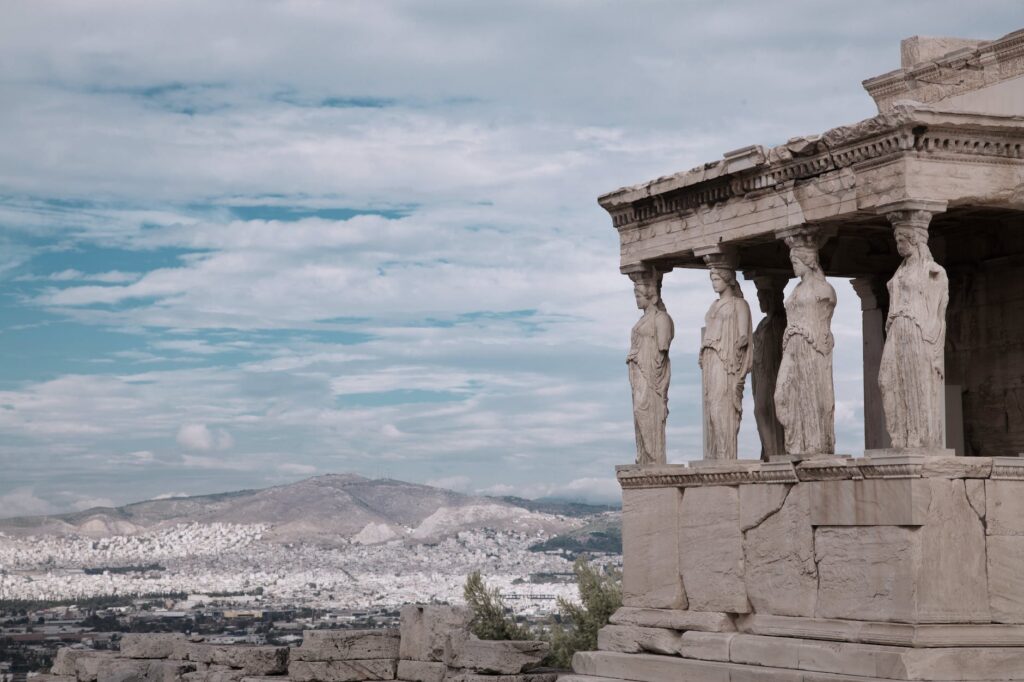
ancient greek temple
Photo by jimmy teoh on Pexels.com

Creation myths often speak of a first created Being that is androgynous , e.g. Adam, Eros, Hermophrodite, Awanawilona,(Pueblo divinity), Tiresias, Tai, Yuan, etc. The genders of male and female are construed as opposites and this in turn demands a dialectical form of description/argumentation because, when apprehended as opposites, it appears as if one opposition term is the negation of the other.

Campbell contrasts the Buddhist position related to Peace in the World with the World Redeemer of Christianity, namely Jesus, and he also notes that Christianity is associated with a partisanship in which the laws of De Civitate Dei appear to apply to a chosen group of people, and this has the military consequence that holy wars are permitted against all the non-chosen “barbarians”. He supports his argumentation by noting that Christian Nation States have a history of “colonial barbarity” and “internecine strife”(Page 134). Marching under the flag of the cross, Campbell argues, is not, however in accordance with the democratic symbol of the cross which is perhaps connected to the wider theme that “All Men are Brothers”. Campbell, proclaims in the context of thisdiscussion that it is to the Eastern Religions we must turn for an account of the experience of the “Transcendental Everlasting”:

“Those who know, not only that the Everlasting lives within them but that they, and all things, really are the Everlastng, dwell in the groves of the wish fulfilling trees, drink the brew of immortality, and listen everywhere to the unheard music of eternal concord. These are the immortals. The Taoist landscape paintngs of China and Japan depict supremely the heavenliness of this terrestrial state.” (Page 142)

Given that the transcendental quality of Being is in a sense beyond thought and beyond speech, it is difficult to contest the picture we have been provided with above. The Philosopher Spinoza is usually referred to as the Philosopher of the Infinite. Much of his work has a hylomorphic character, but he refers not to the infinity of forms but rather to the infinity of modes of God or Substance. God or Substance, for Spinoza, is only accessible by human forms of psuché via the modes of thought and extension, two modes of a possible infinite number of modes. The mode of thought, for Spinoza, is primarily composed of the idea of the object of the body which is also part of the mode of extension, which in its turn is part of the idea of psuché. On this theme, Spinoza claims in his work “Spinozas ethics” in a section entitled “Nature and Origin of the Mind”:

“The idea which constitutes the formal being of the human mind is the idea of the body, which is composed of many individuals, each composed of many parts……Therefore the idea of the human body is composed of the many ideas of the component parts.”(Translated Boyle, A.,London, Aldine Press, 1910. Page 53)

It is clear that the ideas of the mind are not enclosed within their own domain but rather reach out to the external world, and in this process perception is an important power of the body/mind:

“All modes in which any body is affected follow from the nature of the body affected, and at the same time from the nature of the affecting body. Wherefore the idea of them must involve necessarily the nature of each body. Therefore the idea of each mode in which the human body is affected by an external body involves the nature of the human body and that of the external body….Hence it follows in the first place that the human mind can perceive the nature of many bodies at the same time as the nature of its own body. It follows in the second place that the ideas which we have of external bodies indicate rather the disposition of our body than the nature of its own body.” (Page 53)

Kant would subscribe to much of the content in the above quotes and this may not be surprising given that both Philosophers espouse forms of rationalism similar to that of Aristotle. Spinoza believes his Work “Ethics” possesses a mathematical/geometrical structure of arguments which constitute “proofs”. This, of course, is in contrast to the methodologies of both Aristotle and Kant who both wrote in normal academic prose. Spinoza, in this work, also provides us with accounts of the powers of imagination and memory, which both Aristotle and Kant would largely ascribe to. Imagination, Spinoza argues:

“Again, to retain the usual phraseology, the modification of the human body, the ideas of which represent to us external bodies, as if they were present, we shall call the images of things, although they do not recall the figures of things, and when the mind regards bodies in this manner we say it imagines them…And here, so that I may begin to point out where lies error, I would have you note that the imaginations of the mind, regarded in themselves, contain no error, or that the mind does not err from that which it imagines, but only insofar as it is considered as wanting the idea, which cuts off the existence of those things which it imagines, as present to itself. For, if the mind while it imagined things not existing as present to itself, knew at the same time that these things did not in truth exist, it would attribute this power of imagination to an advantage of its nature, not a defect, more especally if this faculty of imagining depends on its own nature alone, that is,if the mind’s faculty of imagining be free.” (Page 55)

Spinoza characterises memory in the following terms:

“If the human body has once been affected at the same time by two or more bodies, when the mind remembers any one of them it will straightway remember the others…..For it is nothing else than a certain concatenation of ideas invoking the nature of things which are outside the human body, and this takes place in the mind according to the order and concatenation of the modifications of the human body.” Pages 55-56)

Spinoza then adds the following remark:

“the mind and the body, are one and the same individual.”

This is an important claim given the historical Cartesian penchant for opposing thought and extension as two different substances, a position modern science largely accepted and adopted in relation to giving an account of psuché. Cartesian dialectical reflection is also involved in the conflict of religions where the central idea appears to be that your God is not my God, not the real God. Indeed, for Spinozas understanding real oppositions such as male and female require adequate ideas for both forms of human psuché which we perceive clearly and distnctly in relation to their logos. Spinoza elaborates upon this theme in the following manner:

“I say expressly that the mind has no adequate, but only confused knowledge of itself, of its body, and of external bodies, when it perceives a thing in the common order of nature, that is, whenever it is determied externally, that is, by fortuitous circumstances, to contemplate this or that, and not when it is determined internally, that is by the fact that it regards many things at once, to understand their agreements, differences, and oppositions , one to another. For whenever it is disposed in this or any other way from within , then it regards things clearly and distinctly.” (Page 62)

The Philosophical conception of science embraced by both Aristotle and Kant includes that of theory which “regrds many things at once” in relation to their “agreements, differences and oppositions”. Philosophical science, in other words, provides us with adequate ideas of the genre and species of psuché, to take one example from one domain of science.

Insofar as psuché is concerned, Spinoza argues that that our idea of this is “very inadequate”:

“We have only a very inadequate kowledge of the duration of our body.The duration of our body does not depend on its essence, nor even on the absolute nature of God; but it is determined for existng and acting in a certain determined ratio by other causes, and these by others, and so on to infinity. Therefore the duration of our body depends on the common order of nature, and the disposition of things. But there is in God an adeqaute knowledge of the reason why things are disposed in any particular way, insofar as he has ideas of all things and not insofar as he has only knowledge of the human body. Wherefore the knowledge of the duration of our body is very inadequate in God insofar as he is considered as constituting only the nature of the human mind, that is, this knowledge is very inadequate in our mind.” (Pages 62-63)

This, of course, is an issue touched upon by the Kantian notion of noumenal reality which includes not only the inadequate idea we have of the external world but also the inadequate idea we have of our bodies as well. Kant, of course, beieves that we can have an adequate idea of the freedom of our mental powers to influence our wills and our actions. Spinoza, disagrees claiming that:

“men are mistaken in thinking themselves free.”(Page 64)

Spinoza believes this proposition, on the grounds that the primary idea of the mind is the inadequate idea of the body which is subject to a large number of causes stretching back to infinity. Spinoza goes on to claim that those that say that:

“human actions depend on the will” (Page 64)

do not understand exactly what they are saying. The question to raise in the context of this discussion is: given the fact that God constitutes our mind and our minds therefore possess a divine element or divine ideas, does this mean that freedom, if it exists, is god-given or not? Kant, we know, argues that freedom is causa sui—cause of itself– and this may imply that this is the divine element of ur constitution and the reason why we needed to be commanded in the Garden of Eden by God not to eat from the tree of the kowledge of good and evil and perhaps it is also why we need to be commanded to love our neighbours and God above all. If, however, this is the case, then our lack of knowledge of the causes that produced a constitution possessing the ideas of God and freedom is irrelevant

Some religions such as Buddhism claim that our life is a journey with a beginning and end on a noble pathway. Buddhism has been construed as an Enlightened religion because of its view of the importance of knowledge of the external world and the mind. The external physical world is conceived of in terms of what is described as the “sermon of the inanimate” which the Philosopher Thales expressed in his proclamation that “all things are full of Gods”. Campbell claimes to see this spirit in the Taoist Tea ceremonies. He also refers in this context to the myths of the Apaches and some African mythologies which proclaim that the rocks, fire, and water, are all alive like the plants. This may be a category mistake insofar as thought is concerned for both hylomorphic and critical Philosophy.

The issue of gods and goddesses, the divine opposites, is an important issue for Campbell who claims in this context that:

“For in the language of the divine pictures, the world of time is the great mother-womb. The life therein, begotten by the father, is compounded of her darkness and his light. We are conceived in her and dwell removed from the father, but when we pass from the womb of time at death (which is our birth to eternity) we are given into his hands. The wise realise, even within this womb, that they have come from and are returning to the father:while the very wise know that she and he are in substance one.”(Page 144)

Campbell continues:

“The union of the two is productive of the world, in which all things are at once temporal and eternal, created in the image of this self-knowing, male, female, God.”(Page 145)

We are created in the image of God and this theme of the opposites occupies Campbells attention at the level of the “opposites” of the male thunderbolt symbol and the female symbol of the bell which provides us with the melancholic sound of eternity. The bell summons us to take the noble path to the end, with the understanding that upon reaching the end we know it to be the beginning: opposites become one, including those most puzzling opposites of good and evil. It is at this point thatCampbell cites from the Upanishads whose claim is that when the hero takes the noble path to Brahman all opposites unite, including good and evil into one God, one Substance.
The Delphic podcasts Review of Campbells “Hero” writings, Season 8, Episode 1

Views: 334

Philip Cousineau in his Introduction to Campbell’s “The Hero’s Journey” claims that Campbell’s search was for the Logos of the phenomena he investigated. The concern, that is, was what these phenomena had in common rather than what differentiated them from each other. The method used was described as comparative historical elucidation and it can be contrasted with the method of Wittgenstein, which sought essentially to differentiate between different phenomena. Cousineau reminds us of the proclamation we encounter in the Vedas, namely:

“Truth is one, the sages speak of it  by many names”

In this regard reference is often made to the collective archetypes of Jung, which are used to justify the denotation of many sacred narratives Campbell calls these sacred narratives or myths the “Masks of god” which partly constitute the “morphogenetic field” which we presume is identified with  “The Truth” mentioned in relation to the Vedas above. The role of the hero is, we have agued in previous reviews of Campbell’s work, an ambiguous reference, which appears to exclude the quiet contemplative rational transformation Philosophers like Socrates, Plato and Aristotle appear to have undergone in their essentially intellectual journeys. These are the “modern” “pathfinders” in the modern morphogenetic field. We do find Socrates engaged in inner communication with his daemon in life-crisis situations, but Psychoanalysis would have no difficulty in explaining this communication as one between the ego and the superego, in a situation where a choice of life-defining alternative actions are being considered. The life defining experiences of saints, prophets and shamans are of course a much more dramatic affair.

Cousineau claimed that Campbell’s method involved the use of  the hermeneutical method. Paul Ricoeur, the Philosopher, articulates well the concern of hermeneutics for “symbols”, claiming that symbols possess the semantic property of “double meaning”. Expressions with a so-called manifest meaning provoke thought to move to another deeper meaning in what Ricoeur calls the “realm of the sacred”, which we mortals seem able to comprehend only through a glass darkly. Kant speaks in his Third Critique of Judgment of a statue of Isis and an inscription that says “no mortal has ever lifted my veil”.

Aristotle refers to this realm in terms of the realm of Being and he further claims that “Being has many meanings” . This concerns not merely our relation to God, but also our relation to life (psuché), death and the mysteries of the external world.  Campbell uses the word “metaphor” in its Ancient Greek meaning of “carrying beyond”: a meaning that transcends the more modern interpretation in terms of a shift from one semantic region to another. Reference is also made to the archetypes of the soul in the spirit of aletheia (unconcealment or revelation). We encounter this spirit in the Gnostic Gospel of Thomas which articulates  a framework for the “many meanings of Being”, by claiming that the Kingdom of God is both within us and out there in the world, here and now. Eastern Religion also articulates this transcendental feature of our experience in terms of “Thou art that!”.

Ambiguous references to the archetype of the  hero and his journey do not, as we have claimed earlier, acknowledge  the possibility that this appears to run contrary to his stated view that we ought to be wary of unnecessarily universalising particular perspectival narratives which express local ethnographic concerns. It is true that prior to the introduction of Philosophical Reasoning and its Categorical concern with Being and Principles (such as noncontradiction and sufficient Reason), the heros narrative was steered by an imaginative idea of the heros journey. But even if our physiology has stayed the same for 40,000 years as Campbell claimed, the organisation of the brain due to the introduction of writing and reading may well be responsible, as Julian Jaynes suggests, for the kind of self-consciousness that has evolved as a human vicissitude of the instincts. We can see clearly in Plato’s writings, the change of emphasis from the virtue of courage to the virtue of wisdom, and the increasing importance of various forms of knowledge insofar as leading the good spirited flourishing life (eudaimonia) was concerned. Achilles excelled in battle, but his courageous life, otherwise did not meet Socratic or Aristotelian criteria. It was Socrates and the mythical Philosophers, returning to the cave from which they originated, that became the new “ideal”, representing wisdom. Whether we can regard these figures as “heros” is not clear. With the advent of philosophers there is an important shift from the individual perspective to the perspective of the polis which, for Socrates, was the soul (psuché) writ large. Socrates was searching for the definition of justice  but it was Aristotle who presented us with an essence specifying definition of Man, namely rational animal capable of discourse which  transcended the old ideal of the courageous warrior, and perhaps the so called archetype of the hero dissipated with Aristotelian  Rationalism and the telos of the contemplative life.

Socrates’ life was, however, in the old sense “heroic” because it ended the way it did for the reasons that it did, but it was not the battlefield but the agora which was the scene of his activities. Challenging those who thought they knew and who were trying to make the worse argument seem the better, of course, took both courage and wisdom. Socrates, like Jesus, knew the risks he was taking in attempting to persuade people to “know thyself!”. What happened to Socrates proved that the Athenian system was not quite equipped to handle appeals to “the child of the Gods”, namely Philosophy. Aristotle too, became persona non grata and was forced to flee from Athens. There is an argument for the position that the polis as a constitutional entity was not equipped to meet the demands for the “new ideals” the Philosophers  were arguing for, namely justice, knowledge, and freedom. An interesting footnote to this discussion is the attempt of Alexander the Great, Aristotle’s pupil, to establish a Greek Empire, thereby helping to destabilise the existing system of  polis/states. In the spirit of the Aristotelian principle of the Golden Mean, it is worth pointing out that  during Kant’s time, neither cities nor empires, but nations became the entities with constitutions.

Campbell in the Preface to his 1949 edition of “The Hero with a thousand faces” refers to a Freudian critique of religion and mythology:

“The Truths contained in religious doctrines are after all so distorted and systematically disguised that the mass of humanity cannot recognise them as truth. The case is similar to what happens when we tell a child that new-born babies are brought by the stork. Here too, we are telling the truth  in symbolic clothing, for we know what the large bird signifies. But the child does not know it. He hears only the distorted part of what we say, and feels he has been deceived: and we know how often his distrust of the grown-ups, and his refractoriness actually take their start from this impression. We nave become convinced that it is better to avoid such symbolic disguisings of the truth in what we tell the children and not to withhold from them a knowledge of the true state of affairs commensurate with their intellectual level.” (Pages 44-45)

Freud’s point was, according to Campbell, that the ancient muses knew what they were talking about and which metaphors to use to carry their message further. We moderns, however, need to  learn again the “grammar of the symbols”. Campbell adds:

“as a key to this mystery I know of no better modern tool than psychoanalysis.”(The Hero with a thousand faces” (Page xii)

Psychoanalysis, however, has a complex history with roots both in Aristotelian Hylomorphism and Kantian Critical Philosophy, but it is perhaps the latter that is especially relevant to this discussion, given the Freudian declaration that he was a “Kantian Psychologist”. Alongside these relevant facts, however, there is also the deliberate Freudian choice of terminology drawn from Platonic Philosophy, e.g. Eros, Thanatos, Ananke, logos, which clearly transcend the technical language Freud uses to characterise the treatment of his patients. The Freudian theory of the “psychic-apparatus” and its possession of psychological powers in relation to the external world, also manifests elements of Greek thinking that presupposed the Greek view of psuché embedded in a categorical framework of areté, dike, arché, epistemé, aletheia and eudaimonia. In this Philosophical/technical framework there is no clear role for narratives of heros and their quests. The heros quest for self- transformation  often contains the occurrence of supernatural events in which tremendous forces are overcome by a superhuman will and determination, communicating perhaps the narcissistic message that “anything is “possible” for such men. The Aristotelian process of self- actualisation is not embedded in a narrative or a story, but is rather part of a philosophical account of the cultural development of a number of powers of human psuché, including the powers of discourse and rationality which are integrated with a number of other psychological/mental powers or functions that in turn have important relations to the external world.

It was Plato that initiated this transition from the form of the narrative to a more enlightened philosophical form of  “Philosophical dialogues” featuring the “ very real character” of Socrates, whose mode of being was one of self-efacement rather than self-proclamation. His power of persuasion was considerable,  because it was founded upon areté, arché, episteme dike, aletheia, logos, and eudaimonia. One can, if one so desires, read the episodes of the dialogues in terms of the adventures of Socrates, but that would be to miss the pedagogical point of the dialogues, which was to herald in the new era of the new ideals of  principles and rationality, emphasising  simultaneously the rejection of  heros and the rejection of the strategy of making the worse argument seem the better.

The heroic narrative is at best an exercise of the imagination and emotion in the name of the good spirited flourishing life of the individual which, in an aesthetic context, carries the subjective message of exemplary universality and necessity articulated in Kant’s Third Critique. It is true that the trilogy of dialogues, Euthyphro, Apology and Phaedo, seemingly promote a narrative of  the Socratic journey to his final destination in a death-cell. The message of these dialogues, however, is more complex. A man who has dedicated his life to justice is convicted for attempting to make citizens aware of the essence of Justice. Socrates at no point proclaimed himself to be a hero or a saviour, and he did not proclaim directly that Philosophy could save us from the Delphic prophecy of ruin and destruction. He nevertheless, over time, became a symbol for  the necessity and transcendence of Philosophy.

Athens was the home of three of the greatest Philosophers in history, in relatively rapid succession, and their bond of connection was a sacred one: that of  teacher-pupil. Plato incorporated the spirit of Socrates into his dialogues, and Aristotle incorporated the spirits of both Socrates and Plato into his writings. Campbells account of the heros journey has a very different structure, which it can be argued, was promoted into a cult of the hero by Thomas Carlysle, which in turn was transformed into the Hegelian idea of world historical individuals such as Napoleon . This underwent a further transformation into  Nietzsches “Will to power”. Associated ideas of “Domination” and Colonisation” were  political ideals that have been embraced by a number of modern tyrants since Napoleon. The Greek political heritage, however, probably lies closer to Schopenhauers “will to live” and Kant’s “good will”. Its epistemological heritage encourages a belief in “scientific” explanation/justification. Its artistic heritage includes a belief in the importance of Art and its associated ideals of the beautiful and sublime.

Campbell was undoubtedly a significant explorer of the breadth and depth of  psuché via the linking of distant mythologies such as that of the Navaho and Hinduism. His arguments are sometimes hylomorphic and sometimes Kantian but they lack an important philosophical dimension which we have attempted to articulate. It is true as Campbell maintains that mans physiology has not altered for 40000 years but mans most important organ is his brain and the organisation of the functions of that organ may have changed during this period. Language, Julian Jaynes has argued was originally a bilateral function like all the other physiological functions of the brain. The science of physiology teaches us that an organ can lose one function and acquire another. In the case of the origins and history of the function of language, Jaynes has interesting theories to contribute:

“Language, Jaynes argues, began as an expressive phenomenon partly connected to events of importance in the external world /e.g. hunting,  and gathering). By a charted series of functions, this developmental sequence eventually reaches the level or representative thought in which we find the names for animals developing into a more complex  stage in which names are given to individual people. At this stage it would be fair to say that we are definitely thinking something. As group life evolved we then find language evolving into more complex forms via the use of sentences with subject-predicate structures which illustrate the fully mental power of thinking something about something which Heidegger called the veritative (truth-making) synthesis. This, however is not the final level of the Mental which is achieved only when the principles of Logic  and Truth tables begin to constitute and regulate the field of sound argumentation—the field of rationality. These higher mental operations are undoubtedly inhabitants of the realm of the mental being essentially connected to the telos of self-conscious thought.” (James, M.R.,D., The World Explored, the World suffered: A Philosophical istory of Psychology, Cognition, Emotion, Consciousness, and Action: Volume four, Page 194)

This is a hylomorphic  account of the development and integration of human psychological powers that are implied by the essence specifying definition of human psuché, namely rational animal capable of discourse. Whilst different languages spoken by different races of man with different histories compel us to attend  to these differences, biological reflection focuses upon what we, who are different in certain respects, have in common. In simple primitive environments  consciousness  may not have possessed the same level of complexity, but mythical narratives certainly appealed to the powers of the imagination and sensibility, quickening in those who had the requisite capacities, an experience of transcendence. Primitive man certainly used myths to orient himself in his environment as well as to begin the attempt to know himself. Campbell claims in this context:

“The symbols of mythology are not manufactured: they cannot be ordered, invented or permanently suppressed. They are spontaneous productions of the psyche, and each bears within it, undamaged, the germ power of its source.” (The Hero with a thousand faces, Page 2)

Many scientific disciplines contribute to our understanding of primitive man and his primitive form of life and Campbell invokes psychoanalysis amongst these. He refers to the long childhood of man, and the subsequent long period of dependence upon our care-givers. As the repertoire of human psychological and mental powers develop much can go awry to disturb this development, and identification of the causes of psychological or mental health problems are not always straightforward matters. One image which the Ancient Greeks use to provide us with an understanding of the human self actualisation process is that of the labyrinth, and psychoanalysis certainly provides us with one of the threads leading out of the cave and into the sunlight. Myth and Religion too provides us with such a thread as does Philosophy.

In an interview entitled “The Road of Trials” Campbell refers to James Joyce and the Arts  as responsible for awakening in them the realisation of the universal  meaning of the symbols we find in our Myths. In this context he also refers to Hinduism which already in the 9th century BC acknowledged that:

“all the deities are projections of psychological power, and they are within you and not  out there. They’re out there also, in a certain way, in a mysterious way but the real place for them is in here (points to the heart).” (Pages 36-37)

James Joyce helped Campbell understand the Eastern texts and laid the foundation for the next phase of his journey, in which he discovered Freud, Jung, and Thomas Mann whilst studying Sanskrit. Yet it was another German Psychologist whom he met in 1981 who would play a large part in helping him to synthesise ideas from Myth, Art, Psychology and Literature, and relate these ideas to the fundamental problem of life, which is:

“to become transparent to transcendence: so that you realise that you are yourself a manifestation of this” (Campbells The Hero’s Journey, Page 51).

Campbell spent one hour with Karlfried Graf Durckheim from Freiburg and emerged from this meeting with a definition of myth as:

“a metaphor transparent to transcendence” (Page 51)

The Ancient Greek spirit of aletheia hovers over all these reflections because it is clear that we are in a world of symbolic language which carries us beyond  the normal concerns of speech into the “realm of the sacred”, which is the realm of psuché (life) in which we feel at one with the Universe and especially with all forms of  life. Schopenhauer, following Kant, highlighted this aspect of metaphysics when he pointed to the phenomenon of humans sacrificing their lives to save the lives of others, thereby transcending Spinoza’s principle of self preservation in which it is claimed all things strive to preserve themselves in existence.