Views: 21
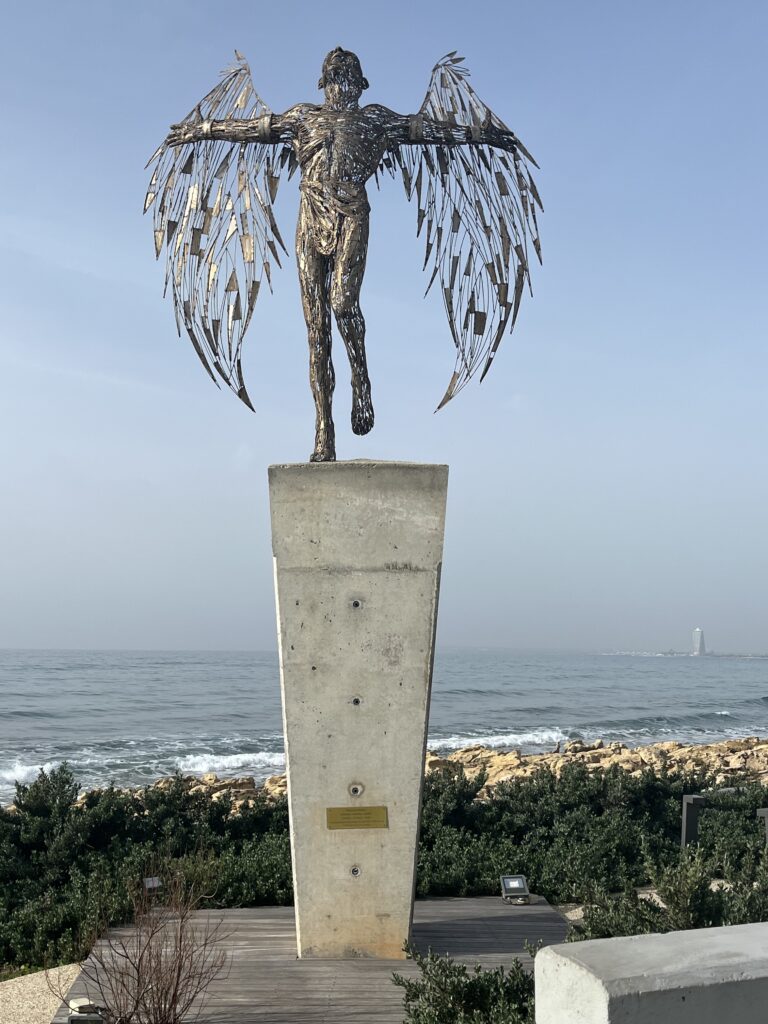
Wittgenstein claimed that the harmony between metaphysical entities such as thought and reality are to be found in the grammar of our language which also houses the essences of phenomenoal entities such as man which Aristotle defined as the “rational animal capable of discourse”. The legend of Icarus in Ancient Greek Mythology is of course a cautionary tale testifying to the consequences of the failure of rationality. Icarus was warned by his father not to fly too close to the sun which he did, thereby melting the wax that held the wings fastened to his body, thereupon plummeting to his death . This of course can not be a “realistic” phenomenal tale simply because we now know that constructed wings and wax do not have the energy to lift us high in the sky.
This tale, rather, had moral transcendental intentions that built upon a Kantian transcendental analogy which Kant defined in relation to our knowledge of God, thus:
“as the promotion of the welfare of children (=a) is to the love of parents (=b), so the welfare of the human species (=c) is to that unknown in God (=x) which we call love.” (Prolegomena to any Future Metaphysics”, trans Ellington J.W., Indianapolis, Hacket Publishing,1977, ftnt Page 98)
Paul Ricouer in his hermeneutical investigations of language, identified what he called the “realm of the sacred” which includes God and the reason he loves those humans who live holy lives, lives that, according to Kant, (who acknowledges this realm of the sacred) are led in accordance with the categorical imperative (treating all humans and higher forms of psuché as ends in themselves). The analogy Kant refers to above involves family relations which may also be in the realm of the sacred, if one reasons that children must be regarded as “known” ends-in themselves.
The love of God is an unknown end-in-itself, which some Freudians may regard as illusory, a wish fulfillment of gigantic cultural proportions. Kant has decided that this is not the case, and if our modern response to Deus Absconditis is a symbol worth interpreting, such an interpretation may result in the judgement that Kant was right in claiming that God is a necessary idea for the cultural development of human psuché: under the important condition, of course, that we “know ourselves”. Icarus was inebriated with the thought of the freedom of flying and refused to heed his fathers Aristotelian advice (The Principle of the Golden Mean). His fate was in accord with the Socratic idea of justice that people ought to get what they deserve in life. This legend was a family drama which was meant to be generalised to everyone in all moral circumstances.
Ricoeurs investigations of the realm of the sacred was conducted mostly as part of his into the “Symbolism of Evil” where he began by investigating the evil men confessed to. These confessions Ricoeur claimed were part of the process of “knowing oneself” , telling the truth about oneself. The nature of the evil is of course crucial to the future . Certain crimes such as murder for Socrates would result in a virtuous man being unable to live with what he had done, because it is now true that he is a murderer and it is impossible to live with a murderer.
We know Wittgenstein was a religious man and claimed to be more interested in aesthetic and religious problems. He, together with Ricoeur, was the most modern of the Philosophers, refusing to abandon certain traditions and regretting the passing of these traditions. The flying invention of Dedalus was a precursor to the invention of flight machines which would takes us around the world wherever we wanted to go. This invention in the name of freedom was of course to be used by the “new men” (Arendts term for those moderns filled with the hubris of Icarus) for the purposes of war and mass destruction which occurred whilst God was making an exit from our lives thanks to modern materialism and scepticism. God of course in a certain specific philosophical sense, lives on in the corridors of universities where Aristotelians, Kantians and Wittgensteinians found a refuge and a home. God lives on also in the pages of the writings of these Philosophers as long as we moderns can summon the energy to continue reading for the purposes of acquiring knowledge.