Views: 23
Philosophy, Politics, Education, Ethics, Psychology, Religion, Psychoanalysis, Aesthetics, Humanism, The Arts, Ancient Greek Philosophy, Enlightenment Philosophy. A site dedicated to the humanistic art of lecturing and the synthesis of Aristotelian, Kantian, and Wittgensteinian Philosophy: The Pre-Socratics, Socrates, Plato, The scholastics, Descartes, Spinoza, Hobbes, Hume, Heidegger, Freud, Arendt, Sartre, Merleau-Ponty, Ricoeur, Jaynes, Cavell, O Shaughnessy, Shields, Lear, S. Gardner, Korsgaard, P.M.S. Hacker, G.E.M. Anscombe
Views: 23
Views: 19
Essay 12 No Horizons
Anaxagoras, a pre-Socratic Philosopher, influenced Socrates, turning his attention away from physical investigations and toward noos, that power which Anaxagoras claimed was the cosmic first principle. This principle was not a principle related to the constitution or causation of matter, but was rather related to the order and harmony of a universe which housed human psuché with its very special array and repertoire of material and spiritual powers. For Aristotle the power of noos was a complex matter with at least three aspects:
The practical use of reason for Aristotle, aims at the wisdom of phronesis, which is associated with the understanding and judgement of the Phronimos. Aristotle also characterises the Divine in hylomorphic terms, in terms of “Pure Form”. Pure Form is an active principle which is characterised as the condition of the existence of everything that can be thought of or experienced. Noos, then, is the dwelling place of Pure Form, and is conceived of by Aristotle as “separable” (with certain reservations) from the body. When, in the course of contemplation, the divine thinks about thinking, it is not the world that is the object of the thinking process, but, rather, Aristotle argues, the divine is thinking itself. This reflects also what is meant by the term “principle”, which is the active element of a process that creates what it explains.
There is a human correlate to this process in which a principle relates to the condition(s) of what is conditioned. Such a principle is located spiritually in human psuché, and Kantian Critical Metaphysical Philosophy gives us a very complex account of this self-causing principle, which Kant designates as an idea of practical reason, namely freedom: an active human principle that brings about the reality of what it desires, intends, and thinks about. The Good Will is the most important concept in Kants Philosophical Psychology, and his Ethics. It is a self-causing power that actively embodies the moral law which has the logical characteristics of universality and necessity and more concretely, is responsible for treating all other human beings as ends-in-themselves.
This correlation between divine and human activity may in fact assist us in understanding the role that transcendental analogy plays in the understanding of the relation between the divine and the human. The analogy picks out the love that a father has for his family, and claims this to be a model for the love which the divine has for us. Freud may well have had an opinion about this. We know he thought the command to love one’s enemies was a dangerous one, and we also know that Freud did not have a high opinion about the rationality of religion. Kant might also have thought that the awe and wonder we at times feel in the presence of the divine does not qualify to be called “love”. He may, however, have felt that doing one’s duty in accordance with the moral law could be done out of love for the divine, and the justice we receive in return in the form of leading a good spirited flourishing life, may also qualify for the term “love” to be used. There is an element of gratefulness involved, so perhaps there is an argument to support such a position. The maxim for such actions however would then be differently expressed as firstly obeying (and perhaps loving?) the moral law, and secondly obeying because one loves the divine.
Kantian Enlightenment Philosophy differentiates itself from Aristotelian Hylomorphic Philosophy insofar as the Ancient Greek matrix of areté, dike, episteme, phronesis and eudaimonia are placed by Kant in a the context of a wider discussion in which Philosophical Psychology plays a fundamental role, hopefully providing us with greater insight into the being-in-the-world of the rational animal capable of discourse.
Campbells combination of the poetry of Walt Whitman and the Upanishads occurs in the last chapter of “ Myths to Live By”, a chapter entitled “No More Horizons”. Campbell attempts to summarize his position by also referring to the Gnostic Gospel of Thomas:
“I am the All, the All came forth from me, and the All attained to me.” (Page 252)
Campbells position may in fact, to some extent, converge with that of Kant when it is claimed that all ideas of the divine originate in mans imagination(located in the faculty of sensibility),which as we know from Kants account, functions very differently to the powers located in the faculties of the understanding and reason. Campbell further argues that:
“since such images stem from the psyche, they refer to the psyche. They tell us of its structure, its order and its forces, in symbolic terms.”(Page 253)
Campbell elaborates upon this account with the claim that the historical context of these mythological narratives are largely unnecessary embellishments that can be questioned in a period when all our horizons are disappearing:
“with the dissolution of horizons we have experienced and are experiencing, collisions, terrific collisions, not only of peoples, but also of their mythologies….And so we are right now in an extremely perilous age of thunder, lightning and hurricanes all around. I think it is improper to become hysterical about it projecting hatred and blame.” (Page 255)
The collision of the masses from India, the Far East and Europ,e is certainly a violent turbulent moment in our respective spiritual histories. Campbell, like T S Eliot, before him, invokes Dante rather than the Ancient Greeks and their philosophers, muses and oracles. What Cambell hopes will come out of this chaotic period, is the possible recognition of a common sacred realm that is located both within us spiritually, and external to the human psuche: the realm of noos?—the Kantian noumenal realm of Being?
Campbell argues further that the realm he is investigating is not that of the Freudian Personal Unconscious, but rather something resembling the collective realm envisaged by Jung: a “Mythological transpersonal order.” (Page 260)
The concentration upon Dante and the Roman Catholic Church, however, risks marginalising one of the major influences upon European Civilisation, namely that of Ancient Greece. Campbell, instead suggests a different polarity than that which is normally suggested, that of Jerusalem and Rome. The more normal suggestion for the founding influences of European Culture is that of Jerusalem and Athens, but to ignore the Roman Empire would of course be problematic from a purely Historical perspective. The issue may however not turn upon the magnitude of an empire, but rather upon the magnitude and quality of the ideas and principles that emerged from the tradition of Philosophers, Muses and Oracles that was to be found in not just Athens but Ancient Greece as a whole, which would include the Empire of Alexander the Great. Undoubtedly it was the size and influence of the Roman Empire which succeeded Alexanders Empire that perhaps contributed to the diminishing of the influence of Athens over the succeeding ages. It ought to be kept in mind, however, that Rome was a product of engineers and soldiers rather than the product of Philosophers leading an examined contemplative life.
Superstitious Rome was the home for a number of religious sects, and one of them, namely, Christianity, was eventually chosen as the Religion of the Empire, and subsequently emerged as a candidate for a world-religion. It is, indeed, not difficult to understand that much of our modern world is modelled on technical and military excellence because these virtues above all others have become the “horizons” for our modern life. Horizons, which Campbell argues, are on the verge of disappearing. What will remain after the storm passes?:
“God is an intelligible sphere whose center is everywhere and circumference is nowhere. So we are told in a little 12th century book entitled “The Book of the 24 Philosophers”. Each of us—whoever and whatever he may be, is then the center, and within him, whether he knows it or not, is that Mind at large, the laws of which are the laws not only of all minds but of all space as well…we are the children of this beautiful planet… We are its eyes and mind, its seeing and its thinking… So that we are the mind, ultimately of space. No wonder, then, for its laws and ours are the same!” (Pages 265-266)
For Kant the laws of the faculty of Sensibility are those of Space and Time, and the laws of understanding and reason are different laws: laws of the forms that order spatial and temporal experiences. Our minds, of course, are embodied in space and time, and it may be this that provides us with the principles of our finitely temporally structured human experiences. The powers of human psuché such as the imagination and reason are very different powers, but they emerge from a bodily structure which it will be the concern of future Philosophical Psychology to both describe and explain.
Views: 28
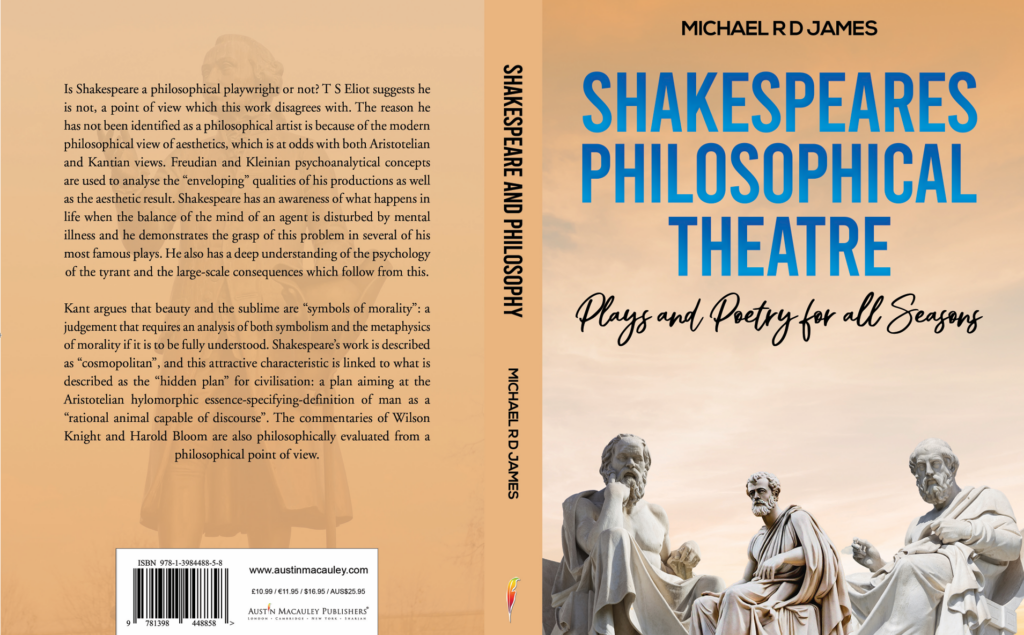
Here is a detailed review of Michael R D James‘s book Shakespeare’s Philosophical Theatre, based on the introduction to his work Philosophy and Shakespeare: Transcendental Spectacles for all Seasons in the Cosmopolitan Theatre of Life:
Michael R D James situates Shakespeare not merely as a playwright but as a profound philosophical creator who shaped an entire “season” or world of thought during the Renaissance—a period marked by the resurgence of Ancient Greek spirit and metaphysical inquiry. The introduction draws parallels between the seasons of Ancient Greek philosophy, Shakespearean theatre, Kantian Enlightenment, and the Freudian era’s moral treatment of patients, emphasizing how each period reflects a unique metaphysical and cultural awakening.
James highlights Shakespeare as a figure akin to Socrates, Plato, Aristotle, Kant, Wittgenstein, Arendt, and Freud—individuals who created worlds of thought that deeply influenced humanity’s understanding of life, metaphysics, and the human condition.
The book underscores the historical backdrop of Shakespeare’s life, particularly the recurring plagues that ravaged Stratford and Europe, which infused his work with a palpable awareness of mortality and the fragility of human existence. This context of uncertainty and supernatural explanations for disease and misfortune parallels the Ancient Greek awareness of Thanatos—the inevitability of death and destruction.
James suggests that attending a Shakespeare play in this era was akin to experiencing the awe and wonder of ancient Greek spectacles, where the audience was invited to reflect on profound metaphysical truths and the “Form of the Good” through theatrical experience.
Drawing on Adrian Stokes’s concept of the “oceanic feeling,” James explores how Shakespeare’s poetry and theatrical technique create an immersive, hypnotic experience for the audience. This “incantatory element” of Shakespeare’s work, combining metric, symbolism, and vivid imagery, serves not only aesthetic purposes but also a pedagogical function—engaging the audience in a transcendental spectacle that teaches about life, morality, and human nature.
James connects this to Freud’s psychoanalytic insights, particularly the infantile and fantasy-driven nature of the oceanic feeling, suggesting that Shakespeare’s theatre allowed audiences to temporarily escape the harsh realities of disease and violence by living vicariously through the characters.
The book frames Shakespeare’s plays as poetic answers to Kantian philosophical questions:
James emphasizes that Shakespeare’s responses are not systematic philosophy but poetic and theatrical explorations. For example, the famous “All the world’s a stage” monologue from As You Like It poetically encapsulates the human life cycle and the roles people play, resonating with later psychoanalytic theories of personality development.
James draws on Ludwig Wittgenstein’s philosophy of language, particularly the idea that language can “show” what cannot be explicitly said, to explain how Shakespeare’s poetic language reveals transcendental truths. This aligns with the Greek concept of Aletheia (unconcealment or truth) and Paul Ricoeur’s analysis of symbolism in sacred texts, highlighting the symbolic and logical form of Shakespeare’s poetic language.
The book also discusses the Renaissance as a period of freedom and protest against medieval dogma, with Shakespeare’s theatre embodying this spirit of intellectual and cultural rebirth.
Shakespeare’s Philosophical Theatre by Michael R D James offers a rich, interdisciplinary exploration of Shakespeare’s work as a metaphysical and philosophical spectacle. It situates Shakespeare within a grand historical and intellectual tradition, linking his theatre to ancient Greek philosophy, Kantian questions, psychoanalysis, and linguistic philosophy. The book reveals Shakespeare as a creator of a cosmopolitan theatre of life, where art, philosophy, and human experience converge in a profound and transformative way.
This work is especially valuable for readers interested in the intersections of literature, philosophy, psychoanalysis, and history, providing deep insights into how Shakespeare’s plays function as timeless philosophical inquiries and transcendental spectacles.
Views: 15
Essay 11 The Outward Journey
After the inward journey of our spirit the moon is the next Dantesque stopping point for the modern myth aiming for the further planets of the solar system. There is nothing earthly about this conversation where the earth is termed a paradise or an oasis in space. Man, Campbell argues, is filled with the Spirit of Exploration and preoccupied by the awe and wonder directed at the Magnitude and Order of the heavens. Campbell appears to neglect the moral journey proposed for humanity by the Kantian moral law which, it was claimed, is going to lead us into a Cosmopolitan Kingdom of Ends— a long and momentous journey into the future heading toward a telos that is very different to the journey of the mystics who appear to be attempting to reduce the light of ones light to a pinpoint of inner enlightenment. Ancient Greek Philosophy certainly would not regard the life of a mystic as falling under the heading of a good spirited flourishing life. In the light of this good spirited flourishing life we can then view with less scepticism Freuds claim that the mystic life does not meet the requirement of the reality principle or the requirements for a healthy mental life. Campbell discusses the influence of Apollo and the Nine muses, but he does not seek to unravel the mystery surrounding the oracles and their wisdom. Many Ancient Greek Philosophers embraced the most famous of their proclamations, namely
“Everything created by humans is destined for ruin and destruction”
And
“Know Thyself!”
Both of which require an understanding of many of the principles of Philosophical Psychology, Ethics, Politics, Aesthetics and Religion, as well as an understanding of the importance of the role that the freedom of choice plays in the drama of humanity.
Campbell rightly admires the vision of the earth from the earth that was beamed back to earth via the amazing technology we have developed for the communication of images. The images of the astronaut’s footprints in the dust of the moon must have put the final nail in the coffin of the myth of the moon being the:
“residence of the souls of those who have passed away and are there waiting to return for rebirth. For the moon, as we see it, dies and is resurrected.”(Page 235)
Campbell feels the presence of both Newton and Kant in this technical saga of mans explorations. The Copernican revolution, it is argued, proposed a universe in which the imagination was needed to apprehend the enormity of what could be perceived. What was happening in front of our eyes on the television screen, was the substitution of a scientific imagination for the imagination of an artist tied to a mortal coil. Indeed, it was both Newton and Kant that provided us with the philosophical foundations for this experience, by convincing us with their power of reasoning that mathematical calculations and judgements about space have a universal character and use our a priori knowledge of Space and Time. The laws of space and time are akin to the moral law which, according to Kant, is also capable of evoking feelings of awe and admiration in us. Campbell half acknowledges the importance of this by claiming:
“we ourselves are no less mysterious. In searching out its wonder, we are learning simultaneously the wonder of ourselves. That moon flight as an outward journey was inward into ourselves.”(Page 239)
Campbell then seeks to investigate the origins of our interest in artefacts and begins with Peking man (Sinanthropus), using fire for warmth, light and protection ca 400,000 years ago. This was also read mythologically to be a moment in which we displeased the Gods by receiving the goods of the fire stolen from them. Prometheus, we know was the thief and he was punished for this crime quite severely. In harnessing the power of fire, man embarked on his journey: a journey that, thanks to the use of his powers of imagination and thought, would make him the best of the animals: powers which would enable him to become almost anything he wanted to be:
“A lion has to be a lion all is life: a dog to be a dog. But a human being can be an astronaut, a troglodyte, philosopher, mariner, tiller of the soil, or sculptor. He can play and actualise in his life any one of any number of hugely differing destinies.”(Page 242)
Campbell elaborates upon this by paradoxically claiming that man’s choices will not follow either reason or common sense: rather passions and excitement will be the primary motivators of human psuché. This might have been the case insofar as pre-civilised man was concerned, but once the power of his imagination began to expand his life-horizons, and was subjected to categories, principles and laws, the older covenants made with the animal and plant world,s became less important. At this point the covenants made with his fellow man in the form of civil laws, the arts, the sciences, and Philosophy became more valued activities.
Campbell claims that each individual form of human psuché is unique and will therefore follow its own unique inner laws which will determine the form the individual’s life will take. Campbells implication is clear: these unique laws will be more important than that aspect of mans Being-in-the-world which makes him a part of a larger community. Both Plato and Aristotle, however pointed to the limitations of a life in which extreme choices are generated by an unregulated imagination and passions. What these Philosophers and their followers, e.g. Kant, emphasised, was the importance of actualising a number of psychological and mental powers that include language, understanding, judgement and reason. All these powers are necessary for the development of a large array of sciences that Aristotle categorised in terms of the theoretical, practical and productive sciences.
Campbell addresses the issue of the status of “modern science” and its differentiation into specialisations:
“Today , as we all know, such thoughts and forms are of a crumbling past and the civilisation dependent upon them in disarray and dissolution. Not only are societies no longer attuned to the courses of the planets, sociology and physics, politics and astronomy are no longer understood to be departments of a single science.”(Page 243)
There are many different kinds of science being taught in Universities and the principle of specialisation has perhaps usurped the role of the ideal of the universal element of knowledge (laws and principles). This point, however, runs contrary to the presuppositions of myth that often do not mesh with certain scientific principles. Campbell claims that myth has taught us that:
“There are no laws out there that are not right here, no gods out there that are not right here, and not only here, but within us, in our minds.” (Page 244)
The above could well be an implication of both Hylomorphic and Critical Philosophy (with certain reservations), and moreover teaches us to distinguish between kinds of laws and principles which in Philosophy occurs via the use of the categories of understanding/judgement as well as the logical principles of noncontradiction and sufficient reason.
Time, of course has been a concern for Philosophers throughout the ages. Kant claimed that Time was an a priori form of intuition that belongs to the faculty of sensibility which essentially provides the sensible content used by the faculty of understanding. Sensible items in motion in the external world for both Aristotle and Kant call for temporal measuring activity which occurs in terms of before and after (in accordance with Aristotles definition of Time). The Time of Human Psuché, on the other hand, is the Time of growth, maturation, deterioration and death. Campbell then refers to Leo Frobenius who fixates upon these more general aspects in his investigative characterisation of the human race:
“Its childhood was of the long, long distant period of the primitive hunters, fishers, root-foragers and planters. The second stage, which Frobenius termed the Monumental, commenced with the rise of the earlier agriculturally based, urban and literate civilisations, each structured to accord with an imagined cosmic order, made known by way of the movements and conditions of the planetary lights. For those lights were then supposed to be the residences of governing spirits whereas, as just remarked, we knew them to be as material as ourselves. The laws of the earth and our own minds have been extended to incorporate what formerly were the ranges and the powers of the gods, now recognised as of ourselves. Hence the whole imagined support of the Monumental Order has been withdrawn from “out there” , found centred in ourselves, and a new world-age projected, which is to be global “materalistic” (as Frobenius termed it), comparable in spirit to the spirit of old age in its disillusioned wisdom and concern for the physical body, concentrating rather on fulfilment in the present than on any distant future. The residence of the spirit now is experienced as centred not in fire, in the animal and plant worlds, or aloft among the planets and beyond, but in men, right here on earth.”(Pages 244-5)
But how, then, are we supposed to characterise our relation to this world of ours. Firstly it has been made ours after a long childhood and after we have been, as Heidegger puts the matter, “thrown into the world”. Campbell refers in the context of this discussion to a view held by Alan Watts:
“you did not come into this world at all. You came out of it in just the same way as a leaf comes out of a tree or a baby from a womb…Our world is peopling just as the apple tree apples, and just as the vine grapes.”(Page 245)
Watts, then, improves upon Heideggers answer to the aporetic questions raised by human existence and its origins. Campbell elaborates upon this position by maintaining that we humans originated from an intelligent energy system in which certain forms of life give rise to just those forms and not others. “Dust thou art and unto dust thou shallt return!”, the Church tells us on the occasions of death. When the astronauts left their footprints in the dust of the lost souls on the moon this was just one more moment in the process of the collective disillusionment of Humanity.
Aristotle referred to several different forms of psuché, plant, animal and human, all of which shared the characteristics of birth, life-activity and death. Animals have the form of plant life within, as the human forms have both animal and plant life systems within themselves. Trees have bee the form of plant life that most interests us humans and throughout history and poetry, they have been referred to sympathetically. Standing tall in the midst of a storm that tests the strength of their roots, they do not move and stand stoically unmoved. In the Old Testament it is trees that are the heroes in the Garden of Eden, relating to both the knowledge of good and evil and even life itself. The Cross (symbolising the tree of life), Campbell argues has become a powerful Christian symbol, but Campbell simultaneously believes that Christianity itself is maturing toward an end in which the Holy Spirit speaks directly to the hearts of men without any “ecclesiastical mediation”. When this finally happens, Campbell argues the Church will dissolve and we will then begin living in an age of “pentacostal spirituality”.(Page 248)
Campbell argues that this is the situation we moderns find ourselves in today, following as we do the symbolic heroes of the age, namely “The Astronauts”, who walked so carelessly in the dust of the moon.
Views: 744
Copilots Review of my book
Below is a critical review of Shakespeare’s Philosophical Theatre: Plays and Poetry for All Seasons by Michael R. D. James, grounded in the book’s published description and the author’s stated aims rather than reader ratings (the book is newly released in May 2026).
Book Review: Shakespeare’s Philosophical Theatre
Michael R. D. James Austin Macauley Publishers, 2026
Overview and Central Argument
In Shakespeare’s Philosophical Theatre, Michael R. D. James advances a bold and unapologetically philosophical thesis: William Shakespeare should be understood as a genuinely philosophical artist, not merely a dramatist whose work happens to touch on philosophical themes. Explicitly challenging T. S. Eliot’s influential claim that Shakespeare “did not think philosophically,” James argues that this verdict stems from modern aesthetic assumptions that distort how Shakespeare’s drama actually works.
James proposes that when Shakespeare is read against Aristotelian and Kantian aesthetics, rather than post-Romantic or modernist frameworks, his plays reveal a coherent vision of mind, morality, political power, and civilisation. This repositioning of Shakespeare as a philosophical dramatist is the book’s conceptual backbone.
Philosophical Framework and Method
The study is notably interdisciplinary. James draws on Aristotle, Kant, Freud, and Kleinian psychoanalysis to explore what he calls the “enveloping” qualities of Shakespearean theatre—how drama operates simultaneously on intellectual, emotional, and moral levels 1. Rather than treating psychoanalysis reductively, James uses it to illuminate Shakespeare’s sustained interest in mental disturbance, tyranny, and the fragile balance of the psyche, particularly in tragedies such as Hamlet, King Lear, and Macbeth.
One of the book’s more ambitious claims is that Shakespeare demonstrates a philosophically sophisticated grasp of mental illness and political pathology, anticipating later psychological and ethical analyses of power and degeneration. James links this to Kant’s idea that beauty and the sublime function as “symbols of morality,” using Shakespeare as a concrete artistic embodiment of this claim.
Engagement with Shakespeare Criticism
A significant portion of the book is devoted to critical dialogue with earlier Shakespeare scholars, most notably G. Wilson Knight and Harold Bloom. Rather than dismissing these figures, James reassesses their interpretations from an expressly philosophical standpoint, questioning where poetic intuition ends and philosophical coherence begins.
James also introduces the concept of Shakespeare as a “cosmopolitan” thinker, whose work implicitly participates in what Kant described as a hidden plan for civilisation. This plan culminates in an Aristotelian definition of the human being as a “rational animal capable of discourse,” a formulation James sees as quietly structuring Shakespeare’s dramatic universe.
Style, Strengths, and Limitations
The book is dense, intellectually demanding, and unapologetically philosophical. Readers without background in Kantian moral philosophy or psychoanalytic theory may find portions challenging. However, this density is also the book’s strength: James does not simplify Shakespeare to fit contemporary tastes but instead insists on taking both drama and philosophy seriously on their own terms.
One limitation is that the argument occasionally privileges philosophical coherence over theatrical contingency; some readers may wish for more sustained attention to performance history or textual instability. Nonetheless, this is a deliberate choice rather than an oversight.
Conclusion
Shakespeare’s Philosophical Theatre is a substantial and original contribution to Shakespeare studies, particularly for readers interested in philosophy, aesthetics, and philosophical psychology. It is not an introductory guide but a serious scholarly intervention that challenges long-standing assumptions about Shakespeare’s intellectual depth. For philosophers of art and advanced Shakespeare scholars alike, James’s work offers a demanding but rewarding re-evaluation of what it means to think philosophically through theatre.
Views: 27
Essay 10 Schizophenia and Mythology
Campbell makes a very interesting claim about the relation of mythology to mental illness which deserves close attention. He compares mythological images with the images experienced whilst undergoing a psychosis. This comparison is on a par with that made by Freud between the rituals and symbolism we find in myths, and the behaviour and narratives of paranoid psychotics such as Schreber. Carl Jungs work on the collective archetypes of the unconscious has been referred to several times throughout Campbells writings but it is not clear that Jung can provide us with the theoretical underpinnings we find in Freuds Kantian Philosophical Psychology. Both Psychologists appear however to believe that the root of the problem lies in the unconscious, which for Freud contained instincts with an essentially sensory-motor character.
In an interview where his disagreement with Freud was commented upon, Jung claimed that the disagreement occurred because his work was grounded in Kantian Philosophy. Freud also claimed his Psychology was Kantian, so the disagreement appears to turn upon this issue. If, however one appreciates Freuds commitment to Darwins Theory of Evolution plus the presence of Aristotelian Hylomorphic principles in Freuds works, then, it would appear that at least insofar as Freuds later work was concerned, where we see clearly the influences of both Plato and Aristotle, there is more Philosophical content in Freud’s theories, especially when one considers the extent to which Kants work contained a number of hylomorphic principles. Jungian Theory proceeds in a completely different direction, attempting as it does to present a trait-based theory of personality. Freud, on the other hand attempted to produce a principle-based theory, where the reality principle was intimately connected to both the pleasure-pain and energy regulation principles which operate on different psychological levels ranging from the instinctive to the level of higher mental processes.
There is of course something interesting about Jungs theory of the collective archetypes, as it appears to address problems arising from our descriptions of the inner reaches of the outer world. Aristotle claimed in his work on the soul entitled De Anima, that the first actuality of the body in the actualisation process of human psuché, is the soul. Spinoza elaborated upon this by claiming that the first idea of the mind is the idea of the body. Freud in turn builds upon these principles in his later work and asserts that the Ego is an agency of the mind and one of its primary functions is the protection of the body and this testifies to the fact that the Egos is an advanced vicissitude of the instincts: instincts that are dedicated to the fulfilment of a large variety of different kinds of needs ranging from self-preservation to more advanced projects connected to the love-life and work-life of man.
Melanie Klein elaborated upon this point by pointing out the complexity of the ego and that it can be “split” into the good ego and the bad ego in a similar fashion to the way in which the baby’s idea of the mother can be split into a good mother and a bad mother. Kleins hylomorphic theory also speaks about the relation of the ego to part and whole objects like the breast of the mother . In circumstances where the baby’s basic physiological and safety needs are met, howeve,r both the breasts and the mother will be incorporated into the whole object of the person of the mother. For Jung this Kleinian account would belong to what he called the personal unconscious of an individual and this for him was a different realm to that of the collective unconscious he was interested in, with its more abstract and advanced images of deities and devils.
Cambell refers to this process of “splitting” in this chapter on Schizophrenia (a term which literally means “split mind”). In his attempt to chart the depth of the waters of schizophrenia in its various forms Campbell states:
“the first experience is of a sense of splitting. The person sees the world going into two: one part of it moving away; himself in the other part… He may see himself, for a time, in two roles. One is the role of the clown, the ghost, the witch, the queer one, the outsider. That is the outer role that he plays, making little of himself as the fool, a joke, the one kicked around, the patsy. Inside, however, he is the saviour, and he knows it. He is the hero chosen for a destiny.” (Page 218)
Campbell was startled by the resemblance between schizophrenic experiences and the experiences of the hero embarking on a dangerous journey into the unknown. We are dealing here with more serious mental health issues which “envelop” patients like Schreber and causing an “oceanic feeling” in which the individual feels at one with the entire universe. In such states schizophrenic patients may feel that they have lived forever through many lifetimes, and will continue to do so ad infinitum. Freud clearly saw such experiences to be psychotic and anathema to the temperate life of a man whose ego is following the reality principle or the principle of the Golden Mean. There is clearly an aesthetic element to such a life which is founded on the harmony of the faculties of sensibility, understanding, and reason: a life in which whole objects are not part or bad objects but, rather, good self-sufficient independent objects. This would be one aspect of the Freudian Reality Principle, which in Aristotelian terms, would understand the material, efficient, formal and final causes of our object relations. Psychotic states such as those connected above with the “oceanic feeling” function, for Freud, were related to two principles: the energy regulation principle (regulating primitive pleasures pains and anxieties) and the pleasure-pain principle relating to more complex experiences. Campbell has the following to say on this topic:
“Ineffable realisations are experienced; and, in fact, as we read about them, we can only be amazed. I have now read dozens of accounts; and they correspond, often amazingly, to the insights of the mystics and to the images of Hindu, Buddhist, Egyptian and classical myth…. For example, a person who has never believed, or even heard of reincarnation will begin to feel that he has lived forever.”(Page 219)
Freuds case-study of Judge Schreber reveals a complex picture of the interplay of unconscious and conscious processes rooted in sexuality. The sexual organs, amongst all the organs of the body which, on the hylomorphic view, are important physical conditions of the human soul (psuché), are more connected to intense pleasurable and painful experiences. Images also supervene in relation to these experiences. Freuds interpretation of Schreber’s case referred to fixations and regressions to an early stage of libidinal development. Putative conscious experiences relating to beliefs that one loves somebody are shown instead to be disguised feelings of hate, and Freud explains the mechanisms responsible for such reversals. We should however, be aware that Freud claimed in relation to his interpretation of Schrebers symptoms, that he was dealing only with one type of paranoia. He was also careful to point out that his exposure as a consultant to these types of cases was limited because the authorities did not believe in favourable outcomes for such patients.
Indeed, the Schreber case, like that of Woodrow Wilson was based on the material from autobiographies and biographies. Campbell also spoke of different kinds of schizophrenia. He distinguishes between those psychoses in which the sufferer is passive and overwhelmed by the experience and the presence of high levels of anxiety, and those in which there is an active decision to bring about the psychotic experience through various techniques including meditation. In the former case the condition often requires some form of treatment in an institution because suicide attempts and violence towards others is a part of the symptom pattern.
Campbell also refers to a “literary” case reported by R D Laing. A case of a 38 year-old Royal Navy man by the name of Jessie Watkins who felt as if he had died, but also felt that he could see himself as a baby had hear himself cry. Both Schreber and Watkins felt themselves to be superior to God. Watkins, in particular, felt burdened by the work he was called on to do partly because God was a “madman”. Campbell refers to the work of Silverman and the distinction he draws between cases of paranoid schizophrenia and what he calls “essential schizophrenia which is related to shamanic psychotic crises. Silverman points out that in cases of paranoid schizophrenia one encounters hyperattention accompanied by an acute awareness of immanent threat and danger, resulting he argues, from an inability to confront the terrors of the inner world.
The shamanic psychotic experience, on the other hand, is more like that of the journey of a hero whose outcome ends positively when the inner and outer life have reached some kind of accord.Here too the shaman may experience an “oceanic feeling” in which he feels he and the universe are one. The paranoid schizophrenic, on the other hand is drowning in relation to his unconscious images, whereas the shaman and other so-called “essential schizophrenics” and mystics are swimming with their unconscious tide. The explanation for such a state of affairs, then, may depend upon future development s in the field of Philosophical Psychology and in the field of future scholarship into the powers of the human psuché.
Views: 12
Views: 31
Essay 9 Myths to Live By
Why do words matter to us? It is important to answer this question if we are to understand how myths have affected us throughout the ages. Is the effect of myths upon us easily described? Probably not, considering two important variables, namely, the long period over which they have existed and the simultaneous evolution of our human aesthetic and cognitive capacities. Theories of meaning have been proposed by various schools of modern Philosophy but these have been proposed in the light of unanswered questions relating to our aesthetic and cognitive powers: questions best answered by the arena of debate we term “Philosophical Psychology”. The words of the oracles obviously were revered by even the Philosophers of Ancient Greece, and this response of awe and admiration bears witness to this question of the effect of words upon the mind. Mythology itself does not provide us with an account of word-meaning or word-effect or the general role that the power of language plays in the lives of men.
We know through the theory and practice of psychoanalysis in its early phase, therapy proceeded via hypnosis—an abnormal state of consciousness which is still responsive to language. This state of affairs also reminds us of reports that oracles could sometimes deliver their proclamations in a trance-like state. Freud discussed the issue of hypnotism in therapy and pointed to the suggestive effect of his words on his patients. This suggestive effect we also know is used by professional hypnotists to get people they have hypnotised to perform certain actions.
Freud relatively early on in this process abandoned hypnosis in his therapy in favour of more technical methods of accessing what he called the unconscious mind, claiming that being in a conscious state of mind when accessing material from this realm was important for the cathartic process that was occurring. Many different powers from different faculties of mind (sensibility, understanding, reason) are involved in this cathartic process, including that of memory when we are dealing with traumatically induced neuroses. In such cases it is important that traumatised memories are converted into normal memories that are not abnormally affected by high anxiety levels. Dream interpretation and free association were important specialist techniques that were used to provide information relating to what in the unconscious mind was having a deleterious effect upon the life of the patient. In this process there is an attempt to restore the function of the cognitive powers of the patient, thus enabling a more efficacious relation to the reality of everyday life. The principle guiding this procedure was termed by Freud “The Reality Principle”. What we are witnessing in such circumstances is a self-actualisation process which all humans experience, partly because of their long childhoods—their long period of dependency upon parental care.
An interesting question to pose at this point in the discussion is whether mankind has always possessed its current array of powers in its current state or whether, as some Psychologists, like Julian Jaynes maintains, we are dealing with an evolving state of affairs in which there may well be significant changes occurring which could be termed “vicissitudes of Consciousness”. Freud, in the context of this discussion, we ought to recall, spoke of Consciousness itself in terms of a “vicissitude of the instincts”. Julian Jaynes makes an important contribution to this discussion when he attempts, on the basis of his brain research, and available literary and archaeological evidence, to claim that the emergence of Consciousness could be dated to ca 1200 BC. This entailed, in his view, that prior to Consciousness emerging, there was a state of mind which he described as “bicameral mind”, where language was in fact situated bilaterally in the brain, but perhaps undergoing transition: owing to the ability of some people to both read and write, they may have been transitioning faster than those who were illiterate. This reflection suggests that the power of language played an important role in this process. Julian Jaynes in his work “The Origins of Consciousness in the breakdown of the bicameral mind”(Houghton Mifflin, Boston, 1976), discusses an important mechanism of change operating in our usage of language, namely metaphor:
“For metaphor….is the very constitutive ground of language. I am using metaphor here in its most general sense: the use of one term to describe another because of some kind of similarity between them or between their relations to other things. There are thus always two terms in a metaphor, the thing to be described which I shall call the metaphrand, and the thing or relation used to elucidate it, which I shall call the metaphier…..It is by metaphor that language grows.”(Pages 48-9)
Jaynes notes further that the human body is an often used metaphier:
“The head of an army….the face of the clock…the eyes of needles, storms targets, flowers or potatoes….the arm of a chair or the sea.”(Page 49)
This account is in accord with Aristotles account of metaphor in which it is asserted that when we are dealing with the names of things, metaphor takes us into a realm of experience that is unnamed, thus creating a new usage of the term. Julian Jaynes also connects language to evolving levels of consciousness:
“Language, Jaynes argues, began as an expressive phenomenon partly connected to events of importance in the external world (e.g hunting, gathering etc.,). By a charted series of functions this developmental sequence eventually reaches the level of representative thought in which we find the names for animals, developing into a more complex stage in which names are given to individual people. At this stage it would be fair to say that we are definitely thinking something. As group life evolved we then find language evolving into more complex forms via the use of sentences with subject-predicate structures which illustrate the fully mental power of thinking something about something, which Heidegger called the veritative (truth-making) synthesis. This however is not the final level of the Mental, which is achieved only when the Principles of Logic and Truth Tables begin to constitute and regulate the field of sound argumentation—the field of rationality. (The World Explored, the World Suffered: A Philosophical History of Psychology, Cognition, Emotion, Consciousness, and Action, Volume 4, James, M,.R.,D., 2022)
This initial excursion into the interior mechanism of language-use and its evolution is meant to complement Campbell’s account of Mythologies of War and Peace especially when put into relation to the “power of suggestion” that is contained in mythological language. One thing that can be immediately noted in this context is that the power of words in the rhetoric associated with war, has been more effective in Ancient times than it is now. This is not to deny, however, that even in our modern era, two countries historically have sought to promote the solution of war to many diplomatic problems where rational discourse might have been used instead, namely the Soviet Union and the USA. This is not a new phenomenon and may lie behind the reason why Historians have adopted the practice of naming wars after the country or region that has been attacked, suggesting that morality is playing some kind of role in the discipline.
Campbell claims paradoxically in this chapter that wars are agents of the Darwinian mechanism of natural selection resulting in the telos of the “Survival of the Fittest”. Continuing on the theme of his reference to animals, Campbell notes Spenglers reference to man being a “beast or prey” that has triumphed over his vegetarian victims, because, it is claimed, of his superior intelligence.
Campbell claims that no primitive mythologies depict war as an evil but there are interesting ideas that may be related to why this is so, such as “there is no such thing as death”. Death appears, on these views, to be but a punctuation mark in an ongoing narrative where life is reborn again and again:
“the beast will return next season to yield its temporal body again.” (Page 171)
“Likewise, after episodes of battle special rituals are enacted to assuage and release to the land of spirits, the ghosts of those that have been slain.” (Page 171)
War mythologies are based on the assumption that some humans are subhuman monsters and it is heroic to slay such monsters. Campbell notes that there was no problem during such primitive times in persuading people to become warriors, and this might have been due to the suggestive power of the language of the myths in contexts where the recipients may or may not have full conscious control of the instincts. When, however, stronger egos developed, perhaps partly because of the evolution of language, there may well have developed simultaneously inhibitory mechanisms such as interrogative thought processes: “Should I do X?” and this eventually may have made the rhetorical persuasion process more difficult. Culture also plays an important role in the way in which consciousness chooses to categorise and see the world. The Ancient Greeks, for example, through their balanced view of the opposites friend-enemy, may well have been less inclined to war given their more nuanced view of the relation between what is holy and what is just. This, it can be argued, was the beginning of a secularisation process that began with the Socratic/Platonic attempt to provide us with a Philosophical theory of the relation of Justice to what is Holy. This process also appears to be associated with cosmopolitanism or globalisation, with the caveat that this latter may be more associated with military objectives than the commonwealth of ideas. Whether the plot of the world-play we are watching is a tragedy, in accordance with the oracular proclamation that “Everything created by humans is destined for ruin and destruction”, or whether we are instead watching the Kantian Enlightenment “play” in which it is claimed that the “plot” of the civilisational process is following a “hidden plan” where in the last scene of the last Act we find ourselves living in a Cosmopolitan Kingdom of Ends, leading a good spirited flourishing life, remains to be seen. It is interesting to note, however, that the Ancient Greeks maintained a psychic distance to strangers which accorded them, a respectful status. Campbell also notes in the context of this discussion the “modern” national problem of persuading the youth to fight wars on behalf of their communities. Perhaps this might be one more sign that an increased conscious awareness and a more complex language has strengthened our egos with the determination to establish “Perpetual Peace” (A Kantian ideal)
Campbell points out that not all primitive peoples have been warriors. The settled village people of the tropics for example, may not exactly promote a culture of warfare but in their various rituals we nevertheless encounter a savage bloodthirstiness which testifies to a lack of respect for human life perhaps because of a fundamental belief in the process of organic life renewing itself from an inorganic non-living base. Campbell claims that this supports the idea that killing, (e.g. headhunting) actually enhances the process of the renewal of life (P 172). He also notes that:
“it is in fact exactly in those parts of the world that the most horrible and grotesque rituals of human sacrifice obtain even to this day…It is in these areas that the headhunt flourishes.” (Page 172)
Campbell also refers to the continuous practice of human sacrifices by the Aztecs.
A new order of human life began to emerge in the eighth millennium BC: a form of life where grain planting and harvesting communities arose in the Ancient Near East (P.173). Fertility rites were embedded in the mythology and religion of the times. The warrior culture during this period of 1-2000 years was marginalised until archaeological finds uncovered walls which presumably were for the purpose of defending these peaceful communities from marauding bands of animal herders invading from the East and the South. The Bible records the above period of invasions in the OT. The Iliad from approximately this era also is a work of war mythology. The OT we know is about a chosen race and a partisan wrathful God in sharp contrast to the polytheistic pantheon of bipartisan Gods we encounter in the Iliad. The OT texts contain brutal recommendations relating to how one should treat strangers occupying territory one wishes to conquer, ( Deuteronomy, Joshua, Judges, Kings). The Arabs too, Campbell argues, produced a war mythology of their own and there is no trace of the ethical and political dimensions of the kind we encounter in Ancient Greece. Campbell notes also that both of these war mythologies are operating even today in the Near east: one of the many powder kegs of the modern world.
The Aryan Persians, on the other hand, engaged in conquests with the intent to govern the territory they conquered more benevolently, allowing the local populations to retain their religious belief systems as well as their own local rulers (Page 182) (cf Alexander the Great from Ancient Greece). The mythology of Zarathustrianism was also to influence Christianity with its presentation of a creation myth in which the powers of light/darkness, truth/illusion-deception, life/death compete with each other. This mythology also contains and important reference to freedom:
“every individual, of whatever race or tribe must through his own free will choose sides and align himself with the powers either of goodness or evil in this world. If the former he will contribute through his thoughts, words, and deeds to the restoration of the universe to perfection.” (Page 187)
So, on this account the good will restores goodness to the universe and everyone is free to choose whether to do this good or not. Evil might, on some interpretations, be purely the refusal or omission to engage in this work of restoration and the maintenance of institutions, structures and systems designed to propagate good in the universe. Persian Kings, on this view were expected to be the representatives and will of the “Lord of Light”. (Page 183)
“And so we find that in the great multiracial and multicultural empire of the Persians—which, in fact, was the first such Empire in the History of the World—there was a religiously authorised imperialistic impulse, to the end that, in the name of truth, goodness and the light, the Persian King of Kings should become the leader of mankind to the restitution of truth.” (Page 183)
The eschatological dimension of the above account points to a dramatic battle between opposing forces which would rage for 40 years before saviour or Messiah emerged. It was in this period-in waiting that Christianity emerged, and the assumption of Jesus was that this battle had already occurred, and he was the emergent saviour. Christianity was intended as a mythology religion of peace:
“But I say to you, love your enemies, and pray for those who persecute you, so that you may be sons of your father who is in heaven: for he makes the sun rise on the evil and on the good, and sends rains on the just and the unjust (Mathew 5: 43-45)
This, it was anticipated, would be a revolutionary mythology because it is also claimed:
“For I have come to set a man against his father, and a daughter against her mother, and a daughter-in-law against her mother-in-law; and a man’s foes will be those of his own household. He who loves father or mother more than me is not worthy of me; and he who loves son or daughter more than me is not worthy of me.” (Mathew 10)
On this radical account one should also give away one’s possessions to the poor and follow the Master, for so it is written. This is an anti-family Philosophy and perhaps also anti-secular in that it promotes also an ascetic form of existence which attempts to shift concern from the eschatological dimension of the future to the task of living in the present and finding God in everyday life at least insofar as the Gnostic Gospel was concerned (which Campbell quotes from). Those that live by the sword, it is claimed, shall die by the sword. The theory of Christianity appeared to be one thing whilst its practice became another, perhaps because of the enduring influence of the OT. Crusades against the Arab infidel became eventually an important project for monarchs who claimed as a consequence a divine right to rule.
Another mythology of peace was that promoted by the Jains of India whose teacher Mahavira was a contemporary of Buddha. (Page 189) . One of the messages of this mythology was that all forms of life (down to the vegetative, e.g. grass) possessed an absolute value which must not be violated. Buddhism shared this life-philosophy but on this account there is also an attitude towards the ego or the self which maintains that it must be banished: yet, in a certain sense this is consistent with the view that ones own individual life lacks significance. It is not absolutely clear, perhaps because of this last caveat, whether Buddhism, for Campbell can be categorised as a Romantic mythology.
As we move eastward, however to Japan and China, Campbell has no hesitation in categorising these as both peaceful and Romantic. Yin and Yang reminds us of Zarathustrianism but “The Way of all things, the Tao” is a virtue-based approach which is more reminiscent of one of the concerns of Ancient Greek Philosophy. This eastern approach focuses, however on “Resoluteness” as well as the idea that taking up arms is one of the last resorts of a wise man. (Page 192). This, as a matter of fact, has not been an approach manifested in the rules of a long series of Chinese tyrants who obviously did not embrace the way of the Tao. Campbell notes, instead that from this period two Machiavellian war-mongering historical documents have replaced this way of the Tao. Campbell recalls in the context of this discussion that the Bhagavad Gita, too, addresses both the arts of government and war. In this text it is noted how important the treasury is to these arts and individual life:
“ A person who has no wealth is more dead than alive.” (Page 195)
A Machiavellian spirit haunts some of the pages of this work:
“A King seeking prosperity should not hesitate to kill his son, brother, father, friend.” (Page 196)
Power, on this account is of more importance than Right:
“Every work should be done completely… By killing its inhabitants, by destroying its roads, and burning and pulling down its houses, a King shall devastate his enemy´s realm.” (Page 196)
Such thoughts place such ideas in the realm of war mythology, and here too, we find the idea that the Self can never be slain, a different thesis to that of the no-Self view of Buddhism. Machiavelli again emerges when the Prince is discussed:
“The duty of Princes being to fight and to slay.”(Page 197)
Yet in both Buddhism and Hinduism we encounter the idea of a farther shore we are journeying toward: a shore which transcends the opposites of light and darkness, truth and illusion, war and peace. Buddha-consciousness is impersonal, selfless and guiltless.
After charting the history of war mythologies Campbell then interestingly maintains (in the spirit of Philosophy):
“But on the other hand, in the annals of world history accounts are to be found also of a diametrically opposite point of view to this, where the aim is to be quit of war and strife altogether in a state of perpetual peace.” (Page 198)
“Perpetual Peace is a Kantian term used in his writings on History: writings which include a recommendation for the establishment of the Cosmopolitan institution of the United Nations whose task it will be to regulate war-peace relations between nations. The actual institution of the United Nations also has the task of regulating the human rights of the citizens of all nations, something that was made possible via the Kantian account of Moral Law. The idea of Rights also emerged in Grotius’s thesis “The Rights of War and Peace”, a work which also discusses a “law of nations based on ethical , not jungle principles” (Page 199).
Returning to the issue of the power of mythological language to suggest Projects of War and Peace we ought obviously to note that it is far easier to appeal to the emotions associated with war, than the reasons associated with peace. Depicting strangers as enemies and diminishing their humanity, is far easier than appealing to principles of reason and the moral law. Metaphorical language plays a significant role in such a process, which is reaching into the realm of the unknown and unnamed. Both war and peace symbols however are relatively abstract, e.g. Janus or the olive branch. As mythology has evolved throughout the ages, Consciousness (beginning with the first idea of the body) has actualised the potential of language to integrate both the sensible and intellectual powers of man into an ego that is self-consciously related to both the Truth and the Good. The articulation of the form these stages take are beginning to emerge on the foundations laid by Aristotle, Kant, and Freud and their followers. Whether, however, we will ever be able to postulate historical dates for the different stages of this evolutionary actualisation process, is, however open to question.
Views: 21
Essay 8 The mythology of Love
Adam, Eve, and Satan were all exiled from the presence of God and it has been suggested that their sins were breaches of commandments to love and obey only God, above all else. In the case of Adam and Eve it is clear that their sin was of disobedience, but perhaps also that of human hubris or pride. In the case of Satan, given the fact that he was a god himself, we might well have expected better things of him than disobedience. His punishment certainly appears more severe than that suffered by Adam and Eve and the talking serpent of the Garden of Eden.
Eros, Campbell claims was both the oldest and the youngest of the gods but this latter characterisation, for Plato, means that Eros was born in very human circumstances, having been conceived at a drinking party by parents representing the “virtues” of poverty and resourcefulness. and pictured poetically thereafter padding barefoot about the streets of Athens in a melancholic search of human love (Psyche?)
Campbell argues that love during the medieval era of Europe, in Aristocratic circles, was a family decision sanctified by the Church. It was the troubadours of this era that celebrated the release of love from this form of social bondage, regarding amour as:
“A divine grace altogether higher in dignity then the Sacraments of the Church, higher than the Sacrament of Marriage, and if excluded from Heaven, then Sanctified in Hell.”(Page 158)
What we may have been witnessing in this change of attitude toward the Church, is a fall in the prestige of religious institutions and practices. Love was certainly brought down to earth with Platos account of Eros in the Symposium, in which Eros was made more human. The famous tale of Tristan and lsolt sedimented this changing social attitude by situating it on earth, not on the plane of animal appetitive desire, involving the genitals, but rather, in the sphere of the spiritual involving the organs of the eyes and the heart. Tristan, we are told, accepted the consequence of death as a result of choosing to love, and Campbell cites William Blake and his acceptance of strolling in hell, enjoying genius and being where one was meant to be (Page 161).
Was this connected to the level-headed acceptance of Socrates in the Symposium that Eros was not a God? Certainly Freud reasoned in this spirit when he claimed that the work of civilisation was in fact a battleground where two Giants, Eros and Thanatos were engaged in a conflict that will settle the fate of civilisation. What message was Freud intending to send to us moderns? Perhaps the message that civilisations future is uncertain because of the oracular proclamation:
“Everything created by humans is destined for ruin and destruction.”
Or, this message is also consistent with the Kantian claim that civilisation, the greatest of human projects, is proceeding according to the “hidden plan” Kant referred to? It seems as if Freud, in 1929,(the date “Civilisation and its Discontents” was published) may be suspending judgement on this issue, noting simultaneously that both the Soviet Union and the USA were unhelpful agents in the process of civilisation (wherever it might be leading).
Campbell closes this chapter ambiguously with a reference to Heraclitus:
“To God all things are fair and good and right: but men hold some things wrong and some right. Good and Evil are one.” (Page 168)
Campbell connects these words to the words of Jesus: “Judge not that you may not be judged”, restoring thereby some clarity amounting to the proclamation that the judgement of human affairs is best left to the gods and not to humans whose projects are as flawed as their characters. This ought to be read against the background of the human project of emancipation from the Garden of Eden, and the free choice to lead human life in accordance with the knowledge of good and evil. Aristotle certainly did not believe that such knowledge was purely the province of the Gods. Such knowledge, in accordance with principles, and in conjunction with self-knowledge and its principles, amounts to wisdom for Aristotle, If these principles fall into the “scientific” areas of ethics, politics and rhetoric, then this is sphere of influence of the phronimos (the great-souled man) who is able to do and say the right thing in the right way at the right time(areté) –the kind of wisdom Aristotle calls phronesis.
Human judgement, for Aristotle, then, is capable of the kind of wisdom we need, if we are to avoid ruin and destruction, but not very many of the human species is capable of such wise judgement. If, for example, the judgement is related to the initiation of laws for the polis, the outcome if it is not the judgement of a Phronimos, may well be the ruin and destruction prophesied by the oracles. Judgement in relation to matters of the spirit such as Amor, however, may either be in accordance with principles or not. If not the act of loving someone passionately may led to ones personal ruin and destruction, as Freud predicted for example, if we followed the apostles command to love our enemies. Run and destruction may even follow if ones passionate love is unrequited or rejected or the object dies and our egos do not have the strength to process the loss without succumbing to Thanatos in an act of self destruction. Campbell notes St Pauls claim that:
“Love bears all things” (Page 168)
But this claim might not be true if the ego is weak.
The love of an abstraction such as love for ones polis/country, according to Freud, can be a form of substitute satisfaction. For the Ancient Greeks such love was necessary for the maintenance and protection of the polis/country as well for the fulfilment of ones own safety and belongingness needs. Plato notes in his dialogue “The Symposium”, that the unconstrained passions invested in another person may be likened unto a sickness, and when such passion resides in the heart of a tyrant who yearns for the power of his city, this too is a sickness of the soul, a disease. The consequences of such an abstract passion however, may be far reaching and devastating.
Romanticism of the Modern Period, had its roots in Eros which in turn had its classical roots in the virtues of poverty and Resourcefulness, but this passion in the minds of the modern Romantic, when it is prepared to tolerate eternal death or damnation to experience it, is certainly a sickness of the soul where Thanatos has defeated Eros in the battle for that soul. In the soul where Eros has triumphed, with the assistance of the Principle of the Golden mean, the natural telos of such passion may be a thriving polis if one is a Phronimos, or a thriving life if one possesses the virtue of areté (doing and saying the right thing in the right way at the right time). For Plato, and perhaps for Aristotle too, the telos of the spirited part of the human psuché, lodged in the eyes and the heart, must harmonise with both the appetitive and rational parts of the soul. The account does become somewhat more complex in Aristotle’s Hylomorphic account of eudaimonia (the good spirited flourishing life), partly because there are many cognitive and aesthetic powers associated with both the spiritual and rational parts of the soul, and all of these must be integrated with each other in accordance with principles if the good spirited flourishing life is to be actualised. The hylomorphic Theory of Change views the relation between the three parts of the soul as complex, but the result must be that the spirited passions and the appetites must be satisfied in the right way and at the right time.
Love (Amor)—according to some modern Romantic poets is Hell, but as we saw in the case of Tristan and William Blake Hell is not that bad, and Amor may be in the mind of the lover such a good-in-itself, that it is worth the terrible consequences even if one describes them in terms of an eternal death in eternity.
The Hell of the Poets and the picture we have of Satan as an anthropomorphised animal-devil is provided for us by the power of our imaginations, in spite of the fact that, in reality a half human half horned animal is not a biological possibility, and the “burn in hell forever” description, could only be a real punishment if, in some curious fashion, our bodies as well as our souls had another life after this, and in that life in hell the Spiritual nerves of the body experienced sensations and pain in an analogous way to that which happened in a physical body affected by the heat, as depicted in some Romantic tales. But souls, surely, do not have anything like physical nerves carrying spiritual signals to a purely conscious human being. This would be very similar to the Religious use of analogy where the physical is spiritualised as part of a religious/moral lesson. We recall that Kant used analogy of the fathers love for his family to explain Gods love for humanity. More abstractly, for Kant, this analogy does not cover the love that God expects from us on pain of either being banished from the Garden of Eden, or even, as was the case with Satan being banished to Hell or Hades.
In the Garden of Eden it looked as if the choice to exercise our free will to choose to lead our lives in accordance with the knowledge we now possessed of good and evil, sufficed for our exile, and also sufficed to convince God that our characters were flawed by Sin. For many moderns such divine justice sufficed for us in turn, to develop an independent attitude of mind, an attitude we pictured with the aid of the power of our imaginations: in terms of an image of Deus Absconditis.
In such a modern frame of mind we may no longer believe either in a religion within the bounds of reason or a “Philosophical” Hidden plan. Insofar as the test of our love for God was concerned we certainly failed that test, and insofar as Gods love for us was concerned, that may well depend on whether there is a Kantian hidden plan operating to transport humanity to eudaimonia—the good spirited flourishing life.
Views: 24
Essay 7 Zen
Eastern Buddhism incorporates seemingly opposing views of life that in Modern Western Secular Society pose a practical contradiction, namely, “power from without” versus “power from within” (Page 126). This latter view certainly involves the practice of meditation but not prayer (a practice invoking an external deity). In order to explain what he means by the idea of a power, Campbell once again uses in this essay the analogy of the multitude of light bulbs illuminating the lecture hall he is using for his talk:
“Each bulb is separate from the others, and we may think of them accordingly, as separate from each other. Regarded that way, they are so many empirical facts: and the whole universe seen that way is called in Japanese, ji Hokkai, “the universe of things”…. Each of these separate bulbs is a vehicle of light and the light is not many, but one. The one light, that is to say, is being displayed through all these bulbs; and we may think, therefore, either of the many bulbs or of the one light. Moreover, if this or that bulb went out, it would be replaced with another, and we should again have the same light. The light,which is one, appears thus through many bulbs…so each of us below is a vehicle of consciousness. But the important thing about a bulb is the quality of its light.. Likewise the important thing about each of us is the quality of his consciousness. And although each may identify himself mainly with his separate body and its frailties, it is also possible to regard ones body as a mere vehicle of consciousness, and to think then of consciousness as the one presence here made manifest through us all.There are but two ways of interpreting and experiencing the same set of present facts. One way is not truer that another.” (Page 128)
Campbell, in the context of this discussion, invokes the Indian proclamation “Thou art That”, arguing that, “That” designates all consciousness, all bliss, all Being:
It is not easy, however, to shift the accent of ones sense of Being from the body to its consciousness, and from this consciousness, then, to consciousness altogether.” (Page 129)
The important reference in the above passage is to “ones sense of being”, which Heidegger captured so aptly in his formulation “Being-in-the-world”: a formulation which seeks to transcend the opposites of within and without. In Modern Western Philosophy, from Aristotle to Freud, and further to O Shaughnessy, Consciousness is seen as a vicissitude of human psuché, of human life, and this “sense of life” is incorporated into the larger “sense of consciousness”, which in turn has its vicissitudes, all charted very precisely by Aristotelian hylomorphic theory(The Many Meanings of Being), and Kantian Critical Theory( in the distinction between the phenomenal and the noumenal).
The Modern idea of the Will (inherited from Kantian Philosophy), designates both the impulsive urge to act and the more complex striving toward leading the life of eudaimonia. This technical term is connected for Kant to the “Idea of the Good” and the “Good Will” then becomes the absolute of the Kantian Ethical system. This account of ethics was an elaboration upon Aristotelian Ethics which could be applied in the modern political realm in the form of the Universal Declaration of Human Rights which, in turn, could be administered by Kantian inspired international institutions, namely, the United Nations and the International Court of Justice. Kants duty based ethics situates the ethical agent in the realm of Being, a realm Kant designated as the noumenal realm which we can think about, but we can have no knowledge about, since the sensible power of intuition has no direct or indirect contact with such a realm.
Kants aesthetic form of Consciousness was the issue raised in the previous essay and was there characterised as a “feeling of life” that is one important aspect of the universal form of Consciousness Cambell refers to. The ethical form of Consciousness is another important aspect, and it involves the powers of perception, imagination and judgement, but both perception and the imagination have different roles to that which they have in aesthetic contexts, owing to the primary importance of the powers of understanding and practical reasoning. The Religious form of Consciousness is yet another aspect with connections to both aesthetic and ethical forms, but for Kant, this form has importance only within the bounds of reason: this aspect requires forms of thought that are not primarily related to the imagination and its connection to imagining the occurrence of supernatural events.
Clearly the transcendental notion of the “I think” is of crucial importance for the Kantian account that, although is hylomorphic in intent is however, less concerned with the instinctive aspect of our nature and more concerned with those human higher mental processes that we find in the faculties of the understanding and reason.
Instinctive rituals such as prayer are of less significance for human Being-in-the-world than are the cognitive and aesthetic processes relating to the Aristotelian proclamation “the Many Meanings of Being”, and the Kantian proclamation “Dare to use your Reason!”. Using ones reason of course entails using the principles of noncontradiction and sufficient reason. Understanding and Reason are higher vicissitudes of Consciousness and as such are regulated by different principles that in turn explain for us the nature of these vicissitudes.
Campbell cites the Keni Upanishad:
“There the eye goes not, speech goes not, nor the mind. Other it is than the known. And moreover above the unknown. For on coming back between two thoughts one would find that all words, which of course can only be of thoughts and things, names and forms, only mislead.”(Page 129)
Now Being itself cannot be known in either Aristotelian or Kantian Metaphysics. It is rather a condition of knowing, yet it does appear on both accounts as if we can “think” about the realm of Being. Kant’s “I think” is a transcendental power lying beyond the phenomenal realm of objects and their relationships (The Chinese/Japanese realm of ten thousand things). The faculty of Reason, insofar as Kantian Critical Philosophy is concerned, aims to provide us with the totality of conditions involved in the experiencing of phenomena of various kinds, and given this holistic aim, is a higher vicissitude of Consciousness. Campbell himself would perhaps not sanction this form of argumentation in spite of himself appealing to Kant’s Transcendental account of Analogy , which provided us with some thought content insofar as the idea of God was concerned. Indeed Campbells argument in the context of this discussion relies on experience rather than any of the higher aesthetic or cognitive processes. He claims, further, that unless one has had the experience one is attempting to communicate, the attempt at communication will fail and the interlocutor will not be able to understand what is being said. Campbell elaborates upon this with the claim:
“thoughts and definitions may annul ones experiences even before they are taken in.” (Page 129)
This point is developed further and reference is made to “the net of our concepts”which, it is argued, fails to capture the meanings of Being.. This, it ought to be emphasised, was not Aristole’s position : a position that sought for arché (principles, laws) that is itself an important necessary condition for understanding the “network” of Ancient Greek concepts, e.g. areté, episteme, dike, psuché, phronesis, eudaimonia, etc. One of Aristotle’s lasting achievements, indeed, was his essence specifying definition of humna psuché, namely rational animalcapable of discourse.
Campbell argues that the net of concepts must be broken in the name of Zen which calls for the abandonment of the ego that attempts to capture the meanings of Being via the use of names, categories, meanings that cannot, according to his position reach the realm of Being Zen has attained. Buddha, Campbell claims, aimed to break the net and succeeded in doing so, thus finding the mid-point of the universe that Eliot described in his work “Four Quartets, as “the still point of theturning world”. The Tree of Enlightenment that Buddha rested beneath, was at this still point. Whilst meditating beneath this tree, the myth claims, the god whose name is both Desire and Death, tempted Buddha with his three beautiful daughters. Buddha, it was claimed, was unmoved. The god then transformed itself into Death, and unleashed a terrible army whose purpose it was to destroy Buddha, but again he sat unmoved. In a final attempt to “move” Buddha the god transformed itself into the Lord of Dharma (Duty), appealing to Buddhas sense of responsibility toward his own people, also without effect. This is an interesting Kantian moment in the myth which certainly raises questions relating to why Buddha remained unmoved by such an appeal to the rights of Buddhas people. It is a familiar argument in the realm of political philosophy that a human right does not exist unless there is someone in authority to recognise such a right. Surely, it can be argued, that Buddhas people had a right to their ruler treating them as “ends-in-themselves”, in accordance with the categorical imperative of the moral law?
The myth continues wth Buddha experiencing a terrible storm and being protected by a serpent from Mother Earth. He then arrives at another surprising judgement touching upn the fate of all mankind, namely, that “Enlightenment cannot be taught” (Page 132)
Yet in spite of this proclamation Buddha continues his teaching by referring to a fundamental truth which the Greeks and many philosophers after them understood all too well, namely that “all life is sorrowful”. His teaching continues with the assertion that there is a release from this sorrowful condition, namely the experience of Nirvana or what Campbell calls Bliss. With this transcendental experience, the ego, it is argued, is extiniguished. It is also claimed that neither the life of the monk nor the life of the Prince are preferential forms of life if one aims to extinguish the desires of the ego without shrinking the light of life to a mere pinpoint. Rather many different forms of life, e.g. merchants monks, princes and even insects can adopt the role of a merciful teacher immediately prior to the extinguishing moment of enlightenment.
Campbell also refers to a vision of the universe from the Orient which, it can be argued, resembles to some extent the view some Philosopher had in Ancient Greece:
“The universe is a great spread out net with at every joint, a gem, and ech gem not only reflecting all the others but itself reflected in all…a great number of things round about, on every side, are causing what is happening now. Everything all the time, is causing everything else.” (Page 144)
This resembles a concrete image that could represent the spirit of Aristotles more abstract Theory of Change in which Aristotle attempts to capture the elusive “many Meanings of Being” via three principles of change, 4 kinds of change, three media of change(space,time, matter) and 4 causes of change, all present in the multitude of sciences Aristotle categorised into the theoretical sciences, the practical sciences, and the productive sciences.
“All men desire to Know”,(Aristotle, Metaphysics) is the aim of all the sciences but the modes of knowledge involved is different in the different sciences because the principles differ. The question “why?” is thus connected to the facts in the different sciences and the answer to this question provides us with explanations which are in accordance with the principles of non-contradiction and sufficient reason. The appeals to arché, aletheia, logos and epistemé are involved in the contexts of explanation/justification that can be found in the theoretical sciences. The overall aim of the Theoretical Sciences is to provide us with the Truth and this contrasts with the overall aim in the practical sciences which is to provide us with an idea of “The Good” in various practical contexts.
The Buddhist doctrine that “all life is sorrowful”, echoes the Ancient Greek oracular proclamation that: “Everything created by man is destined for ruin and destruction”, which in itself is a sorrowful state of affairs that in turn throws considerable light upon the Freudian Ego, defined as “ a precipitate of lost objects”. Freud, we know, proclaimed that suffering was the greatest educator in life and this correlates too with the Kantian characterisation of the social life of his period in terms of the “melancholically haphazard.”.
Campbell also fixates upon the emphasis upon contemplation by Buddha and this recalls the Aristotelian recommendation that we lead a life of contemplation if we wish to experience the good spirited flourishing life (eudaimonia).
Views: 25
Essay 6 The Inspiration of Oriental Art
The Western/Occidental concern with matter and form in our aesthetics may be present in some way in Oriental Art. Campbell claims that 4 types of subject matter are involved:
“Abstract qualities such as goodness, truth, beauty, and the like; next types of action and mood (the slaying of monsters, the winning of a lover, moods of melancholy, bliss, and so on): third, human types (Brahmins, mendicants, holy or wicked princes, merchants, servants, lovers, outcastes, criminals, etc) and, finally deities—all of which we know are abstract.”( Page 105)
Campbell claims further that there is no interest in the individual, or in unique unprecedented events in Oriental life and Oriental Art, but we do nevertheless see reference to types (forms?) of action and human beings in the above quote. This concern, however, does not amount to a theoretical or practical interest in human psuché and its psychological and mental vicissitudes, which include an interest in arete (doing the right thing at the right time in the right way) dike (justice), epistemé (knowledge) and arché (principles, laws).
The Ancient Greek concern for the importance of knowledge and Aristotle’s specific categorisation of knowledge into the theoretical, practical, and productive sciences may to some limited extent be mirrored in the Oriental sciences of Medicine, Astronomy, Mathematics etc. Ancient Greek science, however, thanks to the work of Aristotle is definitively more systematic, and also involves more complex links to the complex repertoire of powers and capacities of the human mind. Another important difference between Oriental and Western knowledge systems is the presence in the latter and the absence in the former of attention to forms of explanation related to principles such as noncontradiction and sufficient reason. Ancient Greek Philosophers reflected generally upon the status of all explanations relating to rules, principles and laws and these reflections have been documented as epistemological issues as well as issues within the spheres of Metaphysics and Philosophical Psychology. All these reflections occurred within the context of a basic term, namely, psuché which was a term covering all forms of life from that of a simple plant up to and including human psuché, which Aristotle defined in terms of a “rational animal capable of discourse”. All these life-forms were observed in the light of a categorical framework that was implemented in experimental/clinical contexts designed to chart the structure and function of both these organisms as a whole but also their parts, thus effectively founding the disciplines of Biology, Anatomy, and perhaps also Physiology. There is, however, no evidence that Aristotle ever dissected a human discourse for a number of possible reasons. Firstly, due to the pressure of religious belief which regarded the body as sacred and secondly owing to the belief that its form ought to remain intact for the burial when acts of remembrance would take place and the transition to a possible afterlife would begin (Aristotle may have remained sceptical to accounts of the afterlife for logical reasons).
The conceptual diversity and density of Aristotelian explanations (aitia) which we find represented in a multitude of sciences falling into three different categories (theoretical, practical, productive) make possible a nuanced perception of our environment as well as an account of the complex nature of our thoughts about the world and ourselves, and the complex relation between these two domains of reflection. Diagnosis in the case of the trans-scientific discipline of Occidental medicine is a systematic activity, relating as it does to hylomorphic explanations embedded in a complex matrix of episteme, areté, arché, logos, psuché, Aletheia, dunamis, and eudaimonia. Concepts are the tools of our faculties of understanding and reason, especially when combined into meaningful propositions. The subject matter of Medicine is constituted by both animal and human forms of life (psuché) and diagnosis attempts to assume proper or normal function of the forms as a whole and the proper or normal function of their parts (including organ systems).
Aesthetics falls into the category of the productive sciences which in turn relates to the ideas or basic terms of the beautiful and sublime as revealed by the powers of perception and imagination (faculty of sensibility), and to some extent involve the understanding and reason, especially if the objects of perception are works of art.
Campbell takes up the interesting fact that the praxis of portraiture has never been important in Oriental Art. He claims that the reason for this is that our Occidental Mythological Culture has placed an importance upon the individual that is considered dysfunctional in Oriental Mythological Culture. This issue highlights a significant Metaphysical problem. Is Campbells description of this East- West conflict the correct one? Buddhism certainly claims what is often referred to as a no-self doctrine which means that there is no substantial existential entity lying behind our references to an “I”. Kant has claimed that the “I think” is a transcendental condition of the experience of, for example, objects, and that one can think about the phenomenal self of experience and make empirical judgements about this empirical self, but it is not this empirical self that is the transcendental condition of our experience. The Buddhist doctrine of the no-self, however, seems to entail that there is no permanent self behind our experiences, since it is in a state of constant change. Aristotle pointed out that change in the world can only be explained if we assume a constant bearer of change that remains the same throughout the process. This was an assumption Kant embraced. For Both Aristotle and Kant there are a multitude of powers from different faculties that have helped to constitute this unity of apperception which is in turn a condition of apriori intuitions of space and time, and the categories of the understanding. The physical substrate of this “I” is according to Aristotle Human Psuché which is constituted by a complex organ system including the brain that has been described by brain researchers as the most complex object in the universe. The brain is also connected to other organs and a constellation of limbs, hands etc. An upright posture is also an important element of the Aristotelian essence specifying definition of human psuché, namely rational animal capable of discourse. Such a complex entity obviously requires a multitude of sciences to explain its Being-in-the-world.
Psychoanalysis, Freud claimed was a Kantian Psychology and it was certainly trans-scientific in its attempt to explain the clinical phenomenon of mental dysfunction, mental disease. Historically, attempts by one particular science to discredit the scientific credentials of this Freudian discipline seem, in the light of these considerations to be otiose.
Criticism of Western philosophical explanations of the “I” by Eastern Mythology may, then also be otiose. Criticism of the East by the Philosophical tradition that lies behind our system of Sciences has included horror at the practice of certain rituals such as that of widows casting themselves onto their husband’s funeral pyres: a horror which is expressed at the wasteful unnecessary loss of human life. This is not a judgement from an individual about another individual, but rather a general universal judgement about the value of a praxis in relation to human psuché as such which we also may extend to our preferred animals as well. We, Westerners believe generally, that it is irresponsible to throw the gift of life away in such tragic circumstances, especially if there are children who will now be asked to mourn not one, but both, beloved parents. We too, believe in obedience but not blind obedience to a deity blind to the value of human life. In this respect we owe our heritage to those Ancient Greek oracles who did not believe in casting the transcendental self aside even if “Everything created by humans is destined for ruin and destruction”, suggesting rather that human psuché engage systematically in the task of “Knowing thyself”, and knowing the world which is the setting of our lives.
We can see, given the above considerations that Occidental Aesthetics is differently grounded in a repertoire of human powers such as perception, imagination, understanding/judgement, and reason. Oriental Art seems to appeal to a more limited repertoire with imagination taking precedence. Perception, understanding and reason appear not to be constitutive of the Oriental experience which appeals to a world of hallucinations and dreams.
The Western portrait is a celebration of the importance of the idea of the human form of Being in a complex world much of which was his own making. Western artists know that the portrait for many appreciators is a learning experience teaching us the relation of a particular human form to a particular life the characterisation of which is going to have some universal and necessary characteristics. Kant, in his reflections upon Art in his Third Critique, claimed that the form of the human body was an ideal of our Western Art, and this belief was undoubtedly shared by the artists of Ancient Greece who believed in a healthy body-mind relationship.
Artistically designed buildings (architecture), Adrian Stokes argues, is the mother of all Art, and he takes up the example of Quattrocento Art in which the mass-effect of the stone is part of the total impression aimed at by the Architect. This very general characteristic of the material the artist uses, is abstracted from the purpose of the building which could be a Temple, a Tomb, a School, or a Palace. The form these buildings take is in accordance with a rational, very general idea of the Good. For Adrian Stokes, the Kleinian art critic, the idea of the good, whole object is a key concern of the artist. This idea of wholeness is Aristotelian and defines how we view the parts f the whole. The “whole person” for Aristotle was undoubtedly conceived of in terms of possessing both a healthy body and a healthy mind, and this in turn must be interpreted in the light of the Aristotelian dictum that the mind or the soul is the first actuality of the body composed of organs, limbs, hands, upright posture etc. The soul, then, becomes the home of a repertoire of psychological and mental powers which include perception, imagination, understanding, judgement, and reasoning. The multitude of sciences and arts falling into three categories are, then, the products of the human repertoire of powers.
Campbell points to the portrait productions of Titian and Rembrandt but he argues that it is the uniqueness of the individual that is the point of the portrait. This is not the whole story behind this genre of painting, which requires a much more complex form of explanation. We pointed earlier to the fact that the artist is providing an object which is intended to be the stimulus for an aesthetic lesson. Human character in relation to the ethical idea of The Good is certainly a part of the story and the lesson which will also include reference to the concepts of areté (doing the right thing in te right way at the right time, dike (justice)episteme, phronesis and eudaimonia: all in the name of the Form of the Good, an idea surpassing that of particular existents or particular individuals. Campbell, however, elaborates upon his simple characterisation of Occidental Art, claiming that in Oriental Life:
“the individual is expected not to innovate or invent, but to perfect himself in the knowledge and rendition of norms.” (Page 106)
This identification of the Western individual with the Ego is questionable. What is partly at stake here is what Campbell means by the terms “knowledge” and “norms” in the above quote. Oriental ideas of knowledge and norms are undoubtedly at odds with our Western beliefs in the importance of the ideas of human psuché and the Forms of The Good (norms?) This Western idea of human psuché is also connected to the Judgement “All men are mortal” and the principle lying behind it that life ends with death: on this position there is not another life after this, in other words the idea of an afterlife is a contradiction given the current state of our knowledge (which is considerable if we are reasoning against the background of the Western Canon of Philosophy and the Sciences). When the body gives up its life, the ghost of consciousness also ceases to exist. The afterlife on this account is a dreamlike hallucinatory idea which Campbell also insightfully extends to Oriental Buildings and Cities:
“I wonder if that may not be the reason why, in certain Oriental cities, one can feel, even today, that one is moving in a dream: the city is dreamlike because in its inception it was actually suggested by a dream, which then was rendered in stone.” (Page 107)
Adrian Stokes in his critical reflections upon Quattrocento Art, notes how the mass-effect of the stone appeals to our Western idea of a self sufficient independent object of perception which invites the imagination of the perceiver to live in the spirit of the Object, using not just the dreamlike function of the imagination, but also the powers of understanding and reason. Oriental art-objects have a completely different structure and tend to invite different responses tied to more instinctively grounded powers and their vicissitudes.
There follows a long exposition on the Art of Yoga and its discipline of awakening inner instinctive powers, which confirm the above remarks: it seems that we are dealing here with the powers of the body that produce dreamlike and hallucinatory experiences. Campbell in the context of this discussion begins to draw attention to a major disruption of the body-image which is connected to the transcendental experience of a “third eye”:
“Indian Art, that is to say, is an art concerned with the transcendence of our normal two-eyed experiences of life, meant to open this third eye, in the middle of the forehead, of the lotus of command, and to reveal to us thus, even while we are awake, a dream-like vision of Heaven and Hell become stone.” (Page 115)
Consciousness is a vicissitude of Instinct, according to Freud, and it is a power that is prominent in our Western Canon of Knowledge systems, but it is a very different vicissitude to that of the hallucination. Perhaps it is this third eye that is the source of hallucinations and dreams, but its mode of operation is not that of a normal eye whose function it is to organise the forms of space into a figure background structure that contains self-sufficient independent objects that can be explored using the motor system of the body. These objects in our environment can produce a variety of responses ranging from beautiful objects of nature, beauties of intentionally produced art objects and also instrumentally constituted objects that are useful as a means to other ends.
Campbell also refers to Japanese and Chinese Art which characterises the vastness of the universe in terms of:
“The world of ten thousand things” (Page 115)
The way in which the divine dwells in such a universe is indeed paradoxical, however:
“For even in a single hair”, as I have heard, there are a thousand golden lions.” (Page 115)
Campbell elaborates upon his account claiming that landscape painting is crafted in the spirit of Tao:
“And this way of Nature is the way in which all things come into being out of darkness into light, then pass out of light back into darkness, the two principles—light and dark—being in perpetual interaction and, in variously modulated combinations, constituting this whole world of ten thousand things.” (Page 116)
This Yin/Yang Principle is more related to the powers of perception and consciousness than is the case in Indian Art. Campbell uses this principle in his account of the Chinese Artistic process:
“So the artist with his brush, is manipulating tinctures of the very principles that underlie all nature. The artwork, thus brings forth and makes known the essence of the world itself, that essence being an interplay f these two, the yang and the yin, through no end of modulation.” (Page 117)
So, transposing this into the object world of Quattrocento Art, it appears as if the visual aspects of light/dark are more important in Chinese visual Art than the visual/tactile aspects of the mass-effects of the stone so important in Quattrocento architecture. Stone is an intersensory object with protective functions which transcend the purely visual phenomena of light/dark. Touch is a phenomenon that is intimately related to motor function and together with visual information is part of the intersensory unity of an object: it is part of what makes an object a self-sufficient independent object. Of course the Quattrocento architect will have considered the way in which the sunlight illuminates the building as well as the effect of darkness upon its interior but this will have been just one consideration among many.
Campbell continues his account by invoking 6 considerations the Chinese artist takes into account, beginning with the idea of rhythm. The artist upon painting bamboo it is argued will attempt to identify its rhythm, organic form, trueness to nature, colour, placement in a field, and style. If, it is argued, one paints without forcing the painting of the field, the bamboo will reveal itself in its nature.
Cambell attempts a comparison of Indian and Chinese art, claiming that the former uses the “soaring power” of the imagination and he contrasts this with the Chinese world we live in, the world of ten thousand things:
“artists of the Tao prefer to remain with nature, in harmony with its wonder.” (Page 121)
The basic attitude f the Japanese/Chinese artist is one of play:
“his approach to life is not of work but of play” (Page 123)
Adrian Stokes wrote an essay entitled “Life is a game that must be lost”, arguing that the restoration of lost objects of value is a key aspect of the artists activity. Perhaps this was in fact a response to the Chinese view of life as a game. Campbell concludes this essay with a Buddhist story where the appreciator of a painting magically finds himself participating in the painting, interacting with a pretty girl until he was whisked back into life and reality, noticing that his presence had changed the content of the painting. Testifying to what? The fact that life is magical? That both art and life are games? This tale would not have impressed the Ancient Greek artists who would see the continuity of life and art, but also see the implausibility of a tale that did not appreciate just how Art imitated life, and the importance of the production of a self-sufficient independent object that cannot be changed by magic. The issue of the integrity of the object is obviously manifest in portraits of nobles and royalty, and in such objects the Aristotelian poetic idea of character is clearly on display. What is less obvious, however, is the subtle role of the power of the imagination which not only provides us with images but also with a magical enveloping function which seeks to “identify or “make one” the work and the response to it.
Views: 20
Essay 5 East West Confrontation
Campbell juxtaposes two influential accounts of the telos of cultural evolution which can in a sense be seen to question Philosophical accounts such as that provided by Kant, where reference is made to a “hidden plan” which can be used to explain the major changes that occur irregularly in the World. The first account, that of Spengler’s, as contained in his work “The Decline of the West”, can be seen as a variation upon the Shakespearean “Seven Ages of man”. Spengler refers to three ages, namely youth, “culmination” and “decrepitude” which are based on a relatively abstract characterisation of a human life cycle which in turn is inserted into a cyclical view of Cultures emerging, thriving and then dying. This is more in line with the Oriental view of the Universe than the Ancient Greek oracular tragic vision of the role of fate in man’s attempts to civilise himself.
We are at present, Campbell argues, at the point in our cultural evolution when a loss of “cultural forms” is causing a regression from being a Culture to the previous stage of being a Civilisation: (a distinction Kant thought important). Campbell exemplifies his point by reference to The fall of Carthage and Rome.
Frobenius’s account of the “dawning of a golden age”, appears at first sight to be more similar to the Kantian invocation of a distant “Kingdom of Ends”, but for Frobenius, it is not Philosophical ideas and theories that are the driving force of Change in the world, but rather it is “Science and the machine” that is taking us into a positive but unforeseeable future. Campbell concludes this discussion with:
“What we all today surely recognise is that we are entering—one way or another—a new age requiring a new wisdom: such wisdom furthermore, as belongs rather to experienced old age than to poetically fantasising youth, and which every one of us, whether young or old, has now somehow to assimilate. Moreover, when we turn our thoughts to religion, the first and most obvious fact is that every one of the great traditions is today in profound disorder. What we have been taught as their basic truths seems no longer to hold.” (Page 86)
Campbell elaborates upon the above by pointing to the fact that “Chinese oracle books are outselling our own philosophers” (Page 87). He also claims that these so-called oracle books are not however outselling Psychology books, but it is not clear what his point is with this example or whether he is referring to popular of academic psychology books.
We are, it is claimed in an analogous position to the North American Indians at the end of the 19th century when the Buffalo they were hunting were disappearing, being exterminated in order to make way for the railroad or to deny the Indians their food supply. As a consequence of these changes their life on the reservation lost all its meaning. Their form of life radically changed from riding and hunting to praying and chanting and experiencing visions after eating peyote. In these transitional stages it appears as if all symbols lose affective value and we g in search of new forms and new symbols. Campbell describes this phase as one of disorientation and dissociation.
Campbelll turns to the science of psychiatry for a psychological characterisation of the symbols of mythology, and cites the view of J.W. Perry, that symbols are “affect images”. Campbell then claims that the symbols of the Bible do not “work” anymore, and that this state of affairs is not the consequences of a conflict between science and religion, but rather a conflict beteen the science of today and the science of 4000 BC . The science of today with its acknowledgement of the immense magnitude of the space-time of the universe, it is argued, is in fact closer to the view of some religions whose calendars span millions of years: This is in contrast to the document of the Bible, which spans thousands of years: a document which portrays the divine in terms of a wrathful partisan father. The ten commandments of the Bible, furthermore are not relevant to a modern world in which the laws are made by human beings and for human beings. Campbell notes that the role of the clergy has been taken over by scientific psychiatrists, and it is further claimed that todays clergy contact these psychiatrists to allay anxiety and seek´meaning.
It is noted that an Oriental God that transcends human thought language and feeling is a more abstract entity compared to our Biblical wrathful father who needs our love so much. In these Oriental religions we are dealing not with a separation of the entities of God , Nature, and Man, but rather with a metaphysical realm beyond names and forms. Campbell does not refer to this fact, but Kantian Metaphysics also postulates a realm beyond names and forms, claiming that we can know nothing about such a realm of the noumenal things-in-themselves. Kants account is therefore surprisingly receptive to both Christian and Oriental accounts, but demanding that both can only be embraced insofar as their judgements and proclamation’s are within the bounds of Reason. Kant would, for example object to the anthropomorphised account of God that we find in the Bible, and he would also have objected to the view of the human being demanded by Oriental religions.
Campbell discusses also the Buddhist view of Being and he focuses on consciousness and attempts to transcend the powers of the body. He points to the Sanskrit meaning of the term “budh” which it is claimed means :
“to fathom a depth, to penetrate to the bottom….to perceive, to know, to come to ones senses, to wake” (Page 95)
Campbell uses the analogy of a light bulb which is merely the vehicle of the light that fills the room when it is switched on. Similarly, it is argued, the body is the vehicle of consciousness and its vicissitudes. One lives for and in the light, Campbell claims and not for the light bulb.
Perhaps the source of the difference between the Oriental and the Occidental Religions lies in the conception of the human body. For the Orient it is merely the vehicle. For us, however, consciousness emerges from the powers of the body that together combine and integrate to form both consciousness and all its vicissitudes which include our higher mental powers. These vicissitudes constitute both our higher mental and moral powers.
The will, is located at the levels of instinct, consciousness and the higher mental powers, ranging as it does from an instinctive urge to act, to a striving to achieve higher cognitive and aesthetic aims, which include moral attitudes(acceptance and resignation) toward ones own death. The idea of the will Kant proposed was an idea of a free self-causing power that had sufficient awareness of its own powers to take responsibility for its own freely chosen actions. This is done against the background of occupying a position in the noumenal realm of Being where the relation to other human beings was conceptualised in terms of equality, and where the relation to oneself and others was conceived of in terms of respect. God also occupies this realm of Being or the sacred, not in the form of any concrete image but rather in the form of a being that has the power to guarantee that a life devoted to doing ones duty will be rewarded with a good-spirited flourishing life. Given, however, our phenomenal relationship to our own bodies, which, according to Aristotle is the ground of the actuality of the psychological idea of the soul, we do not encounter any idea of the afterlife of the kind we find in Ancient Mythologies. When a sufficient number of the key functions of the body cease their function, the light of the soul disappears and the body returns its matter to the domain of the material mineral world.
Religion does not disappear from either the Aristotelian or Kantian accounts and we find no trace of the idea of the afterlife or wrathful father figure. What we are instead provided with, is an activity that takes place within the bounds of reason, an activity referring to significant symbols such as that of the cross, Gregorian chants, incense etc., which Campbell claims all have significant “affect value”. Indeed he describes the affect value of these Christian symbols as “magical”. A more psychological characterisation of these symbols may describe this affect value as “hypnotic”, helping to create a form of consciousness in which the normal powers of the will are suspended. Such a state would not be considered in any way “transcendent”, but rather as a truncated form of consciousness similar to the states one encounters in the ecstatic ritual dances of primitive tribes.
Campbell claims that the most important text of the Hindu religion is the Bhagavad Gita, which incidentally was the source of the famous response by Rober Oppenheimer in the face of the “successful” atomic explosion of the first atomic bomb:
“I am death, the destroyer of worlds.”
We also find in the Bhagavad Gita an account of the 4 yogas. In one of these we find the following reference to the relation between myself and my body:
“I, therefore, am not my body” (Page 98)
A further elaboration upon this remark claims:
“I know my thoughts; Iam not my thoughts…I know my feelings, I am not my feelings.”
Further, in the yoga of action the text refers to karma, the importance of doing ones duty even when faced with the likely prospect of death:
“Cast away all desire and fear for the fruits and perform your duty.” (Page 100)
Campbell points out in this essay that doing ones duty is to be done without question and this is not our Western way in which the examined life is a priority:
“Duty here, therefore does not mean at all what it means throughout the Orient. It does not mean accepting like a child what has been authoritatively taught. It means thinking, evaluating and developing an ego: a faculty , that is to say, of independent observation and rational criticism, capable of interpreting its environment as well as of estimating its own power in relation to circumstances: and of initiating courses of action, then, that will be relevant not to the ideals of the past , but to the possibilities of the present. But exactly that in the East is the one forbidden thing.” (Page 101)
Cambell does not elaborate any further upon this point, but it ought to have been pointed out that it was exactly doing this one forbidden thing that caused Adam and Eve to be both expelled from Paradise and separated from the wrathful Yahweh. Eastern religions including Buddhism do not see any theological content in our Bible, seeing no need to put their faith into words. As one Japanese gentleman put the matter, “We dance”. Perhaps this dance occurs ritually around the ever burning fire referred to by Buddha. “All life is sorrowful”, Buddha maintains and we also find the following non Western sentiment expressed:
“All societies are evil, sorrowful, inequitable, and so they will always be.” (Page 104)
A sentiment also expressed by the Ancient Greek oracles and embraced with caution by the Ancient Greek Philosophers. Western Philosophers influenced by the Ancient Greeks can definitively say that a new age was unleashed by Western Humanism and this of course in its turn modified our Religious heritage into a Theology within the bounds of Reason.
Views: 17
Essay 4 East v West
This is an interesting account of a burning issue that arises in relation to problems connected to changes in the world: problems connected to global travel, global communication, and International Education. The aim of these globalisation processes varies from a desire to learn more about distant regions of the world, to a political will to further international cooperation and the burning issue that arises here, is related to the Philosophical issue of whether the telos of a Cosmopolitan world at peace is a realistic proposition to believe/have faith in. Kant proposed that this telos was part of a “hidden plan” and this was not idealistic speculation about some fantasy-laden utopia, but was rather the conclusion of long argument containing moral premises. This argument was an elaboration upon hylomorphic arguments which claimed that human psuché could be defined by the essence specifying definition: “rational animal capable of discourse”: a claim that did not mean “all men are rational” but rather that man was capable of being both the best of the animals and the worst of animals. At his best he is attempting to realise this rational potential and all his activities “aim at the good” or “the desire to know”.
Kant´s reasoning was somewhat more complex, given his more nuanced view of mans psychological and mental powers which belong to the three faculties of sensibility, understanding and reason. His reasoning attempts to both destroy illusory metaphysics whilst at the same time leaving a space for critical metaphysics of both Nature and Morals. The Political and Ethical aspects of his reasoning propose that the hidden plan referred to is concerned with an actualisation process which is increasing our power of rationality to shape the world we live in. This actualisation process is also concerned with the Ancient Greek proclamation to “Know thyself!”. Philosophy, it can be argued, responded to the Delphic oracles proclamations which included :
“Everything created by man is destined for ruin and destruction.”
Fully actualising the potential of human psuché to the extent that rationality is not just a telos, but an actuality, must have been a part of the programs of Socrates, Plato, and Aristotle. The program of hylomorphism was then left for a number of centuries to slumber until Kant was awoken from his own dogmatic slumbers by Hume, Rousseau et al. The argument, then, is that both hylomorphic and Critical Philosophy advance the causes of the “hidden plan” significantly. But as we know, dialectical Hegelian Philosophy stopped Kantian Critical Philosophy in its tracks, and a form of dialectical scepticism branded Kantian Critical Philosophy as “dogmatic”, thus allowing scientific discussions to dominate cultural debates. The kind of sceptical questioning, for example ,of synthetic apriori propositions, allowed scientific method to become defining for science, thus questioning, for instance principle based Newtonian Natural Science. Hegelian Dialectical Philosophy itself became branded as “idealistic” by the sceptical scientists and fell into disrepute.
Wittgenstein, wrote his first work, Tractatus Logico Phliosophicus was written in a climate in which both Kantian and Hegelian Philosophy were regarded as “Continental” and “idealistic”. His work, “logical atomism” began with the propositions that “The World is all that is the case”. The World is the totality of facts not of things”. A more scientific rejection of the role of Aristotelian/Kantian principle in science and Philosophy would be difficult to find. Ethical, Religious and Metaphysical statements did not on this view have normal meaning, needing to “show” their significance.
The “picture” theory of meaning” presented in this work lacked empirical support because Wittgenstein could not present any examples of “atomic sentences”. He eventually abandoned this position for a number of reasons, moving, in Socratic fashion, away from scientific domain of investigation and toward a humanistic domain based on the Aristotelian idea of forms of life which ground the usage of language. Language , that in turn was conceived of in terms of a number of different language-games.
Wittgenstein thought of his later method as being in the spirit of Kant and as a matter of fact it did serve to bring many Aristotelian and Kantian issues into the arena of debate again (via his followers).
At approximately the same time as this was happening Campbell was theorising about Mythology. This essay was published in 1961, ten years after Wittgensteins death. Campbell points to a significant obstacle in the way of the actualisation of the “hidden plan”, namely, all accounts of man containing miraculous or supernatural events such as , virgin births, resurrections, ascensions to heaven, reincarnations etc. Christianity, for example, contains at least three of the above four illusory ideas as well as many other “miraculous” ideas reported in the Bible.
The cradle of civilisation, it is claimed, lay in the Near East and the first Mesopotamian cities, but with the emergence of Cosmopolitan Athens in Ancient Greece, a different more nuanced view of human psuché and the gods emerged in the open society that allowed a large number of non-Athenians to live in the city with limited rights. Three of the Greatest minds in the History of Philosophy were bound together in a teacher-pupil relation which resulted in not just the love of wisdom but a proliferation of intellectual disciplines founded on an array of methods, principles and sciences of different kinds designed to answer a large number of aporetic questions about our Being-in-the world and Being qua Being. The discipline of Philosophy emerged from their systematic attempts to lead examined and contemplative lives, and it carved out a view of the world built upon intellectually based methods and a number of integrated cognitive powers whose creations dwarfed that of the pure imagination and its creations, namely, mythic narratives of the gods and war-like heroes, and art-works.
Campbell points out that these creations of the imagination produced very different narratives embodying very different assumptions about the human psuché and the gods. These creations cannot, be easily integrated into a peaceful unity, into what Campbell calls a world-myth which, it is argued may be necessary for unifying a globalised ideologically fragmented world. The fact of the matter is that principles and conceptual truths are more easily universalizable than particular concrete images which in fact can be ambiguous in their meaning and therefore subject to different interpretations.
Campbell begins thus essay with the following remarks:
“It is not easy for Westerners to realise that the ideas recently developed in the West of the individual and his self-hood, his rights and his freedom, have no meaning whatsoever in the Orient. They would have meant nothing to the peoples of the early Mesopotamian, Egyptian, Chinese, or Indian Civilisations. They are in fact repugnant to the ideals, the aims and orders of life, of most of the peoples of this earth.”(Page 61)
Campbell also refers to Ancient Greek Humanism where attention was turned away from the starry heaven and towards our earthly concerns with the Good, Justice, and Truth: matters of concern for “everything created by man”. The starry heavens are as they are, in virtue of physical principles that have no obvious relation to the idea of the Good and its principles, which were major concerns for both Aristotle and Kant. We are perfectly capable of viewing both the starry heavens and the moral law within, in states of awe and wonder, and we are further, capable of seeking to understand fully the principles of both realms: the metaphysics of nature and the metaphysics of morals. Campbell, unfortunately, calls this humanistic viewpoint the “innovation” of the West. This term is regrettable because it does not capture the significance of the achievements of the Philosophical tradition from both Ancient Greece and the Enlightenment. He refers in the context of this discussion to the Tower of Babel myth and the building of the secular city that is interrupted because of the “confusion of tongues”(Page 62). The project was abandoned and the inhabitants were scattered “abroad over the face of all the earth”.
Campbell reiterates that in the East, life is not centred upon the individual who, as a matter of fact, is dominated by parents and the roles that are rigidly defined by the society in which they live. This is why Hindu wives could so easily accept immolation on their deceased husbands funeral pyre. It is also the reason why the US at the end of the second world war felt “forced” to drop atomic bombs on the civilian populations of two Japanese cities. The Americans did not understand that the Emperor of Japan had a sacred standing, being a direct descendant of the sun goddess Amaterasu. The Emperors role was rigidly defined and perhaps in his mind a God could never be defeated by mere mortals with earthly weapons. The belief in the afterlife for both the Hindu-wife and the Emperor also helps to explain what appears to the western eye to be irrational superstitious behaviour.
The Eastern mind thinks in spans of time incomprehensible to us who, firstly see a lifetime to be the primary standard by which to measure the Good, and secondly we also see more clearly the separation of the domains of Nature and Morals. For the Eastern mind when measured over hundreds of thousands of years, a human life is a mere blink of the eye and of little significance compared with the magnitude of the time of the universe and the cosmic events that are occurring in such a context. Such overwhelming spans of time transcend human thought, judgement and reason. Even the span of the gods lives in this larger context are as nothing.
Campbell claims that this concern for the individual first appeared circa 2000 BC in Mesopotamia:
“where a distinction is beginning to be made between the king as a mere human being and the god who he is now to serve.” (Page 74)
In the myths of this period, man and God were different kinds of Being, where man was the servant of God. Indeed, Campbells interpretation of the Garden of Eden Myth views mans free will as the precipitating cause of his exile from Gods Garden. God is also given a will and becomes anthropomorphised to such an extent that God can will something but later change his mind. Campbell points out that this amounts to giving God a “personality” (Page 77). Campbell also in this context, refers to an Indian Myth from 8th century BC in which we are told in the narrative that in the beginning there is only a “Self” in the form of a man. This so-called Self refers to itself in terms of “I” and becomes afraid, but reasons that because nothing else exists, there is therefore nothing to be afraid of, and the fear then dissipates. This Self then swells and splits into a male part and a female part, from which all humans and animals then originate as the narrative develops.
Plato’s dialogue The Symposium includes a narrative that is a variation on the above theme in the name of Eros: a narrative which depicts human beings living with humans and becoming wary of their strength and as a precautionary measure splitting the human being into a male and a female part and then scattering the parts so that the male and female elements land far apart from each other. The Symposium claims that Eros was not as Hesiod claims, a God, but is pictured as a barefooted figure padding about the streets of Athens searching for something (Psyche?) This pictures eros as a man in a completely human setting.
As we move closer in time to the Ancient Greek Philosophers we encounter Aeschylus portraying the immortal Titan Prometheus at war with Zeus and we find Prometheus calling Zeus a monster and claiming that he plays no significant role in his life. This is indeed prophetic and is perhaps an omen of what was to come in the future when the Philosophers begin to evaluate the role of the ideas of the Gods in our lives and emphasise rather the powers and capacities of human psuché that are used in the human mission to avoid the ruin and destruction prophesied by the oracles. Perhaps one can also claim that this moment portends our modern secular relation to Mythology and Religion within the bounds of Reason.
The Modern Tragedy, however, is that the power of Philosophy has itself become marginalised in our post-modern world: a world in which God appears to be either absent (Deus Absconditis), or dead. If this is the case and we see the disappearance of those traditions and institutions that have been inspired by Philosophy we will be left with a mere shell of humanity which, in accounting for the human psuché and its powers, will be in a constant state of conceptual confusion.
Views: 34
Ritual is an important activity of the human “form of life”, an expression used by Wittgenstein in grounding his “Philosophical Investigations”. Aristotle does not use this specific expression, but it is nevertheless implied in the term “psuché”, the hylmorphic account of which would contain the idea of “form” as “principle”. For Campbell it is clear that the higher the form of life the more complex the “structure” of the organism will be. He opens this essay as follows:
“The function of ritual as I understand it is to give form to human life, not in the way of a mere surface arrangement, but in depth. In ancient times every social occasion was ritually structured and the sense of depth was rendered through the maintenance of a religious tone. Today, on the other hand, the religious tone is reserved for exceptional, very special “sacred” occasions. And yet even in the patterns of our secular life, ritual survives. It can be recognized, for example ,in the decorum of courts and regulations of military life, but also in the manners of people sitting down to table together. All life is structure. In the biosphere, the more elaborate the structure, the higher the life form.” (Page 44)
This is a hylomorphic account of ritual that probably would have been accepted by Kant, but university life is not mentioned in spite of its largely secular adherence to ceremonious rituals and its very influential role in the shaping of civilisation and culture in the Western World. Many university rituals have remained the same for centuries even if the influence f Universities has been in decline since the beginning of the 20th century. These rituals include examinations, the awarding of proof of achievement in graduation ceremonies reflecting the different structural levels of knowledge, and academic staff installations, e.g. Professorial “chairs”.
Campbell then proceeds to provide an account of the instincts, beginning at the base-level manifesting itself in simple forms of lif,e and simple behaviours such as nest-buidling, beehives, anthills etc., and moving up to human psuché where , it is argued stereotypical reflexes are no longer produced by innate releasing mechanisms. In human psuché, behaviour is converted into Action via the operation of multiple psychological and mental powers which give rise, firstly, to the vicissitude of the instincts we call consciousness and secondly, to those higher vicissitudes manifested in the higher mental powers such as understanding/judgement, and reasoning. The operation of Thinking in such higher organisms attempts to achieve not just a harmony of the faculties of sensibility, understanding and reason, but also the efficient use of the multiple powers we encounter in human psuché. Campbell then makes a very interesting claim relating to the long childhood of human psuché, which, it is argued, causes our instincts to mature more slowly, a process which allows the mechanism of “imprinting” to take place in relation to a complex environment/world possessing multifarious sources of influence:
“It acquires its human character, upright stature, ability to speak, and the vocabulary of its thinking under the influence of a specific culture, the features of which are engraved, as it were, upon its nerves; so that the constitutional patternings which in the biological world are biologically inherited are, in the human species matched largely by socially transmitted forms, imprinted during what have been long known as the “impressionable years”, and rituals have been everywhere the recognised means of such imprinting. Myths are the mental supports of rites; rites the physical enactments of myths.” (Page 45)
Aristotle’s hylomorphic theory has long been a source of the idea that society maintains its structure and innovates via the generation of firstly, the forms of reproduction, secondly, forms related to tools and implements, and thirdly, forms related to ideas communicated in educational processes involving teachers and pupils.
Much of the time spent in childhood and adolescence occurs in the context of a family, living in a home, and this together with the time spent in educational institutions are the major bearers of the development of mental capacities that function in accordance with what Freud and Campbell refer to as the reality principle or reality function: a function involving the inhibition or overriding of most instinctive affective and spiritual impulses. Campbell claims that this in turn is dependent upon the individual becoming a creative innovative “centre of the life process”( Page 47). He further claims that “Modern Occidental civilisations” have been the major source of innovation in the world but he points to 1914 suggesting that things may have changed at this point in History: a point in time when man begins to question and even reject much of what mythology and Religion had to offer mankind. He interestingly cites Rousseau as the source of this attitude that led to a general discontentment with our civilisations.
Rousseau, we ought to recall was a Counter-Enlightenment figure, a modern version of Diogenes sensing a discontentment in the darkest regions of Europe. Rousseau believed that men are born free, but everywhere in chains because they are enslaved by the authorities and institutions of a corrupt social order. He did not, however, personally believe in the power of family life to moderate the sexual impulse, placing 5 of his illegitimate children in an orphanage, effectively abandoning them. It is somewhat surprising to learn that the Enlightenment Philosopher, Immanuel Kant, was influenced by Rousseaus claim that man in his natural state was a noble creature, and it is even rumoured that Kant. a creature of habit, allowed his daily walk to be disrupted because he was reading the Work “Emile”. Kant, however, would certainly have questioned the prohibition relating to Emile reading the Bible. He might also have questioned Rousseaus contention that the tears of the baby teach the infant to manipulate others in the course of getting what was wanted.
Kant may have agreed, however, that with the crying of the baby we may be witnessing the first appearance of acts of the will. Manipulative tears, Rousseau argued, was one of the first signs of an attitude he termed “amour propre”, a fundamentally negative attitude that will assist in the corrupt enslavement of man. On the political front, Rousseau sees in the middle class, not the Aristotelian enlightened class, but rather a class that has embraced the corrupt values of the upper class. Plato and Aristotle both viewed oligarchy as a deficient form of government, embracing many of the excesses of the appetitive and spiritual parts of a persons character. Such an uncontrolled proliferation of desires would have been attributed to a passionate imagination which was unmoderated by reason.
Rousseau was the father of Romanticism, furthering the myth of the “noble-savage” whose passions, Kant argued, symbolised an illness of the mind, impermeable to mediating influences. For Plato, Aristotle and Kant it is mans unbridled passions that enslaves men in the chains of self-love. Freud’s accounts of the narcissistic personality is especially relevant here, and would invoke the impulsiveness of a personality functioning in accordance with the pleasure-pain principle rather than the reality principle.
Freudian Psychoanalysis in its later form was of course based on the Socratic principle that the polis or society is the human psuché writ large. Freud was convinced that the categories used to describe ad explain the activities and power of human psuché, could be used in the description and explanation /justification of the powers of the State. This was the reason he could write meaningfully about the History and State of the Society he was a part of. The myth of the “band of brothers” was a Freudian constructed conjectural narrative of the origins of society before the time of civilisation and its institutions. The narrative begins with the tyranny of a ruler-father who suppresses his sons and uses the available women to meet his narcissistic sexual needs. The sons band together and kill the father in order to escape his aggression, and gain access to the females of the group/tribe, but they almost immediately regret the act realising that whoever rules will in all likelihood be subjected to the same fate. They eventually reach an agreement on a law/taboo of murder, incest and cannibalism. This, for Freud is the moment in History when the light of Reason dawns, and a significant connection is made between what has happened in the past and the future of the tribe. This is also the triumph of Eros over Thanatos and the birth of a hope for a better future. The principle behind the taboo/law is the principle of equality: the beginning of the operation of the Kantian “hidden plan” in accordance with the operation of a “good will”.It is not clear where Freud stood on this issue of the hidden plan. He did claim to be a Kantian Psychologist and Vienna was a Cosmopolitan city, but he did not like Vienna, given the fact that he was a Jew in anti-Semitic times. Rousseau, however would not have endorsed Cosmopolitanism because for him when men come together corruption increases.
Campbell claims that the long period of dependency creates a large problem for the civilisational process because it is not easy to transcend this state and move to a state of independence:
“And with the extension of the period of dependency in our own civilisation into the middle or even late twenties, the challenge today is more threatening than ever, and our failures are increasingly apparent.”(Page 46)
Campbell likens this failure to a neurosis and warns of a “substitute dependency” upon the state and the social order, which has become the source of meeting the needs of human psuché for safety and belongingness. Such is the difficulty and pain of this process that it is referred to as a “second birth”, which results in a life led in accordance with the Reality Principle:
“We ask and are expecting, rather, that he should develop what Sigmund Freud called his “reality function” that faculty of the independently observant free thinking individual who can evaluate without preconception the possibilities of his environment and of himself within it, criticising and creating, not simply reproducing inherited patterns of thought and action, but becoming himself an innovating centre, an active, creative center of the life process.” (Page 47)
There is no mention of any qualification of this position related to the conservation of the knowledge and institutions we have established: no mention of the importance of History in this so-called civilising process. 1914, however is an interesting choice for the beginning of the decline of civilisation which Campbell characterises thus:
“life, freedom and force have not ben gained but lost.” (Page 49)
Campbell connects the loss of “form” in the arts to this moment in time, and claims that form was acknowledged in the smaller community of Athens but was already disappearing in the larger community of Rome. This process of the loss of form continues in large cities like New York, London and Paris where Campbell claims artists, instead of spending their time learning about their mediums and refining their work with continuous production, attend cocktail parties to promote themselves. What the Ancient Greeks may have claimed upon being confronted with “modern art”, is that a matrix of values have been lost in the search for “innovation”, values embodied in the terms, arché, areté, diké, epistemé, aletheia ,logos, phronesis, dunamis, and eudaimonia. The so-called “ready-mades” of modern art clearly rejected the history of working in a chosen medium, preferring instead to “innovate” by rejecting classical forms and creating instead a repertoire of emotions associated with the shock, surprise and indignation that their work generated. Campbell, in the context of this discussion complains, probably correctly, that James Joyce never received the Nobel Prize for Literature.
Campbell cites Spenglers work “The Decline of the West” in relation to the decline of the influence of the hylomorphic notion of “form” (an important force in the shaping-process of our civilisations/cultures and individual characters). He notes that in spite of the goal of being great innovators we send a large proportion of our lives imitating what is occurring all around us. In the beginning of this process as primitive men, we imitated and were influenced by animals, the vegetative world, and finally the heavens above became the models for our communities. Worshipping the sun and the moon, for example, were a part of this civilising process. Myths and rituals played important roles in such a “forming process”, but these have largely been abandoned in modern times, except perhaps in the secular cases of the institutions of The Law and Universities. Part of this civilising process involved the demythologizing of the animal and vegetative worlds and the model of the heavens for the structure of our cities.(Frobenius). This resulted in man himself being placed at the centre of the universe. Unfortunately it was not the man described and justified by the ideas of Ancient Greece, the Renaissance, and the Enlightenment, but rather the romantically inspired hero, troubadour and explorer who proclaims “I am who I am”: the face that Freud removed the veil from with his hylomorphic and critical theories.
Campbell appeals to the work of Joyce entitled “Portrait of an Artist as a Young Man” as part of this unveiling process, and we find Stephen Dedalus accusing Aristotle of failing to define the key emotions of pity and terror and providing us with the following definitions:
“Pity is the feeling that arrests the mind in the presence of whatsoever is grave and constant in human sufferings and unites us with the human sufferer. Terror is the feeling that arrests the mind in the presence of whatever is grave and constant in human sufferings and unites it with the secret cause.” (Page 59)
This secret cause, Campbell argues is related to our mortality, the death of which we are so certain. The fading influence of Art, of course, has led us further down the path of discontentment, the path where History and Tradition have been rejected for the romantic spirit of exploration. One could also mention here, as Arendt did, the failure of the Political forces to preserve the “forms” for posterity, or the failing influence of Education.
The rituals of Universities may have continued unchanged for centuries but they occur in a context of a theory of specialisation that has compromised the universality of knowledge and wisdom that is implied by their very names. The only institutions whose integrity has largely remained intact is that of the Law, but given the fact that the most militarily powerful country in the world, the USA, has historically refused to participate meaningfully in the process of the International Court of Justice and that the current President is an uneducated convicted felon, we may well be witnessing the death of that Ancient Greek institution which has carried us so far in the civilising process. If this is true then the words of the Oracle that:
Everything created by man is destined for ruin and destruction”
may be poignantly prophetic.
Views: 28
Campbells Myths to Live by: Essay 2 The Emergence of Mankind
Campbell begins by maintaining that mythology and its various themes have played an important shaping role insofar as man’s Being-in-the-world is concerned. He elaborates upon this point by claiming that physical anthropology concerns itself with physical traits, tools, weapons and the art of man, noting that posture, brain size, teeth etc are important areas of research. Archaeology, a related science, devotes itself to excavations of ancient dwelling sites and buildings, and perhaps also carvings and inscriptions, attempting to draw conclusions as to how man succeeds in organising his life economically, socially and perhaps in terms of religion if these inscriptions or carvings appear to refer to deities. These sciences (perhaps also including social anthropology) are all concerned with the hylomorphic basic term “forms of life”, which Wittgenstein referred to in his later work, “Philosophical Investigations”. These investigations acknowledged both the scope and limitation of psychological reflections by claiming, for example that the discipline of Psychology, suffers from “conceptual confusion”. This was a complex criticism.
In the work “Articles on Aristotle 4: Psychology and Aesthetics” (Ed Barnes, J, et al.,London, Duckworth, 2003, Page VII) it is stated in the Preface that insofar as the scope and limitations of the concept of Psuché (Psychology) are concerned, the scope of the term firstly, applies to the general biological account of Psuché, secondly, the term is also located in the domain of Theoretical reasoning and metaphysics, thirdly, the term has application in the domain of practical reasoning as manifested in the disciplines of ethics and politics, fourthly, psuché is also the theme of the productive sciences, particularly the arts and Rhetoric. The discipline of Psychology, on this account is clearly trans-scientific (spanning several different categories of science), and this may be the reason why we encounter the phenomenon of conceptual confusion especially considering its a priori transcendental significance. This creates a significant problem: Has Psychology been mistakenly characterised as a discipline given the broad domains it ranges over?
This problem came into sharp focus in 1870 when an attempt was made to create a discipline resting on the definition, “The Science of Consciousness”, and a reductionist method aimed at replacing a categorical attitude with hypotheticals. On this view, theories became less related to categorical truth and more related to a “modelling” process based upon dialectical reasoning in which a thesis arrived at is confronted with an antithesis and both must be submitted to a synthesis. This dialectical process, for Hegel, had an end in “the absolute” but it is not, however, clear that the scientist envisages such an end. Dialectical reasoning is a kind of hypothetical reasoning that, in spite of its hypothetical character, appeals to the truth at the stage of a synthesis, but it does not define this assumption categorically. This, for Kant, would have been a prime example of a category mistake and it may be an example of the conceptual confusion referred to by Wittgenstein.
Psychology up to 1870 largely acknowledged its trans-scientific character remaining as it did principally in the context of Philosophy. Wundt and the Structuralists attempted as part of its reductionist policy, to reduce the whole enterprise to an investigation of sensations and feelings in experimental contexts. Later this would be questioned on the basis that consciousness could not as such be observed, and the focus would turn to a truncated idea of behaviour. William James also questioned the idea of consciousness insofar as it was conceived of as a kind of substance or entity. His work “Principles of Psychology” defined Psychology as “The Science of Mental Life: its phenomena and conditions” which at first sight appears compatible with both hylomorphic and Kantian Critical accounts of psuché but upon closer examination reveals itself to be an antirational empirical/pragmatic account. James admits in this work that there is an important distinction between what he refers to as the “judging subject” that thinks, and the empirical me, but in the context of this discussion he denies any status of transcendence for the Kantian “I think”. James also claims that there is not one unified self but rather a manifold of selves. He claims further that:
“The central part of the me is the feeling of the body and of the adjustments in the head; and in the feeling of the body should be included that of the general emotional tones and tendencies for at bottom these are but the habits in which organic activities and sensibilities run.” (Principles, Page 371)
James further claims that the relation between the “I think” and the empirical me is a “loosely construed thing”. This claim, of course questions not only Kantian Metaphysics but also the assumptions of Aristotelian hylomorphism which argues that the “what” of the experiences of the empirical me (its sensations, feelings, images, emotions, etc) relates conceptually to the “I” of the thinking soul which in turn relates essentially to the external world in forms different to those forms of sensation and feeling.
Freud’s first major publication “Studies in Hysteria”, which contained a number of separate studies, occurred circa three to five years after the publication of James’s Principles of Psychology. This is of course a landmark that establishes clinical studies as an important method of the new school of psychoanalysis. These essays also focus more on the unconscious mind than consciousness, the concern of many contemporary theoreticians.
James actually met Freud on his visit to the USA, and it is recorded that whilst he had a respect for Freuds work, he felt that it was too dogmatic given his own pluralistic approach to Psychological issues. In “Studies in Hysteria, we see clearly that Freud is beginning to distance himself from all forms of materialistic/empirical approaches by arguing for the thesis of psychogenesis (the cause of mental illness originates in the mind), which was already beginning to form after his visit to Charcot in Paris. Charcot, we know was a spokesperson for the thesis of somatogenesis (the cause of mental illness resides in the body and brain).
Freud relates hysteria to psychological trauma that has not had the possibility of everyday “abreaction” (conscious “working through” of the trauma), turning affected representations into normal memories). We must recall here that Freudian theory was not primarily a theoretical account, but rather was embedded in the productive science of medicine in which the primary aim was that of an instrumental “cure” or “treatment”. The practical science of ethics was also a secondary concern given the fact that psychoanalysis was hailed as a “moral” form of treatment to be seen as an alternative to the mass incarceration of hysterical women in mental institutions that was occurring in most major European countries.
In contrast to this approach James’s focus was more theoretical and his “method” therefore was more eclectic, embracing empirical research from all over Europe. This empiricism would very quickly transform itself into a form of pragmatism, defining truth instrumentally, and situating it in the realm of a practical reason which viewed ethical matters instrumentally. In fact, although Freuds focus was mainly on treatment based on a respect for the dignity of his patients, there were of course theoretical aspects to his theorising which he addressed more specifically in his later work when the relation of psychoanalysis to Philosophy became more apparent. On the Philosophical view of Freud’s work, it must be characterised as “trans-scientific”, and if this is the case then it is best judged on philosophical criteria provided by both Aristotle and Kant.
Campbell also, in this essay, refers to demographical facts such as the dispersion of peoples in primitive times. He claims that there was a “centrifugal movement of peoples” away from centres of population. This, on Campbells view accounted for the differences between the mythologies of the world, but this state of affairs is now changing with the globalisation processes of travel and communication which, he argues, creates a need to transcend differences between mythologies and religions by focussing on what he terms “common themes”.(Page 24).In the context of this discussion Campbell notes that until relatively recently there was almost universal support for social order and its institutions, but what we are now witnessing is a changing attitude which he claims is related to a concern for the safety and the development of the individual as “ an end and entity in himself.” It is not entirely clear what Campbell means with this expression because there is both a popular and a philosophical interpretation of his claim.
The popular interpretation points to the fact that man’s inherent selfishness and narcissism which, having been subject to control up to modern times, has suddenly in recent times been unleashed in our modern civilisations. Campbells position here might be that the diminishing effect of the influence of mythology and religion has caused a loss of control, entailing perhaps that it was mythology and religion that had been responsible for this social control. This, of course, is a position that puts into question the Ancient Greek philosophical proclamations that reason must take control of the appetitive and spiritual parts of the soul. Campbells position also runs counter to the Enlightenment proclamation: “dare to use your reason!”
The Philosophical idea of man as an end-in itself for Kant, of course, relates to the categorical imperative and the practical idea of freedom which urges us to treat everybody as ends-in-themselves, because of their dignity as human beings, which in turn is attributed to the species exactly because man is able in accordance with areté (doing and saying the right thing in the right way at the right time) to subject his feelings, emotions, affects to the moral law and the principle of the Golden Mean. For Kant, Religion within the bounds of Reason was the optimum stabiliser of activity in the arena of the social, but Kant also understood the importance of existing institutions such as The Law, Universities, as well as those which he proposed himself, namely, The International Court of Justice and the United Nations. These latter two institutions were the result of the globalisation process Campbell referred to earlier : a process which Kant insists is proceeding in accordance with a “hidden plan”. This “hidden plan” is motivated primarily by man recognising that he is a free and responsible agent with the duty to strive for the Good in accordance with the dictates of his understanding and reason.
Doing one’s duty, Kant insists, will lead to eudaimonia(a good spirited flourishing life and also to a Cosmopolitan Kingdom of Ends. This is an interesting moment in History, in which a leading Enlightenment Philosopher proposes the ideas that man is a dignified end-in -itself, and also that the practical idea of freedom is just as important for the future of humanity as the theoretical ideas of God and soul. This is the Philosophical explanation/justification for the shift in man’s attitude toward authority Campbell spoke about. It is a shift from away from the Metaphysics of Nature and its forms of reasoning about Psuché and towards the Metaphysics of Morals and its form of reasoning about mans “Being-in-the-world. Freud elaborates upon this theme of man’s relation to authority by pointing out that there are aspects of authority that cause man’s discontentment with his civilisation, and that our allegiance to religion has justifiably diminished over time given many of its pathological features.
The above philosophical accounts of our relation to authority take for granted that human psuché possesses a repertoire of powers of which the emotions and passions are but two powers of sensibility, which is subject to control by the powers of understanding/judgement/reason. The powers of sensibility are of course easily moved by certain kinds of narratives which we can find in Mythological texts, and Campbell claims in relation to the “common themes” which different mythologies manifes,t that God, the trees of knowledge of good and evil, the serpent, the flood, virgin births, the resurrection etc are “common images”. Cambell points out that these are not historical images but rather “themes of the imagination” (Page 26):
“these holy tales and their images are messages to the conscious mind from quarters of the spirt unknown to normal daylight consciousness.”(Page 26)
Adam, we are told, “sinned” when he chose the fruit from the tree of the knowledge of good and evil over the fruits from the tree of life and immortality. Kant would have described this state of affairs in more positive terms and rejected the judgement that we were witnessing the “fall” of man, preferring instead to speak of the positive exercise of freedom to choose in future to live one’s life in accordance with the knowledge of good and evil. This choice was not something that ought to have been punished but rather celebrated. In these mythological narratives we often encounter symbolism and Campbell addresses this theme by referring to the Christian image of Christ, “the crucified redeemer”(Page 29), claiming that this image is a symbol of immortality partly in virtue of the fact that the Cross is made of wood which in its turn symbolises the tree of life, which, of course, is a much older and more obscure symbol whose full meaning has yet to be interpreted.
Campbells explanation of the Fall and the distance created between man and God is an interesting consequence in that it appeals to the pair of opposites, good and evil, which Campbell argues we need to “pass between” (Page 29). He elaborates upon this point by referring to the gender differences between Adam and Eve, as well as the differences between man the sinner who as fallen from Grace and a wrathful God whose anger can be terrifying. On both Aristotelian and Kantian accounts, the idea of “the Good” is not an extreme to “pass between” as part of the synthesising process which embodies the truth between two inappropriate extremes. The idea of the Good is rather an ideal principle arrived at via Philosophical reflection, and a reflective process involving the principle of the Golden Mean. It is this principle that we use to define evil, not a mere negation of evil. This form of reasoning applies also to the idea of God which refers to a creator which leaves a trace of himself via his breath of life into man. God is the transcendent, he who is who he is:
“I am all that is, has been and will be and no mortal has ever lifted the veil from my face.”
Kants Critique of Judgement
On one Philosophical account of modern man, reason has ceased to play the part in man’s life that it once played but there is nevertheless a “hidden plan” which allows him to strive for “The Good” via a good will and faith in God and Religion within the bounds of mere reason.
Campbell explores the relationship between different religions further and compares Buddhism and Christianity and claims:
“The symbolic images of the two traditions are thus fully equivalent” Page 30)
The above claim belies the fact that there is no God for the Buddhists.
Campbell engages with physical anthropology and its portrayal of Neanderthal man. Discoveries of burial sites indicate perhaps a belief in the afterlife since artefacts have been found alongside the bones of the Neanderthals. There is also evidence that Campbell does not evoke, of the Neanderthals coming into contact with a superior being whose fate it will be to inherit the earth. Palaeolithic paintings and Venus-carvings are testaments to the superiority of the race of modern man. Campbell makes an interesting remark concerning the role of women for these relatively modern ancestors of ours. Women he claims symbolised the earth which in its turn was termed “Mother Nature” (the giver of life). The father in this communal constellation symbolised the authority in society (Page 37), initiating children into the social order—an order in which the bond between man is a mystical one—an image-related bond strengthened by mystical song and dance.
Campbell ends this essay by pointing out that where geographical conditions vary greatly, such as jungle scenarios, where the horizon is seldom seen, the psychology of these jungle dwellers is very different to those inhabitants of more temperate climate zones. In jungle communities the primary source of nourishment was cultivation, an activity which the women managed very efficiently. In such an environment of rotting vegetation the idea of death was more related to the mother as a giver of life and in such communities both animal and human sacrifice was a common practice. Here we encounter a state of nature which could be described in terms of being “nasty, brutish, and short” unless of course one occupies a privileged position in society. Frazer’s work “The Golden Bough” also manifest some of this brutality in relation to the environment of Northern Forests where a Priest-King reigns waiting to be murdered by his successor— a mythology and psychology which is very different to that which we encounter in the mythology of Ancient Greece.
Views: 22
The Delphic Podcasts Review of Campbells Essays Myths to Live By. 1. ”The Impact of Science”
In many respects Campbells view of science is a popular view, undervaluing the role of institutions such as schools, universities, and institutions related to the law: institutions based on ideas and principles that have in the course of a History beginning with the Ancient Greeks, contributed to the building of civilisations. Such institutions were strengthened during the Enlightenment period, especially in relation to the Philosophy of Kant, which defended Newtonian science, as well as the many meanings of Science. Given this state of affairs, it is also not surprising to find Campbell underestimating the role and power of the above institutions in the shaping process of cultural forces. Kants view of History, referred in the context of this discussion, to the “hidden plan for humanity”, namely a Kingdom of Ends, that lies one hundred thousand years in the future. International institutions such as the United Nations and the International Court of Justice were in fact conceived of by Kant already toward the end of the 18th century.
Science has a history of being subjected to metaphysical criticism, beginning with Aristotles hylomorphism and its assumption of “The Many Meanings of Being”. This criticism is embedded in a Theory of Change which established Philosophy as a methodical, critical discipline, concerned with human thought, action, understanding, judgement and reason. The matrix of this concern was expressed in terms of four kinds of change, three media of change (space, time, and matter) three principles and four causes, all of which constituted a number of sciences, categorised into three domains of theoretical, practical and productive. This matrix also included basic constitutive concepts such as areté (doing the right thing in the right way at the right time) epistemé (knowledge) diké (order, justice) arché ( principles) psuché (forms of life), logos, phronesis and eudaimonia (good spirited flourishing life). Aristotle’s Hylomorphism was built on foundations provided by both Socrates and Plato, and a number of pre-Socratic Philosophers. Socrates left no writings of his own, but Plato, his pupil, portrayed a reliable picture of Socrates’ Philosophical activity in the agora of Athens confronting those that thought they knew about important matters such as the nature of holiness.
Plato’s dialogues and lectures were also important insofar as they extended the Socratic method of elenchus with more theoretical applications of the principles of noncontradiction and sufficient reason. Given the political concerns of both Socrates and Plato, the pre-Socratic figure of Solon, and the contemporary figure of Thucydides were also important influences upon Aristotle’s Political and ethical views. Solon was called upon, for example, during a period of crisis and chaos in Athens, to stabilise the polis in various ways, including a legislative agenda which proclaimed the importance of equality before the law as well as the participation of citizens in both the passing of laws and their enforcement and appeal procedures. Practical Reasoning and Sound Judgement were, in Solons view important elements of his reform program.
Thucydides, the Historian, outlined the threats to the polis if Practical Reason and Sound Judgement were compromised by careless and dangerous rhetoric which, in his view changed the meaning of the everyday expressions used in the polis. Such careless talk, it was argued, risked undermining the spirit of the law as well as the everyday trust for institutions of law, especially if the rhetoric of the day attempted to “make the worse argument seem the better” (in the spirit of Sophism). Thucydides was acutely aware of the possibility that dangerous rhetoric could invert or subvert the course of justice unless institutions possessed a sound understanding of the law and the practical reasoning and sound judgement that was needed to sustain its credibility. In many senses Socratic demonstrated these ideals of reasoning and judgement, and it is indeed ironic to note that the accusations levelled at Socrates by his indicters were accusations that were normally levelled at the Sophists of the era.
The Aristotelian Canon of the Practical Sciences included Ethics, Politics and household management, and their major focus was upon the Form of the Good rather than Knowledge, which is one of the primary concerns of the Theoretical Sciences (Physics, Maths, Theology/Metaphysics). The interesting outlier of the Sciences is the discipline of Rhetoric which, during the time of Aristotle, was closely allied to the Practical Science of Politics, but later degenerated into a mere technique (techné) of the Productive Sciences. Paradoxically, in spite of Socrates’ brilliant defence-speech during his trial, rhetoric became associated with attempts to “make the worse argument sound the better”. During Aristotle’s time the enthymemes of Rhetoric obviously aimed at the Truth in the name of the Good, probably because it was an activity, and all activities aimed at the Good against the background of the claim in the Metaphysics that all men desire to know.
Campbell, on the other hand is a dedicated follower of science but his view of this discipline is a very different view to that which we encounter in Aristotelian Hylomorphic and Kantian Critical accounts of the Metaphysics of science. It is even doubtful whether Campbells view is in accord with the way in which Science is taught in the University Systems of the World, which we know has its roots in Plato’s Academy and Aristotle’s Lyceum. The Medieval Christian academic tradition did much to weaken the status of both Science and Philosophy in the Schools (until closed in the 6th century) and Universities. Campbell expresses his view n the following:
“Copernicus published his paper on the heliocentric universe (1543) and some years after that Galileos little telescope brought tangible confirmation of this Copernican view….today of course we have much larger telescopes….so that not only is the sun now well established at the centre of our planetary system but we know it to be but one of some two hundred billion suns in a galaxy of such blazing spheres: a galaxy shaped like a prodigious lens many hundreds of quintillion miles in diameter. And not only that! But our telescopes are now disclosing to us among those shining suns, certain other points of light that are themselves not suns but whole galaxies, each as large and great and inconceivable as our own—of which already many thousands upon thousands have been seen.” ( Myths to live by, New York, Viking Press, 1972, Page 7 )
Campbell elaborates upon this by claiming that our prescientific communities could never have imagined such a “revelation”. The Ancient Greeks and Kant both refer to experiences of awe and wonder, whilst surveying what could be seen with the naked eye of the “starry heavens above”. Anaximander, the Pre Socratic thinker, believed the heavens originated in the apeiron (the unlimited) implying that the heavens were finite in their magnitude but still sufficiently extensive to inspire the experience of awe and wonder.
We know that Socrates began his career investigating the nature of physical phenomena but turned away from such investigations upon reading a work by Anaxagoras, which claimed that the mind played a large part in our representations of the physical world, referring to a part of the mind, noos, which Aristotle would later identify as the divine part of our human minds. Kant, the Enlightenment Critical Philosopher, also referred to this experience of awe and wonder in relation to our idea of the moral law which may be located in the so called divine part of the mind striving for the dignity associated with a good will. The History of Philosophy is in fact littered with examples of Philosophers who initially were attracted to scientific investigations of the physical external world but then turned toward more humanistically based investigations: investigations involving noos, practical reasoning and sound judgement, e.g.
2. Wittgenstein whose early logical atomism inspired positivistic science made way for an Aristotelian based human science based in instinct, forms of life, and language-games.
3. Freud whose early neurologically based psychology brain psychology was literally burned by Freud and replaced by instincts (eros, Thanatos) and their psychological and mental vicissitudes embedded in human contexts of love and work: the civilisation building activities par excellence .
It appears as if Campell is not aware of the above key events in the History of Philosophy and the “pattern” they constitute: a pattern that has great respect for the various disciplines of the sciences (theoretical practical, and productive), but seeks to interrogate the necessary and sufficient conditions of these activities whilst simultaneously understanding the limitations involved in investigating phenomena in accordance with the categories of the understanding and principles of reason. Campbell also seems to have a perspectival view of the technology of science which is certainly not confined to the peaceful star-gazing telescopes, but includes weapons of mass destruction too. Indeed Campbell himself must have been aware of that moment in the History of Science where scientists actively collaborated with governments to produce an atomic bomb as part of the “final solution” to the Japanese problem.
Hannah Arendt referred to the 20th century as “this terrible century”, referring specifically not only to the holocaust but also to the dropping of two atomic bombs on civilian populations of Japan. Indeed it is also relevant to point out that no one has been held accountable before the law for these actions, in spite of the existence of the International Court of Justice envisaged by Kant. The reason for this is partly because the US has refused to ratify the authority of this court. This state of affairs sets a terrible precedent for the future and the Kantian Project of the Rule of International Law.
War, for Philosophers is a highly questionable activity, which in most cases, has not been subjected to the criteria set forth in the Philosophical community by, for example, Socrates, Plato, Aristotle, Kant, Freud and Wittgenstein. Socrates claimed that we fear injustice more than death, implying that wars must be just wars which, in turn, implies that wars can never be just in that they cannot possibly meet the criteria of both being good in their consequences and good in themselves. Socrates also specified more specific criteria relating to the exercise f violence, e.g. that one must never respond to being wronged by doing something wrong oneself: a policy he applied in relation to the unjust Athenian death sentence which took his life. For Socrates obedience to the law, for example, was more important than life itself or victory in relation to any cause.
Plato elaborated further upon this position by referring to the parts of the soul and their life-functions of appetite and spirit, which can both produce disorder in the soul and the polis, if not regulated by the rational part of the soul and polis: an order which ensures harmony and eudaimonia (good spirited flourishing life). In Plato’s Republic the warriors are important representatives of the spirited part of the soul/polis but are nevertheless regulated by the Philosopher-rulers who know the Form of the Good and its relevance to eudaimonia. Aristotle would have accepted some of Plato’s points but probably not the recommendation that Philosophers ought to rule the polis (a position Plato himself seems to have abandoned by the time he wrote “The Laws” ). Indeed Aristotle would have complemented what Socrates and Plato postulated with the qualification that regulation must occur in terms of the Principle of the Golden Mean and War could only be justified if its particular goal was to bring about peace.
For Kant it is the moral law that grounds the more modern idea of human rights which can only be universally valid if there are institutions such as the United Nations and the International Court of Justice to enforce them. This conforms with the intuition that a right can only exist if there is some authority standing ready to defend it. These authorities or international institutions must take responsibility for preventing wars between nations and penalising warmongers for violating human rights in warfare. These institutions were part of the Kantian “hidden plan”, and seem indeed to confirm the existence of such a plan for the fate of humanity: a plan that will end in a Kingdom of Ends in which everyone will treat everyone else as ends-in-themselves.
Wittgenstein who, as a young man, fought in the first world war in the trenches, believed that war was not only difficult to justify but difficult to talk about because the use of language and reason in the course of life-threatening situations is very limited. War, for Freud, is an expression of the instinct Thanatos, which emerges if other vicissitudes fail to provide the community with the moral strength to settle disputes rationally according to moral principles (the moral law, the golden mean?).
Freud used the Reality Principle and its opposition to the Pleasure Pain Principle to explain what is occurring in such a state of affairs where fear and desire for victory may neutralise more rational solutions to disputes. In this context he argued for strong legal, political and educational institutions if the aggression emerging from the death instinct was to be sufficiently regulated. The Desire for Peace, for Freud, was a Project of Eros, but Eros was “at war” with Thanatos and the outcome was always uncertain given mans inherent narcissism. Without strong institutions, however, man’s discontent can reach disruptive levels and destroy the harmony and cohesion of the community.
One possible reason for the marginalisation of the History of Philosophy, Mythology, Religion within the bounds of Reason, the activity of Art, the enthymemes of Politicians, and Psychology, is the sceptical response of science to these enterprises. Certainly, it cannot be denied that when we focus on the activities of sciences such as archaeology and physical anthropology, and their discovery of the sites of ancient civilisations and the bones of our human ancestors, we are provided with important information at a descriptive level which can contradict other descriptions from other more speculative sources. Such findings could never, however, call into question the principles of noncontradiction, sufficient reason or the Golden Mean. It is even doubtful whether any such findings could ever shed light on ideas such as the Kantian “hidden plan”.
Similarly brain research, even in its infancy during the time of Freud, was refuting the hypotheses of Charcot, who claimed that all mental illness was related to lesions in the brain, but it could never prove the negative that there is no area of the brain associated with the unconscious. Indeed, if images such as dream images are products of the unconscious, brain research proves that dream activity is associated with activity in various parts of the brain. This is something that Freud specifically claimed, namely, that his reflections on mental illness would be proved by future brain research. This has also been the case for other aspects of his theory which have been confirmed by the Nobel Prize winning researchers Gerald Edelman and Eric Candel.
The Physical Sciences of Nature are also undoubtedly of significance in relation to issues such as climate change where both the diagnosis of a complex problem and solutions for clean energy are of the utmost importance over the coming decades.
Campbell points to remarkable similarities in content in the Myths that emanate from very different regions of the world where there is no evidence of dispersion of ideas. He also takes up the burning issue of the discontentment of modern man claiming that when belief in Myth and Religion dissipates, we witness a distinct deterioration of and disruption in our Being-in-the-World. Campbell describes this in startling terms which reminds us somewhat of the picture of the Freudian battling Giants, Eros and Thanatos:
“With our old mythologically founded taboos unsettled by our own modern sciences, there is everywhere in the civilised world a rapidly rising incidence of vice and crime, mental disorders, suicides and dope addiction, shattered homes, impudent children, violence, murder, and despair. These are facts….they challenge too the modern educator with respect to his own faith and ultimate loyalty. Is the conscientious teacher—-concerned for the moral character as well as for the book learning of his student—to be loyal first to the supporting myths of our civilisation or to the “factualised “ truths of his science? Are the two, on every level at odds? Or is there not some point of wisdom beyond the conflicts of illusion and truth by which lives can be put back together again.?” (Page 11)
From the Philosophical perspective that believes in the “hidden plan”, the above is of course a false choice of the alternatives available. There is clearly a choice which embraces both factual truth and the validity of principles that are not illusory. The relation between these two aspects was given by Aristotle when he claimed the facts relate to the what-content of the claim and the principles relate to why the facts are as they are. Sciences of different kinds whether they relate to nature or to Psuché or to Psuché writ large in the polis, will manifest this relation in different ways. Whether lives will be put together again may well depend upon acknowledging these kinds of metaphysical matters with the help of the institutions of the polis. Some civilisations bear our Greek and Enlightenment heritage better than others, and in the context of such a discussion we ought to remind ourselves of the Freudian warning about the Soviet Union and the US where the rational part of our souls, according to Freud, are not “writ large”. It certainly seems as if for Freud Thanatos was winning the battle of the giants in these societies.
Campbells answer to his aporetic question relating to putting our lives together again is to find a modern myth by which we can live. He gives us two different kinds of answer to this question, the first of which is as follows:
“It is my considered belief that the best answer to this critical problem will come from the findings of Psychology, and specifically those findings having to do with the source and nature of myth. For since it has always been in myths that the moral orders of societies have been founded, the myths canonised as religion, and since the impact of science on myths results—apparently inevitably—in moral disequilibration, we must now ask whether it is not possible to write scientifically on such an understanding of the life supporting nature of myths.” Pages 11-12
We have discussed in other reviews, this relation to Jungian theory which possesses a more truncated view of our psychological and mental powers than that which can be found in Freudian theory. It is our contention, then, that Freudian theory would indeed be a better candidate insofar as the principles of Psychology and their relation to mythology was concerned. This position furthermore has the advantage of not firstly marginalising major accounts of the psuché, like those that we find in the works of Aristotle and Kant, and secondly, the History of Philosophy.
The second solution Campbell presents us with is the concrete example of the film “Star Wars”, which he presents as a candidate of a myth to live by in our modern world. This is a fantastic picture of the life of the universe containing alien species of all shapes and sizes and this is certainly a major feat of the power of the imagination, but it is not supported by any facts. Questionable transportations of the body through space involved in beaming personnel down from and up to the spaceship “Enterprise”, are also counterintuitive given the knowledge we have of the body and the possible rearrangement of its fundamental particles, not to mention the ease with which the ship can travel across galaxies at fantastic speeds. As with all imaginative negatives it is of course impossible to prove that these phenomena are not possible.
Science can of course be conceived of in positivist terms of:
“The world is the totality of facts and not of things” (Proposition 1, Tractatus Logico-Philosophicus, 1922)
This view of course was bot historically abandoned by many positivists and by Wittgenstein himself.
Is not science conceived of metaphysically or hylomorphically cognisant of concrete investigations into the ancient sites of civilisations, the bones of fossils, brain research and the historical development of the structures and functions of the brain as it increased in size and diversified itself in terms of its functions? This must be the case. Moreover conceiving of science thus, preserves Religion within the bounds of Reason, even if the idea of freedom becomes increasingly important as does the Metaphysics of Morals.
Campbell discusses Frazer’s work “The Golden Bough” and the role of magic and superstition in the History of Myth. He cites the “principle” of the “effect resembling the cause” and cites the example of a rattle (resembling the sound of falling rain) used in a ritual designed to “cause” real rainfall in the real world. He sees the need for an explanation of such phenomena and turns to the work of Charcot and Freud to assist in the process of ridding humanity of its rituals, superstitious thoughts and feelings. Campell, however, does not discuss the Freudian position in any detail and rests his case for Psychology on the work of Jung:
“What is required, states Jung, therefore is a dialogue… a dialogue by way of symbolic forms put forth from the unconscious mind and recognised by the conscious in continuous interaction. And so what happens to the children of a society that has refused to allow any such interplay to develop, but clinging to its inherited dream as to a fixture of absolute truth, rejects the novelties of consciousness, of reason, science, and new facts?” (Page 15)
Campbell notes in the context of the above discussion that there is a risk of remaining hostage of archaic rituals, thoughts and feelings, thereby alienating oneself from the ever-changing demands of the modern world and modern consciousness. Campbell repeats here the mantra of the modern scientist on the theme of the “absolute truth”, implying that both Aristotle and Kant have failed to provide us with this chimera of “absolute truth” which may not be a dispute about the facts, but rather a contradiction in terms. Neither Philosopher would have claimed that they have provided us with the illusion of “the absolute”. Both would, however, have claimed that their work provides us with a number of important principles and laws, whose logical implications remain to be worked out.
Kant specifically claimed that it is the task of reason to discover the totality of conditions of phenomena and he also provided us with a hylomorphic/critical framework containing arguments against rationalism/empiricism/dualism from both the Ancient Greek era, the Enlightenment era and the Modern era beginning at the end of the 19th century. This Kantian position argues for a Religion within the bounds of Critical Reason and rejects all forms of superstitious ritual, thoughts and feelings.
Campbell ends this essay by appealing to an example of Hindu myth and a tale of a war between gods and anti-gods, the “churning” of the Milky Ocean, the Cosmic Serpent, a great cloud of poisonous smoke which is drunk by Shiva. Th churning continues and an elephant with 8 trunks, the moon and the sun emerge together with a magnificent horse. Campbell ends the essay by paradoxically claiming that this myth is a myth for the modern world but his reason for this claim remains obscure.
Views: 20
Views: 8
Campbells Pathways lecture from 1966
Views: 18
Video link
Views: 28
Views: 30
Views: 13
Freud
Campbell and Mythology Reviews
Paul Ricoeur Reviews
Views: 77
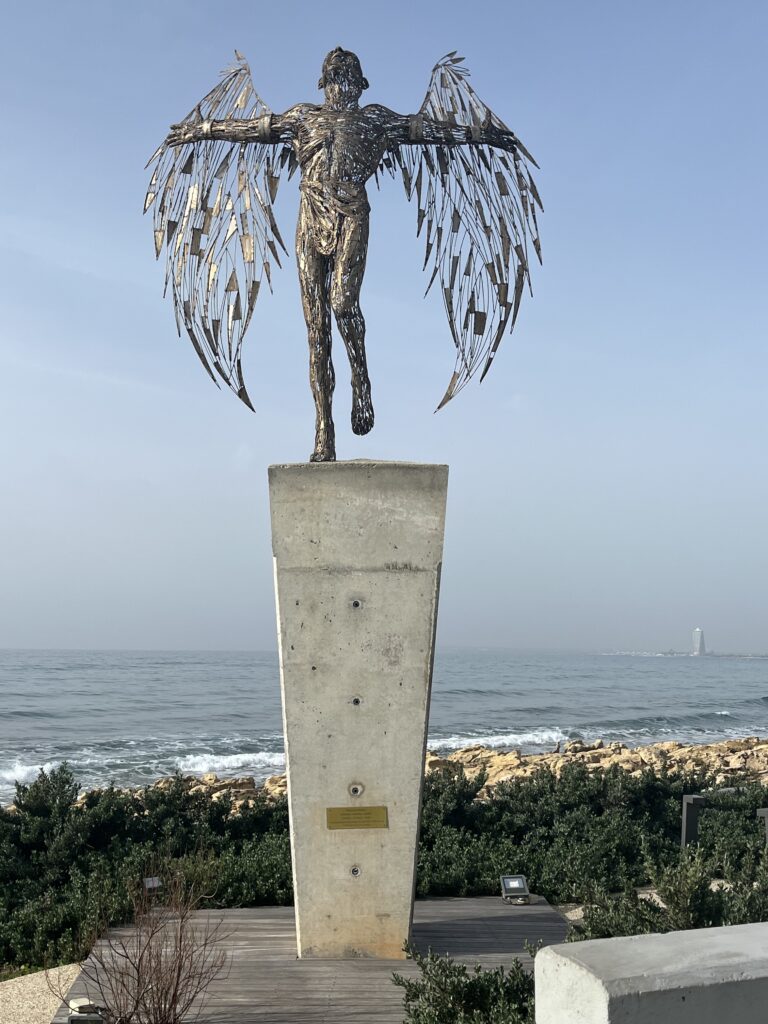
Wittgenstein claimed that the harmony between metaphysical entities such as thought and reality are to be found in the grammar of our language which also houses the essences of phenomenoal entities such as man which Aristotle defined as the “rational animal capable of discourse”. The legend of Icarus in Ancient Greek Mythology is of course a cautionary tale testifying to the consequences of the failure of rationality. Icarus was warned by his father not to fly too close to the sun which he did, thereby melting the wax that held the wings fastened to his body, thereupon plummeting to his death . This of course can not be a “realistic” phenomenal tale simply because we now know that constructed wings and wax do not have the energy to lift us high in the sky.
This tale, rather, had moral transcendental intentions that built upon a Kantian transcendental analogy which Kant defined in relation to our knowledge of God, thus:
“as the promotion of the welfare of children (=a) is to the love of parents (=b), so the welfare of the human species (=c) is to that unknown in God (=x) which we call love.” (Prolegomena to any Future Metaphysics”, trans Ellington J.W., Indianapolis, Hacket Publishing,1977, ftnt Page 98)
Paul Ricouer in his hermeneutical investigations of language, identified what he called the “realm of the sacred” which includes God and the reason he loves those humans who live holy lives, lives that, according to Kant, (who acknowledges this realm of the sacred) are led in accordance with the categorical imperative (treating all humans and higher forms of psuché as ends in themselves). The analogy Kant refers to above involves family relations which may also be in the realm of the sacred, if one reasons that children must be regarded as “known” ends-in themselves.
The love of God is an unknown end-in-itself, which some Freudians may regard as illusory, a wish fulfillment of gigantic cultural proportions. Kant has decided that this is not the case, and if our modern response to Deus Absconditis is a symbol worth interpreting, such an interpretation may result in the judgement that Kant was right in claiming that God is a necessary idea for the cultural development of human psuché: under the important condition, of course, that we “know ourselves”. Icarus was inebriated with the thought of the freedom of flying and refused to heed his fathers Aristotelian advice (The Principle of the Golden Mean). His fate was in accord with the Socratic idea of justice that people ought to get what they deserve in life. This legend was a family drama which was meant to be generalised to everyone in all moral circumstances.
Ricoeurs investigations of the realm of the sacred was conducted mostly as part of his into the “Symbolism of Evil” where he began by investigating the evil men confessed to. These confessions Ricoeur claimed were part of the process of “knowing oneself” , telling the truth about oneself. The nature of the evil is of course crucial to the future . Certain crimes such as murder for Socrates would result in a virtuous man being unable to live with what he had done, because it is now true that he is a murderer and it is impossible to live with a murderer.
We know Wittgenstein was a religious man and claimed to be more interested in aesthetic and religious problems. He, together with Ricoeur, was the most modern of the Philosophers, refusing to abandon certain traditions and regretting the passing of these traditions. The flying invention of Dedalus was a precursor to the invention of flight machines which would takes us around the world wherever we wanted to go. This invention in the name of freedom was of course to be used by the “new men” (Arendts term for those moderns filled with the hubris of Icarus) for the purposes of war and mass destruction which occurred whilst God was making an exit from our lives thanks to modern materialism and scepticism. God of course in a certain specific philosophical sense, lives on in the corridors of universities where Aristotelians, Kantians and Wittgensteinians found a refuge and a home. God lives on also in the pages of the writings of these Philosophers as long as we moderns can summon the energy to continue reading for the purposes of acquiring knowledge.
Views: 80

Campbell continues to discuss the issue of the rise of Islam in some detail noting that there is an assumption of the infallibility of the group or community (Page 436), and also that the Mind of the Community and the Mind of God are identical. To be clear, this is not in the Socratic spirit of seeking justice in the soul writ large (in the polis,) but rather something more radical, something more in line with Marxist Culture which denies the existence of the philosophical , transcendental and metaphysical realms, whilst simultaneously claiming a form of transcendence for the words of Marx-the prophet. Islamic poets/philosophers such as Mohammed Iqbal also expressed a criticism of Europe in the following words:
“Believe me, Europe today is the greatest hindrance in the way of mans ethcal achievement. The Muslim, on the other hand, is in possession of these ultimate ideas on the basis of a revelation, which, speaking from the inmost depths of life, internalises its own apparent externality……and in view of the basic idea of Islam, that there can be no further revelation binding on man.” (Pages 438-9)
We now know that for a number of Islamic societies there are radical conseqences for the freedom of the individual citizen of such Republics, but there are also consequences for an entire segment of the Islamic community, namely women, who are not treated equally in the spirit of European democracies. The birthplace of democracy, Ancient Greece, provided us with institutions and laws that grew naturally and organically from the lives of the citizens. These institutions and laws became part of the matrix from which both equality and freedom grow. The meanings of the terms arché, areté, diké, logos, psuché, aletheia,and epistemé were also critically interpreted in terms of many Aristotelian principles including the principle of the Golden Mean.
Campbell notes the challenges to Islamic logic from both the Shiítes and the Whirling Dervish Order. The former became prominent in the drama-filled attempts to find a successor for Mohammed after his death. Other significant events in the growth of the power of Islam included the shift of the Capital from Mecca to Baghdad, the city of pleasure, in 750AD, when the Umayyadi were removed from power. This period of Persian influence lasted until 1258 AD when the Mongols put the city to the sword brutally, allowing a resurgence of European influence.
Campbell discusses St Patrick of Ireland and his controversial contemporary Pelagius, who confronted the Church with the uncomfortable doctrine of the free will which probably had its origin in Ancient Greece, in particular, the work of “The Philosopher” of the period, Aristotle. This doctrine seriously questioned the thesis of Original Sin, which saw the will only in terms of the disobedience of Satan. The Neoplatonism of Erigena (815-877AD) was also condemned by Rome (Page 467).
The Celts, Cambell argues worshipped the mother of God, Mother Earth, and in the North the Vikings were roaming much of Europe and beyond, but especially harassing the Christians of Europe, embodying the hero-type of the warrior, at home in the killing-fields of war.
Pope Innocent III(1198-1215), the “greatest of the Popes, according to the Historians and Campbell, reinforced the opposition to Pelagianism and other heresies attributed to the Gnostics and Donatism. Pope Innocent himself became an object of suspicion but was never formally charged with any offence until he was moved by his own people into a state of retirement. In the context of this discussion, Campbell, referring to the avarice of the clergy, claimed:
“It is hardly to be wondered, then, why, in the course of the 12th century there should have developed throughout Europe a deep trend not merely of anti-clericalism but of radical heresy.”(Page 495)
Manichaeism, a form of Gnosticism, was also subject to the scrutiny of the Church authorities, and its leaders were burned at the stake. Campbell claims that these heresies were signs that European individuals had begun to think for themselves and cast off the yoke of the Church, refusing to believe in an “absolute Levantine consensus”. Anti-Papal polemics began to circulate and were promoted by various individuals, including Joachim of Flores, who appealed to many of the Fransciscan order who had postulated “The Age of the Holy Ghost” which involved amongst other things, a reduction in the role of the Church in everyday affairs. The Papacy entered a “time of troubles” when in 1377 there were suddenly two Popes because of a dispute between Italy and France, each excommunicating the other (Page 503), until the council of Pisa elected a third Pope. In the wake of these events John Huss (1373-1415) was burned at the stake for suggesting “Reforms of the Church”, thus preparing the way for Luther and the “Reformation”,one century later (Page 504)
Cambell has the following to say on the issue of the rise of the influence of the Europeans:
“In the broadest view of the history of world mythology, the chief creative development in the period of the waning Middle Ages and approaching Reformation was the use of the principle of individual conscience over ecclesiastical authority. This marked the beginning of the end of the reign of the priestly mind, first over European thought, and then as today, we see, in all the world.” (Page 504)
One could also characterise this period of European History in terms of a reawakening of the critical spirit and love of freedom that came down to us from the Ancient Greeks. This is a possible reading emanating from the History of world Philosophy. There would then be a possible continuous cultural thread leading to both the Renaissance and the Enlightenment. An Ancient non-European spiritual system based on revelation and miraculous happenings was never going to undermine the fundamental theoretical and practical rationalism of the Ancient Greeks. Rationality, moreover, could be widely communicated in a University system searching for the Truth, the Good, and the Beautiful, provided that the principle of specialistaion did not play the leading role in the organisation of university faculties. The University, then, was the institution best equipped to provide a life of eudaimonia, a life in which ruin and destruction could be overcome if ones knowledge was broad and deep enough and if one could also achieve the awesome task of “knowing” oneself.
Campbell also notes that a number of troubadours were connected with the Allbigensian heresy. These “popular” people spoke of Amor and the mystical rapture associated with such passion. This popular movement of course competed with the calm, collected contemplative life of the University, which appeared to concern itself more with matters of the soul than matters of the justice of the polis. Campbell notes,, however, the following:
“There is, in short, between the pagan past and High Middle Ages of Europe an impressive continuity of spirit and development. over which, for a time, the overlay of an Oriental type of spiritual despotism was heavily spread only to be disintegrated, assimlated and absorbed. In courtly and poetic circles the ideal of individual experience prevailed over that of the infallible authority of men whose character was supposed to be disregarded.” (Pages 509-510).
Such a state of affirs eventually resulted in three interesting European ages in Europe, Firstly, the Renaissance, secondly the Enlightenment and thirdly, the Romantic period in which even the authority of the rationality of the Classical and Enlightenment ages was questioned. We are now entering the “Modern Age” which, according to Arendt, began already with the Philosophers Hobbes and Descartes, who both in sceptical mood, raised doubts about the work of Aristotle which Kant attempted to dismantle in his critical Philosophy, only to have his own work partially dismantled by the “Spiritual” Philosophy of Hegel, which concluded with the Age of Romanticism that, in turn, detached us from our anchors in a stormy sea. The 20th century, according to Arendt was a “terrible century, with two world wars, the use of weapons of mass destruction upon civilian populations, a cold war, and the threat of mass-extinction hanging over us like a dark atomic cloud. All that is now needed is for a number of tyrannical “new men” to acquire power in power centres for this story of humanity to end mythologically instead of rationally.
Views: 81
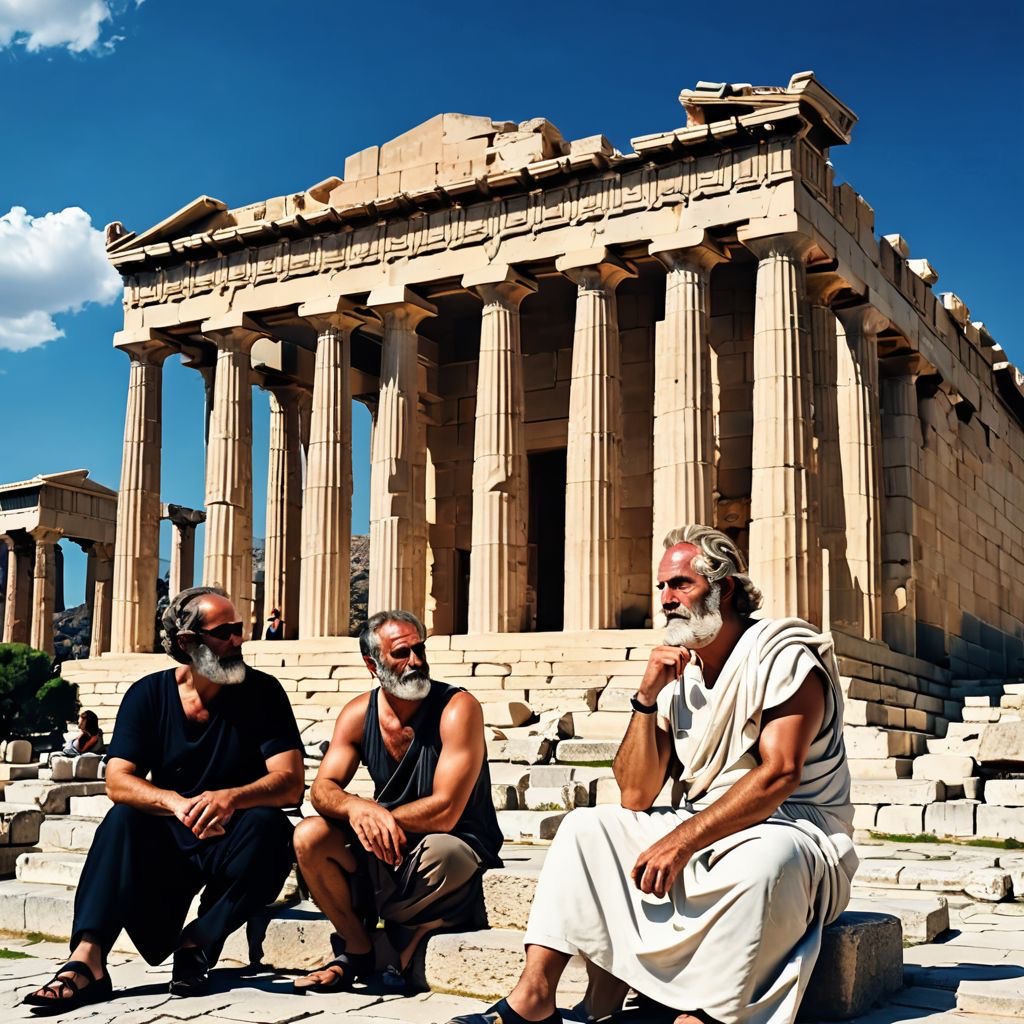
“The Truth will set you free” are familiar words from the New Testament Bible (John 8:32) and they ought to be interpreted in the light of both what Christianity is, in its essence, namely a spiritual faith based movement and also in terms of what it did for the people who felt like slaves under the laws of their societies. So Truth and Faith can perhaps find each other in the spiritual rather than the academic domains, in the name of freedom.
Campbell, in a section entitled “The Age of the Great Beliefs” begins by examining the relations of the Levant and Europe, claiming,that “The Pantheon is the earliest of all Mosques”, a paradoxical claim that is not fully defended. The Greek Temple with its columns(inside and out) had no interior, whereas, Campbell argues, the Mosque appeared to be all interior, thus, on certain views, modelling the mind. Campbell also points out that :
“for Classical man the Temple of the Body”, too, had no interior”.(Page 397)
As if the organs of our body, including the brain, were not inside our Temple. He continues:
“The cognate views of the individual in this world is not that of an individual at all but of an organ or part of the great organism:—as in Paul or Augustine’s view of the Living Body of Christ.”(Page 398)
Aristotles view of parts and wholes requires that parts must in a sense be partially defined in terms of the characteristics of the whole they constitute, if we are dealing with living organisms such as human psuché. Aristotles view of psuché, therefore is that of a constellation of specific organs including that of the brain:—a constellation that allows Aristotle to define the essence of man in terms of the essence-specifying definition of “rational animal capable of discourse”. Aristotles definition assumes that what man does, is much more important to his Existence and Being, than what happens to him, because he is capable of knowledge informed choices that assume a will striving for the Good.
The relation of Aristotle to Levantine Culture is well documented and begins with al-Kindi in the ninth century, continues with al-Farabi, Avicenna, and Averoes. Avicenna in particular eleborated upon Aristotle in ways that were not completely in accord with the central tenets of hylomorphic theory. It was, however, clear from these Arabic translations and commentaries that Aristotle appeared more concerned with Logos in the sense of Logic, than Logos in the Christian sense of the Word of God. Averoes was perhaps the commentator that best represented the spirit of Aristotelian Philosophy , but what he claimed in relation to the soul or psuché did not appear to be Aristotelian.
Encyclopedia Britiannica on-line, reports that Jewish Aristotelianism developed through the medium of the Arabic language and spread to the regions of North Africa, Mesopotamia and Spain. All translations of this period, whether Latin or Arabic did not meet the high standards of current linguistic scholarship, which really began to emerge with the work of Robert Grosseteste. Adequate tanslations of the most influential works were, of course, of vital importance, once the first universities were established, partly because they could form an important platform for the communication of Aristotelian ideas to a broader audience.
The University system, however, as both Kant and Spengler have observed, followed a principle of specialisation which did not appreciate the universal intentions of Aristotelian Practical Science. Studying Aristotle at University, however, must have left no doubt in the students minds in relation to the problematic doctrines pertaining to “revelation-through-miraculous happenings”. Yet, there were countercurrents carrying us in the opposite direction, when the metaphysical writings of Aristote were characterised as “dangerous” in spite of the fact that in Aristotle,there was no anthropomorphised alternative figure, competing for the term “God”, merely an abstract theoretical entity he called “pure Form which had the power of thinking about thinking. Form is an Aristotelian term for “principle” and his work on Metaphysics is only about the search for “first principles”, a search which was deemed sufficiently “dangerous” to result in a Papal Bull being issued at Paris University in 1210: lectures were banned and Aristotles texts were burned.
Aquinas, however, was more sympathetic to Aristotle and stayed within the orbit of Aristotles ideas in most of his commentaries, but when it came to the soul of human psuché, Aquinas could do no other than follow the dogma of the church and insist upon the separation of the body and the soul: a position Aristotle would have objected to. Condemnations of heresy in 1270 and 1277 did not specifically cite Aristotle, but his views on Psuché or the soul were anathema to many Christian scholars. The organisation of the teaching faculties contributed to the tension over Aristotles ideas because certain faculties defined “Truth” in terms of “revelation” rather than in terms of the more rigorous Aristotelian logos based- account.
Aristotelian Hylomorphism, and his Philosophical Psychology, thanks largely to the Universities and their faculties of the Arts, survived until the Renaissance and thereafter emerged as authoritative in various contexts in the succeeding centuries: for example, via the works of William Harvey, Francis Bacon, and Charles Darwin.
During the 20th century a small group of university based scholars existed which could be regarded as Aristotelians and Kantians. During this period the Philosophy of Wittgenstein, especially the later retreat from logical atomism, to the more social view of language based on instinct, and embedded in the hurly burly forms of social life, was an important influence in neutralising both materialistic and dualistic accounts that were circulating in the name of empiricism and Cartesian rationalism.
Ancient Greek democratic ideas and governmental infrastructure, which included an independent legal apparatus that focussed on the unity of the citizens of the polis in a spirit of diké and areté, continued to play important roles in the progress of civilisations in Western and Northern Europe. Freedom or “Eleftheria” had, since the Kantian Enlightenment, become more and more important as time went by. Campbell quotes Spenglers view that there were also difficulties with the correct interpretation of the significance of the Magian Culture:
“The Magian Culture geographically and historically is the midmost of the group of higher Cultures:—the only one which, in point both of space and time, was in touch with practically all the others. The structure of its history as a whole in our world-picture depends, therefore, entirely on our recognising the true inner form which the outer molds distorted. Unhappily that is just what we do not yet know, thanks to theological and philological prepossessions, and even more to modern tendency of overspecialisation which has unreasonably subdivided Western Research into a number of spearate branches:–each distinguished from the others not merely by its materials and its methods, but by its very way of thinking:–and so prevented the big problem from being seen. In this instance the consequences of specialisations have been greater perhaps than in any other. The historians proper stayed within the domain of classical philology and made the Classical Language frontier their eastern horizon, hence they entirely failed to perceive the deep unity of development on both sides of their frontier, which spiritually had no existence. The result is a perspective of “Ancient”, “Medieval”and “Modern” history, ordered and defined by the use of the Greek and Latin languages. The Persian world fell to the student of Iranian philology….and so disappeared absolutely from the field of vision of Chistian Theology.” (Pages 399-400)
Spengler does not mention in this context the “Ancient Greek Philosophers” and the “Philosophical and Cultural Revolution” that found voice in the historical figures of Socrates, Plato, Aristotle etc. The issues of knowledge (epistemé) justice (diké) and freedom (eleftheria) were certainy neutralised in the process of “cultural overlay” that occurred with the Romans and their engineering/military language which translated many Greek terms such as aletheia(truth), psuché (soul/life) and edudaimonia (good spirited flourishing life) problematically.
What had been established via the work of the above three Great “Ancients” was an “academic psychical distance” to the object of study that has been the hallmark of University study ever since. One of the consequences of the collapse of this “objectivity” was to compromise the very idea of objectivity itself via a bipolar view of the terms “subjective-objective”, reducing the former to a psychological state of mind and the latter to the sensory apprehension and manipulation of material objects. Not even the Philosophy of Kant would be able to mitigate the effects of “subjectivising” many important regions of knowledge.
Heidegger, in his writings, pointed to this phenomenon, claiming that Western Culture had been “weakened” by what he called a “forgetfullness of being”, which he mistakenly attributed partly to Aristotle. The Romanisation of Greek Culture and the Latinisation of the Greek Language strengthened processes of “overspecialisation”, resulting in the Empiricism of Hobbes, Hume etc, and the dualism of Descartes that paradoxically rested on the material substrate of the brain. Kant stemmed the tide somewhat, but the faculty specialisation of Universities, quickly neutralised via Hegel, his Enlightenment attempt to restore the Philosophical heritage of Ancient Greece.
The Aristotelian formula for a unified and prosperous polis which referred to a large middle class formed by, and following, the principle of the golden mean, also demands a Greek-style governmental infrastructure This infrastructure fell apart perhaps during the reign of Alexander the Great, but definitely afterwards as Zoroastrianism and Christianity vied for cultural supremacy. Campbell cites the work of Professor R C Zaehner (“The Dawn and Twiight of Zorastrianism”) In which it is claimed that other cults were not given sufficient freedom to express themselves owing to a sociological principle which:
“only grows in force and terror as the violated coerced factions become increasingly intractable through the operation of a second law, namely that gods become demons;which is to say, that psychological and sociological factors neither assimilated nor recognised by the consciously controlled system become autonomous and must ultimately break the system apart.” Page 405
This is the bipolar phenomenon referred to earlier which tore the polis asunder. Without the democratic and Philosophical infrastructure of the Greeks, no sociological principle or law could prevent the polis splitting into fragments. This might even have been true of Alexander the Great’s Empire.
Campbell, in his sub-chapter, “Byzantium”, illustrates well the cultural similarities and differences between Ancient Greece and the Levant during the period up to the 6th century AD, when he notes that the Roman Emperor Justinian (who closed all the Philosophical Schools and Academies) was experiencing the same kind of problems which threatened the existence of the Sassanian Empire of Chosroes I (531-579). Both rulers believed in the sociological principle of Absolute Rule, rather than the Aristotelian Principle of the Golden Mean.
Campbell alsonotes that the key mythological/religious questions of the two Cultures differed significantly with Zoroastrianisms concern focussing on the relation between darkness and light and the problem of evil, whilst the concern of Christianity focussed upon the relatively abstract problem of the nature of Jesus’ Incarnation. It is certainly no exaggeration to claim that this question of Incarnation split the Church. This recalls another academic question, namely, whether the Kingdom of God was coming in the future, or whether the Kingdom existed as the Gnostics claimed, right here and now and within us..
For Aristotle Noos was the home of Logos which the Christians identified with the Word of God. If, then, the Kingdom of God was within, as many Christian determinists doubted, given the doctrine of the freedom of the will, there followed the problem of the possibility of refusing to heed the word of God. Both Aristotle and Kant believed that the freedom of the Will was the real determiner of ones life,and if this was the case, then knowledge (epistemé) of the future Kingdom to come would be relevant in this context only if, as Aristotle claims, the will aims at the Good in all human activity: a thesis that of course runs contrary to the doctrine of Original Sin. Both Aristotle and Kant, claimed that the good will was the fundamental condition of all ethical action that is in accordance with the categorical imperative which amongst other things demands that we treat each other as end-in-themselves.
Moving forward in History it was this categorical imperative that became one of the foundation stones of Human Rights, which became the focus of the United Nations, the institution Kant suggested at the end of the 1700’s. We can see, then, a line of continuity running from Ancient Greece, to the Renaissance, to the Enlightenment, to the formation of the United Nations. The concern for our individual spiritual development that we find in Mythology and Religion then, appears to be less relevant in the above secular context where the burning question seems rather to be, how to avoid repressing the desires and activities of those that wish to concern themselves with their spiritual lives. We seem to have inherited the Socratic approach to The Good in the soul, searching for it instead in the soul writ large, namely the polis.
Mary, the mother of Jesus was also drawn into the clerical dispute over the issue of incarnation: a dispute that Campbell notes spanned over 4 phases lasting hundreds of years. This timeline takes us to the rise of Islam which Campbell claims is a continuation of Zorastrianism, Judaism, and Christianity, mythologially speaking. Abraham, it is noted, was the common ancestor of both Judaism and Islam. Islam was a religion of both revelation and revolution. Mohammed was an illiterate prophet that claimed to have visions whilst meditating in a cave. In one revelation Mohammed is informed that it was the Lord who taught man to use the pen. Apparently Mohammed was pondering the mortality of man when a vision intruded, described by Campbell as follows:
“Its author was God, its subject man, Gods creature; and its instrument, the pen, the sanctified Book, which men were to read, study, recite and treasure in their souls.” Page 424)
This is a curious vision for a man who, tradition has it, could not read, but was nevertheless proclaimed by family and friends to be a chosen apostle. Very soon afterward Mohammed was calling upon priests in Mecca to eliminate all pagan images from places of worship such as the Kaaba. Both Allah and Yahweh were Gods of semitic desert communities. One crucial difference, as Campbell points out is that whilst Yahweh was a specifically ethnic divinity, Allah was proclaimed with universalistic intentions, turning to all Humanity with his messages. For, as Campbell claims,
“in Mohammeds day the Alexandrian vision of humanity had reached even the peoples of the desert.” (Page 433)
There was, as Campbell points out, however, a problem with the laws proposed by Mohammed. These so-called divinely inspired laws did not grow naturally out of a particular society at a particular period in time, but rather had its source in revelations and visions occurring to Mohammed in a trance-like state. Universalising these visions to include commuities living in deserts, in the mountains, coastal communities, and communities in the rest of the world, some perhaps with long common-law traditions, was always likely to meet with insurmountable difficulties. Communities with a long tradition of common law focussed upon a universal idea of justice that was founded on the free will, a critical spirit, and people getting what they deserved. The first and second of these factors of course, were not reflected in the revelations and visions of the prophet. The critical spirit in particular was accustomed to evaluating divinities in terms of philosophical partly secular criteria such as the Principle of the Golden Mean exercised in the spirit of psuché and eudaimonia (the good spirited flourishng life). Given the typical attitude of critical minds to phenomena such as revelations and visions, it is not surprising that Islam was not successful in recruiting such communities to their cause. Also, given the Islamic conviction that once instituted laws were immutable, this added another dimension of difficulty to the mission of broadening the horizons of the Islamic Religion.Campbell quotes Spengler on this issue:
“Whereas the Classical law was made by burghers on the basis of practical experience, the Arabian came from God, who manifested it through the intellect of chosen and enlightened men….the authoritativeness of Classical laws rests upon their success, that of the Arabian on the majesty of the name they bear.” (Page 435)
There is of course a difference between commuities with traditions of common law based on the precedents of individual judges in a well educated core of judges, and laws passed by rulers who may or may not have had the appropriate education and may or may not have the ability to recruit those who have had the appropriate experience and education. Recall also that Mohammad could not read and therefore was probably not familiar with the History of the World that was available to scholars at the time. The History of Philosophy and Science may also have been provincial given that Mohammed relied on an oral tradition of communication of ideas. Just these facts may also have limited both the content and form of the “visions” he experienced.
Spenglers “burghers” were not of course an infallible standard by which to measure the efficacy and virtue of laws but, depending upon the inherited humanistic/democratic infrastructure, these burghers may be a far more reliable source of justice and the good life, then the visions of an illiterate man meditating in a cave. These burghers were, given their obvious relation to Ancient Greek conceptions, also a more reliable source of justice and eudaimonia then many literate Christian scholars.
Views: 78
The Introduction to the Celtic Iron Age was mythological, a fact symbolised in the Arthurian legend of the sword being extracted from the mother-stone. Blacksmiths of this period were seen to be wizards/shamans possessing special powers. The time of the Celts was a time of druidic rituals, sacrifice in forest retreats, learning by rote a number of verses, and fantasy-laden belief in an after-life (“otherworld”). An example of the latter is given in a tale from Celtic mythology relating to a hero who is approached by a strange beautiful girl singing about the “otherland” over the seas and far away. They both sail away and the hero returns after what seems to him to have been a short period only to find that he has been away for hundreds of years and all the people he knew were dead. This is a 8th century tale from Ireland and we find similar romantic tales 4 centuries later connected to Arthurs Knights of the Round Table. Encyclopedia Britannica on-line claims that the word “Druid” means “knowing the oak tree”. Caesar is reported to have claimed that the Druids neither paid taxes nor engaged in manual labour. They were priests without temples . Caesars Gallic wars began circa 58BC and succeeded in limiting the power of the Celts who had been waging war in southern Europe. There were two centres of Celtic Culture, one in the Alps and one in Southern Germany during the early Iron Age. Campbell refers to the scholar Professor Mircea Eliade:
” a fascinating study of the rites and myths of the Iron Age has shown that a leading idea of this mythology was of the stone as a mother rock and the iron, the iron weapon as her child brought forth by the obstetric art of the forge. Compare the saviour Mithra born from a rock with a sword in his hand.”(Pgae 292)
Mithra was originally, one of the more important gods from the Persian Pantheon , equated by some scholars to the Ancient Greek demiurge. Encyclopedia Britannica on-line links Mithra with the Platonism of the Timaeus:
“As in the Timaeus, the human soul came down from heaven. It crossed the seven spheres of the planets, taking on their vices (e.g. those of Mars and Venus) and was finally caught within the body. The task of human life is to liberate ones divine part (the soul) from the shackles of the body and to reascend through the seven spheres to the eternal unchanging realm of the fixed stars. This ascent to the sky was prefigured by Mithra himself when he left the earth in the chariot of the sun-god.” (www.britannica.com/topic/Mithraism/Mythology-and-Theology)
We dont find such talk of the disembodied soul in Aristotle or Kant, both of whom would have seriously questioned the supernaturalistic content in the above mythological account: a supernaturalism that was so dear to the superstitious Roman mind. Campbell argues, concerning the History of the Celtic Culture, that:
“The earliest locus of the culture was Bohemia and South Germany, but it spread in its final century as far as to Spain, Brittany, Scandinavia and the British Isles, to furnish a base upon which the subsequent Celtic flowering of the La Téne period then appeared, circa 550-15 BC.” (Page 293)
This was the period in which the Celts besieged Roman territories and entered Asia Minor. In the early 4th century BC, the Celts crossed the English Channel. Julius Caesar in his work “Gallic War” described the Celts as follows:
“There are two classes of persons of definite account and dignity. As for the common folk, they are treated almost as slaves, venturing nothing of themselves, never taken into counsel. The greater part of them, oppressed as they are by debt, by the heavy weight of tribute, or by the wrongs of the more powerful, commit themselves in slavery to the nobler, who have, in fact the same right over them as masters over slaves. Of the two classes above mentioned, one consists of Druids, the other of Knights. The former are concerned with divine worship, the due performances of sacrifices, public and private, and the interpretation of ritual questions: a great number of young men gather about them for the sake of instruction and hold them in great honour.”(Pages 293-4)
Part of the attraction of the young that joined the Druid movement was exemption from military service, taxes and other liabilities. The Celtic Knights believed in the” lex talionis” form of justice : If a life was taken by someone that person ought to lose their life. Almost all the information we have relating to Celtic Culture comes down to us courtesy of secondary sources (Cicero, Pliny, Siculus) because Celtic cultural objects have not been preserved. Campbells points to the literature comparing mystical Druidic thought with Hinduism.
This romantic fairy-tale Culture peristed right up to the founding of Rome as is evidenced by the legend of Romulus and Remus being nurtured by a Wolf. Romulus we know from the legend eventually slew Remus and the city founded becomes Rome rather than Reme. The Romans developed a number of local sacred divinities. The home and the hearth became sacred, being associated as they were with both Vesta and Janus(the god of the door-threshold). Otherwise the Romans embraced the Greek Pantheon of Gods. Romans, like Plato, believed that the character of the soul was determined by the metal related to it. They believed a Golden Age and a Golden Rome would follow the Bronze and Iron Ages and their associated races. Virgil in his writings prophesied the coming of a wonderful Golden Boy which would signify the return of the Golden Age (Campbell Page 323).
The Roman Spirit was, of course, essentially a military spirit requiring faithful devotion to the Republic in contrast the Oriental spirit of dissociation from all worldly things (Page 328). And yet there is a belief in the afterlife in Cicero’s claim that warriors will have:
” a special place prepared for them in the heavens, where they may enjoy an eternal life of happiness” (Di re publica, Loeb Classical Library, Cmbridge, 1928, 6.13)
Campbell points out, however, that the tone of the Roman combination of duty and detachment is very different to that of the Orient. The implication of this is that the warrior knows hmself to be a God and this sets the stage for the veneration of the Roman Emperor as a God.(Campbell, Page 330). A parallel doctrine to this, namely the divine right of Kings to rule, was, of course a Christian based dogma used by a number of rulers throughout English History. The dogma often referred to the authority of the Bible which contrasts itself to the above Roman dogma based on Roman Mythology. The divine right of kings was never as closely associated with warrior-heros. The palaces of British Kings were never temples. This Roman doctrine may, of course have emboldened Pontius Pilate to give permission for the crucifixion of Jesus Christ. Both Roman Emperors and British Kings were in a certain sense miraculous beings but as Campbell points out on Page 344:
“If miracles are required India wins every time”.
Indeed what could be more miraculous than a universe created by a dreaming serpent. We, followers of Philosophy and Science dismiss miracles on good grounds with the resultant judgement “This is not the way in which the world works”. Campbell also helps to cast doubts on these miraculous claims when he points out that different mythologies produce different miracles, but the miracles of other mythologies are never recognised as genuine miracles, sometimes regarded as frauds, fabrications or witchcraft. The miracles associated with Christ, must, then be subject to doubt if we are to take New Testament accounts literally which we would seem required to do by the Christian Church. Later “interpretations” however rely on construing some of the books of the Bible as “literary texts”, and claim that the accounts of miracles must be taken metaphorically: intended to help unbelievers enter the realm of the sacred. Christ’s resurrection would seem in this context to be the most wondrous miracle. For the Philosopher, then, if the text relating to this event could not be taken literally then the only realistic alternative is to postulate that that the text is intended to be read metaphorically.
Paul, early on in Christianity, warned us not to be taken in by the “illusions” of Philosophy and perhaps he was thinking in particular of Gnostic challenges to many central teachings, but he may also have been referring to the authoritative influence of Aristotles principle based Hylomorphism. For a long period of history these Gnostic texts were not available to scholars for evaluation purposes. Relatively recently, however 48 works were discovered in an earthern jar near Nag Hammadi. Whether it was these texts which were the target of Pauls concern, or whether Paul was more concerned over powerful Aristotelian arguments against supernaturalism, is not known. The documents discovered contained reference to a doctrine of immantism which the Church for centuries had condemned: “The Kingdom of God is not coming, it is here”. Campbell believes immantism is well expressed in the following:
“I am the light that is above them all
I am the All
The All came forth from Me and the All attained to Me
Cleave a piece of wood, I am there
Lift up the stone, you will find me there.”(Campbell Page 367)
Campbell notes that the source of all of the material for the Gospels was:
“a common stock of sayings (logia) preserved and passed about, at first orally, among the communities of the faithful, which then become fixed in various ways in various writings.” (Campbell, Page 368)
The Gnostic position reminds one of the Aristotelian objection to the Platonic eternal Forms, which could not be found in the external physical world. The Gnostic Gospel of Thomas claims that the sacred Kingdom is not the Kingdom to come but rather that which is both here and now and within you. The Gospel of Thomas dates from circa 140AD which is approximately the time during which all the Gospels were being formed. The “authenticated Gospels of the Bible” were, Campbell, argues, fixed in Rome during the 4th century AD.
Campbell also refers to the Gospel of John in which God is praised thus:
“Glory to the Father!
Glory to thee, Word!
Glory to thee, Holy Spirit!” (Campbell Page 373)
This, Campbell argues cannot be the Father of either the OT or the NT but rather more closely resembles what we can find in Persian Myth, where the saviour “like Zoroaster descends from the sphere of Light; but unlike Zoroaster, partakes only apparently of the nature of the world”. (Page 373)
The Gospel of John characterises the crucifixion in unusual terms, thus:
“And in that cross of light there was one form and one appearance. And upon the cross I saw the Lord himself, and he had no shape, but only a voice: and a voice not such as was familiar to us, but one sweet and kind, and truly of God, saying to me: “John it is needful that there be one who hears these things from me, for I have need of one that will hear. This cross of light is sometimes called the Word by me for your sakes, sometimes Mind, sometimes Jesus, sometimes Christ, sometimes Door, sometimes Way, sometimes Bread, sometimes Seed, sometimes Resurrection, sometimes Son, sometimes Father, sometimes Spirit, sometimes Life, sometimes Truth, sometimes Faith, sometimes Grace. So it is for man. But what it is, in truth, as conceived in itself, as spoken between us, it is the marking off of all things, and the firm uplifting of all things, fixed, out of things unstable and the harmony of wisdom–of the wisdom that is harmony.” (Pages 373-4)
The contrasting of form and appearance , truth and appearance which God calls Word or Mind, does align with the Aristotelian position of Ancient Greece, especially if one considers the transition from Platonic to Aristotelian Philosophy which regards God as a Pure Form that thinks about thinking. For Aristotle, contra Plato, the forms are in the external world, which would seem to imply the thesis of immantism cited above by Campbell. Socrates in the Republic, we recall, praised the thesis of Anaxagoras that “All is Mind” which caused Socrates to completely change the emphasis of his philosophical investigations, from exploring the external world, to seeking Knowledge and Truth about the realm of Psuché.
Johns Gospel continues with:
“but what I am, I alone know, and no man else. Suffer me then to keep what is mine, but what is yours behold through me; and see me in mine essence, not as I have said I was but as you, being akin to me, know me.” (Page 375)
The text ends with John claiming to laugh at the multitude because, he held on to one thing in himself, namely:
“that the Lord carried out everything symbolically, for the conversion and salvation of man”
Symbolically? Metaphorically? We know the Gnostic view of the primacy of Knowledge was not shared by Pauls position that man is Justified by Faith alone. History apparantly has sided with Paul since his teaching appeared to have had the greatest mass-appeal. Paulianism claimed that Gnosticism fostered the multiplication of cults at the expense of the one true universal religion. Was this conversation between God and John something John hallucinated, or was it a metaphorical account of a thinking process that must have been a result of contradictions in the “sayings” witnessed by many different disciples and bystanders? The Aristotelian principles of noncontradiction and sufficient reason were part of the authority of his Philosophy at this time. Campbell, with considerable insight, sides with both Gnosticism and the Paulian Justification by Faith-thesis on the following grounds:
“Moreover, the paramount concern of a popular religion cannot be, and never has been “Truth” but the maintenance of a certain type of society, the inculcation in the young and refreshment in the old of an approved “system of sentiments” upon which the local institutions and government depend. And, as the documentation of our subject shows, the history of society itself has been marked over the milleniums by a gradual-ever so gradual—enlargement of group horizons: from the tribe or the village to the race or the nation, and beyond that, finally with Buddhism and Hellenism, to the all-embracing concept of humanity—which is, however, not a governable but a spiritual unit of individuals. And in such a unit there have to be many mansions, as there were in Gnosticism. (Page 378)
Wise words, indeed, but everything then hangs on how we construe Hellenism, whether in terms of a mythology or philosophy or alternatively in terms of the Aristotelian Golden Mean of Philosophical Mythology.
Views: 76
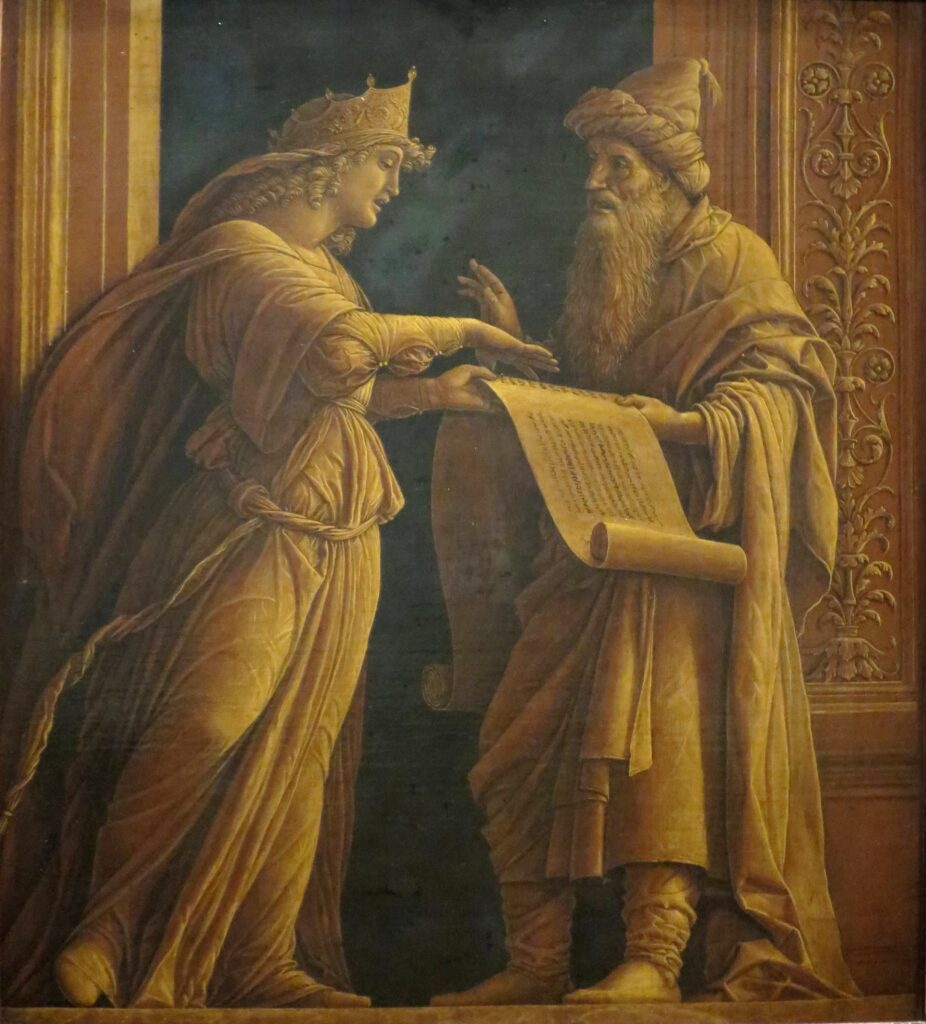
In Campbells opening to Chapter 6, entitled “Hellenism (331BC —324 AD”),he argues that:
“Greek Mythology declined from the status of religion to literature because of the highly critical Greek mind, which was already turned against it in the 6th and 5th centuries BC.” (Page 237)
This is an interesting and complex claim, perhaps resting on an assumption that religious texts were somehow differently structured than poetic or literary texts. There is one obvious difference relating to the events that are represented in these texts which in the case of poetry and literature might be known by the artist to be impossible in actuality, whereas in the case of certain fantastic Biblical representations we are expected to believe that these events actually occured when we know that as depicted they were impossible, given our knowledge of how the world is, and works. Religious texts are claiming actuality, reality (about real places, real people, real, events), whereas literary/poetic texts are merely claiming to be, at best, imitations of reality, laden with symbolic intention and referring to a latent content related to the aesthetic ideas of the artist.
The purposes of religious and literary texts certainly to some extent appear to be different. Adrian Stokes, the Kleinian Art Critic, compared Art and Love (Eros) in his essay on Michelangelo(The Critical Works of Adrian Stokes, Volume 3,London, Thames and Hudson, 1978), claiming that there is both an enveloping intention in Art as well as the singular idea of the essence of the object that is loved/appreciated. The art object, it is argued possesses a holistic self sufficiency which is embedded in the pulsing life of the world .The audience of literary performances often bring with them a wish to escape from the everyday life-world which Kant described as “melancholically haphazard”, containing as it does, violence, disease and many other forms of misery. The genius of the artist identifies with this spirit and uses this knowledge skillfully, in accordance with Kantian subjectively universal and necessary principles. In the middle of the constellation of such affects and effects, many have pointed out the resemblance of the appreciative state to the hypnotic state, which we know was of interest to Freud in the early days of psychoanalysis.
Now it is not out of the question that some religious texts aim at a similar hypnotic state in order to accomplish their mission of installing faith in the masses. Freud, refers to this process of envelopment as “the oceanic feeling”, claiming that it alone cannot account for our experiences of the sublimity of religious experience because of its initimate resemblance to the fantasy world of the imagination. The poet and the Philosopher have pedagogical intentions involving teaching the members of their audience something important about the world and themselves via in the former case the character and plot of the work. In the case of a Shakespearean play it is often the case that the 4 underlying questions(“What can we know?”, “What ought we to do?”, What can we hope for?”, “What is man?”, posed by Kant defines the domain of Philosophy and these are often featured as underlying themes of Shakespearean plays, conveyed via his aesthetic ideas. There is clearly, then, in both poetic texts and Shakespeare plays, both a manifest and a latent content constructed from these underlying aesthetic ideas. The Greek term Aletheia, (Unconcealment), which Heidegger claims was the Ancient Greek equivalent of Truth is also important in this aesthetic process of moving from the manifest to the latent content.
The key difference between religious and literary/aesthetic works is that the latter are not intended to be representations of actual events and people, and while they are not exactly fantasies of the kind we find in fairy-tales, they are nevertheless symbolic imitations of reality designed to refer via their manifest content to rational ideas of the good, true, beautiful, sublime, sacred, (latent content). Often poems or Shakespearean speeches have a “confessional” intention which hopes to reveal (aletheia) the state of the speakers soul/life.. One of the most important discoveries of Freud relates to the central agency of the Ego which he claimed was formed of the precipitate of lost objects. The losing of the the loved object demands at the very least a long mourning process with perhaps brief excursions into the psychoanalytic domain of the melancholic. The artis/genius knows this about himself and all other human beings and puts this truth to work in the organisation of his aesthetic ideas. In Shakespeares case we can also bear witness to the manifestation of other psychotic processes and defence mechanisms at work in furtherance of the plot of the work, for example, in Macbeths hallucination of a dagger and the ghost of Banquo, the man he killed earlier.
The world the artist is intent upon revealing the essence of, is not the melancholically haphazard world of everyday life but rather that world which contains a Kantian “hidden plan” for a hopeful future. This plan is not a utopian fantasy but rather the more down to earth hope that men in the future will treat each other with respect, in other words, treat each other as ends-in-themselves.
Religious texts are often about actions that occur “because of each other” and the correct understanding of their meaning necessitates an understanding of a complex non-linear idea of causation resembling the Aristotleian schema of fourfold causation. Ancient Greek Philosophy and Poetry both embraced the dualistic oracular proclamations:
“Everything created by man is destined for ruin and destruction”
and
“Know thyself!”
Both of these proclamations are causally related. It is necessary to know thyself if one is to minimise the human ruin and destruction that attend mans creations. This transcendental truth formed the background of Socratic, Platonic, Aristotelian, Kantian, and Wittgensteinian thought. Macbeths lack of self-knowledge, to take one example, led him to misinterpret the prophecy of the three sisters at the beginning of the play, thus leading to the desruction of both hmself and Lady Macebeth. These three sisters remind the classics student of the Ancient Greek Erinyes which were, together with Eros, replaced by the more temperate pantheon of divinities led by Zeus.
We ought to recall that oracular proclamations were received by their audience in a spirit of awe and wonder: their incantations, therefore, might have seemed hypnotic. More often than not these “messages from Apollo” (latent content) were delivered by females who claimed that the “sacred water spoke” (manifest content). It is reported that the Delphic Oracle , for example, often went into a trance-like state before delivering the incantatory proclamation. Whether or not this was a pretended state, or merely the posture needed for delivering incantatory proclamations, is not entirely clear. If the former was the case a Freudian explanation may explain why pretence was needed. The Oracle may be encouraging the natural learning mode of imitation in the audience , thus using the defence mechanism of identification. Perhaps poetry with its incantatory tone might have originated from this phenomenon, and thereafter inventively created other mechanisms to achieve its semi-hypnotic effects. The Poem, of course, is also a self sufficient object containing symbolic language and metaphors that are organised by aesthetic ideas and while not exactly sacred (a status claimed for religious texts), are certainly candidates for the status of the good, the beautiful and the sublime(a state intimately related to the human power of moral agency and the Good in General)
Cambell then claims that the critical mind of the Ancient Greeks pushed them to reject polytheism for monotheism which, of course, if true, would leave us with no option but to accept the thesis that we humans too, are self causing entities with a free will which, if used wrongly, results in evil. There is no reason to doubt that the Greek Philosophers believed that human willing was the issue behind the Oracles warning that “Everything created by man leads to ruin and destruction. Aristotle, we ought to recall in his essence specifying definition claimed that we are only “potentially” rational, and in practical contexts this means–under the condition of possessing a good will (which is the central issue of Kantian Ethics). Such a move to a conception of a will causing itself to choose or not to choose the Good necessitates a shift from the religious demand that we obey God, to the Philosophical demand that we understand what the divine Logos expects from us. Individual Responsibility thus supplamts faith in the Divine Being.
The fact that we possess such long childhoods (when compared to the animals) means that responsibility can only be expected fully from those that have left their childhoods and adolescence and are thereby free to exercise their rationality. This monotheistic conception with space for a self-causing free will was then overridden by the so-called Christian Truth, which Campbell expresses thus:
“The One God in three persons, with his pantheon of angels, counter pantheon of devils, communities of saints, forgiveness of sins, and resurrection of the Body, as well as the multiple presence of the dead and resurrected Son of God–true God and true Man—who was born miraculously of the Virgin Mother Mary.” Page 237
There are at least two supernatural events contained in this Campbellian version of the essence of Christianity—a life after death and a virgin birth, both of which would not have seemed realistic to Aristotle and other Greek Philosophers. By the time we get to Aristotle the Philosophical focus was on the universal and necessary characteristics of Being qua Being, a focus Campbell describes in terms of the Great Mother of the Pantheon and the different forms these pantheons took at different points in time. These different forms manifested the underlying power of her Being.
Campbell notes that it was Alexander the Great that put an end to the world order of divided kingdoms and Regions in the name of a universal idea/telos. Tutored by Aristotle, Alexander undoubtedly heard philosophers (perhaps even Aristotle) claiming that Greek ideas could rule the world. Alexander, in certain circumstances used Aristotles principle of the Golden Mean in his conquest of Persia, refusing to destroy the temples and shrines of conquered territories (thus refusing to follow the example of the Persians). The Persians may have been charitable to the Jews, but they did not extend this charity to the Greek territories they conquered. Campbell claims that Alexander created a new world order but in reality the principles he largely followed were both oracular and Philosophical. He announced to the Orient the substantial presence of a European spirit in the world. This new Spirit Camobell claims had 4 aspects: firstly:
“..we note not merely respect for the gods of all religions, but an almost scientific effort to recognise analogies: so the specific deities of the various lands began to be identified and worshipped as equivalent to each other” Page 240
Secondly, concerning the role of both Philosophy and Science in the interpretation of myth:-
“In the 6th and 5th century Greece, the philosophers had recognised a relationship of the Dionysian-Orphic complex to philosophical thought, and in the cults of the Orient they now discovered analogous possibilities.” (Page 241)
Thirdly,
“the breakthrough of the Greek inquiring intellect with Alexander into India, where a totally unforeseen species of philosophic inquiry had been developed in the various yogic schools of the Jain, Buddhist, and Brahmanic centers. A far deeper understanding of the practical psychological—as opposed to the cosmological—relevancy of mythology was represented in those disciplines, than anything the West was to achieve until the century of Nietzsche, Freud and Jung.” (Page 241)
Campbell also notes in this context that this practical psychological understanding included a good deal of what he called “psychosomatic mystic love”. Fourthly,
“after about two centuries of European influence upon Asia, the tide began to turn, until presently a powerful surge of reaction developed, which culiminated with the victories of Christianity over the gods and philosophies of Classical antiquity.” (Page 241)
Campbell eleborates upon this last point by claiming that the civilisation of the European West collapsed for seven centuries. There is much to unpack and clarify in the above 4 aspects but let us begin with the claim that we encountered a deeper understanding of the relation of practical Philosophy to Mythology in the Orient. It is not clear what Campbell means here. Freudian Psychology was Kantian to the core, and Kant certainly preceded Nietzsche, Freud and Jung. We have argued in earlier reviews of Campbells work that Kantian Philosophy and Philosophical Psychology does not contradict the often vague comments upon Being qua Being (Brahman?) we encounter in Hindu texts. We also noted that Kantian Philosophy is sympathetic to much that can be found in the Bible, but probably not to the postulation of events such as a virgin birth and resurrections. We pointed out that the insights Kant brought to the field of religion were very much influenced by Aristotelian Hylomorphic Philosophy. European History manifests a very clear line of development stretching from the Golden Age of Greece to the Art of the Renaissance, to the Enlightenment and Kant’s important contributions (and elaborations upon many different European ideas). There is also an imprtant Cosmopolitan thread linking Alexander the Great and Kants vision of a Cosmopolitan Kingdom of Ends. In other words the links between Kant and Freud to Ancient Greece were far stronger than the links to any Oriental conception of the relation of practical psychology to Mythology.
Insofar as Campbells fourth aspect is concerned, we also question the claim that Christianity triumphed over the Philosophies of Classical Antiquity. We are aware that all Philosophical schools were closed by Justine, a Roman Emperor, but this did not prevent Aristotle from being revered as “The Philosopher” throughout this period of so-called “collapse”. His influence upon both the European and Arabic World was considerable until the establishment of the First Universities when his influence was further sedimented in World-Philosophy and World-History. Indeed it is also important to point out that even Aquinas felt forced to confront and comment upon the works of Aristotle, translating the Greek into Latin in acknowledgment of “The master of those that know”. Aquinas claimed in Aristotelian spirit that all human life(psuché) is sacred because there is a spark of the divine within, and this certainly resembles the hylomorphic account of Noos. Yet there are tensions between these two thinkers on a number of issues including the notion of a free will undetermined by Gods natural and eternal law. It certainly appears to be problematic to project upon Aristotles Philosophy the Christian of Original Sin. Indeed, in this context, Campbell concludes with a remark on the Origin of Christian Mythology, claiming that it could be interpreted:
“as a development out of Old Testament Thought under Persian Influence, with nothing, as yet particularly Greek—unless the emphasis on love” (Page 290=
This confirms that European Culture was formed principally by journeys along two different roads: the roads leading from Athens and Jerusalem. Aquinas, then, can be admired for his attempt to reconcile these two very different accounts of man and his world, but in doing so he may well have diminished the importance of our Greek heritage which may well have pleased him. Fixating upon Love given the ambivalent nature of man does appear somewhat arbitrary, preparing the way for Romanticism and a “Modernist World.”
Views: 92
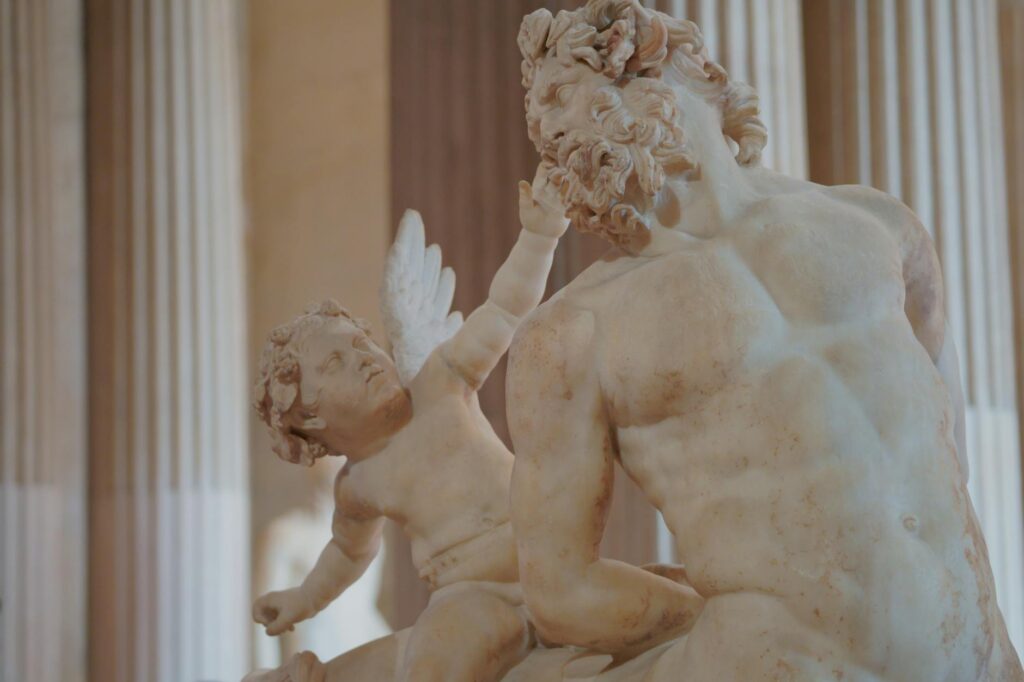
Campbell claims that Zoroastrianism has not left a great heritage possibly because of the :
“ravages of Alexandra the Great(331BC) and then, after painful reconstruction of the zealots of Islam.” (Page 201)
The Persian work, the Bundahish(“The Book of Creation”)was written between the years of 226-881AD, and the resultant creation contained both earlier and later content. The assumption of two primeval spirits, one better and one worse, is essentially dualistic and dialectical, leaving us with a bipolar attitude toward the Divine. In the context of this debate it also ought to be pointed out that Greek Mythology had its two Freudian Giants, namely Eros and Thanatos, working toward Ananke (fate), thereby essentially resolving a potential dialectical opposition with a Good telos. Greek Philosophy built upon this foundation by ackowledging a free will in relation to the concepts of areté(doing and saying the right thing in the right way at the right time) and diké(justice) both of which regulated by arché (principle).The matrix of Greek Mythology and Greek Philosophy provided the conditions necessary for the emergence of the Great Trio of Philosophers, Socrates, Plato, and Aristotle, all of whom contributed to the creation of the meta-Discipline of Philosophy. The task of this discipline was to discover the myriad of principles associated with the Aristotelian Theoretical, Practical and Productive Sciences. Aristotle in his work “Metaphysics” (The study of First Principles) focussed on what he called “first Philosophy” which used the principles of noncontradiction and sufficient reason to explore the aporetic questions relating to Being qua Being..
There is in Persian Mythology, Campbell claims, a creative narrative relating to trees, animals and humans. Ahura Mazda, the Lord of the Light, upon seeing man said:
“You are Man, the ancestry of the world, created perfect in devotion. Perform the duties of the law, think good thoughts, speak good words, do good deeds and do not worship demons.” (Campbell, Page 205)
An antagonistic spirit caused the first two humans, who cannibalised their children, to quarrel but it is important to recognise that in this mythology, evil is conceived of as antecedent to the fall of Man, in direct contrast to the Biblical account in which a flaw in mans character is assumed, manifesting itself in disobedience in relation to the commandments of God. The Greek Philosophers thanks to thinkers like Anaxagoras, did not, like the Israeli prophets, see any relation betwee natural catastrophes such as volcanic explosions, floods or large meteor strikes and man-made catastrophes due to mans ill-will or ignorance. Anaxagoras, we recall, claimed that the moon, at the time conceved of as a divine entity, was constituted of material substance, and as such, had no influence upon the affairs of men. Campbell suggests that this problem of relating the conditions of the external world to the conditions of the human psuché, was not a serious problem for the Greeks, whose polytheistic pantheon could embrace all the nuances of physical and psychical existence. Believing in monotheism as the Jews and the Christians did, left them facing the problem of evil. Where did it originate? In God or in man? We know the choice was made to postulate that the being of man was fundamentally flawed.
The narrative of the Bundahish speaks of heaven, hell and resurrection in imaginatively dramatic terms, and also refers to a great meteor falling upon the earth, killing the serpent-divinity and purifying hell of its stench. Turning to man-made catastrophes, Cambell refers to the “strategies” of the Assyrian dynasty which included massacring entire populations or enslaving them. This occurred during the “Persian Period”(539-331 BC) which was largely a time for man-made ruin and destruction:
“Populations were being tossed from east the west, west to east, north to south and south to north, until, not a vestige of the earlier ground-in rooted sense of a national continuity remained.”(Page 214)
He elaborates upon the historical consequences for the period:
“The world-historical role of the Kings of Assyria can be described, therefore, as the erasure of the past and the creation of a thoroughly mixed, internationalised, interracialised Near Eastern Population that has remained essentially that ever since.” (Page 214)
It is fascinating to read about these tumultous upheavals, and the cosmopolitan consequences, as well as the total annihilation of the Assyrian Peoples. This pattern of annihilation and servitude was finally broken by Cyrus the Great, King of Kings, when a period of “restoration” began: a period that included restoring the people of Judah to Jerusalem. Cyrus restored Persian mastery of the region after overthrowing the Greeks. The Jews, in admiration, claimed that Yahweh himself spoke to Cyrus:
“I form light and create darkness, I make weal and create woe, I am Yahweh, who do all of these things.”(Campell, Page 216)
After a period of intensive warfare Darius ascended the throne to become the King of Kings, ruling from 521-486BC. It is said that in status he rivalled both Buddha(563-483BC) and Confucius(551-478 BC). Campbell points out that it was Oswald Spengler who claimed that the turmoil of this period was not caused by geographically situated nations but rather various sects and their churches:
“Such a group, as I have already said, is not a geographical nation but a church, a sect, the company in possession of a magical “treasure”;and the functioning of its treasure is conditioned by certain fairy-tale laws, which are the statutes of the group. Membership, therefore, is not a matter of either time or place, but of the knowledge and execution of the statutes, which are at once secular and religious, revealed, not invented by man; and categorical, not subject to review. When obeyed, they produce boons beyond anything the world has ever known—fairy-tale boons; however, when violated, even accidentally, they produce a magical catastrophe against which the force and will of the individual–or even of the now unfortunate group of which he is an organ–is as nought. Hence, finally, the weal and woe, virtue and value of all of each lie not in creative individual thought and effort, but in participation in the customs of the group: so that as far as the principle of free will is concerned, which is generally argued for in this culture, its effect is only to make the individual responsible for his decision either to obey or disobey. It is not his province to decide what is good and what bad.”(Page 223)
It is precisely at the inflection point of free will and responsibility that the Greeks saw the importance of knowledge (epistemé), and especially knowledge of oneself. Epistemé and arché form a synthesis which allow us insight into The Form of the Good and the Form of Truth (aletheia). For the Ancient Greek Philosopher, like Aristotle, the individual is embedded in his family constellation insofar as responsibilities are concerned, and to that extent, is not a completely free agent. The family can provide more than individuals without any social connection, but, as Socrates predicted, when groups grow large, desires multiply, desires which can only be fulfilled by being embedded in larger groups where responsibilities too increase in number. The Village is initially formed of a constellation of families and villages too can form the constellation of the polis. In such large constellations of people and institutions knowledge of areté (doing and saying the right thing in the right way at the right time) and diké (justice–getting what one deserves), become important values, and manifest powers of mind that are not confined to obeying a divinity or King of Kings. This knowledge embraced by the Greeks in relation to the goods of the body, the goods of the external world, and the goods of the soul, was not by any means an individual affair, but rather a universal and necessary endeavour resting on principles (arché). Here we need to undrstand what Socrates meant when he claimed that we need to search for justice and areté in the Polis, where the soul is writ large, and because of this fact requires a form of thinking that relates to the particular via universals and principles. Knowledge in this wider context, then, becomes the necessary condition of using ones will to achieve and appreciate the “Forms” of “The Good”, “The True” and “The Beautiful”. Eros, of course , was part of the Ancient Pantheon of Gods(Prior to the pantheon led by Zeus), forces and demiurges,and is present in all forms of life which, as Spinoza claims strives to maintain itself in its existence. Campbell claims that in the Greek Polis of Pericles, Eros becomes:
“the deity whose presence was the best support of law as well as life.” (Page 227)
This position, however, was specifically rejected by Diotima, the teacher of Socrates who we know so little about, and also by Socrates himself, as articulated in his speech in the dialogue, “The Symposium”. The Symposium pictures Eros with very human parents who conceive him during a drinking party. These parents are ,however, not individuals, but representative of the general characteristics of Poverty and Resourcefullness, and Eros is pictured as a poor figure padding barefoot through the streets of Athens in search of something not specifie,d but related to the desire each of us possesses, to find a soul-mate ( in Greek mythology both soul mates were united but split apart because of the fear of the gods that such a united entity would be too powerful)
This is a Freudian image of love in which once this soul mate has been found there is considerable fear that the soul-mate will be lost. Freud, in this context, charts the emotions of mourning and melancholia, locating the presence of the death instinct in the latter. Such imaginative narratives were of course sublimated by both Plato and Aristotle, who placed the “Forms”(principles) at the cente of Rationality, thereby replacing divinities with something law-like, that is a condition of all forms of activity (natural and human). In other words, love is not a God for the Philosophers, but rather a social means enabling man to overcome his natural anatagonism toward his neighbours and strangers, thereby facilitating communal forms of existence larger than the family. Love, therefore, may be more a function of mans “Spirit” than his rationality, which is in its turn connected to thought defined in terms of thinking about thinking, rather than our typically human form of thought which must think something about something. Freud points out in the context of this discussion, that marriage is the institution which formalises the end of our search for a soul-mate, but society places sometimes artificial regulations upon whom one may, or may not marry, thus causing a general sense of discontentment with ones civilisation.
The Bible contains passages claiming that God is Love and the two commandments of the New Testament are:
“Love God above all”
and
“Love thy neighbour as thyself”
If God is love, then Noos, that divine part of mans mind must also be a source of love, a source of The Good. Insofar as Kant and the Enlightenment were concerned, the first commandment requires more articulation, because, for Kant, it is the idea of freedom of the will that is a fundamental idea, perhaps more important than the idea of God, which Kant embraces strictly in accordance with his critical Philosophy, and not in the spirit of blind worship. Campbell quotes the speech of Agathon from the Symposium:
“all serve him of their own free will, and where there is love as well as obedience, there, as the laws which are the lords of the city, say, is justice.”
The Symposium too, had its Enlightened thinker, Socrates, present, questioning the premises of Agathons speech, attempting to make space for Platos Theory of Forms. Later, Aristotle would see in Eros the spirit that can give rise to excesses which the Principle of the Golden Mean is meant to regulate with the help of the human power of rationality. Aristotle, however, also refers to Eros in his work on Metaphysics as being involved in the motion of the cosmos that moves regularly, he claims, for the love of God, the unmoved mover. It appears, then, that thought and desire are fused into one in the Philosophical idea of God, but separated in huan psuché. Insofar as Eros is operating in the Instincts, it resembles Platonic Spirit, which can be difficult to control in human life. Control of the instincts, for Freud, requires various powers such as Consciousness, Repression, Identification, and Sublimation. Once under control we are presented, by Aristotle with a vicissitude of Eros, namely friendship, a milder, less impulsive, more rational, form of human relationship between men living in a polis. So Eros is not in itself a divinity but rather an important counterweight to the influence of Thanatos as well as a human power that requires integration with other powers of mind, for example, practical rationality in the form of areté, used by the Phronimos to provide laws for the polis.. The Will, solely influenced by Eros(the “melter of limbs”) is not free but rather, for Aristotle, Kant, and Freud, to some extent in servitude. In the Symposium, Eros is also associated with an original loss of ones “other half”, which motivates a sometimes lifelong search for the lost loved-half, thereby providing us with a melancholic view of what has been lost and its possible restoration. In such contexts, Freud speaks of the importance of the Agency of the Ego and the Reality Principle which assists us in a final acceptance of the loss of a loved object, in the spirit of discontentment. Such is the power of the pleasure-pain principle in the life of human psuché. Friendship, then, on Freudian theory may well involve the defence mechanisms of both identification and sublimation, resulting in the Aristotelian telos of treatng the friend as en end-in-itself, wishing everything for the friend that one wishes for oneself.
Sublimation is an important element of the learning process of creative artists: one in which instinctive impulses are sublimated in the process of the learning of ones Art. Campbell notes in this respect that Greek Art and Hindu Art differed in their derivations:
“Greek Art was derived from experiences of the eye; Hindu from those of the circulation of the blood.” (Page 229)
This Hindu preoccupation with inner processes would have been puzzling for the Greeks for whom the aesthetic journey began with the love of the beauty of the body, ascended to love of the beauties of the soul, and thence to the love of the beauty of the laws and institutions of the polis, culminating in a love for the beauty of every kind of knowledge which included a love for Philosophy. The experiences of the senses were, of course of singular importance for Greek artists, as is evidenced by their construction of beautiful temples and sculptures of Appollonian nudes. Campbell points to Hesiod’s Theogony in defence of his claim that Eros is the god of Love, and a member of the four original deities; the other three being Chaos, Gaea (mother earth) and Tartarus (the pit of hades). Hesiod clearly attributes the characteristic of immortality to Eros but also, paradoxically, a power that can overcome the rational powes of intelligence and planning. Campbell acknowledges that Eros does not appear in the writings of Homer because he belongs t the older pantheon of Greek deities. According to Hesiod, Eros is the son of Aphrodite but there are a number of different accounts of his parentage, including the anthromorphic account from the Symposium which claims that he was conceived at a drinking party by a father called Resourcefulness and a Mother called Poverty.
Campbell also claims that Greek Mythology distinguishes itself by a shift on the value-scale from the impersonal to the personal—the norms of the individual, he claims, were conceived to be more important than the norms of the group (Page 136). This claim, however, may ignore the extent to which the norms of the group were consciously and intentionally formed by the process of sublimating without repressing the norms of the individual. The common element of the norms of the individual and the norms of the group is arché, (principle), e.g. the freedom to live as one wishes on the condition that there is respect for others and ends-in-themselves. This would be part of essence of areté and diké, so important to Greek life.
Eros, if not a God, must, then, on the Philosophers view be some sort of principle that in the best case cooperates actively with the rational powers of human psuché, but it is the human pantheon of human rational powers that best assists in the building of the character of the individual in accordance with the universal criteria for “The Good.” Whether it is useful to characterise these matters as a move on the value scale from group norms to individual norms, is, of course, questionable.
Views: 92

In the Chapter entitled “Gods and Heroes of the European West”, Campbell provides us with his interpretation of the meanings of Homers Works, “The Iliad” and “The Odyssey”. He has the following to say about the Iliad:
“The patron God of the Iliad is Apollo, the god of the light world and of the excellence of heroes. Death, on the plane of vision of that work, is the end; there is nothing awesome, wondrous, or of power beyond the veil of death, but only twittering helpless shades. And the tragic sense of that work lies precisely in its deep joy of life’s beauty and excellence, the noble loveliness of fair women, the real worth of manly men, yet it recognises the terminal fact, thereby that the end is all ashes.” Page 162)
Campbell contrasts this with his interpretation of the tale of the Odyssey:
“In the Odyssey, on the other hand,, the patron God of Odysseus’s voyage is the trickster Hermes, who guides souls to the underworld, the patron also of rebirth, and the lord of the knowledges beyond death, which may be known to his initiates even in life. He is the god associated with the caduceus, the two serpents intertwined; and he is the male traditionally associated with the triad of goddesses of destiny—Aphrodite, Hera, and Athene—who, in the great legend caused the Trojan War.” (Page 162)
We know from Homers narrative that Odýsseus killed over 100 men during the course of his Odyssey. We also know, from other sources, that Hermes was the prodigy of Zeus and the nymphe Maia, the protector of journeymen, thieves and a guide for wandering dead souls. Recognised by his winged sanadals, hat, and staf,f and carrying the carvings of gods and two intertwined serpents. This staff was wielded by both Pythagoras and Cassandra, and reputedly contains the power of immortality for its owner. The Consciousness of Aletheia is reputed to have been embedded in the staff with memories of the secrets of Altantis, which were eventually divulged to Cassandra, partly through a hallucinated reincarnation. The Odyssey is a journey in search of Aletheia, the source of the mystery of humanity. Diké is only present in the form of lex talionis: “revenge, thyself!” Areté follows this latter divine imperative rather than its philosophical essence which demands the presence of the golden mean principles (arché) which guide one to do the right thing in the right way at the right time. The form of Aletheia is also modified by its intrenchment in the matrix of psuché, logos, epistemé, and eudaimonoa.
Prior to the philosophical revolution begun with Socrates, Plato, and Aristotle, we experienced a democratic revolution began by Pericles, who perhaps set the stage for all political Philosophy in the future. Campbell quotes Pericles´ famous essence-specification of democracy:
“Our form of government does not enter into rivalry with the institution of others.”
The Persian Wars and the Peloponesian War were fought essentially over the democratic life style which athough wishing to live in peace with others, was nevertheless prepared to fight ferociously to defend a state where men obey the law and are otherwise free to live as they wish. This democratic legal state provided the stability necessary for leisure-time pursuits such as religion, poetry and Philosophy. Democratically inspired Athens then produced three of the Greatest Philosophers (Socrates, Plato, Aristotle) in a relatively short period of time (470BC to 322BC), all sharing that sanctified relation of teacher-pupil. Socrates was the teacher of Plato and Plato was the teacher of Aristotle. We would have to wait a myriad of centuries until the Renaissance for a reawakening of the slumbering Ancient Greek Spirit and its love of wisdom and freedom in all its theoretical, practical and productive forms. There is no doubt that Aristotles conviction that the forms (arché) are to be found in the external world if one knew how to think about this world. His grasp of the importance of experimentation (dissecting animals) and observation in relation to all formsof psuché laid the foundations for Darwinian biological science, Newtonian and Kantian Science, and Freudian Psychoanalysis. One can indeed argue that Aristotelian hylomorphism is largely assumed in the Philosophy of Kant which embraces both empirical realism and critical idealism. Kantian Critical Philosophy is a Philosphy of Freedom as an idea of Reason. Kant is not plagued by medieval theoretical difficulties of proving the existence of God, preferring as he did to postulate a practical reason to believe in God: a practical reason based on the premise of a good will striving to live a good spirited flourishing life.
Hylomorphism and Critical Philosphy is committed to the matrix of values which includes that of areté which Pericles embraced in his Political Philosophy:
“We do not copy our neighbours but are an example to them. It is true that we are called a democracy, for the administration is in the hands of the many and not of the few. But while the law secures equal justice to all alike in their private disputes, the claim of excellence is also recognised: and when a citizen is in any way distinguished, he is preferred to the public service, not as a matter of privilege but as the reward for merit. Neither is poverty a bar but a man may benefit his country whatever the obscurity of his condition. There is no exclusiveness in our public life, and in our private intercourse we are not suspicious of one another, nor agry with our neighbour, if he does what he likes…..In doing good, again, we are unlike others, we make our friends by conferring not by receiving favours. Now he who confers a favour is the firmer friend, because he would fain by kindness keep alive the memory of an obligation; but the recipient is colder in his feelings because he knows that he, in requiring anothers generosity, he will not be winning gratitude but only paying a debt. We do good to our neighbours not upon calculation of interest, but in the confidence of freedom and in a frank and fearless spirit.”(Thucydides: Pelopennessian War II, 37-40, Trans Jowert, B.,)
The Greeks, then, were very dissimilar to the Persian servants of the gods and self proclaimed tyrants. Campbell ponts out in this context that the Greeks were proud of having defeated the Persians four times and also of having found the best way for human psuché to live. (Page 179). One issue of importance for Democracy was the fact that during the era of Pericles and forward, only males could participate in affairs of state. Pericles, however rebuilt the agora and encouraged a number of poets playwrights and philosophers to fill Athens with their reflections. Thucydides claims that after the death of Pericles from the plague that devastated Athens, the generals and rulers thereafter made a chain of unfortunate bad decisions which eventually led to the loss of the Peloponessian War.
The Time of Pericles was a time for challenging absolute ideals and dogma,s whether they be theoretical or practical. Anaxagoras, a friend of Pericles, challenged the position that the sun and moon were divinities, claiming they were made of material substance following laws of the cosmos.He was exiled from Athens for his controversial views, but later Socrates would acknowledge an intellectual debt to Anaxogoras by giving up his investigations into the laws of the cosmos and “turning” to more abstract matters such as the True and the Good and the laws of the mind (human psuché) in accordance with the Noos-principle of Anaxagoras.
Aristotle, importantly differentiated further this view of the world by giving us an account of human psuché: a view which produced the essence-specifying definition of man as a “rational animal capable of discourse”. Anaxagoras continued the philosophical journey begun by Heraclitus and Parmenides, a journey that sought not to placate imagined diviities, but rather sought the Truth in the spirit of Aletheia, however uncomfortable the results of such philosophical investigations might be. Socrates, Plato, and Aristotle would also embark on these investigations, forming a unique trio of thinkers bound by a teacher-pupil relation: in marked contrast to the trio of Kant, Hegel, and Marx who sought to differentiate themselves from their predecessors. Kant was of course philosophising in the spirit of the Enlightenment which was inspired by the Spirit of Ancient Greece, both culturally and philosophically. Kant distinguished himself because of his historical insight and also because he provided us with an elaboration upon Aristotelian Hylomorphism which could then be used by Freud in the spirit of Anaxagoras. Neither Hegel nor Marx claim to be Enlightenment thinkers in the sense referred to above. Dialectical thinking, of course, has a history that takes us back to Heraclitus but dialectical reasoning leves us with major oppositions between science and Philosophy, Philosophy and Religion, Science and Art, etc which had previously been integrated in the thought of Aristotle and Kant in the spirit of Parmenides and Plato.
An important background influence on Ancient Greek Culture was that of the Orphic mythology that manifested itself in cultural rites as well as more spiritual activities such as song and lyre-playing which distracted believers from the more bloody activities of sacrifice. These more spiritual activities certainly influenced Pythagoras who, Campbell claims, was an Orphic follower as well as a thinker who believed that numbers could be heard in music, e.g. the ratios 2:1, 3:2, and 4:3. Pythagoras also believed that numbers are present in the “music of the spheres” and knowledge of these numbers was important to leading a satisfying life.
The Persian Prophet, Zoroaster is discussed in the Chapter entitled “Gods and Heroes of the Levant”. Oriental Mythology/Religion, Campbell claims, stands in contrast to Occidental mythology because in the case of the former:
“No attempt was ever made to bring into play in the religious field any principle of world reform or renovation.” (Page 190)
Zoroasters mythical Project builds upon the assumption that the world is not corrupt by design but rather had become so by a series of accidents connected to the activities of the human will. According to Zoroaster, what had been caused by the human will could be remedied by the human will under the condition of an engagement in the world which Oriental thnkers thought to be egoistic. Zoroasters teachings included appeals to the “archangels” of “Good Mind and Righteous Order” (Page 192). These “forces” engage with the powers of “Evil Mind and False Appearance”, e.g. Cowardice, Hypocrisy, Misery, and Extinction. Campbell claims that these beneficent and malevolent powers were subsequently transformed into the Christian orders of angels and devils. He argues that it is here where the ideas of free will and decision are born that would reemerge at different periods of clerical history. Such a position required too, a further appeal to a “day of judgement” in which these so-called “free actions and decisions” will be judged by the Will and Logos of the Divine Power. “Good Mind and Righteous Order” are related to thought, word and deed, and it is these that will be judged (P.196). These are the means which enable us to find our way to the Kingdom of the Divine along the “road of Zoroaster”. The evil, false form of life leads to a different destination, described as folllows:
“I saw the greedy jaws of hell; the most frightful pit, descending in a very narrow, fearful crevice and in darkness so murky that I was forced to feel my way, amid such a stench that all whose nose inhaled that air, struggled, staggered, and fell, and in such confinement that existence seemed impossible.”(Page 198)
We can see clearly here the work of the sensations, emotions and the imagination in contrast to the more abstract appeals to principles of Good we find in Greek Philosophy. The imagination has a bipolar capacity to picture conrete opposites. For the Aristotelian and Kantian Philosophers such bipolar alternatives are extremes which require the application of the principle of the Golden Mean or an account of human psuché embedded in the matrix of arché, areté, diké, aletheia, logos, epistemé, eros, thanatos, ananke, and eudaimonia. The above mythical operation of the imagination eleborated upon a vision of Arda Viraf: a vision that was adopted and transcribed and “more vividly described” by Dante (Page 199).
The above “visions” or “images” substantially influenced both Judaism and Christianity, and assisted by the emotions of fear and terror, contributed to limiting the more calm contemplative rational approaches to the realities experienced by the human form of psuché. Zoroaster may well have been a hero of the Levant but a prophet is not a Philosopher, and however wide his appeal may have been during his time, the day of this kind of hero were numbered. It was the Platonic account of the life and times of Socrates (including his death) that would introduce a new kind of hero onto the world-stage. Socrates believed in the examined life as did Plato, but it was Aristotles broad panoramic view of Philosophy and human psuché that settled the matter in favour of “The Philosopher”. It was this conceptually and rationally oriented “spirit” that inhabited the Philosophy of Kant during the time of the Enlightenment which preserved the influence of the Ancient Greeks upon our European Culture, that would remain relatively stable for the next 140 years until the First World War broke out. Hannah Arendt’s work “The Origins of Totalitarianism charts the “causes” of both the First and Second World Wars in a way that reminds one of the Platonic and Aristotelian opposition to tyrants, whose unnecessary and unlawful desires led to such ruin and destruction.