Views: 113
The Romantic commitment to viewing man as an individual whose fundamental interest is in using instrumental foms of reasoning to survive and provide himself with Hobbesian commodious forms of life in accordance with a social contract with the state, is, of course, an anti-Enlightenment position. Yet Romanticism is, as Campbell claims,an important elemental component in our Western Traditions. T S Eliot’s “modernist” perspective on the consequences of this tradition involves characterising the state of the modern world in terms of a Wasteland”:– a land in which people lead inauthentic lives.
Campbell notes in an interview entitled “The Meeting with the Goddess” ( “The Heros Journey), how Christianity was assimilated in Europe during the 11th, 12th, and 13th centuries. In elaborating upon this theme, he notes that the bishop/abbot, Joachim of Florence, characterised the Christian Spirit in terms of “Three Ages”: The Age of the Father(Judaism), The Age of the son and the Church spreading the good news to the world, and the final Age of the Holy Spirit which dawned in the 15th century, and in which the Spirit has no need of the church, because the spirit will be directly teachable. This view was regarded by the Church as heretical but according to Campbell this is the view that is embraced by the Grand Romances and stories about the Knights of Arthurs Round Table, which mark a significant deviation from the Christian doctrines preached by the Church.
Given the history of what can only be described as the relative collapse of the role of the Church in our communities, and the subsequent wave of secularisation in the West (which may or may not retain the memory of the teachings of Christ and the Holy Spirit), it is hardly surprising that the consequences of these processes bore the poisoned fruit of the 20th century:—the century of the wasteland which Arendt described as “this terrible century”. Some psychoanalysts took the view that man was in need of treatment for his unnecessary desires and fantasies, and that the balance of mind of man had been significantly disturbed.
In an interview entitled “The Magic Flight” contained in the work “The Hero’s Journey”, Campbell is asked about his pilgrimage to Japan and, and he responded with the observation that the whole society seemed comfortably structured. He also points to the continuity of Art and Nature, and a union of the spiritual with the physical, which is a part of the Zen idea that all the things in the universe are part of a greater universal consciousness. Contained in this idea, Campbell argues, is the recognition that the separation of individual consciousnesses is a result of the organisation of our spatial- temporal experiences. On this view, reference to the particular historial events of Buddhism are of secondary importance to the general significance of Buddhist wisdom. Campbell points out this is not the case with Christian religion. If, for example one questions whether the Exodus actually took place, or whether the resurrection of Jesus actually occurred, this form of questioning suffices to call the whole tradition into question. Philosophically, of course, it is far easier to believe in the phenomenon of the Exodus than that of a physical human being genuinely dying and returning to life. Campbell notes in relation to this discussion that a particular historical perspective may well conceive of the impossibility of the end of time but this is psychologically irrelevant to the believer. In his view what is important to the believer is:
“When you have seen the radiance of eternity through all the forms of time and it is a function of art to make that visible to you, then you have really ended life in the world as it is lived by those who think only in historical terms.” (Page 185, The Hero’s Journey).
Campbell claims interestingly that the “Christ and Buddha ideas are perfectly equivalent mythological symbols” (Page 185). We in the West, however, in contrast to our Buddhist and Japanese friends, have lost the capacity to “Live in accord with nature”. Campbell responds to this point by reference to Biological science and a film of raw protoplasm under a microscope flowing this way and that, changing shape. Campbells interviewer puts the following question:
“So you think at the protoplasmic level there is some intention?”
Campbell replies:
“There has to be!”
He adds that the physicists of his time are claiming that energy and consciousness are two aspects of the same thing, which is certainly in accordance with the Kantian distinction of the phenomenal and the noumenal. Campbell elaborates further upon this vision:
“Let us say that every organ of the body has its energy impulse, an impulse to action, and the experience of the different conflicts of these energies is what constitutes the psyche.”(Pages 187-188)
One could also add here that the harmony of these energies in the collective action of several organs, is also an important part of the human psuché. Kant, the transcendental philosopher, par excellence, was called by critics, the great destroyer of metaphysics, but his works in fact are a testament to the idea of transcendence we find especially in the Oriental Mythologies.
Campbell claims that “Mythological images are transparent to transcendence” (Page 197) and this is confirmed in his constant references to the Gnostic Gospel of Thomas, where it is proclaimed:
“The Kingdom of the Father is spread upon the earth and men do not see it.”(Page 197)
This Gospel also states that the Kingdom is within you, making sense of that ancient Greek oracular challenge to “know thyself!”. The wave of secularisation in the West has ensured a focus on the science of sociology at the expense of Biological science and the hylomorphic Philosophy of Aristotle and Kant, and the unsurprising consequence of this has been diminished attention to the concerns of both mythology and Philosophy.
Campbell, like Piaget, believes in Lamarkian ideas rather than the “mechanical ” view of Darwin which appears to eschew the concept of the telos of life or its intention. Aristotle, we recall, argued that psychic life cannot be completely characterised without reference to its final cause, which compliments references to the material, efficient and formal causes. Campbell refers to the Myth relating to the tree of life in the Garden of Eden from which humanity has been exiled because of the sin of eating the fruit of the tree of the knowledge of good and evil. Jesus we know was crucified on the wood of this tree. Here we are provided with a dual message about life: firstly that phenomenal life is temporal(where the final cause is the end of life (psuché) and,secondly, the noumenal eternal, immortal life, something which we however can only understand from the present here and now-perspective.
In spite of several references to the Philosophy of Kant there is no reference to the moral and political ideas of Kant, including the moral telos for humanity referred to as the “Kingdom of Ends”. This telos or final cause answers the Kantian aporetic Philosophical question posed for the whole of humanity, namely “What can we hope for?”. The answer Kant offers, is that we ought, categorically, to treat each other as ends rather than as means to ends and this in turn requires of responding to the oracular proclamation to “know thyself!” and perhaps also to the Hindu message “Thou art that!”. Kants hopeful message is, however, also tinged with a melancholic lament over mans tendency not to know of himself that he is a being that is in need of a master but whose narcissism rejects the leadership of others.
Campbell is very critical of purely historical accounts of the lives or prophets and saviours on the following grounds:
“The Buddha lived from 563 to 483 BC. The first life of Buddha was written in 80 BC in Ceylon. We dont know anything about Buddha. We dont know anything about Christ. We dont know anything about Zoroaster. All we know are the legends of what the meaning of their lives is”(Hero’s Journey, Page 205)
If, as Cambell maintains, Art is the interpreter of Myth then the Great period of the Renaissance ought to be studied more closely from this point of view. Campbell provides us with a starting point:
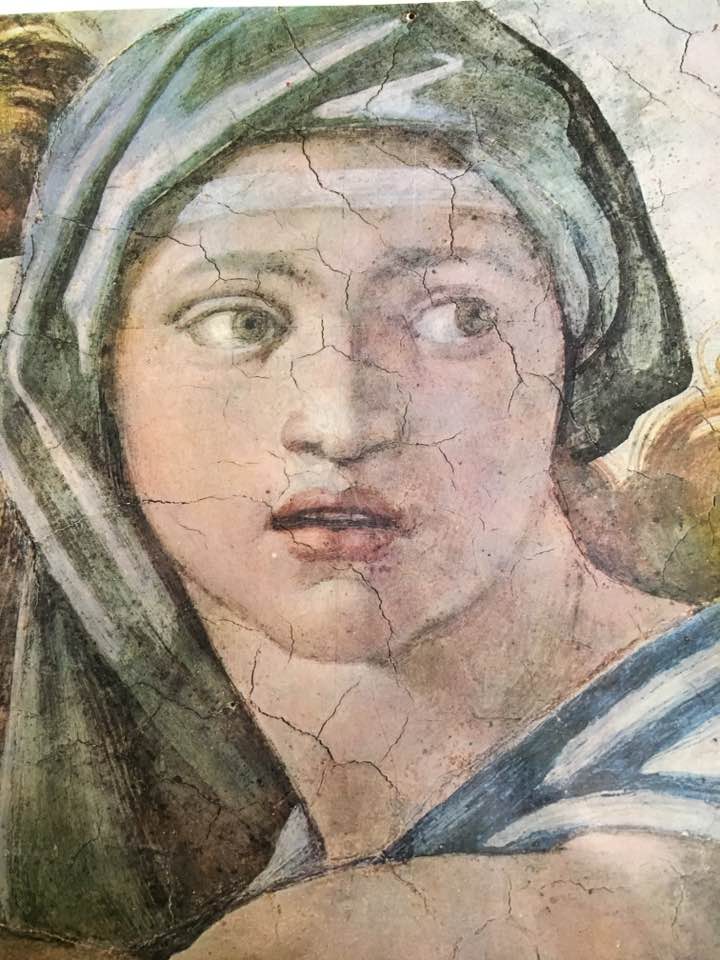
“What happened in the Renaissance is facinating, Cosimo de Medici received a manuscript from Macedonia that was brought by a Greek Monk. It was a manuscript of the Corpus Hermeticum, which was a body of late classical text about the symbology of the classical world, which was exactly contemporary with the formative period of Christianity the first two centurues.The text was translated by Marsilio Firino and immediately it was realised that the symbology of the Christian Faith and the symbology of the late classical myths were saying the same thing. Thats what inspired Renaissance art. Botticelli is full of it, and Michelangelo, and the whole lot of them. This gave a new vitality to the Christian imagery itself. Because they understood its spiritual sense, not its historical reference. Do you see? The reference is not to something that happened which has released us from sin. It didnt release us from sin. What the crucifixion did was give a model so you could release yourself from it…This is the big inspiration of Renaissanc Art.”(Pages 212-213)
We know from Michelangelos letters that he possessed a melancholic disposition and sought though his art to find strength to live a difficult life. He restored lost archaic objects through his art and thereby sought to restore in his appreciators an Ancient idea of “balance of mind”. He, like Shakespeare,was religious: perhaps in the spirit outlined above by Campbell: A spirit in which some of the teachings of the Church could be challenged aesthetically in the name of “artistic licence”. This challenge manifested a freedom of thought valued by the Ancient Greeks.
Adrain Stokes, a Kleinian Art Critic, uses psychoanalysis to interpret the spirit of art-works, especially those from the Renaissance period which he categorised as “QuattroCento Art”. Stokes points to two important aspects of the work of Art: firstly its tendency to “envelop” the appreciator( draw them into its world), and secondly, the tendency of the work to express the independent nature or self sufficiency of the art-object in the Heideggerian spirit of “putting truth to work”. This kind of practical truth belongs of course in the domain of the Aristotelian Productive sciences, which include artefacts and aesthetic objects. Campbell’s expression “transparence to transcendence” is perhaps another way of making the same point.
Michelangelo’s sculpture, “Times of the Day” at the entrance to the Medici tombs feature a melancholic array of figures depicting , day, night, evening and dawn. They have lost their Princes and are in mourning. The mass-effect of the stone, and the suggestion of movement are expressing the weight and difficulty of life (psuché). In this work beauty and sublimity dwell side by side and the effect is that we participate in the difficult life of the Medicis, and in their death. We, participate at a disctance(the aesthetic distance); who knows what the life of a Prince must be like? We moderns have certainly forgotten. Who knows what the life of a God is like? This too we moderns have forgotten. The distance, of course , allows us to judge both Princes and Gods and that fact expresses well the Kantian declaration of the power of Humanism expressed in the Principles “Nothing too much!” an “The Golden Mean”.
Campbell raises the question of Naturalism in relation to the issue of the search for a planetary myth and suggests the possibility of modern film, only to reject this art-form on the following grounds:
“Naturalism is the death of Art. And thats one of the big problems in our American Arts. I think they dont understand the metaphor. Its all naturalism”.
The film “Star Wars” is of course a different genre for Campbell, because, as he says, Lucas the director, understands metaphors, in particlar metaphors related to human psuché via the interaction of man with machine. The machine, according to Campbell, is a metaphor for the totalitarian state and the faceless bureaucrat. This admiration for Star Wars occurs against the background of an admiration for Spenglers work “The Decline of the West”. A society is organic, like psuché, Campbell argues, it is born, matures and ages like all forms of life. The latter aging process is obviously a process of decline. Campbell elaborates upon this theme with the thoughts of Goethe relating to the “Ages of the Spirit”. The first phase is a poetical mythical period followed by a phase he called “naturalistic prose”. Goethe concludes his reflections with the thought that out of such a phase “God himself could not generate another world”. Campbell’s respinse to this point is:
“but I do think we are at the end of a civilisation. And I do think we’re at the beginning of a Global Age.” (Pages 247-248)
We have argued earlier that since Kant we have been living in the Age of the Free Will. Campbell argues that music is the sound that awakens the will:
“The rhythm of the music awakens certain life rhythms, ays of living and experiencing life.”(Page 261)
When music is joyous it lifts the heart, but when it is sad, we, like Buddha, need to participate joyfully in the sorrows of the world.