Views: 3
https://books.apple.com/us/book/the-metaphysics-and-logos-of-psuché-and-psychoanalysis/id6738741227
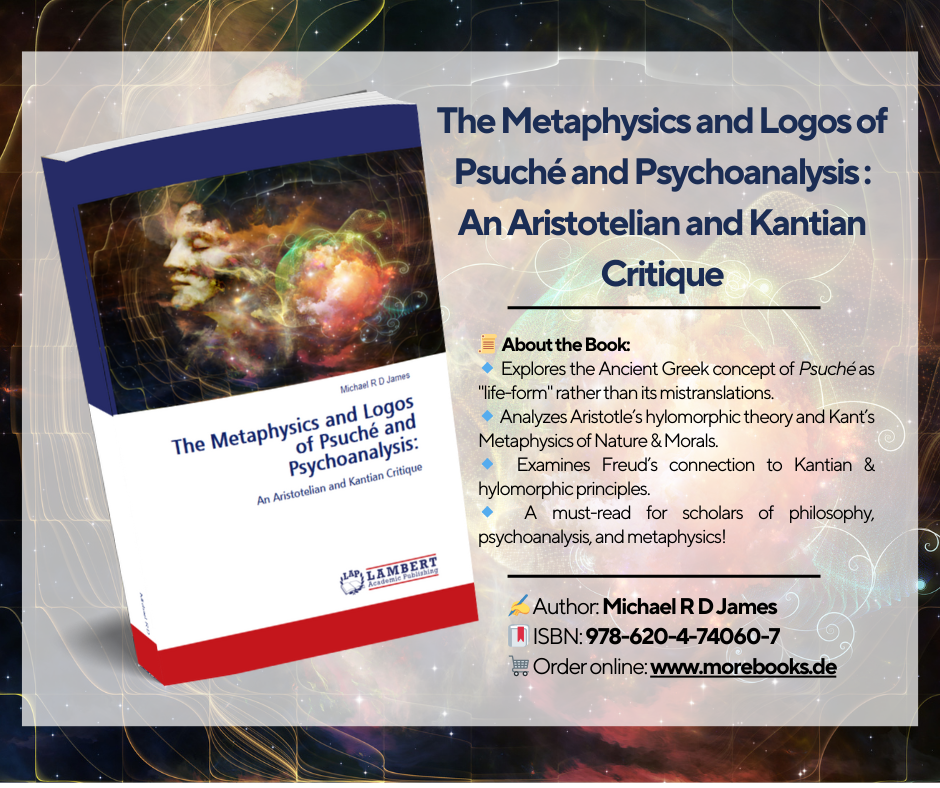
The Metaphysics and Logos of Psuché and Psychoanalysis: An Aristotelian and Kantian Critique (2024) by Michael R. D. James is Book 6 in his series The World Explored, the World Suffered. It is a dense, architectonic work of philosophical psychology that seeks to re-ground Freudian psychoanalysis in Aristotelian hylomorphism and Kantian critical philosophy.
Core Thesis
James’s central claim is that the ancient Greek category of psuché has been systematically mistranslated (typically as “soul” or “psyche” in a dualistic or consciousness-centred sense) and thereby repressed in medieval and modern thought. The more accurate rendering is “life-form.” Aristotle’s hylomorphic theory of life-forms—contrasting organic, teleologically organised beings with inorganic mineral existence—provides the proper metaphysical framework. Kant later reinstated key elements of this approach through his distinction between a metaphysics of nature and a metaphysics of morals, each requiring its own categorical framework (logos) that resists reduction to a single scientific method.
Freud declared his psychology Kantian. James takes this seriously: because Kant recovers hylomorphic insights, Freud’s metapsychology is itself committed (often latently) to a hylomorphic understanding of the human life-form. Psychoanalysis is therefore not primarily a natural-scientific or purely clinical enterprise but an exegetical and ethical inquiry into the meaning of a life, concerned with the actualisation of human powers under the constraints of Ananke (necessity).
Structure and Key Themes
The book is organised into eight chapters, moving from foundational concepts through historical and political implications:
- Introduction treating psuché, Eros, Thanatos, and the “lost objects” of the ego.
- Analysis of the modern “age of discontentment” (manic “new men” and melancholic masses).
- Explicit engagements with Aristotelian and Platonic themes in Freud.
- The claim that “Health is the Logos and Knowledge in the soul.”
- Systematic comparison with Kantian themes (theoretical, practical, and teleological judgement).
- Political dimensions: Freud’s views on tyranny, law, and the dangers of political pathology, linked to Plato and Aristotle.
- Concluding reflections on history and psychology.
Central innovations include:
- Reinterpreting the pleasure principle, reality principle, and dream-work within a teleological and normative framework rather than a purely energetic or biological one.
- The “impulse-control triangle” (Desire–Demand–Refusal), aligned with Aristotelian areté (excellence/virtue) and practical reasoning (phronesis). Psychoanalysis becomes an educational-ethical process aimed at strengthening the ego’s capacity for truth-seeking, living, loving, and working.
- Treating Eros and Thanatos not as raw biological drives but as teleologically structured aspects of the life-form.
- Emphasising that Freud’s work spans the Aristotelian division of sciences (theoretical, practical, productive) and therefore cannot be dismissed for failing a narrow, mathematised model of “science.” Lived space and time, not quantifiable space-time, is the proper domain of the sciences of psuché.
James also recovers problematically translated Greek terms—areté, diké, arché, phronesis, eudaimonia—arguing that materialist or dualistic readings obscure their hylomorphic meaning and their relevance to both psychic health and political order.
Strengths
The book’s greatest strength is its systematic ambition. It refuses the common reductions of Freud to proto-neuroscientist, clinical technician, or cultural critic alone. Instead it restores metaphysical depth, ethical seriousness, and cultural-political relevance. The synthesis of Aristotle’s four causes and teleology, Kant’s dual metaphysics and questions (“What can I know? What ought I to do? What may I hope? What is man?”), and Freud’s metapsychology is executed with considerable erudition. Psychoanalysis is repositioned as a humanistic, meaning-oriented discipline continuous with the examined life and the pursuit of a “good-spirited flourishing life.”
The political chapters are particularly notable: Freud’s concerns about tyranny and the psychology of leaders and masses are shown to resonate with classical accounts of the dangers of unbalanced psuché in the polis.
Limitations
The text is demanding. It presupposes familiarity with Aristotle, Kant, Freud, and related figures (Wittgenstein, Ricoeur, and others appear in the broader series). Readers seeking clinical technique, empirical validation, or engagement with contemporary cognitive science or post-Freudian schools will find the metaphysical focus restrictive. The strong commitment to hylomorphism may not persuade those committed to stricter naturalism. At roughly 230–240 pages it is concentrated rather than expansive, and the style is that of sustained philosophical argumentation rather than accessible exposition.
Overall Assessment
James has produced a distinctive contribution to philosophical psychology. The work is less a conventional monograph than a re-foundation: an attempt to recover a coherent metaphysical logos of the human life-form and to show that psychoanalysis, properly understood, belongs within that tradition. It will primarily interest readers already oriented toward classical philosophy, Kantian critical thought, and non-reductive approaches to Freud—those who regard psychology as inevitably resting on ontological and ethical assumptions about what a human being is.
For those prepared to engage its density, it offers a rigorous alternative to both materialist psychologies and dualistic or purely hermeneutic readings of psychoanalysis. It continues James’s larger project of integrating ancient Greek, Enlightenment, and selected modern thinkers into a unified humanistic framework centred on psuché.