
Views: 3
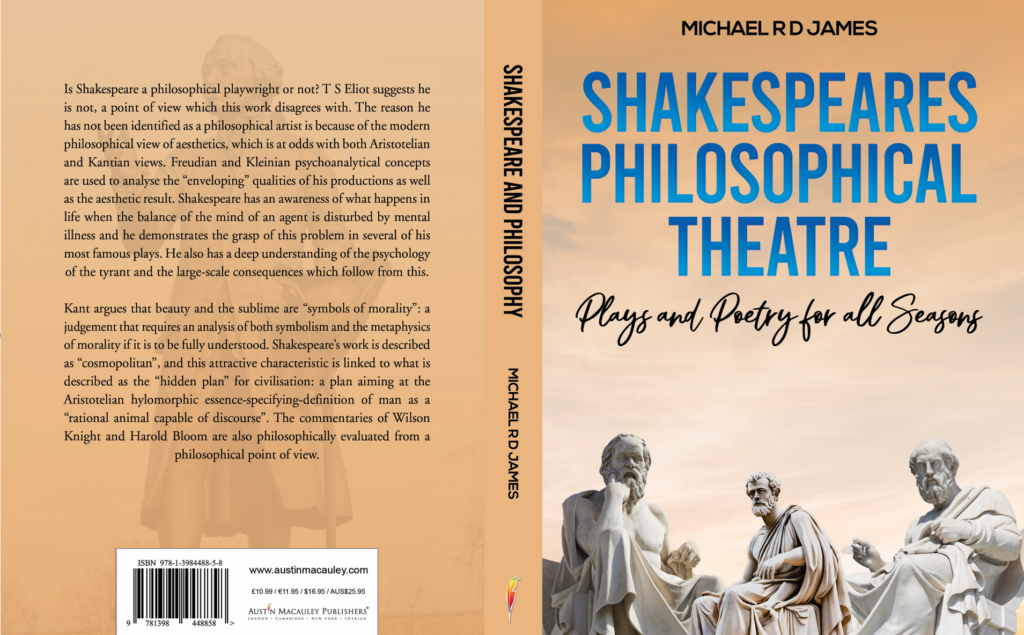

Shakespeares Philosophical Theatre: Plays and Poetry for all Seasons (Austin Macauley Publishers, 2026) by Michael R. D. James is a philosophical reading of Shakespeare that argues he should be understood as a genuinely philosophical artist rather than merely a dramatist who occasionally touches on philosophical themes.
Core Thesis
James directly challenges T. S. Eliot’s influential view that Shakespeare “did not think philosophically.” He contends that this judgment rests on modern aesthetic assumptions that are incompatible with both Aristotelian and Kantian aesthetics. When Shakespeare is read through those classical and critical frameworks, his plays reveal a coherent vision of mind, morality, political power, civilisation, and the human condition.
The book presents Shakespeare’s theatre as a form of “transcendental spectacle” — an enveloping artistic experience that operates simultaneously on intellectual, emotional, moral, and aesthetic levels. Shakespeare’s work is described as cosmopolitan, linked to what Kant called a “hidden plan” of civilisation and to the Aristotelian definition of man as a “rational animal capable of discourse.”
Approach and Framework
James draws on a synthesis familiar from his earlier work:
- Aristotelian hylomorphism (form/matter, the four causes, the structure of change, and the classification of the sciences)
- Kantian critical philosophy (especially the questions “What is man?”, “What can I know?”, “What ought I to do?”, and “What may I hope?”, together with the role of beauty and the sublime as symbols of morality)
- Freudian and Kleinian psychoanalysis (used to examine mental disturbance, tyranny, and the fragile balance of the psyche in plays such as Hamlet, King Lear, and Macbeth)
- Occasional reference to Wittgenstein (particularly the idea that language can “show” what cannot be said)
He also engages critically with earlier Shakespeare commentators such as G. Wilson Knight and Harold Bloom, evaluating their insights from an explicitly philosophical standpoint.
Key Themes
- Shakespeare’s deep understanding of mental illness and the psychology of the tyrant, and the large-scale political consequences that follow from psychological imbalance.
- The “enveloping” quality of the plays — how they create an immersive aesthetic experience that engages both imagination and understanding.
- The cosmopolitan character of Shakespeare’s world (illustrated, for example, in Antony and Cleopatra) and its relation to broader civilisational aims.
- The way Shakespeare’s poetic language and imagery function symbolically, drawing on both the metaphysics of nature and the metaphysics of morals.
- The idea that Shakespeare’s theatre continues a tradition that begins with the Greek philosophers and finds later echoes in Kant, Freud, and Wittgenstein.
Style and Audience
The book is written in James’s characteristic lecture-like, essayistic style — serious, interdisciplinary, and densely allusive. It is not an introductory guide to Shakespeare nor a conventional work of literary criticism. Readers unfamiliar with Aristotelian and Kantian philosophy (or with James’s broader project in The World Explored, the World Suffered) may find the argument demanding. Those already interested in the intersection of philosophy, psychoanalysis, and drama will find it a coherent extension of his earlier concerns.
Strengths
- A clear, sustained philosophical thesis that refuses to treat Shakespeare’s intellectual content as secondary or accidental.
- Productive use of Aristotelian and Kantian aesthetics to reframe long-standing critical debates.
- Insightful attention to the psychological and political dimensions of the major tragedies.
- An ambitious attempt to locate Shakespeare within a long civilisational and philosophical narrative rather than isolating him as a purely literary figure.
Limitations
- The density of the philosophical framework can sometimes overshadow close textual analysis.
- The book assumes a fair degree of familiarity with the author’s preferred thinkers; it does not always pause to introduce them for a broader literary audience.
- As a relatively recent publication (May 2026), independent critical reception is still limited.
Overall Assessment
Shakespeares Philosophical Theatre is a serious and original contribution for readers interested in philosophical approaches to literature. It positions Shakespeare as a central figure in a continuous tradition of reflection on the human condition that runs from the Greeks through the Enlightenment and into modern psychology. Whether or not one fully accepts the claim that Shakespeare is a “philosophical playwright” in the strong sense James proposes, the book offers a thoughtful, humanistic, and intellectually ambitious reading that rewards engagement.